 Скачать презентацию Measuring the Problem Being an Informed Consumer of
c1414bda6ef974f966cd105cd3373f70.ppt
- Количество слайдов: 22



Measuring the Problem: Being an Informed Consumer of Poverty Statistics Dr. Norman R. Cloutier, Director UW-Parkside Center for Economic Education Presented February 13, 2009 at the UW-Parkside Center for Economic Education teacher workshop, Poverty: Economic, Historical, and International Perspectives
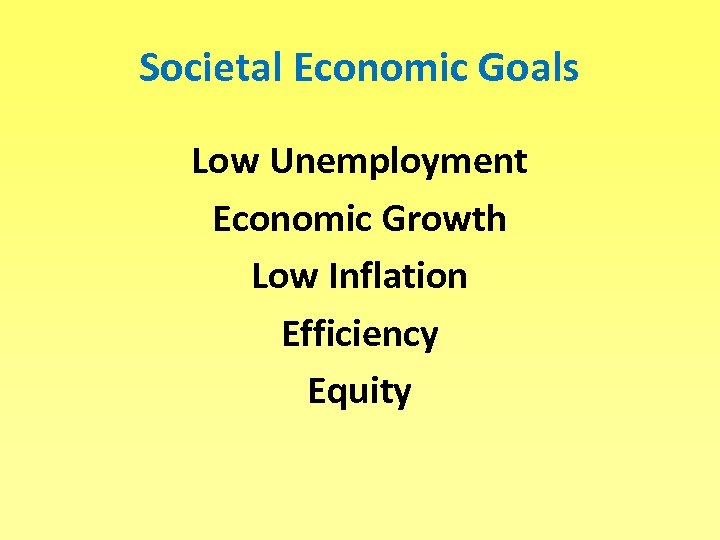
Societal Economic Goals Low Unemployment Economic Growth Low Inflation Efficiency Equity
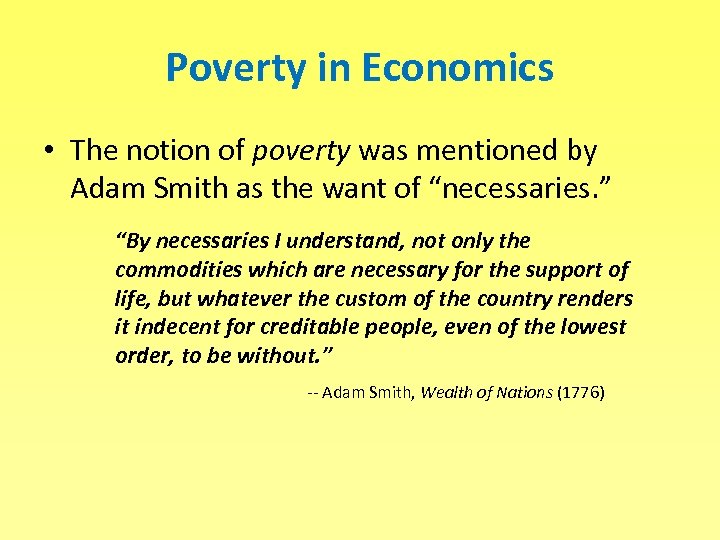
Poverty in Economics • The notion of poverty was mentioned by Adam Smith as the want of “necessaries. ” “By necessaries I understand, not only the commodities which are necessary for the support of life, but whatever the custom of the country renders it indecent for creditable people, even of the lowest order, to be without. ” -- Adam Smith, Wealth of Nations (1776)
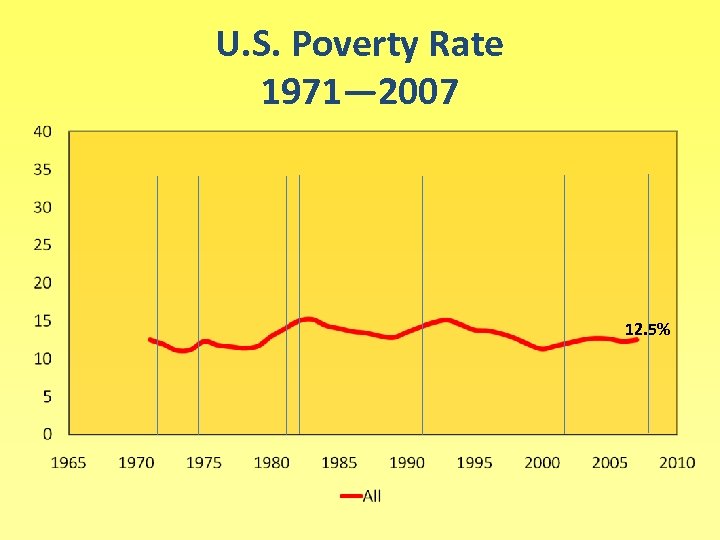
U. S. Poverty Rate 1971— 2007 12. 5%
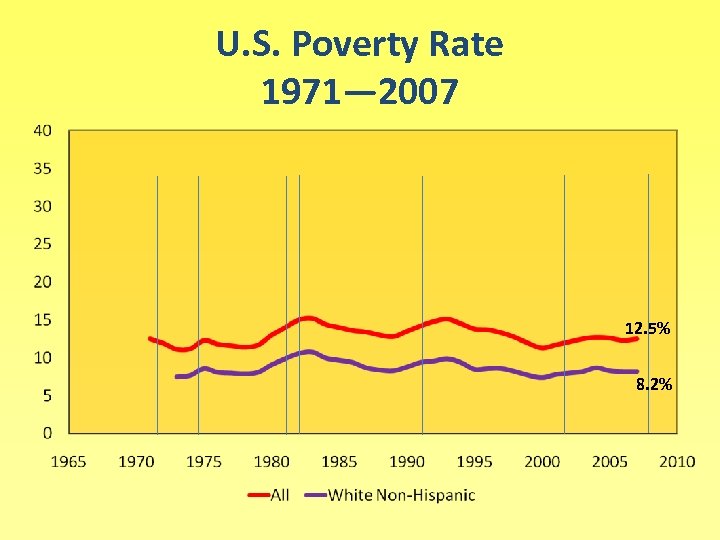
U. S. Poverty Rate 1971— 2007 12. 5% 8. 2%
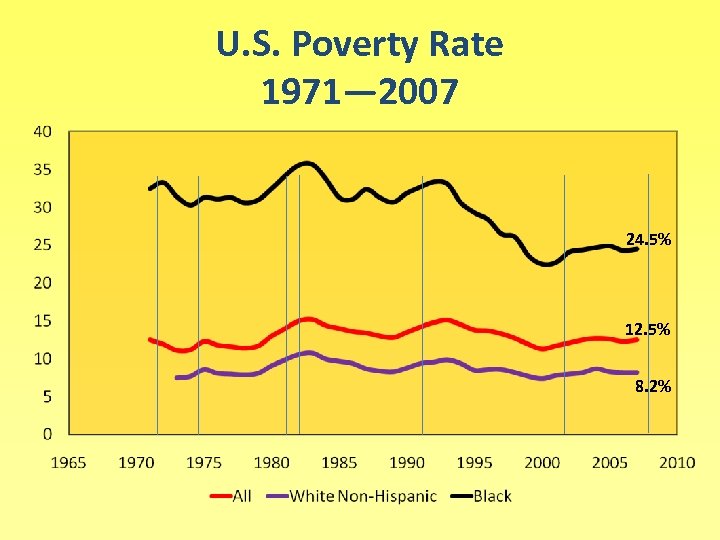
U. S. Poverty Rate 1971— 2007 24. 5% 12. 5% 8. 2%
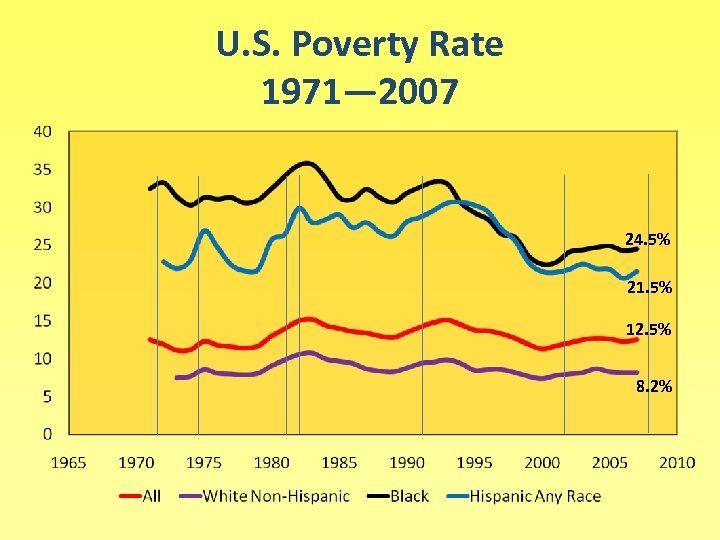
U. S. Poverty Rate 1971— 2007 24. 5% 21. 5% 12. 5% 8. 2%
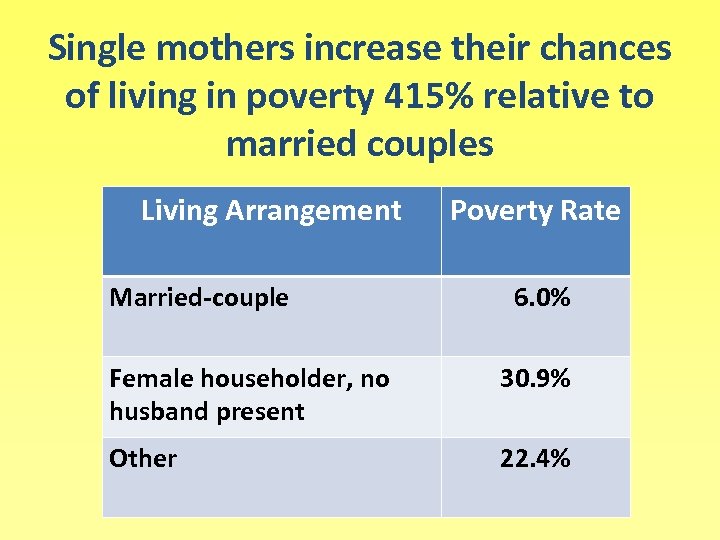
Single mothers increase their chances of living in poverty 415% relative to married couples Living Arrangement Married-couple Poverty Rate 6. 0% Female householder, no husband present 30. 9% Other 22. 4%
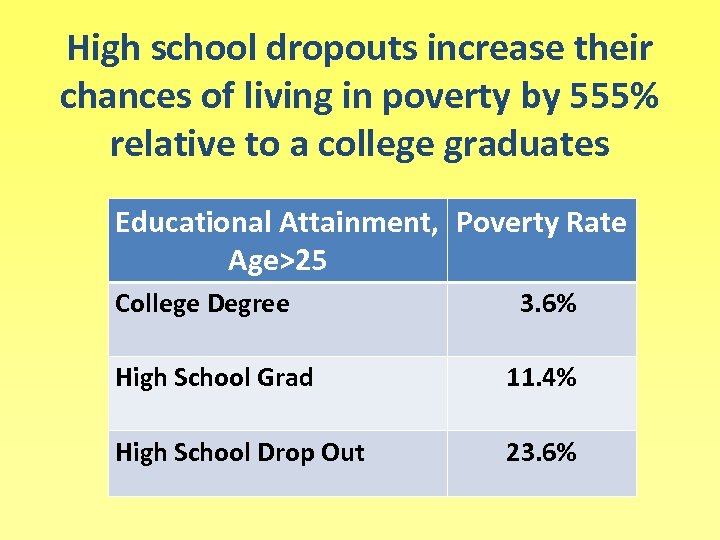
High school dropouts increase their chances of living in poverty by 555% relative to a college graduates Educational Attainment, Poverty Rate Age>25 College Degree 3. 6% High School Grad 11. 4% High School Drop Out 23. 6%
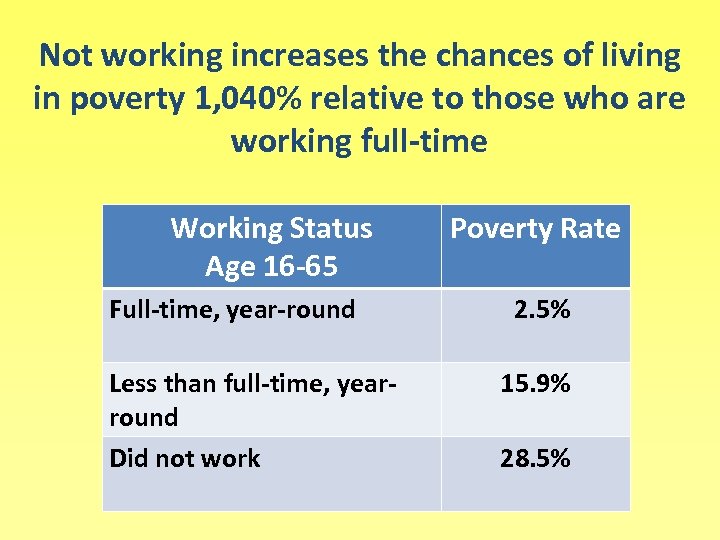
Not working increases the chances of living in poverty 1, 040% relative to those who are working full-time Working Status Age 16 -65 Full-time, year-round Less than full-time, yearround Did not work Poverty Rate 2. 5% 15. 9% 28. 5%
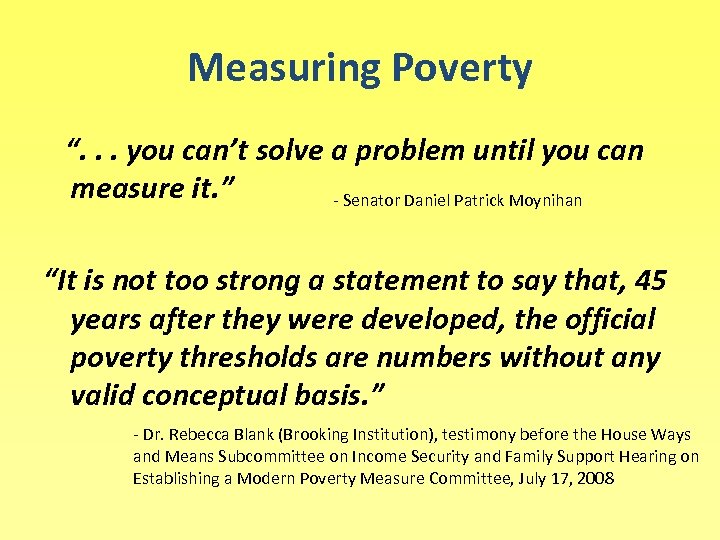
Measuring Poverty “. . . you can’t solve a problem until you can measure it. ” - Senator Daniel Patrick Moynihan “It is not too strong a statement to say that, 45 years after they were developed, the official poverty thresholds are numbers without any valid conceptual basis. ” - Dr. Rebecca Blank (Brooking Institution), testimony before the House Ways and Means Subcommittee on Income Security and Family Support Hearing on Establishing a Modern Poverty Measure Committee, July 17, 2008
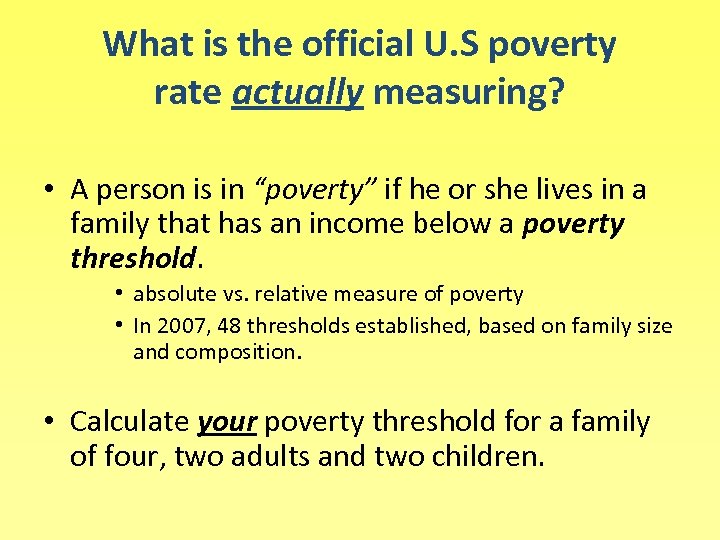
What is the official U. S poverty rate actually measuring? • A person is in “poverty” if he or she lives in a family that has an income below a poverty threshold. • absolute vs. relative measure of poverty • In 2007, 48 thresholds established, based on family size and composition. • Calculate your poverty threshold for a family of four, two adults and two children.
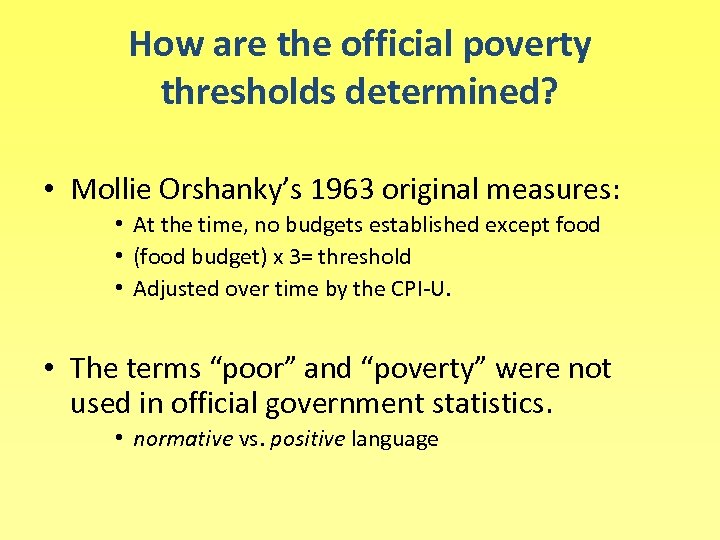
How are the official poverty thresholds determined? • Mollie Orshanky’s 1963 original measures: • At the time, no budgets established except food • (food budget) x 3= threshold • Adjusted over time by the CPI-U. • The terms “poor” and “poverty” were not used in official government statistics. • normative vs. positive language
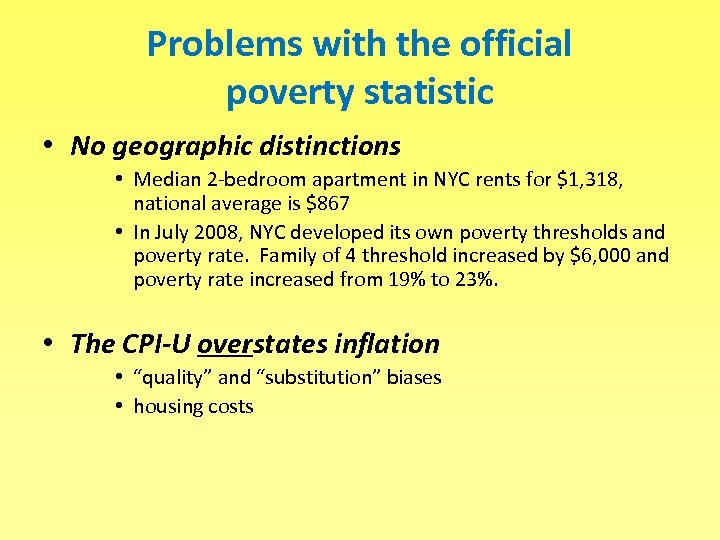
Problems with the official poverty statistic • No geographic distinctions • Median 2 -bedroom apartment in NYC rents for $1, 318, national average is $867 • In July 2008, NYC developed its own poverty thresholds and poverty rate. Family of 4 threshold increased by $6, 000 and poverty rate increased from 19% to 23%. • The CPI-U overstates inflation • “quality” and “substitution” biases • housing costs
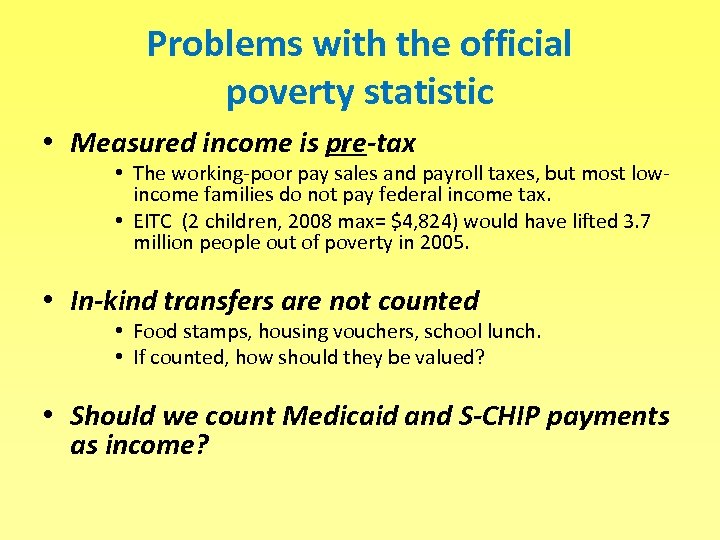
Problems with the official poverty statistic • Measured income is pre-tax • The working-poor pay sales and payroll taxes, but most lowincome families do not pay federal income tax. • EITC (2 children, 2008 max= $4, 824) would have lifted 3. 7 million people out of poverty in 2005. • In-kind transfers are not counted • Food stamps, housing vouchers, school lunch. • If counted, how should they be valued? • Should we count Medicaid and S-CHIP payments as income?
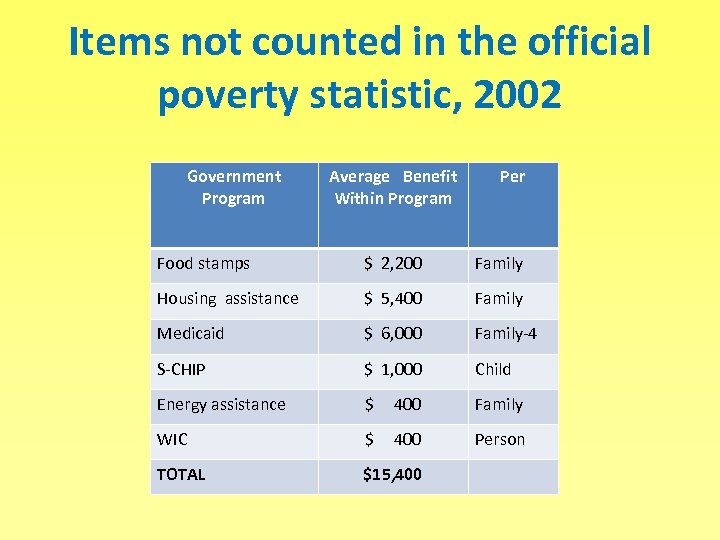
Items not counted in the official poverty statistic, 2002 Government Program Average Benefit Within Program Per Food stamps $ 2, 200 Family Housing assistance $ 5, 400 Family Medicaid $ 6, 000 Family-4 S-CHIP $ 1, 000 Child Energy assistance $ 400 Family WIC $ 400 Person TOTAL $15, 400
Problems with the official poverty statistic • Should the unit of analysis be the “family” or the “household”? • In 1992, counting household income would have resulted in 1. 6 million fewer poor. • Counting all possible sources of income, but using current official thresholds, would decrease measured poverty by 36%. • 2007: official=12. 5%, adjusted= 7. 9%
Threshold Problems • Surveys have indicated that the general public would set thresholds 60%-70% higher than the official level. • In the early-1960 s Orshansky assumed family spent 1/3 of their income on food. Today it is closer to 1/7. • 1/3 yields a multiplier of 3 • 1/7 yields a multiplier of 14
Threshold Problems • Thresholds should incorporate explicit budgets for clothing, shelter, child care, personal care, transportation, household supplies. • Within region cost-of-living differences? • Equivalence scales • Economic Policy Institute “basic family budgets” • Milwaukee, family of four= $52, 019
Consumption-based Poverty Measures • Material well-being is derived from the consumption of goods and services, not income per se. • Reported consumption tends to be higher than reported income. • 1973 -83 the official poverty rate increased from 11. 1% to 15. 2%, while a consumption-based measure showed that poverty actually declined from 10. 9% to 6. 8%. • Data problems.
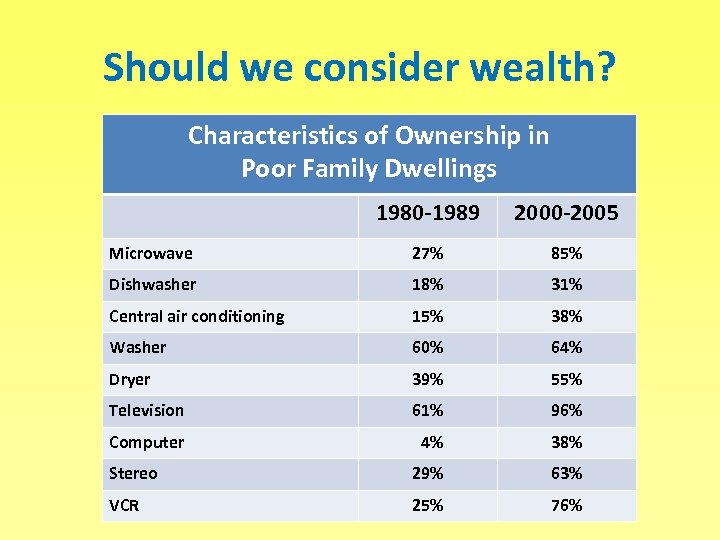
Should we consider wealth? Characteristics of Ownership in Poor Family Dwellings 1980 -1989 2000 -2005 Microwave 27% 85% Dishwasher 18% 31% Central air conditioning 15% 38% Washer 60% 64% Dryer 39% 55% Television 61% 96% Computer 4% 38% Stereo 29% 63% VCR 25% 76%
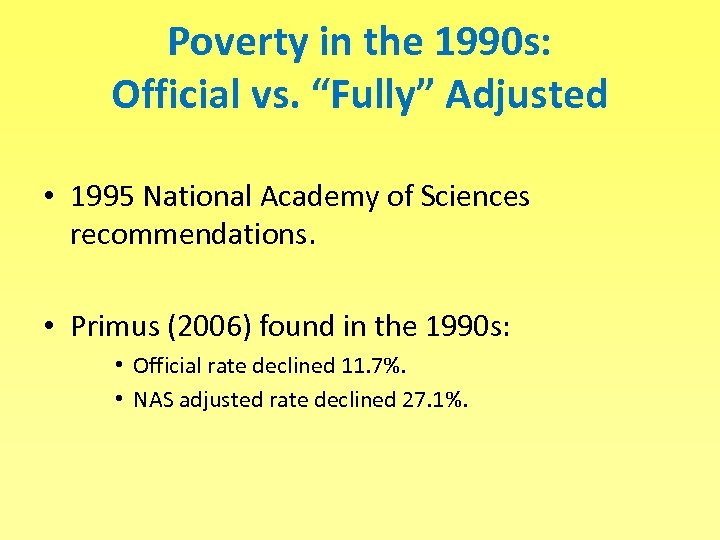
Poverty in the 1990 s: Official vs. “Fully” Adjusted • 1995 National Academy of Sciences recommendations. • Primus (2006) found in the 1990 s: • Official rate declined 11. 7%. • NAS adjusted rate declined 27. 1%.
Скачать презентацию Measuring the Problem Being an Informed Consumer of
c1414bda6ef974f966cd105cd3373f70.ppt