 Скачать презентацию Measuring the Economic Impact of the British Library
0f34779c64266eaba8730182307beeea.ppt
- Количество слайдов: 13



Measuring the Economic Impact of the British Library 15 th October 2004, ippr/BBC seminar Dr Caroline Pung, Head of Strategy & Planning, The British Library Tabitha Elwes, Partner, Spectrum Strategy Consultants
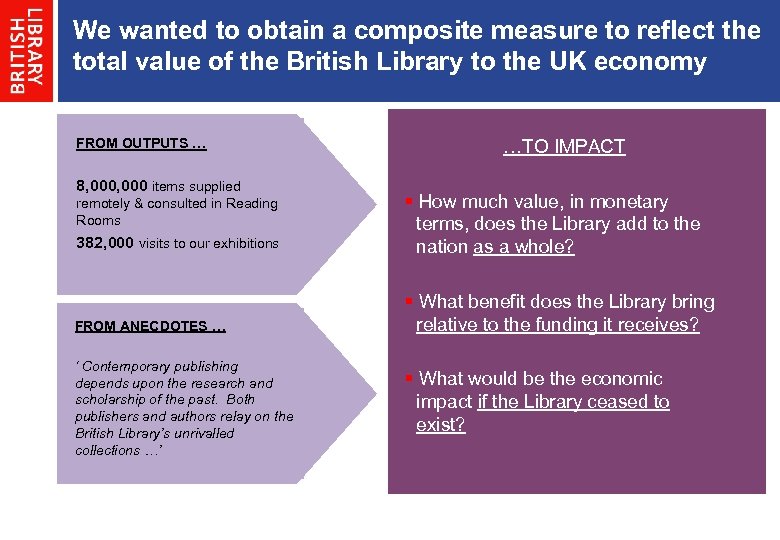
We wanted to obtain a composite measure to reflect the total value of the British Library to the UK economy FROM OUTPUTS … 8, 000 items supplied …TO IMPACT 382, 000 visits to our exhibitions § How much value, in monetary terms, does the Library add to the nation as a whole? FROM ANECDOTES … § What benefit does the Library bring relative to the funding it receives? remotely & consulted in Reading Rooms ‘ Contemporary publishing depends upon the research and scholarship of the past. Both publishers and authors relay on the British Library’s unrivalled collections …’ § What would be the economic impact if the Library ceased to exist?
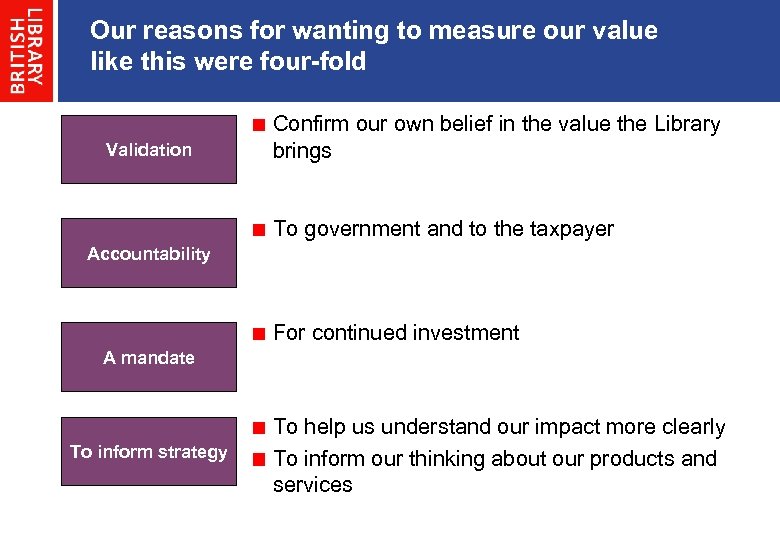
Our reasons for wanting to measure our value like this were four-fold Validation Confirm our own belief in the value the Library brings To government and to the taxpayer Accountability For continued investment A mandate To inform strategy To help us understand our impact more clearly To inform our thinking about our products and services
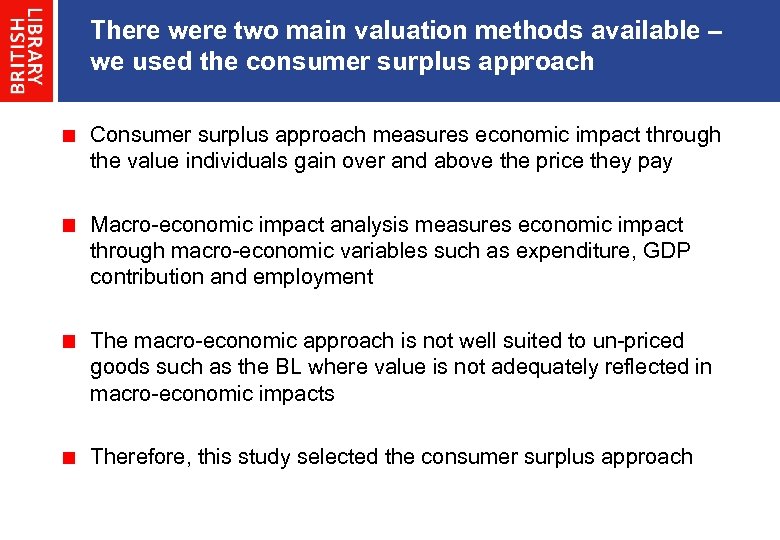
There were two main valuation methods available – we used the consumer surplus approach Consumer surplus approach measures economic impact through the value individuals gain over and above the price they pay Macro-economic impact analysis measures economic impact through macro-economic variables such as expenditure, GDP contribution and employment The macro-economic approach is not well suited to un-priced goods such as the BL where value is not adequately reflected in macro-economic impacts Therefore, this study selected the consumer surplus approach
We primarily adopted a leading stated preference technique: Contingent Valuation Involves the construction of a hypothetical market within a questionnaire Interviewees asked a range of questions and asked to provide a monetary estimate of the value of the Library to them directly measures consumer surplus captures use value, option value and existence value Cross checked against values derived from investment in access and cost of alternatives
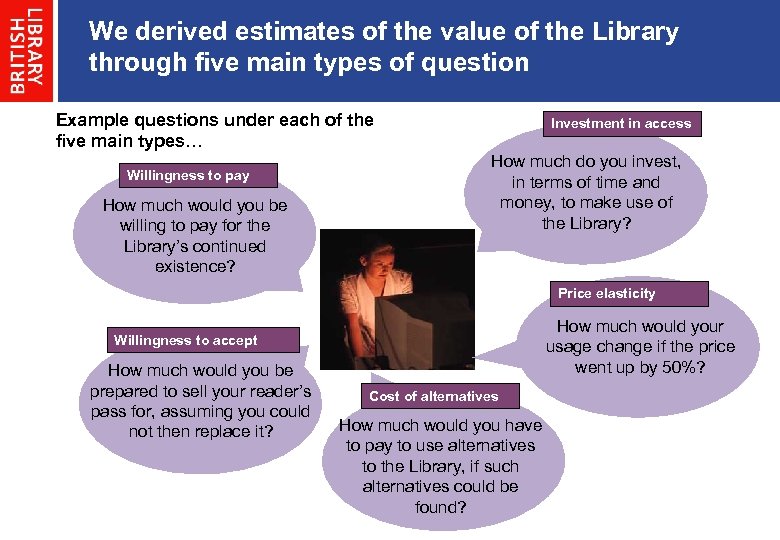
We derived estimates of the value of the Library through five main types of question Example questions under each of the five main types… Willingness to pay How much would you be willing to pay for the Library’s continued existence? Investment in access How much do you invest, in terms of time and money, to make use of the Library? Price elasticity How much would your usage change if the price went up by 50%? Willingness to accept How much would you be prepared to sell your reader’s pass for, assuming you could not then replace it? Cost of alternatives How much would you have to pay to use alternatives to the Library, if such alternatives could be found?
Prioritisation was important to focus efforts on some key areas No precedents for a holistic impact assessment of a National Library – partial values for New Zealand national library and some work on public libraries Not all the Library’s services could be included. We focused on Reading room access to collections Remote document supply and bibliographic services Public exhibitions and events Indirect value of existence and option to use the Library to wider society We did not include Emerging products and services Smaller established products and services Overseas users
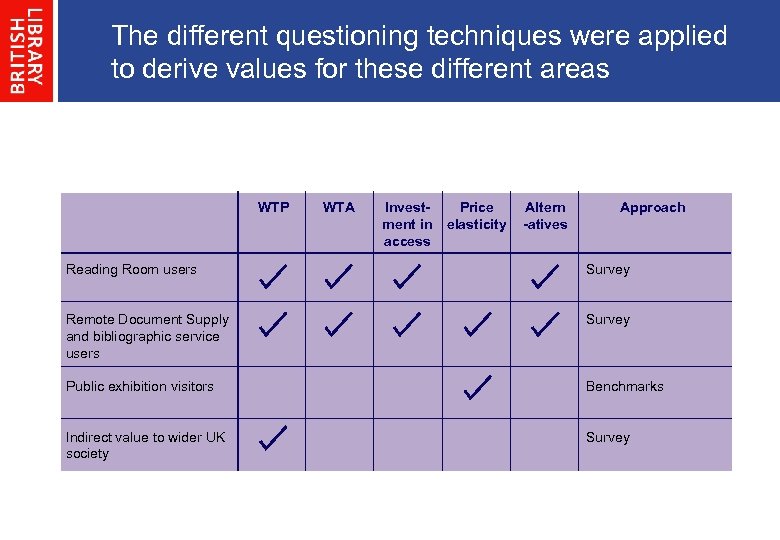
The different questioning techniques were applied to derive values for these different areas WTP WTA Investment in access Price elasticity Altern -atives Approach Reading Room users Survey Remote Document Supply and bibliographic service users Survey Public exhibition visitors Benchmarks Indirect value to wider UK society Survey
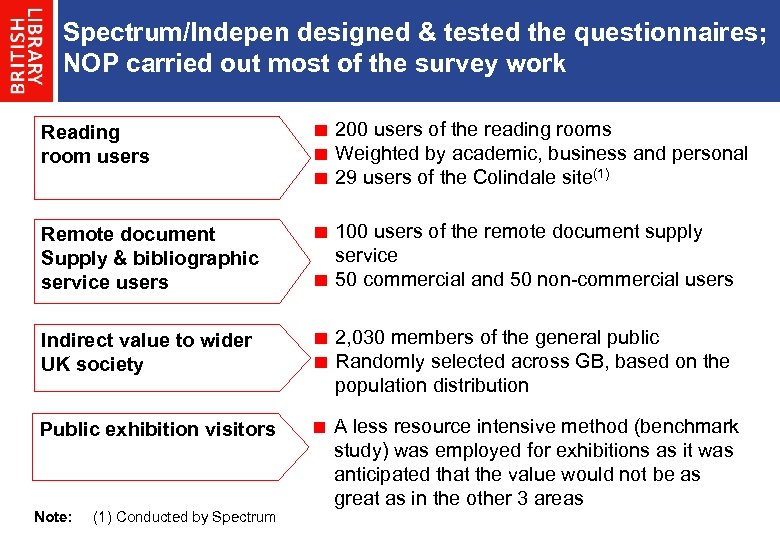
Spectrum/Indepen designed & tested the questionnaires; NOP carried out most of the survey work Reading room users 200 users of the reading rooms Weighted by academic, business and personal 29 users of the Colindale site(1) Remote document Supply & bibliographic service users 100 users of the remote document supply service 50 commercial and 50 non-commercial users Indirect value to wider UK society 2, 030 members of the general public Randomly selected across GB, based on the population distribution Public exhibition visitors A less resource intensive method (benchmark study) was employed for exhibitions as it was anticipated that the value would not be as great as in the other 3 areas Note: (1) Conducted by Spectrum
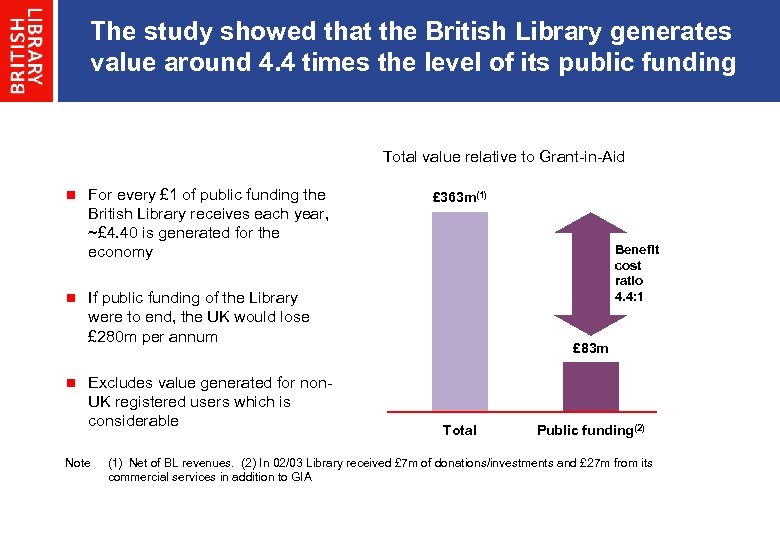
The study showed that the British Library generates value around 4. 4 times the level of its public funding Total value relative to Grant-in-Aid n n n For every £ 1 of public funding the British Library receives each year, ~£ 4. 40 is generated for the economy £ 363 m(1) Benefit cost ratio 4. 4: 1 If public funding of the Library were to end, the UK would lose £ 280 m per annum Excludes value generated for non. UK registered users which is considerable Note £ 83 m Total Public funding(2) (1) Net of BL revenues. (2) In 02/03 Library received £ 7 m of donations/investments and £ 27 m from its commercial services in addition to GIA
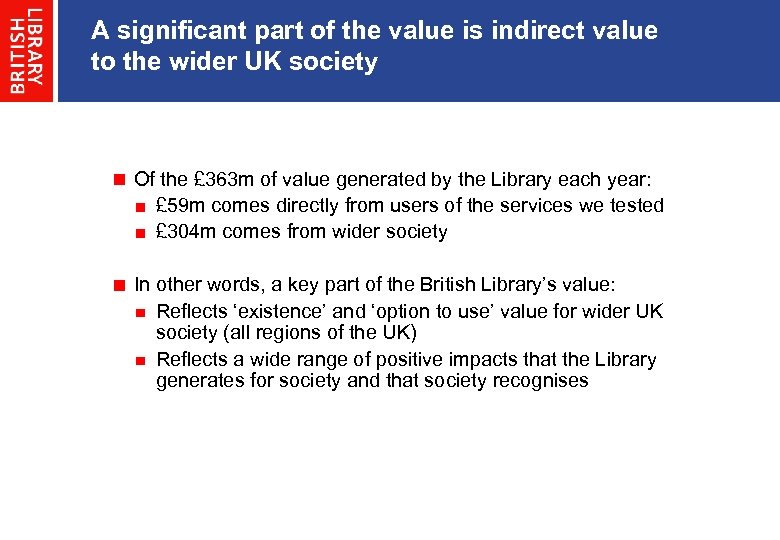
A significant part of the value is indirect value to the wider UK society Of the £ 363 m of value generated by the Library each year: £ 59 m comes directly from users of the services we tested £ 304 m comes from wider society In other words, a key part of the British Library’s value: Reflects ‘existence’ and ‘option to use’ value for wider UK society (all regions of the UK) Reflects a wide range of positive impacts that the Library generates for society and that society recognises
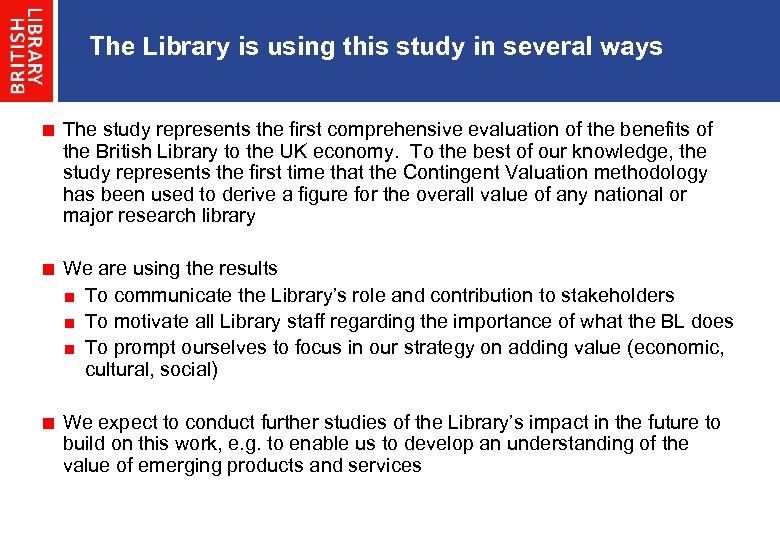
The Library is using this study in several ways The study represents the first comprehensive evaluation of the benefits of the British Library to the UK economy. To the best of our knowledge, the study represents the first time that the Contingent Valuation methodology has been used to derive a figure for the overall value of any national or major research library We are using the results To communicate the Library’s role and contribution to stakeholders To motivate all Library staff regarding the importance of what the BL does To prompt ourselves to focus in our strategy on adding value (economic, cultural, social) We expect to conduct further studies of the Library’s impact in the future to build on this work, e. g. to enable us to develop an understanding of the value of emerging products and services
Contact information Caroline Pung, British Library caroline. pung@bl. uk Spectrum Strategy Consultants Indepen Consulting Ltd Greencoat House Francis Street London SW 1 P 1 DH Diespeker Wharf 38 Graham Street London N 1 8 JX T +44 (0)20 7630 1400 F +44 (0)20 7630 7011 T +44 (0)20 7324 1800 F +44 (0)20 7704 0872 www. indepen. co. uk www. spectrumstrategy. com tabitha. elwes@spectrumstrategy. com laurie. patten@spectrumstrategy. com phillipamarks@indepen. co. uk
Скачать презентацию Measuring the Economic Impact of the British Library
0f34779c64266eaba8730182307beeea.ppt