


 Скачать презентацию Measuring Supply and Demand for Healthcare Professions LINDA
1fd878d054cfbe88af9ab0737174bb08.ppt
- Количество слайдов: 22
 Measuring Supply and Demand for Healthcare Professions LINDA M. LACEY PRESIDENT LACEY RESEARCH ASSOCIATES
 My background 15 years as the Associate Director: Research for the North Carolina Center for Nursing Supply/demand cycle of research Extensive use of ‘administrative’ data Primary data collection efforts To address supply-side issues the administrative data could not To collect demand data from employers Research Associate with BC/BS of NC Research Associate & Project Manager with the Cecil G. Sheps Center for Health Services Research
 Mission of the Virginia HWDC To improve the healthcare system in the Commonwealth by: improving data collection and measurement of the healthcare workforce through regular assessment of workforce supply and demand.
 Mission Implications Improve upon current data collection efforts – if needed “Accurate and appropriate data collection is critical in order to be able to plan for the future and provide access to quality healthcare. ” - VA Healthcare Reform Commission 1. Align data collection surveys with long-range data needs 2. Implement data collection strategies that ensure data quality and completeness.
 Mission Implications Focus on measurement of workforce metrics that illuminate where and how people work 1. Include these critical elements in survey instruments Productivity (hours worked) Practice location(s) by county Practice type Personal demographics Professional demographics
 Factors affecting supply in the future ‘aging out’ – retirement Demographic of the baby boomers bottleneck - fewer young workers to labor productivity - more recruit into anything part-timers? Capacity limits in our New entrants at older education systems ages = fewer years in the profession / decreased Bottle-necks created by physical ability? a shortage of qualified faculty Poor image of health care as a career choice
 ROI for high quality supply data The ability to track changes in number, composition, location, and work behavior in each professional group over time. A source of Virginia-specific data forecasting May reveal unanticipated shifts/trends More effective and cost-efficient public policy by tracking intervention outcomes applied to the education system, recruitment campaigns, loan repayment programs, etc.
 Mission Implications Regular assessment of supply and demand for health professionals means that demand data will be needed 1. What is ‘demand data’ exactly?
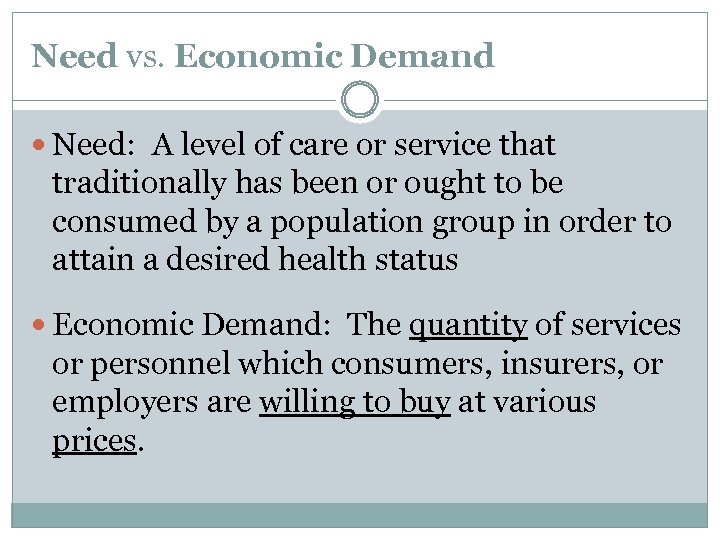 Need vs. Economic Demand Need: A level of care or service that traditionally has been or ought to be consumed by a population group in order to attain a desired health status Economic Demand: The quantity of services or personnel which consumers, insurers, or employers are willing to buy at various prices.
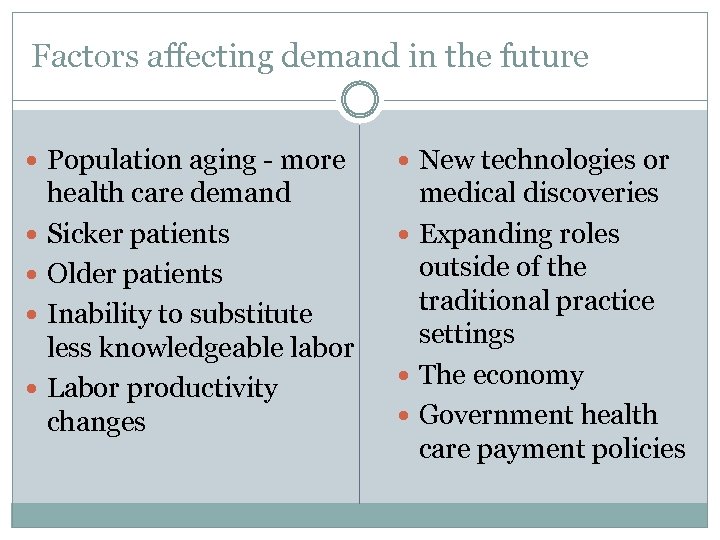 Factors affecting demand in the future Population aging - more New technologies or health care demand Sicker patients Older patients Inability to substitute less knowledgeable labor Labor productivity changes medical discoveries Expanding roles outside of the traditional practice settings The economy Government health care payment policies
 Demand data continued - Where will the necessary information come from? Is there a single source of information for all health professions?
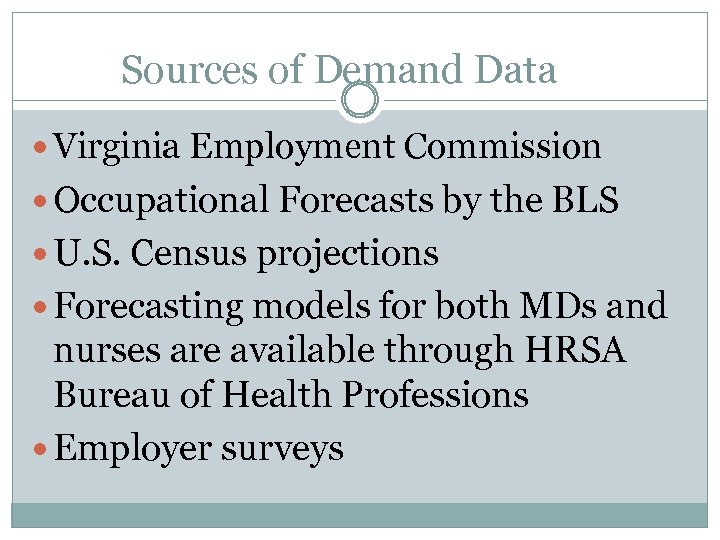 Sources of Demand Data Virginia Employment Commission Occupational Forecasts by the BLS U. S. Census projections Forecasting models for both MDs and nurses are available through HRSA Bureau of Health Professions Employer surveys
 ROI for collecting demand data Employer surveys – Industry-specific information based on Virginia employers Ability to collect exactly the information needed to address Virginia policy issues Benchmark metrics are valued by employers - e. g. vacancy rates, turnover rates, weeks-to-fill, etc. Ability to do sector and geographic analyses to pinpoint problem areas in the Commonwealth Ability to match supply characteristics with industry sectors to identify potential problems areas -e. g. expected retirement rates in hospitals vs other employment settings
 Supply and demand comparisons What is the best way of assessing shortage, surplus or balance in various healthcare workforce groups? Depends on your philosophy, data availability, and/or analysis capabilities
 When is it a shortage? “Economic Demand” model – When the total number of providers available and willing to work at a specific wage is smaller than the total number of providers that employers or clients want to hire at that wage.
 When is it a shortage? “Need” model – When the total number of providers available is smaller than the total number of providers needed to meet the healthcare needs of the population.
 Forecasting the future By the time you have current supply data and current demand data in hand, it is already out of date. It tells you where you have been. Forecasting is the “Holy Grail” of workforce planning. It tells you where you are headed – maybe.
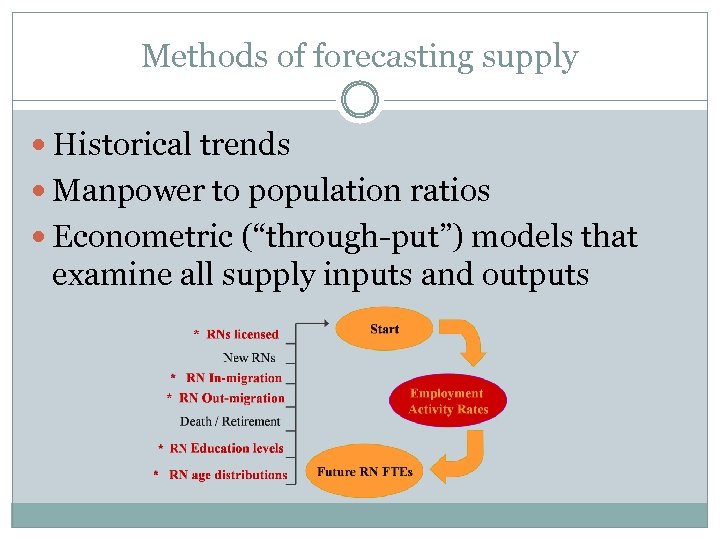 Methods of forecasting supply Historical trends Manpower to population ratios Econometric (“through-put”) models that examine all supply inputs and outputs
 Methods of forecasting demand Population ratio methods Service targets / standards Analysis of service utilization by population groups Econometric & simulation methods
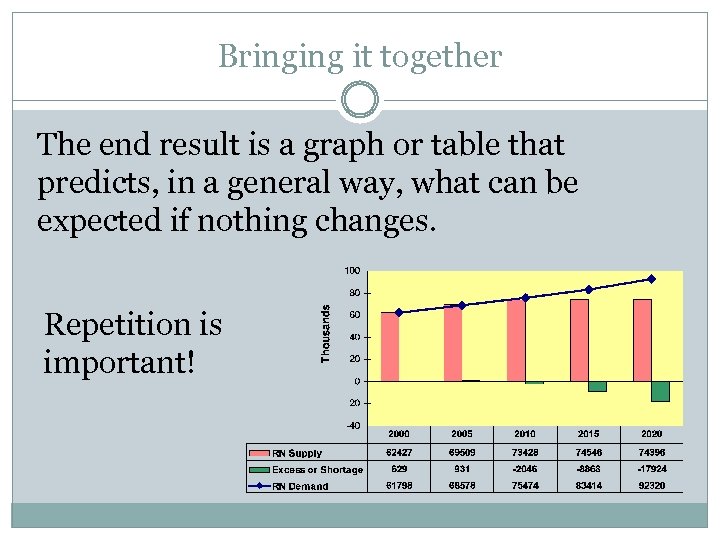 Bringing it together The end result is a graph or table that predicts, in a general way, what can be expected if nothing changes. Repetition is important!
 Overview Much to do at the beginning Success is heavily dependent on strong collaboration among stakeholders Long-term gains include: Technology upgrades for some boards Better operational and administrative efficiency A better informed legislature A factual basis for policy and spending decisions Regular updates of progress toward policy goals
 Questions? Thank you. Questions?