


 Скачать презентацию Measuring Refractive Indices of Nematic LC Elastomers Volodymyr
10a9333db60c89dbc5a81c6b27027514.ppt
- Количество слайдов: 15
 Measuring Refractive Indices of Nematic LC Elastomers Volodymyr Borshch Research advisor: Professor Peter Palffy-Muhoray 25 August 2008 1
 Outline • • • Motivation Nematic LC elastomer Methods and previous results Theory Materials selection Experimental setup Obtained data Conclusions Acknowledgments 2
 Motivation • Nematic LC Elastomers have bright future • Not all physical properties are quite extensively described so far • E. g. Refractive index 3
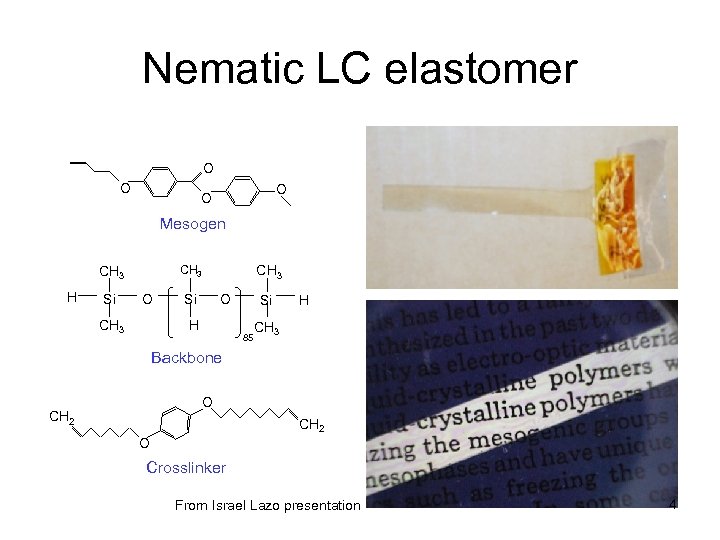 Nematic LC elastomer O O Mesogen H Si CH 3 O CH 3 Si O Si H 85 H CH 3 Backbone O CH 2 O Crosslinker From Israel Lazo presentation 4
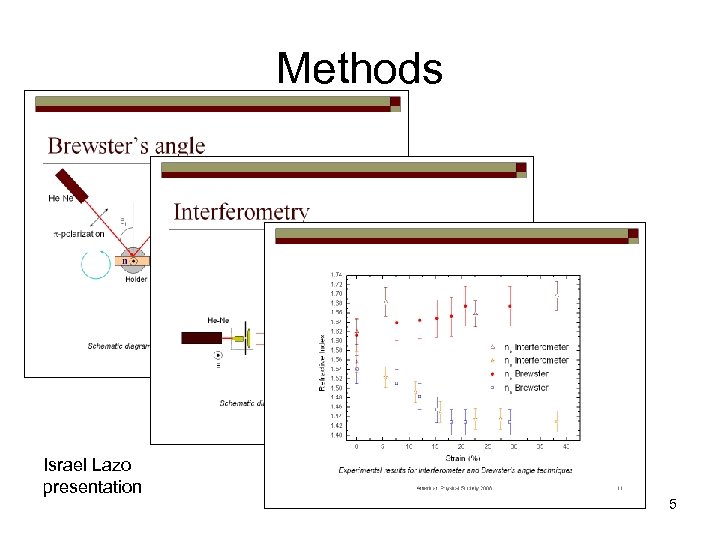 Methods Israel Lazo presentation 5
 Yet another approach • From Fresnel equations: The main idea of the method R=0 6
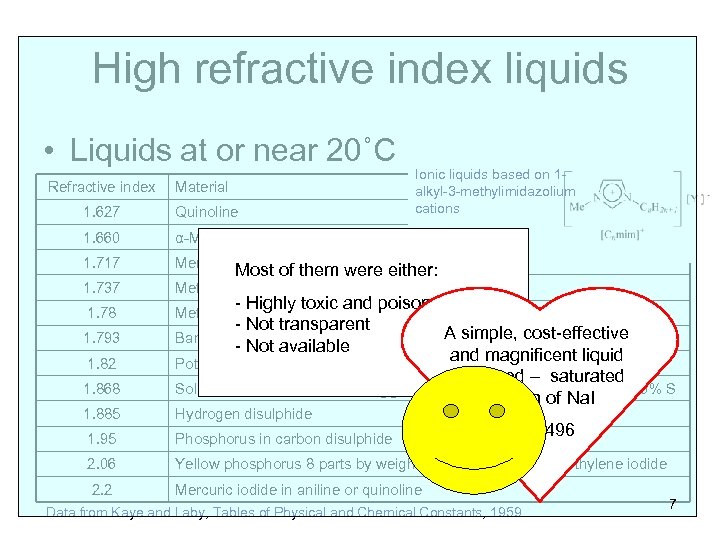 High refractive index liquids • Liquids at or near 20˚C Refractive index Material Ionic liquids based on 1 alkyl-3 -methylimidazolium cations 1. 627 Quinoline 1. 660 α-Monobromonaphthalene 1. 717 Mercury potassium iodide 1. 737 Methylene iodide 1. 78 Methylene iodide and sulphur (saturated) Most of them were either: 1. 82 - Highly toxic and poisonous - Not transparent A simple, cost-effective Barium mercuric iodide aq. - Not available and magnificent liquid 1. 868 Solutions of 35% by weight CH 2 I 2, 31% Sn. I 4, 16% As. I 3, 8% Sb. I 3 and 10% S 1. 885 Hydrogen disulphide 1. 95 Phosphorus in carbon disulphide 2. 06 Yellow phosphorus 8 parts by weight + 1 part sulphur + 1 methylene iodide 2. 2 Mercuric iodide in aniline or quinoline 1. 793 Potassium iodide and mercuric iodide aq. was used – saturated solution of Na. I n = 1. 496 Data from Kaye and Laby, Tables of Physical and Chemical Constants, 1959 7
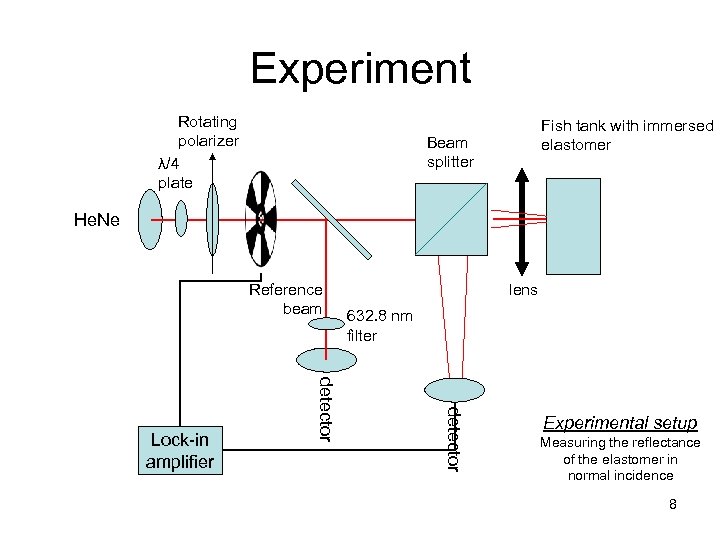 Experiment Rotating polarizer λ/4 plate Fish tank with immersed elastomer Beam splitter He. Ne Reference beam 632. 8 nm filter detector Lock-in amplifier lens Experimental setup Measuring the reflectance of the elastomer in normal incidence 8
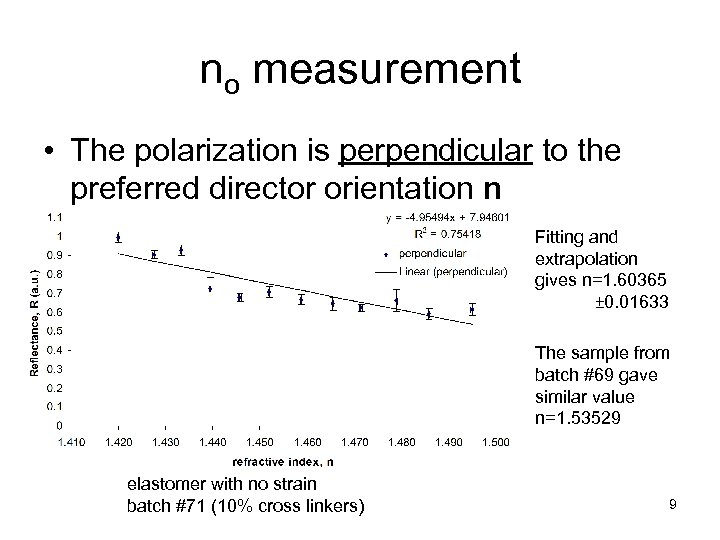 no measurement • The polarization is perpendicular to the preferred director orientation n Fitting and extrapolation gives n=1. 60365 ± 0. 01633 The sample from batch #69 gave similar value n=1. 53529 elastomer with no strain batch #71 (10% cross linkers) 9
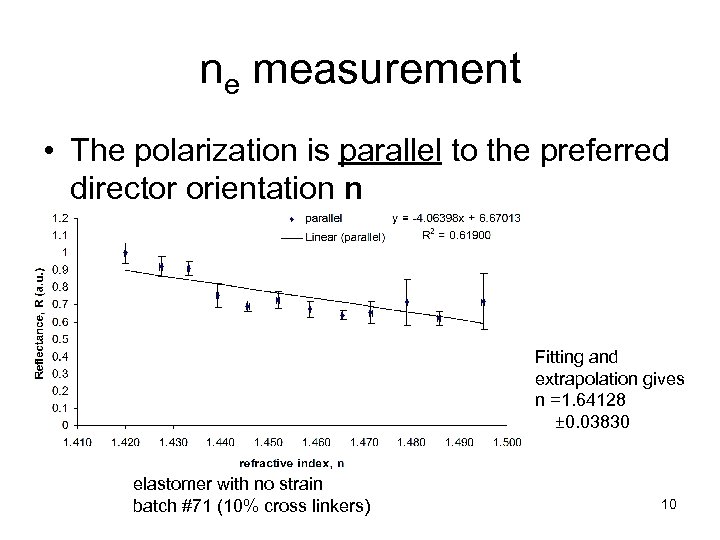 ne measurement • The polarization is parallel to the preferred director orientation n Fitting and extrapolation gives n =1. 64128 ± 0. 03830 elastomer with no strain batch #71 (10% cross linkers) 10
 Benefits and drawbacks of the method • Looks simple • Inhomogeneity of elastomer • Scattering 11
 12
12
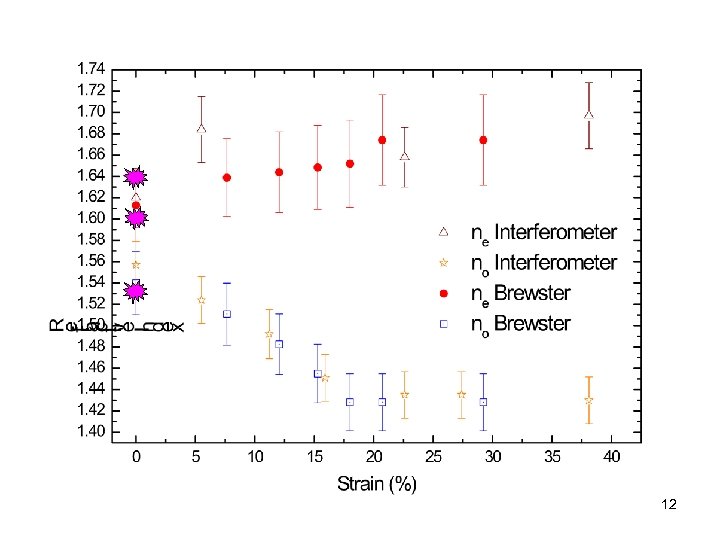
 Conclusions • The sample was different but the results agree with previous measurements • The refractive indices need to be measured more accurately • Future work: Generalized Ellipsometry • Need to measure inhomogeneity 13
 Acknowledgement • • • Prof. Peter Palffy-Muhoray Jake Fontana, Israel Lazo Paul Luchette, Michele Fontana Jeremy Neal, Sabrina Relaix Rafael Zola 14
 Thank you ! 15