 Скачать презентацию Measuring cause specific mortality the use of verbal
bbab3e097a99989148afd2b415cb9a55.ppt
- Количество слайдов: 24



Measuring cause specific mortality: the use of verbal autopsies Alan Lopez Chalapati Rao
Uses of cause of death data • To study and explain levels, trends and differentials in age specific mortality (Preston and disciples) • To guide priorities for resource allocation for intervention programs, biomedical and sociomedical research • To monitor public health programs • To provide clues for epidemiological research
Sources of national cause-specific mortality data – vital registration systems – GOLD STANDARD – sample registration systems – household surveys – population laboratories and surveillance systems – epidemiological estimates • For deaths registered in these systems, cause of death is either – certified by a medical practitioner – based on "verbal autopsies" – not given at all
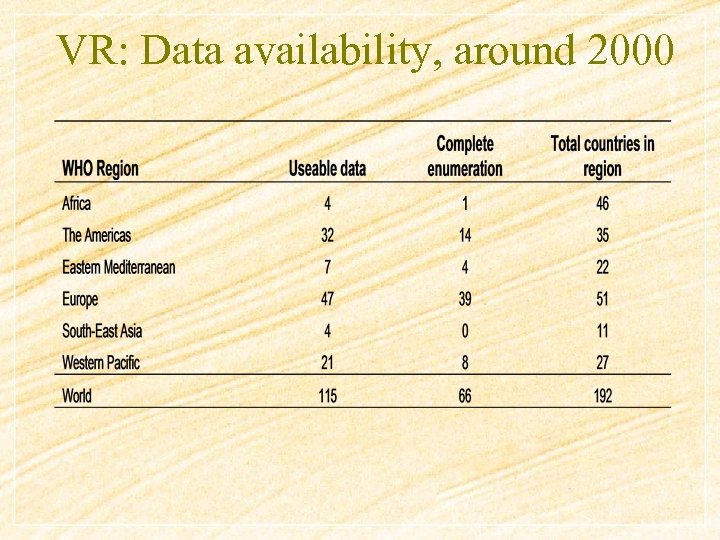
VR: Data availability, around 2000
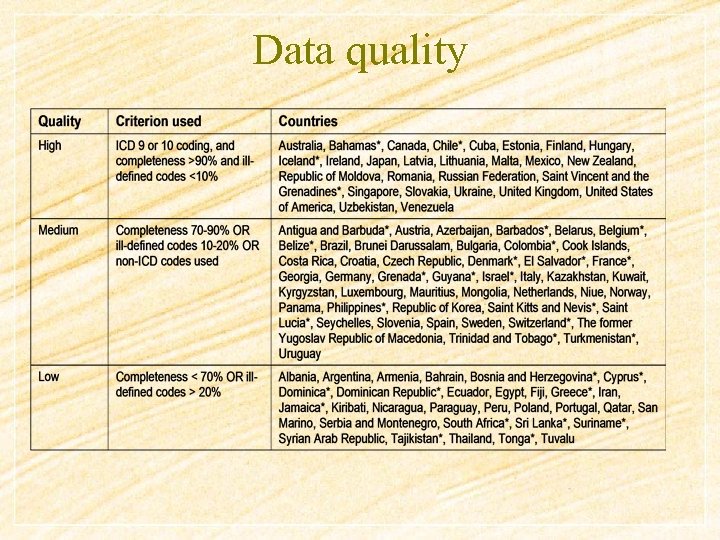
Data quality
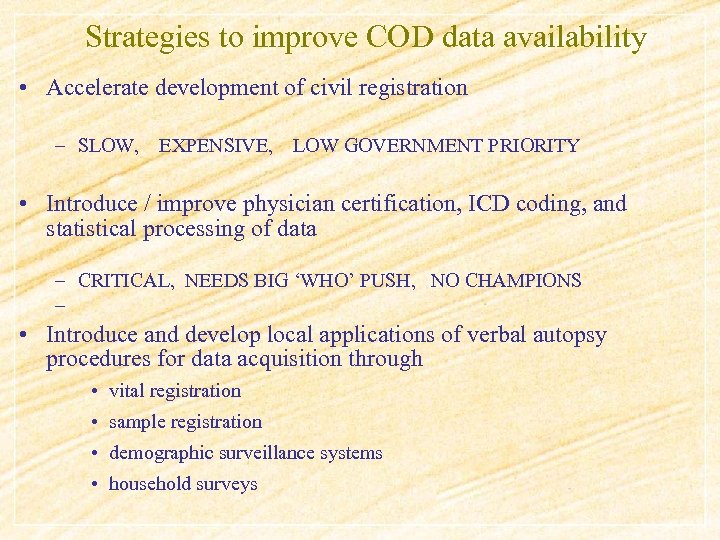
Strategies to improve COD data availability • Accelerate development of civil registration – SLOW, EXPENSIVE, LOW GOVERNMENT PRIORITY • Introduce / improve physician certification, ICD coding, and statistical processing of data – CRITICAL, NEEDS BIG ‘WHO’ PUSH, NO CHAMPIONS – • Introduce and develop local applications of verbal autopsy procedures for data acquisition through • vital registration • sample registration • demographic surveillance systems • household surveys
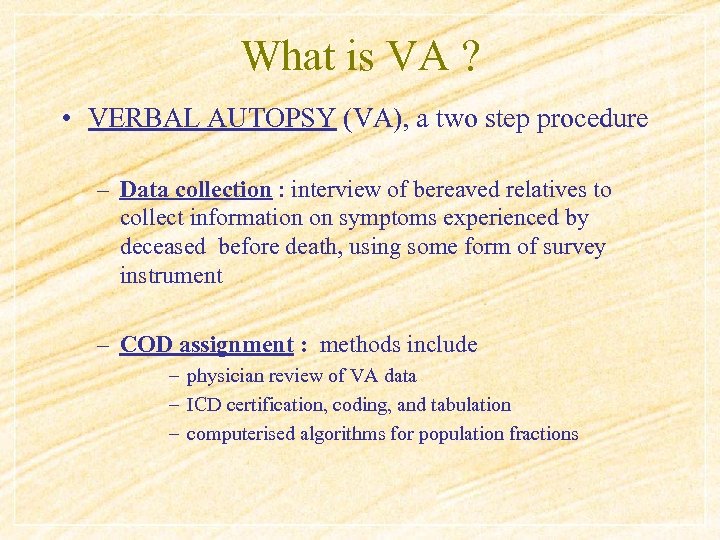
What is VA ? • VERBAL AUTOPSY (VA), a two step procedure – Data collection : interview of bereaved relatives to collect information on symptoms experienced by deceased before death, using some form of survey instrument – COD assignment : methods include – physician review of VA data – ICD certification, coding, and tabulation – computerised algorithms for population fractions
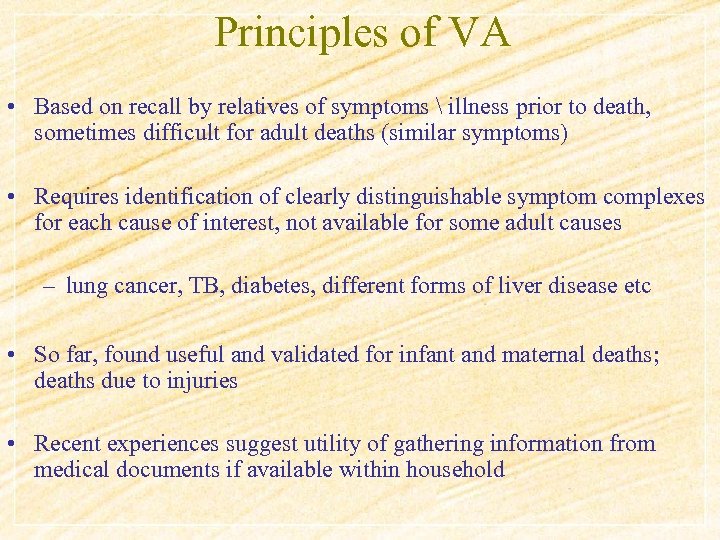
Principles of VA • Based on recall by relatives of symptoms illness prior to death, sometimes difficult for adult deaths (similar symptoms) • Requires identification of clearly distinguishable symptom complexes for each cause of interest, not available for some adult causes – lung cancer, TB, diabetes, different forms of liver disease etc • So far, found useful and validated for infant and maternal deaths; deaths due to injuries • Recent experiences suggest utility of gathering information from medical documents if available within household
Historical use of VA • Measuring cause specific mortality in populations – SCDR / SRS - India – DSP / VR – China – AMMP (Tanzania) • Investigating COD in specific age-sex cause groups – infant / child deaths – maternal causes of death – Injury related deaths • Investigating outbreaks / epidemics – Ebola fever epidemic in West Africa – Diarrhoeal disease in Bangladesh
Historical use (contd) • Assessing coverage and effectiveness of disease specific interventions – insecticide impregnated bed nets in Africa – Pneumococcal vaccine trials in Bohol – Home based neonatal care in India • In developed countries – confidential enquiries of maternal mortality – Sudden infant death syndrome – QOL / mental health status in terminal illness among elderly
VA in India • Survey of causes of death – rural (SCDR) 1967 – 1998 (1400 PHCs, rep) • Structured instrument, lay assignment of cause, ICD classification since 1996 • problems with incomplete coverage, inadequate investigator training / physician verification of cause • New system being implemented in SRS, covering 8 million • New instruments, field protocols, training support • Five year retrospective survey planned soon • independent field studies by Ind C Med Res in 5 zones, 1 million pop each • Need for integrated approach, involving civil registration systems
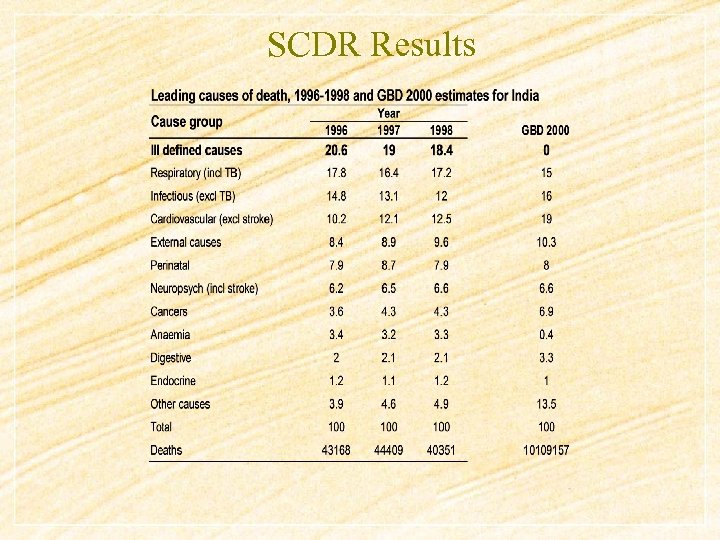
SCDR Results
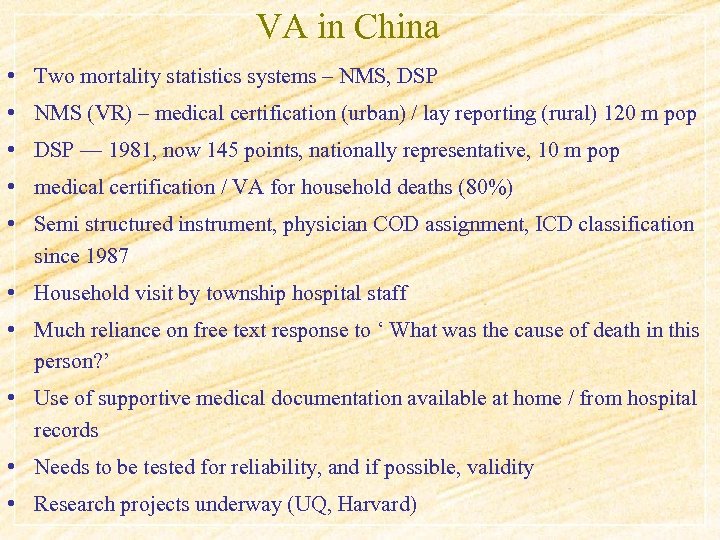
VA in China • Two mortality statistics systems – NMS, DSP • NMS (VR) – medical certification (urban) / lay reporting (rural) 120 m pop • DSP –– 1981, now 145 points, nationally representative, 10 m pop • medical certification / VA for household deaths (80%) • Semi structured instrument, physician COD assignment, ICD classification since 1987 • Household visit by township hospital staff • Much reliance on free text response to ‘ What was the cause of death in this person? ’ • Use of supportive medical documentation available at home / from hospital records • Needs to be tested for reliability, and if possible, validity • Research projects underway (UQ, Harvard)
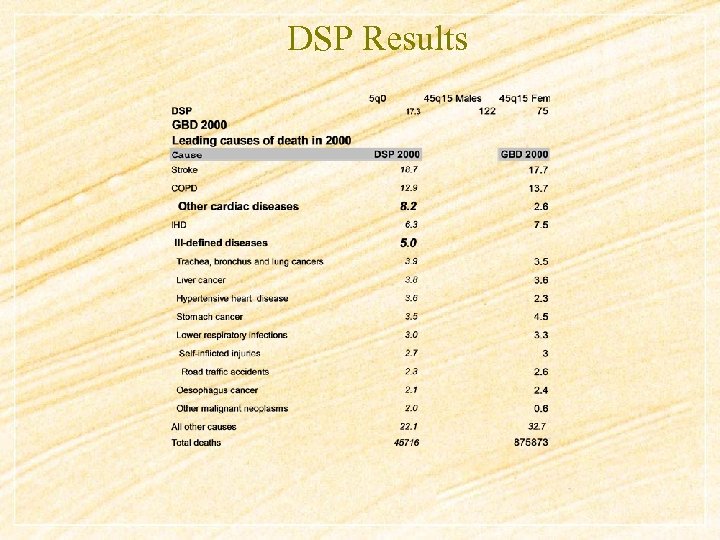
DSP Results
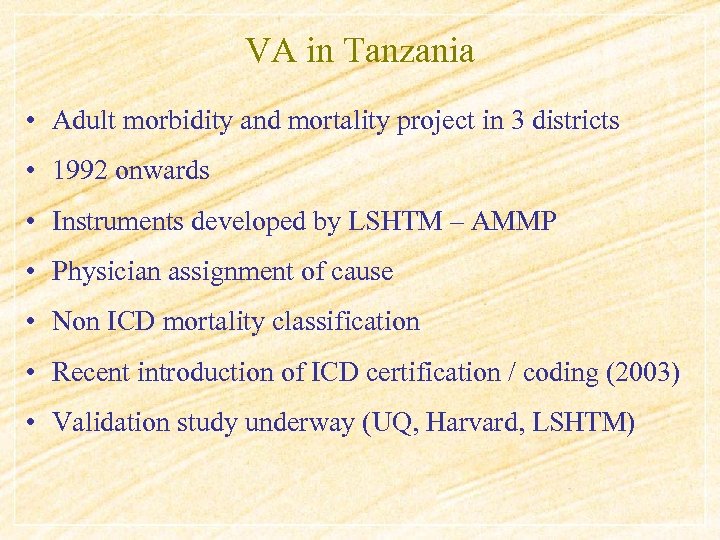
VA in Tanzania • Adult morbidity and mortality project in 3 districts • 1992 onwards • Instruments developed by LSHTM – AMMP • Physician assignment of cause • Non ICD mortality classification • Recent introduction of ICD certification / coding (2003) • Validation study underway (UQ, Harvard, LSHTM)
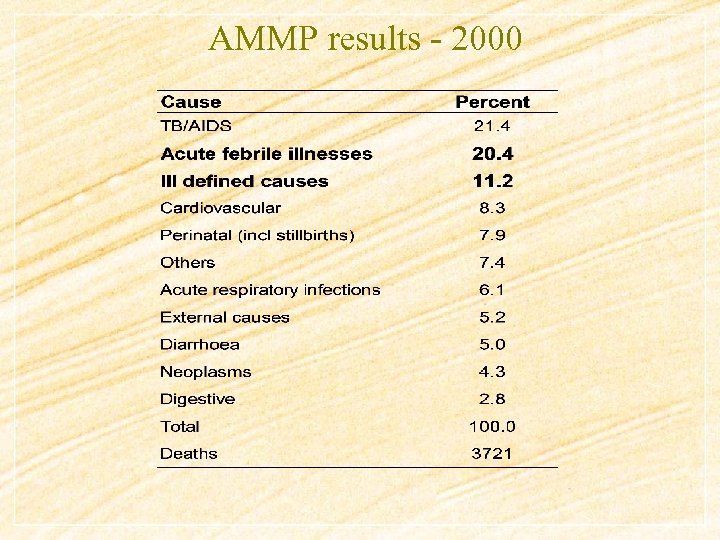
AMMP results - 2000
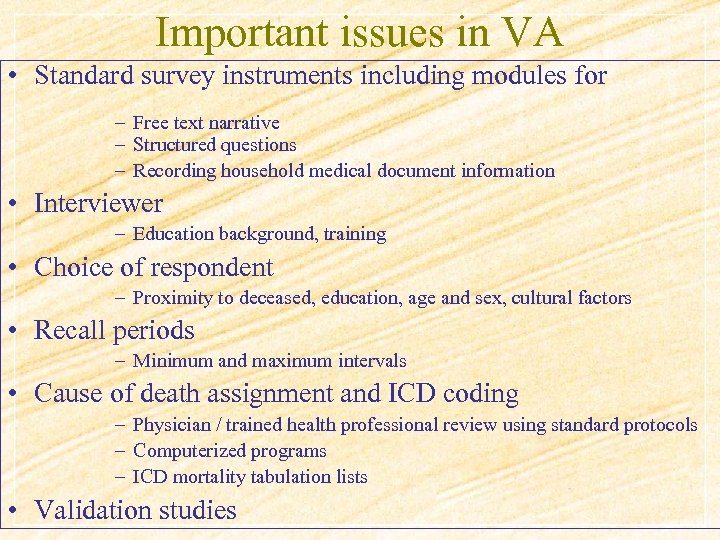
Important issues in VA • Standard survey instruments including modules for – Free text narrative – Structured questions – Recording household medical document information • Interviewer – Education background, training • Choice of respondent – Proximity to deceased, education, age and sex, cultural factors • Recall periods – Minimum and maximum intervals • Cause of death assignment and ICD coding – Physician / trained health professional review using standard protocols – Computerized programs – ICD mortality tabulation lists • Validation studies
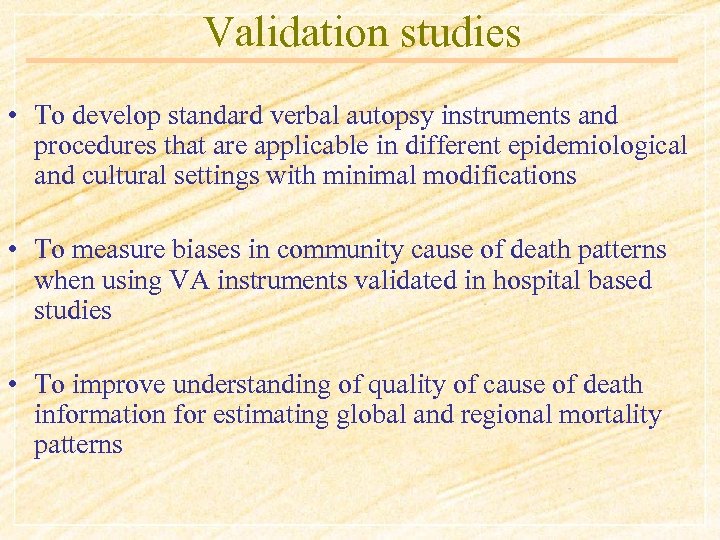
Validation studies • To develop standard verbal autopsy instruments and procedures that are applicable in different epidemiological and cultural settings with minimal modifications • To measure biases in community cause of death patterns when using VA instruments validated in hospital based studies • To improve understanding of quality of cause of death information for estimating global and regional mortality patterns
Methods • VA validation study in Tanzania • VA validation and mortality statistics evaluation study in China
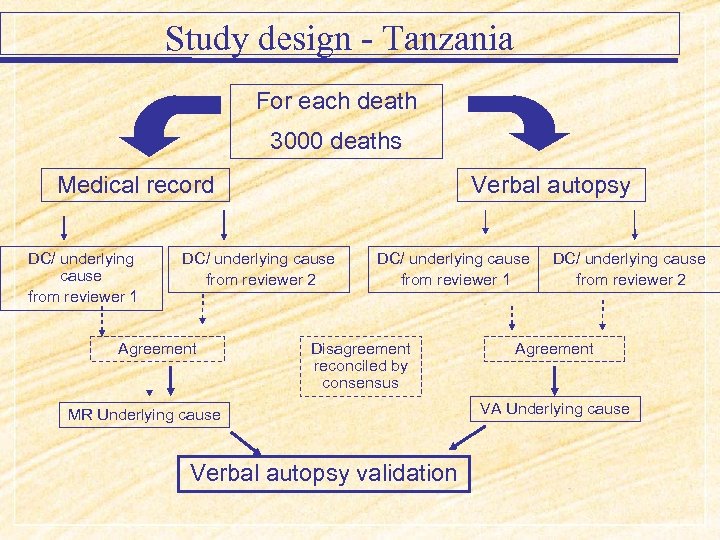
Study design - Tanzania For each death 3000 deaths Medical record DC/ underlying cause from reviewer 1 Verbal autopsy DC/ underlying cause from reviewer 2 Agreement DC/ underlying cause from reviewer 1 Disagreement reconciled by consensus MR Underlying cause Verbal autopsy validation DC/ underlying cause from reviewer 2 Agreement VA Underlying cause
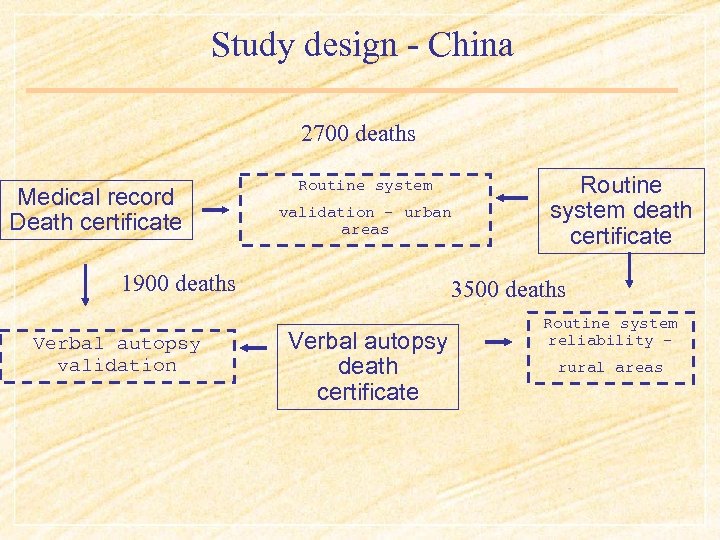
Study design - China 2700 deaths Medical record Death certificate Routine system validation – urban areas 1900 deaths Verbal autopsy validation Routine system death certificate 3500 deaths Verbal autopsy death certificate Routine system reliability – rural areas
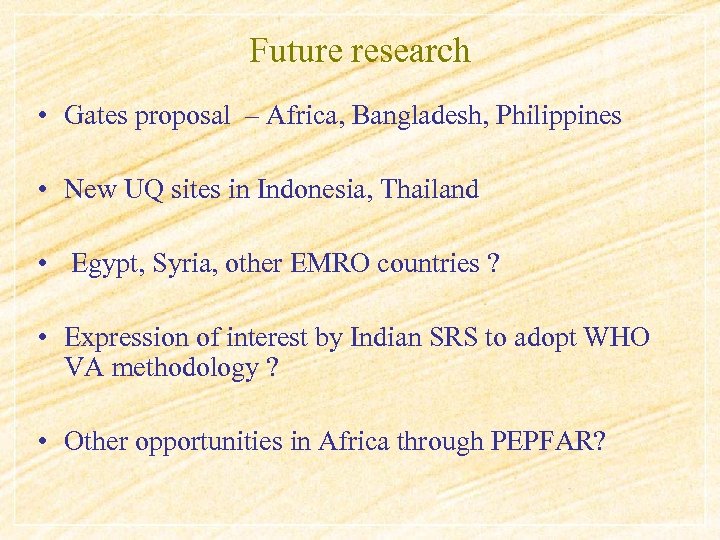
Future research • Gates proposal – Africa, Bangladesh, Philippines • New UQ sites in Indonesia, Thailand • Egypt, Syria, other EMRO countries ? • Expression of interest by Indian SRS to adopt WHO VA methodology ? • Other opportunities in Africa through PEPFAR?
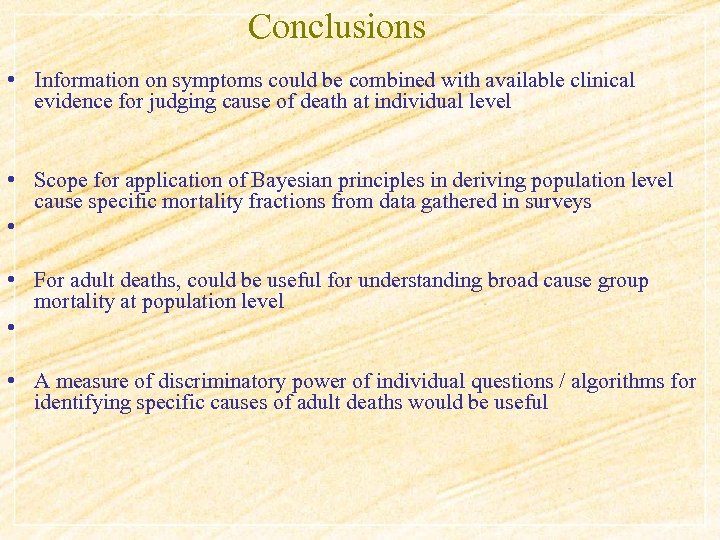
Conclusions • Information on symptoms could be combined with available clinical evidence for judging cause of death at individual level • Scope for application of Bayesian principles in deriving population level cause specific mortality fractions from data gathered in surveys • • For adult deaths, could be useful for understanding broad cause group mortality at population level • • A measure of discriminatory power of individual questions / algorithms for identifying specific causes of adult deaths would be useful
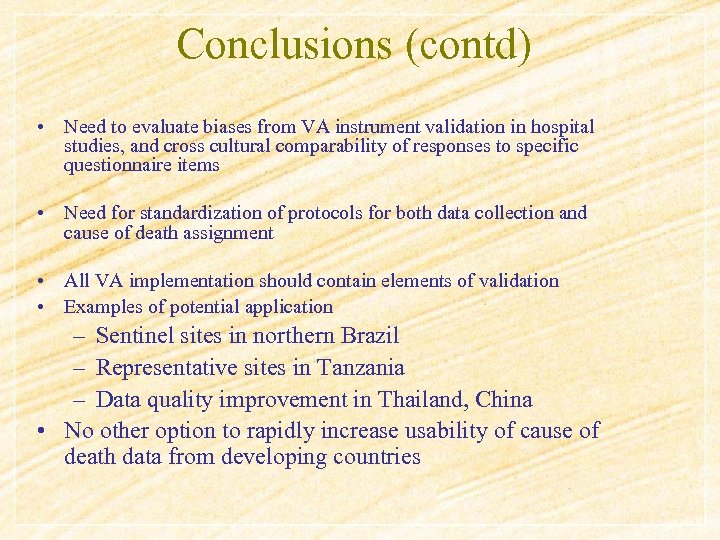
Conclusions (contd) • Need to evaluate biases from VA instrument validation in hospital studies, and cross cultural comparability of responses to specific questionnaire items • Need for standardization of protocols for both data collection and cause of death assignment • All VA implementation should contain elements of validation • Examples of potential application – Sentinel sites in northern Brazil – Representative sites in Tanzania – Data quality improvement in Thailand, China • No other option to rapidly increase usability of cause of death data from developing countries
Скачать презентацию Measuring cause specific mortality the use of verbal
bbab3e097a99989148afd2b415cb9a55.ppt