


 Скачать презентацию Measurement Verification and Forecasting Protocols for Demand Response
fbf90af3d9a2b4202d9368ef086dcce4.ppt
- Количество слайдов: 11
 Measurement, Verification, and Forecasting Protocols for Demand Response Resources: Chuck Goldman CAGoldman@lbl. gov Lawrence Berkeley National Laboratory NARUC-FERC Demand Response Collaborative Washington DC February 18, 2007
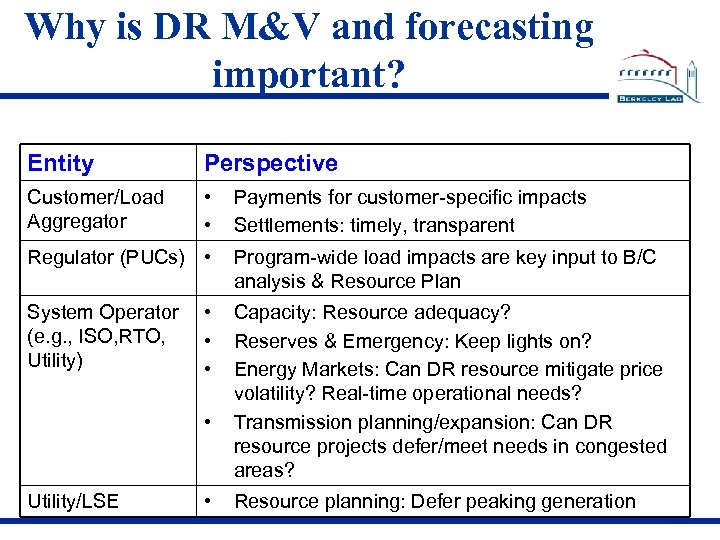 Why is DR M&V and forecasting important? Entity Perspective Customer/Load Aggregator • • Regulator (PUCs) • System Operator (e. g. , ISO, RTO, Utility) • • Utility/LSE • Payments for customer-specific impacts Settlements: timely, transparent Program-wide load impacts are key input to B/C analysis & Resource Plan Capacity: Resource adequacy? Reserves & Emergency: Keep lights on? Energy Markets: Can DR resource mitigate price volatility? Real-time operational needs? Transmission planning/expansion: Can DR resource projects defer/meet needs in congested areas? Resource planning: Defer peaking generation
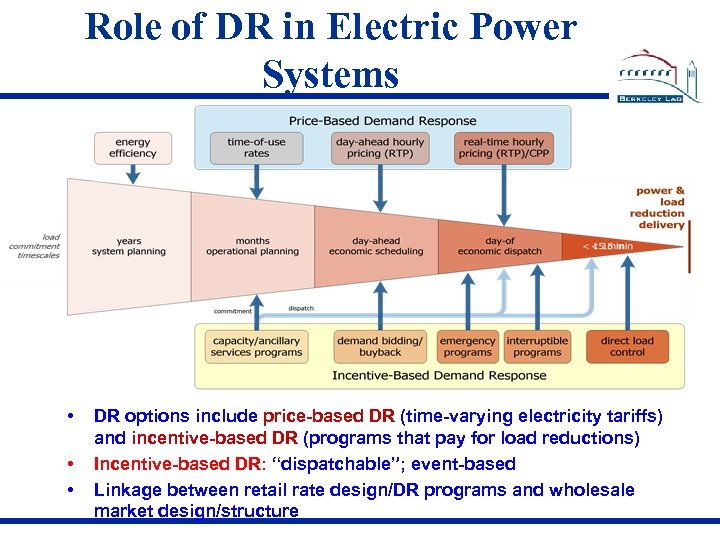 Role of DR in Electric Power Systems • • • DR options include price-based DR (time-varying electricity tariffs) and incentive-based DR (programs that pay for load reductions) Incentive-based DR: “dispatchable”; event-based Linkage between retail rate design/DR programs and wholesale market design/structure
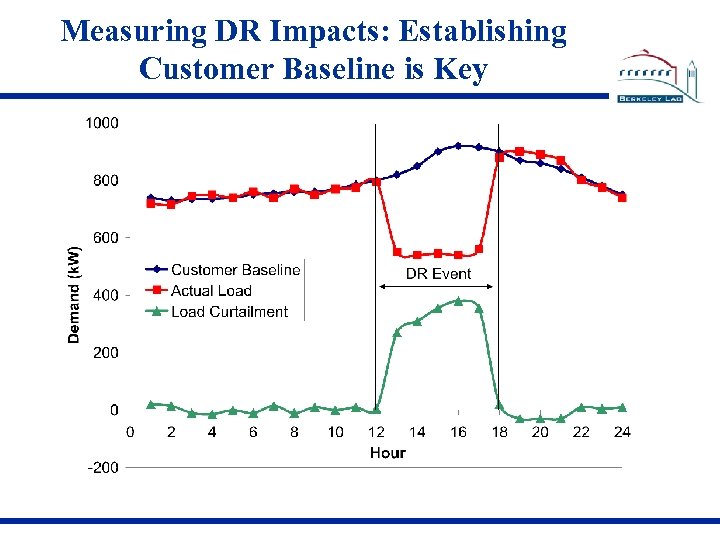 Measuring DR Impacts: Establishing Customer Baseline is Key
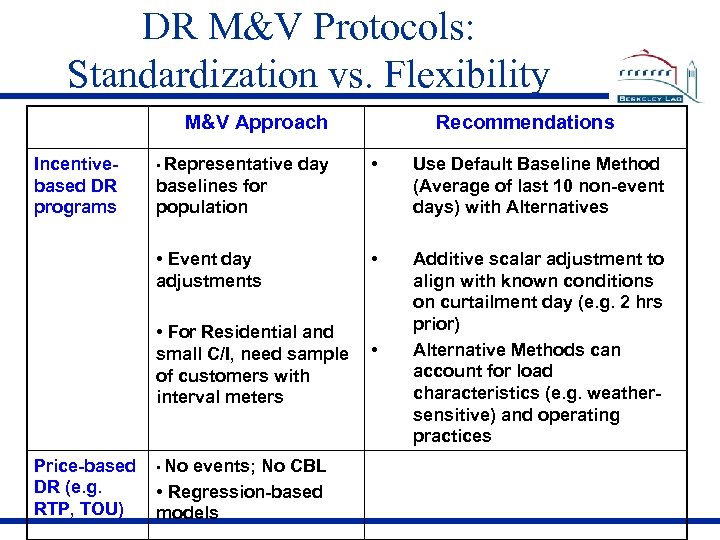 DR M&V Protocols: Standardization vs. Flexibility M&V Approach Incentivebased DR programs • Representative day • Use Default Baseline Method (Average of last 10 non-event days) with Alternatives • Additive scalar adjustment to align with known conditions on curtailment day (e. g. 2 hrs prior) Alternative Methods can account for load characteristics (e. g. weathersensitive) and operating practices baselines for population • Event day adjustments • For Residential and small C/I, need sample of customers with interval meters Price-based DR (e. g. RTP, TOU) Recommendations • No events; No CBL • Regression-based models •
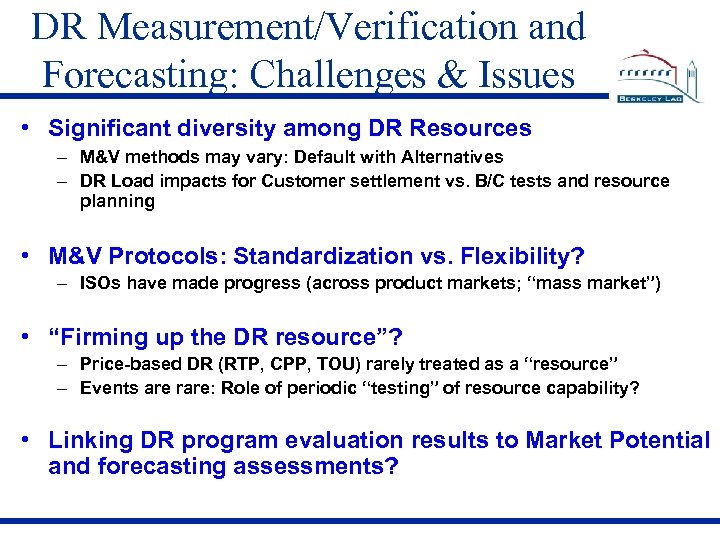 DR Measurement/Verification and Forecasting: Challenges & Issues • Significant diversity among DR Resources – M&V methods may vary: Default with Alternatives – DR Load impacts for Customer settlement vs. B/C tests and resource planning • M&V Protocols: Standardization vs. Flexibility? – ISOs have made progress (across product markets; “mass market”) • “Firming up the DR resource”? – Price-based DR (RTP, CPP, TOU) rarely treated as a “resource” – Events are rare: Role of periodic “testing” of resource capability? • Linking DR program evaluation results to Market Potential and forecasting assessments?
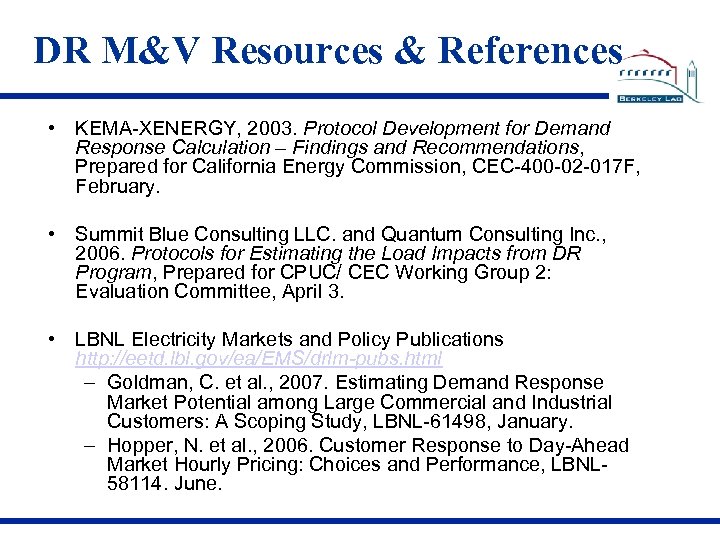 DR M&V Resources & References • KEMA-XENERGY, 2003. Protocol Development for Demand Response Calculation – Findings and Recommendations, Prepared for California Energy Commission, CEC-400 -02 -017 F, February. • Summit Blue Consulting LLC. and Quantum Consulting Inc. , 2006. Protocols for Estimating the Load Impacts from DR Program, Prepared for CPUC/ CEC Working Group 2: Evaluation Committee, April 3. • LBNL Electricity Markets and Policy Publications http: //eetd. lbl. gov/ea/EMS/drlm-pubs. html – Goldman, C. et al. , 2007. Estimating Demand Response Market Potential among Large Commercial and Industrial Customers: A Scoping Study, LBNL-61498, January. – Hopper, N. et al. , 2006. Customer Response to Day-Ahead Market Hourly Pricing: Choices and Performance, LBNL 58114. June.
 Background slides
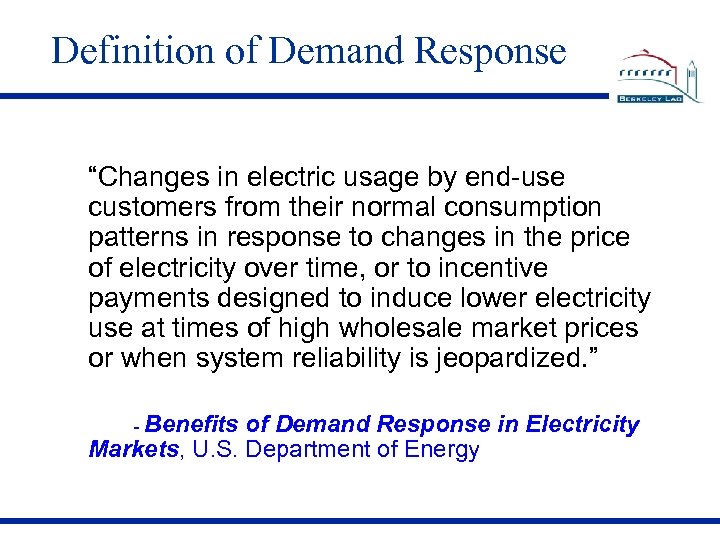 Definition of Demand Response “Changes in electric usage by end-use customers from their normal consumption patterns in response to changes in the price of electricity over time, or to incentive payments designed to induce lower electricity use at times of high wholesale market prices or when system reliability is jeopardized. ” - Benefits of Demand Response in Electricity Markets, U. S. Department of Energy
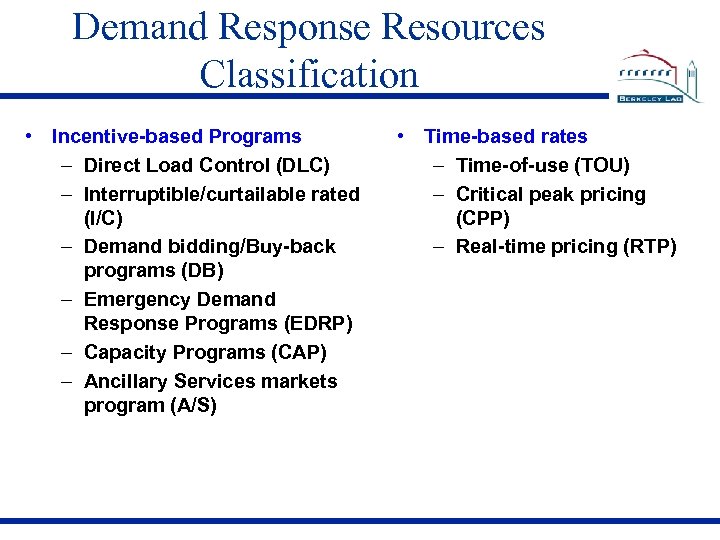 Demand Response Resources Classification • Incentive-based Programs – Direct Load Control (DLC) – Interruptible/curtailable rated (I/C) – Demand bidding/Buy-back programs (DB) – Emergency Demand Response Programs (EDRP) – Capacity Programs (CAP) – Ancillary Services markets program (A/S) • Time-based rates – Time-of-use (TOU) – Critical peak pricing (CPP) – Real-time pricing (RTP)
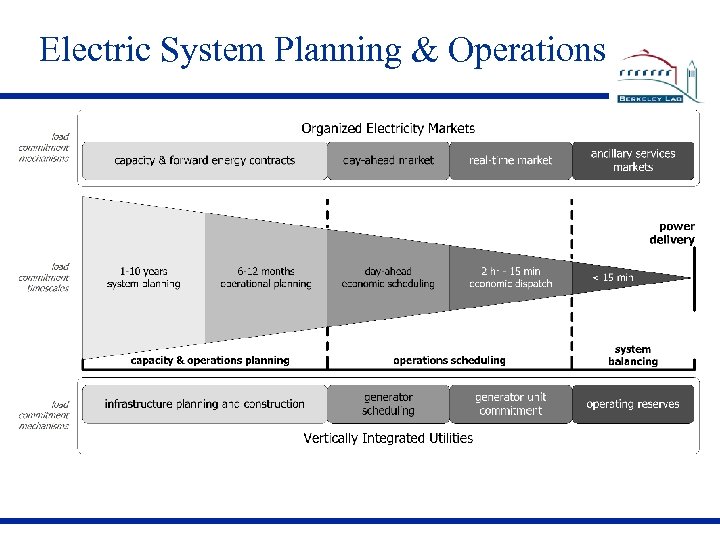 Electric System Planning & Operations