 Скачать презентацию Measurement 4 Trade and Migration General problems
bb157a3ef03e3ddcdcf85067a1f684ff.ppt
- Количество слайдов: 11



Measurement 4 Trade and Migration
General problems of measurement Flows of goods or of people, or of money (capital transfers, cash remittances…) between two countries Statistics are usually built at State level: customs, people’s registration, banks, etc. Clandestine / unregistered flows across borders Inconsistencies
Trade Total exports should fit total imports between one area A and one area B Sometimes not (ex. Oil from Africa) Trade balances from national accounts ≠ Balance of payments (customs and central banks data) Measurement of protection is a hard task: tariffs and especially tariff-equivalent measures of nontariff barriers (e. g. quotas) Mac. Maps Database of CEPII in France
Foreign Direct Investments Balance of payments source (IMF standards): money flows, potentially disaggregated by sectors (OECD database) Multinational firms data with employment, output, etc. : only for some countries, from national sources (industrial censuses), specific surveys…
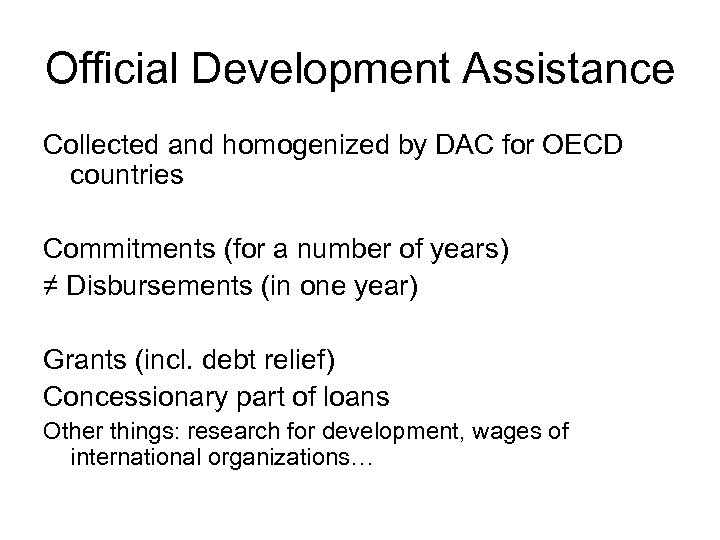
Official Development Assistance Collected and homogenized by DAC for OECD countries Commitments (for a number of years) ≠ Disbursements (in one year) Grants (incl. debt relief) Concessionary part of loans Other things: research for development, wages of international organizations…

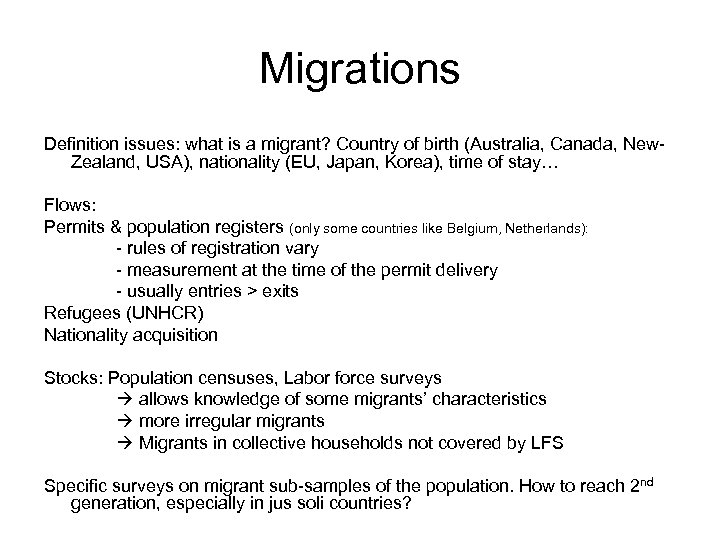
Migrations Definition issues: what is a migrant? Country of birth (Australia, Canada, New. Zealand, USA), nationality (EU, Japan, Korea), time of stay… Flows: Permits & population registers (only some countries like Belgium, Netherlands): - rules of registration vary - measurement at the time of the permit delivery - usually entries > exits Refugees (UNHCR) Nationality acquisition Stocks: Population censuses, Labor force surveys allows knowledge of some migrants’ characteristics more irregular migrants Migrants in collective households not covered by LFS Specific surveys on migrant sub-samples of the population. How to reach 2 nd generation, especially in jus soli countries?
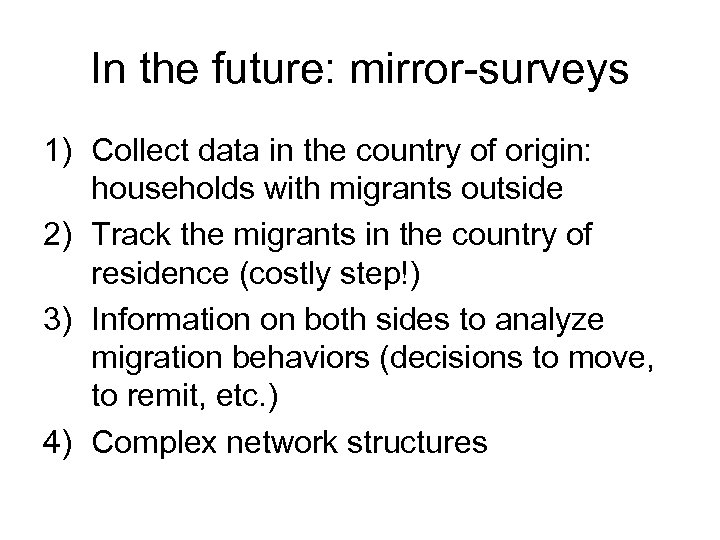
In the future: mirror-surveys 1) Collect data in the country of origin: households with migrants outside 2) Track the migrants in the country of residence (costly step!) 3) Information on both sides to analyze migration behaviors (decisions to move, to remit, etc. ) 4) Complex network structures

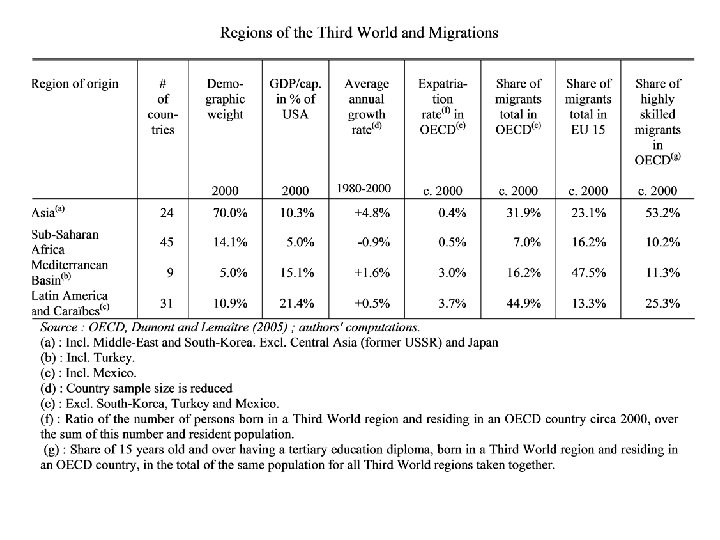
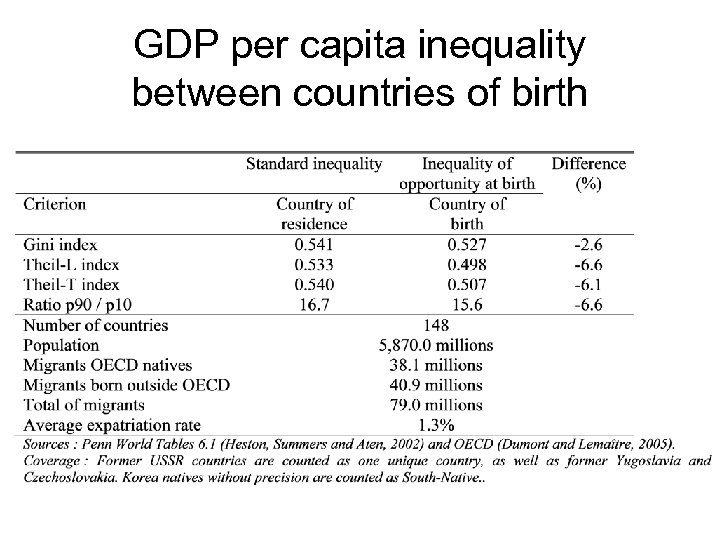
GDP per capita inequality between countries of birth
Скачать презентацию Measurement 4 Trade and Migration General problems
bb157a3ef03e3ddcdcf85067a1f684ff.ppt