 Скачать презентацию Means of Doing Business Presentation outline Choices
a11bb0c6b80371c008d3997361cb82ba.ppt
- Количество слайдов: 21



Means of Doing Business Presentation outline • Choices of investment – – representative office, joint venture, wholly-owned foreign enterprise Foreign investor shareholding corporation • Site location • Finding the right partner • Principle of building relationship with China business
Representative Office • Appropriate for selling imported products in China • No allow to do business directly • build relations and provide technical support and training • Ministry of Foreign Trade and Economic Cooperation (MOFTEC)- supervisory government agency for representative offices • Need a local sponsor or consultancy from MOFTEC or FESCO (Foreign Enterprise Service Corp. ) to set up a representative office
Representative office- continued • Legal documents and Procedure – home company’s business activities – a complete list of board of directors – article of association – recent balance sheet and income statements – register with State Administration for Industry and Commerce (SAIC) – after approval from SAIC Open a bank account with Bank of China, Register with Public Security Bureau, the Customs and the Tax Bureau
Joint Ventures In joint venture agreements, they include: Name of the joint venture and location Production capacity and quality Total investment and source of funds Percentage of investment and division of profits methods of marketing form of investment/cooperation
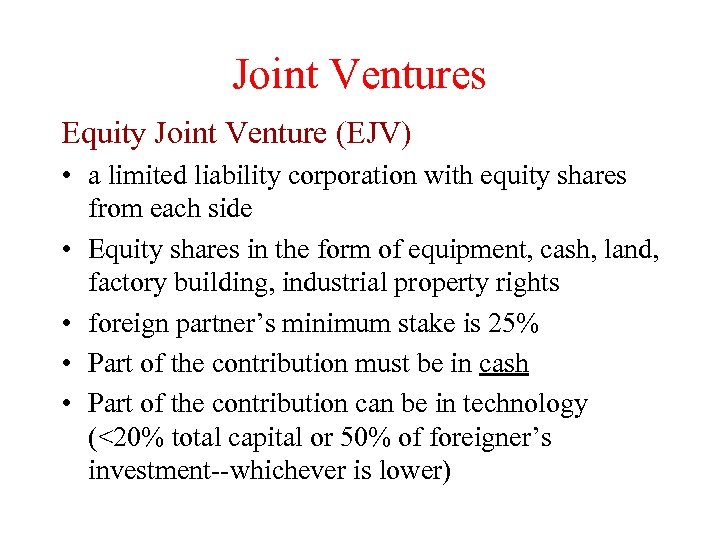
Joint Ventures Equity Joint Venture (EJV) • a limited liability corporation with equity shares from each side • Equity shares in the form of equipment, cash, land, factory building, industrial property rights • foreign partner’s minimum stake is 25% • Part of the contribution must be in cash • Part of the contribution can be in technology (<20% total capital or 50% of foreigner’s investment--whichever is lower)
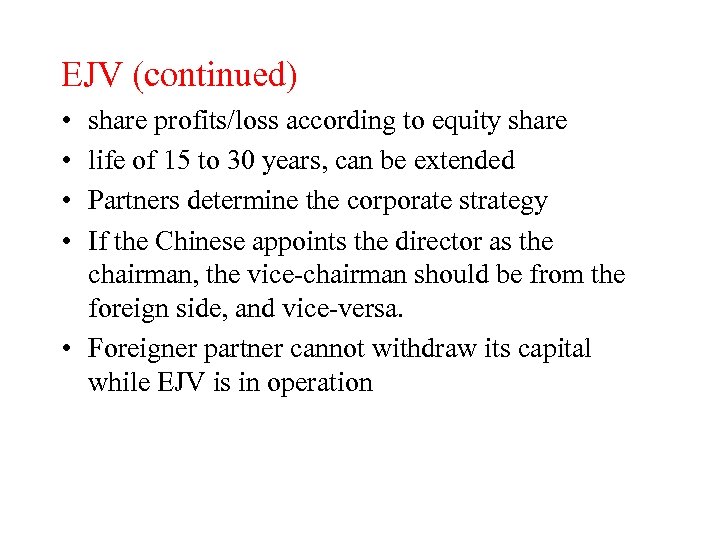
EJV (continued) • • share profits/loss according to equity share life of 15 to 30 years, can be extended Partners determine the corporate strategy If the Chinese appoints the director as the chairman, the vice-chairman should be from the foreign side, and vice-versa. • Foreigner partner cannot withdraw its capital while EJV is in operation
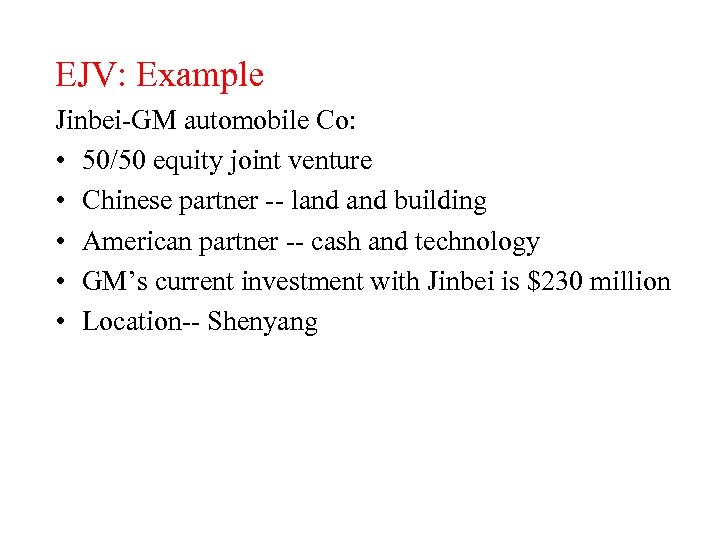
EJV: Example Jinbei-GM automobile Co: • 50/50 equity joint venture • Chinese partner -- land building • American partner -- cash and technology • GM’s current investment with Jinbei is $230 million • Location-- Shenyang
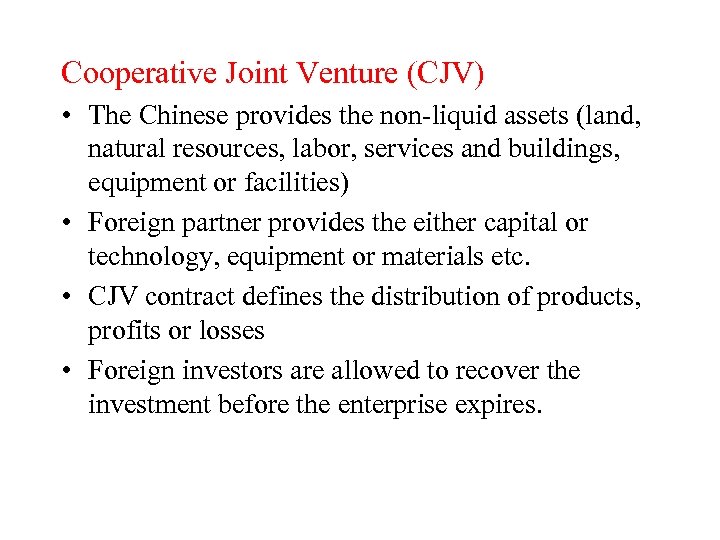
Cooperative Joint Venture (CJV) • The Chinese provides the non-liquid assets (land, natural resources, labor, services and buildings, equipment or facilities) • Foreign partner provides the either capital or technology, equipment or materials etc. • CJV contract defines the distribution of products, profits or losses • Foreign investors are allowed to recover the investment before the enterprise expires.
CJV: Example Motorola-Apple-Panda March 1996, cooperative joint venture Apple contributes design of the PC, Motorola, the G 4 processing chip and Panda, the land building space Failure: Apple was not happy with Motorola’s slow G 4 chip production decided to withdraw from the joint venture (which was then dissolved).
Compensation Trade (CT) deals--counter-trade • Firms sell raw materials (or technology etc) and buys back the manufactured goods or other substitute products • The foreign side supplies the production equipment and technology • Two ways to raise capital for CT – Foreign investor obtains foreign bank loan to pay for the equipment imported by the Chinese – The Chinese side uses the export loan from foreign bank to buy equipment • Leasing arrangement falls into CT
Processing and Assembly Agreement • • foreign side supplies materials Chinese side processes or assembles them The Chinese receives a fee for their efforts Foreign partner pays the fee in either cash or open a letter of credit account with Bank of China or other approved Chinese bank for the finished goods. • Industries include --labor intensive (cloth-making) and others (calculators) • preferential treatment such as tax free for imports
Wholly Foreign-owned Enterprise (WFOE) • Limited liability company • Foreign investment may be in the form of hard currency, machinery, industrial property rights or know-how • Condition for approval – advance technological know-how – more than 50% of output in terms of foreign exchange
WFOE (continued) • Restricted areas: • News, publication, broadcasting, television, film industry, foreign trade, insurance, post and telecommunications and others. • In 1986, WFOE 1% of foreign investment In 1991, WFOE was 37% • Usually require 15% of capital registered within 3 months of establishment
Foreign Investor Shareholding Corporation (FISC) • joint stock company • Foreign company allows local Chinese partners to have minority stakes in return for their business assets (factories, and trucks) • Local partners do not participate in management of the firm, but help the firm to access to markets • Kodak (China): invest $1. 2 b for a freeze on foreign competition until 2002 • 80% share-20% local (Xiamen Fuda and Shantou Era), each appoints a board member while Koda remaining 8 members
Foreign Investor Shareholding Corporation • Regulatory framework allows foreign corporations to convert existing joint ventures and whollyowned foreign subsidiaries into FISC, provided they have been profitable for 3 years. • China’s State Development Planning Commission is involved in creating FISC. • FISCs are well placed to obtain quick listings on the Shenzhen and Shanghai stock exchanges, making it easier for them to raise new capital.
Site Location • No one can own a piece of land but to rent it • The renting period is – 70 years (housing) – 50 years (industrial, educational, scientific and sporting use) – 40 (commercial, tourism and recreation) • You can transfer, lease or mortgage to third party within the legally-specified period
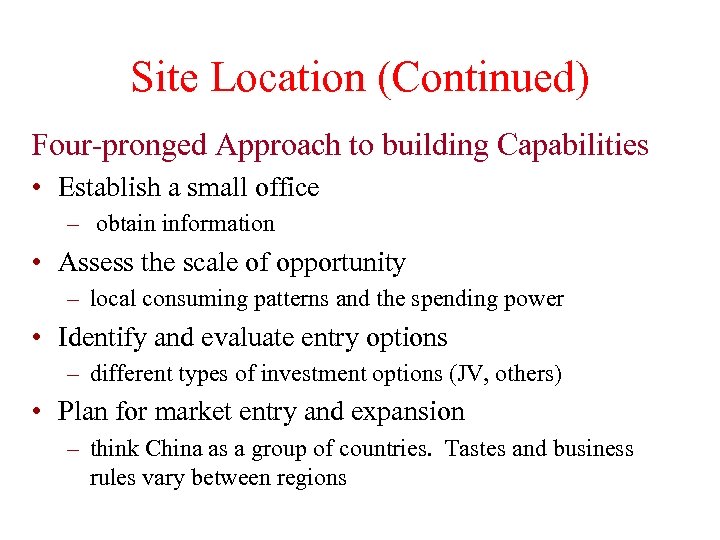
Site Location (Continued) Four-pronged Approach to building Capabilities • Establish a small office – obtain information • Assess the scale of opportunity – local consuming patterns and the spending power • Identify and evaluate entry options – different types of investment options (JV, others) • Plan for market entry and expansion – think China as a group of countries. Tastes and business rules vary between regions
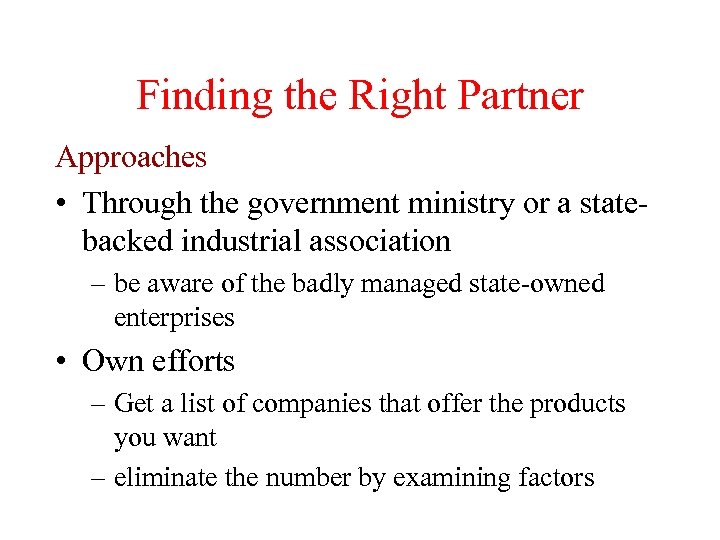
Finding the Right Partner Approaches • Through the government ministry or a statebacked industrial association – be aware of the badly managed state-owned enterprises • Own efforts – Get a list of companies that offer the products you want – eliminate the number by examining factors
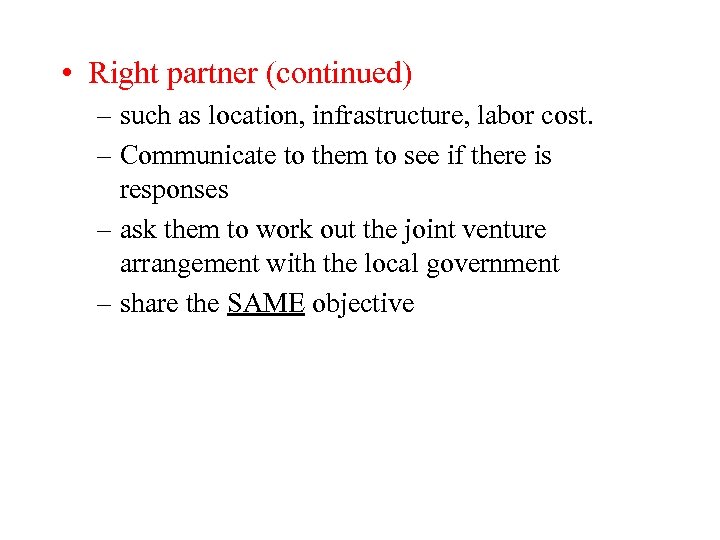
• Right partner (continued) – such as location, infrastructure, labor cost. – Communicate to them to see if there is responses – ask them to work out the joint venture arrangement with the local government – share the SAME objective
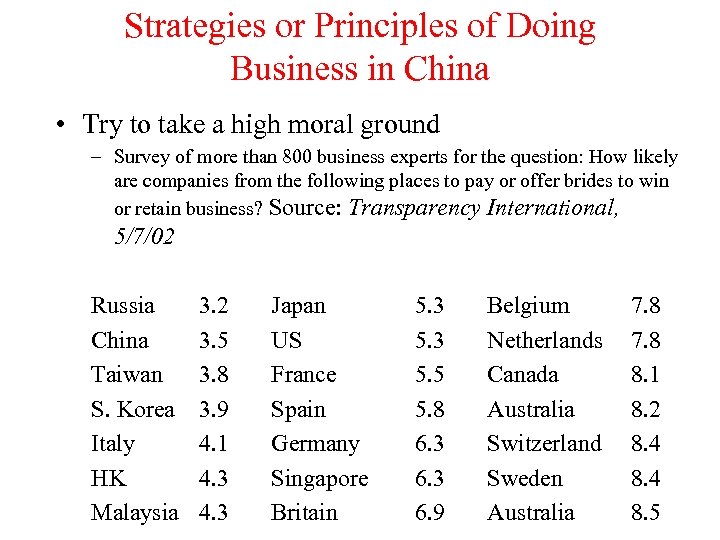
Strategies or Principles of Doing Business in China • Try to take a high moral ground – Survey of more than 800 business experts for the question: How likely are companies from the following places to pay or offer brides to win or retain business? Source: Transparency International, 5/7/02 Russia China Taiwan S. Korea Italy HK Malaysia 3. 2 3. 5 3. 8 3. 9 4. 1 4. 3 Japan US France Spain Germany Singapore Britain 5. 3 5. 5 5. 8 6. 3 6. 9 Belgium Netherlands Canada Australia Switzerland Sweden Australia 7. 8 8. 1 8. 2 8. 4 8. 5
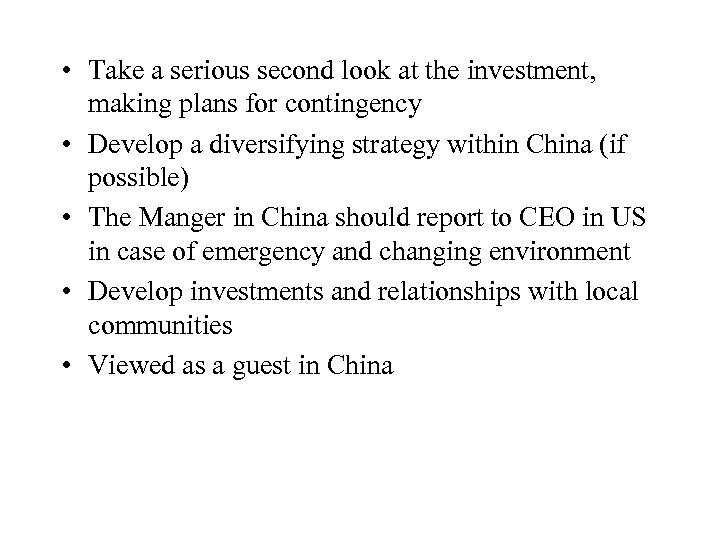
• Take a serious second look at the investment, making plans for contingency • Develop a diversifying strategy within China (if possible) • The Manger in China should report to CEO in US in case of emergency and changing environment • Develop investments and relationships with local communities • Viewed as a guest in China
Скачать презентацию Means of Doing Business Presentation outline Choices
a11bb0c6b80371c008d3997361cb82ba.ppt