 Скачать презентацию me elco ck W do rad gs B
f74c2e3209da0435f6b735d94ebb617a.ppt
- Количество слайдов: 96



me elco ck W do rad gs!!! B ldo ul B 200 6 -20 07 MRS. CONTRERAS Language Arts 9 th Grade – Eng I IGCSE Honors Room C 209
Weekly Forecast 4/23/07 – 4/27/07 • • • Monday – Introduction "To Kill a Mockingbird" (1930 s) Ch 1 -4. Study & take quiz on grammar hdts 141 -150. Tuesday – Math Interims. Study & take quiz on grammar rules (hdts 151 -156 & 235 -240). Work on Home learning assignment. Wednesday – Reading Interims. Study & take quiz on grammar rules (hdts 151 -156 & 235 -240). Work on Home learning assignment. Thursday – "To Kill a Mockingbird" (1930 s) Ch 5 -8. "To Kill a Mockingbird" (1930 s) Ch 9 -12. Friday – "To Kill a Mockingbird" (1930 s) Ch 13 -16.
Home Learning • • By Monday, 4/30: Read To Kill a Mockingbird chapters 17 - end. Answer assigned questions and email to classmate. Read The Siege Introduction - Chapter 7. Bring grammar hdts 245 -260 next week to class for Finals Review! Have a great week!
Extended Home Learning Assignment (Due 5/7/07). • In an effort to enhance student writing skills and performance, all students are to rewrite (retype) all essay writing samples editing flaws and incorporating feedback provided. This assignment includes all hand-written essays in class as well as both research paper(s). Staple updated final draft on top of previous drafts. • Recap Sheets must be updated and placed on top of all drafts which must be compiled in date order. • A student reflection must be attached to the top evaluating your written work this year. Obviously this should take into consideration the feedback that has been provided throughout the course of the year.
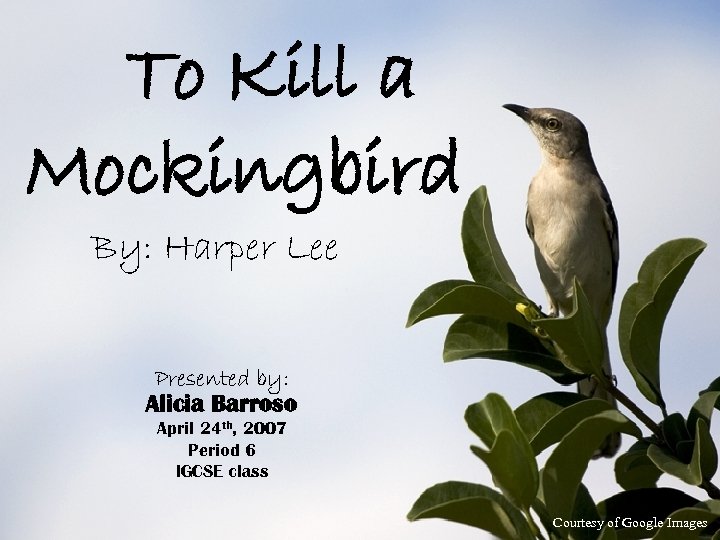
To Kill a Mockingbird By: Harper Lee Presented by: Alicia Barroso April 24 th, 2007 Period 6 IGCSE class Courtesy of Google Images
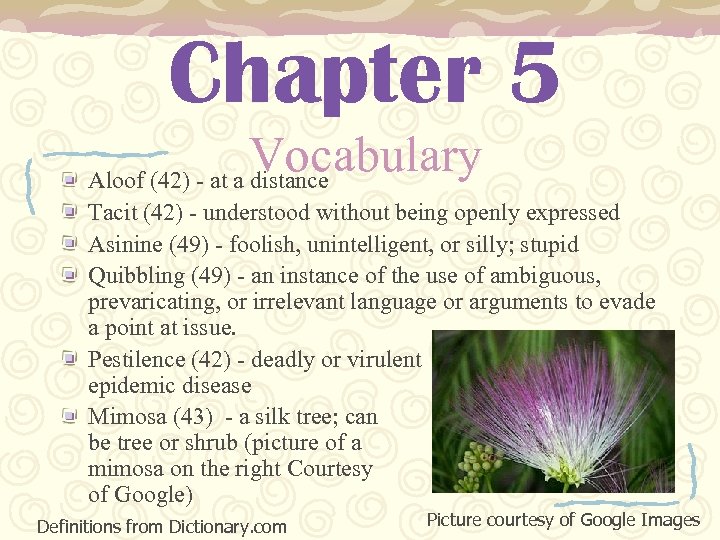
Chapter 5 Vocabulary Aloof (42) - at a distance Tacit (42) - understood without being openly expressed Asinine (49) - foolish, unintelligent, or silly; stupid Quibbling (49) - an instance of the use of ambiguous, prevaricating, or irrelevant language or arguments to evade a point at issue. Pestilence (42) - deadly or virulent epidemic disease Mimosa (43) - a silk tree; can be tree or shrub (picture of a mimosa on the right Courtesy of Google) Definitions from Dictionary. com Picture courtesy of Google Images
Chapter 5 Plot Sequence § Scout begins to feel left out of the trio because Jem and Dill are growing closer in this chapter. § Consequently, she begins to spend her time with her neighbor, Miss Maudie is woman of wisdom who loves gardening and has a talent for cake baking. She is a widow and was childhood friend’s with Atticus’ brother, Jack. § While talking, Scout asks Miss Maudie about Boo Radley. Miss Maudie tells her that his name is Arthur Radley and to call him by his name, not by Boo. Scout asks why he never comes out of his house and wonders if he is even alive. Miss Maudie tells Scout that Arthur Radley (Boo) is still alive; she knows this because she hasn’t seen him “been carried out yet” (Lee 43). Background courtesy of Google Images
Ch. 5 Plot Sequence (continued) § She also informs her that Boo is the victim of a ruthless childhood. She explains that his father (who has already passed away) was a “foot washing Baptist”. His father was an extremist who prophases any pleasure was a sin and that almost everyone was going to hell. § Miss Maudie clears things up. She tells Scout that Arthur was polite and outgoing at all times as a child. She also tells Scout not to believe any Rumors about him because they are most likely false. § Simultaneously, Dill and Jem are anxious to see Boo. They write his a note to tease him in order of coming outside. They invite Boo to go get ice cream with them. § As they try to stick the note with a fishing pole to the window of the Radley house, Atticus catches them and demand that they “stop tormenting that man” and stop playing the Boo Radley game (49). Background courtesy of Google Images
Chapter 5 Analysis • This chapter is significant because in it, Scout is able to talk to Miss Maudie about her doubts as a child. Miss Maudie serves as mother to Scout; she consoles her and offers helpful advice. She tells Scout not to judge Boo Radely. • Moreover, Miss Maudie tells Scout to view life from Boo’s perspective and in that way she will come to understand him and sympathize with his troublesome past. Background courtesy of Google Images
Chapter 6 Vocabulary Kudzu (51) - a fast-growing Chinese and Japanese climbing vine Prowess (51) – expertise; skill Ramshackle (52) - loosely made or held together Eerily (52) - uncanny, so as to inspire superstitious fear Dismemberment (55) - to deprive of limbs; divide limb from limb Lattice (57) - window, gate, or the like consisting of such a structure Desolate (57) – isolated; without company Definitions from Dictionary. com
Chapter 6 Plot Sequence For the remainder of the summer, Jem and Dill obey Atticus until Dill’s last day in Maycomb. This day, Jem and Dill plotted to creep over to the Radley place and look inside through a loose shutter. Scout discovers this and accompanies them only because she would seem girly if she were to back down after finding out the plan. They sneak around the house and when looking into a window, they are startled by the shadow of a man wearing a hat. They rapidly run in attempt to escape and then they hear a shotgun behind them. While climbing a fence to escape, Jem’s pants get stuck to the fence and he has to take them off in order to flee. Background courtesy of Google Images
Ch. 6 Plot Sequence (continued) When the children reach their home, they find a crowd of neighborhood adults. Miss Maudie notifies the trio that Nathan Radley (Boo’s brother) had just shot at “a Negro” in his yard. Atticus soon notices Jem’s pants are no where to be seen and he asks where they are. Dill rapidly interrupts and claims that won over Jem’s pants, while playing strip poker. Atticus tells Dill to bring back Jem’s pants first thing the next morning. Jem did not want Atticus to find out about what happened this he sneaks out to the school yard fence to get his pants back. Background courtesy of Google Images
Chapter 6 Analysis • When Scout accompanies Dill and Jem on their mission, she does so because Jem tells her she is acting too much like a girl. • Scout is a tomboy and she doesn’t like it when she is told she is acting like a girl because girls are classified as weak and prissy. Because of this, Scout joins the two on their mission • She also goes because she has much love for her brother. She wants to make sure he is safe and thus she helps in the scheme. • Jem represents the American boy. He is a daredevil and dreams of playing football. Background courtesy of Google Images
Chapter 7 Vocabulary Honed (60) - to enlarge or finish (a hole) with a hone Ascertaining (61) -To discover with certainty, as through examination or experimentation Cleaved (61) - to adhere closely; stick; cling Rendered (61) - To give or make available Definitions from Dictionary. com
Chapter 7 Plot Sequence • • • A few days post the commencement of school, Jem reveals to Scout that he found his pants mended and hung neatly over the fence. While walking home from school that day, they find a present hidden in the knothole of the tree. Inside was a ball of gray twine. To make sure some kid ‘left it there and was planning to get it back, they waited a few days before taking it home. That fall, the children find another present in the knothole; it was two soap figures that resembled Scout and Jem. They later found chewing gum, an old spelling bee medal, and a worn out pocket watch. The following day, Jem and Scout find that the knothole has been filled with cement.
Chapter 7 Analysis • • This is the chapter in which there is an uprising of all the awkward yet favorable things which have been happening to the Finch children. Jem’s pants were mended and the children are encountering numerous gifts in the knot-hole of a tree in front of the Radley Place. This chapter reveals that someone is being extremely kind and caring in the town of Maycomb. Several hints point out that it is Boo Radley. The children do feel guilty that they were mocking someone who could be the one being so nice.
Chapter 8 Vocabulary Rosetta Stone (63) – a stone slab, found in 1799 near Rosetta, bearing parallel inscriptions in Greek, Egyptian hieroglyphic, and demotic characters, making possible the decipherment of ancient Egyptian hieroglyphics. Aberrations (63) - A deviation from the proper or expected course. Appomattox (65) - a town in central Virginia where Lee surrendered to Grant on April 9, 1865, ending the Civil War. Libel (67) - the act or crime of publishing it. Direst (68) - causing or involving great fear or suffering Shambles (73) – disaster; mess Definitions from Dictionary. com
Chapter 8 Plot Sequence • Maycomb undergoes a real winter with actual snowfall; This is Maycomb’s first real winter in several years. • Consequently, Jem and Scout make a snow figure. Their creation looks a lot like Mr. Avery, a repulsive neighbor that lives down the street. • Atticus stresses that the children disguise the snowman because it’s likeness to Mr. Avery is too obvious. As a result, Jem locates Miss Maudie’s sunhat on its head and sticks her hedge clippers in the snowman’s hands. • That same night, Atticus wakes Scout because Miss Maudie’s house is on fire. • Miss Maudie’s neighbors help her save some of her furniture, nonetheless, her house burns down to the ground. The firefighters and fire trucks came in time to prevent the fire from spreading to other houses, but not quick enough to save Miss Maudie’s house. Background Courtesy of Google Images
Chapter 8 Plot Sequence (continued) • In the chaos of the night, a blanket is draped over Scout’s shoulder without no one noticing who it was. Scout had no idea who placed it on her shoulders. • Jem begins to comprehend everything that is happening. He resolves that it was Boo Radley who covered her with the blanket and he tells Atticus the story of the presents he found inside of the knothole about his mended pants. • The following day, Miss Maudie has a smile on and seems extremely optimistic, regardless of having lost her home the nigh before. • She informs the kids how she hated her previous home and that she was actually already planning on building a smaller home with a larger garden. Background Courtesy of Google Images
Chapter 8 Analysis • In this chapter we see Atticus parenting skills at work. He demands that his children change the appearance of the snowman, for it was insulting to Mr. Avery. This shows how he has morals and how he wants his children to know that although Mr. Avery is an unpleasant man, it is wrong to mock him • In another incident, the readiness of the Maycomb neighbors to help Ms. Maudie shows that although they each have their faults, they all have sympathy and they care for one another. Nobody is perfect but love for one another allows us to stand each other • Miss Maudie’s cheerfulness the next day upon having lost her home reveals the optimistic spirit she holds. She is s fantastic woman. Instead of feeling hatred towards those neighbors who probably deserved their house to be burned down, she is content that her house is destroyed because she wanted a new one. Background Courtesy of Google Images
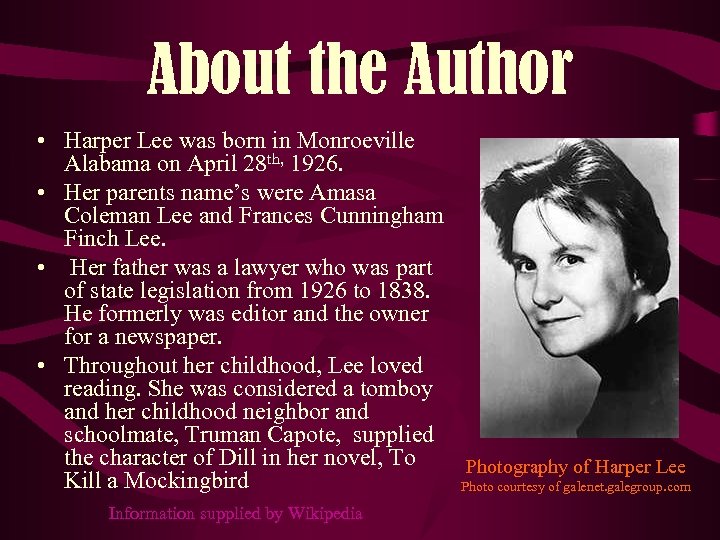
About the Author • Harper Lee was born in Monroeville Alabama on April 28 th, 1926. • Her parents name’s were Amasa Coleman Lee and Frances Cunningham Finch Lee. • Her father was a lawyer who was part of state legislation from 1926 to 1838. He formerly was editor and the owner for a newspaper. • Throughout her childhood, Lee loved reading. She was considered a tomboy and her childhood neighbor and schoolmate, Truman Capote, supplied the character of Dill in her novel, To Photography of Harper Lee Kill a Mockingbird Photo courtesy of galenet. galegroup. com Information supplied by Wikipedia
More on the author - harper Lee • • • In 1931, Lee was 5 years old and living in the small town of Scottsboro in Alabama. In April of this year, the first trials took place concerning the accusation of two white woman being raped by nine black men. The nine men accused of rape were practically mobbed before entering the courthouse. Moreover, they weren’t supplied a lawyer until their first day in court. The all-white jury convicted the nine men guilty and sentenced them to death, except the youngest who was 12, despite the evident information proving the men innocent which included medical reports denying that the woman were raped. This case left an immense impression and reaction on Harper Lee. Consequently, she used this case as the backbone for the story/case of Tom Robinson. Like her own father was a lawyer, so was Scout’s father Atticus. Much of her childhood experiences and impressions are presented from Scout’s point of view in To Kill a Mockingbird. To kill a Mockingbird was Lee’s first and only novel which she published in 1960, post a period of two years of revising and editing. To Kill a Mockingbird was awarded the 1961 Pulitzer Prize. Despite significant criticism of the novel and critical reviews labeling Harper Lee as a racist, the novel was very popular and sold over fifteen million copies. Information supplied by Wikipedia

• The Great Depression was overall a time of chaos and poverty. It was period of economic crisis which began with the stock market crash on October 29, 1929, also referred to as Black Tuesday. • Although to stock market crash occurred in the United States, it quickly spread to Europe. Since many countries depended on the prosperity of the United States during the “Roaring 20 s”, the depression of the U. S. in the 1930 s severely impacted the world economy, putting several other countries, both industrialized and raw material-exporting countries, at risk. • There was a steep decline in in International trade, personal incomes, tax revenues, profits, and prices. Industrial and agricultural sectors both suffered extremely all over the world.
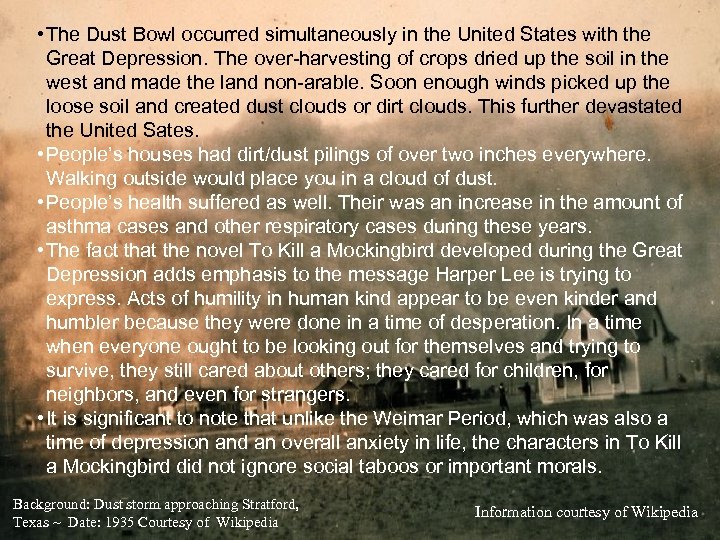
• The Dust Bowl occurred simultaneously in the United States with the Great Depression. The over-harvesting of crops dried up the soil in the west and made the land non-arable. Soon enough winds picked up the loose soil and created dust clouds or dirt clouds. This further devastated the United Sates. • People’s houses had dirt/dust pilings of over two inches everywhere. Walking outside would place you in a cloud of dust. • People’s health suffered as well. Their was an increase in the amount of asthma cases and other respiratory cases during these years. • The fact that the novel To Kill a Mockingbird developed during the Great Depression adds emphasis to the message Harper Lee is trying to express. Acts of humility in human kind appear to be even kinder and humbler because they were done in a time of desperation. In a time when everyone ought to be looking out for themselves and trying to survive, they still cared about others; they cared for children, for neighbors, and even for strangers. • It is significant to note that unlike the Weimar Period, which was also a time of depression and an overall anxiety in life, the characters in To Kill a Mockingbird did not ignore social taboos or important morals. Background: Dust storm approaching Stratford, Texas ~ Date: 1935 Courtesy of Wikipedia Information courtesy of Wikipedia
Critiques • Darren Felty This critic infers that the gifts Arthur Radley gave to the children were in attempt to establish relations with Jem and Scout. Felty believes that this was his “awkward way of communicating with them”. • Annie Kasper states that Atticus stressed that the important thing was “to appreciate the good qualities in people and understand the bad qualities by treating people with sympathy and trying to see from their perspective”. This was the foundation to becoming a more understanding compassionate person. • Laura M. Zaidman talks about the analogy between the senseless slaughter of a mockingbird and that of Tom Robinson. She believes Harper Lee does an excellent job dramatizing the best and worst of human nature. • Rebecca Sbordone and Resheea Boone This was an informative book review that talks about specific charcaters. Moreover, it considers the period in which the story-plot developed: The Great Depression
More Critiques • Jay Pribe He brings up the three main moral compass characters which include: Calpurnia, Miss Maudie and Atticus Finch. Moral Compass means directing towards a righteous, ethical path • Susan Arpajian Jolley Susan does a deep analyzing of the character Calpurnia in To Kill a Mockingbird. She describes her as a mom to the children and as a bridge from the black community to the white one.
OUTLINE Thesis statement: Manifested throughout To Kill a Mockingbird, Harper Lee places emphasis on the kindness and sympathy that lays in humanity. I. One of the novel’s mockingbirds, Arthur Radley (Boo), displays an extreme sense of generosity and contemplation towards the protagonist children, Jem and Scout. A. Although the children would mock him, Boo Radley performed numerous acts of kindness towards Scout and Jem Finch. 1. Boo was extremely thoughtful and bestowed several of his belongings to Scout and Jem. 2. Towards the end of the novel, Arthur Radley killed Mr. Ewell when he saw Ewell was about to kill Jem, thus saving Jem’s life. 3. Arthur Radley was not only being caring and kindhearted, he was more importantly risking himself in order to do so. II. The widespread concern of the Maycomb adults on the moral teachings of the young displays the involvement of the community to conserve good values of compassion and kindness in the future generations to come. A. The teachings of an experienced, older generation to the innocent, newer generation exposes the concerns of humanity for good values to be implanted on the newer generation. 1. Mr. Finch is relentlessly involved in the moral education of his children in attempt that they’ll forever follow the values of honesty and sympathy. Courtesy of Google 2. Miss Maudie explains to Scout the importance of placing
OUTLINE III. Against the backdrop of the Great Depression, Lee further exhibits how truly charitable and compassionate the community is despite the harsh conditions of the period. A. Because Lee’s novel developed during the Great Depression, a period in which the majority of America was needy and desperate, she further emphasizes the humility that reigns in humankind. 1. The generosity of Arthur Radley towards the children shows how despite any economical difficulties, he presented Jem and Scout with his own possessions. 2. When Miss Maudie’s home was burned down, the neighbors offered their time and work to help her move her furniture. Almost all the neighbors were very comforting and helpful. 3. It is amazing to note that despite the chaos the period is known for, Atticus and Miss Maudie still tightly conserved their moral values, therefore displaying how important and highly esteemed they held them. Concluding Statement: The over-all readiness of the Maycomb townspeople to help others in acts of kindness, moral advice, and meeting practical needs, foreshadows the true significance of the novel which is to acknowledge the good qualities in people while placing yourself in the shoes of others thus attempting to understand their faults. Courtesy of Google
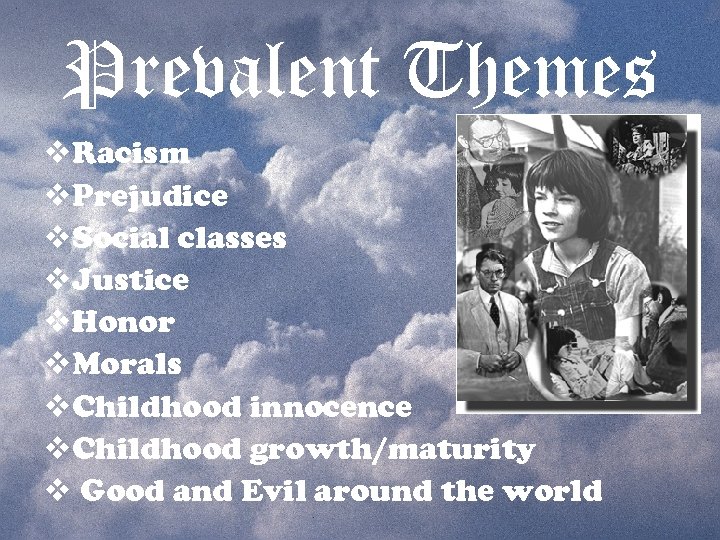
Prevalent Themes v. Racism v. Prejudice v. Social classes v. Justice v. Honor v. Morals v. Childhood innocence v. Childhood growth/maturity v Good and Evil around the world
Works Cited n n n n http: //www. catawba. k 12. nc. us/techtrac/plus/mcintosh/Index. 1. gif "cleaved. " Dictionary. com Unabridged (v 1. 1). Random House, Inc. 25 Apr. 2007. <Dictionary. com http: //dictionary. reference. com/browse/cleaved>. "Rendered. " The American Heritage® Dictionary of the English Language, Fourth Edition. Houghton Mifflin Company, 2004. 25 Apr. 2007. <Dictionary. com http: //dictionary. reference. com/browse/Rendered>. "Kudzu. " Dictionary. com Unabridged (v 1. 1). Random House, Inc. 25 Apr. 2007. <Dictionary. com http: //dictionary. reference. com/browse/Kudzu>. "eerily. " Dictionary. com Unabridged (v 1. 1). Random House, Inc. 25 Apr. 2007. <Dictionary. com http: //dictionary. reference. com/browse/eerily>. "Ramshackle. " Dictionary. com Unabridged (v 1. 1). Random House, Inc. 25 Apr. 2007. <Dictionary. com http: //dictionary. reference. com/browse/Ramshackle>. "Dismemberment. " Dictionary. com Unabridged (v 1. 1). Random House, Inc. 25 Apr. 2007. <Dictionary. com http: //dictionary. reference. com/browse/Dismemberment>.
Works Cited n n n n "Lattice. " Dictionary. com Unabridged (v 1. 1). Random House, Inc. 25 Apr. 2007. <Dictionary. com http: //dictionary. reference. com/browse/Lattice>. "Rosetta Stone. " Dictionary. com Unabridged (v 1. 1). Random House, Inc. 25 Apr. 2007. <Dictionary. com http: //dictionary. reference. com/browse/Rosetta Stone>. "Aberrations. " The American Heritage® Dictionary of the English Language, Fourth Edition. Houghton Mifflin Company, 2004. 25 Apr. 2007. <Dictionary. com http: //dictionary. reference. com/browse/Aberrations>. "appomattox. " Dictionary. com Unabridged (v 1. 1). Random House, Inc. 25 Apr. 2007. <Dictionary. com http: //dictionary. reference. com/browse/appomattox>. "direst. " Dictionary. com Unabridged (v 1. 1). Random House, Inc. 25 Apr. 2007. <Dictionary. com http: //dictionary. reference. com/browse/direst>. Jolley, Susan Arpajian. "Integrating Poetry and To Kill a Mockingbird. " Literature Resource Center. Nov 2002. Thomson Gale. 26 Apr 2007 <http: //galenet. galegroup. com/>. Felty , Darren. "An overview of To Kill a Mockingbird. " Literature Resource Center. 1998. Thomson Gale. 26 Apr 2007 <http: //galenet. galegroup. com>.
Works Cited n n n Kasper, Annie. "General semantics in To Kill a Mockingbird. " ETC. : A Review of General Semantics Vol 63. July 2006. 272 -273. <http: //galenet. galegroup. com/>. Lee, Harper. To Kill a Mockingbird. Philadelphia, Pennsylvania, United States: Warner Books, 1982. Pribe, Jay. "Which way is the right way? . " To Kill a Mockingbird. 12 Jan 2006. 22 Apr 2007 <http: //www. sheboyganfalls. k 12. wi. us/students/2009/09 jpribe/tkam_2. htm>. Sbordone , Rebecca and Resheea Boone. "Book Review. " To Kill a Mockingbird < http: //www. tqnyc. org/NYC 041080/tokillamockingbird. htm> "The Great Depression. " Culture and society in the Great Depression. Encyclopædia Britannica. 2007 <http: //www. britannica. com/eb/article-234457/Great-Depression>. Zaidman, Laura M. . "Harper Lee: Overview. " Literature Resource Center. 1994. Thomson Gale. 26 Apr 2007 <http: //galenet. galegroup. com/>.

Bloom’s Questions
BLOOM’S QUESTIONS Knowledge 1. 2. What did Scout do when Dill and Jem began to leave her out? List all the objects that Scout and Jem found in the knot-hole of tree. Comprehension 3. Compare and contrast Scout and Jem Application 4. Discover and tell a more effective method in getting Boo to go outside of his house.
BLOOM’S QUESTIONS continued… Analysis 5. Can you connect the mysterious events that have been happening in the chapter to a central person. (HINT: who do you think is the person doing so many acts of kindness? ) Synthesis 6. Substitute the tree with the knot-hole and use another place in which to place the gifts. What would this place be? Evaluation 7. Judge Arthur Radley (Boo). What is your opinion on him.
Harper Lee’s To Kill a Mockingbird Fryda Guedes IGCSE English Period 6 April 25, 2007 Background Courtesy of Getty Images
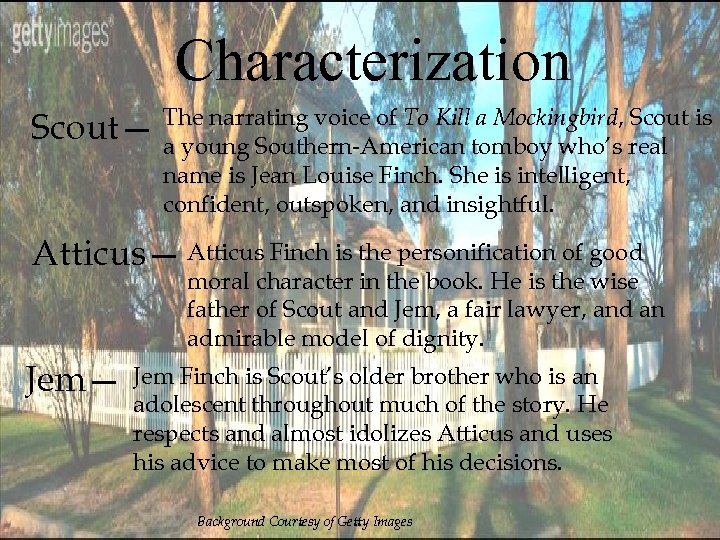
Characterization a Mockingbird, Scout— The narrating voice of To Killtomboy who’s real is a young Southern-American name is Jean Louise Finch. She is intelligent, confident, outspoken, and insightful. Atticus— Atticus Finch is the personification of good moral character in the book. He is the wise father of Scout and Jem, a fair lawyer, and an admirable model of dignity. Jem— Jem Finch is Scout’s older brother who is an adolescent throughout much of the story. He respects and almost idolizes Atticus and uses his advice to make most of his decisions. Background Courtesy of Getty Images
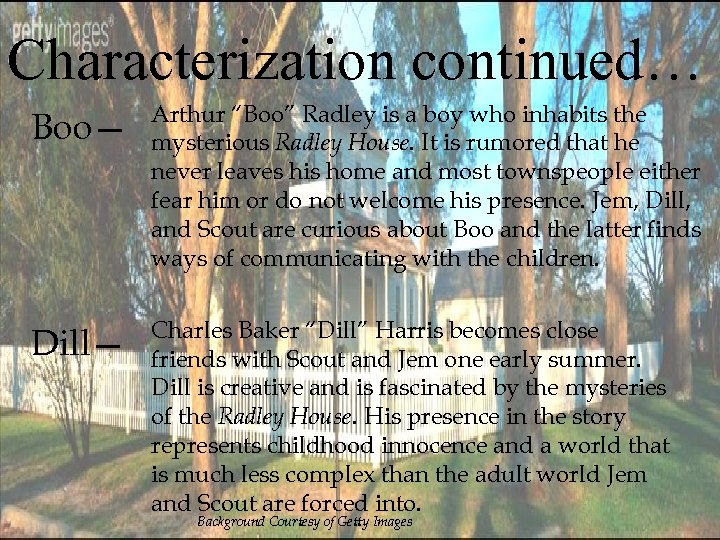
Characterization continued… Boo— Arthur “Boo” Radley is a boy who inhabits the mysterious Radley House. It is rumored that he never leaves his home and most townspeople either fear him or do not welcome his presence. Jem, Dill, and Scout are curious about Boo and the latter finds ways of communicating with the children. Dill— Charles Baker “Dill” Harris becomes close friends with Scout and Jem one early summer. Dill is creative and is fascinated by the mysteries of the Radley House. His presence in the story represents childhood innocence and a world that is much less complex than the adult world Jem and Scout are forced into. Background Courtesy of Getty Images
Characterization continued… Bob Ewell— The villain of the story, Bob Ewell is a low and otherwise dishonorable man. He is racist and poor, with a willingness to blame others for his and his family’s faults. Miss Maudie— Miss Maudie Atkinson is the Finch Family’s widowed neighbor. She speaks her mind and prefers justice. Miss Maudie is among the Finch children’s favorite adults. Background Courtesy of Getty Images
Characterization Finches’ black cook. Unlike continued… Calpurnia is the Calpurnia— most other black servants, she is treated like family and acts as a disciplinarian authority for Scout and Jem. Tom Robinson— Tom Robinson is the African American who is wrongly accused of raping Bob Ewell’s daughter, Mayella. He remains honest throughout the entire trial in which Atticus defends him. prim, proper, Aunt Alexandra— Aunt Alexandra isinfatuation with and ladylike. Her family history and social class causes her misunderstanding of Scout. Background Courtesy of Getty Images
Vocabulary for Chapter 9 • Gastric- “pertaining to the stomach. ” (Dictionary). • Lineaments- ”distinguishing features; distinctive characteristics” (Dictionary). • Changelings- “a child secretly exchanged for another” (Dictionary). • Deportment- “demeanor; conduct; behavior” (Dictionary). • Obstreperous- “resisting control or restraint in a difficult manner; unruly” (Dictionary). • Tenterhooks- “A hooked nail for securing cloth on a tenter” (Dictionary). • Invective- “an insulting or abusive word or expression” (Dictionary). Background Courtesy of Getty Images
Chapter 9 In the last chapter, Miss Maudie’s house had burnt down and her optimism helped express a main theme in the book. In chapter 9, Cecil Jacobs states that “Scout Finch’s daddy defends niggers” (Lee 74). Scout is angered and denies the claim although she is completely unaware of the nature of the offence. (74) This event serves to prove Scout’s innocence towards the existence of racism. She does not know what her father has been called and is solely irritated by the manner in which Cecil Jacobs words his offence. Scout later asks her father if what Cecil Jacobs said was, in fact, true (75). Atticus teaches scout that “nigger” is a foul word and that she should neither say it nor believe that defending one is wrong, regardless of what other people think (75). Since defending black people is presented as an offensive matter to Scout, she becomes convinced that it is wrong until Atticus speaks to her and clears up the situation. Atticus’s words serve as moral guidance for Scout and makes sure that she grows up to be a tolerant and sensitive adult. Background Courtesy of Getty Images
Chapter 9 continued… Atticus also introduces to Scout the specific case he has been chosen and has accepted to defend (Tom Robinson’s case) (75). Atticus tells Scout that he believes the case is doomed, causing Scout to question his reasons for following through (75 -76). He explains that it is right to defend this innocent man and that refusing this trial is enough reason for him to lose Scout and Jem’s respect (75). With this, you learn of Atticus’s adherence to consistency. He refuses to be hypocritical as others often are. Atticus is a model for his children; he represents perseverance and moral values. Soon after, Christmas comes along and traditionally, Uncle Jack comes to visit for a week and the holidays are spent at the Landing with Aunt Alexandra (77). Scout has a habit of cursing and Uncle Jack speaks to her about it, warning her that it would get her into trouble (78 -79). Background Courtesy of Getty Images
Chapter 9 continued… As soon as they reach the Landing, Scout and Francis, Aunt Alexandra’s son, speak about their Christmas presents, revealing that Scout and Jem received air rifles while Francis received a new set of formal attire (80). Aunt Alexandra then speaks to Scout about her clothing in an attempt to make her into a “lady” (81). Francis eventually offends Scout by saying Dill is homeless and calling Atticus a “nigger lover” (83). He continues to nag and tease Scout about it until she threatens Francis, Francis hides in the kitchen, and Aunt Alexandra walks in and misjudges the situation (83 -84). Throughout this part of the story, you realize how differently Atticus and Aunt Alexandra brought up their children. Scout and Jem can run free and do not follow stereotypes, while Francis obnoxiously minds about formality and immaturely disapproves of Atticus and his children. Background Courtesy of Getty Images
Chapter 9 continued… Francis soon continues to tease Scout and she curses at him and beats him up (84). Aunt Alexandra and Uncle Jack walk in and he spanks Scout without hearing her side of the story (85). Afterwards, Scout tells Uncle Jack her side, making him understand that Atticus had told her not to fight for him (86). Uncle Jack feels ashamed that he was unfair, but does not tell Atticus for Scout’s sake (87 -89). Here, the difference between Atticus and other adults is most evident. Aunt Alexandra and Uncle Jack fail to be fair and hear both sides of the argument while Atticus would have never made this mistake. Francis also comes to light as an ignorant child who is intolerant and annoying because of his upbringing. He serves as another example of how deeply racism dwelt in the youth of this time. Atticus speaks to Uncle Jack about Tom Robinson’s case and the effect it would have on his family (88 -89). Background Courtesy of Getty Images
Vocabulary for Chapter 10 • Inconspicuous- “not conspicuous, noticeable, or prominent” (Dictionary). • Rudiments- “a mere beginning, first slight appearance, or undeveloped or imperfect form of something” (Dictionary). • Providence- “God, esp. when conceived as omnisciently directing the universe and the affairs of humankind with wise benevolence” (Dictionary). • Mausoleum- “a stately and magnificent tomb” (Dictionary). • Foliage- “the leaves of a plant, collectively; leafage” (Dictionary). • Alist- “inclined to one side; heeling or listing” (Dictionary). Background Courtesy of Getty Images
Chapter 10 Since Atticus is relatively older than most fathers in Maycomb, Jem and Scout are sometimes embarrassed by the odd things he does and the many impressive things he can’t do (89). He defends the people no one else dares to defend, and on top of that, he does not go fishing or do anything “impressive” (90). Scout and Jem go around asking about their father (to Calpurnia and Miss Maudie) , wondering whether he ever did anything interesting when he was younger (90 -92). Soon after, a “mad dog”, now known as a rabid dog, is seen walking up the road (92). Fearing what it might do, Calpurnia urgently warns the neighbors (93 -94). Background Courtesy of Getty Images
Chapter 10 continued… Eventually, Heck Tate, the town sheriff, gives his rifle to Atticus and he shoots the animal with a single shot (96). Jem and Scout are both shocked and impressed by this, but know that they should not boast about it when Atticus takes no pride in this talent (97 -98). The mad dog not only proves Scout and Jem’s misjudgment of their father but foreshadows the crazy and irrational events that are to come. Just as the town needed one shot Finch to protect them against the mad dog, they will later need him to be the light of hope and the model for tolerance during Tom Robinson’s trial. Background Courtesy of Getty Images
Vocabulary for Chapter 11 • Apoplectic- “of or pertaining to apoplexy, a hemorrhage into an organ cavity or tissue” (Dictionary). • Scuppernong- “a silvery ambergreen variety of muscadine grape” (Dictionary). • Philippic- “A denunciation in speech or writing, direct and often abusive” (Dictionary). • Umbrage- “a feeling of anger caused by being offended” (Dictionary). • Interdict- “any prohibitory act or decree of a court or an administrative officer” (Dictionary). • Skulked- “To lie in hiding, as out of cowardice or bad conscience; lurk” (Dictionary). • Palliation- “to relieve or lessen without curing; mitigate; alleviate” (Dictionary). • Antagonized- “to act in opposition to; oppose” (Dictionary). • Reconnaissance- “the act of making preliminary inspection” (Dictionary). • Calomel- “a white, tasteless powder, Hg 2 Cl 2, used chiefly as a purgative and fungicide” (Dictionary). • Tirade- “a prolonged outburst of bitter, outspoken denunciation” (Dictionary). • Devoid- “not possessing, untouched by, void, or destitute ” (Dictionary). Background Courtesy of Getty Images
Chapter 11 Jem and Scout decided to walk to town alone, but unfortunately, they would have to cross Mrs. Dubose’s house in order to reach their destination (100). Mrs. Dubose disliked them and always yelled at them when they went by her house (99). However, Atticus always set an example for the children by consistently acting courteously towards Mrs. Dubose (100). On their way through Mrs. Dubose’s house, she said Scout would end up as a waitress if she continued to dress that way, being a disgrace to the Finch family, just as Atticus had been by deciding to defend a black man (101). When they got back from town, Jem lost his temper and ruined Mrs. Dubose’s garden (103). When Atticus got home, he made Jem go say sorry to Mrs. Dubose (103104). Background Courtesy of Getty Images
Chapter 11 The fact that Jem, the more mature out of the two Finch children, lost his temper to an old lady, is surprising to the reader and to Atticus. Jem could resist his anger against those who were young and ignorant, but could not do so when an adult proved to be as biased. This part of the story shows how the court case deeply affected Jem, especially since he was at a stage of adolescence. When Jem walks over to Mrs. Dubose to say sorry, she requires him to read to her after school and on Saturdays for a month (105). Atticus approves and insists that he does so (105). Hence, Jem complies with his obligation and Scout comes along as well (106). They both realize that soon after Jem begins to read, Mrs. Dubose falls asleep (107). A month after Jem’s time is over with Mrs. Dubose, she dies and the Finch children find out her struggle with a morphine addiction (110). She leaves Jem a camellia from her garden to show her gratitude (111). Mrs. Dubose’s struggle with morphine proves her to be a brave individual. Her gratitude towards Jem shows another side of her that Jem cannot comprehend, for he is not yet mature enough to understand how good and bad can coexist inside an individual. Background Courtesy of Getty Images
Vocabulary for Chapter 12 • Contentious- “tending to argument or strife; quarrelsome” (Dictionary). • Rotogravure- “a photomechanical process by which pictures, typeset matter, etc. , are printed from an intaglio copper cylinder” (Dictionary). • Ecclesiastical- “of or pertaining to the church or the clergy; churchly; clerical; not secular” (Dictionary). • Garish- “excessively bright; glaring” (Dictionary). • Austere- “severe in manner or appearance; uncompromising; strict; forbidding” (Dictionary). • Voile- “lightweight, semisheer fabric of wool, silk, rayon, or cotton constructed in plain weave” (Dictionary). • Altercation- “a heated or angry dispute; noisy argument or controversy” (Dictionary). • Boded- “to be an omen of; portend” (Dictionary). • Habiliments- “clothes or clothing” (Dictionary). • Asafoetida- “a soft, brown, lumpy gum resin having a bitter, acrid taste and an obnoxious odor… formerly used in medicine as a carminative and antispasmodic” (Dictionary). • Contemptuously- “showing or expressing contempt or disdain; scornful” (Dictionary). Background Courtesy of Getty Images
Chapter 12 This chapter begins with introducing Jem’s sudden transition into adolescence (115). He acts wiser and wishes to be alone most of the time (116). Even Calpurnia began to call him “Mister Jem” (115). Scout is left with the hope that Dill would come and accompany her this summer (116). Unfortunately, he is unable to come and Scout is greatly disappointed (116). Atticus was also sent to an emergency session for the state legislature, leaving Scout without him for two weeks (116). The presence of Dill had always symbolized happy and blissful summers for Scout and Jem. His absence foreshadows their drastic introduction to the worries and preoccupations of the adult world. Atticus’s absence will force his children to momentarily face the adult world without his guidance. Background Courtesy of Getty Images
Chapter 12 continued… Calpurnia decides to take the children to her African American church First Purchase African M. E. Church (117). Scout and Jem must dress nicely and promise to behave (117). Once they arrived they are welcomed by most of the people there; everyone except Lula (119). Lula gets into a discord with Calpurnia about bringing “white chillun” to a Negro church (119). Ultimately, Calpurnia states that they are all living under the same God and the rest of the church members welcome them there (119). This is the first example you see of African American prejudice against whites. Unlike most of the Southern White population, in the church, almost all of the Blacks welcome Scout and Jem without any racial prejudice. In this, Harper Lee portrays the Blacks favorably and describes them as a caring group that is much less racist than the whites. During this time, Calpurnia speaks just as the others in the church do (125). Background Courtesy of Getty Images
Chapter 12 continued… Zeebo, the town’s trash collector, reads hymns to the congregation from a worn out Bible, and they sing along by repeating after him (121). Jem and Scout are amazed by their ability to hold a mass under such poor means and with such little resources, for they are used to the wealth and abundance of white churches (121). Afterwards, money is collected in order to help Helen, Tom Robinson’s wife, who is unable to get a job after husband was accused of rape (122). The preacher did not allow anyone to leave until enough money was collected (122 -123). As they returned home, Scout asked if she could visit Calpurnia at her house, and Calpurnia answered that she could (126). Out on Jem and Scout’s porch was Aunt Alexandra, sitting leisurely in a rocking chair (126). Background Courtesy of Getty Images
Themes • Significance of Moral values in a worldly setting • Racism and Prejudice • Respect • Consistency • How the environment and the setting at home changes affects how a child judges and makes decisions Background Courtesy of Getty Images
Themes continued… • The coexistence of good and evil in each person • Using sympathy to place yourself in another person’s perspective • The shedding of innocence • Differences between the world of children and the world of adults • Gothic elements in a small town setting • What real courage is Background Courtesy of Getty Images
Symbols The Mockingbird which is a representation of innocent individuals who have not done any harm but are judged wrongly by society. Tom Robinson and others in the story could be considered Mockingbirds. “When he gave us our air-rifles Atticus wouldn't teach us to shoot. Uncle Jack instructed us in the rudiments thereof; he said Atticus wasn't interested in guns. Atticus said to Jem, ‘I'd rather you shot at tin cans in the back yard, but I know you'll go after birds. Shoot all the bluejays you want, if you can hit ‘em, but remember it's a sin to kill a mockingbird. ’ That was the only time I ever hear Atticus say it was a sin to do something, and I asked Miss Maudie about it. ‘You're father's right, ’ she said. ’Mockingbirds don't do one thing but make music for us to enjoy. They don't eat up people's gardens, don't nest in corncribs, they don't do one thing but sing their hearts out for us. That's why it's a sin to kill a mocking bird’" (90). Background Courtesy of Getty Images
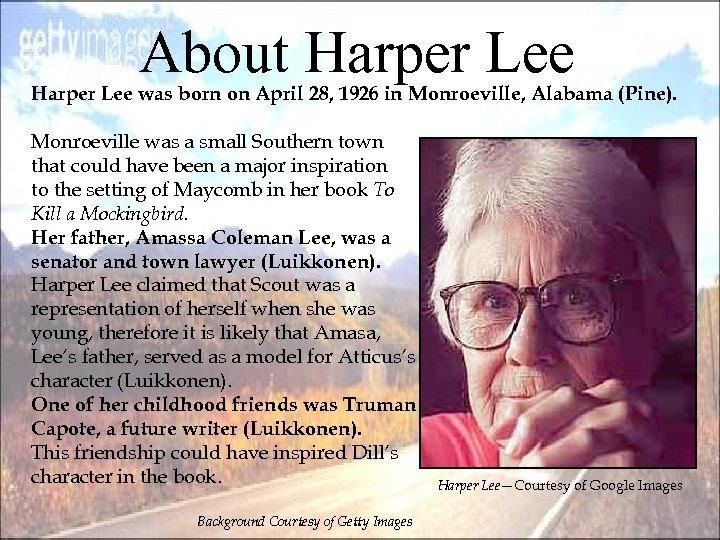
About Harper Lee was born on April 28, 1926 in Monroeville, Alabama (Pine). Monroeville was a small Southern town that could have been a major inspiration to the setting of Maycomb in her book To Kill a Mockingbird. Her father, Amassa Coleman Lee, was a senator and town lawyer (Luikkonen). Harper Lee claimed that Scout was a representation of herself when she was young, therefore it is likely that Amasa, Lee’s father, served as a model for Atticus’s character (Luikkonen). One of her childhood friends was Truman Capote, a future writer (Luikkonen). This friendship could have inspired Dill’s character in the book. Background Courtesy of Getty Images Harper Lee—Courtesy of Google Images
Events in History Overall, Lee lived at a time where racial prejudice was at its peak. Segregation was legal, and ignorant children could be seen following the footsteps of their equally ignorant ancestors. Lee wrote her book to show the world an honest story about growing up, the injustice of racism, and the ability the good have to triumph over evil. In 1931, there was a court case in Alabama called the Scottsboro Case in which nine black men were harshly accused of raping two white women (“Encyclopedia: Lincoln, Abraham”). The case, occurring while Lee was still five, is very similar to trial of Tom Robinson in To Kill a Mockingbird. Background Courtesy of Getty Images
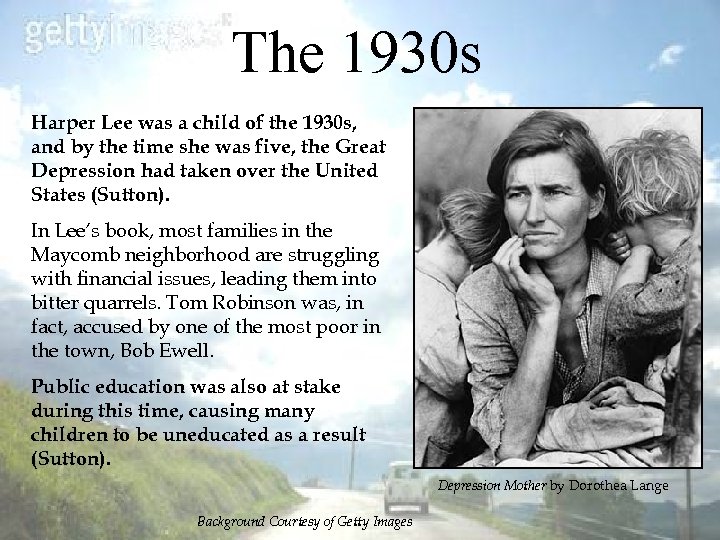
The 1930 s Harper Lee was a child of the 1930 s, and by the time she was five, the Great Depression had taken over the United States (Sutton). In Lee’s book, most families in the Maycomb neighborhood are struggling with financial issues, leading them into bitter quarrels. Tom Robinson was, in fact, accused by one of the most poor in the town, Bob Ewell. Public education was also at stake during this time, causing many children to be uneducated as a result (Sutton). Depression Mother by Dorothea Lange Background Courtesy of Getty Images
The 1940 s – 1960 s In the late 1940 s and early 1950 s, America and many European countries had just emerged from World War II, a war against the Nazis and their racial prejudice against the Jewish people (Goodwin). The genocide of the Holocaust that had just occurred in the 1940 s could have caused Lee to write her book soon afterwards. Harper Lee’s To Kill a Mockingbird is published 1960, just before the Civil Rights Movement (Pine). The Civil Rights Movement of the 1960 s movement could have caused the popularity of the book to grow in overwhelming amounts. Background Courtesy of Getty Images
American Writers Jay Parini writes a summary of Harper Lee’s life as well as extended information on her best-selling book, To Kill a Mockingbird. (American Writers) In this packet, one will find an analysis of the novel with emphasis on the social class system in Maycomb, moral righteousness, the judging of the innocent, and the importance of time span to the reader. (American Writers) Besides this analysis, excerpts of more specified literary criticisms are included as well. (American Writers) Background Courtesy of Getty Images
The Romantic Regionalism of Harper Lee Fred Erisman writes about the Maycomb townsmen’s attempt to retain as much of the traditional past as possible. (The Romantic Regionalism of Harper Lee) He also writes of the ‘Southern caste system’ as well as Atticus’s resemblance to an ‘Emersonian man’. (The Romantic Regionalism of Harper Lee) Background Courtesy of Getty Images
(Nelle) Harper Lee This critique summarizes Harper Lee’s life, including personal information, career, and awards, while explaining how To Kill a Mockingbird was inspired by her Lee’s own experiences. ((Nelle) Harper Lee) The writer also elaborates on the details of the novel, focusing on racial issues and sympathy as main themes. ((Nelle) Harper Lee) Background Courtesy of Getty Images
Reconstructing Atticus Finch Ann Althouse writes about the court scenes and Atticus’s role as both a lawyer and a morally conscious individual. (Reconstructing Atticus Finch) She focuses on Atticus’s cross examination of Mayella as well as the absurdity of the trial. (Reconstructing Atticus Finch) Background Courtesy of Getty Images
General Semantics in To Kill a Mockingbird Annie Kasper writes about the main plot of the novel, which is the court case of Tom Robinson. (General Semantics in To Kill a Mockingbird) She mentions prejudice, Atticus’s outstanding parental skills, and the importance of empathy and compassion in the novel. (General Semantics in To Kill a Mockingbird) Background Courtesy of Getty Images
The Female Voice in “To Kill a Mockingbird” Dean Shackelford focuses on relating the film and the novel to each other. (The Female Voice in “To Kill a Mockingbird”) However, the main purpose of this critique is to provide substantial evidence on significance of the presence of a prominently female narrator voice. (The Female Voice in “To Kill a Mockingbird”) Background Courtesy of Getty Images
Outline Thesis Statement: In To Kill a Mockingbird, Harper Lee emphasizes the importance of strong parental direction by demonstrating that it leads to a more profound moral sense that manifests itself in characters’ compassion towards others. I. Throughout the novel, the majority of mislead and prejudiced individuals are evidently a result of exposure to immoral and dishonorable influences who have thus succeeded in reflecting their intolerance and acrimoniousness upon others. A. The Radley family, particularly Nathan, the son of Mr. Radley and brother of Arthur ‘Boo’ Radley, provides a dramatized example of how the influence of a fanatical and intolerant father begets a son who becomes his equivalent. B. Members of the Ewell Family, a poor and dishonorable clan of farmers, are known as uneducated drunkards who, generation after generation, have raised lowly and lazy children. Robert Ewell, the most recent patriarchal figure of the Ewell family consequently raised children who were considered abominations to society. Background Courtesy of Getty Images
Outline Continued… II. In To Kill a Mockingbird, Atticus Finch’s children are the only individuals of that generation who are exposed to a father who is wise, empathetic, and the epitome of moral character in a human being; thus, according to the overall trend of the novel, Scout and Jem adopt their father’s honorable character and allow it to assist them in judging the actions of others. A. Atticus Finch is an ideal parent who acts as an admirable example for his children B. Surely, in the novel, Jean Louise ‘Scout’ Finch is a uniquely wise and tolerant individual who judges yet continues to forgive others according to an elevated moral understanding she acquired from Atticus. C. Due to Atticus’s enduring moral instruction towards his children, Jem gradually follows in Atticus’s footsteps throughout the novel, during which he understands the importance of sympathy. Concluding Statement: Harper Lee accentuates the essential role of parents in her novel by making their children’s level of compassion analogous to the moral direction they received. Background Courtesy of Getty Images
Works Cited Althouse, Ann. "Reconstructing Atticus Finch? A response to Professor Lubet. (response to book review by Steven Lubet in this issue, p. 1339)(Classics Revisited)(1999 Survey of Books Related to the Law). " Michigan Law Review 97. 6 (May 1999): 1363 -1369. Info. Trac Thomson Gale. MIAMI DADE PUBLIC LIBRARY. 25 Apr. 2007 <http: //galenet. galegroup. com>. Dictionary. com. 2007. Lexico Publishing Group, LLC. 7 Apr 2007 "Encyclopedia: Lincoln, Abraham. " 2004. The History Channel website. 09 May 2006, 19: 13 <http: //www. historychannel. com> Erisman, Fred. "The Romantic Regionalism of Harper Lee. " The Alabama Review XXVI(1973): 122 -36. Goodwin, Susan. "American History- 1940 -1949. " Kingwood College Library. Sep 2005. 8 Apr 2007 <http: //kclibrary. nhmccd. edu/decade 40. html>.
Works Cited Continued… Kasper, Annie. "General semantics in To Kill a Mockingbird. (Critical essay). " ETC. : A Review of General Semantics 63. 3 (July 2006): 272(3). Thomson Gale. MIAMI DADE PUBLIC LIBRARY. 25 Apr. 2007 <http: //galenet. galegroup. com>. Lee, Harper. To Kill a Mockingbird. New York: Warner Books, 1960. Luikkonen, "Harper Lee. " Authors' Calendar. 2007. 8 Apr 2007 <http: //www. kirjasto. sci. fi/harperle. htm>.
Works Cited Continued… "(Nelle) Harper Lee. " Contemporary Authors Online June 2004. Thomson Gale. 20 April 2007 <http: //galenet. galegroup. com> Parini, Jay. American Writers: A Collection of Literary Biographies. VIII. New York: Charles Scribner's Sons, 2001. Pine, "Harper Lee. " Microsoft Encarta Online Encyclopedia. 2007. Microsoft Corporation. 8 Apr 2007 <http: //encarta. msn. com>. Shackelford, Dean. "The female voice in 'To Kill a Mockingbird': narrative strategies in film and novel. " The Mississippi Quarterly 50. n 1 (Winter 1996): 101(13). Info. Trac One. File. Thomson Gale. MIAMI DADE PUBLIC LIBRARY. 26 Apr. 2007 <http: //find. galegroup. com/itx/infomark. do? &content. Set=IACDocuments&type=retrieve&tab. ID=T 002&prod. Id=ITOF&doc. Id=A 19 898481&source=gale&user. Group. Name=29081_mdpls&version=1. 0>. Sutton, Bettye. "American History- 1930 -1939. " Kingwood College Library. 30 June 2005. 8 Apr 2007 <http: //kclibrary. nhmccd. edu/decade 30. html>.
Knowledge (Q. ) Which character constantly attempts to make Scout more ‘ladylike’? Background Courtesy of Getty Images
Comprehension (Q. ) What differences exist between Jem and Scout’s attitude towards insults about the trial? Background Courtesy of Getty Images
Application (Q. ) Do you know another instance where an innocent person has been blindly accused and forced to face unnecessary consequences? Background Courtesy of Getty Images
Analysis (Q. ) What was the significance of the sudden appearance of the mad dog? Background Courtesy of Getty Images
Comprehension (Q. ) When Atticus was speaking about true courage, what do you think he means when he said, “It’s when you know you’re licked before you begin but you begin anyway and you see it through no matter what” (112)? Background Courtesy of Getty Images
Synthesis (Q. ) What do you suggest would happen if Atticus were not so consistently dedicated to upholding his moral values? Background Courtesy of Getty Images
Evaluation (Q. ) Can you defend your position on Jem’s decision to destroy Mrs. Dubose’s camellia garden? Could you consider it a sign of his maturity, immaturity, or both? Background Courtesy of Getty Images
To Kill a Mockingbird Chapters 13 -16 Denisse Hernandez Pre-Aice English I April 27, 2007 Period 6 Courtesy of Google Images
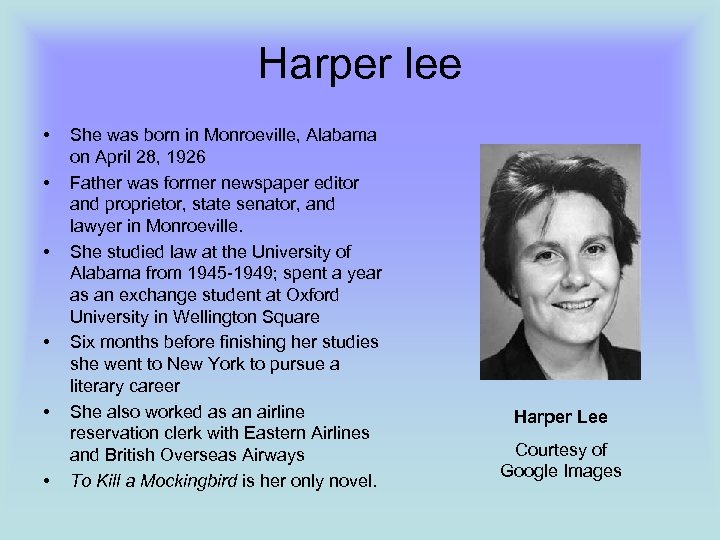
Harper lee • • • She was born in Monroeville, Alabama on April 28, 1926 Father was former newspaper editor and proprietor, state senator, and lawyer in Monroeville. She studied law at the University of Alabama from 1945 -1949; spent a year as an exchange student at Oxford University in Wellington Square Six months before finishing her studies she went to New York to pursue a literary career She also worked as an airline reservation clerk with Eastern Airlines and British Overseas Airways To Kill a Mockingbird is her only novel. Harper Lee Courtesy of Google Images
Chapter 13 • • • Aunt Alexandra arrives and is making demands while the children are trying to figure out her purpose for being there (Lee 127). On a gloomy Sunday, Atticus finally arrives and Jean Louise questions him about the true meaning on Aunt Alexandra’s visit. He responds that it is so that she can help take care of them (128 -129). Aunt Alexandra talks about the streaks and characteristics of families (129). Jean Louise narrates the history of Maycomb and how it came to be the way it is. Here, she also discusses the reason for everyone looking so closely related and theory behind Aunt Alexandra’s talks of families, which was that the town had grown inward and therefore people began to be incestuous (130 -131). Jean Louise meets her cousin Lily, who she had never met before. She also embarrasses Aunt Alexandra because she says, in front of Cousin Lily, that she had never known she was cousins with her (132). Aunt Alexandra is the representative of society in Maycomb and tries to make sure everything is done properly and with class. Atticus talks to Jean Louise and Jem about being a Finch and this began because Aunt Alexandra had told him to talk to the children about their great family (133). This shows that Aunt Alexandra, no matter how stubborn, has great care, pride, and respect for her family.
Chapter 14 • • • Jean Louise asks Atticus for a definition of the word rape, after overhearing it in an ‘obscure’ comment a gentleman made. Atticus responds, but questions her after Jean Louise says that Calpurnia – coming back from her church on Sunday- disliked deeply the fact that she asked that question. This starts an argument because when Aunt Alexandra tells Jean Louise that she can not go to Cal’s church again the following Sunday, Jean Louise breaks out and tells her that she wasn’t asking her. Atticus makes it clear to Jean Louise that she must do as Cal says, he says, and Aunt Alexandra says no matter what. After this, Atticus and Aunt Alexandra had a n argument about what to do with Jean Louise and Aunt Alexandra Mentions that she believes Calpurnia should be fired (135 -137). Bringing up the subject of firing Calpurnia is one of the first examples of racial prejudice seen in chapters 13 through 16. Aunt Alexandra is once again serving as a representative of Maycomb society. Jean Louise and Jem get into a fight because Jem was trying to give demands to Jean Louise, flike trying to not antagonize Aunt Alexandra (137 -138). This shows the maturing side of Jem. He is trying to follow in his father’s footsteps and keep the family together. Another part that plays into this, of course, is the fact that Jem is learning the roles of society and therefore wants Jean Louise to start listening to her Aunt and act more like a lady. Jean Louise and Jem find Dill under her bed and Jem tells Atticus. Dill gets dinner and is decided to go home with his aunt Miss Rachel, after telling his story of getting to the Finch home. That night, he sleeps over the Finch home (139 -144). Another example of Jem’s maturity, he makes Atticus aware of Dill because he is trying to be responsible. Although Scout can not see that and instead calls him a traitor, he is once again following in the footsteps of his father.
Chapter 15 • • • Atticus gets called outside to the yard by Heck tate. The group of men discuss some one being moved to the county jail and Atticus being in possible danger. Atticus said that the reason he took the case was for the truth to be told and he wouldn’t let anything happen to the defendant until it was (145 -146). Jean Louise come home to hear Aunt Alexandra and Atticus discussing something and asks Jem what they are talking about; Jem tells her that they were fussing over the Tom Robinson case. Jean Louise finds out that Jem is scared for Atticus -he tells her this- because he is afraid that someone might try to hurt him (147). Jean Louise is surprised to see the massive amount of people attending church the next day, Sunday (148). Atticus announces, after a day filled with nothing to do, that he will be out for a while in the late evening and takes his car, which is a very peculiar thing to do. Jem, Jean Louise, and Dill try to go find him because Jem had ‘a feeling’ that they should do so (148 -149). The children go looking for Atticus and find him in the jail with the light bulb he was carrying out of the house that evening, when a group of men arrive to the jail. They begin pressuring Atticus to leave and then suddenly Jean Louise comes out followed by Dill and Jem. Although Atticus is scared and demands for Jem to take the children home, Jean Louise manages to make the group of men go away when she tells Mr. Cunningham to say hello to his son for her and talks about entailments (he is a classmate of hers). Mr. Underwood comes out of a corner, just as Atticus had supposed he was doing (151 -154). The last transition from boy to man in Jem, concerning maturity, is seen when Jem refuses to go home like Atticus demands him to. Only a child would run away at one strong order from his father in a desperate and dangerous situation. Also, Jean Louise’s innocence and idea that goodness prevails in all cais shown in this chapter. Simply by being completely oblivious to the situation occurring and being her innocent self, she manages to break up the lynching mob.
Chapter 16 • • • Jean Louise finally realized what had occurred that night, with the lynching mob, and began to cry and let her feelings out to Jem, who handled it nicely – like a brother should (155 -156). Atticus gave Aunt Alexandra an excuse for their being out late the previous night, but she said that it didn’t metter because Mr. . Underwood was there the whole time. Atticus made a comment that Underwood hates negroes. As soon as Calpurnia was done serving the coffee and left the room, Aunt Alexandra scolded Atticus for saying such things in front of Calpurnia, what with her being a negro. She says that she might say something about it to someone and then Atticus would be talked about in a rather unpleasant way. Atticus completely disregards any of it (156 -157). Atticus explains to Jem and Jean Louise that Mr. Cunningham, despite having gone to the jail with the other men, is a good man and explained to them the concept of a mob. He also brings up the fact that it only took a little girl asking about a classmate in school to break up a mob. Jean Louise says that’s she is going to hurt Walter Cunningham the minute she seems him in class, Mr. Cunningham's son. This provokes a comment from Aunt Alexandra about how Jean Louise needs to straighten up and stop acting the way she does (157158). Aunt Alexandra once again brings up the idea that a girl must be perfect, according to the rules of society which meant being very ladylike, with no talk of fighting anyone.
Chapter 16 (cont. ) • • • As a plethora of people begin to pass by the Finch home, Jem begins to give a descriptions of each group. This included history, appearance, and general attitudes. The reason behind the amount of people arriving to the town is for the court date of Tom Robinson’s trial. One of the women passing by, Jem asks her if she is going to court that morning, says that it is wrong to get riled up to watch a poor man be on trial for his life. People at court were dressed up and all. Jem talks once again, about Mr. Dolphus and history and general attitude. The colored people are sitting in a corner because they are separated from the white people (159 -162). The fact that the woman who said she was not going to attend the trial said that, signifies that she is not racist contrary to society’s beliefs. Jean Louise over hears people saying that although the court appointed Atticus to defend Tom Robinson, he aims to defend him and they don’t like that. This makes her think as she attempts to put the pieces together and understand (163). Since the court was so crowded and the children got there late, Jean Louise and Jem ended up being invited to sit at the colored balcony with Reverend Sykes. Judge Taylor presided over the case and Jean Louise makes the observation that although he permits smoking in his courtroom he does not himself smoke. They watch the trial and manage to get there in time for Heck Tate to be at the witness stand (164 -165). Like the woman passing by the house, Jem and Jean Louise represent the part of society that is not prejudiced against blacks. There is a convinience to the fact that they end up in the colored balcony for that specific reason. Any other person would have said no and stood the whole day if they had to.
Vocabulary • • • • Permanence- perpetual or continued existence Formidable- causing fear, apprehension, or dread ‘amanuensis’- a person employed to write what another dictates or to copy what has been written by another; secretary Prerogative- an exclusive right or privilege exercised by virtue of rank, office or the like Incestuous- being so close or intimate as to prevent proper functioning Oblique- neither perpendicular nor parallel to a given line or surface; slanting; sloping Tavern- a place where liquors are sold to be consumed on the premises Devoid- not possessing, untouched by, void, or destitute Mandrake- a narcotic, short-stemmed European plant of the Nightshade family, having a fleshy, often forked root somewhat resembling a human form Inflection- modulation of the voice; change in pitch or tone of voice Enema- the injection of f fluid to the rectum to cause bowel movement Morphodite- shortened version of hermaphrodite Manacle- a shackle for the hand; handcuff Starchiness- stiff and formal, as in manner
Characterization • Jean Louise- an innocent little girl who is learning lessons of morality, prejudice, and social dogma. • Atticus- a brave, moral man (Jean Louise and Jem’s father) who cares deeply for his children but also cares for those who are rejected by society, like blacks. • Jem- a young man (Jean Louise’s older brother) who is learning about responsibility and tries to follow his dad’s footsteps. • Aunt Alexandra- a woman who is rigid on following the rules of society and being a reputable woman. She is trying to teach Jean Louise how to be more lady-like, like her. • Dill- a young black boy who is very good friends with Jean Louise and who plays with her almost everyday after running away from home • Calpurnia- the Finches’ black cook; she is like part of the family but Aunt Alexandra does not accept her because of her old ways
Themes • Racial Prejudice- Tom Robinson, Calpurnia • Innocence- Jean Louise talking to Mr. Cunningham • Social Dogma- ladylike, dresses, social classes, families • Good vs. Evil- Were people truly good at heart like Jean Louise believed them to be (like when she asks about Mr. Cunningham)? • Moral Education- Atticus wants to teach his children the right things (Ex. Not firing Calpurnia against the fact that she was black) • Bravery- Atticus to take the case where he could lose everything
Influences The life of Harper Lee influenced Scout Finch’s character and indeed resembled it. For example, both of their fathers were attorneys for Alabama legislature and both their older brother and younger neighbors were playmates. Another influence was the period of time in which the book was written, which was the Civil Rights Era. This period dealt greatly with prejudice and segregation and trying to unite two races as one.
Critics • “Lee’s To Kill a Mockingbird” – Laurie Champion This paper discusses the hidden meaning of the commonly used ‘left’ and ‘right’ in the book. Left being the wrong way and right being the right way. • “In Defense of To Kill a Mockingbird” – Jill May This criticism defends To Kill a Mockingbird when people say that it portrays white people badly. It discusses prejudice against blacks seen in the book. • “An overview of To Kill a Mockingbird” – Darren Felty This paper mainly highlights Boo Radley, Tom Robinson, and racial prejudice. • “Historical Backgrounds” – Claudia Durst Johnson This criticism just discusses events that actually happened in the period of time when the book was written and how those events influenced the author. • “Theme Analysis” – Novel. Guide This analysis shows all the major themes of the story, especially racial prejudice and the social dogmas of women. It is not only limited to that but also includes bravery and education. • “Character Analysis” – Novel. Guide This paper basically analyzes each character in the work. It provides you with a description of Aunt Alexandra which makes her a proper Southern woman with a strict code.
Outline Thesis: Clearly depicted throughout the novel, Aunt Alexandra portrays all major characteristics of social dogma in Maycomb. I. Aunt Alexandra comes to Maycomb to take care of her niece, Jean Louise, and to be a “feminine influence”. A. She constantly picks on the defects of Jean Louise, mainly obsessing with those that involve society’s opinion. 1. The majority of the time, she is trying to get Jean Louise to become more feminine and less ‘tomboy. ’ Being boyish when you’re a girl was unacceptable in that society and you could be ridiculed for it. (Novel. Guide) B. She used Atticus as a means of getting through to Jean Louise. 1. Aunt Alexandra knew that Jean Louise trusted Atticus and usually followed everything he said to do, so she took advantage of this and complained to Atticus about how he needed to get on her case to change. (To Kill a Mockingbrid) II. An integral characteristic of Maycomb’s society is a system called “family consciousness”. A. Family consciousness is to describe people based on a generalization of their relatives and ancestors and also relates to the so-called ‘caste system’ and the amount of money one had. 1. People in Maycomb judged others based on their family and made sure that if something were wrong about them, they could blame it on the fact that all the rest of the family was like that. (To Kill A Mockingbird) 2. These judgments led to a caste system that involved the family of a person and, therefore, how much money one had. (Novel. Guide) III. Another manner in which Alexandra most evidently portrays social dogma of Maycomb concerns the racial prejudice. A. Society in Maycomb is intolerant to the black race and treats them as inferiors.
Outline (cont. ) 1. An example of this is the lynching mob that is formed in order to kill Tom Robinson, who was going to court for being accused of raping a white woman. (Felty, May) B. Aunt Alexandra displays, with no doubt, that she dislikes black people, especially Calpurnia, Atticus’ cook. 1. First of all, she attempts to convince Atticus to fire Calpurnia because she is not needed and implies that it is also because she dislikes black people. (To Kill a Mockingbrid) 2. Second, she also tries to convince Jean Louise to not attend church the next Sunday with Calpurnia, all because she was colored and might influence her, which supports the statements previously discussed. (To Kill a Mockingbrid) 3. Thirdly, her prejudice is displayed further when she begins to scold Atticus about discussing the fact that Mr. Underwood despises Negroes in Calpurnia’s attendance. She says that Cal could talk about the subject with others and talk about that Atticus said those things about Mr. Underwood. It shows that she is uncomfortable in the presence of black people and that she perceives them as gossipers. (To Kill a Mockingbird) Conclusion: In the final analysis, the characteristics of social dogma in Maycomb are clearly visible is Aunt Alexandra’s personality and actions. This causes various other things in the novel and further supports the need for a rigid and prejudiced social infrastructure. Aunt Alexandra does this by way of racial prejudice, family consciousness, and being a female influence. This advancement of the social dogma by way of continuing it not only limits Aunt Alexandra’s actions but also makes her what she is: over caring for the family and a follower of the system which society has given her, which she follows without flexibility. Aunt Alexandra’s position, attitude, actions, and words of social hierarchy and not disgracing that family play a huge role in making this novel what it is.
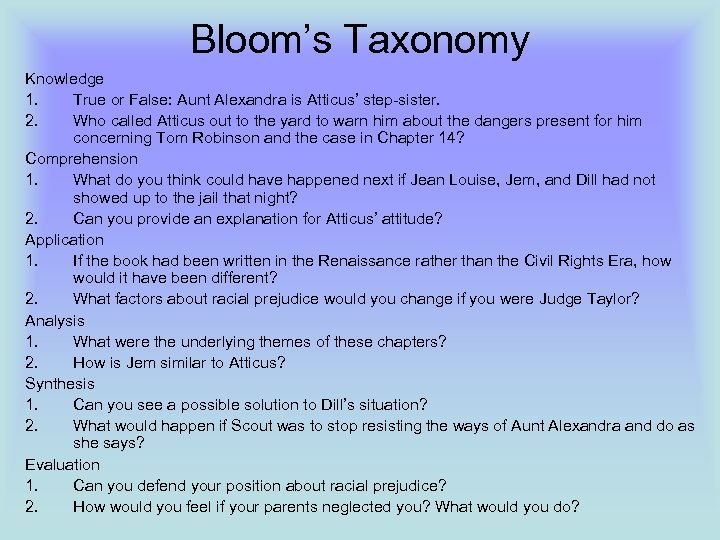
Bloom’s Taxonomy Knowledge 1. True or False: Aunt Alexandra is Atticus’ step-sister. 2. Who called Atticus out to the yard to warn him about the dangers present for him concerning Tom Robinson and the case in Chapter 14? Comprehension 1. What do you think could have happened next if Jean Louise, Jem, and Dill had not showed up to the jail that night? 2. Can you provide an explanation for Atticus’ attitude? Application 1. If the book had been written in the Renaissance rather than the Civil Rights Era, how would it have been different? 2. What factors about racial prejudice would you change if you were Judge Taylor? Analysis 1. What were the underlying themes of these chapters? 2. How is Jem similar to Atticus? Synthesis 1. Can you see a possible solution to Dill’s situation? 2. What would happen if Scout was to stop resisting the ways of Aunt Alexandra and do as she says? Evaluation 1. Can you defend your position about racial prejudice? 2. How would you feel if your parents neglected you? What would you do?
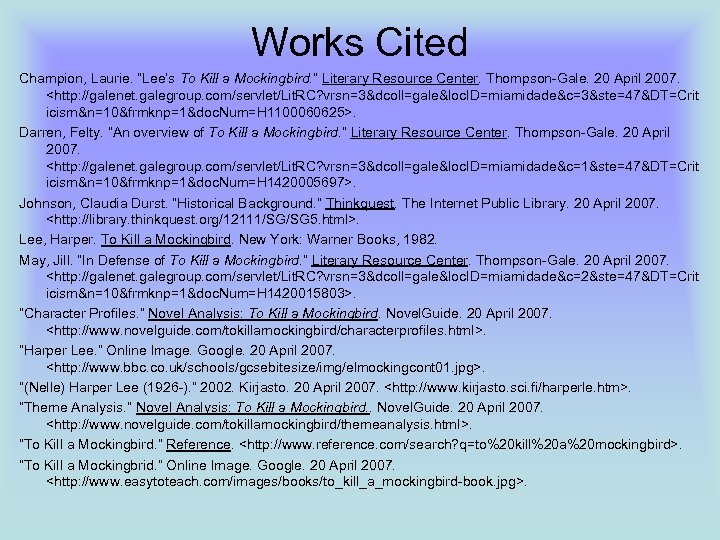
Works Cited Champion, Laurie. “Lee’s To Kill a Mockingbird. ” Literary Resource Center. Thompson-Gale. 20 April 2007. <http: //galenet. galegroup. com/servlet/Lit. RC? vrsn=3&dcoll=gale&loc. ID=miamidade&c=3&ste=47&DT=Crit icism&n=10&frmknp=1&doc. Num=H 1100060625>. Darren, Felty. “An overview of To Kill a Mockingbird. ” Literary Resource Center. Thompson-Gale. 20 April 2007. <http: //galenet. galegroup. com/servlet/Lit. RC? vrsn=3&dcoll=gale&loc. ID=miamidade&c=1&ste=47&DT=Crit icism&n=10&frmknp=1&doc. Num=H 1420005697>. Johnson, Claudia Durst. “Historical Background. ” Thinkquest. The Internet Public Library. 20 April 2007. <http: //library. thinkquest. org/12111/SG/SG 5. html>. Lee, Harper. To Kill a Mockingbird. New York: Warner Books, 1982. May, Jill. “In Defense of To Kill a Mockingbird. ” Literary Resource Center. Thompson-Gale. 20 April 2007. <http: //galenet. galegroup. com/servlet/Lit. RC? vrsn=3&dcoll=gale&loc. ID=miamidade&c=2&ste=47&DT=Crit icism&n=10&frmknp=1&doc. Num=H 1420015803>. “Character Profiles. ” Novel Analysis: To Kill a Mockingbird. Novel. Guide. 20 April 2007. <http: //www. novelguide. com/tokillamockingbird/characterprofiles. html>. “Harper Lee. ” Online Image. Google. 20 April 2007. <http: //www. bbc. co. uk/schools/gcsebitesize/img/elmockingcont 01. jpg>. “(Nelle) Harper Lee (1926 -). ” 2002. Kirjasto. 20 April 2007. <http: //www. kirjasto. sci. fi/harperle. htm>. “Theme Analysis. ” Novel Analysis: To Kill a Mockingbird. . Novel. Guide. 20 April 2007. <http: //www. novelguide. com/tokillamockingbird/themeanalysis. html>. “To Kill a Mockingbird. ” Reference. <http: //www. reference. com/search? q=to%20 kill%20 a%20 mockingbird>. “To Kill a Mockingbrid. ” Online Image. Google. 20 April 2007. <http: //www. easytoteach. com/images/books/to_kill_a_mockingbird-book. jpg>.
Скачать презентацию me elco ck W do rad gs B
f74c2e3209da0435f6b735d94ebb617a.ppt