 Скачать презентацию me elco ck W do rad gs B
4d15be72a2a49cf420f228182a3cb953.ppt
- Количество слайдов: 106



me elco ck W do rad gs!!! B ldo ul B 200 6 -20 07 MRS. CONTRERAS Language Arts 9 th Grade – Eng I Gifted Honors Room C 209
Home Learning THE FOLLOWING ARE DUE: • (bring up when called) Cultural PP presentation • (bring up when called) Individual PP
Weekly Forecast 10/23/06 – 10/27/06 • Monday – Plot Core Story Elements into Acts Flowchart • Tuesday – Plot Core Story Elements into Acts Flowchart • • Wednesday – Character development Thursday – Group PP Presentation (Chinese) Confucius "Analects" pg 434 • Friday – Lao-tzu "Tao Te Ching" pg 440. Chuang Tzu "The Fish Rejoice" pg 444
Home Learning By Monday 10/30: • Read introduction to Chinese culture pg 420. • Read Li Po "The River-Merchant’s Wife: A letter", "Still Night Thoughts" & "Gazing at the Lu Mountain Waterfall" pg 452 -458. • Complete Chinese Literature questionnaire. • Movie Project: movie concept page completed, Core Story elements page (behind it), Movie Acts Flowchart (8½ x 14) Have a great week!
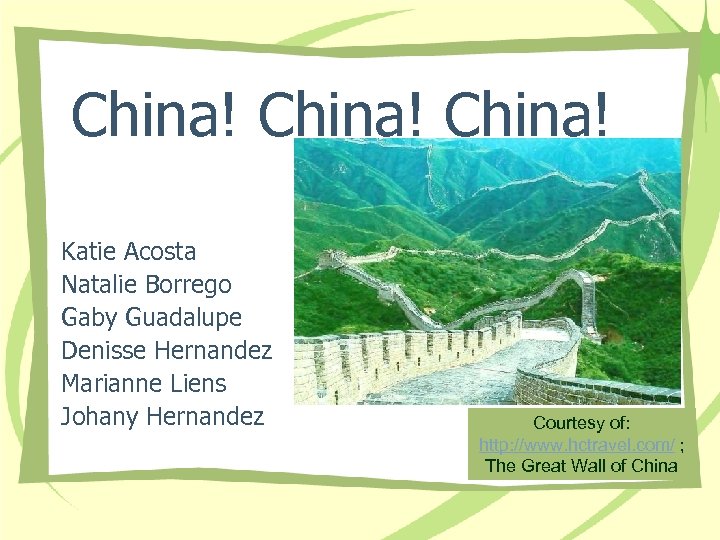
China! Katie Acosta Natalie Borrego Gaby Guadalupe Denisse Hernandez Marianne Liens Johany Hernandez Courtesy of: http: //www. hctravel. com/ ; The Great Wall of China
Literature of Ancient China • Third largest country of the world and the largest population as well as the oldest continuing civilization (Applebee 420). • Writing: used pictographs (simplified drawings of objects) on turtle shells were found in ancient site of Anyang. Shells date back to about 1400 BC (420). • Geography: includes mountains, deserts, hills, and plains; Because only one-tenth of China is suitable for farming, this civilization developed along the Yellow and Yangtze River (421). • Border Protection: Great Wall of China (along northern border) was built in the third century B. C. and has an average height of 23 -26 feet and wide enough for 5 horses to gallop side by side along the top (421). • Emperors: the first emperor was the leader of Ch’in who expanded borders and created an empire. He was buried in a heavily guarded tomb guarded by 6, 000 statues (421). • Silk Trade: along Silk Roads (long routes between China and Europe) camel caravans traveled with silk, which gave many merchants fortune and resulted in interaction among wide variety of cultures (420).
Historical Highlights: The Great Dynasties of Ancient China
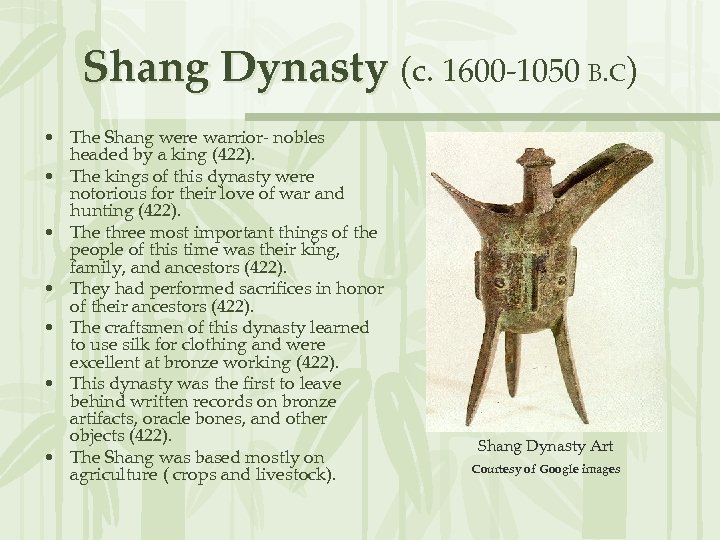
Shang Dynasty (c. 1600 -1050 B. C) • The Shang were warrior- nobles headed by a king (422). • The kings of this dynasty were notorious for their love of war and hunting (422). • The three most important things of the people of this time was their king, family, and ancestors (422). • They had performed sacrifices in honor of their ancestors (422). • The craftsmen of this dynasty learned to use silk for clothing and were excellent at bronze working (422). • This dynasty was the first to leave behind written records on bronze artifacts, oracle bones, and other objects (422). • The Shang was based mostly on agriculture ( crops and livestock). Shang Dynasty Art Courtesy of Google images
Chou Dynasty (c. 1050 -221 B. C) • This was the longest dynasty in Chinese history. • The Chou conquered the Shang and established their own dynasty. • They first founded feudalism and expanded their territory. • Under Feudalism, there was a king but lords were assigned to the different provinces. • It was the lord’s duty to be faithful to the king and defend the people. • But with constant invasions coming from the north (by surrounding tribes), it was the beginning of the end of the Chou dynasty. • The lords also began feuding against each other. • This entered into the Warring States period which was the time of the ruin of the Chou.
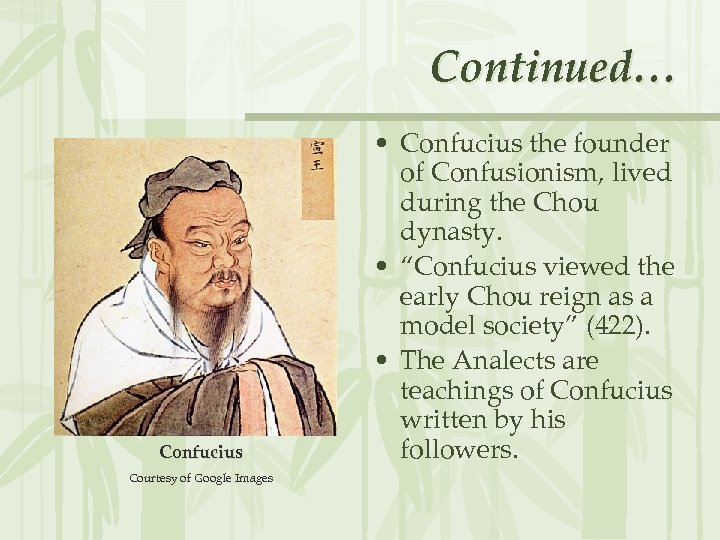
Continued… Confucius Courtesy of Google Images • Confucius the founder of Confusionism, lived during the Chou dynasty. • “Confucius viewed the early Chou reign as a model society” (422). • The Analects are teachings of Confucius written by his followers.
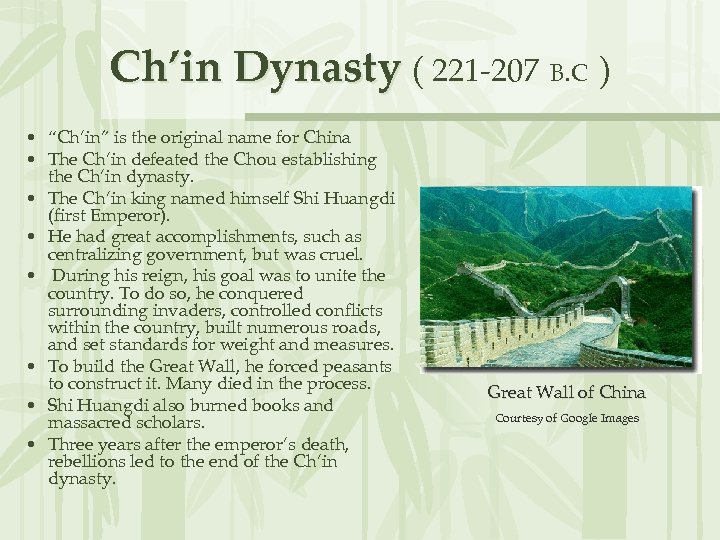
Ch’in Dynasty ( 221 -207 B. C ) • “Ch’in” is the original name for China • The Ch’in defeated the Chou establishing the Ch’in dynasty. • The Ch’in king named himself Shi Huangdi (first Emperor). • He had great accomplishments, such as centralizing government, but was cruel. • During his reign, his goal was to unite the country. To do so, he conquered surrounding invaders, controlled conflicts within the country, built numerous roads, and set standards for weight and measures. • To build the Great Wall, he forced peasants to construct it. Many died in the process. • Shi Huangdi also burned books and massacred scholars. • Three years after the emperor’s death, rebellions led to the end of the Ch’in dynasty. Great Wall of China Courtesy of Google Images
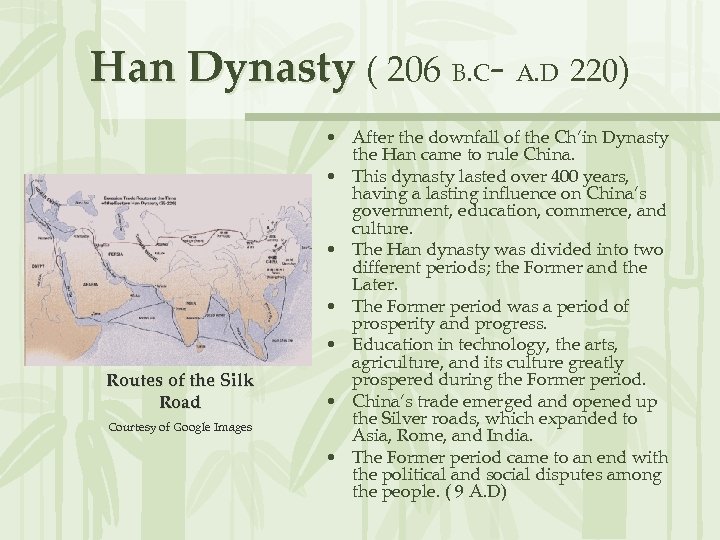
Han Dynasty ( 206 B. C- A. D 220) Routes of the Silk Road Courtesy of Google Images • After the downfall of the Ch’in Dynasty the Han came to rule China. • This dynasty lasted over 400 years, having a lasting influence on China’s government, education, commerce, and culture. • The Han dynasty was divided into two different periods; the Former and the Later. • The Former period was a period of prosperity and progress. • Education in technology, the arts, agriculture, and its culture greatly prospered during the Former period. • China’s trade emerged and opened up the Silver roads, which expanded to Asia, Rome, and India. • The Former period came to an end with the political and social disputes among the people. ( 9 A. D)
Continued… • Around 25 A. D, the Han was re-established and returned to supremacy. • This was the beginning of the Later period which thrived the first couple of decades. • A new religion entered China, that came from India known as Buddhism. • But for the same reasons that brought the Former period to a close; the Later period was slowly coming apart. • In A. D 220, the last emperor gave up power to rule China. Before the kingdom separated into three opposing kingdoms.
The T’ang Dynasty (A. D 618 - 907) • Came to power about 4 centuries after the Han Dynasty ended, and other insignificant dynasties collapsed as well. • It is considered the Golden Age of China. Poetry and painting blossomed in the T’ang Dynasty. • More importantly, the Chinese empire expanded, the bureaucracy was reinstated, agriculture improved, and foreign trade was endorsed. • Ch’ang-an, the capital city was the most advanced in its time. Its population increased, was wealthy, and education continued to develop. • The T’ang Dynasty fell after a series of weak rulers (after Empress Wu) • In 907 A. D, it fell in the hands to rebel forces.
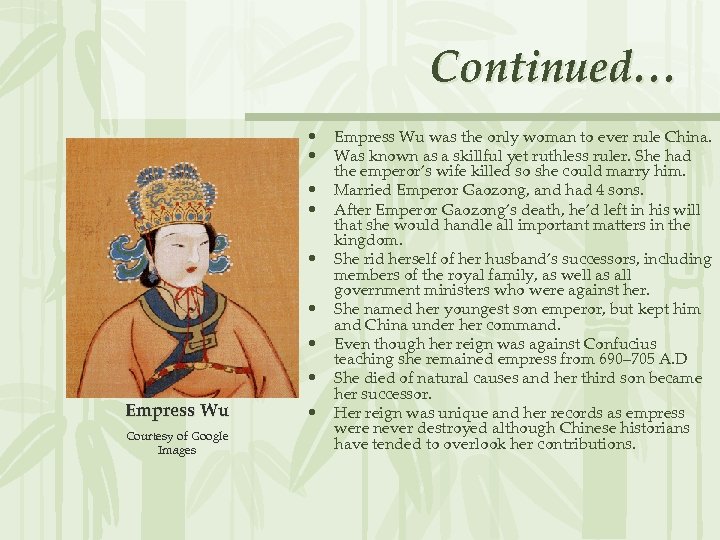
Continued… • • Empress Wu Courtesy of Google Images • Empress Wu was the only woman to ever rule China. Was known as a skillful yet ruthless ruler. She had the emperor’s wife killed so she could marry him. Married Emperor Gaozong, and had 4 sons. After Emperor Gaozong’s death, he’d left in his will that she would handle all important matters in the kingdom. She rid herself of her husband’s successors, including members of the royal family, as well as all government ministers who were against her. She named her youngest son emperor, but kept him and China under her command. Even though her reign was against Confucius teaching she remained empress from 690– 705 A. D She died of natural causes and her third son became her successor. Her reign was unique and her records as empress were never destroyed although Chinese historians have tended to overlook her contributions.
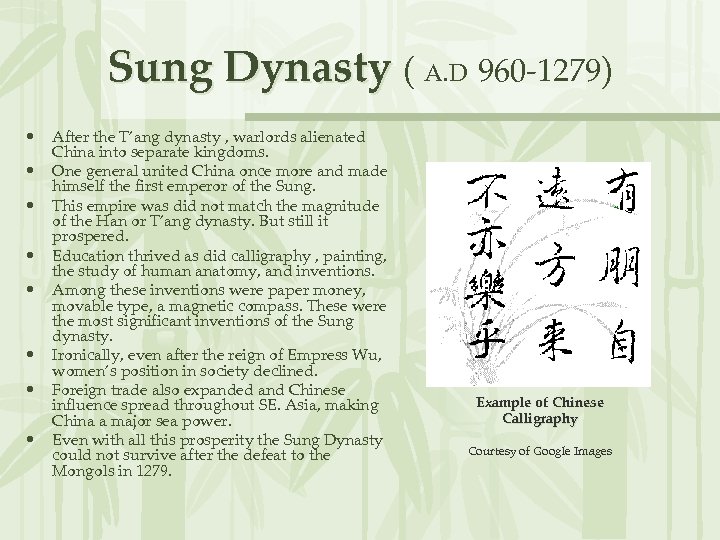
Sung Dynasty ( A. D 960 -1279) • • After the T’ang dynasty , warlords alienated China into separate kingdoms. One general united China once more and made himself the first emperor of the Sung. This empire was did not match the magnitude of the Han or T’ang dynasty. But still it prospered. Education thrived as did calligraphy , painting, the study of human anatomy, and inventions. Among these inventions were paper money, movable type, a magnetic compass. These were the most significant inventions of the Sung dynasty. Ironically, even after the reign of Empress Wu, women’s position in society declined. Foreign trade also expanded and Chinese influence spread throughout SE. Asia, making China a major sea power. Even with all this prosperity the Sung Dynasty could not survive after the defeat to the Mongols in 1279. Example of Chinese Calligraphy Courtesy of Google Images
People and Society The Chinese society from ancient times had a strict class structure. It was organized by the emperor at the top and the lowliest workers at the bottom. There were four main social classes. The four social classes names were the Rulers, Peasants, Artisans, and Merchants.
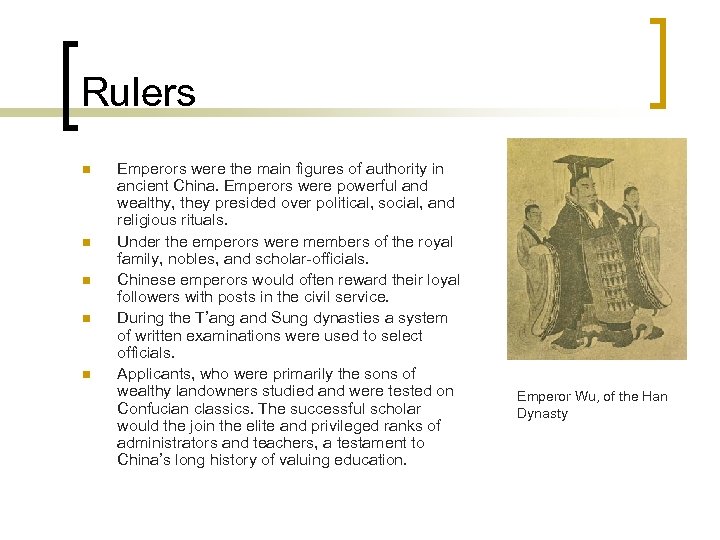
Rulers n n n Emperors were the main figures of authority in ancient China. Emperors were powerful and wealthy, they presided over political, social, and religious rituals. Under the emperors were members of the royal family, nobles, and scholar-officials. Chinese emperors would often reward their loyal followers with posts in the civil service. During the T’ang and Sung dynasties a system of written examinations were used to select officials. Applicants, who were primarily the sons of wealthy landowners studied and were tested on Confucian classics. The successful scholar would the join the elite and privileged ranks of administrators and teachers, a testament to China’s long history of valuing education. Emperor Wu, of the Han Dynasty
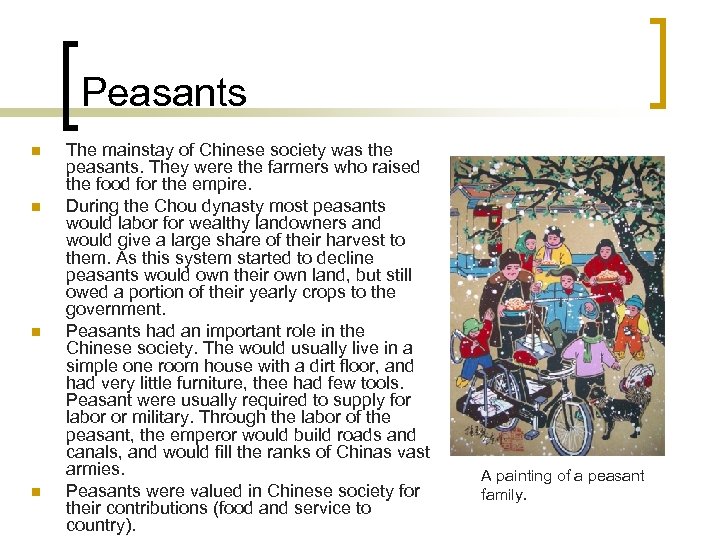
Peasants n n The mainstay of Chinese society was the peasants. They were the farmers who raised the food for the empire. During the Chou dynasty most peasants would labor for wealthy landowners and would give a large share of their harvest to them. As this system started to decline peasants would own their own land, but still owed a portion of their yearly crops to the government. Peasants had an important role in the Chinese society. The would usually live in a simple one room house with a dirt floor, and had very little furniture, thee had few tools. Peasant were usually required to supply for labor or military. Through the labor of the peasant, the emperor would build roads and canals, and would fill the ranks of Chinas vast armies. Peasants were valued in Chinese society for their contributions (food and service to country). A painting of a peasant family.
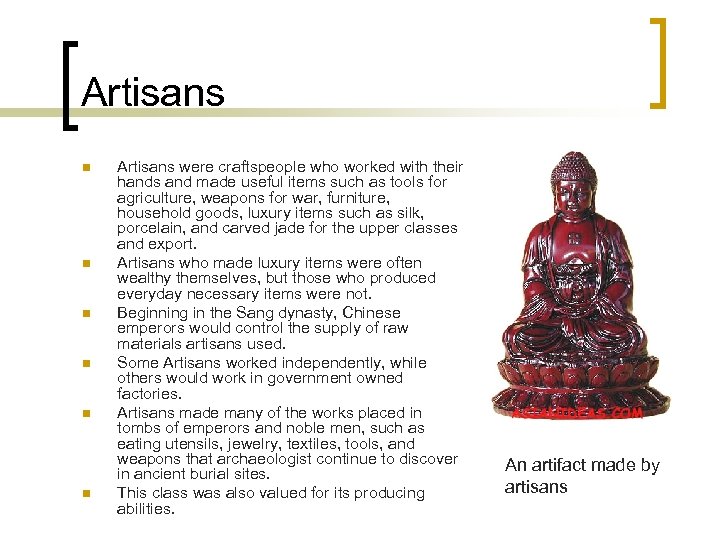
Artisans n n n Artisans were craftspeople who worked with their hands and made useful items such as tools for agriculture, weapons for war, furniture, household goods, luxury items such as silk, porcelain, and carved jade for the upper classes and export. Artisans who made luxury items were often wealthy themselves, but those who produced everyday necessary items were not. Beginning in the Sang dynasty, Chinese emperors would control the supply of raw materials artisans used. Some Artisans worked independently, while others would work in government owned factories. Artisans made many of the works placed in tombs of emperors and noble men, such as eating utensils, jewelry, textiles, tools, and weapons that archaeologist continue to discover in ancient burial sites. This class was also valued for its producing abilities. An artifact made by artisans
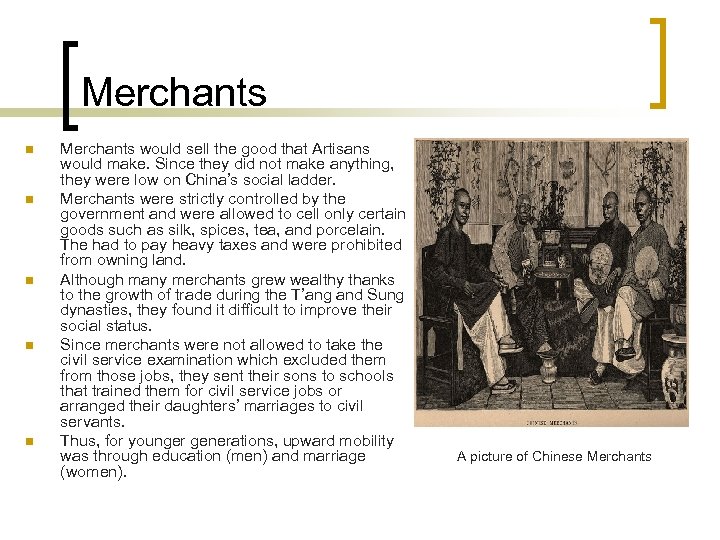
Merchants n n n Merchants would sell the good that Artisans would make. Since they did not make anything, they were low on China’s social ladder. Merchants were strictly controlled by the government and were allowed to cell only certain goods such as silk, spices, tea, and porcelain. The had to pay heavy taxes and were prohibited from owning land. Although many merchants grew wealthy thanks to the growth of trade during the T’ang and Sung dynasties, they found it difficult to improve their social status. Since merchants were not allowed to take the civil service examination which excluded them from those jobs, they sent their sons to schools that trained them for civil service jobs or arranged their daughters’ marriages to civil servants. Thus, for younger generations, upward mobility was through education (men) and marriage (women). A picture of Chinese Merchants
Servants and Slaves n These people were the lowest rungs of Chinese society and were not considered important or worthy enough to have their own class. n Such people included servants, migrant laborers, professional soldiers, entertainers, butchers, tanners, and slaves. n During the T’ang dynasty, nomads from Central Asia and Mongolia were captured in war and were forced into slave labor. n All of these groups were regarded as inferior to the main four social classes of society, and excluded from the civil service examination.
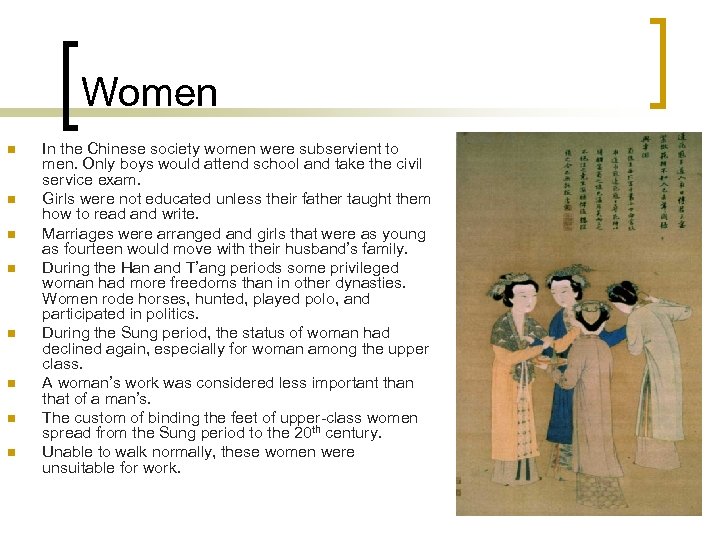
Women n n n n In the Chinese society women were subservient to men. Only boys would attend school and take the civil service exam. Girls were not educated unless their father taught them how to read and write. Marriages were arranged and girls that were as young as fourteen would move with their husband’s family. During the Han and T’ang periods some privileged woman had more freedoms than in other dynasties. Women rode horses, hunted, played polo, and participated in politics. During the Sung period, the status of woman had declined again, especially for woman among the upper class. A woman’s work was considered less important than that of a man’s. The custom of binding the feet of upper-class women spread from the Sung period to the 20 th century. Unable to walk normally, these women were unsuitable for work.
• Since the sixth century B. C. to the first century A. D. , three key systems of thought took hold in in ancient China – Confucianism, Taoism, and Buddhism. The sixth century B. C. was when Confucianism and Taoism emerged (426). • Confucianism focused on family relationships and order in society. The teachings emphasized virtue in all interactions between people and valued learning, respect and duty (426). • Taoism was based on following the Way, or the Tao, a universal force underlying all of life. Taoist sought humility, simplicity, and harmony with nature (426). • Buddhism was based on the teachings of Siddhartha Gautama, originated in India and reached China, about the first century A. D. More a religion than a philosophy, Buddhism emphasized detachment for earthly life in order to attain spiritual enlightenment (426). • From earliest times, the ancient Chinese also practiced religious devotion to their ancestors. They believed that the dead live on as spirits and are closely tied to the living. Ancestors were honored through offerings, prayers, and elaborate ceremonies. These various philosophical and religious teachings existed together in Ancient China. Sometimes they were in opposition, but in general there was tolerance and even a blending of beliefs and practices (426).
• China has one of the oldest continuing literacy traditions in the world, dating back more than 3, 000 years (426). • It is a vast body of work, surpassing that of any civilization (426). • The earliest known major literacy works in the Book of Odes, a collection of poems dating from the Shang and Chou Dynasties. These poems have been revered, studied, and memorized throughout China’s history (426). • In later dynasties, writing poetry was considered an essential accomplishment for scholars and gentlemen (426). • The finest poems in all of China’s literature were produced during the T’ang Dyna-sty when the lyric poets Li Po and Tu Fu were writing (426). • Prose was also a strong tradition. Important works include the Analects of Confucius, Taoist tales, philosophy essays, and the Records of the Historian, a main source of information about Early China (426).
• From Shang times, the ancient Chinese excelled in the arts (426). • They distinguished themselves in the production of pottery, bronze work, sculpture, jade carvings, calligraphy, and painting (426). • As early as 2, 000 B. C. , Chinese artists used a potter’s wheel to create beautiful vases and urns. They discovered how to make porcelain during the later T’ ang times (426). • Chinese artists were known for their realistic sculptures. For example, their skills include the life-like Terra-cotta figures buried in Shi Huangdi’s tomb and the thousands of stone Buddha statues carved into caves after Buddhism spread to China (426). • Calligraphy or “beautiful writing” was considered one of the fine arts. The best calligraphers became famous, and their work was much sought after (426). • During the Sung Dynasty, Chinese paintings reached its greatest glory. The focus shifted from the human figure to landscapes. Artists painted towering mountains, plunging waterfalls, and peaceful lakes. This attention to landscapes, which reflects the Taoist love of nature, influenced painting in China for the next thousand years (426).
• The paintings were done on silk, or paper scrolls, and the artist often preferred black ink. One Sung artist said, “Black is 10 colors” (427). • During the Sung Dynasty, the combination of the “three perfectionscalligraphy, poetry, and landscape painting-was regarded as the highest achievement of the arts (427).
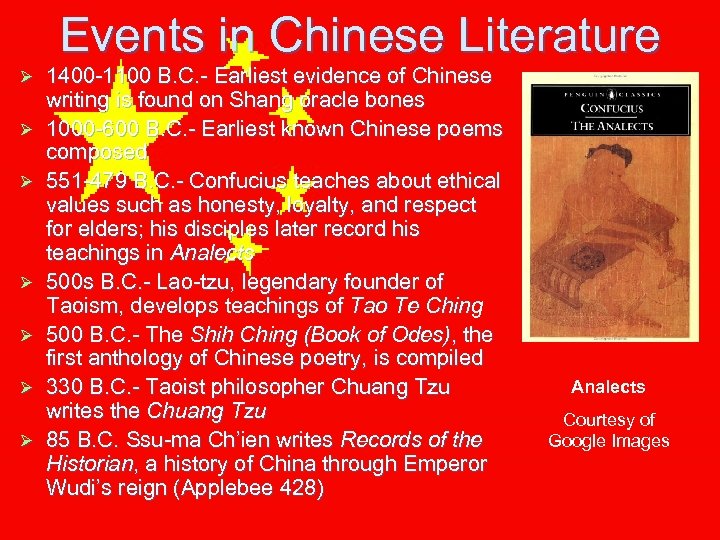
Events in Chinese Literature Ø Ø Ø Ø 1400 -1100 B. C. - Earliest evidence of Chinese writing is found on Shang oracle bones 1000 -600 B. C. - Earliest known Chinese poems composed 551 -479 B. C. - Confucius teaches about ethical values such as honesty, loyalty, and respect for elders; his disciples later record his teachings in Analects 500 s B. C. - Lao-tzu, legendary founder of Taoism, develops teachings of Tao Te Ching 500 B. C. - The Shih Ching (Book of Odes), the first anthology of Chinese poetry, is compiled 330 B. C. - Taoist philosopher Chuang Tzu writes the Chuang Tzu 85 B. C. Ssu-ma Ch’ien writes Records of the Historian, a history of China through Emperor Wudi’s reign (Applebee 428) Analects Courtesy of Google Images
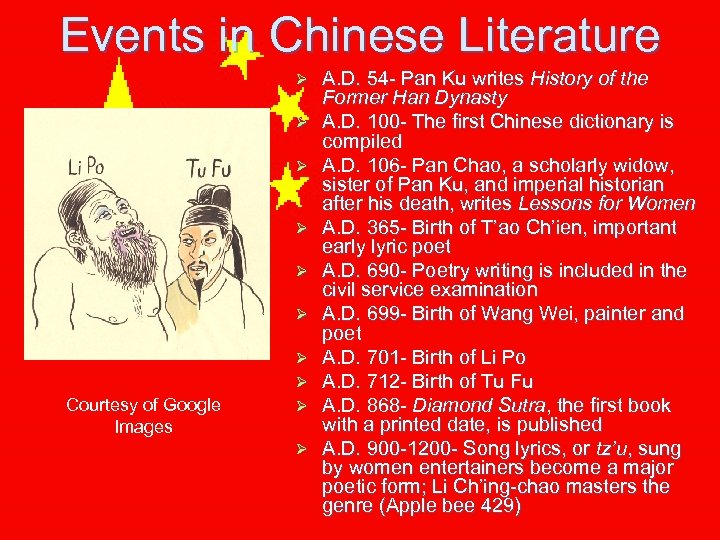
Events in Chinese Literature Ø Ø Ø Courtesy of Google Images Ø Ø A. D. 54 - Pan Ku writes History of the Former Han Dynasty A. D. 100 - The first Chinese dictionary is compiled A. D. 106 - Pan Chao, a scholarly widow, sister of Pan Ku, and imperial historian after his death, writes Lessons for Women A. D. 365 - Birth of T’ao Ch’ien, important early lyric poet A. D. 690 - Poetry writing is included in the civil service examination A. D. 699 - Birth of Wang Wei, painter and poet A. D. 701 - Birth of Li Po A. D. 712 - Birth of Tu Fu A. D. 868 - Diamond Sutra, the first book with a printed date, is published A. D. 900 -1200 - Song lyrics, or tz’u, sung by women entertainers become a major poetic form; Li Ch’ing-chao masters the genre (Apple bee 429)
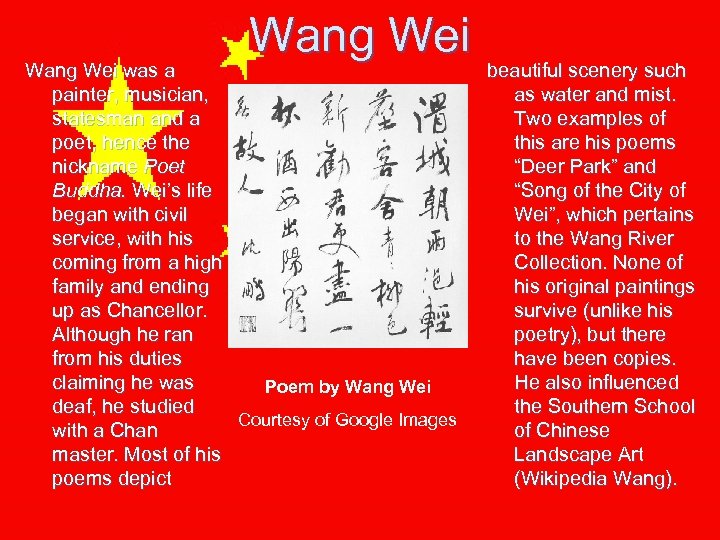
Wang Wei was a painter, musician, statesman and a poet, hence the nickname Poet Buddha. Wei’s life began with civil service, with his coming from a high family and ending up as Chancellor. Although he ran from his duties claiming he was Poem by Wang Wei deaf, he studied Courtesy of Google Images with a Chan master. Most of his poems depict beautiful scenery such as water and mist. Two examples of this are his poems “Deer Park” and “Song of the City of Wei”, which pertains to the Wang River Collection. None of his original paintings survive (unlike his poetry), but there have been copies. He also influenced the Southern School of Chinese Landscape Art (Wikipedia Wang).
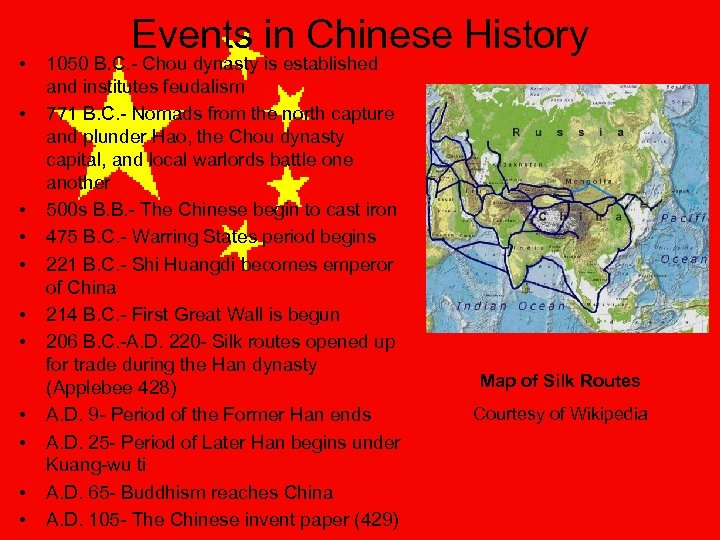
• • • Events in Chinese History 1050 B. C. - Chou dynasty is established and institutes feudalism 771 B. C. - Nomads from the north capture and plunder Hao, the Chou dynasty capital, and local warlords battle one another 500 s B. B. - The Chinese begin to cast iron 475 B. C. - Warring States period begins 221 B. C. - Shi Huangdi becomes emperor of China 214 B. C. - First Great Wall is begun 206 B. C. -A. D. 220 - Silk routes opened up for trade during the Han dynasty (Applebee 428) A. D. 9 - Period of the Former Han ends A. D. 25 - Period of Later Han begins under Kuang-wu ti A. D. 65 - Buddhism reaches China A. D. 105 - The Chinese invent paper (429) Map of Silk Routes Courtesy of Wikipedia
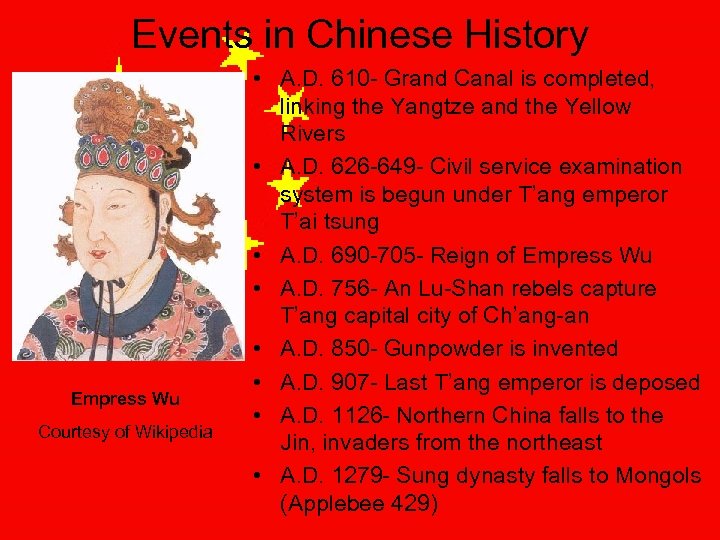
Events in Chinese History Empress Wu Courtesy of Wikipedia • A. D. 610 - Grand Canal is completed, linking the Yangtze and the Yellow Rivers • A. D. 626 -649 - Civil service examination system is begun under T’ang emperor T’ai tsung • A. D. 690 -705 - Reign of Empress Wu • A. D. 756 - An Lu-Shan rebels capture T’ang capital city of Ch’ang-an • A. D. 850 - Gunpowder is invented • A. D. 907 - Last T’ang emperor is deposed • A. D. 1126 - Northern China falls to the Jin, invaders from the northeast • A. D. 1279 - Sung dynasty falls to Mongols (Applebee 429)
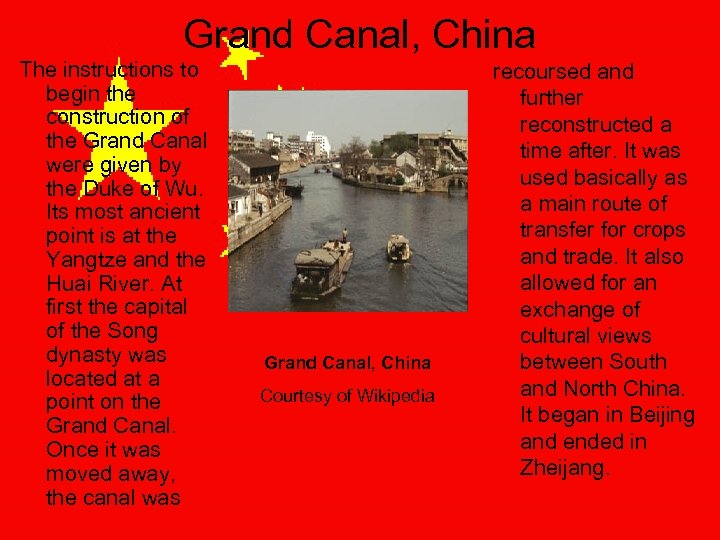
Grand Canal, China The instructions to begin the construction of the Grand Canal were given by the Duke of Wu. Its most ancient point is at the Yangtze and the Huai River. At first the capital of the Song dynasty was located at a point on the Grand Canal. Once it was moved away, the canal was Grand Canal, China Courtesy of Wikipedia recoursed and further reconstructed a time after. It was used basically as a main route of transfer for crops and trade. It also allowed for an exchange of cultural views between South and North China. It began in Beijing and ended in Zheijang.
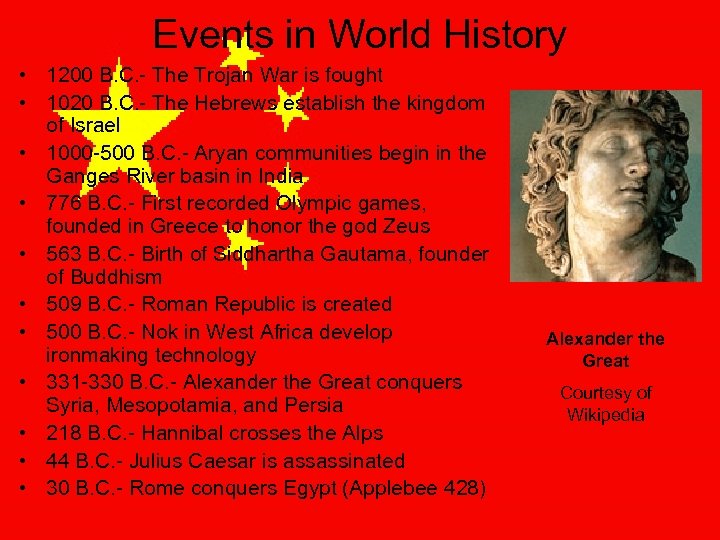
Events in World History • 1200 B. C. - The Trojan War is fought • 1020 B. C. - The Hebrews establish the kingdom of Israel • 1000 -500 B. C. - Aryan communities begin in the Ganges River basin in India • 776 B. C. - First recorded Olympic games, founded in Greece to honor the god Zeus • 563 B. C. - Birth of Siddhartha Gautama, founder of Buddhism • 509 B. C. - Roman Republic is created • 500 B. C. - Nok in West Africa develop ironmaking technology • 331 -330 B. C. - Alexander the Great conquers Syria, Mesopotamia, and Persia • 218 B. C. - Hannibal crosses the Alps • 44 B. C. - Julius Caesar is assassinated • 30 B. C. - Rome conquers Egypt (Applebee 428) Alexander the Great Courtesy of Wikipedia
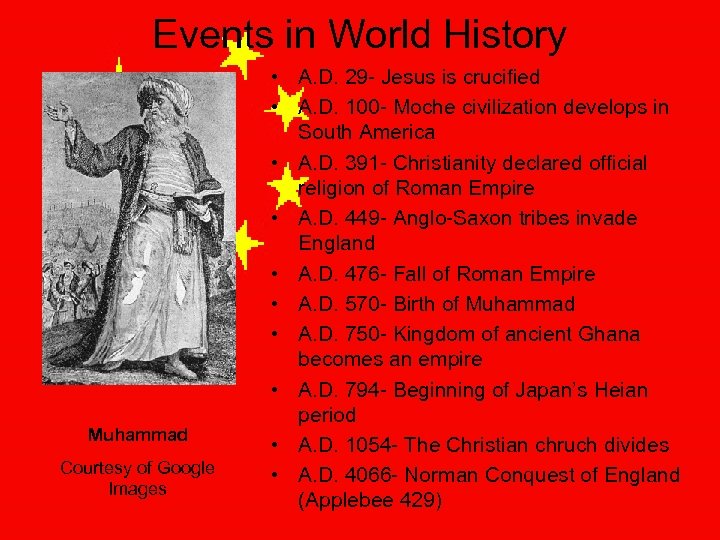
Events in World History Muhammad Courtesy of Google Images • A. D. 29 - Jesus is crucified • A. D. 100 - Moche civilization develops in South America • A. D. 391 - Christianity declared official religion of Roman Empire • A. D. 449 - Anglo-Saxon tribes invade England • A. D. 476 - Fall of Roman Empire • A. D. 570 - Birth of Muhammad • A. D. 750 - Kingdom of ancient Ghana becomes an empire • A. D. 794 - Beginning of Japan’s Heian period • A. D. 1054 - The Christian chruch divides • A. D. 4066 - Norman Conquest of England (Applebee 429)
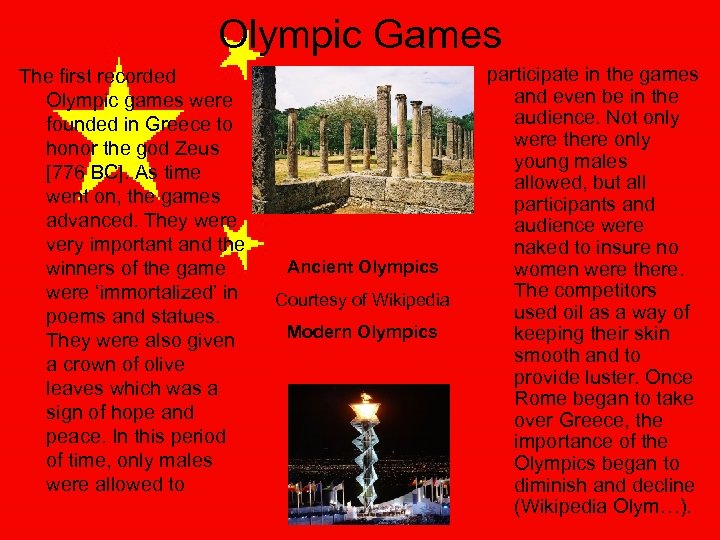
Olympic Games The first recorded Olympic games were founded in Greece to honor the god Zeus [776 BC]. As time went on, the games advanced. They were very important and the winners of the game were ‘immortalized’ in poems and statues. They were also given a crown of olive leaves which was a sign of hope and peace. In this period of time, only males were allowed to Ancient Olympics Courtesy of Wikipedia Modern Olympics participate in the games and even be in the audience. Not only were there only young males allowed, but all participants and audience were naked to insure no women were there. The competitors used oil as a way of keeping their skin smooth and to provide luster. Once Rome began to take over Greece, the importance of the Olympics began to diminish and decline (Wikipedia Olym…).
Connect To Today The Chinese have made so many contributions, inventions that we use or experience daily. Many of these inventions and ideas were first developed in ancient China and still have an impact on the 21 st century. They have made various contributions to art, science, medicine, technology, agriculture, philosophy, and mathematics.
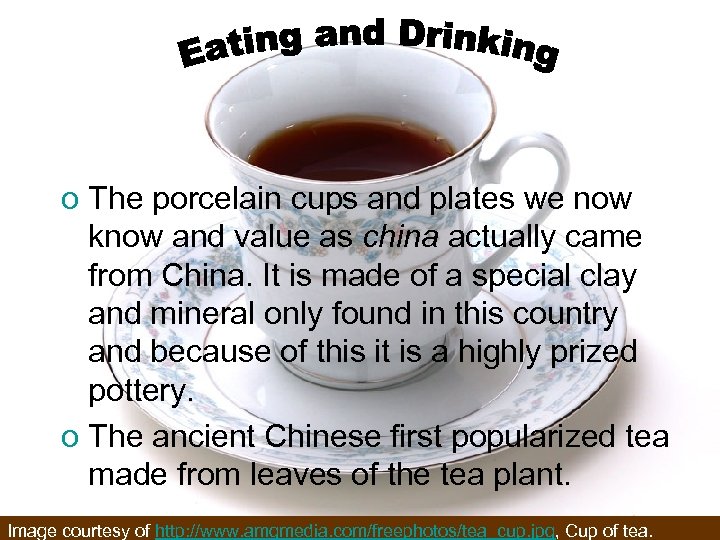
o The porcelain cups and plates we now know and value as china actually came from China. It is made of a special clay and mineral only found in this country and because of this it is a highly prized pottery. o The ancient Chinese first popularized tea made from leaves of the tea plant. Image courtesy of http: //www. amgmedia. com/freephotos/tea_cup. jpg, Cup of tea.
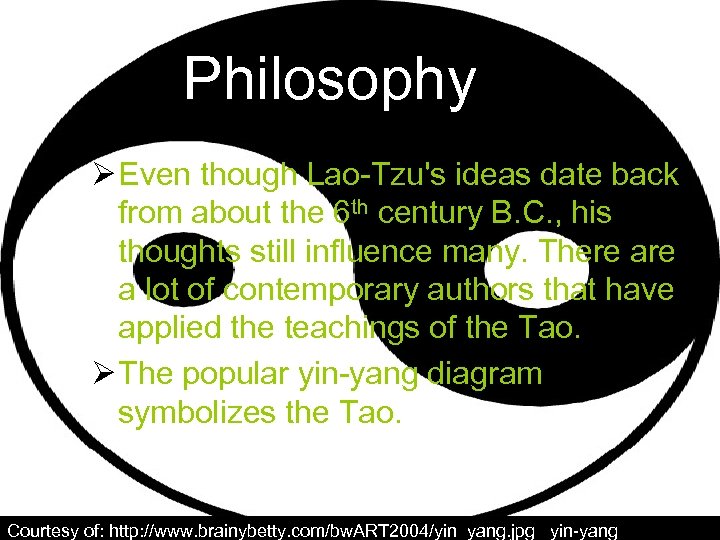
Philosophy Ø Even though Lao-Tzu's ideas date back from about the 6 th century B. C. , his thoughts still influence many. There a lot of contemporary authors that have applied the teachings of the Tao. Ø The popular yin-yang diagram symbolizes the Tao. Courtesy of: http: //www. brainybetty. com/bw. ART 2004/yin_yang. jpg , yin-yang
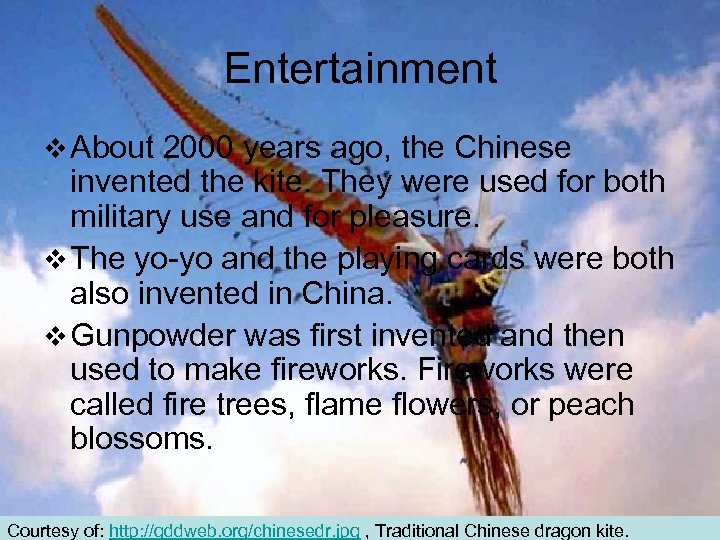
Entertainment v About 2000 years ago, the Chinese invented the kite. They were used for both military use and for pleasure. v The yo-yo and the playing cards were both also invented in China. v Gunpowder was first invented and then used to make fireworks. Fireworks were called fire trees, flame flowers, or peach blossoms. Courtesy of: http: //gddweb. org/chinesedr. jpg , Traditional Chinese dragon kite.
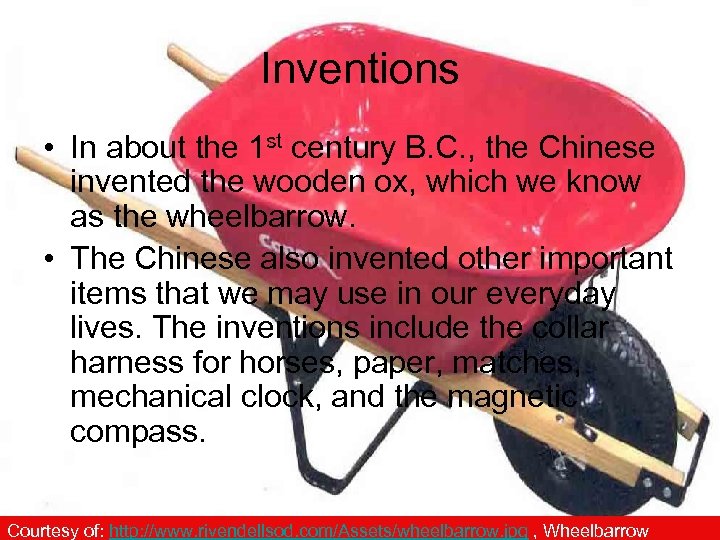
Inventions • In about the 1 st century B. C. , the Chinese invented the wooden ox, which we know as the wheelbarrow. • The Chinese also invented other important items that we may use in our everyday lives. The inventions include the collar harness for horses, paper, matches, mechanical clock, and the magnetic compass. Courtesy of: http: //www. rivendellsod. com/Assets/wheelbarrow. jpg , Wheelbarrow
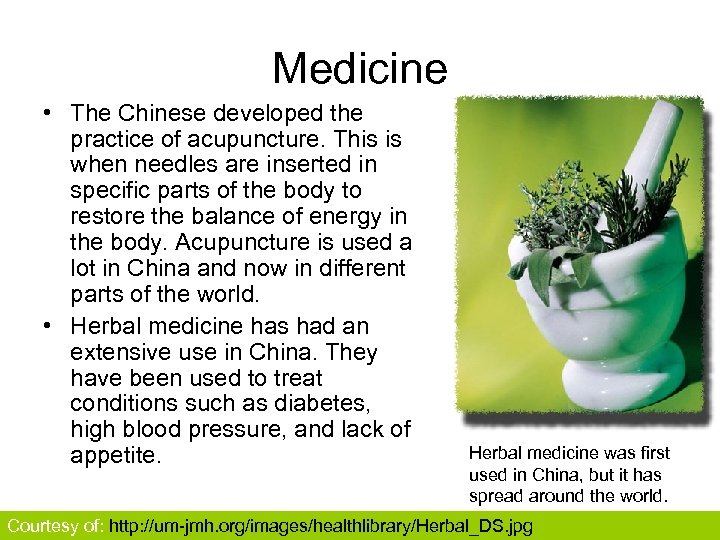
Medicine • The Chinese developed the practice of acupuncture. This is when needles are inserted in specific parts of the body to restore the balance of energy in the body. Acupuncture is used a lot in China and now in different parts of the world. • Herbal medicine has had an extensive use in China. They have been used to treat conditions such as diabetes, high blood pressure, and lack of appetite. Herbal medicine was first used in China, but it has spread around the world. Courtesy of: http: //um-jmh. org/images/healthlibrary/Herbal_DS. jpg
Conclusion • The literature of Ancient China involved the development of writing, its geography, border protection, the rule of emperors, and the silk trade. Key events in Chinese literature, Chinese history, and world history are: Analects (the teachings of Confucius) is written, the birth of Li Po and Tu Fu, the birth of Wang Wei, silk routes are opened up, Empress Wu reigns, the Grand Canal is constructed, Alexander the Great conquers various places, the birth of Muhammad, and the first Olympic games in Greece.
Conclusion • Ancient China was truly one of the most unique cultures in its time. • They made many accomplishments, they had an Empress, build the Great Wall, and created the Silk Roads. • Even with all their success, Ancient China is one of many examples of an empire that reached their peak point, but could not avoid their ruin.
Conclusion • Ancient Chinese society had a strict class structure. The four main social classes were the Rulers, Peasants, Artisans, and Merchants. The rulers were the highest class. The rulers were emperors ( the highest form of authority). The next social class is Peasants. Most people fell into this class, they were farmers who lived difficult lives. Next is the Artisans. They were craftspeople who worked with their hand, they were wealthy if their work was sold for high prices. The last social class is Merchants who sold what the artisans made, and they were not very wealthy. Slaves and servants were in the lowest rungs of Chinese society and “did not deserve” a social class.
Conclusion • In conclusion, the Chinese had a lot of art, culture, literature, and their people and society were based Confucianism, Taoism, and Buddhism. • Many of our every day items were created or popularized by the Chinese. Some of these items include the kite, wheelbarrow, and the china we use now actually was created in China.
“Ancient Chinese and Japanese writers were among those who used literature to communicate their ideas about what they considered to be right and wrong. Philosophers and religious teachers…recognized the power of literature to convey the moral ideals they followed and to persuade readers to act in certain ways. They and their followers expressed their teachings [through didactic literature] using maxims, anecdotes, and parables” (432).
• Didatic Literature: literature that instructs its readers. It can teach a lesson on how to live a moral life. Such as what is right and wrong. (432) • Maxim- a statement of a general truth about human behavior. It may offer practical advice. (432) §It explains what ideals to pursue and what actions and attitudes to avoid. (432) §Aphorisms- Easy to recall and memorize. (432) Ex: “To study without thinking is futile. To think without studying is dangerous. ” (437)
• Japanese and Chinese writers were among the writers whom talked about what is right and wrong. (432) • Anecdote- a brief story that focuses on a single interesting event. (433) • Parable- A brief story, intended to illustrate an aspect of some moral truth. (433)
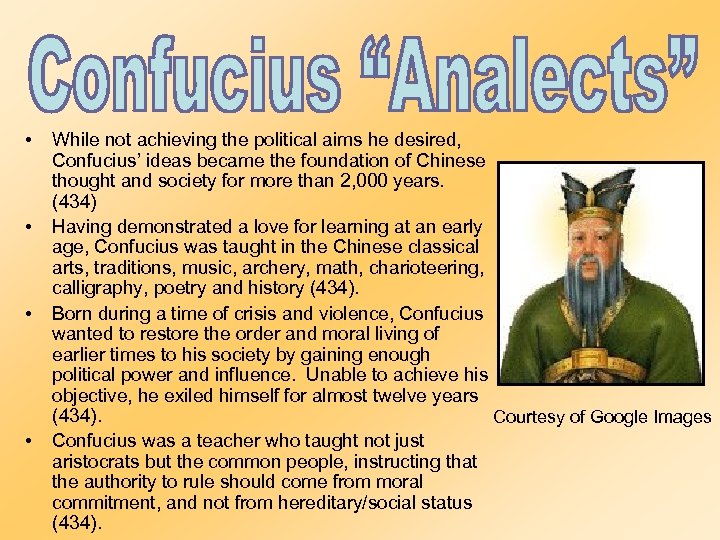
• • While not achieving the political aims he desired, Confucius’ ideas became the foundation of Chinese thought and society for more than 2, 000 years. (434) Having demonstrated a love for learning at an early age, Confucius was taught in the Chinese classical arts, traditions, music, archery, math, charioteering, calligraphy, poetry and history (434). Born during a time of crisis and violence, Confucius wanted to restore the order and moral living of earlier times to his society by gaining enough political power and influence. Unable to achieve his objective, he exiled himself for almost twelve years (434). Courtesy of Google Images Confucius was a teacher who taught not just aristocrats but the common people, instructing that the authority to rule should come from moral commitment, and not from hereditary/social status (434).
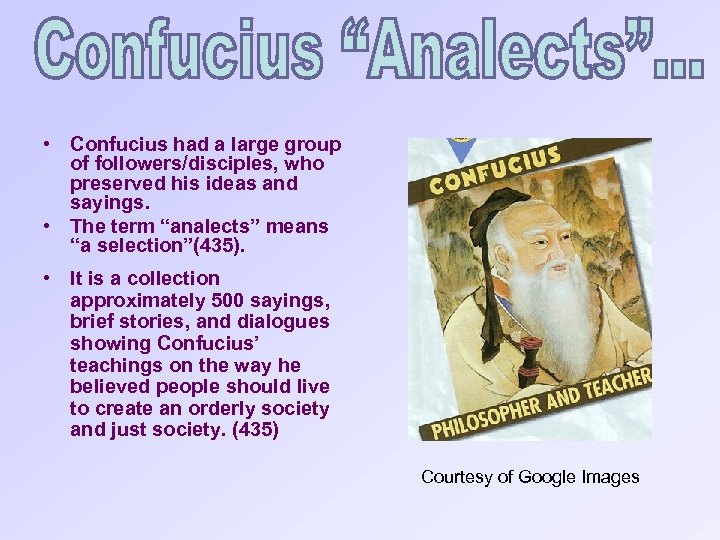
• Confucius had a large group of followers/disciples, who preserved his ideas and sayings. • The term “analects” means “a selection”(435). • It is a collection approximately 500 sayings, brief stories, and dialogues showing Confucius’ teachings on the way he believed people should live to create an orderly society and just society. (435) Courtesy of Google Images
![Confucius’ teachings were “revolutionary for his time…[R]ulers must have high standards for themselves and](https://present5.com/presentation/4d15be72a2a49cf420f228182a3cb953/image-53.jpg "Confucius’ teachings were “revolutionary for his time…[R]ulers must have high standards for themselves and")
Confucius’ teachings were “revolutionary for his time…[R]ulers must have high standards for themselves and must care for…their subjects…Educated people had a responsibility to act with loyalty, courtesy, and respect” (435). Images Courtesy of Google
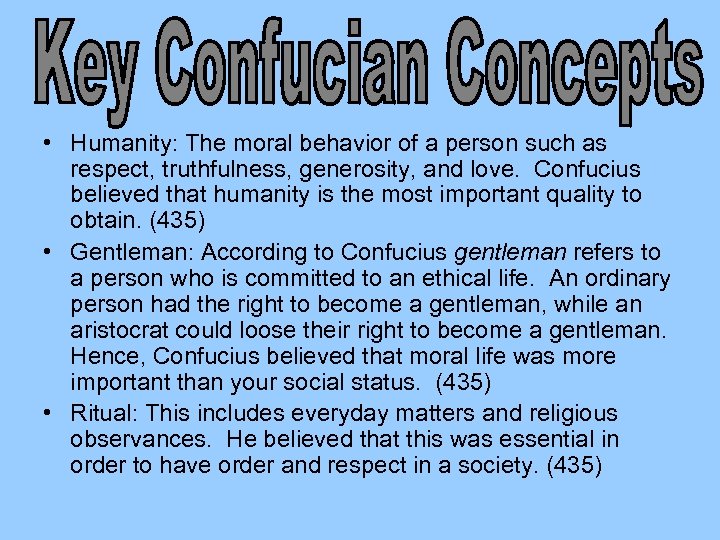
• Humanity: The moral behavior of a person such as respect, truthfulness, generosity, and love. Confucius believed that humanity is the most important quality to obtain. (435) • Gentleman: According to Confucius gentleman refers to a person who is committed to an ethical life. An ordinary person had the right to become a gentleman, while an aristocrat could loose their right to become a gentleman. Hence, Confucius believed that moral life was more important than your social status. (435) • Ritual: This includes everyday matters and religious observances. He believed that this was essential in order to have order and respect in a society. (435)
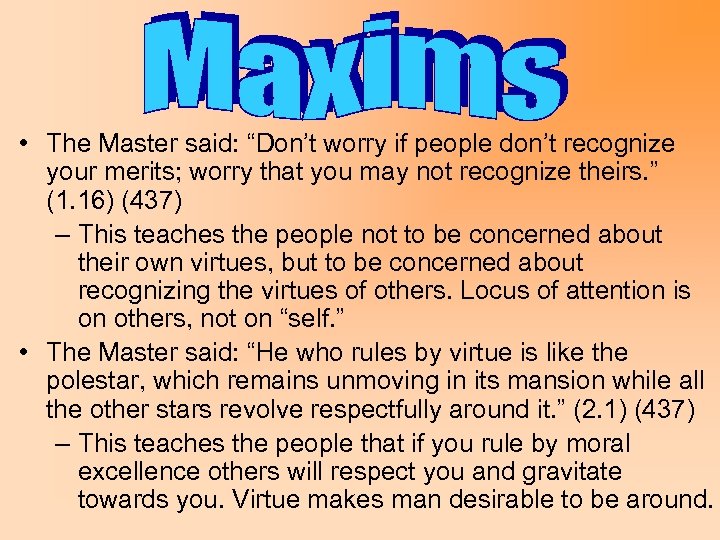
• The Master said: “Don’t worry if people don’t recognize your merits; worry that you may not recognize theirs. ” (1. 16) (437) – This teaches the people not to be concerned about their own virtues, but to be concerned about recognizing the virtues of others. Locus of attention is on others, not on “self. ” • The Master said: “He who rules by virtue is like the polestar, which remains unmoving in its mansion while all the other stars revolve respectfully around it. ” (2. 1) (437) – This teaches the people that if you rule by moral excellence others will respect you and gravitate towards you. Virtue makes man desirable to be around.
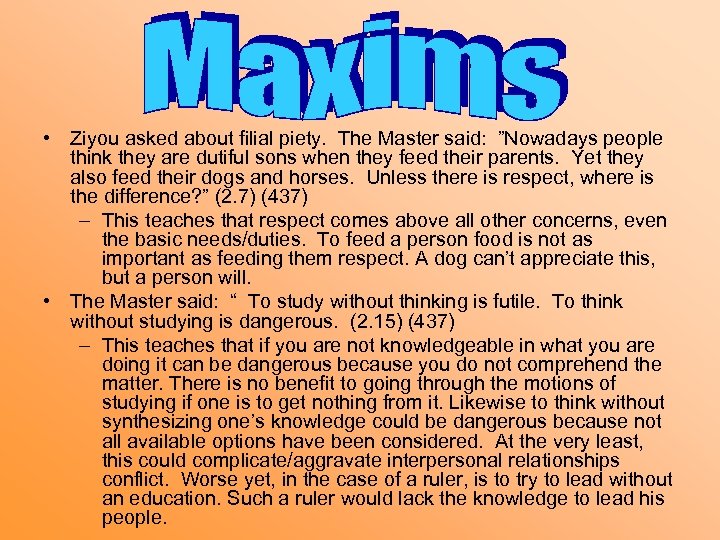
• Ziyou asked about filial piety. The Master said: ”Nowadays people think they are dutiful sons when they feed their parents. Yet they also feed their dogs and horses. Unless there is respect, where is the difference? ” (2. 7) (437) – This teaches that respect comes above all other concerns, even the basic needs/duties. To feed a person food is not as important as feeding them respect. A dog can’t appreciate this, but a person will. • The Master said: “ To study without thinking is futile. To think without studying is dangerous. (2. 15) (437) – This teaches that if you are not knowledgeable in what you are doing it can be dangerous because you do not comprehend the matter. There is no benefit to going through the motions of studying if one is to get nothing from it. Likewise to think without synthesizing one’s knowledge could be dangerous because not all available options have been considered. At the very least, this could complicate/aggravate interpersonal relationships conflict. Worse yet, in the case of a ruler, is to try to lead without an education. Such a ruler would lack the knowledge to lead his people.
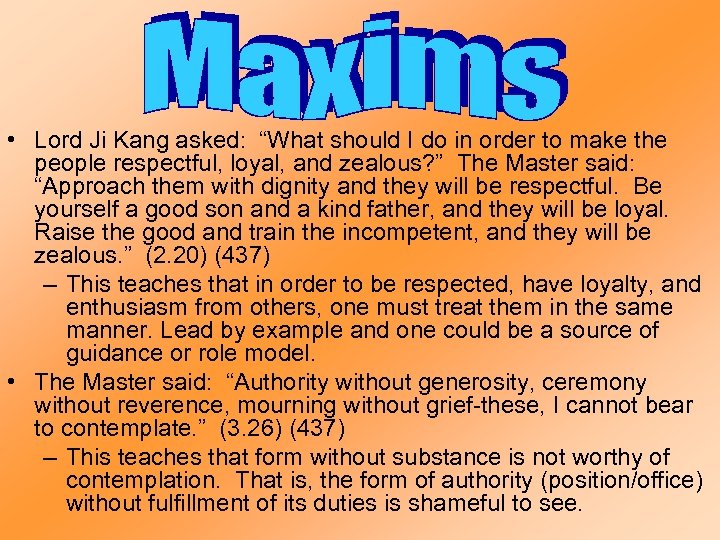
• Lord Ji Kang asked: “What should I do in order to make the people respectful, loyal, and zealous? ” The Master said: “Approach them with dignity and they will be respectful. Be yourself a good son and a kind father, and they will be loyal. Raise the good and train the incompetent, and they will be zealous. ” (2. 20) (437) – This teaches that in order to be respected, have loyalty, and enthusiasm from others, one must treat them in the same manner. Lead by example and one could be a source of guidance or role model. • The Master said: “Authority without generosity, ceremony without reverence, mourning without grief-these, I cannot bear to contemplate. ” (3. 26) (437) – This teaches that form without substance is not worthy of contemplation. That is, the form of authority (position/office) without fulfillment of its duties is shameful to see.
• The Master said: “I have never seen a man who truly loves goodness and hated evil. Whoever truly loves goodness would put nothing above it; whoever truly hates evil would practice goodness in such a way that no evil could enter him. Has anyone ever devoted all his strength to goodness just for one day? No one ever has, and yet it is not for want of strengththere may be people who do not have even the small amount of strength it takes, but I have never seen any. ” (4. 6) (437) – This teaches that its nearly impossible to devote oneself to goodness. Man at best is inconsistent, unable to achieve integrity (man’s actions are at one with his beliefs). • The Master said: “Do not worry if you are without a position; worry lest you do not deserve a position. Do not worry if you are not famous; worry lest you do not deserve to be famous. ” (4. 14) (438) – This teaches to worry that to desire a position or any sort of recognition, one must strive to deserve first deserve it. Merit/ substance/virtue is better than external rank/fame.
• The Master said: “Set your heart upon the Way; relay upon moral power; follow goodness; enjoy the arts. (7. 6) (438) – This teaches to live your life in an ideal pattern meaning the Way; which is being ethical, good, respecting, and enjoying your life. The arts are those things that nurture inner being. • The Master said: “Without ritual, courtesy is tiresome; without ritual, prudence is timid; without ritual, bravery is quarrelsome; without ritual, frankness is hurtful. When gentlemen treat their kin generously, common people are attracted to goodness; when old ties are not forgotten, common people are not fickle. ” (8. 2) (4. 38) – This teaches that without respect you have nothing. Proper action disrupts natural effect, curbs the natural end of any action, and ensures civility.
• The Master said: “ A gentleman abides by three principles which I am unable to follow: his humanity knows no anxiety; his wisdom knows no hesitation; his courage knows no fear. ” Zigong said: “Master, you have just drawn your own portrait. ” (14. 28) (438) – This teaches that a gentleman must have different virtues he must live by, including: being good to others, being knowledgeable, and courageous. Harmony flows from a gentleman’s core to his thoughts, and actions. Ironically, Confucius does not see in himself (humility) what others (his disciples) see in his example. • Zigong asked: “Is there any single word that could guide one’s entire life? ” The Master said: “Should it not be reciprocity? What you do not wish for yourself, do not do to others. ” (15. 24) (438) – This teaches to “do onto others as you would have them do unto you. ” Reciprocity assumes there’s a balance in the universe and this governs the extent of our actions.
Special Terms/Vocabulary 1. Master: Confucius. (437) 2. Polestar: the North Star, which, unlike other stars, appears to remain in the same place in the sky as the earth rotates. (437) 3. Ziyou: a younger disciple of Confucius, known for his literary talent. (437) 4. filial piety: respect and reverence for one’s parents and ancestors – an important concept in Confucianism. (437) 5. futile: useless. (437) 6. Lord Ji Kang: a powerful official on Confucius’ home state of Lu. (437) 7. zealous: enthusiastic. (437) 8. contemplate: think about; consider(437) 9. Way: ideal pattern of behavior(438) 10. ritual: an important Confucian concept, as is “gentlemen” in the sentence(438) 11. prudence: caution and forethought(438) 12. frankness: blunt, honest expression. (438) 13. fickle: quick to change their mind or opinion. (438) 14. humanity: virtuous behavior toward others. (438) 15. Zigong: a diplomat and merchant who was one of Confucius’ most dedicated disciples. (438)
Parallelism is the use of similar grammatical constructions to express ideas that are related or equal in importance. The parallel elements may be words, phrases, sentences, or paragraphs. Example: The Master said: “Do not worry if you are without a position; worry lest you do not deserve a position. Do not worry if you are not famous; worry lest you do not deserve to be famous. ” –Confucius, Analects (438)
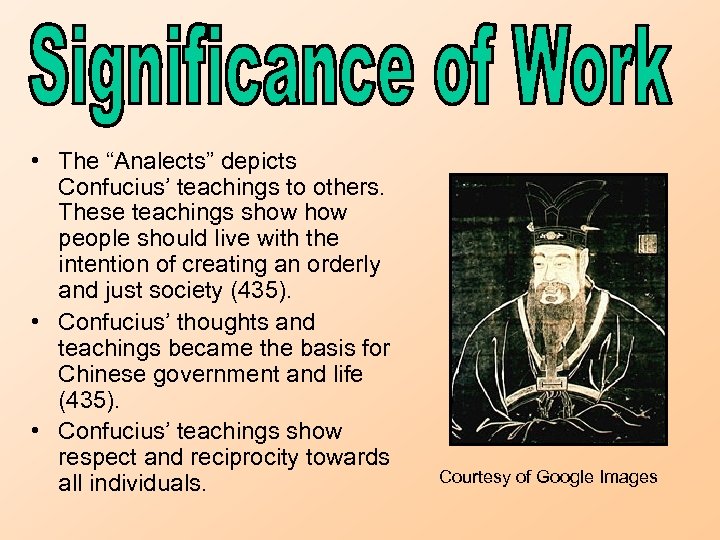
• The “Analects” depicts Confucius’ teachings to others. These teachings show people should live with the intention of creating an orderly and just society (435). • Confucius’ thoughts and teachings became the basis for Chinese government and life (435). • Confucius’ teachings show respect and reciprocity towards all individuals. Courtesy of Google Images
What do you think? Were the Analects surprising in any way? The teaching in the Analects were not surprising because I believe that you should live by those teachings. Overall, these teachings explain that if you wouldn’t like something to be done to you, then don’t do it to others. In addition, if you were to follow your heart, and not worry to much your future will turn out better. Comprehension Check : What kinds of behavior does Confucius talk about in the Analects? Confucius talks about worrying, being respectful, loyal, kind, hesitation, courage, hesitation, and courtesy. What does Confucius mean by the word reciprocity? Reciprocity means that if you don’t wish for something to be done to you, then don’t do it to others.
What kind of person does Confucius seem to be? Confucius seems to be a person whom wants the world and society to be a better place. He isn’t selfish; on the contrary he cares for others and tries to make the best out of every situation. Do you think Confucius views human nature in an optimistic or pessimistic way? Explain your opinion. It seems as if Confucius views human nature in a pessimistic way because he tells us all the wrong we are doing as human beings in order to help us improve. Does Confucius seem more concerned with individual behavior or with behavior toward others? Confucius seems more concerned with behavior towards others because he talks about how people should treat others with respect, and how in order to get their respect you must do the same.
Do you agree with all of Confucius’s teachings? Explain your opinion. I agree with all of Confucius teachings because they are all based around the concept of respecting humanity, gentleman, and ritual. I believe that you should guide your life with reciprocity in order to have a fair and just society. One critic suggests that reading the Analects is like being invited into a conversation with Confucius. Do You think this is a helpful way of approaching theses experts? Explain your answers. Approaching Confucius teachings through a conversation is helpful because it helps you put yourself in the situation and realize what he is saying.
Choose one of Confucius’ sayings that you think relates directly to life today. Explain your choice. “To study without thinking is futile. To think without studying is dangerous. ” (437) This relates directly to life today because if you aren’t thinking about the material you are studying, then you aren’t going to know what you just studied. It will be dangerous because when you need to know what you studied you will not know, and the time you had tried to studied without thinking would become useless.
• “Confucius” October 18 2006. <http: //en. wikipedia. org/wiki/Confucius> • “Confucius” October 18 2006. <http: //plato. stanford. edu/entries/confuci us/>
• Applebee, Arthur N. , et. al. The Language of Literature. Evanston, IL: Mc. Dougal Littell Inc. , 2003. • “Confucius” Online Image. October 20 2006. <www. witn. psu. edu/. . . /newsmaker. phtml? show_id=9> • “Confucius” Online Image. October 20 2006. <http: //www. bigwhiteguy. com/images/sides/festival/15. jpg> • “Confucius” Online Image. October 20 2006. http: //myhero. com/Reading. Room/books/confucius. jpg • 21 Oct 2006 <http: //www. meet-greatwall. org/zhuanzhu/wen/gwcn/pho/150. jpg>. • 21 Oct 2006 <http: //img. auctiva. com/imgdata/1/0/1/5/0/7/webimg/14158014_o. jpg>. • 21 Oct 2006 <http: //us. st 11. yimg. com/us. st. yimg. com/I/asianideas_1919_26333666>. • 21 Oct 2006 <http: //libweb. hawaii. edu/libdept/asia/books/images/singapore/11. jpg>. • 21 Oct 2006<http: //www. historyforkids. org/learn/china/clothing/pictures/tangyinming. jpg>. • 22 October 2006 http: //www. amgmedia. com/freephotos/tea_cup. jpg • 22 October 2006 http: //www. brainybetty. com/bw. ART 2004/yin_yang. jpg • 22 October 2006 http: //gddweb. org/chinesedr. jpg • 22 October 2006 http: //www. rivendellsod. com/Assets/wheelbarrow. jpg
• Applebee, Arthur N. , et. al. The Language of Literature. Evanston, IL: Mc. Dougal Littell Inc. , 2003. • 22 October 2006 http: //um-jmh. org/images/healthlibrary/Herbal_DS. jpg “Analects”. No Date. Online Image. Geometry. Oct 22 2006. <http: //images. amazon. com/images/P/0140443487. 01. LZZZZZZZ. jpg>. “Li Po and Tu Fu”. No Date. Online Image. Picture Swamp. Oct 22 2006. <http: //www. urbanhonking. com/pictureswamp/archives/li%20 po%20 tu%20 fu. jpg>. “Poem by Wang Wei”. No Date. Online Image. Chinese Art. Oct 22 2006. <http: //www. chineseartnet. com/Shen/shen 20. jpg>. “Karakorum Routes”. No Date. Online Image. Wikipedia. Oct 22 2006. <http: //en. wikipedia. org/wiki/Image: Karakorumroutes. jpg>. “Wu Zeitan”. No Date. Online Image. Wikipedia. Oct 22 2006. <http: //en. wikipedia. org/wiki/Image: Wu. Zetian. jpg>. “Kaiser Canal”. No Date. Online Image. Wikipedia. Oct 22 2006. <http: //en. wikipedia. org/wiki/Image: Kaiserkanal 01. jpg>. “Alexander the Great”. No Date. Online Image. Wikipedia. Oct 02 2006. <http: //en. wikipedia. org/wiki/Image: Alexanderthe. Great. jpg>. “Muhammad”. No Date. Online Image. Faith Freedom. Oct 02 2006. <http: //www. faithfreedom. org/muhammad. gif>. “Palestra at Olympia”. No Date. Online Image. Oct 22 2006. <http: //en. wikipedia. org/wiki/Image: Palestra_at_Olympia. jpg>. “ 2002 Winter Olympics Flame”. No Date. Online Image. Wikipedia. Oct 22 2006. <http: //en. wikipedia. org/wiki/Image: 2002_Winter_Olympics_flame. jpg>.
• • • http: //en. wikipedia. org/wiki/Wang_Wei http: //en. wikipedia. org/wiki/Grand_Canal_of_China http: //en. wikipedia. org/wiki/Olympic_Games#Modern_Olympics Image of Shang Dynasty art www. culture. gr/2/21/21108 m/00/lk 08 m 023. jpg Information on Shang Dynasty http: //en. wikipedia. org/wiki/Shang_Dynasty Image of Confucius http: //static. flickr. com/13/14883623_cb 1 bb 55 bb 4_o. jpg Image of Great Wall of China www. medieval-castles. org/castles/images/Great. Wall Image of Empress Wu http: //www. mynetcologne. de/~nc-jostenge/banas-Dateien/image 002. gif Information on Empress Wu http: //www. fofweb. com/Nu. History/default. asp? Item. ID=WE 49&New. Item. ID=True Image of Chinese Calligraphy http: //chinese. bendigo. latrobe. edu. au/Chinapic. gif

“Tao Te Ching” 道德經 By: Lao Tzu and “The Fish Rejoice” 魚高興 Courtesy of Google Images Background shows Chinese Art of fish rejoicing By: Chuang Tzŭ Alicia Barroso Period 6 IGCSE Class

Introduction Ø Ø Ø Lau-Tzu is credited with being the first philosopher of Taoism (Applebee 440). Lao-tzu is not his real name, but he has been called that for its meaning. Lao-Tzu means “Old Master” or “Old Philosopher” (440). Lao-Tzu is recognized a person who sought virtue and harmony with the universe rather than fame (440). Lao-Tzu was begged by a border guard, to write down his teachings and he did so in the Tao Te Ching (440). The Tao Te Ching includes the dogma, or beliefs, of Taoism. (440). Drawing Of Lao-Tzu Courtesy of Google Images

Introduction (continued) Ø Ø Ø Some scholars argue that the Tao Te Ching was written by probably more than one author in the third or fourth century (440). Even though we may never be certain whether Lao-Tzu had anything to do with the writings, he has been a honored idol for many centuries in China (440). Lao-Tzu has been titled a philosopher, a saint, and even a God by others (440). The Taoist teachings have been essential to the establishment of a Chinese civilization (440). The Taoist focus on simplicity and harmony has been valued for more than 2, 000 years (440). Above is Lao-Tzu on a bull Image provided by Google Images

Background on the Tao Te Ching Ø Ø Ø Ø The Tao Te Ching is a book of approximately 81 pages and is the best-known work in Chinese literature(441). It is the second most translated book in history, second to the Bible, (441). Tao Te Ching can be translated into The Book of the Way and its Virtue, and it concentrates on teaching what is referred to as the way, or “the Tao”(441). Whereas Confucian precepts focus on the proper behavior of the individual and respect for order in society, the Tao seeks harmony (441). The Tao gives birth to all living things, and simultaneously becomes part of all living things. (441) The Tao is a force that drives all things toward being in harmony with their true nature (441). To live accordingly with Taoist thought, a person must be close to nature and live in simplicity and joy (441). Wu-wei, the important concept meaning non-action, means that instead of being competitive, ambitious, and active, a person should just let things happen (441).

Key Concepts Ø Paradox– A paradox is a statement that seems contradictory but is actually true. Paradoxes force the reader to concentrate on the certain verse in order to solve the puzzle and understand what is being spoken of (441) Ø Maxim- A maxim is a short concise statement that expresses a general truth or rule of conduct. Maxims condense important ideas into memorable language that gets the reader's attention. Some maxims are phrased in a particularly pointed an witty way. (435) Ø Parallelism- Parallelism is the use of similar grammatical constructions to express ideas that are related or equal in importance. The parallel elements may be words, phrases, sentences or paragraphs. (577)

Maxim A maxim is a short concise statement that expresses a general truth or rule of conduct. Maxims condense important ideas into memorable language that gets the reader's attention. Some maxims are phrased in a particularly pointed an witty way. Because of their clever yet simple structure such maxims sometimes called aphorisms – are easy to recall and memorize Examples from the passages of the Tao Te Ching: l “If you look to others for fulfillment, you will never be fulfilled” (442). l If your happiness depends on money, you will never be happy with yourself”(442). l “When there is no desire, all things are at peace” (442). l “Be content with what you have; rejoice in the way things are. l This maxim states that if you look to others for fulfillment you will never be truly fulfilled because you need to fulfill yourself; you need to be happy with what you are if you want others to be happy with you. Likewise, if you look for respect, you first must respect yourself if you expect others to respect you. This maxim reveals that money is only temporary and can only do so much, so if your happiness true depends on money, you will never be happy with yourself because you will always want more money and you never will be satisfied. When there is no desire, there also is no jealousy, nor crime. No desire brings a huge state of peace because people can get along since material objects or other desires wont get in the way. When you realize there is nothing lacking, the whole world belongs to you” (442). This maxim declares people should be content with what they have. When people find happiness in what they have, then they notice the world belongs to them, nothing is lacking. A relevant quote to compare this maxim to is “happiness is not having what you want. Happiness is wanting what you have” If powerful men and women could center themselves in it [the Tao], the whole world would be transformed by itself, in its natural rhythms. People would be content with their simple, everyday lives, in harmony, and free of desire” (442). If people would let the natural rhythms of life, there would be no regret, no worry, no desire. People would be happy with simple lives and they wouldn’t have that chaotic possessive ambition of an unceasingly desire of wanting more and more.

Vocabulary Ø Ø Ø Integrity: personal honesty and uprightness (442). Communal good: welfare of the community (443). Chuang Tzu: A Taoist philosopher of the fourth century B. C. , author of book (called Chuang Tzu as well) that is one of the main works of Taoist literature (444). Hui Tzu: a Confucian scholar and senior minister at the royal court, with whom Chuang Tzu had a friendly rivalry with (444). Hao: a river in the province of Anhwei in Eastern China (444).

Parallelism is the use of similar grammatical constructions to express ideas that are related or equal in importance. The parallel elements may be words, phrases, sentences or paragraphs. ØExamples from the passages of the “Tao Te Ching” “Fame or integrity: which is more important? Money or happiness: which is more valuable? Success of failure: which is more destructive? ” (442) “If you look to others for fulfillment, you will never be fulfilled. If your happiness depends on money, you will never be happy with yourself”. (442) “The best athlete wants his opponent at his best. The best general enters the mind of his enemy. The best businessman serves the communal good. The best leader follows the will of the people”. (443) ØExamples from the “The Fish Rejoice” “You’re no fish, ” said Hui Tzu. “How could you know their joy? ” (444) “You’re no Chuang Tzu, " said Chuang Tzu. “How could you know I don't know the joy of fish? ” (444)

Significance of the Tao Te Ching Ø Ø The Tao Te Ching is significant because it is one of many philosophies/religions which help form peoples’ identity and help them find meaning in their existence. It is important to know that each of us are significant to the world, and the Tao Te Ching teaches people how to practice wu-wei and let life take you face-to-face with your purpose so that you may complete it. The Tao Te Ching can be interpreted in various ways. When in need of guidance, individuals could read the passages and attempt to make sense of life, and what they should do in order to live the best life possible (didactic literature). The Tao Te Ching is in some aspects unexplainable. Many may wonder about the Tao and its specific, detailed, role in this belief, but their questions remain vaguely answered. There can be controversy on the issues raised by this work. For example, in questioning “which is more destructive, success or failure, ” failure is obviously destructive in that out of a possible outcome, the result was negative. That is, standards or expectations where not met, and thus that is destructive in that it can bring resentment upon the person deemed as a “failure. ” It can destroy the person, not allowing them to move on from what they failed, thus not allowing for improvement. One can argue that success is most destructive because success inflates the ego of man. When this occurs, the man typically becomes thirsty for more success, more power, more control, which leads to a blind ambition and ignorance. In the given case, success is definitely destructive, because the excess of ambition has turned into arrogance, and it is rare that this person can be truly successful afterwards. When discussing the maxim “when there is no desire, all things are at peace, ” I would say I disagree, because without desire, I think there is no purpose in life. Why live, if there is no chance for advancement, no chance for change. Is peace necessarily what humans consider to be most important? . Ironically, while forbidding oneself from desiring, to attain peace with one’s surroundings, one is desiring Peace. Therefore the followers of Taoism are not avoiding desire, as “ this force move[s] them in harmony with nature” (441), but they are nonetheless sublimely working towards something, which is still “desiring. ”

Ø Ø Ø Significance of The Fish Rejoice This passage makes humans wonder: do you really have to be whatever it is you are trying to understand, in order to understand it? Can anything ever be completely understood by all means possible? The Fish Rejoice uses a simple incident, such as fish swimming about joyfully, to pose a question that has been asked several times and evidently, since the writing of this story. The passage deals with understanding. Ancient Greek philosophers taught about the art and science of understanding during the time of the Greek polis. The concept of Understanding has been the point of discussion many times around the world; this shows how ancient peoples questioned life and desired to understand life, and the unknown. Hui Tzu is a Confucian scholar, adhering to the importance of form to demarcate boundaries. Hui Tzu, in contrast is a Taoist philosopher, emphasizing the Tao’s versatility as a life force that indwells all things. Thus their argument becomes that of form versus content and who decides “correct” thought. People in a society may attempt to understand certain things, and they might have found it quite hard to do so. Hence philosophy and/or religion aid society comprehend phenomenon, especially in times of political, social, and natural chaos. Chinese drawing of fish rejoicing Courtesy of Google Images

Research http: //en. wikipedia. org/wiki/Tao_te_ching This website was used to research on the writing Style of Lao -Tzu. Information on the beliefs of Taoism and the role of Lao -Tzu in Taosim helped me understand his poem the “Tao Te Ching”. Ø http: //en. wikipedia. org/wiki/Chuang_tzu This page enriched me with information on Chuang-Tzu, and his beliefs that all living thing in nature where equal. This gained knowledge on his perspectives allowed me to understand “The Fish Rejoice” Ø http: //www. abichal. com/html/spirituality/lao_tzu. htm This website provided a biography on Lao-Tzu. Taoist thought was discussed in this article and the concept of wuwei. The article also included picture of Lao-Tzu and told the tale as to why he wrote the Tao Te Ching. Ø

Works Cited Ø Ø Ø Ø Applebee, Arthur N, et all. The Language of Literature. United States of America: MC Dougal, 2003. Abichal, "Lao Tzu. " Who was Lao-Tzu? . 2003. Abichal. 21 Oct 2006 <http: //www. abichal. com/html/spirituality/lao_tzu. htm>. Abichal “Lao_Tzu”. 2003. Online Image. 21 Oct 2006 <http: //www. abichal. com/html/spirituality/lao_tzu. htm> Tang, You-Shan. Christ the Eternal Tao. Platina, CA: Saint Herman Press, 1999. Unkown “Chinese Fish Wall Scroll”. Online Image. October 24, 2006. <http: //www. asianartistsonline. com/images/scrolls/wall-scroll-lg 1/a. IMG_3915. jpg> Wikipedia, "Tao Te Ching. " The Text: Historical authenticity. 23 Oct 2006. Wikipedia. 23 Oct 2006 <http: //en. wikipedia. org/wiki/Tao_te_ching#Historical_authenticity>. Wikipedia, "Tao Te Ching. " Interpretation and themes. 23 Oct 2006. Wikipedia. 23 Oct 2006 <http: //en. wikipedia. org/wiki/Tao_te_ching#Interpretation_and_ themes>. Wikipedia, "Zhuangzi. " The beliefs. 23 Oct 2006. Wikipedia. 23 Oct 2006 <http: //en. wikipedia. org/wiki/Chuang_tzu#The_beliefs>.

Question and Answer Which of the teachings do you most agree with? Explain your choice. I agree most with the teachings of Lao-Tzu from the Tao Te Ching. Similar to the Tao Te Ching, I believe that ambition and the yearn for material possession is what has brought about problems and unhappiness in people. I know that the more one person has, the more they want, and the harder it gets to satisfy that person. Evidently, there comes to a point when a person is unhappy with oneself or the life they live, either because they don’t know what to live for if they already have anything they could possibly want, or nothing seems to satisfy them anymore. On the contrary, to one who lives a simplistic life, any little thing makes them happy, and are usually in a more harmonious mood amongst one another. I don’t exactly agree with “the Fish Rejoice”, because I have previously noticed I can’t fully understand something unless I’m in there shoes; or unless I am that. I can even say I don’t fully understand myself at times, so how could one know whether or not the fish are happy. People tend to assume things, that aren't necessarily true, and in many circumstances, it has caused problems. 2. In Passage 37, the writer refers to “powerful men and women”. What do you think is the Taoist attitude toward being a powerful person? The Taoist attitude toward a powerful person is not very admiring. Taoism probably think that powerful people are the ones who cause all the problems in the world because they go against the Tao. Powerful men and women have many desires and goals and that causes a lot of problems because the world is not at peace. Others viewing how successful powerful mean and women have become, want to do the same, and once again the Taoist beliefs are affected and not followed. 1.

Question and Answer (continued) 3. According to your understanding of Taoist thought, what do you think are the correct answers to the questions posed in passage 44? Explain your ideas. -Fame or integrity: which is more important? Integrity is more important because one has to be honest and truthful to themselves and the others surrounding them. Fame would not be consistent with having a “simple, everyday life”(442). Also : If you look to others for fulfillment, you will never be truly fulfilled” (442). This statement states that if you look to others for acceptance or in hopes of gaining fame, then you will never be fulfilled; you will only be content by being truthful to yourself (having integrity) and finding it inside of yourself. A person will be respected and trusted by their integrity, not fame -Money or Happiness: which is more valuable? One’s happiness is more valuable according to Taoist thought because “if your happiness depends on money, you will never be happy with yourself” (442). money is a desire, and when there is desire, things are not at peace, hence there is no happiness. Happiness is more valuable than money because it is priceless, and one can have all the money in the world and still not be satisfied. -Success of Failure: which is more destructive? According to my understanding of Taoist thought, Success would probably be the most destructive of the two because great success alters the ego of the man. When a man grows too prideful, he becomes arrogant and blind to the truths that surround him, and he slowly destroys himself because of his ambition for power. With success, man only covets more success because of course one is never content when they desire so much, and hence, such ignorance can easily lead to self-destruction.

Question and Answer (continued) 4. In passage 68, the writer speaks of competing in a “spirit of play”. What do you think he means? By competing in a “spirit of play”, the author means that people should compete like children, in a happy spirited mood, like if life where just a game with no real consequences. The writer thinks that humans should compete for mere fun, not giving importance to winning or losing. (443) 5. Identify paradoxes. Discuss the paradoxes you identified and their meanings. -The Tao never does anything, yet through it all things are done(442). The Tao is a force that doesn’t do anything, its not an actual person or action, but everything in life is done through the Tao. All the natural process of the Earth, and interaction between humans are all done through the Tao. -Success of Failure: Which is more destructive? In the eyes of Lao-Tzu, failure, which literally means destruction, is least destructive than success. Success can create a high ego to the man, and that will lead to blind ambition and arrogance, which is failure. (442) 6. Reread “The Fish Rejoice” on page 444. Which of the excerpts from the Tao Te Ching relates most closely to this tale? Support your ideas with details from the selections. “When there is no desire, all things are at peace””(442) relates most closely to “The Fish Rejoice”. Similarly “Be content with what you have; rejoice in the way things are”(412)relates the most to the poem “The Fish Rejoice”. Fishes don’t have desires, besides surviving, eating, and probably intercourse. Since they don’t have any desires, all things are at Peace and they can rejoice with one another. The fish are content with what they have because they really cant use a big beautiful house, or any other material possession, thus they “rejoice in the way things are”(442), and are happy that way.

Question and Answer (continued) 7. Compare the passages you have read from the Tao Te Ching with the selection from the Analects on page 437 -438. How do the two schools of thought differ in their teachings about conduct in everyday life? How do they compare in their attitudes toward leadership and authority. The selection of the Analects and the passages of the Tao Te Ching compare in that they both are philosophies in life. Both stories are moral teachings that guide one into having a happier righteous life. The two schools of thought differ in their teachings of conduct in everyday life in that the passages from the Tao Te Ching tell humans to allow things to happen, let the rhythms of life take you so you can find the “way”, whereas the selection of the Analects encourages one to act up and treat others courteously. The analects encourages one to have humanity and allows believes that proper people should practice rituals, from everyday manners to religious observances. (435, 441) 8. How would life in modern American society change if people lived according to Taoist teachings? Do you think the change would be for the better? Explain. Life in modern American society would change into a dormant, withering society if people lived according to Taoist teachings. America is all about competition and working hard to excel in life. Thanks to the sweat, blood, and tears of our forefathers, America has grown into a World Power. I believe the change would be for the worse. If we would live according to Taoist thought, there would be no advancement in technology. Technology advances and new products come out into the market due to competition; competitors create the best projects to try to lure consumers into buying their product. The common hope that one can sustain a better lifestyle in the future, or that one can accomplish “The American Dream” makes people work hard and thus advance this nation.

“The River-Merchant’s Wife: A Letter” By: Li Po “Still Night Thoughts” By: Li Po and “Gazing at the Lu Mountain Waterfall” By: Li Po A painting of Li Po Courtesy of Google Images Alicia Barroso Period 6 IGCSE Class

Introduction • The best-known poet of China is probably Li Po. He was a romantic rebel who spent his life writing poetry, traveling and enjoying time with his friends. (452) • As he traveled, Li Po liked to emphasize his unique beginnings, having been born in Asia, where his family had gone into exile (452). • Even though he had demonstrated great literary talent from an early age, Li Po never took the civil-service exam which could have earned him a government position. This is one way in which we know the poet is a non-conformist (452). • While Li Po spent some time as a Taoist recluse in the mountains, he did marry at least twice and fathered children (452). • After being appointed poet to the T’ang capital of Ch’ang-an, he was dismissed two years later probably due to his “outrageous behavior” (452). Background picture from frontpage. simnet. is The Picture Shows Li Po traveling, something he did many times throughout his life. He went on a famous voyage with Tu Fu and when he came back, he wrote The narrow Road to the Deep North”, a story/poem describing his voyage to a region known as Oku.

Introduction • Li Po became involved in political intrigue and was sent to jail and later exiled. He was forgiven at a later time but became sick while political chaos continued. He continued to travel, and died from an illness while visiting a family member in the winter of 762 (453). • The T’ang dynasty experienced a flourishing of literature unsurpassed by all the history of China. More than 2, 200 poets where writing during the highlight of the T’ang period, and their 49, 000 poems that have survived, complete only a portion of their fascinating work, partly due to Empress Wu (453). • Two major poets of the time where Li Po and Tu Fu. Ti Fu was more formal and serious in his poetry, whereas Li Po was energetic and unrestricted. Li Po favored poems that would allow the writer to vary and express themselves freely, rather than the poetic forms that required strict regular lines and patterns (453). • His writing topics varied, but where centered around friendship, drinking, nature, solitude, love, and his desire towards other places and time (453).

Key Concepts Imagery- words and phrases the create vivid sensory experiences for the reader. Imagery makes the descriptions and experiences talked about in the poems sharp and memorable (453). Visualize – To form a mental picture from a written description. Vivid details in a description of a scene from nature helps the reader see the scene in their imagination (453). Parallelism- Parallelism is the use of similar grammatical constructions to express ideas that are related or equal in importance. The parallel elements may be words, phrases, sentences or paragraphs (577).

Explain/Analyze/Visualize The River-Merchant’s Wife reveals the desires and aches of a young woman who is married to a river merchant. Throughout her letter she speaks/writes in a serious sorrowful tone. She begins by describing the scene in which she met what she later refers to as her “Lord”(454). At age 14 she married her “Lord, ” revealing how in ancient times, Chinese girls where married in their teenage years. At first there is no evident communication shown between her and her “Lord”. She seems uncomfortable near her husband, typical of young marriages, which for the most part, were arranged. She doesn’t appear to have much affection for her husband until age 15, when she “stopped scowling” (454). Moreover, she states “I desired my dust to be mingled with yours forever and forever” (454). Then at age 16, the river-merchant (her husband) goes on trips, traveling through the river to market areas/cities, where he can trade products and purchase new ones to profit and gain fascinating items from distant places. His departure saddens this young wife, who after five months of waiting, expresses her sorrow by emphasizing the time he has been away. She states “By the gate now, the moss is grown, the different mosses, too deep to clear them away!” (455). She evidently is eager to see him again. She looks forward to their reunification when she states “If you are coming down through the narrows of the river Kaing, please let me know beforehand, and I will come out to meet you, as far as Cho-fu-Sa. ” She wants to know if he will come down the river, so that she can go see him. Scene of a River Market, where rivermerchants trade their goods. Courtesy of Google Images

Explain/Analyze/Visualize Still Night Thoughts depicts the speaker’s remembrance of home as he looks at the moon. One interpretation could be that the speaker remembers the climatic conditions of the location he considers his home (snowy/frosty) as when he “mistakes the moonlight for frost in the ground”(456), and this brings back memories of home. One can visualize the character rapidly lifting his head with enthusiasm and illusion, hoping to discover that he is at home, or at least nearby similar to the lit-up face of a little boy when running to the Christmas tree on a Christmas morning, and hoping to see what wonderful gifts “Santa has brought for him”. After noticing the bright moon and realizing he “mistook the moonlight for frost”, the character is disappointed and saddened. He lowers his head, similar to when a one hears horrible grieving news, such as hearing of the death of a loved one. He dreams of home, probably in a frigid climate, revealing that while he can’t have it in reality, he might as well enjoy it in his dreams. Courtesy of www. chinese-poems. com The image to the left shows the poem Still Night Thoughts in its original form, traditional Chinese. It also includes a phonetic in English.

Explain/Analyze/Visualize Gazing at the Lu Mountain Waterfall talks about the adoration the speaker has for this natural setting. Li Po shows deep admiration for the river because of its purity, and he supports this by stating “there the world’s dust [is] rinsed from my face”(457). The same admiration is not extended to mankind, however. He appears to be escaping “that peopled world forever” (457). Given what we know of Li Po, the speaker of the poem may be voicing the author’s disagreement with the complexity of civilization. As a Taoist recluse, Li Po did find solitude in the mountains preferable for some time during his life. Perhaps he felt that spending time alone with nature may bring him closer to it. The speaker makes the river seem powerful when saying he “looks up into force churning in strength (the waterfall), all power, the very workings of Creation” (457). He relates the power to the very workings of Creation, possibly suggesting the river and its dashing strength takes part in the workings of Creation. In this way, the Force, or Tao, is the power of creation, working through all living things. It is obvious that the speaker believes the most important relationship one can ever have is with nature. He proves his love for nature when declaring “I’ll stay close to what I’ve always loved”(457). The image above shows the Lu Mountain Waterfall in Japan. Courtesy of Google Images

Imagery Ø Imagery- words and phrases the create vivid sensory experiences for the reader. Imagery is used by Poets to allow the reader to quickly grasp details such as sights and sounds and easily comprehend them. Ø Examples from “The River-Merchant’s Wife: A Letter”: “My hair was still cut straight across my forehead”(454) -shows that the character still has a simple child haircut, not a detailed one, which is more suitable for a young woman. “I never laughed, being bashful”(454) -shows character is shy, or perhaps uncomfortable with her husband, probably because it was an arranged marriage or because she is so young. “I desired my dust to be mingled with yours” (454) -The character matures, and now feels attraction towards her husband wants to be with him now. She now feels in need of him and wants to be with him forever. “You dragged your feet when you went out”(455) -Her husband the river-Merchant does not seem like he wanted to leave his wife behind, or did not seem eager to depart and this voyage. He has feelings for her and cares for her, he doesn’t want to leave her alone. ” Ø Examples from “Gazing at the Lu Mountain Waterfall”: “Here the World’s dust is cleansed from my face”(457) -Reveals the purity of the river and nature and the adoration the speaker has for the River “The heart grows rich with repose”(457) -Describes the calmness the speaker experiences when looking at the waterfall while visiting Lu Mountain ”Sudden as lightning breaking into flight, its white rainbow of mystery appears. ”*457) The speed of the water falling from the waterfall is fast like lightning in the sky

Visualize ØVisualize – To form a mental picture from a written description. Vivid details in a description of a scene from nature helps the reader see the scene in their imagination. (453) ØExamples from “The River-Merchant’s Wife: A Letter”: “By the gate now, the moss is grown, the different mosses, Too deep to clear them away!” (455) -Since he has not come back, the gate is untouched, and thus moss is growing off it. He has been a way for so long that the different mosses are too deep to be cleared away of. She probably didn’t go out much, she most likely stayed home, pondering upon the arrival of her husband. ØExamples from “Gazing at the Lu Mountain Waterfall”: ”Sudden as lightning breaking into flight, its white rainbow of mystery appears. Afraid at first the celestial Star River is falling, splitting and dissolving into clouds of heaven, I look up into force churning in strength, all power, the very working of creation. ” (457) -One can visualize the water rapidly pounding down the waterfall. The view is as amazing as the celestial Star River, the Milky Way. The water dissolves into clouds of heaven which is the mist at the bottom of the waterfall. The force of the falling water is extremely strong, its even compared to the Force of the very working of creation.

Vocabulary Chokan: a town near Nanking in eastern China, located on China’s longest river, the Yangtze River (454) “Why should I climb the look out”: a reference to the story of a young wife who spent years in a tower, watching for the return of her departed husband (454) Ku-to-en: a marrow dangerous section of the Yangtze, far up river from the Chlkan (454) Eddies: whirlpools (454) River Kiang: the Yangtze River (455) Cho-fu-Sa: “Long Wind Beach” several hundred miles upriver from Chlkan (455) Incense-Burner Peak: a peak of Lu Mountain in China’s Kiangsi province. Seeking to escape a war in his home region, Li Po moved to a town near Lu Mountain for a time (455) Celestial Star River: the milky way (455) Repose: rest; calm (455) Elixirs of immortality: magic potions with the power to make people live forever (455)

Examples of Parallelism is the use of similar grammatical constructions to express ideas that are related or equal in importance. The parallel elements may be words, phrases, sentences or paragraphs. Examples: “At fourteen I married My Lord you…” (454) “At fifteen I stopped scowling…” (454) “At sixteen you departed…” (454) “Forever and forever”(454)

Significance of The River-Merchants Wife: A Letter The letter “written” by a river-merchant's wife is significant because it allows others in a similar situation to relate to her sorrow and feelings. The letter reveals a typical life of a river-merchant’s wife. In her letter to him, she reminisces the time they first met. She thinks of their past, when they where physically together, when they married, and finally, she remembers his departure. She freely portrays her agony for his being away. This shows the dependency of women on men in past times. She repeatedly refers to her husband as her “Lord, ” and this epithet demonstrates the relationship between a man and his wife in past times; the man was more powerful and important than the woman, and held control over her. The couple was married when she was 14, an extremely young age for present time in America, but in ancient times, young marriages where common, especially arranged marriages. Her husband was probably much older than she was, also true of ancient cultures. The sketch above is a picture of a young Chinese married couple in the late 19 -th century Courtesy of Augustpoetry. org

Significance of Still Night Thoughts This poem is significant because it shows the loneliness/solitude of one’s thoughts when we have time to ponder. It demonstrates how people often dream of better lives or good things. Right before a person goes to sleep they think about something they love, be it a lover, family, or God. The process of staring up into the sky when thinking is significant because back then the sky was quite unknown compared to all the information we have now. Hence, people would look up to the heavens when they had some sort of question or desire. They would look up in hope that whoever/whatever was up there would listen, or that they could figure out what they where unsure of. Per the introduction to this work, the moon is of great significance to Li Po. One third of his poems are based on the moon. The MOON IS… The fact that the speaker mistook the moonlight with frost shows that, sometimes people see what they want to see. We might believe what we want to believe and try to disguise the truth. When the speaker lifts up his head, he is doing so to check if what he took for frost really is frost. His expression might be similar to that of a person who is eager to open a birthday present and see what it is. When he notices he mistook the moonlight for frost, the speaker seems quite bummed out and disappointed; he lays his head down, similar to the reaction of a little kid who’s dad keeps missing his soccer games. Nonetheless, the speaker does not lose hope and he dreams about home. It is important for man to retain hope. Even when one undergoes temporary suffering, one does so with a bigger picture in mind; The person hopes for a better future. Without hope, no one would have the strength to keep on going, nor would they find much purpose to life.

Significance of “Gazing at Lu Mountain Waterfall” is significant in that it shows the valuable connection with nature valued by many followers of Taoism. This poem reveals the ideal relationship between a human and the world’s natural environment. The speaker reveals his adoration and love towards nature, as well as his desire to stay with it when saying ”I’ll stay close to what I’ve always loved, content to leave that peopled world forever” (457) The author believes nature is pure; he prefers being in solitude rather than in the peopled world, corrupt, chaotic, and impure. We see evidence of this preference in that “the world’s dust (the dirtiness of the sinful human world) [is] rinsed from my face (the river is pure and thus cleans the soul)” (457). The lines, “climbing west towards Incense-Burner Peak” and “hanging there, three thousand feet high”(457) in the passage emphasize Li Po’s effort to get to this beautiful scene. Lu Mountain’s waterfall is spectacularly beautiful in the eyes of Li Po writes about the cascade which such emotion and enthusiasm. He notices the importance of the Tao. The speaker states “It keeps ocean winds blowing ceaselessly, shines a mountain moon back into empty space, empty space it tumbles and sprays through, rinsing green cliffs on both sides, sending pearls in flight scattering into mist and whitewater seething into towering rock” (457). Li Po admires the river for its strength too, he compares the great force of the river to the force of Creation. Background Image shows the Yangtze River in china, which passes through Lu Mountain Courtesy of: China Discovery Tours Website

Research http: //en. wikipedia. org/wiki/Li_Bai In this website, I researched information over Li Po (Li Bai). There I found a biography on Li Po, which talked about his constant traveling and mentioned many of his poetic works. http: //www. eliteskills. com/analysis_poetry/Gazing_at_the_Cascade_on_Lu_ Mountain_by_Li_Po_analysis. php This website was about the poem “Gazing at the Lu Mountain Waterfall”. It analyzed parts of the poem and there I noticed differences in the wording of the poems depending on the source. I concluded translations are only so correct, and thus the meaning of poems can be easily misinterpreted or confusing. http: //nation. ittefaq. com/artman/publish/article_30612. shtml This website supplied information on Taoism and human relationships with nature. It said the old Chinese term stating “ a picture is worth a thousand words” means everyone views a picture of painting differently, depending on the ability of people to convey the intentional message, and thus 1000 ideas or words can be thought up of to explain the one painting or picture. In addition it talked about the emphasis in nature, human relations with nature, literal interpretation of nature, and spiritual reflections.

Works Cited Applebee, Arthur N, et all. The Language of Literature. United States of America: MC Dougal, 2003. Bachman, Bill. “Busy Water Market River” 2006. Online Image. October 22, 2006. <www. painetworks. com/pages 2/hf/hf 1375. html> Bohrn, Jon. “Young Married Couple” 2004. Online Image. October 24, 2006” <www. augustpoetry. org/passage/river_merchant. htm> China Discovery Tours. “Yangtze River”. Online Image. October 24, 2006 <http: //www. chinadiscoverytours. com/image/2005 Yangtze-river-1_lg. jpg> Buckler, Mc. Kay Hill. "A History of World Societies. " 4 th. 1999. Houghton Mifflin. 23 Oct 2006 Khan, S. A. . "Art and Culture. " Nature in Chinese Paintings. 06 09 2006. The New Nation. 24 Oct 2006 <http: //nation. ittefaq. com/artman/publish/article_30612. shtml>. Wikipedia, "Li Bai. " Biography. 23 Oct 2006. Wikipedia. 23 Oct 2006 <http: //en. wikipedia. org/wiki/Li_Bai>. Wikipedia, "Li Bai. " Poetry. 23 Oct 2006. Wikipedia. 23 Oct 2006 <http: //en. wikipedia. org/wiki/Li_Bai>. "seething. " Dictionary. com Unabridged (v 1. 0. 1). Based on the Random House Unabridged Dictionary, © Random House, Inc. 2006. 23 Oct. 2006. <http: //dictionary. reference. com/browse/seething>

Question and Answer 1. Which of these poems appealed to you the most? “The River-Merchants Wife: A Letter”, was most appealing to me. The reason why it was appealing was because I know how it is to miss someone you love, and at times, you feel helpless. I could easily understand an relate to this poem. -In “The River-Merchants Wife: A Letter”, why is the wife writing a letter? The wife is writing a letter to her husband saying how much she misses him and she tells him to notify her in advance if he is coming down through the narrows of the river Kiang, so that she can meet him, wherever it is that he is (455). -In “Still Night Thoughts”, what does the speaker say the moonlight looks like? The speaker says the moonlight looks like frost. (456) -What kind of scene does the poet describe in “Gazing at the Lu Mountain Waterfall”? The Poet describes beautiful scene, that is pure and majestic. 2. How would you describe the relationship between the speaker of “The River- Merchant’s Wife: A Letter” and her husband? -There seems to be an emptiness between them, could be the distance. They have known each other for only 3 or 4 years, yet have such a strong attraction for each other. They evidently care about each other. We can see the husband reluctantly leaves his home, when the speaker states “You dragged your feet when you went out” (455). The letter she writes to him is the telling of her soul. She is eager to know if he’ll becoming down the river again so that she can meet up with him (455), because she cant stand being apart for so long. She loves her husband because she waits for him and only has space for one man in her heart, her Lord.

Question and Answer 3. What do you think are the speaker’s feelings in “Still Night Thoughts”? The speaker feels homesick. He probably lives in a frigid climate in China, and misses his home. Looking at the moonlight, he thought it was frost, and was happy because it reminded him of his home. Noticing it wasn’t frost, he put his head down and dreamt of his home. 4. In “Gazing at the Lu Mountain Waterfall”, what effect does seeing the waterfall have on the speaker? The waterfall impresses and offsets the speaker. The speaker is delighted by the marvels of the waterfall and the river and the force of the falling water when it pounds and seeps through the cracks on the rocks. The speaker is happy to be there, with the purity of the river, and wants to stay there, instead of in the peopled world. 5. How did visualizing the scenes in these poems help you understand the experiences being described? Visualizing the scenes in these poems helped me to understand the experience being described because I was able to picture myself in China, centuries ago, at the scene, and in the shoes of the speaker. I placed myself in the situation, and considered many details in the poem, and lived that moment described by the speaker. If one doesn’t visualize the scene, then they wont come even close to feeling what the speaker felt at the moment, or feeling the impulse, or reason, as to why the speaker wrote the poem.

Question and Answer 6. Look again at “Mulberry on the Lowland” from the book of Odes. What similarities and differences are there between the feelings of the speaker in that poem and those of the speaker in “The River-Merchant’s Wife: A Letter”? Both speakers are talking about their husband, which they are deeply in love. Both speakers emphasize the adoration and immeasurable love for what they both refer to as their “Lord”. The speakers feelings are different in that in “Mulberry on the Lowland" the speaker is joyful and happy. She is thrilled to see her love and she freely expresses how in love she is. On the other hand in “The River-Merchant’s Wife: A Letter”, the speaker is sad and going through a time of sorrow because she has been apart from her husband for 5 months and counting. She isn't that open on her love for her Lord, but by using the literary devices and precise word usage, she portrays the her strong affection for her Lord and her desperate state of need to be with him. (447, 454 -455) 7. In much of Li Po’s poetry. Nature is a source of renewal and serenity. How do people in today’s world view nature? Today, some view nature as a thing of the past. They are extremely high tech, and make no room for nature or anything that doesn’t require a plug or battery. Many have become to high class to be around living things like lizards, mosquitoes and others pests, or are afraid of them, since they lack on knowledge on how to react and deal with animals. Others are protectors of nature, and look towards nature as a place where they can relax and spend some time alone. In today’s modern society, we hardly have time to take care of ourselves, and people take outdoor trips to cleanse their minds, and even their lungs from the intoxications of pollution in the city.
Скачать презентацию me elco ck W do rad gs B
4d15be72a2a49cf420f228182a3cb953.ppt