 Скачать презентацию me elco ck W do rad gs B
d52a5fd33cf8cd55123dbe38b37982af.ppt
- Количество слайдов: 75




me elco ck W do rad gs!!! B ldo ul B 200 6 -20 MRS. CONTRERAS Language Arts 9 th Grade – Eng I IGCSE Honors Room C 209 07
Home Learning PLACE COMPLETED ASSIGNMENT(S) IN HOMEWORK BOX BEFORE THE BELL RINGS! • Create your own “Book of the Dead” burial papyrus. • Individual/Group Creative Project: Egyptian pyramid model (attach all names and research material (copies/printouts) used for project). • Note similarities & differences between Gilgamesh flood story (Mesopotamian) and "Noah and the Flood” (Hebrew) using Venn Diagram. • Notes taken on history of Israel through excerpts from the Torah/Bible.
• • • Weekly Forecast 9/11/06 – 9/15/06 Monday – Papyrus & Pyramid presentations; Discuss Hebrew literature (home learning readings from PP slides). Discuss "Noah and the Flood" pg 70 Tuesday – Discuss sample essay to discuss how the fusion of descriptive and narrative modes can enhance an expository essay & note benefits of writing process. Review expository writing: Comparison & Contrast essay handout. Discuss similarities & differences between Gilgamesh flood story & Hebrew one using Venn Diagram. Wednesday – Test (Library concepts, Egyptian & Hebrew Literature & Voc. ). Group PP Presentation: (Indian) OPEN HOUSE!!! Thursday – Indian literature, cultural characteristics, hymns, figurative language, paradox in "Rig Veda: Creation Hymn" pg 114 & "Burial Hymn" pg 117. Friday – Development of epic and strategies for reading pg 120 -121. Characteristics of an epic, seeing contrasts "Mahabharata" pg 122.
Home Learning • • • By Tuesday, 9/12: Read sample essay. Make notes on structure, in particular how descriptive and narrative modes enhance this expository essay. Also, note what specific enhancements are made in each revision of essay (2 nd & 3 rd drafts). Study for Wednesday’s test! (Library concepts, Egyptian & Hebrew Literature & Voc. ) Extra Credit Opportunity: First 4 volunteers to stay after school today & tomorrow (Monday 9/11 & Tuesday 9/12) to finish Egyptian backdrop. By Monday, 9/18: Bring signed letters (movie & books). Write a comparison & contrast essay. Read Greek literature packet (highlight & make marginal notes). Purchase necessary books from Borders (Dolphin Mall Only) by Monday 10/9! Have a great week!
Hebrew Literature: Babylon • After the flood (around 2370 BC), the descendants of Noah repopulated the earth • All people shared one common language • The men of Babylon wanted to build a tower that reached the sky • God confused the languages so they would not succeed • The place is called Babel for this is where God confused languages and scattered the people
Hebrew Literature: Abraham • God speaks to Abram telling him to go to a land that would be his and his descendants (Canaan) • Abram leaves Ur of the Chaldeans with nephew Lot and Sarai, his wife • Abram goes to Egypt due to famine in the land (around 1943 BC) • Abram lies about Sarai, telling the Egyptians that she is his sister • Pharaoh almost takes her for a wife but God sends plagues on Egypt
Hebrew Literature: Abraham • Pharaoh asks Abram to leave Egypt • Abram’s men and Lot’s men quarrel, so Abram asks Lot for separation • Lot takes the plains of Jordan while Abram goes on to Canaan • Abram’s lineage
Hebrew Literature: Joseph • Joseph (son of Jacob, son of Isacc, son of Abraham) is sold into slavery by his brothers who are jealous of his visions of glory • Joseph is sold to Potiphar, an official in Pharaoh’s court (around 1750 BC) • When Potiphar’s wife accuses Joseph of rape, he is put in jail • Eventually the Pharaoh has a dream and they seek Joseph’s help to decipher the dream’s meaning • Joseph speaks of 7 years of plenty and 7 years of famine • Pharaoh promotes Joseph to second in command of Egypt
Hebrew Literature: Joseph • Joseph’s brothers come to Egypt in search of food • Joseph accuses the brothers of stealing and demands they be imprisoned until one of them brings back their youngest sibling • When his brothers break down and tell him how sorry they were for selling the youngest into slavery, Joseph reveals his identity to them explaining that it was God’s will
Hebrew Literature: Joseph • Joseph’s brothers come to Egypt in search of food • Joseph accuses the brothers of stealing and demands they be imprisoned until one of them brings back their youngest sibling • When his brothers break down and tell him how sorry they were for selling the youngest into slavery, Joseph reveals his identity to them explaining that it was God’s will • Jacob brings his father and brothers to live in Egypt (1876 BC)
Hebrew Literature: Israel in Egypt • New Pharaoh is concerned over the prosperity of Israelites in Egypt (1730 -1570 BC) • Moses born (1527 BC) • Pharaoh commands the Hebrew male infants to be killed • Midwives disobey, so Pharaoh gives new order to have male children thrown into the river • A woman of the tribe of Levi (priest tribe) puts her baby in the water • Moses “because I drew him out of water” is born and adopted by Pharaoh’s daughter
Hebrew Literature: Israel in Egypt • Moses leaves Egypt after killing an Egyptian and realizing he’s Hebrew • God speaks to Moses on Mt. Sinai, ordering him to return to Egypt to save the Hebrew people • Moses does not want to go but obeys • Pharaoh does not relinquish his slaves • Moses pronounces 10 plagues upon Egypt given by God • The final plague initiates the “passover” tradition. Blood on the doors would prevent inhabitants of house from being killed by angel of death.
Hebrew Literature: Israel in Egypt • When Pharaoh’s own son is killed in last plague, he relinquishes the Hebrew people • Hebrew “Exodus” from Egypt (1446 BC)
Hebrew Literature: Babylon • Nebuchadnezzar II (605 -562 BC) ruled Babylon during Neo-Babylonian period • Famous for his raids against Judah & Jerusalem (Israel in two parts) • Nebuchadnezzar has troubling dreams and none of his wise men or astrologers can give an interpretation • God gives Daniel the interpretation and he is brought before the king
Hebrew Literature: Babylon • Daniel recounts the dream of an image of gold, silver, iron & clay • Nebuchadnezzar is the head (gold) but subsequent kingdoms would follow and fall • Daniel foretells of a kingdom that would never end • Nebuchadnezzar promotes Daniel to chief of his wise men • This story is very similar to Joseph’s promotion in Egypt when he was able to decipher Pharaoh’s dream
Hebrew Literature: “Noah & The Flood” • Sacred literature: the Torah & Bible are examples of sacred literature or scriptures in that these texts convey the traditions, beliefs and rituals of particular religions. This literary form is didactic in the sense that its principal aim is to teach cultural values (concerns, morality, meaning of human existence, humanity’s relation to the divine). The morals they teach convey the expectations of the culture and its values. Sacred verse can be seen as divinely inspired and used in worship or reverence.
Hebrew Literature: “Noah & The Flood” • Characters: Noah, his family, his neighbors, God • Conflicts that arise: External force vs External force (God is angry at “sons of God” & their union to mankind), External force vs Man (God is angry at mankind’s wickedness), Man vs Man (indirectly) (Noah alone is rescued. No mention is made about warning neighbors) • Resolution to conflict: flood and mankind’s destruction
Hebrew Literature: “Noah & The Flood” • Language: Use of repetition (tells what God said and then it repeats this by saying that Noah does “according to all God said…”). The use of dialogue, in telling the part of the story in which God speaks, is effective characterization tool. Through God’s words, we can tell what and how he thinks. It also creates suspense, making us wonder about the nature of God. It may even create fear of displeasing him. • Images/Symbols: The number “ 7” as number of completion. The dove as a symbol of peace (“holding an olive branch”). The rainbow as a symbol of the promise God made to never again destroy the earth in similar fashion.
Hebrew Literature: “Noah & The Flood” • Theme: The central idea/message of the work. It is a perception about life/human nature shared with the reader. It is important to live life in such a way (obedient to God’s laws and humble). • Subject: Hebrew flood story • Vocabulary: renown, covenant, assuaged, abated, smite • Know similarities & differences between Mesopotamian & Hebrew flood stories
Hebrew Literature: “Noah & The Flood” • Sacred Literature & Myth: While scholars believe that the flood was an actual historic event, early forms of literature do not distinguish between history and mythology. In fact, one role of mythology is to explain natural phenomena. • The Bible: This work is more than just a literary work about the ancient Hebrews; it is the sum total of their literature (histories, biographies, laws, genealogical records, census figures, songs, love poetry, stories, proverbs, and more).
Comparison & Contrast Writing: See Handout • Establish a basis for comparison: Consider the similarities you noted in your readings (common elements both stories share) • Decide your Focus: Similarities, Differences, or Both. Your thesis should communicate your focus. • Two forms of arrangement: Subject by subject & Point by Point
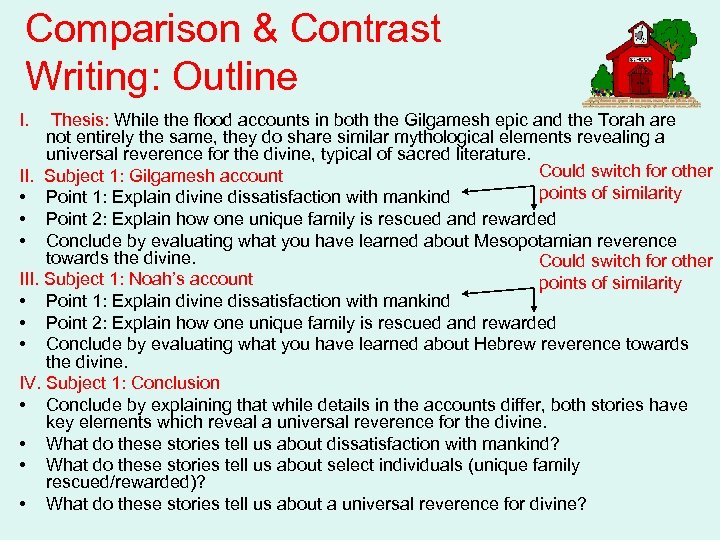
Comparison & Contrast Writing: Outline I. Thesis: While the flood accounts in both the Gilgamesh epic and the Torah are not entirely the same, they do share similar mythological elements revealing a universal reverence for the divine, typical of sacred literature. Could switch for other II. Subject 1: Gilgamesh account points of similarity • Point 1: Explain divine dissatisfaction with mankind • Point 2: Explain how one unique family is rescued and rewarded • Conclude by evaluating what you have learned about Mesopotamian reverence towards the divine. Could switch for other III. Subject 1: Noah’s account points of similarity • Point 1: Explain divine dissatisfaction with mankind • Point 2: Explain how one unique family is rescued and rewarded • Conclude by evaluating what you have learned about Hebrew reverence towards the divine. IV. Subject 1: Conclusion • Conclude by explaining that while details in the accounts differ, both stories have key elements which reveal a universal reverence for the divine. • What do these stories tell us about dissatisfaction with mankind? • What do these stories tell us about select individuals (unique family rescued/rewarded)? • What do these stories tell us about a universal reverence for divine?
ﺍﻟﻘﺪﻳﻤﺔ ﺍﻟﺜﻘﺎﻓﺔ ﺍﻟﻬﻨﺪﻳﺔ . Ancient Indian Culture Presented By: • Osmel Liriano • Natalie Ferrer • Marianne Liens • Alejandro Armas • Sabrina Gonzalez • Carson Berg • Alicia Barroso • Stacy Pereda • Fryda Guedes Cambridge IGCSE Class September 13 th, 2006 Period 6
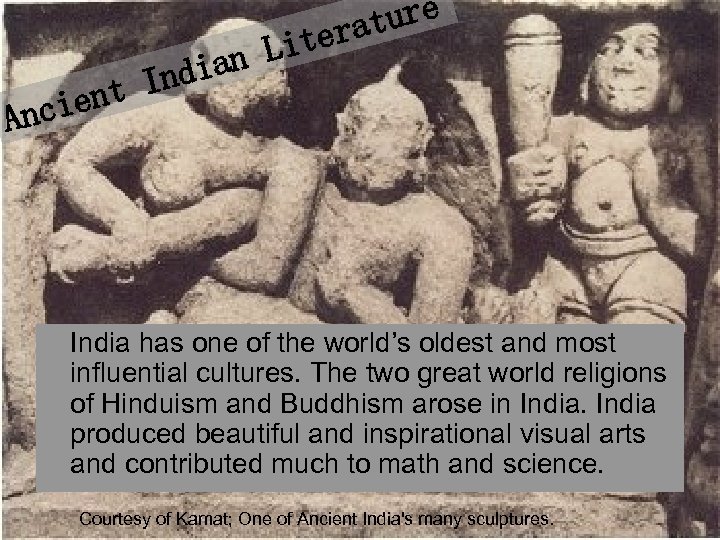
ture era Lit dian In ient Anc India has one of the world’s oldest and most influential cultures. The two great world religions of Hinduism and Buddhism arose in India produced beautiful and inspirational visual arts and contributed much to math and science. Courtesy of Kamat; One of Ancient India's many sculptures.
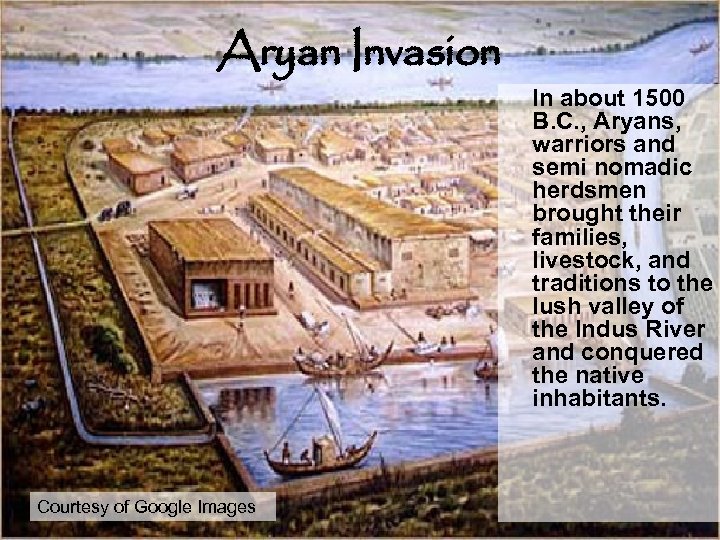
Aryan Invasion Courtesy of Google Images In about 1500 B. C. , Aryans, warriors and semi nomadic herdsmen brought their families, livestock, and traditions to the lush valley of the Indus River and conquered the native inhabitants.
Land of Kingdoms Over time the Aryan tribal settlements transformed into warring kingdoms. By 250 B. C. , all of India became a large united empire ruled by Asoka. Throughout his rule of empire, Asoka had stone pillars created with his humane policies. Courtesy of Google Images
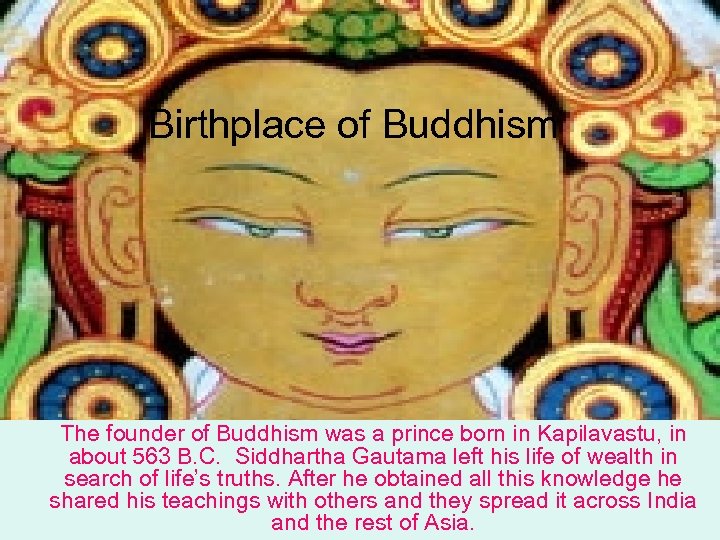
Birthplace of Buddhism The founder of Buddhism was a prince born in Kapilavastu, in about 563 B. C. Siddhartha Gautama left his life of wealth in search of life’s truths. After he obtained all this knowledge he shared his teachings with others and they spread it across India and the rest of Asia.
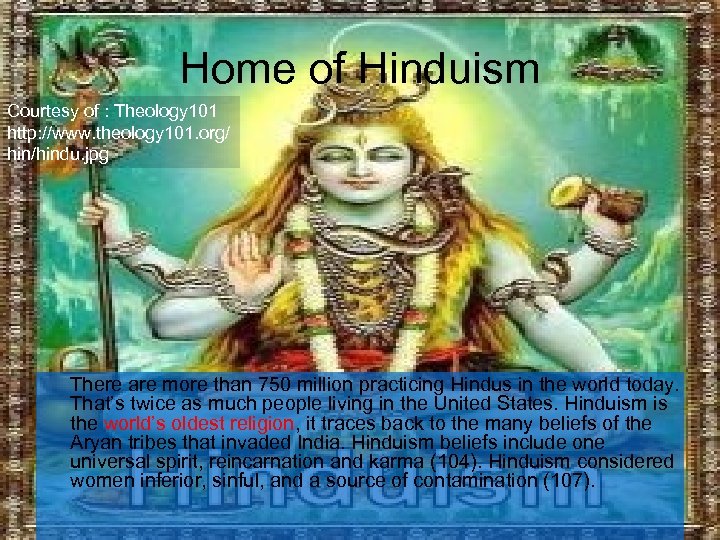
Home of Hinduism Courtesy of : Theology 101 http: //www. theology 101. org/ hin/hindu. jpg There are more than 750 million practicing Hindus in the world today. That’s twice as much people living in the United States. Hinduism is the world’s oldest religion, it traces back to the many beliefs of the Aryan tribes that invaded India. Hinduism beliefs include one universal spirit, reincarnation and karma (104). Hinduism considered women inferior, sinful, and a source of contamination (107).
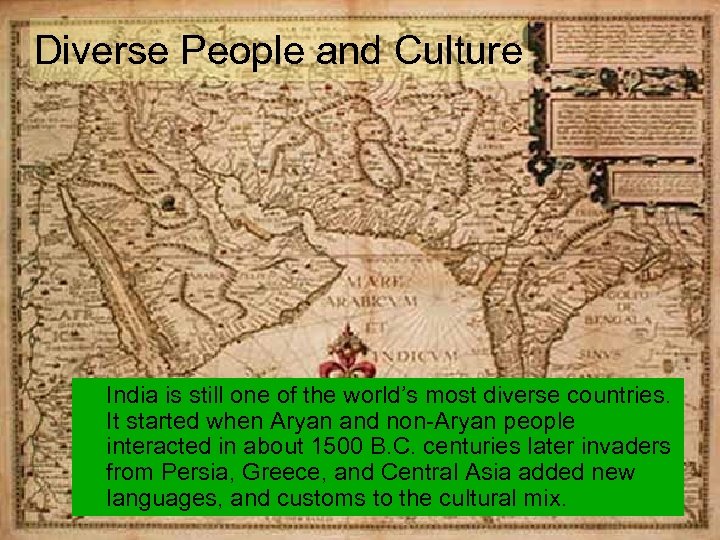
Diverse People and Culture India is still one of the world’s most diverse countries. It started when Aryan and non-Aryan people interacted in about 1500 B. C. centuries later invaders from Persia, Greece, and Central Asia added new languages, and customs to the cultural mix.
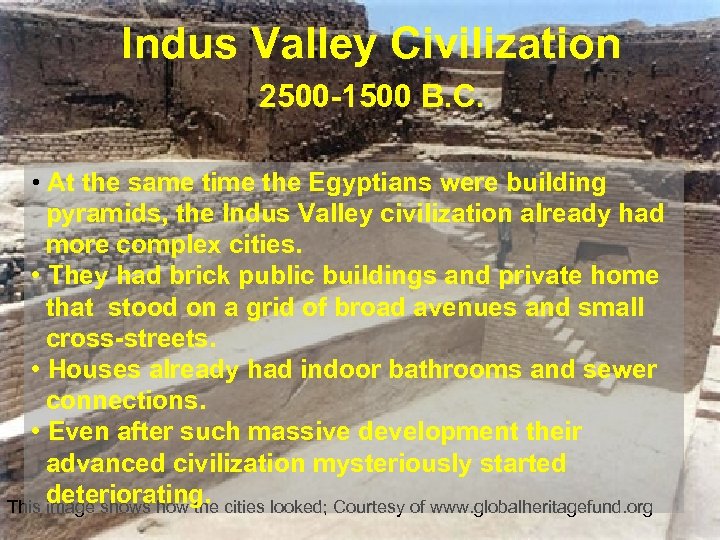
Indus Valley Civilization 2500 -1500 B. C. • At the same time the Egyptians were building pyramids, the Indus Valley civilization already had more complex cities. • They had brick public buildings and private home that stood on a grid of broad avenues and small cross-streets. • Houses already had indoor bathrooms and sewer connections. • Even after such massive development their advanced civilization mysteriously started deteriorating. This image shows how the cities looked; Courtesy of www. globalheritagefund. org
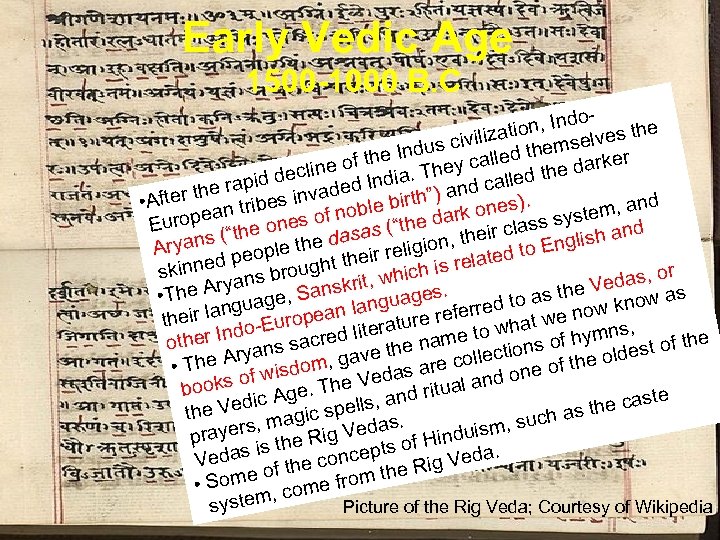
Early Vedic Age 1500 -1000 B. C oon, Ind ves the zati s civili d themsel du f the In hey calle darker ine o the ecl. T apid d vaded India ) and called he r th” After t n tribes in d • ble bir dark ones). a em, an no e st Europ “the ones of sas (“the lass sy h and ir c yans ( ople the da r religion, the d to Englis Ar te ei pe inned s brought th which is rela sk or edas, ryan krit, e. V • The A guage, Sans anguages. o as th w know as ed t eir lan -European l rature referr hat we no th o w s, te her Ind ns sacred li the name to ons of hymn st of the ot e cti lde rya The A wisdom, gav as are colle one of the o • f ed ooks o Age. The V nd ritual and b ste Vedic gic spells, a the ca as the , ma , such as. s prayer the Rig Ved of Hinduism is ts Vedas f the concep e Rig Veda. th eo • Som , come from Picture of the Rig Veda; Courtesy of Wikipedia system
Late Vedic Age 1000 -500 B. C • As the Aryans spread along the Ganges River, they developed farms and villages (104). • As powerful families established larger cities, violent confrontations aroused on over who should have the power (104). • Priests even became determined to take power, causing concerns about their power (104). • India’s great epics, the Mahabharata and the Ramayana, describe political struggles of this period and explain important social and religious concerns (104). Courtesy of postershop. co; This is an image of a farm.
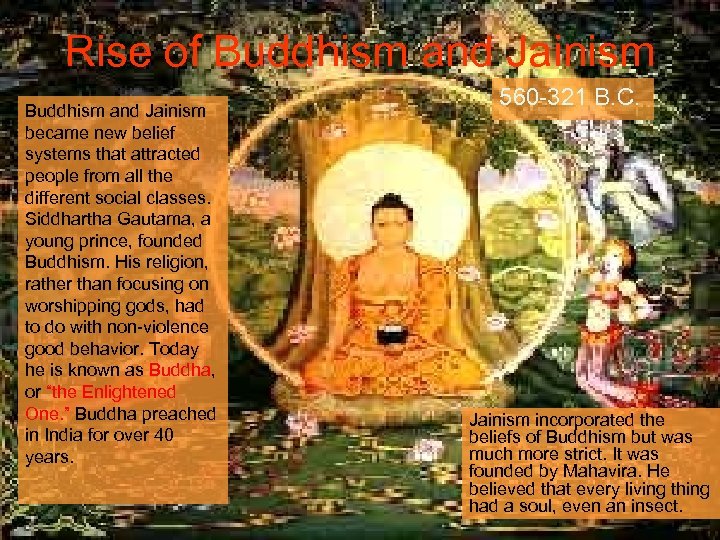
Rise of Buddhism and Jainism became new belief systems that attracted people from all the different social classes. Siddhartha Gautama, a young prince, founded Buddhism. His religion, rather than focusing on worshipping gods, had to do with non-violence good behavior. Today he is known as Buddha, or “the Enlightened One. ” Buddha preached in India for over 40 years. 560 -321 B. C. Jainism incorporated the beliefs of Buddhism but was much more strict. It was founded by Mahavira. He believed that every living thing had a soul, even an insect.
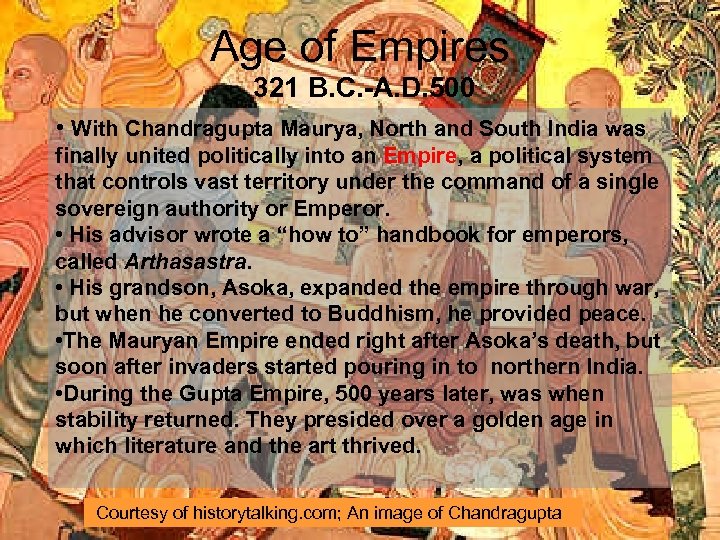
Age of Empires 321 B. C. -A. D. 500 • With Chandragupta Maurya, North and South India was finally united politically into an Empire, a political system that controls vast territory under the command of a single sovereign authority or Emperor. • His advisor wrote a “how to” handbook for emperors, called Arthasastra. • His grandson, Asoka, expanded the empire through war, but when he converted to Buddhism, he provided peace. • The Mauryan Empire ended right after Asoka’s death, but soon after invaders started pouring in to northern India. • During the Gupta Empire, 500 years later, was when stability returned. They presided over a golden age in which literature and the art thrived. Courtesy of historytalking. com; An image of Chandragupta
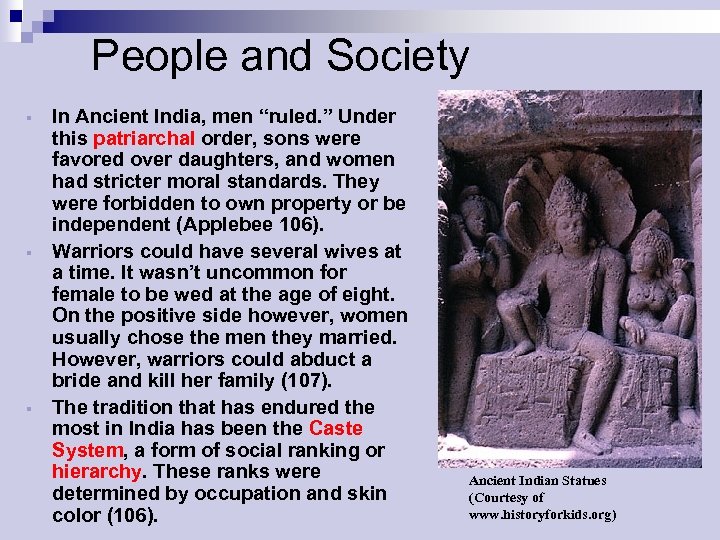
People and Society § § § In Ancient India, men “ruled. ” Under this patriarchal order, sons were favored over daughters, and women had stricter moral standards. They were forbidden to own property or be independent (Applebee 106). Warriors could have several wives at a time. It wasn’t uncommon for female to be wed at the age of eight. On the positive side however, women usually chose the men they married. However, warriors could abduct a bride and kill her family (107). The tradition that has endured the most in India has been the Caste System, a form of social ranking or hierarchy. These ranks were determined by occupation and skin color (106). Ancient Indian Statues (Courtesy of www. historyforkids. org)
People and Society § § § The caste system, or social hierarchy of the Aryans, according to the Rig Veda emerged in order from the body of Purusha, the first man. The caste system is as follows: Brahmans: from the mouth of Purusha This consisted of priests. Since priests conducted sacred rituals, they were considered the purest class. They wore white clothes to distinguish themselves. In early Vedic times, they were more powerful than kings (Applebee 106). Kshatriyas: from Purusha’s arms Born as warriors and rulers, Kshatriyas were the second class in the caste system. They wore red and commanded the most respect. They were expected to battle in order to satisfy their dharma or “duty, ” as all classes had sacred responsibilities or duties to maintain order in the universe (106). Vaishyas: from the thighs of Purusha Farmers, merchants and trades-people (carpenters, physicians, etc). Poets, and even dancers fell into this caste and wore yellow. During late Vedic age, men from top two castes could marry women of lower classes, but men of lower classes could not marry women of upper classes (106). Shudras: from Purusha’s feet These were servants and menial laborers, which included the dasas, which gradually came to mean slave. By the late Vedic age, it was legal to beat and kill Shudras. An interesting crack in the caste structure occurred during India’s shift from hereditary rule by tribal chiefs to the government of kingdoms by powerful monarchs. Vaishyas continued to rule local communities but most kings came from Shudra families (107). Outcastes: Known as untouchables, this group was believed to be so unclean and polluted that even touching one would endanger your purity. Individuals who dug graves, worked with meat or animals, or disposed of human waste were placed into this caste. The hope for this class was the Hindu belief to be reborn into a better class in their next life (107).
n Literature of India is an ancient tradition mixed with religion. As sacred literature, its principal aim is to convey religious instruction teaching the morals and values prized by the culture. Hindus sing hymns from one of the many sacred texts called “Rig Veda” for weddings and funerals (Applebee 108). n The sacred texts of the Mahabharta and the Ramayana have tales for children. A famous Indian poet known as Kalidasa has works that are performed today on Indian stages (108). n In Southern India a literary tradition formed “ by people who spoke the Tamil language (108).
• • • Hinduism is a religion in India that comes from Aryan and non-Aryan traditions. Hinduism beliefs are polytheistic and monist (the belief that there is only one unitary organic whole with no independent parts – Merriam Webster) (Carrington 62). More an abstract spirit than a being, Brahman exists everywhere, both within all living things and in the surrounding cosmos (Applebee 108). Below Brahman are Brahma, the creator, Vishnu, the preserver, and Shiva, the destroyer. Vishnu is said to have come to earth in various bodily forms or avatars. He takes the form of Krishna, Arjuna’s charioteer in the Ramayana (108). Central to Hindu beliefs is the concept of reincarnation, where the soul passes from one body to be reborn into another. Depending on the deeds or actions of the person, the laws of karma would apply, dictating what class he/she is born into next (108). • • • Buddhism was a response to complex Hinduism rituals and the power of Vedic priests (109). Buddhism’s founder was Siddhartha Gautama. While accepting the Hindu belief in reincarnation, he rejected the caste system and would not worship Hindu gods (109). Instead, he stressed “the Middle Way” or moderation, manifested between desire and self-denial (109). The ultimate goal is to become “enlightened” and achieve union with the universal spirit (nirvana) (109). To this end, Buddhism stresses non -violence, meditation, and religious tolerance (109). Buddhism eventually died out in India, becoming more popular in Sri Lanka, East and Southeast Asia (109). Jainism also arose in response to the power of Vedic priests. Jainism practices extreme forms of selfdenial and non-violence (109).
Arts & Architecture Indian arts had a religious purpose. l For Hindus an important architecture … is the Hindu temple made out of stones and carvings. l In Buddhism there are special monuments or “stupas” which were built in shapes of mounds to be like the universe (Applebee 109). Inside there are gorgeous paintings and murals where monks worshipped (Carrington 71). l
Timeline: Events In Indian History l l l l 2500 -1700 B. C. – Advanced civilization flourishes in the Indus river valley. 1500 B. C. – Aryan tribes invade northwest India. 1100 B. C. - The Bharata tribes victory in the battle of the ten kings increase power. 1000 -500 B. C. – Aryan communities begin to appear in the granges river basin. 900 B. C. – Descendants of the Bharata kings fight for control of the kingdom. 599 B. C. – Birth of Mahavira, founder of Jainism. 563 B. C. – Birth of Siddhartha Gautama, founder of Buddhism. 500 B. C. - The Aryan kingdom of Magadha, expands by taking over some of the smaller kingdoms. 326 B. C. – Alexander the great invades the Indus valley and temporarily bringing it under Greek control. 321 -301 B. C. – Chandragupta Maurya unites northern India in the Mauryan empire. 269 -232 B. C. – Asoka brings Mauryan empire to its heights. A. D. 320 – Chandra Gupta I, From Magadha, begins building the Gupta empire. A. D. 415 – Death of Chandra Gupta II weakens Gupta empire. A. D. 499 – Aryabhata, an Indian mathematician, Calculates the value of pie and the number of days in a solar year. A. D. 500 – Germanic invaders, called Huns, and other central Asian nomads overturn India.
Special Area of Research: Siddhartha Gautama l l l l Gautama was born at around 563 B. C. into modern day Nepal. He was born into a tribe known as the Shakyas with his father, Suddhodana, who was then the chief of the tribe. Siddhartha grew up living the extravagant life of a young lord. According to custom of his tribe, he was married at the young age of sixteen to a girl named Yasodhara. After living a peaceful life inside the small palace, he decided to venture outside in the village against his fathers orders. At that moment he was confronted with the cruel reality of the inevitable suffering of life that the people had and so he decided he wanted to find the truth of the reason for all the suffering he had encountered. During the next few days, he left everything to look for that which he seeked to find by leading an ascetic life and determine a way to relieve universal suffering. Then for the years that followed He completely submitted himself into rigorous ascetic practices, and studying and following different methods of meditation with various religious teachers not gaining anything. Then One day however, while he was sitting under the Bodhi tree, He finally understood everything. Now knowing that karma and dharma are not the only ways to become totally liberated and by that he gained many followers who saw him as the Buddha, or the "Enlightened One".
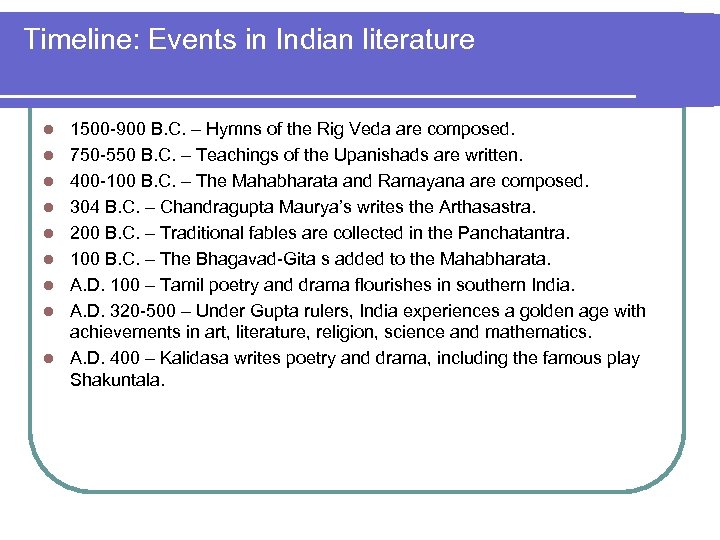
Timeline: Events in Indian literature l l l l l 1500 -900 B. C. – Hymns of the Rig Veda are composed. 750 -550 B. C. – Teachings of the Upanishads are written. 400 -100 B. C. – The Mahabharata and Ramayana are composed. 304 B. C. – Chandragupta Maurya’s writes the Arthasastra. 200 B. C. – Traditional fables are collected in the Panchatantra. 100 B. C. – The Bhagavad-Gita s added to the Mahabharata. A. D. 100 – Tamil poetry and drama flourishes in southern India. A. D. 320 -500 – Under Gupta rulers, India experiences a golden age with achievements in art, literature, religion, science and mathematics. A. D. 400 – Kalidasa writes poetry and drama, including the famous play Shakuntala.
Special Area of Research: Kalidasa l l l Kalidasa was a famous Indian poet and dramatist. According to many legends that circulated, it was said that Kalidasa was a beautiful man with such inspiring beauty that he was even able to capture the eye of the an extravagant princess who wanted to marry him. It was said that the princess grew aggravated with Kalidasa’s ignorance and so turned to ask help of the goddess Kali to ask her to change her future husband’s attitude towards everything that ever mattered to her. The goddess answered her prayers and turned Kalidasa into an extremely smart and intelligent man. From that moment on he started creating great dramas and poems.
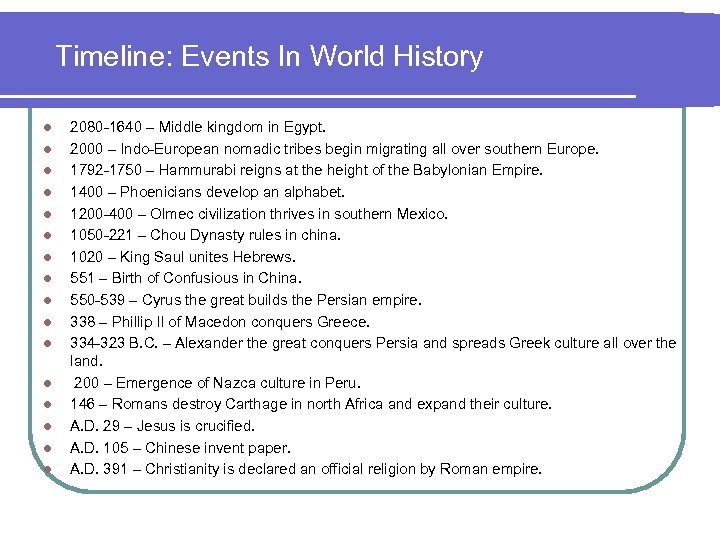
Timeline: Events In World History l l l l 2080 -1640 – Middle kingdom in Egypt. 2000 – Indo-European nomadic tribes begin migrating all over southern Europe. 1792 -1750 – Hammurabi reigns at the height of the Babylonian Empire. 1400 – Phoenicians develop an alphabet. 1200 -400 – Olmec civilization thrives in southern Mexico. 1050 -221 – Chou Dynasty rules in china. 1020 – King Saul unites Hebrews. 551 – Birth of Confusious in China. 550 -539 – Cyrus the great builds the Persian empire. 338 – Phillip II of Macedon conquers Greece. 334 -323 B. C. – Alexander the great conquers Persia and spreads Greek culture all over the land. 200 – Emergence of Nazca culture in Peru. 146 – Romans destroy Carthage in north Africa and expand their culture. A. D. 29 – Jesus is crucified. A. D. 105 – Chinese invent paper. A. D. 391 – Christianity is declared an official religion by Roman empire.
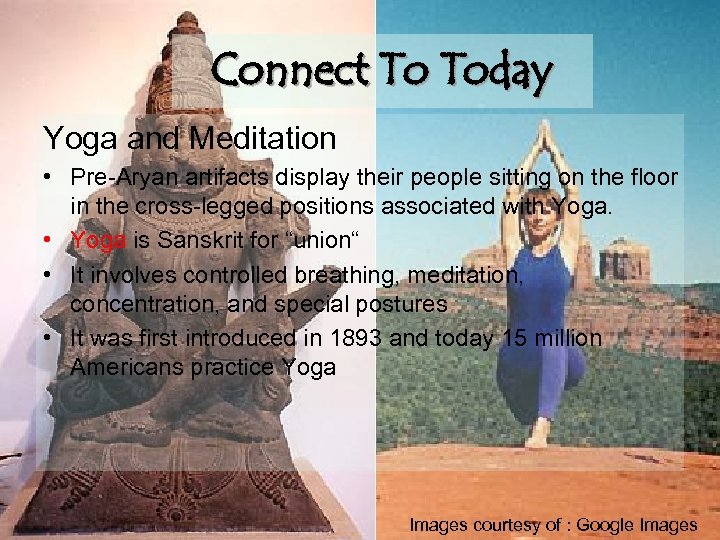
Connect To Today Yoga and Meditation • Pre-Aryan artifacts display their people sitting on the floor in the cross-legged positions associated with Yoga. • Yoga is Sanskrit for “union“ • It involves controlled breathing, meditation, concentration, and special postures • It was first introduced in 1893 and today 15 million Americans practice Yoga Images courtesy of : Google Images
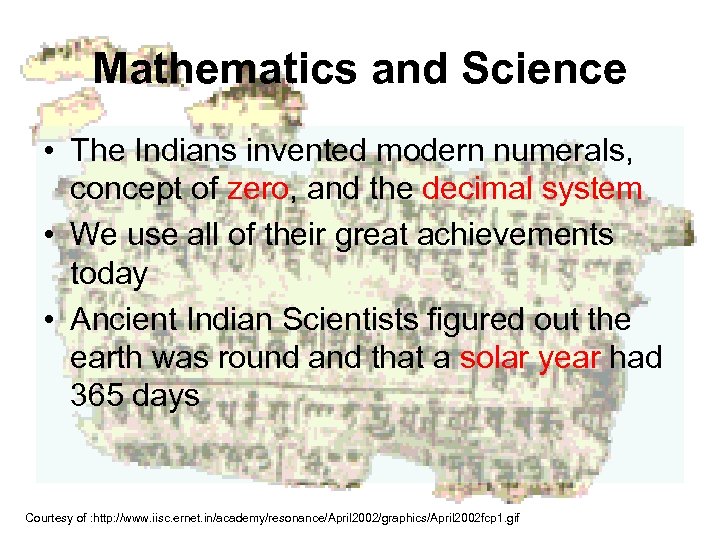
Mathematics and Science • The Indians invented modern numerals, concept of zero, and the decimal system • We use all of their great achievements today • Ancient Indian Scientists figured out the earth was round and that a solar year had 365 days Courtesy of : http: //www. iisc. ernet. in/academy/resonance/April 2002/graphics/April 2002 fcp 1. gif
non Violence • Ahimsa, or non-violence, was one of the central Jainism, Buddhism and Hinduism beliefs. • Mohandas Ghandi used passive resistance in order to gain Indian independence by using ahimsa. • His strategy of peace influenced Martin Luther King Jr. roll in the Civil rights Movement in the USA in the 1960 s
Ancient Ideas Still Around Today • Believe it or not most of the “traditions” that are practiced to this day were originated in ancient India. Examples of such “traditions” include: • Vegetarianism • Animal rights • Gurus • Ayurvedic medicine
Vegetarianism and Animal Rights • • • Although it was said that Aryans began vegetarianism, it was actually Buddhists who began this practice. The Buddhists, believe it or not, ate meat. The Buddha was said to have consumed meat during his last meal A greater majority of Indians were meat eaters or “non- vegetarians. ” When the term vegetarian was used in Ancient Indian culture it meant “non- violence. ” it is known as ahimsa. Unfortunately, as generations passed by, the term “vegetarianism” was known as nonmeat eaters. Although “vegetarianism” is now interpreted differently, we can say that this practice was originated in India, one of the many cherished trends nowadays. Back then animal rights also followed nonviolence and it is now practiced quite often. For example, now people protest against animal testing and experimenting. (Applebee, 112).
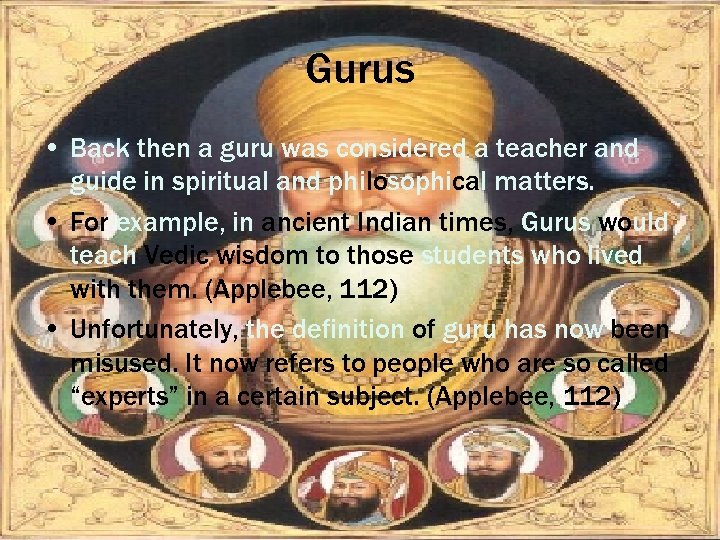
Gurus • Back then a guru was considered a teacher and guide in spiritual and philosophical matters. • For example, in ancient Indian times, Gurus would teach Vedic wisdom to those students who lived with them. (Applebee, 112) • Unfortunately, the definition of guru has now been misused. It now refers to people who are so called “experts” in a certain subject. (Applebee, 112)
Ayurvedic medicine • Ayurveda is the traditional health care system that is older than any other system of medicine; it has been practiced in India for over 5000 years. • It represents life and originated in the Vedic traditions of India. It involves symbiosis of body, mind, and spirit. It was known as a system of healing based on body type. • To this day Ayurvedic medicine is gaining practitioners, therefore is still being used.
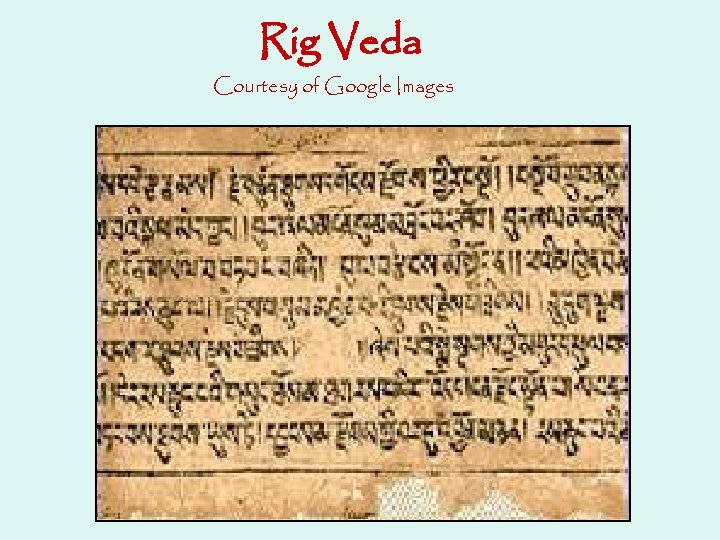
Rig Veda “A collection of Vedic Sanskrit hymns counted as the holiest of the four religious texts of Hindus, known as the Vedas. It is also the oldest known collection of ideas of mankind. ” These hymns—being the oldest of the existing Vedas--were chanted, praised, used during sacrifices and passed down as part of oral tradition before they were ever written down (Applebee 114). To this day, the Rig Veda is still considered a sacred text and is used during special ceremonies such as weddings (114). The Rig Veda exhibits the complex concerns & moral values of the Ancient Aryans, and they also reflect their daily customs (114). Just as the bible to the Judaic Culture, the Rig Veda is crucial to the understanding of Ancient India and the Aryan Culture.
About Paradox & Inference… Paradox— A paradox can be a phrase or a sentence that contradicts itself in order to propose truth. In the Creation Hymn, many paradoxes are evident; the following is an example: “There was neither non-existence nor existence then; there was neither the realm of space nor the sky which is beyond” (115). Inference— To use intellect and reason in order to conclude what the meaning of a phrase implies. In the Burial Hymn, the following sentences require readers to make inferences in order to comprehend its meaning: “Go away, death, by another path that is your own, different from the road of the gods. I say to you who have eyes, who have ears: do not injure our children or our men” (115). By this we can infer that death is a being (as is personified) and can be addressed as undesirable. It is something separate from the gods.
Creation Hymn This hymn explains the Hindu view on the creation of our universe and also gives a representation of the unique state of existence present before “The Creation”. Through the use of paradox (dichotomies), the speaker suggests how the universe came together to create life. According to the Rig Veda: That one means “the unknown force that caused the creation of the world. ” Desire was the first thought that “That One” had in order to initiate the process of creation. The manner in which the “cord” is used implies a boundary to separate the elements from one another. Alternatively, we can also view this as an umbilical chord. There is a universal hierarchy. “The One” initiated all. The gods were created by “That One, ” as well as the rest of mankind.
Creation Hymn Continued… • At the time of creation, there was nothing. “Darkness was hidden by darkness” (115). • Poets found through wisdom “the bond of existence in non-existence. ” This could suggest that through their imagination, poets straddle the abyss of these dimensions, forming a conduit for both to manifest or exist simultaneously (115). • There were “seed-placers; there were powers…an impulse beneath; there was a giving-forth above” implies that all dimensions mentioned (existence, nonexistence, above, below – all dichotomies converged to create life). The language suggests at the very least an “attraction” of elements. Alternatively, the language evokes images of sexual reproduction (seed, desire/impulse (egg), giving-forth (sperm), a coming together to form life). • The paradoxes, such as “there was no distinguishing sign of night nor day” are used to blur the dichotomous lines of our understanding of these concepts and to consider an alternate state of reality (before creation). • “All of this water (natural element)…covered with emptiness” is associated with the natural/earthly realm and suggests a “void” or “emptiness” before creation.
Creation Hymn Continued… • “That one arose through the power of heat ” (115). This suggests that “That one” is in sharp contrast to earth (water). Heat, therefore symbolizes a supernatural element. • The speaker in this hymn does three things: 1) Validates the indisputable fact that we are here or exist. The speaker explains the origin of life as a process called “creation. ” 2) The speaker, representative of Aryan culture, tries to explain that process (by explaining what elements came together). 3) He questions his own beliefs. While he proposes that “The one who l looks down on it, in the highest heaven, only he knows, ” the Speaker also acknowledges that “perhaps he does not know” (115). The speaker’s apparent contradiction can be taken as a sign of humility, implying that while universally we try to explain the origins of life, 100% certainty is difficult. Perhaps the Speaker is acknowledging his own limited understanding.
Burial Hymn This hymn was/is used in funeral burials and reflects the culture’s feelings towards death and to explain the dividing line (relationship) between life and death. According to the Rig Veda: Tvastr is the “creator of the gods protector of all living things. Purified Butter was used to protect the eyes of women mourners. Rise up, Woman is directed to the widows who would lay beside the body of their dead husbands (part of ritual). Yama is the lord of the dead.
Burial Hymns Continued… • Stanza 1: Death is something that isn’t welcomed. It is addressed as one would address an enemy and is therefore, personified. The tone in the first stanza is assertive and authoritative. • Stanzas 2 - 3: Addresses/admonishes (instructs) the mourners on how to face life and their future reincarnation (“stretching farther your own lengthening span of life”). The Speaker’s “invitation to the gods has become auspicious…We have gone forward…” implies a ritual where mourners believe themselves to have left the immediate setting (outdoors on a burial site) and gone elsewhere to be with the gods. • Stanzas 4 – 6: Distinguishes a separation between the dead and those who are living. The speaker asks that people live “a hundred full autumns” or live to be 100 years old, living a full life by Tvastr, the creator of gods and living things. Thus, the passage promotes a long life and is thought to be controlled by this god or “Arranger” (epithet). This stanza also implies sequence or chronology of time, divine order or hierarchy that extends to social relationships (the young should not abandon the old).
Burial Hymns Continued… • Stanza 7: Addresses the role of unwed women which is to become married and procreate “climb into the marriage bed” (117). • Stanza 8: Addresses the dead man’s widow who ceremonially may have laid by the man’s corpse. This ritual may suggest a reinforcement of the Indian belief that women were never to displease their husbands, even after death. The laying down next to the dead man’s corpse may be a sign of dedication/loyalty to dead husband. Alternatively, this ritual may have religious significance. • Stanza 9: Emphasizes the legacy of patriarchal order. The living man takes the bow from the dead man, addressing themselves as “heroes, ” whether in life or death. • Stanza 10: The Speaker instructs the dead man to be reconciled to the earth. We see use of figurative language (metaphor). The earth is “the mother…kind and gentle…a young girl, soft as wool” (118).
Burial Hymns Continued… • Stanzas 11 -12: Speaker addresses earth to be kind to the body of the deceased. • Stanza 13: Addresses the actual burying of the deceased. The Speaker “shore[s] up the earth all around [the dead man]” (118). • Stanza 14: The Speaker concludes by acknowledging his own death. The hymn is circular/cyclical in nature because it begins with death and ends with death. His last comment “I hold back speech that goes against the grain, as one would restrain a horse with a bridle” could suggest that he would keep silent about his negative feelings about death for these feelings might go “against the grain” (cultural beliefs about the order of life and the universe). The Speaker may be expressing fear of death and the unknown, believing that perhaps he may be reincarnated into a lower class due to his deeds in his current life.
Rig Veda Courtesy of Google Images
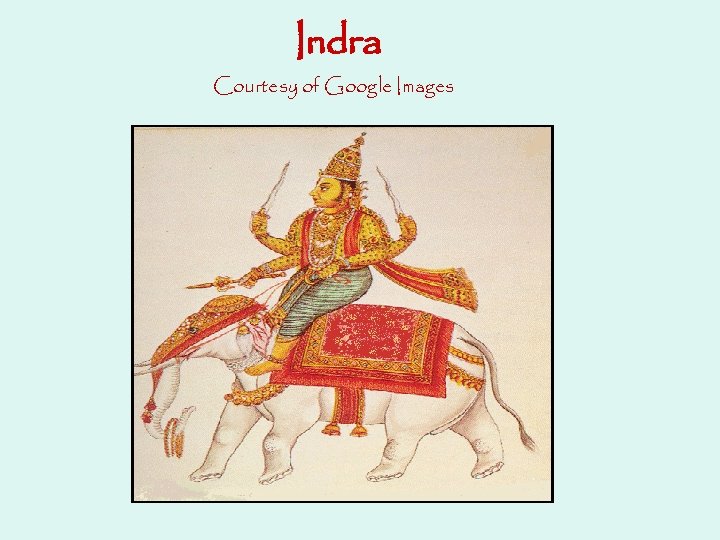
Indra Courtesy of Google Images
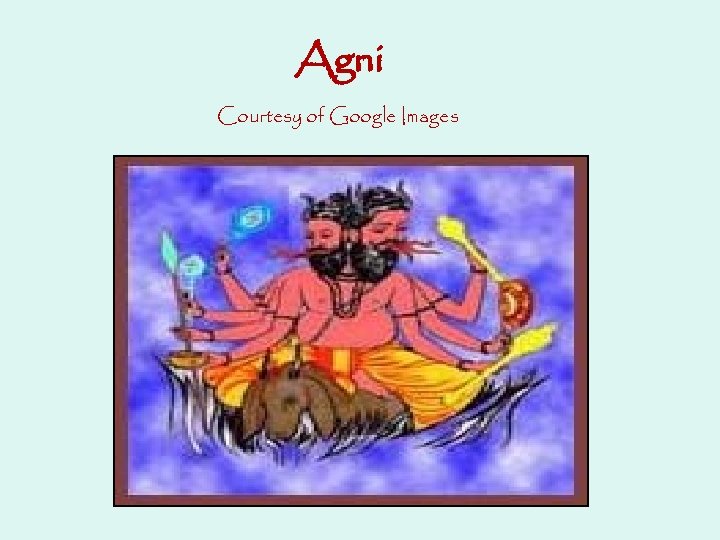
Agni Courtesy of Google Images
• • Conclusion Ancient India’s Literature has been a great inspiration such as with its religion, it’s culture, and it’s history. Ancient India’s culture is known as a blend of the Indus (native population), the Aryans. Buddhism and Jainism attracted members from all social classes. Norther and Southern India were united for the first time under the Mauryan Empire. Literature and arts flourished under the Guptan Indian society was stratified into four classes (Brahmans, Kshatriyas, Vaishyas, Shudras). In later Vedic times, the Outcastes division arose. Religious beliefs are infused into the literature of India, teaching the culture’s concerns and moral beliefs. Writings from the “Rig Veda” are still used today in weddings and funerals. Contributions from India include yoga, meditation, vegetarianism, animal rights, gurus, Ayurvedic medicine, non-violence, mathematics and scientic advancements. Courtesy of Fabricandart. com
Works Cited Unknown. “Ancient Indian Culture. ” September 9, 20006 Online Image. <www. farhorizon. com/. . . /gods_temples_of_india. htm> Applebee, Arthur N, et all. The Language of Literature. United States of America: MC Dougal, 2003. Unkwown. “Ancient Indian Culture. ” September 9, 20006 Online Image. <www. farhorizon. com/. . . /gods_temples_of_india. htm> Severi, Erin. "Fabulous & Fancy Decorative Papers. "Natural Heavy Papyrus. <http: //www. fabricandart. com/web_images/paper_arts/Art%20 Paper/nat. papyrus. jpg > Ajanta Caves Sculpture. ca 500 AD. Marathas, Maharashtra, India. 07 September 2006. http: //www. historyforkids. org/learn/india/index. htm Kamat, K. L. . ""A Jaina Saint". " "Khajuraho Museum" September 1, 1977 September 8, 2006 <http: //www. kamat. org/picture. asp? Name=635. jpg>. Bhan, Kuldeep. ""Indus Center, India. ". " September 8, 2006 <<>where/indus_scroller. html>>. Unknown. September 8, 2006 <www. ficklefish. net/images/temple. jpg>. Unknown September 8, 2006 <www. buddhanet. net/. . . /theme_buddha. jpg>. Bain, S. W. ""Hinduism". " September 8, 2006 <http: //www. theology 101. org/hindu. jpg>. Cristal, Ellie. "Science, Medicine, Technology in Ancient India. " Medicine & Surgery 1995 13 09 2006 <http: //72. 14. 209. 104/search? q=cache: 9 her 3 DF 4 EQc. J: www. crystalinks. com/indiasc ience. html+yoga+ancient+india&Ancient>. "Mere Humsafer. " 2. 16 06 2006 <http: //www. geocities. com/dipalsarvesh/index. Aryan. html>.
Works Cited Lambah, Abha. "Indus Center, India. " 9/06/2006 <http: //www. globalheritagefund. org/where/indus_scroller. html>. "Rig. Veda. " Rig. Veda 06/21/2006 09/06/2006 <http: //en. wikipedia. org/wiki/Rig_veda Penney , Jacqueline. White Birch Farm 09/05/2006 <http: //www. postershop. com/Penney-Jacqueline-White-Birch. Farm-9953352. html>. "Chandragupta. " The Court of Chandragupta painted on dome 9/06/2006 <http: //www. historytalking. com/images/gallery 1/indiahouse/india_house_4 CG. htm>. Brown, Amy. Meditation 09/05/06 <http: //shekinah. elysiumgates. com/meditation. html>. "Rigveda. " Wikipedia. 09 Sep 2006 <http: //en. wikipedia. org/wiki/Rig_veda>. Applebee, Arthur N. , et al. The Language of Literature. Evanston, IL: Mc. Dougal Little Inc. , 2003 "Demigods and Godesses. " dharmakshetra. 04 Sep 2006. 11 Sep 2006 <http: //www. dharmakshetra. com/demigods%201. html>. Rennie, "Major Hindu Scriptures. " Understanding religious Experience and Expression. 09 Sep 2006 <www. westminster. edu/staff/brennie/hinduscr. htm>. Jaroslav. Namaste. 23 May 2006. 09 Sep 2006 <http: //jogin. bloguje. cz/>. Getty Images. 2006. Getty Images, Inc. . 11 Sep 2006<http: //creative. gettyimages. com/source/home. Creative. aspx>.
Works Cited Bernier, Francois. ""Ancient map of India". " September 8, 2006 <http: //www. geocities. com/Athens/Atrium/1344/Pictures/ancientindia. jpg>. Applebee, Aurthur N. . The Language Of Literature. Evanston, IL ; Mc. Dougal Littell Inc. , 2003. Carrington, Laurel. , World History The Human Journey. Austin: Holt, Rinehart, Winston Inc. , 2005. 2001. NOVO's library. 12 Sep 2006 <http: //www. geocities. com/Athens/Atrium/1344/Pictures/ancientindia. jpg>. unknown. the map shop, co. . 12 Sep 2006 <http: //www. themapshop. co. uk/images/world/natgeoworldant. jpg>. unknown. wikipedia encyclopedia. 12 Sep 2006 <http: //en. wikipedia. org/ wiki/Cow-tipping >. Columbia. june 2004. unknown. 12 Sep 2006 <http: //www. columbia. edu/itc/mealac/pritchett/00 routesdata/1500_1599/sik hism/gurus 1. jpg>. "Mere Humsafer. " 2. 16 06 2006 <http: //www. geocities. com/dipalsarvesh/index. Aryan. html>. Cristal, Ellie. "Science, Medicine, Technology in Ancient India. " Medicine & Surgery 1995 13 09 2006 <http: //72. 14. 209. 104/search? q=cache: 9 her 3 DF 4 EQc. J: www. crystalinks. com /indiascience. html+yoga+ancient+india&Ancient>.
Mahabharata Notes: • Longest epic in the world (8 times the size of the Iliad and Odyssey combined (Applebee 122). • Author is said to be Vyasa, a legendary sage who also appears as a character in the epic (grandfather). • According to J. A. B van Buitenen, the Mahabharata is “an encyclopedia of…history, legend, edification, religion, and art; drama and morality” (122).
Mahabharata Notes: • The term “Mahabharata” means “great epic of the Bharata dynasty (122). • The epic recounts the conflict between the Kauravas, descendents of Kuru (demons in human form) and the Pandavas, descendants of Pandu (fathered by the gods) (122). • The eldest among the 100 sons of the Kurus is Duryodhana, who arranges to have the Pandus exiled (122). • The eldest among the 5 sons of the Pandus is Yudhisthira, the rightful heir to the kingdom (122).
Mahabharata Notes: • While the Pandavas are in exile, having escaped their burning house, Arjuna (the great warrior) wins the hand of the princess Draupadi by stringing a bow that no one else can bend and hitting a target (123). • Arjuna’s mother instructs her son to share his prize with his brothers. Thus Draupadi is shared by all five brothers (123). • Upon the return of the Pandavas, Duryodhana goads (like a pointed weapon used to stimulate an animal) Yudhisthira (123). • When he loses, the Pandavas are exiled for 13 years (123). • Upon their return, war ensues as the Kurus don’t want to relinquish power (123).
Mahabharata Notes: • Krishna (Vishnu in human form) serves as Arjuna’s charioteer (123). • When Arjuna does not wish to fight his cousin, Krishna lectures him on the importance of performing his dharma or “duty” (123).
Mahabharata Notes: • Characterization: Techniques the writer uses to develop characters. In an epic, the hero is usually developed through his superhuman actions, noble speeches, and the admiring or fearful reactions of other characters (123). • Epithets: brief descriptive phrases such as “king of men, ” which provide insight into the character (123). • Hero is Contrasted: Epics celebrate qualities admired in a culture. Arjuna’s qualities stand out when he is contrasted with others around him (123).
Mahabharata Notes: • • • Arjuna is characterized as: “best on every weapon” (124). “in weaponry and devotion to his guru” (124). “distinguished by his excellence” (124). “among all princes, he was the outstanding warrior” (124) Epithets used for Arjuna: “left-handed archer”, “bullike warrior of the Pandavas”, “king of men”, “Terrifier”, “Partha”, “Phalguna”, “strongarmed Arjuna” (124 -125). Epithets used for Drona: “Angirasa”, “bull among Bharatas”, “great-spirited Drona” (125).
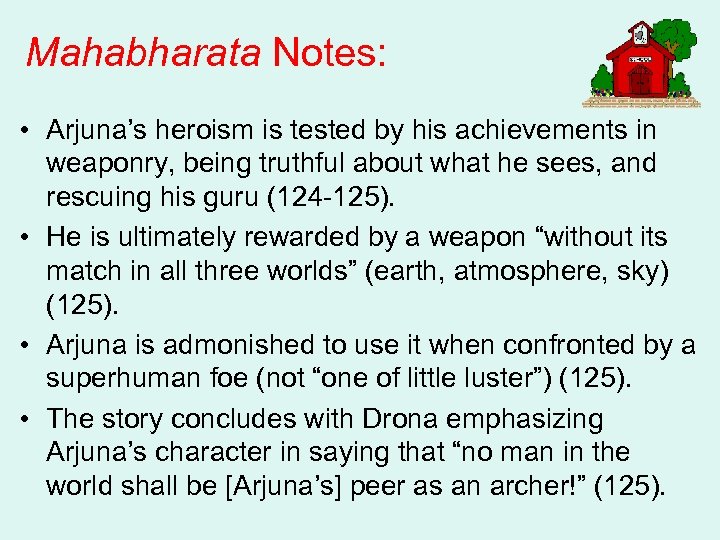
Mahabharata Notes: • Arjuna’s heroism is tested by his achievements in weaponry, being truthful about what he sees, and rescuing his guru (124 -125). • He is ultimately rewarded by a weapon “without its match in all three worlds” (earth, atmosphere, sky) (125). • Arjuna is admonished to use it when confronted by a superhuman foe (not “one of little luster”) (125). • The story concludes with Drona emphasizing Arjuna’s character in saying that “no man in the world shall be [Arjuna’s] peer as an archer!” (125).
Mahabharata Notes: Complete the following questions in class. Turn in as part of this week’s class participation grade.
Скачать презентацию me elco ck W do rad gs B
d52a5fd33cf8cd55123dbe38b37982af.ppt