


 Скачать презентацию ME 489 Practices of Modern Engineering Lecture 3
4c9d3a8cdad365d8770771f8445a6dd7.ppt
- Количество слайдов: 30
 ME 489 Practices of Modern Engineering Lecture 3 Engineering - What You Don’t Necessarily Learn in School Luis San Andres January 27, 2011 Mast-Childs Tribology Professor Texas A&M University Lsanandres@tamu. edu http: //rotorlab. tamu. edu/me 489 1
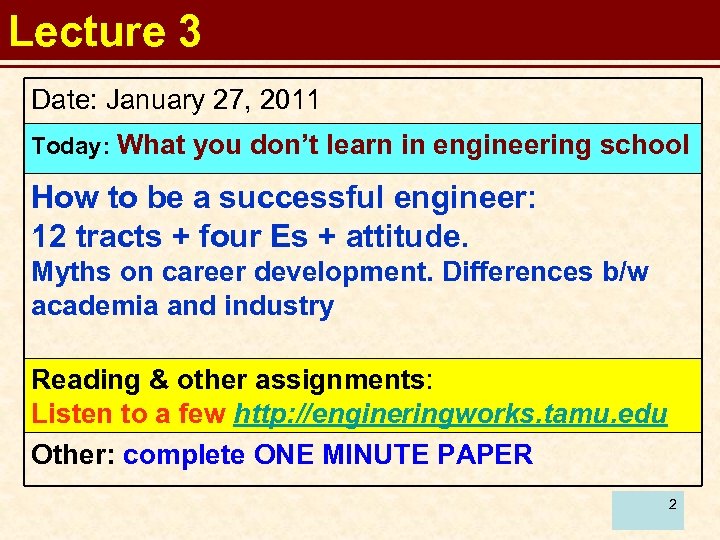 Lecture 3 Date: January 27, 2011 Today: What you don’t learn in engineering school How to be a successful engineer: 12 tracts + four Es + attitude. Myths on career development. Differences b/w academia and industry Reading & other assignments: Listen to a few http: //engineringworks. tamu. edu Other: complete ONE MINUTE PAPER 2
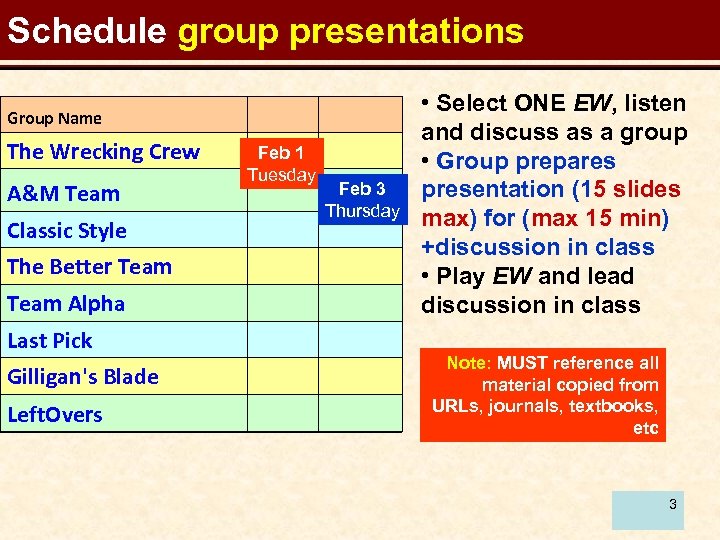 Schedule group presentations Group Name The Wrecking Crew A&M Team Classic Style Feb 1 Tuesday Feb 3 Thursday The Better Team Alpha Last Pick Gilligan's Blade Left. Overs • Select ONE EW, listen and discuss as a group • Group prepares presentation (15 slides max) for (max 15 min) +discussion in class • Play EW and lead discussion in class Note: MUST reference all material copied from URLs, journals, textbooks, etc 3
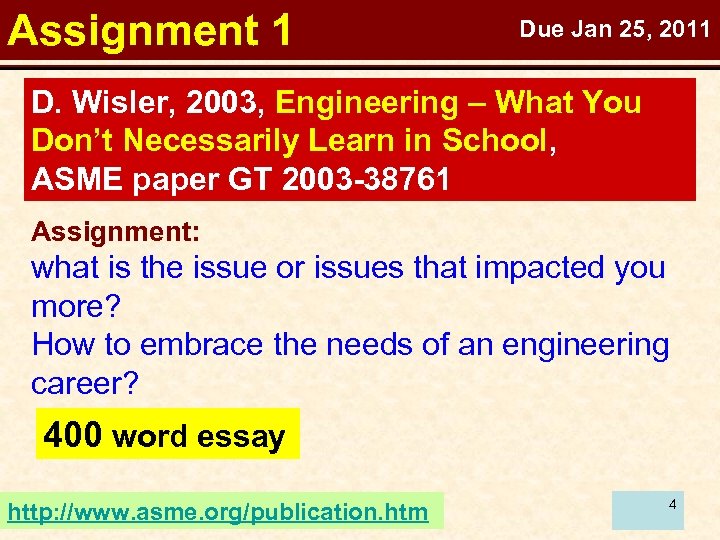 Assignment 1 Due Jan 25, 2011 D. Wisler, 2003, Engineering – What You Don’t Necessarily Learn in School, ASME paper GT 2003 -38761 Assignment: what is the issue or issues that impacted you more? How to embrace the needs of an engineering career? 400 word essay http: //www. asme. org/publication. htm 4
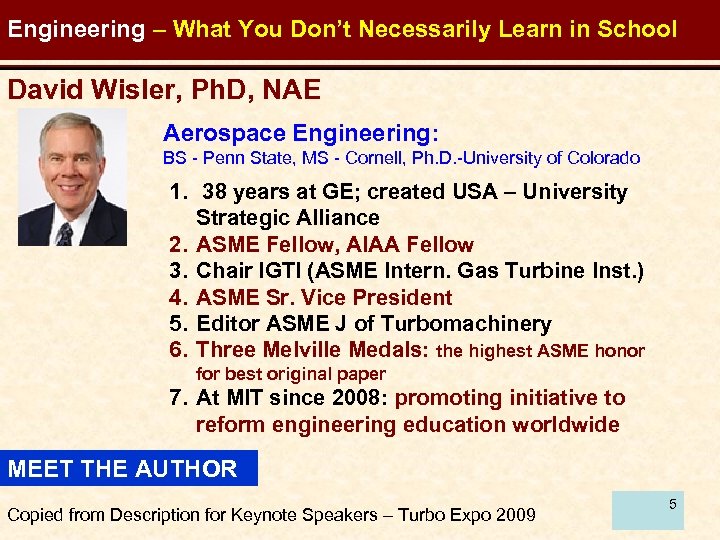 Engineering – What You Don’t Necessarily Learn in School David Wisler, Ph. D, NAE Aerospace Engineering: BS - Penn State, MS - Cornell, Ph. D. -University of Colorado 1. 38 years at GE; created USA – University Strategic Alliance 2. ASME Fellow, AIAA Fellow 3. Chair IGTI (ASME Intern. Gas Turbine Inst. ) 4. ASME Sr. Vice President 5. Editor ASME J of Turbomachinery 6. Three Melville Medals: the highest ASME honor for best original paper 7. At MIT since 2008: promoting initiative to reform engineering education worldwide MEET THE AUTHOR Copied from Description for Keynote Speakers – Turbo Expo 2009 5
 Engineering – Twelve tracts for a successful career 1. learn to be business oriented; 2. expect tough, multi-disciplinary problems; 3. learn to work and network in the new multi-cultural and multinational environment; 4. understand the differences between academe and industry; 5. learn to differentiate all over again; 6. understand the values and culture of their particular company or organization; 7. be open to ideas from everywhere; 8. have unyielding integrity; Give/Find 9. make their manager a success; examples 10. support their university and technical society; of each 11. have fun; and 12. manage their careers. D. Wisler, Engineering – What You Don’t Necessarily Learn in School, 2003 (ASME GT Paper) tract 6
 Engineering – MYTHS on Career Development 1. Do a good job and the Company will “take care of you”, or better yet, “take care of you for life. ” 2. It’s not what you know, but whom you know that counts. 3. Career planning is my manager’s job. 4. Nobody reads performance reviews anyway. 5. You only get ahead if you work in the current “high visibility” area. 6. I would rather be lucky than good. 7. Just tell me the career path I need to be on to reach my goal. Manage your career: control your own destiny! D. Wisler, Engineering – What You Don’t Necessarily Learn in School, 2003 (ASME GT Paper) 7
 How to: Capture the four E’s ENERGY: demonstrate high energy levels and enthusiasm at work. You are a dynamo who accomplishes things ENERGIZE: Be able to energize others around common goals. Your enthusiasm is contagious. EDGE: Have discernable characteristics that separate you from others in measurable, favorable ways. You can make though yes- and –no decisions. EXECUTE: You consistently deliver on your promises. It is not that you do not never make mistakes or take risks. Overwhelmingly you deliver! D. Wisler, Engineering – What You Don’t Necessarily Learn in School, 2003 (ASME GT Paper) 8
 What are some of the qualities that companies and employers look for when recruiting YOUNG engineers? In real estate transactions, there are three + things people consider about buying a piece of property — location, location. In your engineering career, there are likewise three important things people will notice about you — attitude, attitude. Nourish a positive, can-do attitude. It is an important key to success. There are few things, aside from downright incompetence, that can hinder you as rapidly as a bad attitude. Recruiters look for a positive attitude + communication skills + experience as a team player + plus professional integrity (grades matter little? ) D. Wisler, Engineering – What You Don’t Necessarily Learn in School, 2003 (ASME GT Paper) 9
 Insights from The Wrecking Crew The four E’s, a + attitude, and actively controlling your career destiny will not guarantee a successful career, but will put you ahead of the game! 10
 Insights from Leftovers As competition for jobs in the world market increases, there will be engineers who find jobs and those who make (create) jobs. Innovation required! The new breed of engineer must possess a broader understanding of the big picture (creativity, economics and the ability to work with others). 11
 Insights from The Better Team Learning all of the technical information and non-technical skills in four or even six years is impractical. …. . It would be beneficial for universities to better prepare students with a general knowledge that will best support their job duties and for industry to provide the new hire with specific training prior to “throwing them into the deep end. ” Teams produce better results than individuals, so working more effectively on teams will maintain (increase) our value. Therefore, our soft skills will make the hard cash! 12
 Insights from Gilligan’s Blade Business skills and awareness, along with teamwork skills, ensure engineering success. It is important to ask ourselves whether or not what we are doing satisfies the needs of a customer and whether or not it is a useful thing. Careful! 13
 Insights from Team Alpha … in a global marketplace, we could study abroad to adopt to other cultures and learn to communicate effectively across cultural and global barriers. Could do it here too! Be the guy that can do a lot with a little! 14
 Insights from A&M Team Technology grows at an exponential rate … engineers are left with no option but to adapt to new technologies or become outdated. Networking is vital! Who you know or what you know? A myth 15
 Insights from Classic Style Knowing that we all need to work towards career advancement instead of relying on others makes it a whole different ballgame. We should have fun with our job, while most educators, especially before college, seem to detest even the thought of encouraging happiness! Nothing is fun until you’re good at it, “Battle Hymn of the Tiger Mother, ” Amy Chua, 2010 16
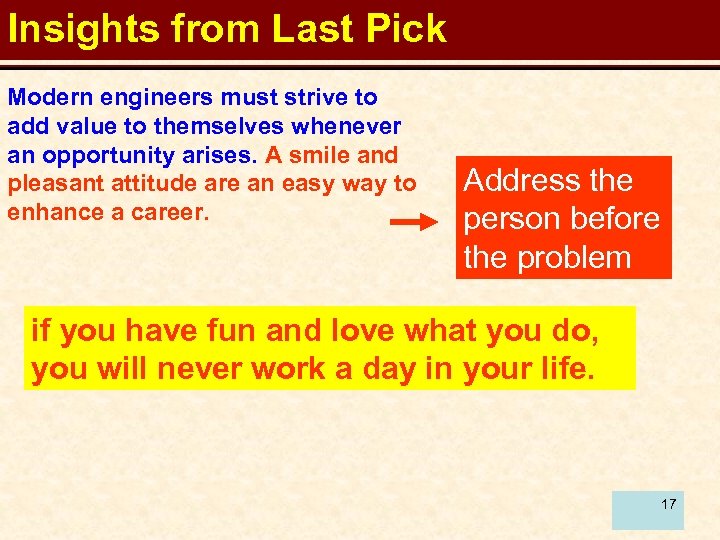 Insights from Last Pick Modern engineers must strive to add value to themselves whenever an opportunity arises. A smile and pleasant attitude are an easy way to enhance a career. Address the person before the problem if you have fun and love what you do, you will never work a day in your life. 17
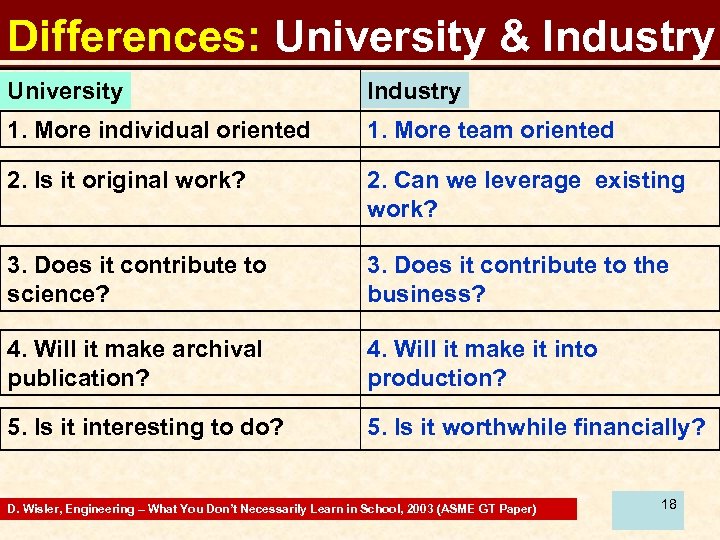 Differences: University & Industry University Industry 1. More individual oriented 1. More team oriented 2. Is it original work? 2. Can we leverage existing work? 3. Does it contribute to science? 3. Does it contribute to the business? 4. Will it make archival publication? 4. Will it make it into production? 5. Is it interesting to do? 5. Is it worthwhile financially? D. Wisler, Engineering – What You Don’t Necessarily Learn in School, 2003 (ASME GT Paper) 18
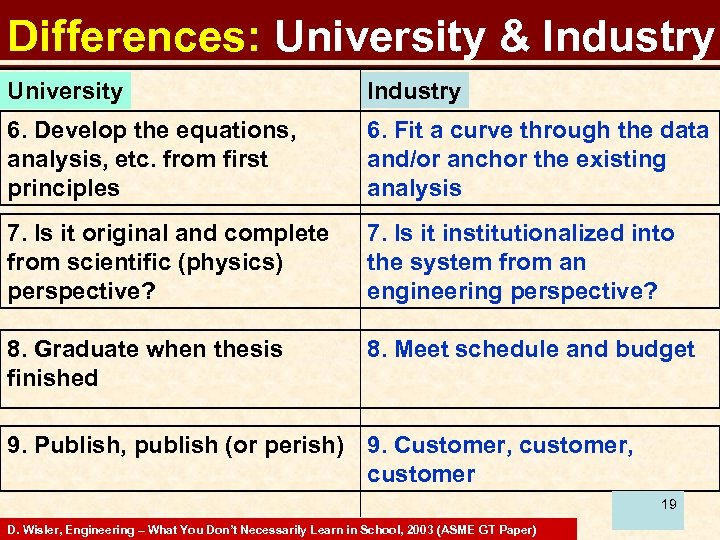 Differences: University & Industry University Industry 6. Develop the equations, analysis, etc. from first principles 6. Fit a curve through the data and/or anchor the existing analysis 7. Is it original and complete from scientific (physics) perspective? 7. Is it institutionalized into the system from an engineering perspective? 8. Graduate when thesis finished 8. Meet schedule and budget 9. Publish, publish (or perish) 9. Customer, customer 19 D. Wisler, Engineering – What You Don’t Necessarily Learn in School, 2003 (ASME GT Paper)
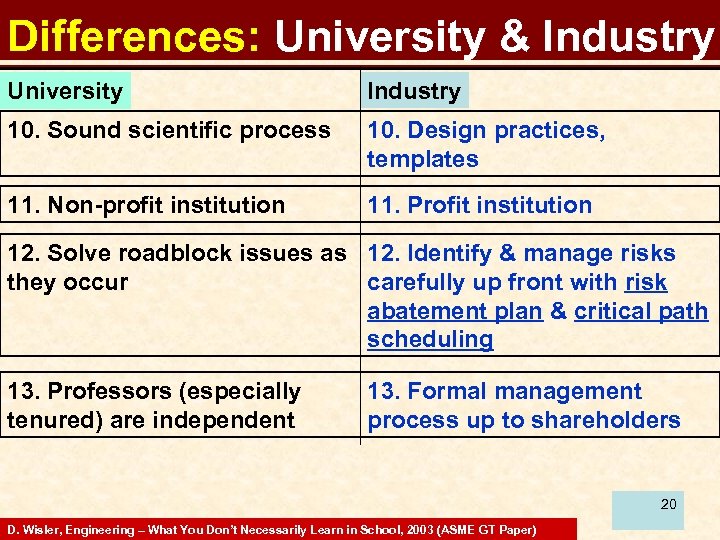 Differences: University & Industry University Industry 10. Sound scientific process 10. Design practices, templates 11. Non-profit institution 11. Profit institution 12. Solve roadblock issues as 12. Identify & manage risks they occur carefully up front with risk abatement plan & critical path scheduling 13. Professors (especially tenured) are independent 13. Formal management process up to shareholders 20 D. Wisler, Engineering – What You Don’t Necessarily Learn in School, 2003 (ASME GT Paper)
 Insights…from past students We must admit that present (eng) curricula are unsatisfactory, and have to change classroom assignments to ready for adjust in industry …. . Engineers have moved to become problem solvers, innovators, leaders and team players. A company life cycle depends on technology enablers: its engineers 21
 More insights…. Tools have changed, processes evolved and yet eng. students are still faced with learning the basics……. The necessary broad education is learnt (the hard way) in the first days at work; most of the times following a strong cultural shock Understanding the workplace does no end with one’s company, but also extends into being aware of global events in the world market. 22
 More insights…… For starters, step out of the ME department and learn relevant knowledge from beyond the scope of engineering. Expanding one’s horizon will boost one’s standing in his field of work…. . Learning is never limited to the classroom; constant self improvement is necessary to stay competitive. 23
 Insights…… … it comes back to our desire for self-improvement. After all, no success can come without hard work. Hence, we ought to get out of our comfort zone and be more pro-active in acquiring the skills and mindset to embrace the needs of a modern engineering career. 24
 Insights…… Engineers must have dedication and passion. Not only do they envision, design, develop, and support new products and services, but they also make sure that every minor detail is in place, such as staying within budget and being on schedule…. . The only constant is change A change is needed and we can be the catalysts for its ignition! 25
 Questions? Next lecture Communication skills Writing technical memoranda in engineering practice 26
 Insights from Singapore . . must realise that this article is taken from United States, therefore issues addressed are mostly directed to the US context. However, we cannot deny that these are extremely relevant to Singapore too. As Singaporeans are generally individualistic as trained in a competitive education environment from a young age, students will find it difficult to adapt in the working industry. 27
 Insights… from South Korea As Asians, we tend to be more conservative and reserved. To break from this convention, we must become more vocal and constructive during tutorial discussions. Schools should also encourage their students to participate more in oral presentations. 28
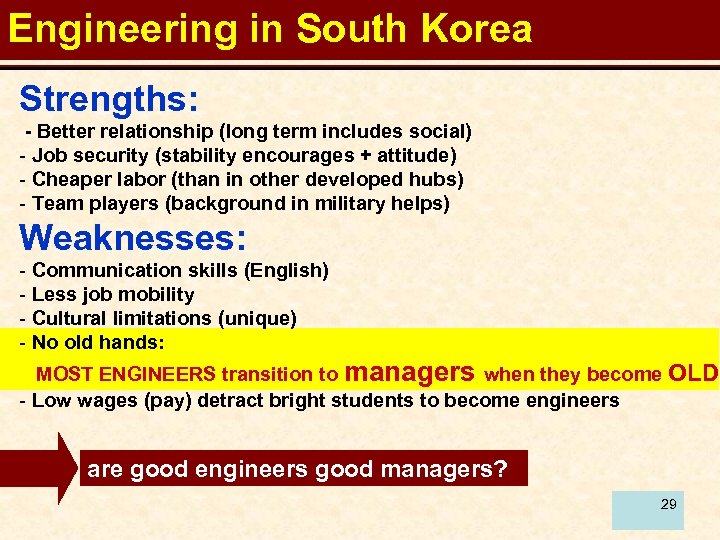 Engineering in South Korea Strengths: - Better relationship (long term includes social) - Job security (stability encourages + attitude) - Cheaper labor (than in other developed hubs) - Team players (background in military helps) Weaknesses: - Communication skills (English) - Less job mobility - Cultural limitations (unique) - No old hands: MOST ENGINEERS transition to managers when they become OLD - Low wages (pay) detract bright students to become engineers are good engineers good managers? 29
 Practices of Modern Engineering © Luis San Andres Texas A&M University 2011 http: //rotorlab. tamu. edu/me 489 30