 Скачать презентацию MCB 372 13 Selection Data Partitioning Gene Transfer
bfc3f2c82fee4141e6ff539034072a2e.ppt
- Количество слайдов: 62



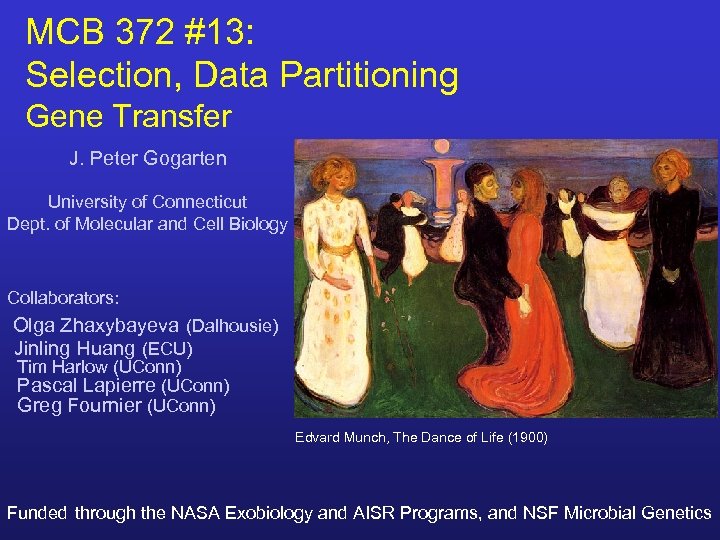
MCB 372 #13: Selection, Data Partitioning Gene Transfer J. Peter Gogarten University of Connecticut Dept. of Molecular and Cell Biology Collaborators: Olga Zhaxybayeva (Dalhousie) Jinling Huang (ECU) Tim Harlow (UConn) Pascal Lapierre (UConn) Greg Fournier (UConn) Edvard Munch, The Dance of Life (1900) Funded through the NASA Exobiology and AISR Programs, and NSF Microbial Genetics
Hy-Phy - Hypothesis Testing using Phylogenies. Using Batchfiles or GUI Information at http: //www. hyphy. org/ Selected analyses also can be performed online at http: //www. datamonkey. org/
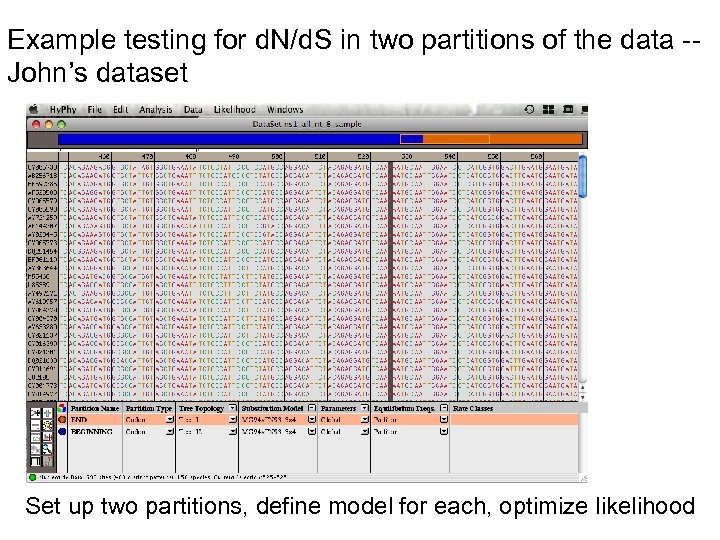
Example testing for d. N/d. S in two partitions of the data -John’s dataset Set up two partitions, define model for each, optimize likelihood
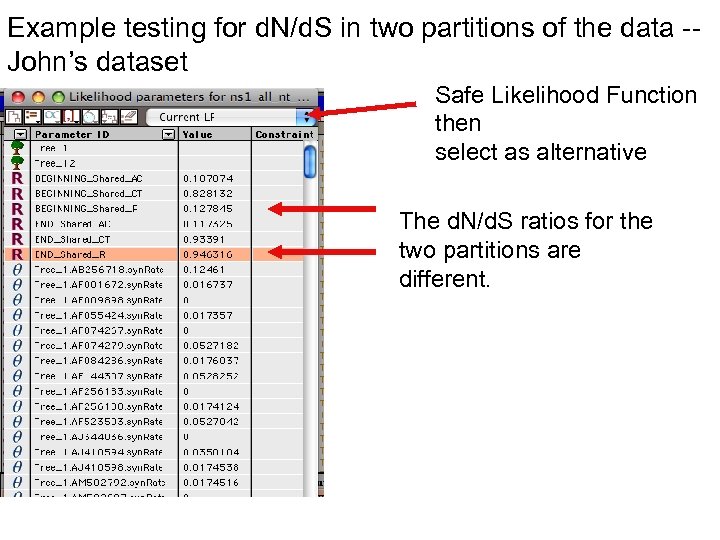
Example testing for d. N/d. S in two partitions of the data -John’s dataset Safe Likelihood Function then select as alternative The d. N/d. S ratios for the two partitions are different.
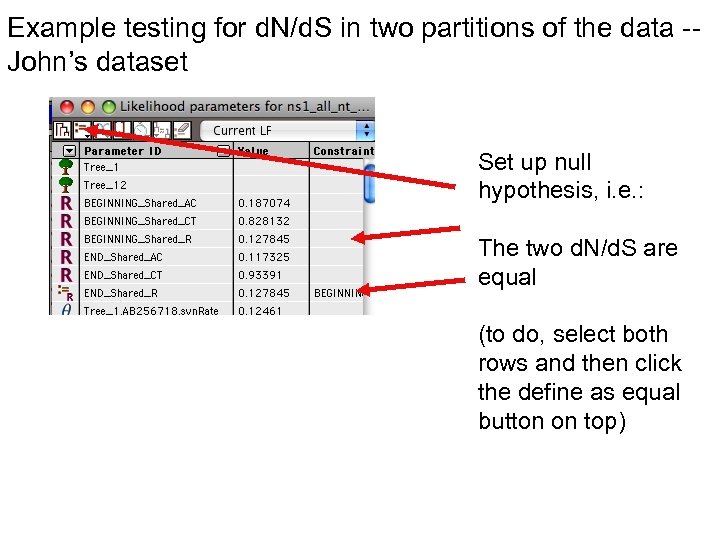
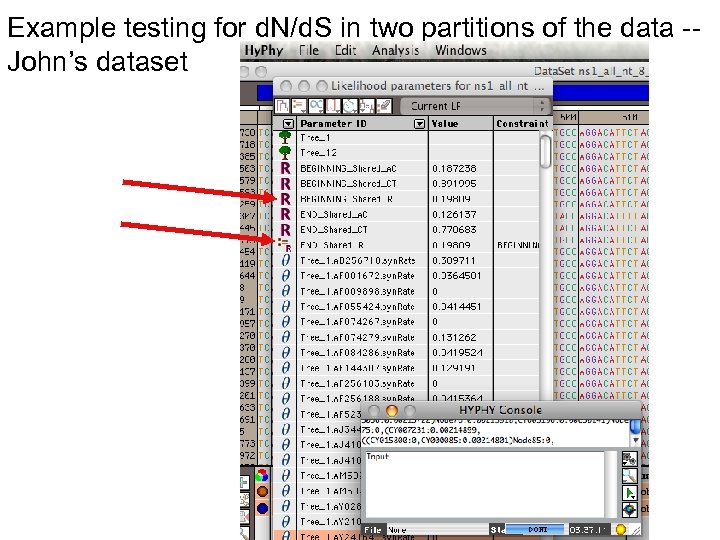
Example testing for d. N/d. S in two partitions of the data -John’s dataset Set up null hypothesis, i. e. : The two d. N/d. S are equal (to do, select both rows and then click the define as equal button on top)
Example testing for d. N/d. S in two partitions of the data -John’s dataset
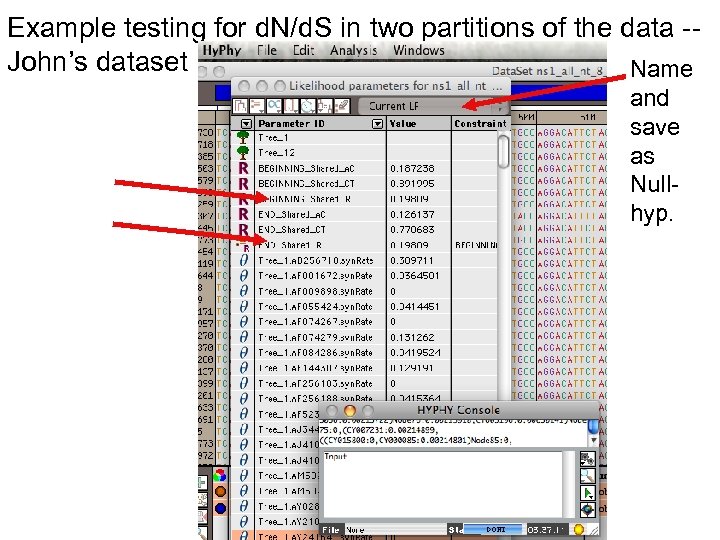
Example testing for d. N/d. S in two partitions of the data -John’s dataset Name and save as Nullhyp.
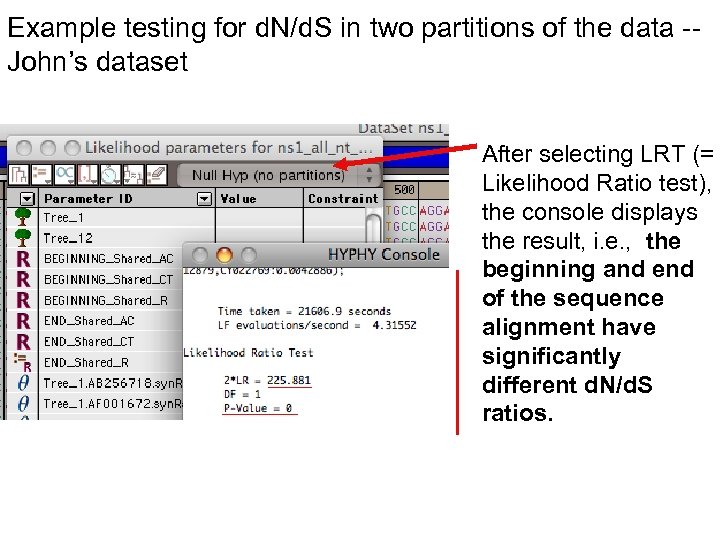
Example testing for d. N/d. S in two partitions of the data -John’s dataset After selecting LRT (= Likelihood Ratio test), the console displays the result, i. e. , the beginning and end of the sequence alignment have significantly different d. N/d. S ratios.
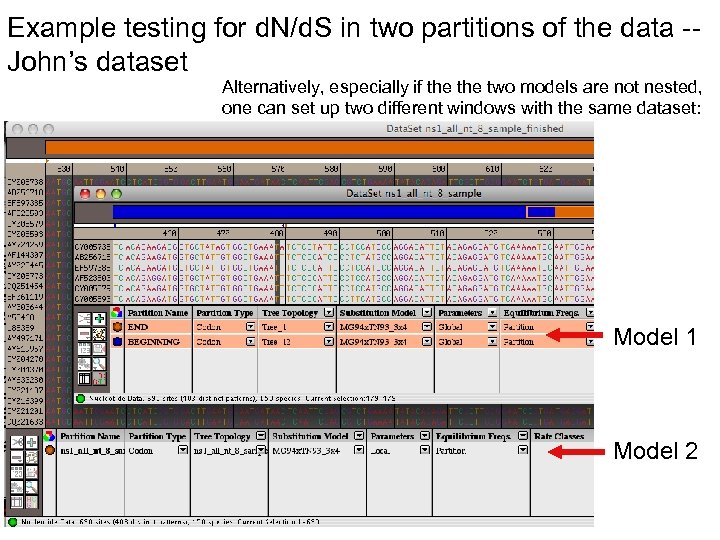
Example testing for d. N/d. S in two partitions of the data -John’s dataset Alternatively, especially if the two models are not nested, one can set up two different windows with the same dataset: Model 1 Model 2
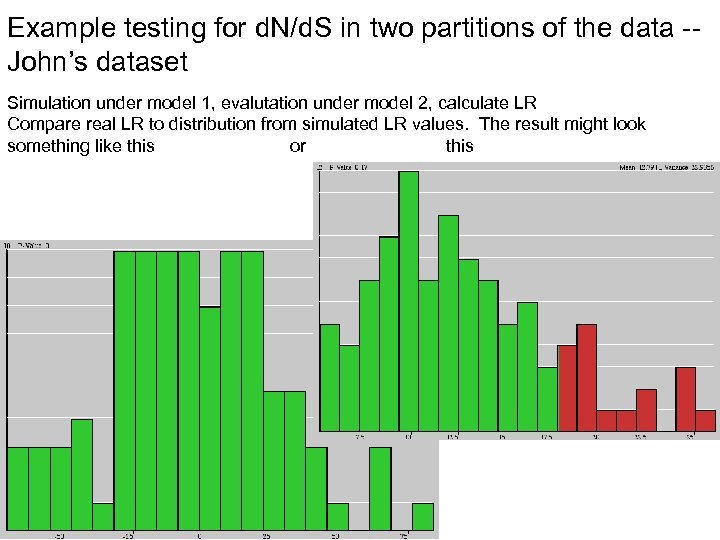
Example testing for d. N/d. S in two partitions of the data -John’s dataset Simulation under model 1, evalutation under model 2, calculate LR Compare real LR to distribution from simulated LR values. The result might look something like this or this
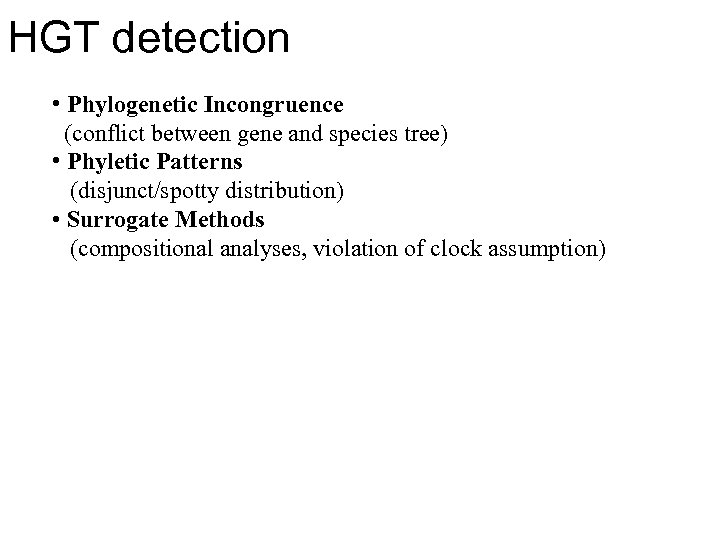
HGT detection • Phylogenetic Incongruence (conflict between gene and species tree) • Phyletic Patterns (disjunct/spotty distribution) • Surrogate Methods (compositional analyses, violation of clock assumption)
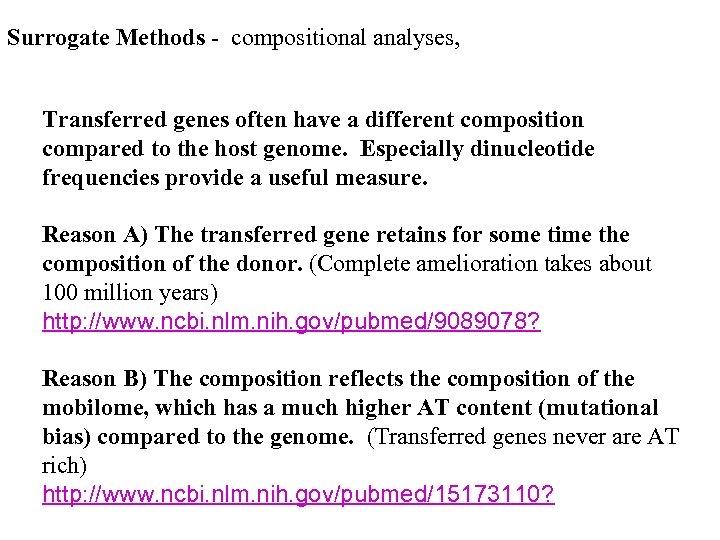
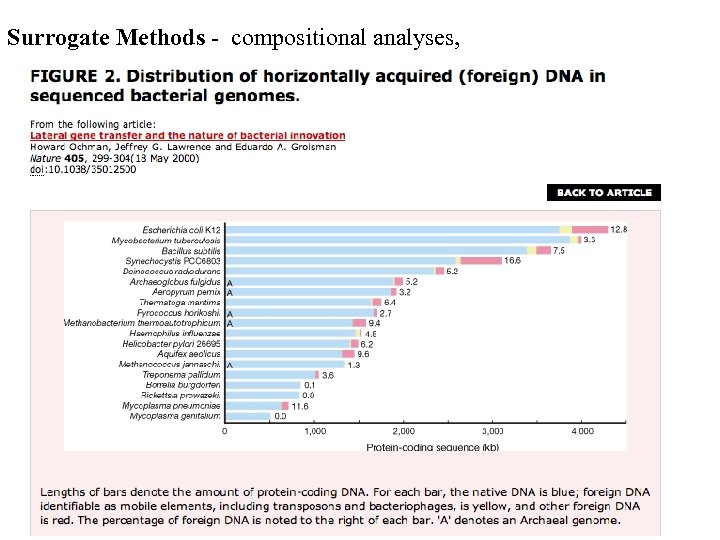
Surrogate Methods - compositional analyses, Transferred genes often have a different composition compared to the host genome. Especially dinucleotide frequencies provide a useful measure. Reason A) The transferred gene retains for some time the composition of the donor. (Complete amelioration takes about 100 million years) http: //www. ncbi. nlm. nih. gov/pubmed/9089078? Reason B) The composition reflects the composition of the mobilome, which has a much higher AT content (mutational bias) compared to the genome. (Transferred genes never are AT rich) http: //www. ncbi. nlm. nih. gov/pubmed/15173110?
Surrogate Methods - compositional analyses,
Surrogate Methods - clocks Use of an approximate molecular clock to detect horizontally transferred genes. For each gene, the distance between the gene and its orthologs from closely related genomes is calculated and plotted against the evolutionary distance separating the organisms. The latter can be approximated by ribosomal RNAs or by a genome average. If the gene was inherited vertically, and if the substitution rate remained approximately constant, then the points will fall on a straight line through the origin, with a slope depending on the substitution rate of the individual gene (A). If the gene was acquired from outside the organisms considered in the analysis (organism X), then all gene distances will be approximately the same and independent of the distance between the organisms (B). If the transfer occurred to a deeper branch in the tree, part of the points will fall on the diagonal, and part on a parallel line to the abscissa. Modified from Novichkov, P. S. , M. V. Omelchenko, M. S. Gelfand, A. A. Mironov, Y. I. Wolf and E. V. Koonin (2004). Genome-wide molecular clock and horizontal gene transfer in bacterial evolution. J. Bacteriol. 186(19): 6575 -6585.
Phyletic Methods • taxonomic distribution of blast hits • taxonomic position of best blast hit Any non-taxonomic distribution of gene presence and absence can be explained either by Gene transfer, or by Gene loss. Under the assumption of gene loss any gene present in at least one archaeon and one bacterium would have to be assumed present in the ancestral “Garden of Eden” genome. (Doolittle, W. F. , Y. Boucher, C. L. Nesbø, C. J. Douady, J. O. Andersson and A. J. Roger (2003). How big is the iceberg of which organellar genes in nuclear genomes are but the tip? Philosophical Transactions of the Royal Society B: Biological Sciences 358(1429): 39 -58. )
Phyletic Patterns (asisde)
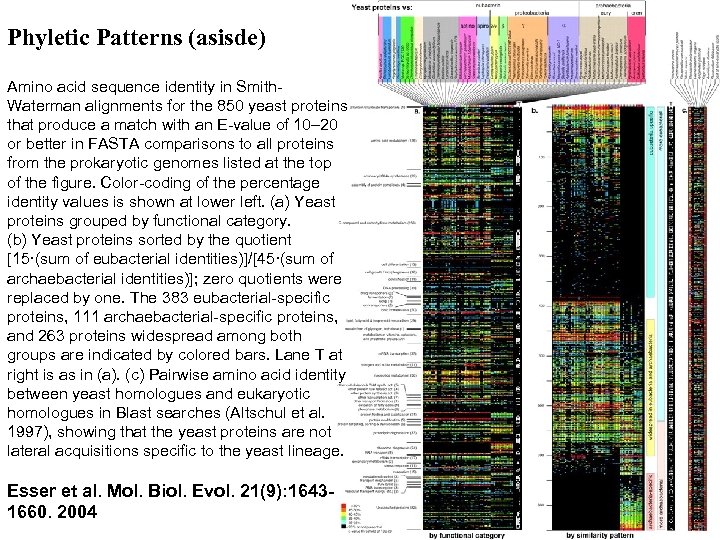
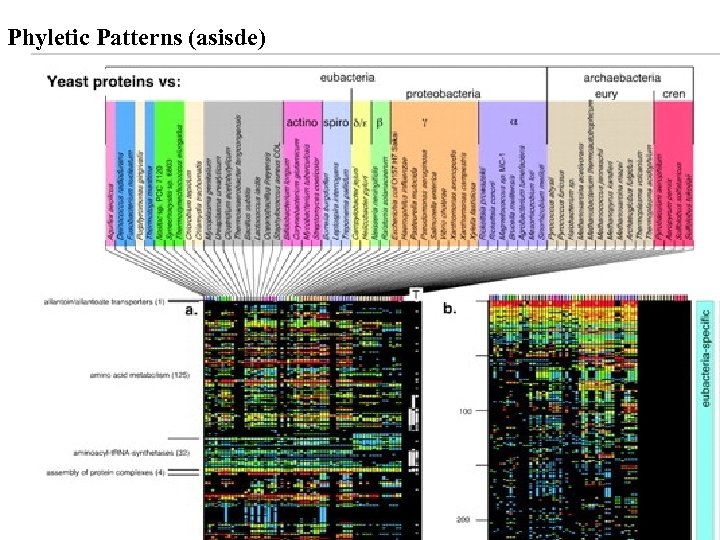
Phyletic Patterns (asisde) Amino acid sequence identity in Smith. Waterman alignments for the 850 yeast proteins that produce a match with an E-value of 10– 20 or better in FASTA comparisons to all proteins from the prokaryotic genomes listed at the top of the figure. Color-coding of the percentage identity values is shown at lower left. (a) Yeast proteins grouped by functional category. (b) Yeast proteins sorted by the quotient [15·(sum of eubacterial identities)]/[45·(sum of archaebacterial identities)]; zero quotients were replaced by one. The 383 eubacterial-specific proteins, 111 archaebacterial-specific proteins, and 263 proteins widespread among both groups are indicated by colored bars. Lane T at right is as in (a). (c) Pairwise amino acid identity between yeast homologues and eukaryotic homologues in Blast searches (Altschul et al. 1997), showing that the yeast proteins are not lateral acquisitions specific to the yeast lineage. Esser et al. Mol. Biol. Evol. 21(9): 16431660. 2004
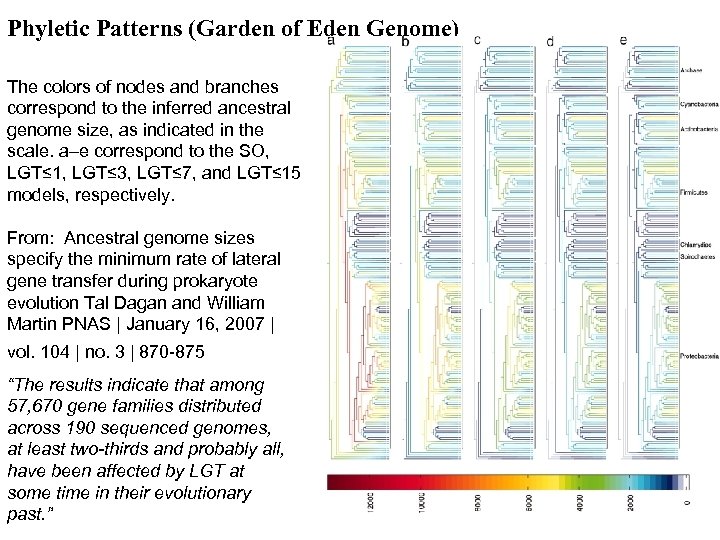
Phyletic Patterns (Garden of Eden Genome) The colors of nodes and branches correspond to the inferred ancestral genome size, as indicated in the scale. a–e correspond to the SO, LGT≤ 1, LGT≤ 3, LGT≤ 7, and LGT≤ 15 models, respectively. From: Ancestral genome sizes specify the minimum rate of lateral gene transfer during prokaryote evolution Tal Dagan and William Martin PNAS | January 16, 2007 | vol. 104 | no. 3 | 870 -875 “The results indicate that among 57, 670 gene families distributed across 190 sequenced genomes, at least two-thirds and probably all, have been affected by LGT at some time in their evolutionary past. ”
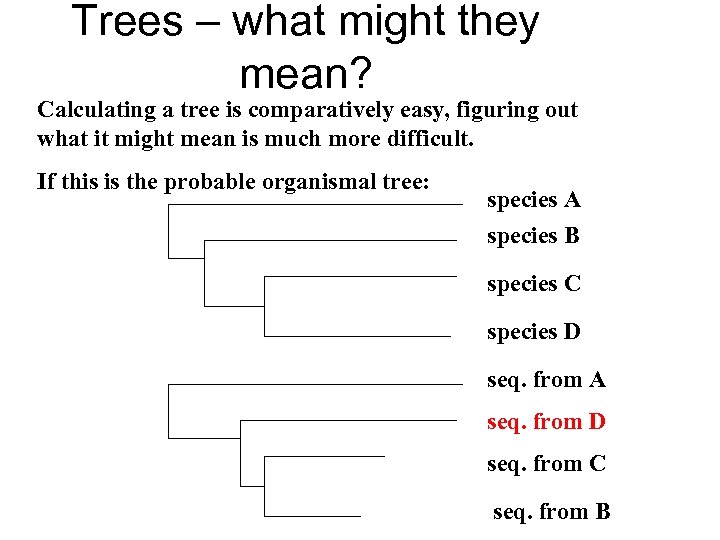
Trees – what might they mean? Calculating a tree is comparatively easy, figuring out what it might mean is much more difficult. If this is the probable organismal tree: species A species B species C species D seq. from A seq. from D seq. from C seq. from B
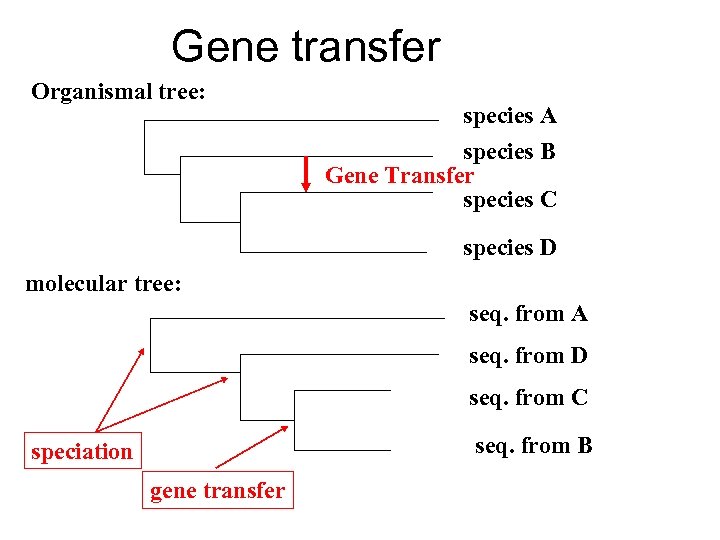
Gene transfer Organismal tree: species A species B Gene Transfer species C species D molecular tree: seq. from A seq. from D seq. from C seq. from B speciation gene transfer
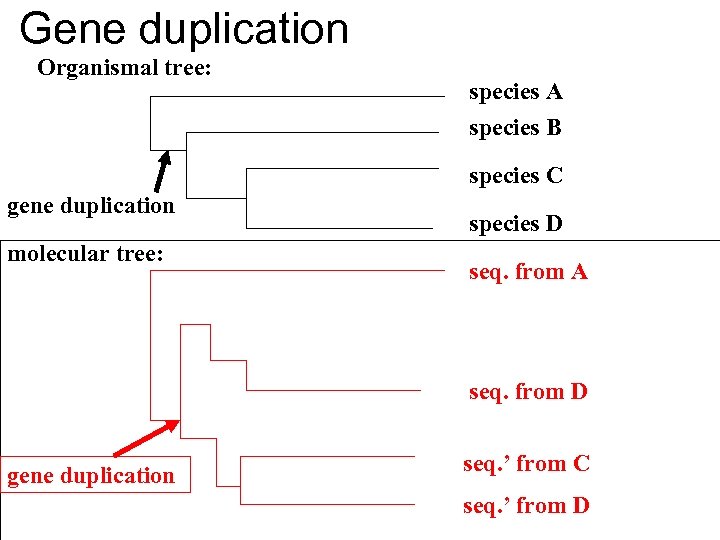
Gene duplication Organismal tree: species A species B species C gene duplication molecular tree: species D seq. from A seq. from B seq. from C seq. from D seq. ’ from B gene duplication seq. ’ from C seq. ’ from D
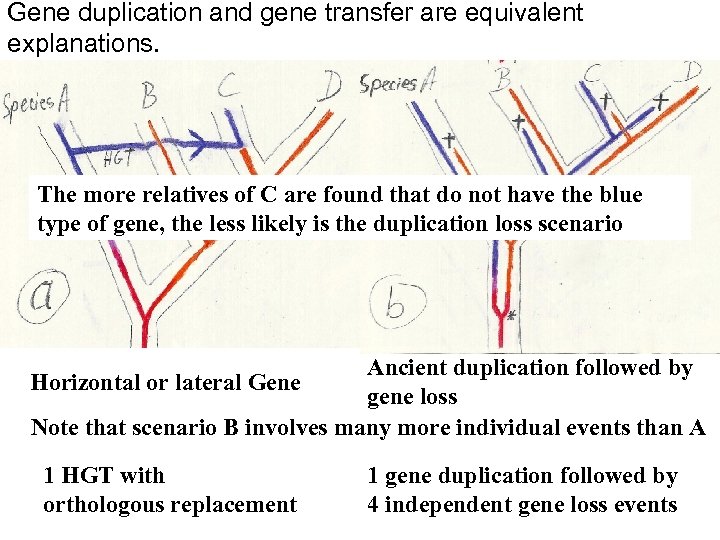
Gene duplication and gene transfer are equivalent explanations. The more relatives of C are found that do not have the blue type of gene, the less likely is the duplication loss scenario Ancient duplication followed by Horizontal or lateral Gene gene loss Note that scenario B involves many more individual events than A 1 HGT with orthologous replacement 1 gene duplication followed by 4 independent gene loss events
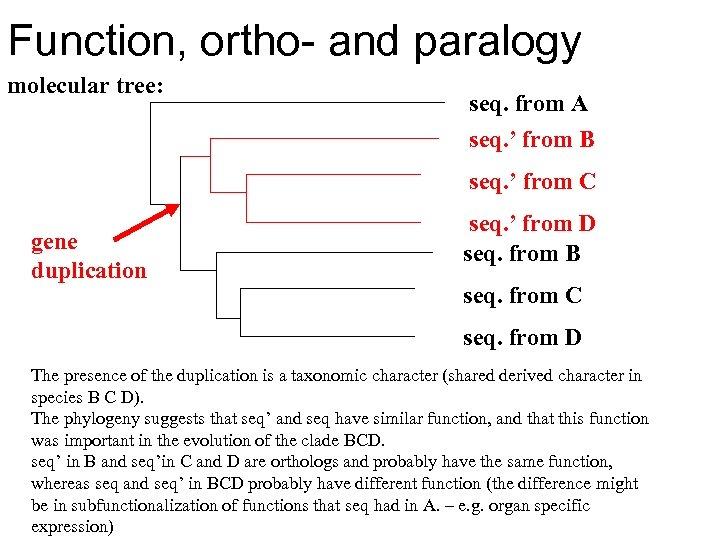
Function, ortho- and paralogy molecular tree: seq. from A seq. ’ from B seq. ’ from C gene duplication seq. ’ from D seq. from B seq. from C seq. from D The presence of the duplication is a taxonomic character (shared derived character in species B C D). The phylogeny suggests that seq’ and seq have similar function, and that this function was important in the evolution of the clade BCD. seq’ in B and seq’in C and D are orthologs and probably have the same function, whereas seq and seq’ in BCD probably have different function (the difference might be in subfunctionalization of functions that seq had in A. – e. g. organ specific expression)
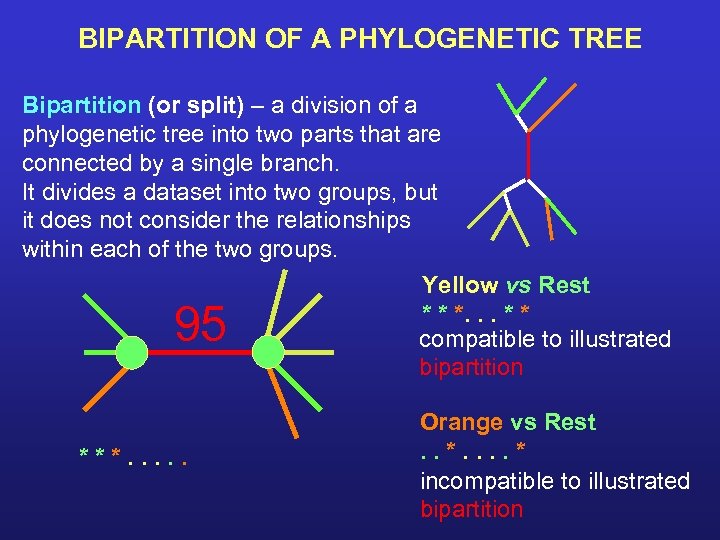
BIPARTITION OF A PHYLOGENETIC TREE Bipartition (or split) – a division of a phylogenetic tree into two parts that are connected by a single branch. It divides a dataset into two groups, but it does not consider the relationships within each of the two groups. Yellow vs Rest * * *. . . * * compatible to illustrated bipartition 95 ***. . . Orange vs Rest. . * incompatible to illustrated bipartition
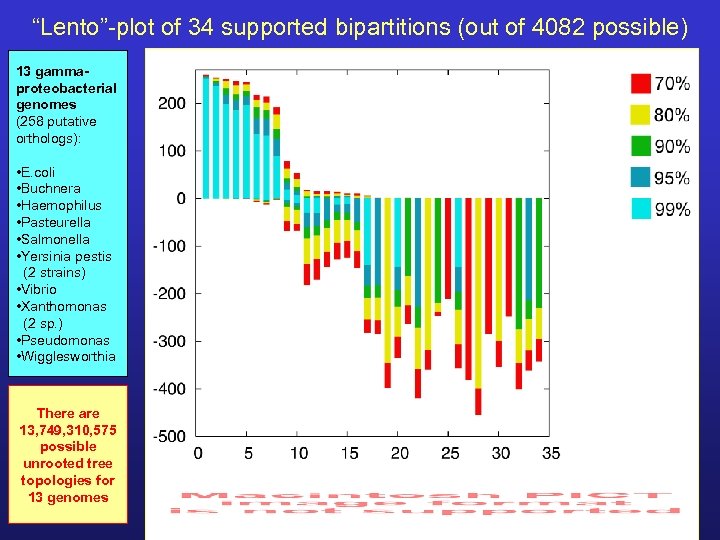
“Lento”-plot of 34 supported bipartitions (out of 4082 possible) 13 gammaproteobacterial genomes (258 putative orthologs): • E. coli • Buchnera • Haemophilus • Pasteurella • Salmonella • Yersinia pestis (2 strains) • Vibrio • Xanthomonas (2 sp. ) • Pseudomonas • Wigglesworthia There are 13, 749, 310, 575 possible unrooted tree topologies for 13 genomes
PROBLEMS WITH BIPARTITIONS • No easy way to incorporate gene families that are not represented in all genomes. • The more sequences are added, the shorter the internal branches become, and the lower is the bootstrap support for the individual bipartitions. • A single misplaced sequence can destroy all bipartitions.
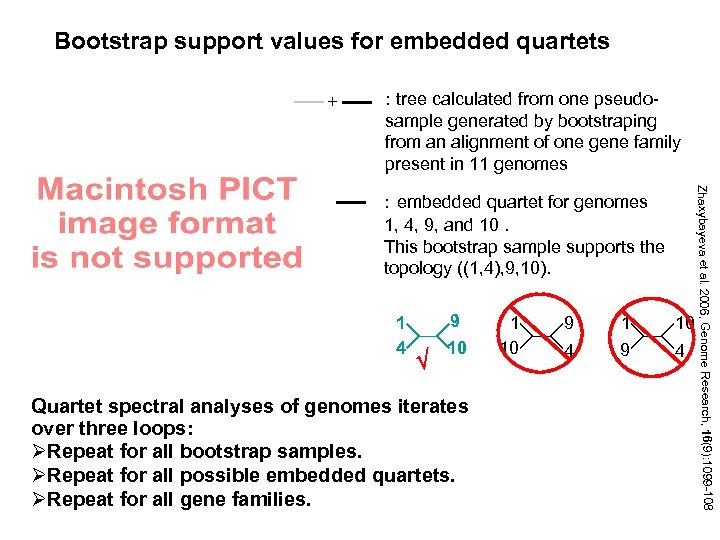
Bootstrap support values for embedded quartets + : tree calculated from one pseudosample generated by bootstraping from an alignment of one gene family present in 11 genomes 1 4 9 10 Quartet spectral analyses of genomes iterates over three loops: ØRepeat for all bootstrap samples. ØRepeat for all possible embedded quartets. ØRepeat for all gene families. 1 10 9 4 1 9 10 4 Zhaxybayeva et al. 2006, Genome Research, 16(9): 1099 -108 : embedded quartet for genomes 1, 4, 9, and 10. This bootstrap sample supports the topology ((1, 4), 9, 10).
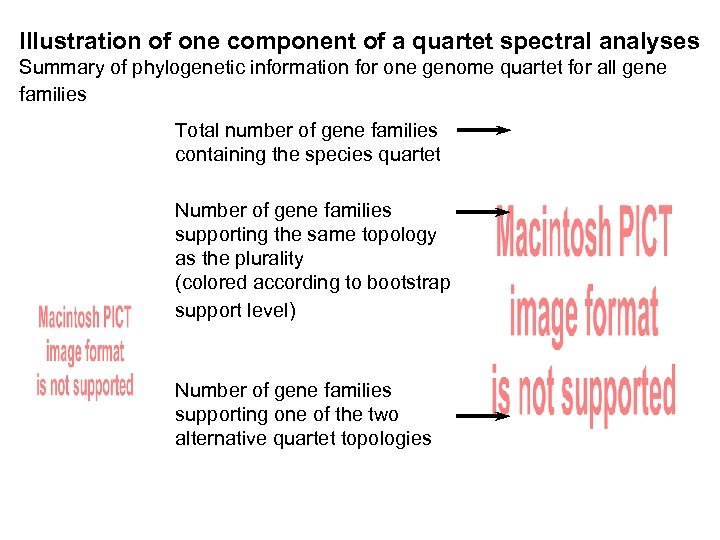
Illustration of one component of a quartet spectral analyses Summary of phylogenetic information for one genome quartet for all gene families Total number of gene families containing the species quartet Number of gene families supporting the same topology as the plurality (colored according to bootstrap support level) Number of gene families supporting one of the two alternative quartet topologies
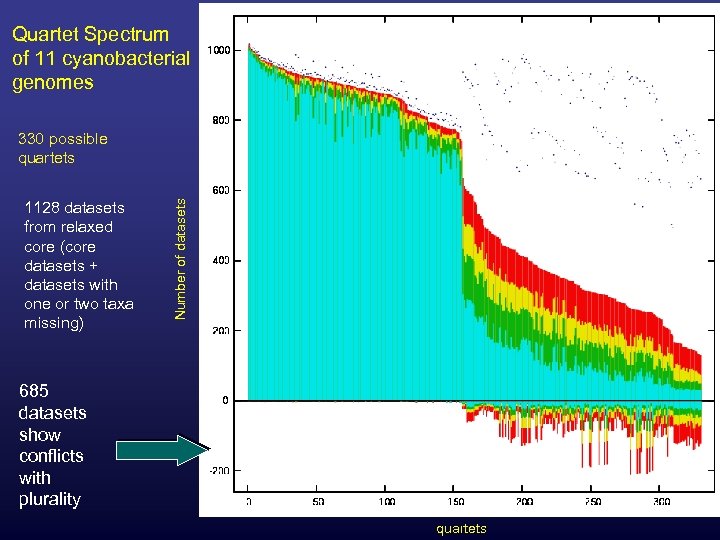
Quartet Spectrum of 11 cyanobacterial genomes 1128 datasets from relaxed core (core datasets + datasets with one or two taxa missing) Number of datasets 330 possible quartets 685 datasets show conflicts with plurality quartets
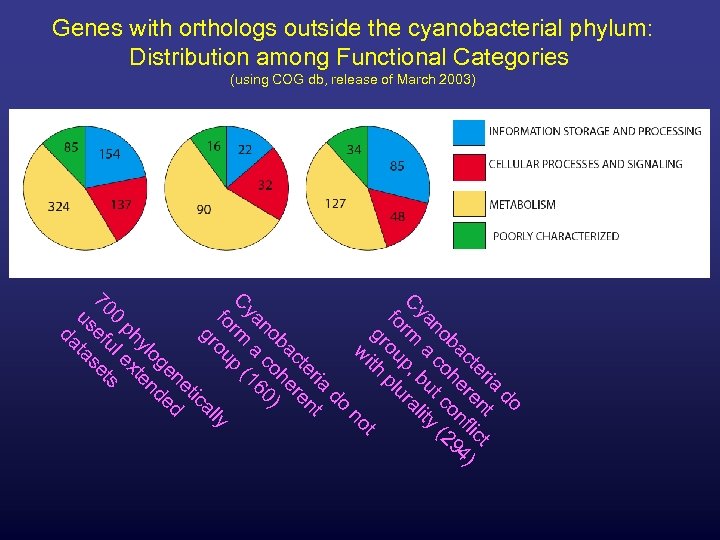
Genes with orthologs outside the cyanobacterial phylum: Distribution among Functional Categories (using COG db, release of March 2003) do ia t er n ct ct re fli 4) ba he on 29 no co t c ( ya a bu ity C rm p, ral fo ou plu gr ith t w no do ia t er n ct re ba he no co 0) ya a 16 C rm p ( fo ou ly al gr ic et en ed og d yl ten ph x 0 le s 70 efu set us ta da
Plurality Signal form Quartet Decomposition Modified from Zhaxybayeva, O. , Gogarten, J. P. , Charlebois, R. L. , Doolittle, W. F. , Papke, R. T. (2006) Genome Res. 16(9): 1099 -108
Flow Chart for Quartet Decomposition Analysis
Ancient Gene Transfer and Phylogenetic Reconstruction: Friends or Foes? Popular view Gene transfer is a disruptive force in phylogenetic reconstruction. New view Events of ancient gene transfer are valuable tools for reconstructing organismal phylogeny.
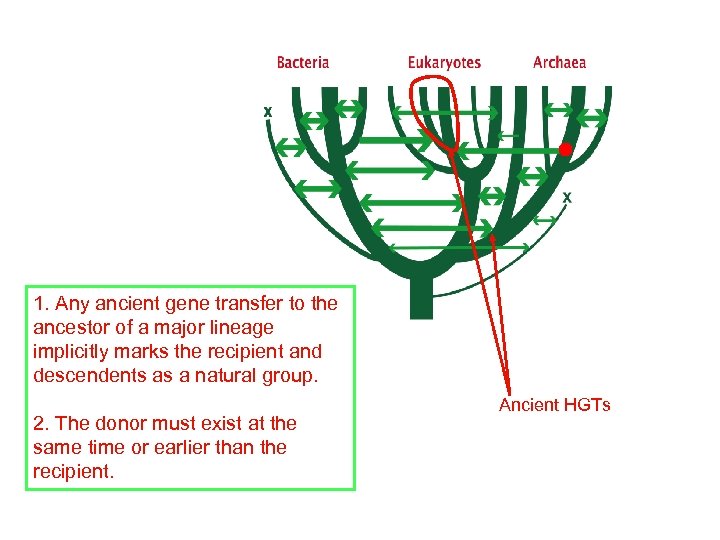
1. Any ancient gene transfer to the ancestor of a major lineage implicitly marks the recipient and descendents as a natural group. 2. The donor must exist at the same time or earlier than the recipient. Ancient HGTs
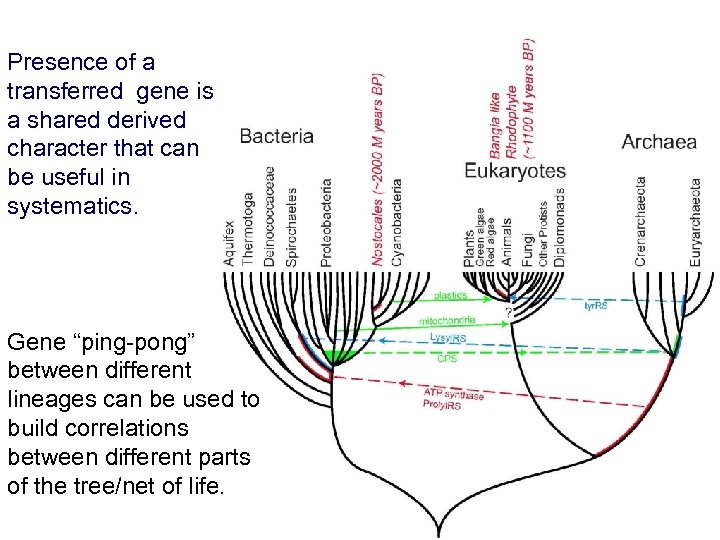
Presence of a transferred gene is a shared derived character that can be useful in systematics. Gene “ping-pong” between different lineages can be used to build correlations between different parts of the tree/net of life.
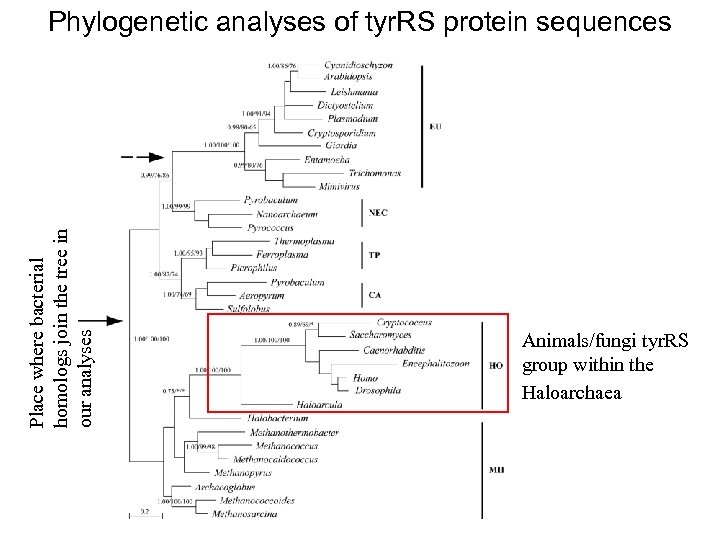
Place where bacterial homologs join the tree in our analyses Phylogenetic analyses of tyr. RS protein sequences Animals/fungi tyr. RS group within the Haloarchaea
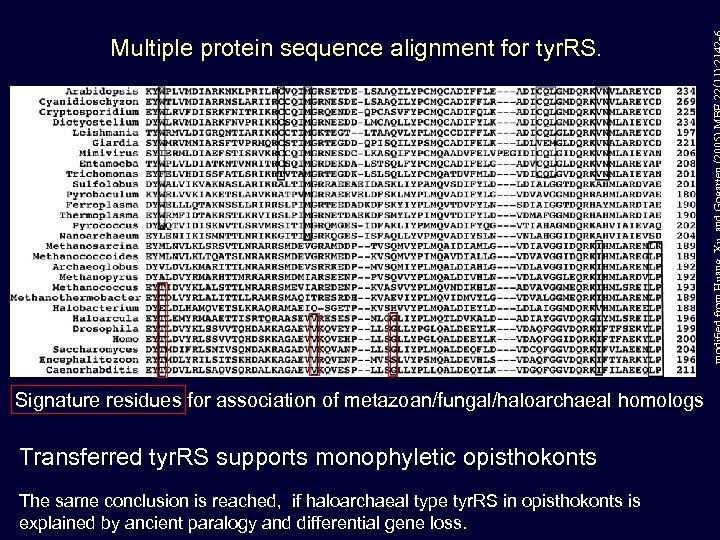
Multiple protein sequence alignment for tyr. RS. Signature residues for association of metazoan/fungal/haloarchaeal homologs Transferred tyr. RS supports monophyletic opisthokonts The same conclusion is reached, if haloarchaeal type tyr. RS in opisthokonts is explained by ancient paralogy and differential gene loss.
Monophyly of primary photosynthetic eukaryotes is supported by more than 50 ancient gene transfers from different bacterial phyla to the ancestor of the red algae and green plant lineage. • E. g. , ancient gene transfer of frp-gene (florfenicol resistance protein) Gene from Green plants and Red algae groups with delta proteobacteria modified from Huang and Gogarten (2006), Trends in Genetics 22, 361 - 366
Consistent phylogenetic signal links Chlamydiae, red algae and green plants. modified from Huang and Gogarten 2007, Genome Biol 8: R 99 Red Algal and Green Plant Genes of Chlamydial Origin
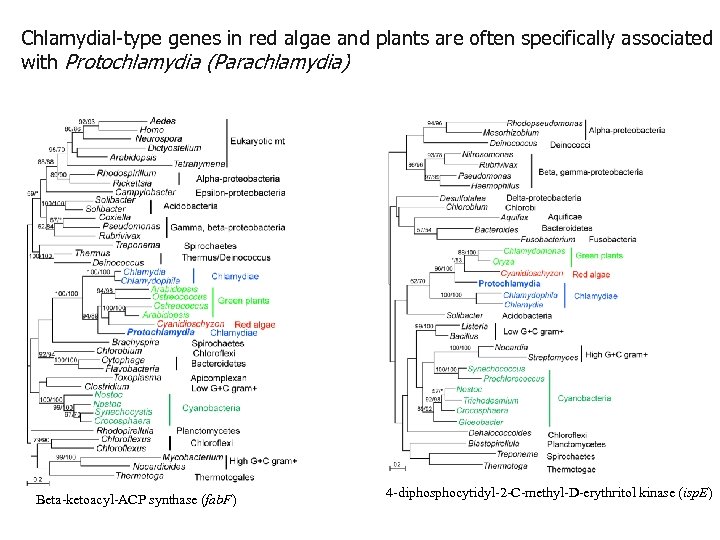
Chlamydial-type genes in red algae and plants are often specifically associated with Protochlamydia (Parachlamydia) Beta-ketoacyl-ACP synthase (fab. F) 4 -diphosphocytidyl-2 -C-methyl-D-erythritol kinase (isp. E)
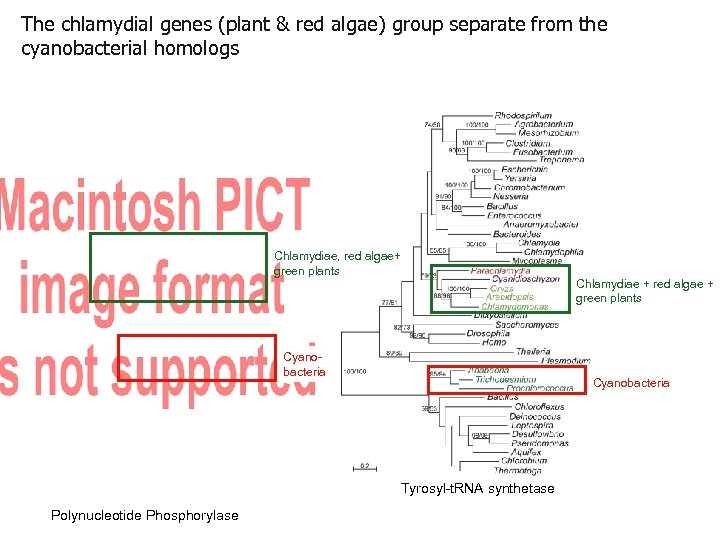
The chlamydial genes (plant & red algae) group separate from the cyanobacterial homologs Chlamydiae, red algae+ green plants Cyanobacteria Tyrosyl-t. RNA synthetase Polynucleotide Phosphorylase Chlamydiae + red algae + green plants
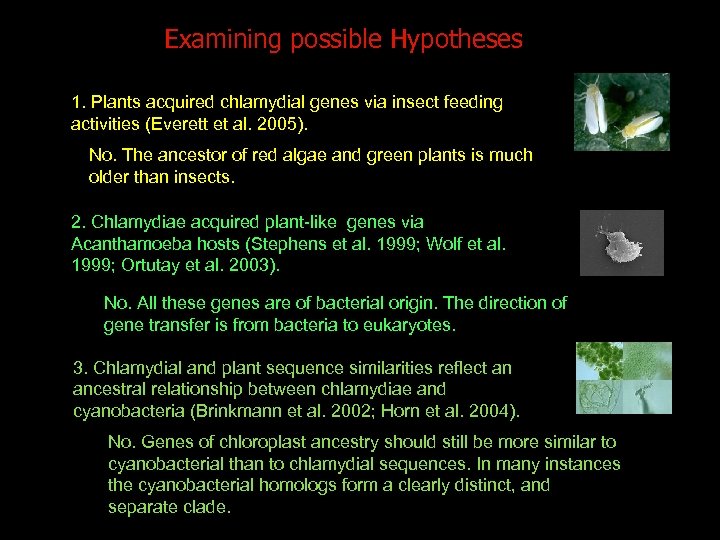
Examining possible Hypotheses 1. Plants acquired chlamydial genes via insect feeding activities (Everett et al. 2005). No. The ancestor of red algae and green plants is much older than insects. 2. Chlamydiae acquired plant-like genes via Acanthamoeba hosts (Stephens et al. 1999; Wolf et al. 1999; Ortutay et al. 2003). No. All these genes are of bacterial origin. The direction of gene transfer is from bacteria to eukaryotes. 3. Chlamydial and plant sequence similarities reflect an ancestral relationship between chlamydiae and cyanobacteria (Brinkmann et al. 2002; Horn et al. 2004). No. Genes of chloroplast ancestry should still be more similar to cyanobacterial than to chlamydial sequences. In many instances the cyanobacterial homologs form a clearly distinct, and separate clade.
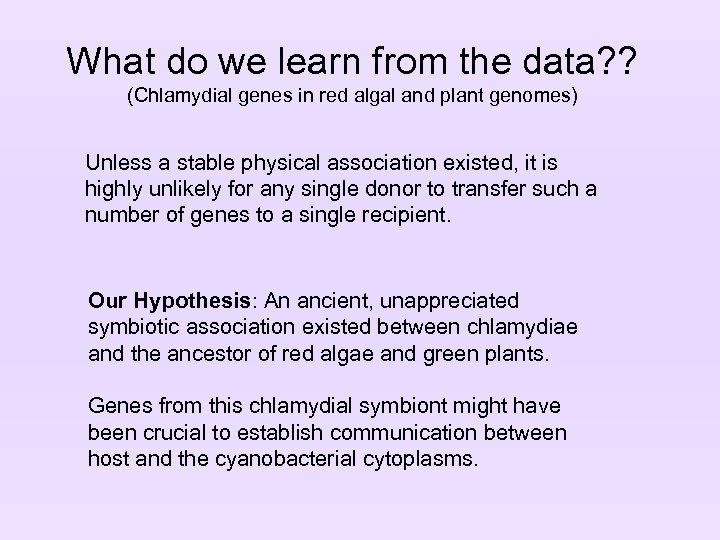
What do we learn from the data? ? (Chlamydial genes in red algal and plant genomes) Unless a stable physical association existed, it is highly unlikely for any single donor to transfer such a number of genes to a single recipient. Our Hypothesis: An ancient, unappreciated symbiotic association existed between chlamydiae and the ancestor of red algae and green plants. Genes from this chlamydial symbiont might have been crucial to establish communication between host and the cyanobacterial cytoplasms.
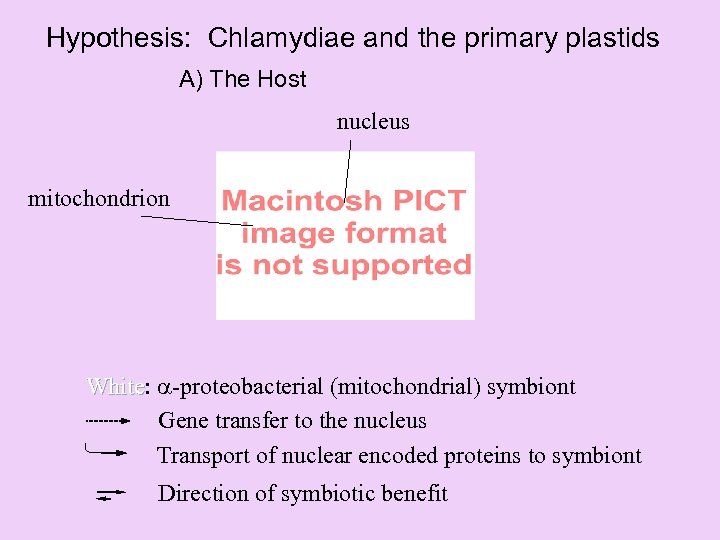
Hypothesis: Chlamydiae and the primary plastids A) The Host nucleus mitochondrion White: -proteobacterial (mitochondrial) symbiont White Gene transfer to the nucleus Transport of nuclear encoded proteins to symbiont Direction of symbiotic benefit
Hypothesis: Chlamydiae and the primary plastids B) The Host invaded by a parasite nucleus mitochondrion cyanobacterium in food vacuole parasitic chlamydial bacterium Yellow: parasitic chlamydial bacterium Yellow Green: cyanobacterium (as food) Gene transfer to the nucleus Transport of nuclear encoded proteins to symbiont Direction of symbiotic benefit
Hypothesis: Chlamydiae and the primary plastids C) The chlamydial symbiont becomes mutalistic Genes might be transferred between the different symbionts nucleus The machinery that provides benefits to the chlamydial parasite also begins to provide some benefits to the enslaved cyanobacterium Gene transfer from the symbionts to the nucleus Transport of nuclear encoded proteins to symbiont Direction of symbiotic benefit
Hypothesis: Chlamydiae and the primary plastids D) The cyanobacterium evolves into an organelle nucleus mitochondrion Products from genes that were transported to the nucleus are targeted into the cyanobacterium Chlamydial and cyanobacterial type gene products are targeted to the plastid Gene transfer from the symbionts to the nucleus Direction of symbiotic benefit
Hypothesis: Chlamydiae and the primary plastids D) Loss of chlamydial symbiont With the help of genes contributed by the chlamydial parasite, the cyanobacterium has evolved into a photosynthetic organelle The chlamydial symbiont is lost - possibly without trace, except for the genes that facilitated the integration of the metabolism of the host with that of a photoautotroph. This hypothesis also explains why the evolution of an organelle from a primary endosymbiont is rare. A photoautotroph with a single compartment has few transporters available that would allow integration with the host metabolism. The simultaneous presence of an intracellular parasite allows for the integration of the two cytoplasms.
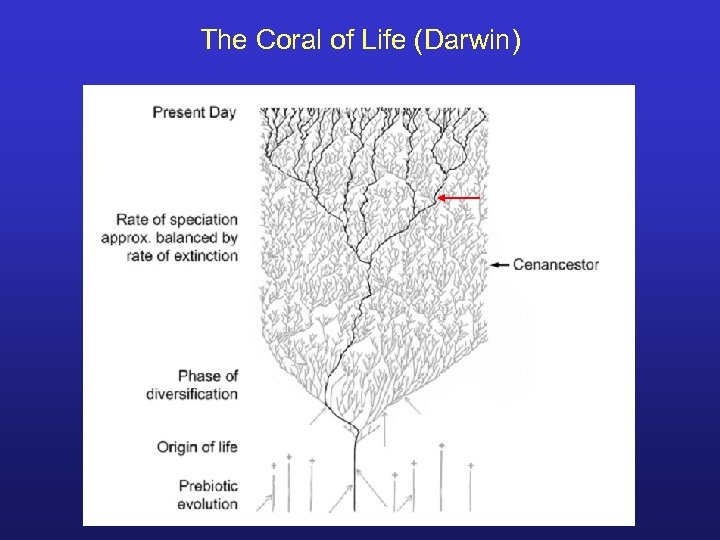
The Coral of Life (Darwin)
Mapping Metabolic Pathways on the Tree of Life Chris House, Bruce Runnegar, and Sorel Fitz-Gibbon conclude from their analyses of genome based phylogenetic trees (Geobiology 1, 15 -26, 2003): “Our results suggest that the last common ancestor of Archaea was not a methanogen and that methanogenesis arose later during subsequent microbial evolution. This leaves sulphur reduction as the most geochemically plausible metabolism for the base of the archaeal crown group. ”
Thermoplasmatales Pyrococci Modified from: Galagan et al. , 2002
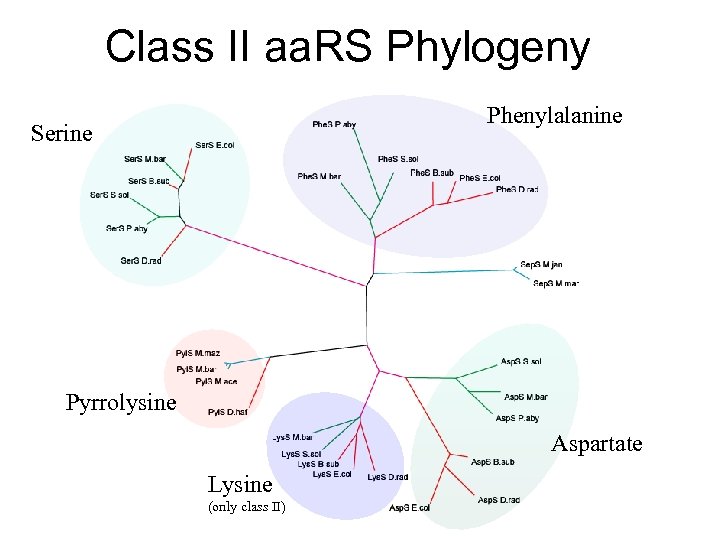
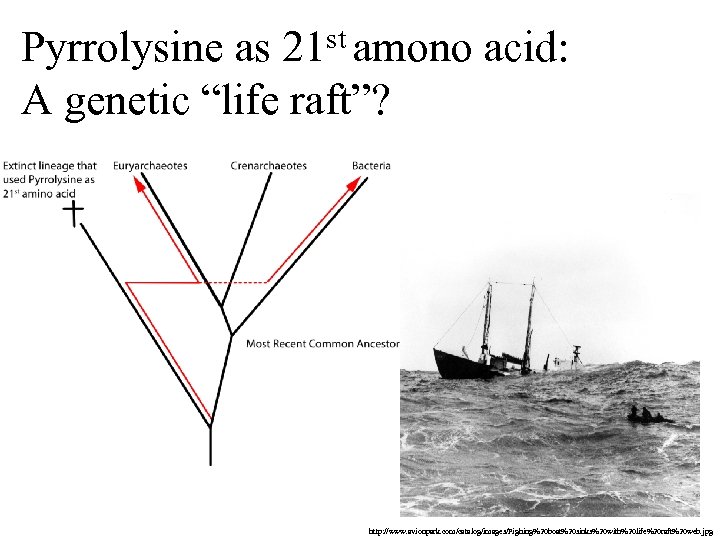
Mapping Metabolic Pathways on the Tree of Life Chris House, Bruce Runnegar, and Sorel Fitz-Gibbon conclude from their analyses of genome based phylogenetic trees (Geobiology 1, 15 -26, 2003): “Our results suggest that the last common ancestor of Archaea was not a methanogen and that methanogenesis arose later during subsequent microbial evolution. This leaves sulphur reduction as the most geochemically plausible metabolism for the base of the archaeal crown group. ” This conclusion is at odds with the ancient origin of many of the enzymes specific to methanogens. Enzymes involved in methylamine reduction use pyrrolysine as a 21 amino acid. The enzyme that charges the pyrrolysine t. RNA is as old as the genetic code.
Class II aa. RS Phylogeny Phenylalanine Serine Pyrrolysine Aspartate Lysine (only class II)
st amono 21 Pyrrolysine as A genetic “life raft”? acid: http: //www. avionpark. com/catalog/images/Fighing%20 boat%20 sinks%20 with%20 life%20 raft%20 web. jpg
Evolution of Aceticlastic Methanogenesis in Methanosarcinales via Horizontal Gene Transfer from Clostridia
Thermoplasmatales Pyrococci Modified from: Galagan et al. , 2002
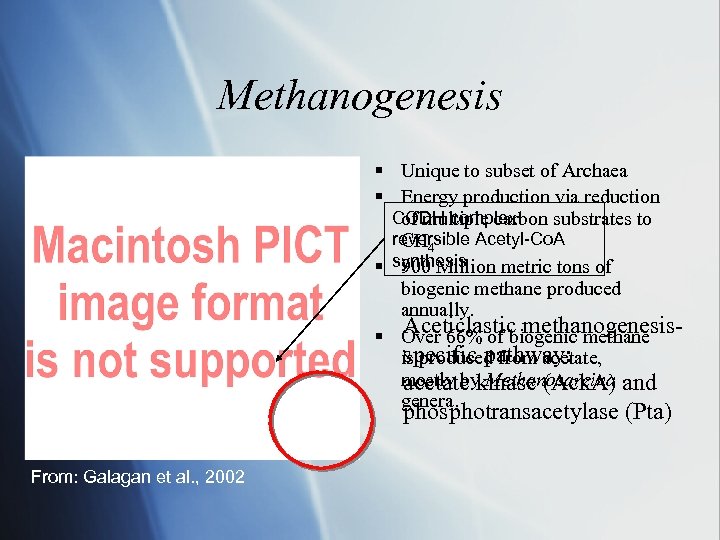
Methanogenesis § Unique to subset of Archaea § Energy production via reduction CODH complex: of multiple carbon substrates to reversible Acetyl-Co. A CH 4 § synthesis 900 Million metric tons of biogenic methane produced annually. Aceticlastic methanogenesis§ Over 66% of biogenic methane specific pathway: is produced from acetate, mostly by Methanosarcina and acetate kinase (Ack. A) genera. phosphotransacetylase (Pta) From: Galagan et al. , 2002
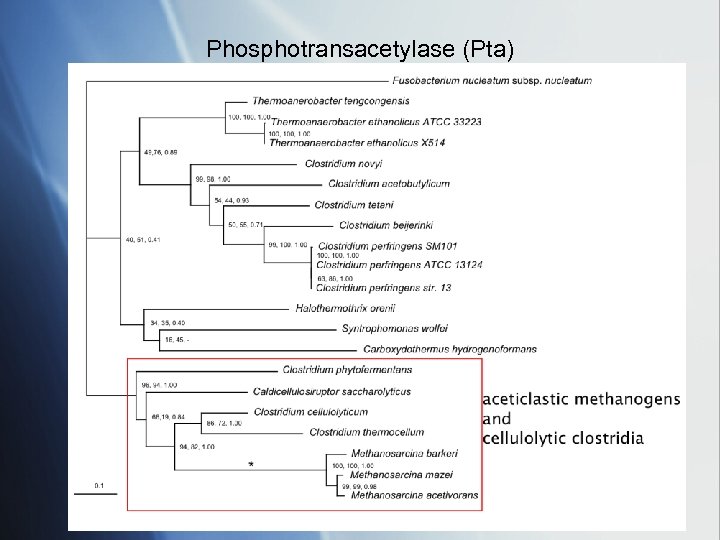
Phosphotransacetylase (Pta)
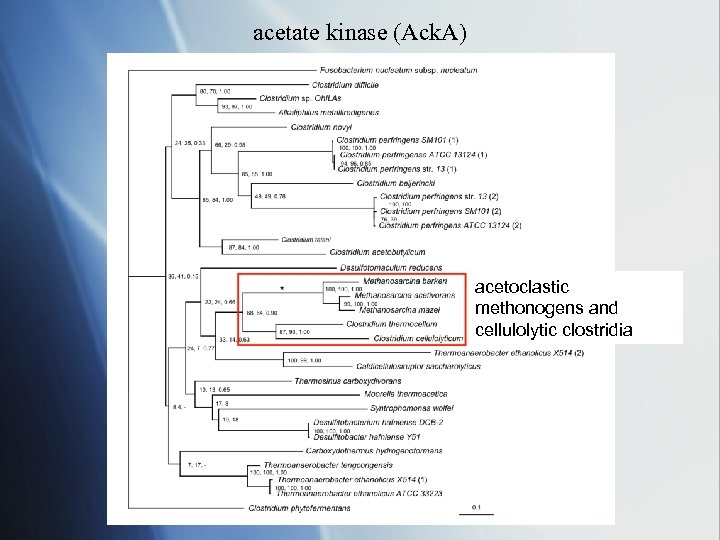
acetate kinase (Ack. A) acetoclastic methonogens and cellulolytic clostridia

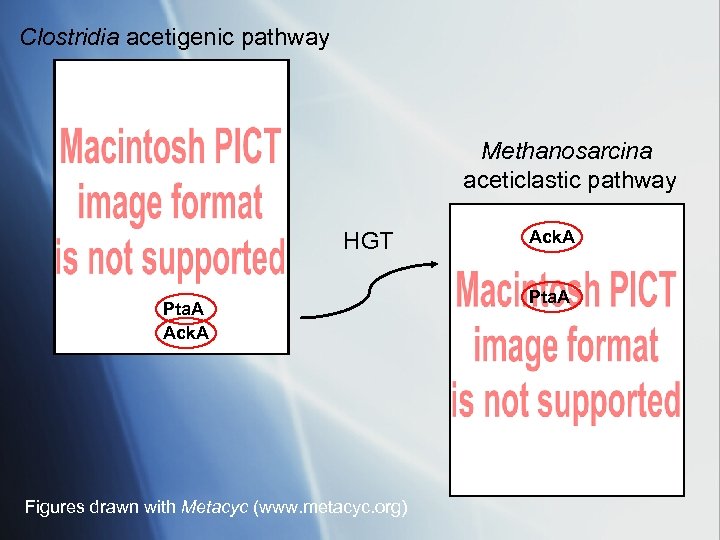
Clostridia acetigenic pathway Methanosarcina aceticlastic pathway HGT Pta. A Ack. A Figures drawn with Metacyc (www. metacyc. org) Ack. A Pta. A
• Methanogenesis from acetate evolved in the Methanosarcinales via HGT of Ack. A and Pta genes from a species closely related to cellulolytic Clostridia • The transfer was a relatively recent singular event involving derived taxa. • The ancestral state of the recipient likely was a chemoautotrophic methanogen that used the CODH complex for Acetyl-Co. A synthesis from C-1 substrates. (Grahame et al. 2005 Arch Microbiol 184 32 -43, 2005) • Gene transfer of Ack. A/Pta. A would provide metabolic reversal of CODH reaction in presence of acetate, with no additional genes required.
Скачать презентацию MCB 372 13 Selection Data Partitioning Gene Transfer
bfc3f2c82fee4141e6ff539034072a2e.ppt