 Скачать презентацию Maya civilization Shcherbakov Maxim The Maya is
Maya civilization.pptx
- Количество слайдов: 11



Maya civilization Shcherbakov Maxim.
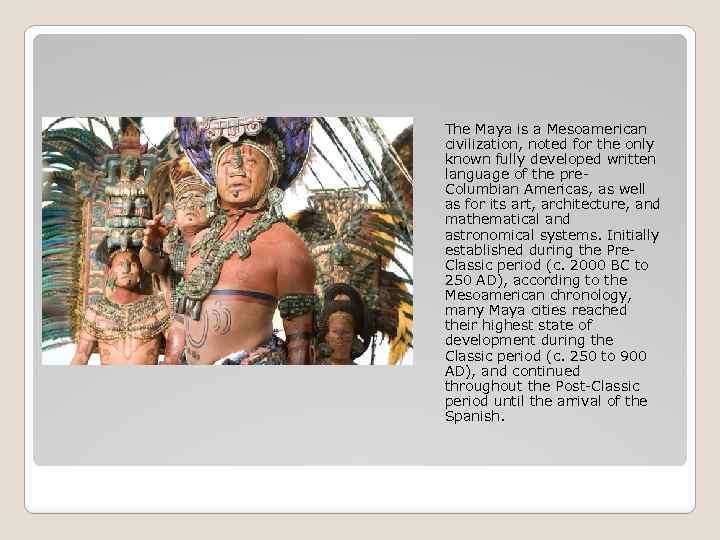
The Maya is a Mesoamerican civilization, noted for the only known fully developed written language of the pre. Columbian Americas, as well as for its art, architecture, and mathematical and astronomical systems. Initially established during the Pre. Classic period (c. 2000 BC to 250 AD), according to the Mesoamerican chronology, many Maya cities reached their highest state of development during the Classic period (c. 250 to 900 AD), and continued throughout the Post-Classic period until the arrival of the Spanish.
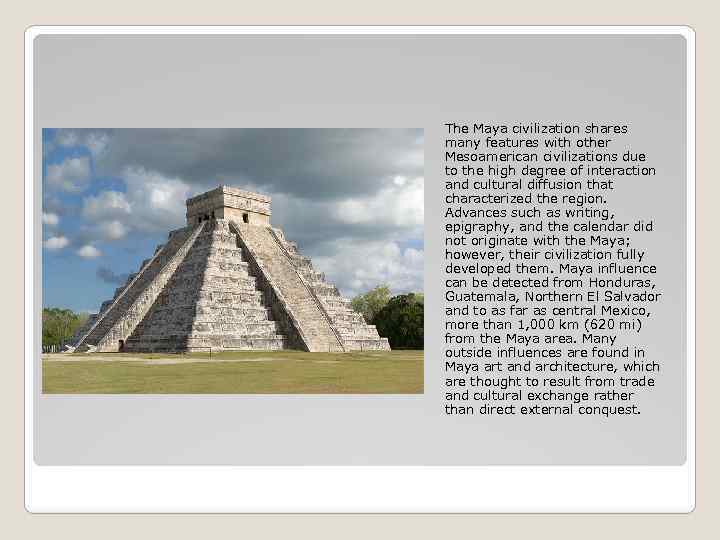
The Maya civilization shares many features with other Mesoamerican civilizations due to the high degree of interaction and cultural diffusion that characterized the region. Advances such as writing, epigraphy, and the calendar did not originate with the Maya; however, their civilization fully developed them. Maya influence can be detected from Honduras, Guatemala, Northern El Salvador and to as far as central Mexico, more than 1, 000 km (620 mi) from the Maya area. Many outside influences are found in Maya art and architecture, which are thought to result from trade and cultural exchange rather than direct external conquest.
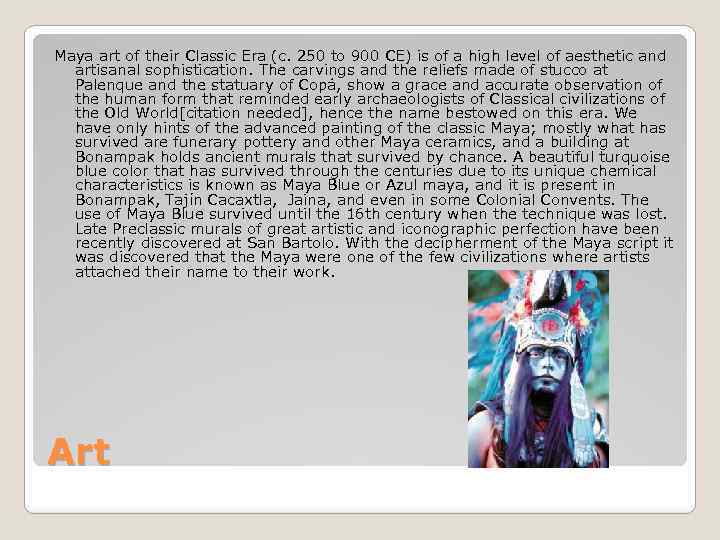
Maya art of their Classic Era (c. 250 to 900 CE) is of a high level of aesthetic and artisanal sophistication. The carvings and the reliefs made of stucco at Palenque and the statuary of Copá, show a grace and accurate observation of the human form that reminded early archaeologists of Classical civilizations of the Old World[citation needed], hence the name bestowed on this era. We have only hints of the advanced painting of the classic Maya; mostly what has survived are funerary pottery and other Maya ceramics, and a building at Bonampak holds ancient murals that survived by chance. A beautiful turquoise blue color that has survived through the centuries due to its unique chemical characteristics is known as Maya Blue or Azul maya, and it is present in Bonampak, Tajín Cacaxtla, Jaina, and even in some Colonial Convents. The use of Maya Blue survived until the 16 th century when the technique was lost. Late Preclassic murals of great artistic and iconographic perfection have been recently discovered at San Bartolo. With the decipherment of the Maya script it was discovered that the Maya were one of the few civilizations where artists attached their name to their work. Art
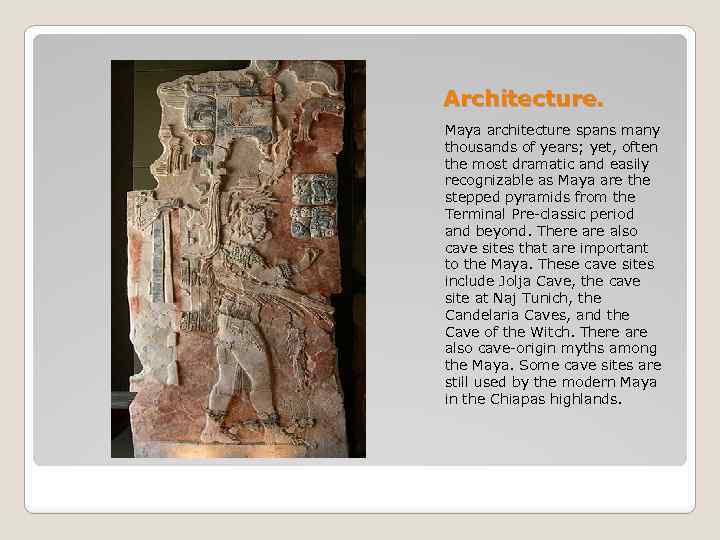
Architecture. Maya architecture spans many thousands of years; yet, often the most dramatic and easily recognizable as Maya are the stepped pyramids from the Terminal Pre-classic period and beyond. There also cave sites that are important to the Maya. These cave sites include Jolja Cave, the cave site at Naj Tunich, the Candelaria Caves, and the Cave of the Witch. There also cave-origin myths among the Maya. Some cave sites are still used by the modern Maya in the Chiapas highlands.
In common with the other Mesoamerican civilizations, the Maya used a base 20 (vigesimal) and base 5 numbering system (see Maya numerals). Also, the preclassic Maya and their neighbors had independently developed the concept of zero by 36 BC. Inscriptions show them on occasion working with sums up to the hundreds of millions and dates so large it would take several lines just to represent it. They produced extremely accurate astronomical observations; their charts of the movements of the moon and planets are equal or superior to those of any other civilization working from naked eye observation.
Uniquely, there is some evidence to suggest the Maya appear to be the only pre-telescopic civilization to demonstrate knowledge of the Orion Nebula as being fuzzy, i. e. not a stellar pin-point. The information which supports this theory comes from a folk tale that deals with the Orion constellation's area of the sky. Their traditional hearths include in their middle a smudge of glowing fire that corresponds with the Orion Nebula. This is a significant clue to support the idea that the Maya detected a diffuse area of the sky contrary to the pin points of stars before the telescope was invented. [25] Many preclassic sites are oriented with the Pleiades and Eta Draconis, as seen in La Blanca, Ujuxte, Monte Alto, and Takalik Abaj. The Maya were very interested in zenial passages, the time when the sun passes directly overhead. The latitude of most of their cities being below the Tropic of Cancer, these zenial passages would occur twice a year equidistant from the solstice. To represent this position of the sun overhead, the Maya had a god named Diving God. [citation needed] The Dresden Codex contains the highest concentration of astronomical phenomena observations and calculations of any of the surviving texts (it appears that the data in this codex is primarily or exclusively of an astronomical nature). Examination and analysis of this codex reveals that Venus was the most important astronomical object to the Maya, even more important to them than the sun.
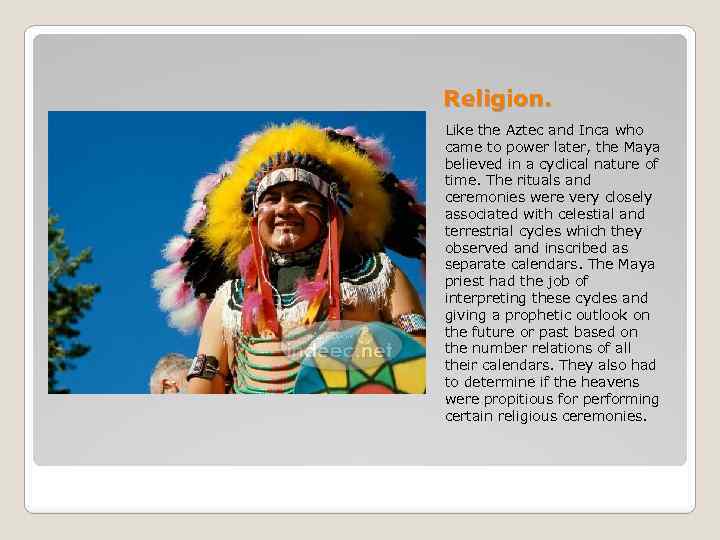
Religion. Like the Aztec and Inca who came to power later, the Maya believed in a cyclical nature of time. The rituals and ceremonies were very closely associated with celestial and terrestrial cycles which they observed and inscribed as separate calendars. The Maya priest had the job of interpreting these cycles and giving a prophetic outlook on the future or past based on the number relations of all their calendars. They also had to determine if the heavens were propitious for performing certain religious ceremonies.
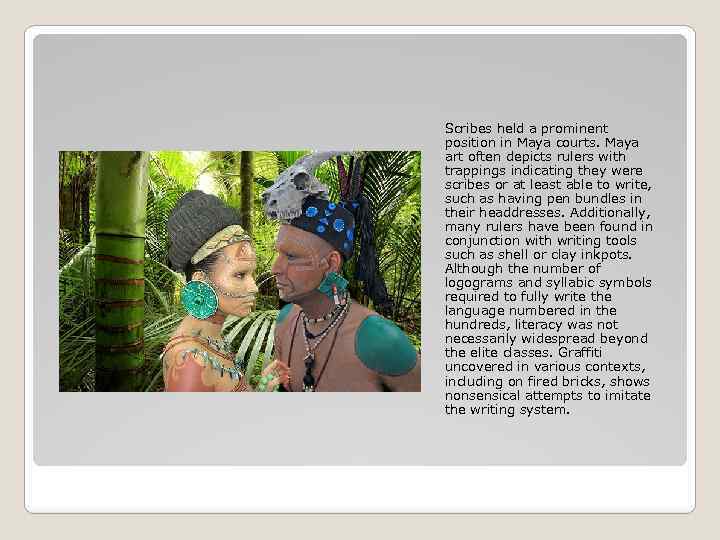
Scribes held a prominent position in Maya courts. Maya art often depicts rulers with trappings indicating they were scribes or at least able to write, such as having pen bundles in their headdresses. Additionally, many rulers have been found in conjunction with writing tools such as shell or clay inkpots. Although the number of logograms and syllabic symbols required to fully write the language numbered in the hundreds, literacy was not necessarily widespread beyond the elite classes. Graffiti uncovered in various contexts, including on fired bricks, shows nonsensical attempts to imitate the writing system.
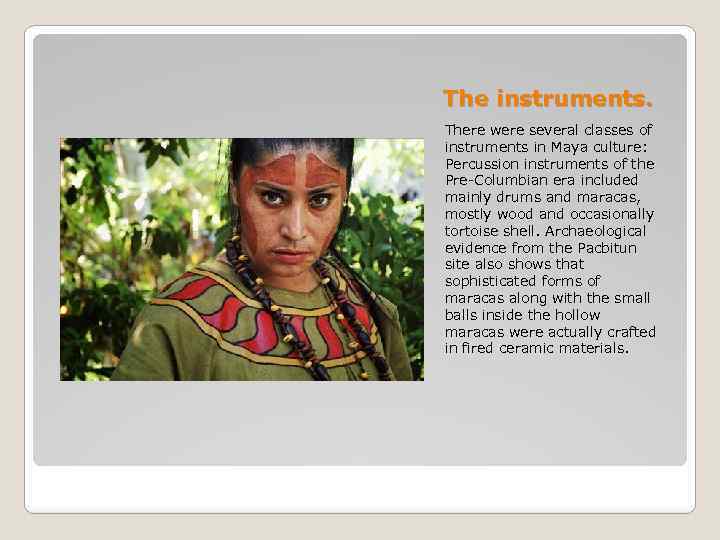
The instruments. There were several classes of instruments in Maya culture: Percussion instruments of the Pre-Columbian era included mainly drums and maracas, mostly wood and occasionally tortoise shell. Archaeological evidence from the Pacbitun site also shows that sophisticated forms of maracas along with the small balls inside the hollow maracas were actually crafted in fired ceramic materials.
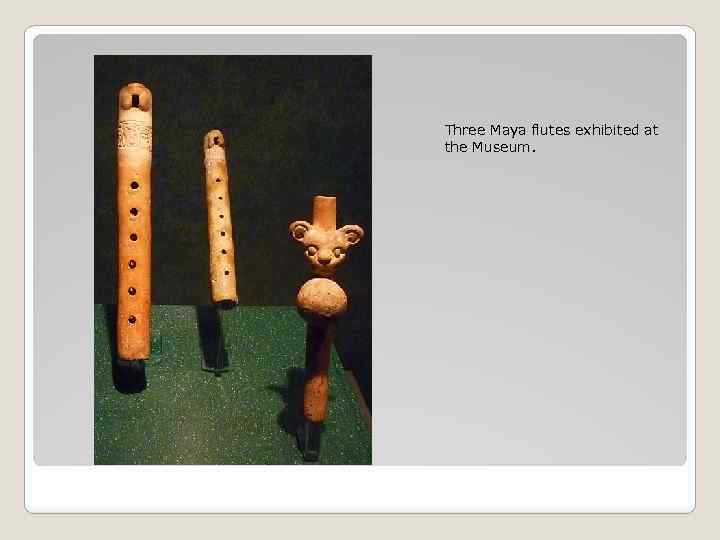
Three Maya flutes exhibited at the Museum.
Скачать презентацию Maya civilization Shcherbakov Maxim The Maya is
Maya civilization.pptx