


 Скачать презентацию May 2008 doc IEEE 802 15 -08
563e5cce4660b553e3db1c45e2cf48db.ppt
- Количество слайдов: 11
 May 2008 doc. : IEEE 802. 15 -08 -0366 -00 -0006 Project: IEEE P 802. 15 Working Group for Wireless Personal Area Networks (WPANs) Submission Title: TG 6 Closing Report for the Session in May 2008 Date Submitted: May 17, 2008 Source: Arthur Astrin Contact: Arthur Astrin (Astrin Radio) Voice: +1 650 704 -2517, E-Mail: astrin@ieee. org Re: TG 6 Closing Report for May 2008 Session Abstract: Closing Report for the TG 6 Session in Jan 2008. Purpose: To summarize activities during the meeting Notice: This document has been prepared to assist the IEEE P 802. 15. It is offered as a basis for discussion and is not binding on the contributing individual(s) or organization(s). The material in this document is subject to change in form and content after further study. The contributor(s) reserve(s) the right to add, amend or withdraw material contained herein. Release: The contributor acknowledges and accepts that this contribution becomes the property of IEEE and maybe made publicly available by P 802. 15. Submission Slide 1 Arthur Astrin
 May 2008 doc. : IEEE 802. 15 -08 -0366 -00 -0006 IEEE 802. 15 TG 6 Body Area Network Closing Report 3 nd Meeting as a Task Group 6 Jacksonville, FL 15 May, 2008 Submission Slide 2 Arthur Astrin
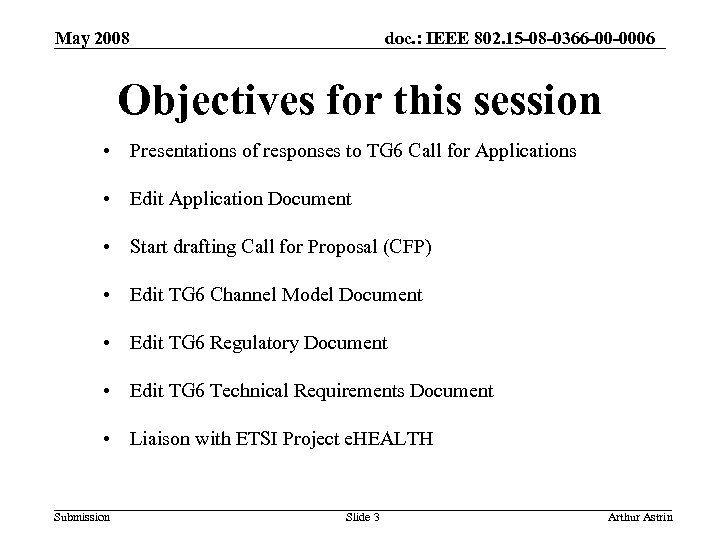 May 2008 doc. : IEEE 802. 15 -08 -0366 -00 -0006 Objectives for this session • Presentations of responses to TG 6 Call for Applications • Edit Application Document • Start drafting Call for Proposal (CFP) • Edit TG 6 Channel Model Document • Edit TG 6 Regulatory Document • Edit TG 6 Technical Requirements Document • Liaison with ETSI Project e. HEALTH Submission Slide 3 Arthur Astrin
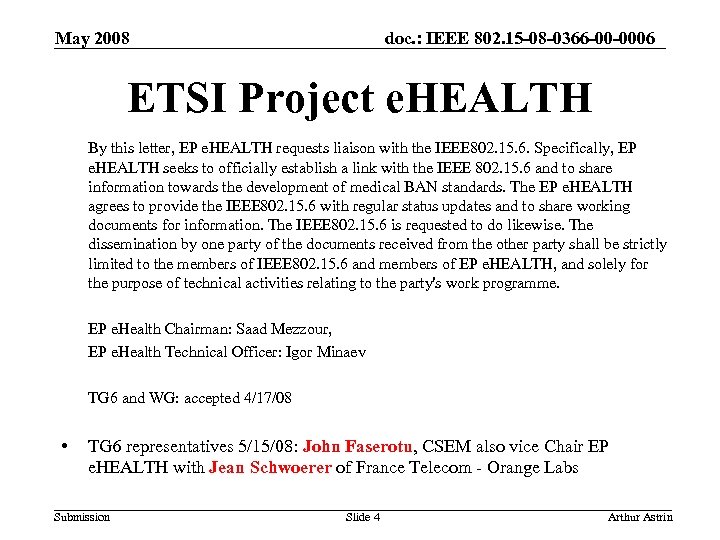 May 2008 doc. : IEEE 802. 15 -08 -0366 -00 -0006 ETSI Project e. HEALTH By this letter, EP e. HEALTH requests liaison with the IEEE 802. 15. 6. Specifically, EP e. HEALTH seeks to officially establish a link with the IEEE 802. 15. 6 and to share information towards the development of medical BAN standards. The EP e. HEALTH agrees to provide the IEEE 802. 15. 6 with regular status updates and to share working documents for information. The IEEE 802. 15. 6 is requested to do likewise. The dissemination by one party of the documents received from the other party shall be strictly limited to the members of IEEE 802. 15. 6 and members of EP e. HEALTH, and solely for the purpose of technical activities relating to the party's work programme. EP e. Health Chairman: Saad Mezzour, EP e. Health Technical Officer: Igor Minaev TG 6 and WG: accepted 4/17/08 • TG 6 representatives 5/15/08: John Faserotu, CSEM also vice Chair EP e. HEALTH with Jean Schwoerer of France Telecom - Orange Labs Submission Slide 4 Arthur Astrin
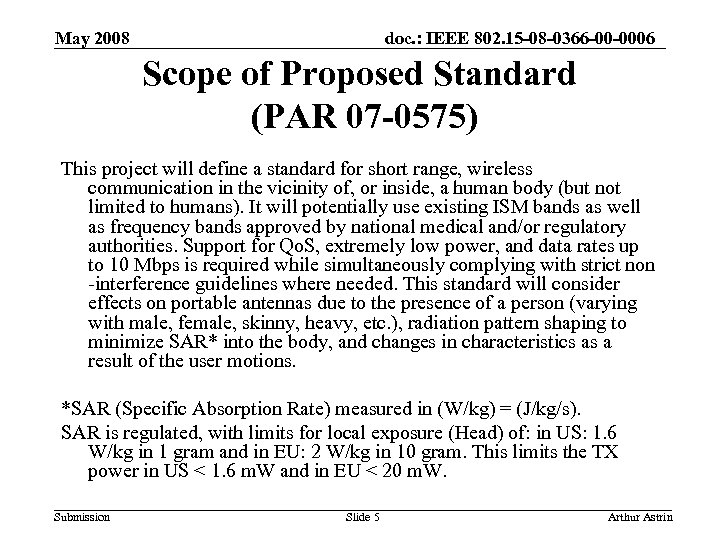 May 2008 doc. : IEEE 802. 15 -08 -0366 -00 -0006 Scope of Proposed Standard (PAR 07 -0575) This project will define a standard for short range, wireless communication in the vicinity of, or inside, a human body (but not limited to humans). It will potentially use existing ISM bands as well as frequency bands approved by national medical and/or regulatory authorities. Support for Qo. S, extremely low power, and data rates up to 10 Mbps is required while simultaneously complying with strict non -interference guidelines where needed. This standard will consider effects on portable antennas due to the presence of a person (varying with male, female, skinny, heavy, etc. ), radiation pattern shaping to minimize SAR* into the body, and changes in characteristics as a result of the user motions. *SAR (Specific Absorption Rate) measured in (W/kg) = (J/kg/s). SAR is regulated, with limits for local exposure (Head) of: in US: 1. 6 W/kg in 1 gram and in EU: 2 W/kg in 10 gram. This limits the TX power in US < 1. 6 m. W and in EU < 20 m. W. Submission Slide 5 Arthur Astrin
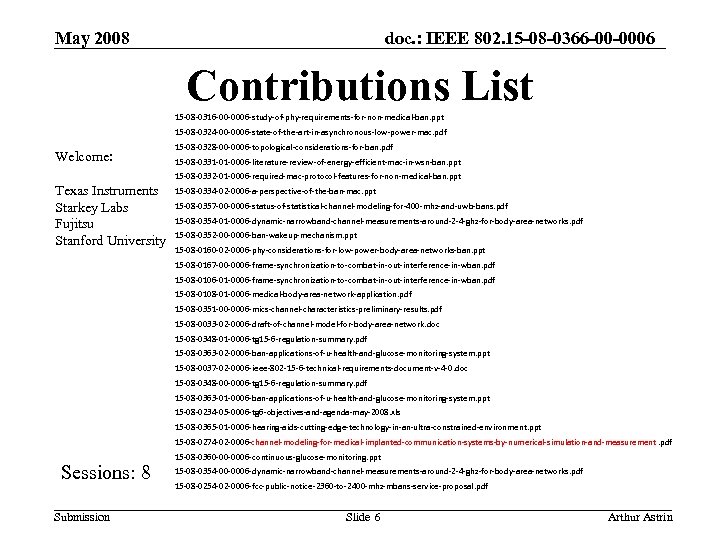 May 2008 doc. : IEEE 802. 15 -08 -0366 -00 -0006 Contributions List 15 -08 -0316 -00 -0006 -study-of-phy-requirements-for-non-medical-ban. ppt 15 -08 -0324 -00 -0006 -state-of-the-art-in-asynchronous-low-power-mac. pdf Welcome: 15 -08 -0328 -00 -0006 -topological-considerations-for-ban. pdf 15 -08 -0331 -01 -0006 -literature-review-of-energy-efficient-mac-in-wsn-ban. ppt 15 -08 -0332 -01 -0006 -required-mac-protocol-features-for-non-medical-ban. ppt Texas Instruments Starkey Labs Fujitsu Stanford University 15 -08 -0334 -02 -0006 -a-perspective-of-the-ban-mac. ppt 15 -08 -0357 -00 -0006 -status-of-statistical-channel-modeling-for-400 -mhz-and-uwb-bans. pdf 15 -08 -0354 -01 -0006 -dynamic-narrowband-channel-measurements-around-2 -4 -ghz-for-body-area-networks. pdf 15 -08 -0352 -00 -0006 -ban-wakeup-mechanism. ppt 15 -08 -0160 -02 -0006 -phy-considerations-for-low-power-body-area-networks-ban. ppt 15 -08 -0167 -00 -0006 -frame-synchronization-to-combat-in-out-interference-in-wban. pdf 15 -08 -0106 -01 -0006 -frame-synchronization-to-combat-in-out-interference-in-wban. pdf 15 -08 -01 -0006 -medical-body-area-network-application. pdf 15 -08 -0351 -00 -0006 -mics-channel-characteristics-preliminary-results. pdf 15 -08 -0033 -02 -0006 -draft-of-channel-model-for-body-area-network. doc 15 -08 -0348 -01 -0006 -tg 15 -6 -regulation-summary. pdf 15 -08 -0363 -02 -0006 -ban-applications-of-u-health-and-glucose-monitoring-system. ppt 15 -08 -0037 -02 -0006 -ieee-802 -15 -6 -technical-requirements-document-v-4 -0. doc 15 -08 -0348 -00 -0006 -tg 15 -6 -regulation-summary. pdf 15 -08 -0363 -01 -0006 -ban-applications-of-u-health-and-glucose-monitoring-system. ppt 15 -08 -0234 -05 -0006 -tg 6 -objectives-and-agenda-may-2008. xls 15 -08 -0365 -01 -0006 -hearing-aids-cutting-edge-technology-in-an-ultra-constrained-environment. ppt 15 -08 -0274 -02 -0006 -channel-modeling-for-medical-implanted-communication-systems-by-numerical-simulation-and-measurement. pdf Sessions: 8 Submission 15 -08 -0360 -00 -0006 -continuous-glucose-monitoring. ppt 15 -08 -0354 -00 -0006 -dynamic-narrowband-channel-measurements-around-2 -4 -ghz-for-body-area-networks. pdf 15 -08 -0254 -02 -0006 -fcc-public-notice-2360 -to-2400 -mhz-mbans-service-proposal. pdf Slide 6 Arthur Astrin
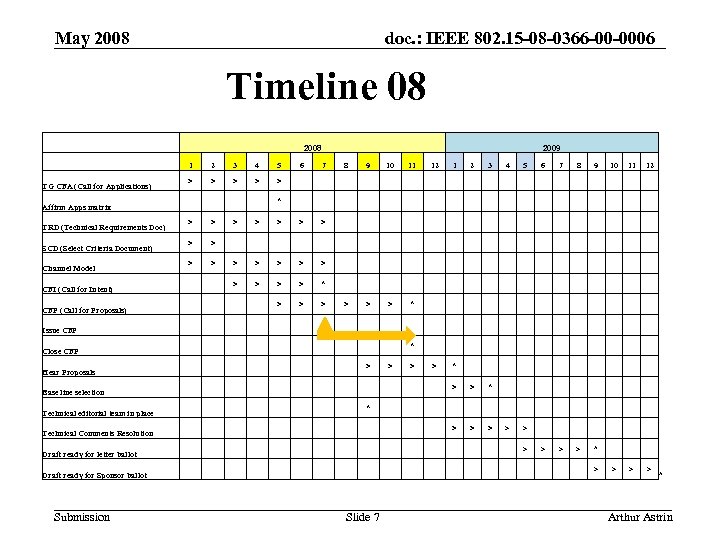 May 2008 doc. : IEEE 802. 15 -08 -0366 -00 -0006 Timeline 08 2008 2009 1 TG CFA (Call for Applications) 2 3 4 5 6 7 8 9 10 > > > ^ > > > > > > > > ^ > > > ^ ^ > > > ^ Affirm Apps matrix TRD (Technical Requirements Doc) SCD (Select Criteria Document) Channel Model CFI (Call for Intent) CFP (Call for Proposals) Issue CFP Close CFP Hear Proposals Base line selection Technical editorial team in place Technical Comments Resolution Draft ready for letter ballot Draft ready for Sponsor ballot Submission Slide 7 11 12 > 10 11 12 9 8 7 6 5 4 3 2 1 ^ > > > > > > > ^ Arthur Astrin
 May 2008 doc. : IEEE 802. 15 -08 -0366 -00 -0006 Plans for July 2008 meeting • • Issue Call for Proposals (CFP) • Next meeting: Wednesday, May 28, 2008 (need a Teleconference bridge volunteer) Have regular teleconferences on Wednesdays – – – – Submission 6: 00 AM PST (West Coast USA , G-7 ), 9: 00 AM EST (East Coast USA , G-4 ), 13: 00 PM (UK, G) 14 : 00 PM (EU, G+1), 18 : 30 PM (Bangalore, India, G+5. 5), 22 : 00 PM JST(Japan, G+9), KST(Korea), 00: 00 AM (Canberra, Australia, G+11), ( Midnight Wed /Thu 4/3) Slide 8 Arthur Astrin
 May 2008 doc. : IEEE 802. 15 -08 -0366 -00 -0006 Thank You ! Any Questions ? Submission Slide 9 Arthur Astrin
 May 2008 doc. : IEEE 802. 15 -08 -0366 -00 -0006 Purpose of Proposed Standard (PAR 07 -0575) The purpose of the proposed standard it to provide an international standard for a short range (ie about human body range), low power and highly reliable wireless communication for use in close proximity to, or inside, a human body. Data rates, typically up to 10 Mbps, will be offered to satisfy an evolutionary set of entertainment and healthcare services. Current PANs do not meet the medical (proximity to human tissue) and relevant communication regulations for some application environments. They also do not support the combination of reliability (Qo. S), low power, data rate and noninterference required to broadly address the breadth of body area network applications. Submission Slide 10 Arthur Astrin
 May 2008 doc. : IEEE 802. 15 -08 -0366 -00 -0006 Need for the Project (PAR 07 -0575) There is a need for a standard optimized for ultra low power devices and operation on, in or around the human body to serve a variety of applications including medical and personal entertainment. Examples of the applications served by the proposed standard are: EEG, ECG, EMG, vital signals monitoring (temperature (wearable thermometer), respiratory, wearable heart rate monitor, wearable pulse oximeter, wearable blood pressure monitor, oxygen, p. H value , wearable glucose sensor, implanted glucose sensor, cardiac arrhythmia), wireless capsule endoscope (gastrointestinal), wireless capsule for drug delivery, deep brain stimulator, cortical stimulator (visual neuro-stimulator, audio neuro stimulator, Parkinson’s disease, etc…), remote control of medical devices such as pacemaker, actuators, insulin pump, hearing aid (wearable and implanted), retina implants, disability assistance, such as muscle tension sensing and stimulation, wearable weighing scale, fall detection, aiding sport training. This will include body-centric solutions for future wearable computers. In a similar vein, the same technology can provide effective solutions for personal entertainment as well. The existence of a body area network standard will provide opportunities to expand these product features, better healthcare and well being for the users. It will therefore result in economic opportunity for technology component suppliers and equipment manufacturers. Submission Slide 11 Arthur Astrin