


 Скачать презентацию May 2003 doc IEEE 802 11 -03 379
86fdc0bca230ff8d2af9b7da03f34024.ppt
- Количество слайдов: 25
 May 2003 doc. : IEEE 802. 11 -03/379 r 0 Multiple Antennas: Performance Gains with Channel Measurements Minnie Ho, Qinghua Li, Sumeet Sandhu Cliff Prettie, David Cheung Submission 1 Minnie Ho, Intel Corporation
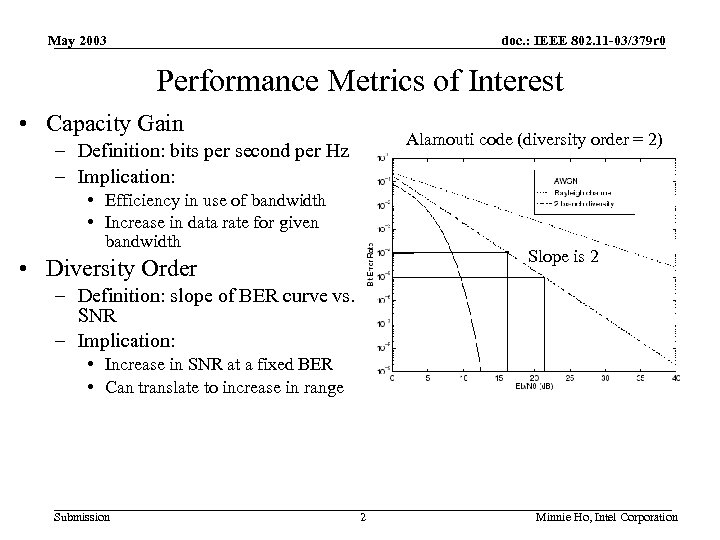 May 2003 doc. : IEEE 802. 11 -03/379 r 0 Performance Metrics of Interest • Capacity Gain Alamouti code (diversity order = 2) – Definition: bits per second per Hz – Implication: • Efficiency in use of bandwidth • Increase in data rate for given bandwidth Slope is 2 • Diversity Order – Definition: slope of BER curve vs. SNR – Implication: • Increase in SNR at a fixed BER • Can translate to increase in range Submission 2 Minnie Ho, Intel Corporation
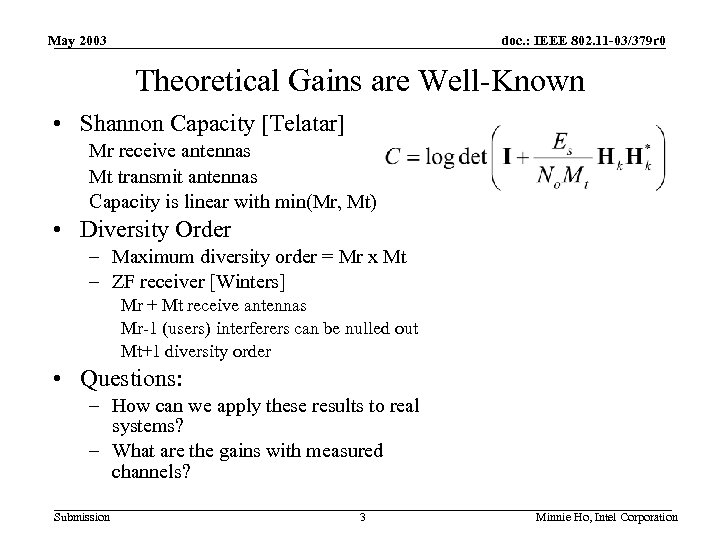 May 2003 doc. : IEEE 802. 11 -03/379 r 0 Theoretical Gains are Well-Known • Shannon Capacity [Telatar] Mr receive antennas Mt transmit antennas Capacity is linear with min(Mr, Mt) • Diversity Order – Maximum diversity order = Mr x Mt – ZF receiver [Winters] Mr + Mt receive antennas Mr-1 (users) interferers can be nulled out Mt+1 diversity order • Questions: – How can we apply these results to real systems? – What are the gains with measured channels? Submission 3 Minnie Ho, Intel Corporation
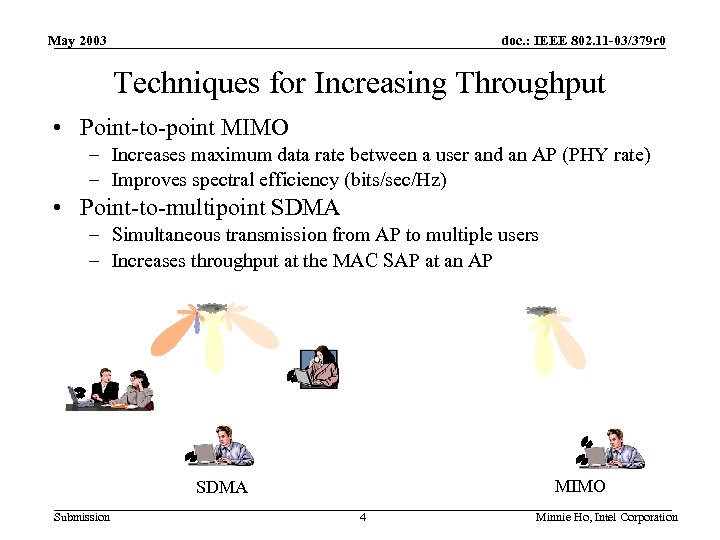 May 2003 doc. : IEEE 802. 11 -03/379 r 0 Techniques for Increasing Throughput • Point-to-point MIMO – Increases maximum data rate between a user and an AP (PHY rate) – Improves spectral efficiency (bits/sec/Hz) • Point-to-multipoint SDMA – Simultaneous transmission from AP to multiple users – Increases throughput at the MAC SAP at an AP MIMO SDMA Submission 4 Minnie Ho, Intel Corporation
 May 2003 doc. : IEEE 802. 11 -03/379 r 0 Techniques for Increasing Diversity • • • Switched diversity (selection between multiple antennas) MRC Alamouti MMSE (minimum mean-squared error) ZF (zero-forcing) ML (maximum likelihood) Submission 5 Minnie Ho, Intel Corporation
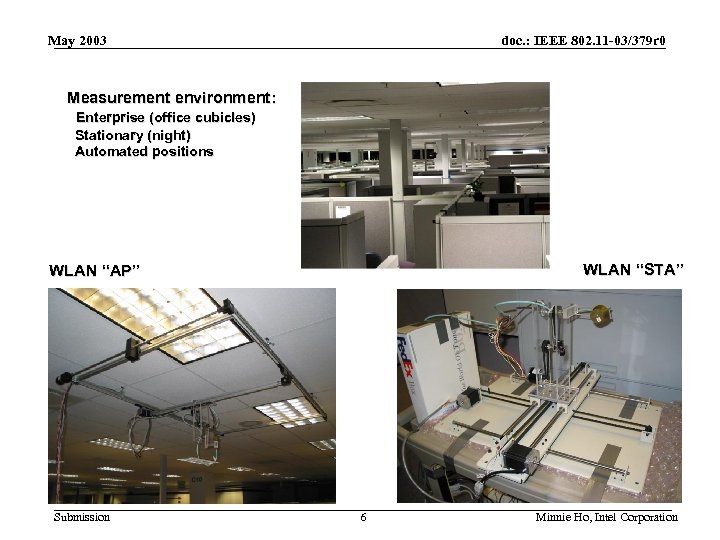 May 2003 doc. : IEEE 802. 11 -03/379 r 0 Measurement environment: Enterprise (office cubicles) Stationary (night) Automated positions WLAN “STA” WLAN “AP” Submission 6 Minnie Ho, Intel Corporation
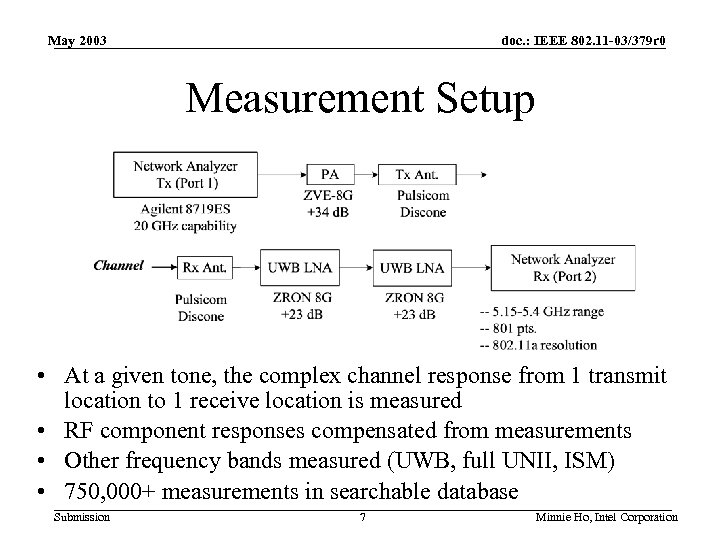 May 2003 doc. : IEEE 802. 11 -03/379 r 0 Measurement Setup • At a given tone, the complex channel response from 1 transmit location to 1 receive location is measured • RF component responses compensated from measurements • Other frequency bands measured (UWB, full UNII, ISM) • 750, 000+ measurements in searchable database Submission 7 Minnie Ho, Intel Corporation
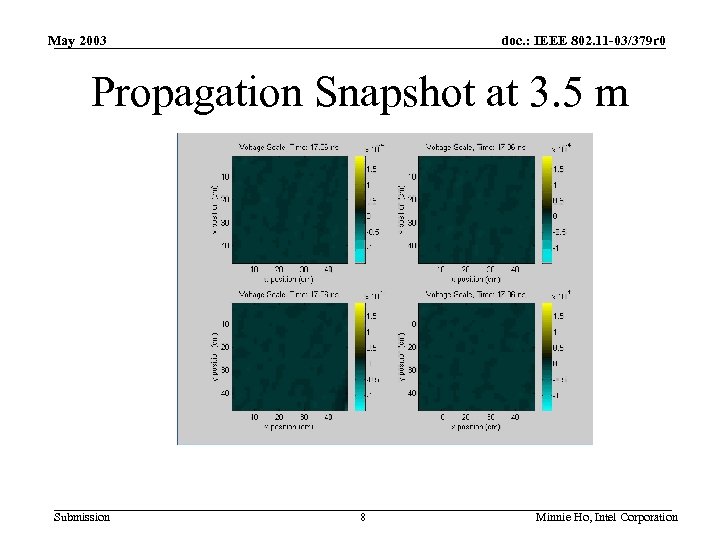 May 2003 doc. : IEEE 802. 11 -03/379 r 0 Propagation Snapshot at 3. 5 m Submission 8 Minnie Ho, Intel Corporation
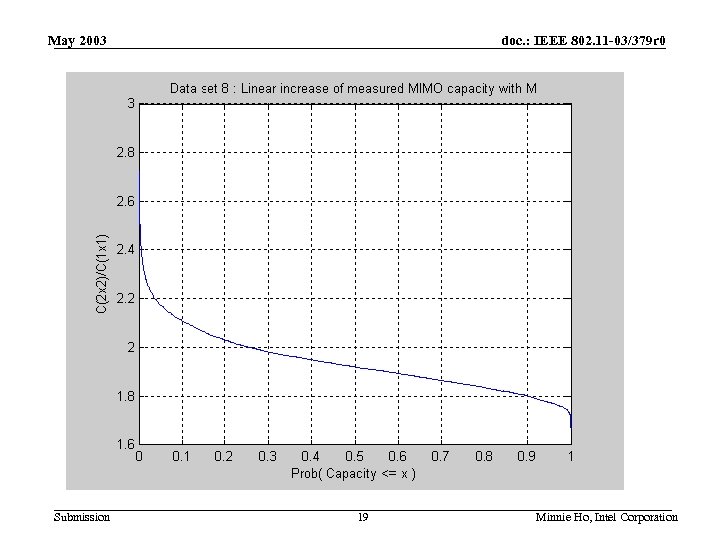
 May 2003 doc. : IEEE 802. 11 -03/379 r 0 Theoretical Capacity Results • SDMA – 4 antennas at the AP (Mr = 4) – 1 antenna at each STA (Mt = 1) – Four “degrees of freedom” – AP should be able to support 4 simultaneous users • MIMO – 2 antennas at the AP (Mr = 2) – 2 antennas at the STA (Mt = 2) – Link should be able to support 2 x the data rate Submission 9 Minnie Ho, Intel Corporation
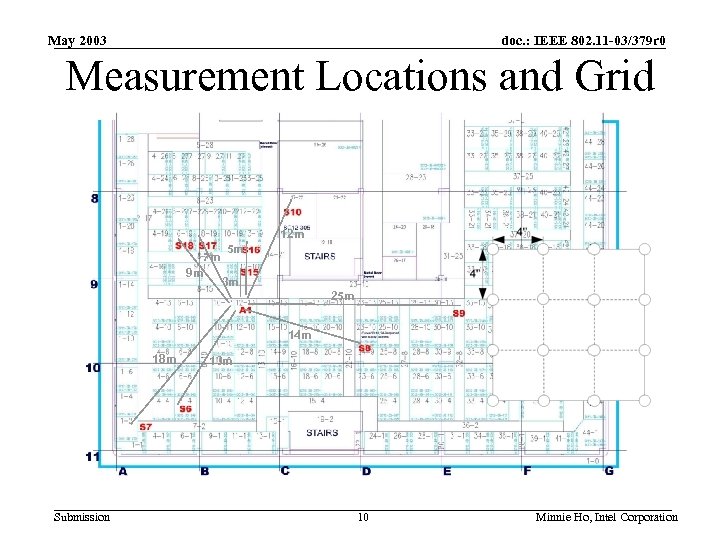 May 2003 doc. : IEEE 802. 11 -03/379 r 0 Measurement Locations and Grid 12 m 7 m 9 m 5 m 3 m 25 m 14 m 18 m Submission 13 m 10 Minnie Ho, Intel Corporation
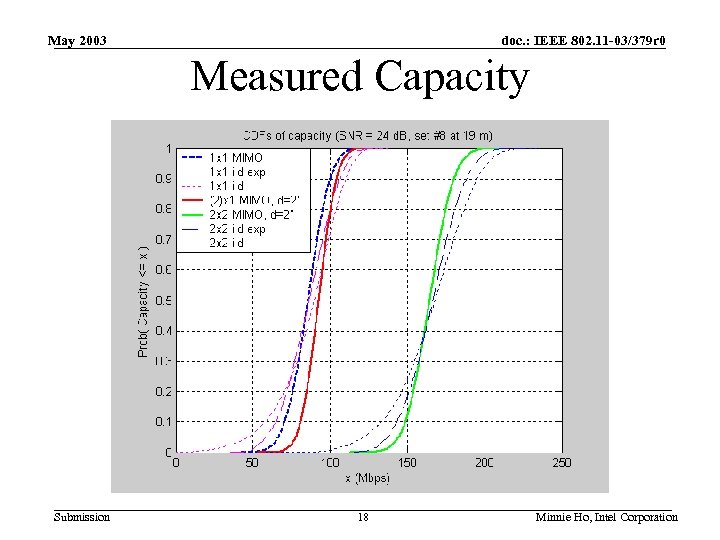
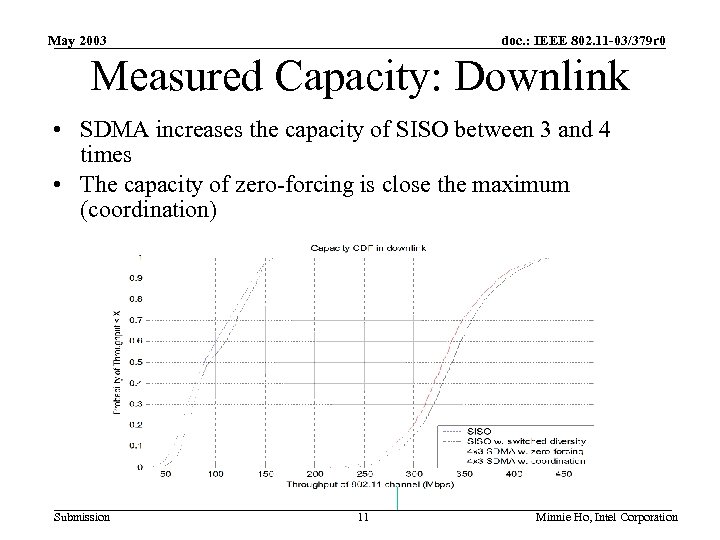 May 2003 doc. : IEEE 802. 11 -03/379 r 0 Measured Capacity: Downlink • SDMA increases the capacity of SISO between 3 and 4 times • The capacity of zero-forcing is close the maximum (coordination) Submission 11 Minnie Ho, Intel Corporation
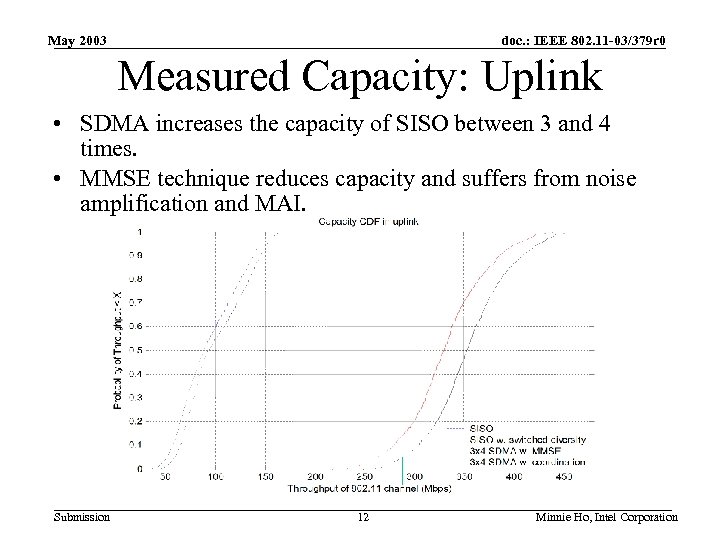 May 2003 doc. : IEEE 802. 11 -03/379 r 0 Measured Capacity: Uplink • SDMA increases the capacity of SISO between 3 and 4 times. • MMSE technique reduces capacity and suffers from noise amplification and MAI. Submission 12 Minnie Ho, Intel Corporation
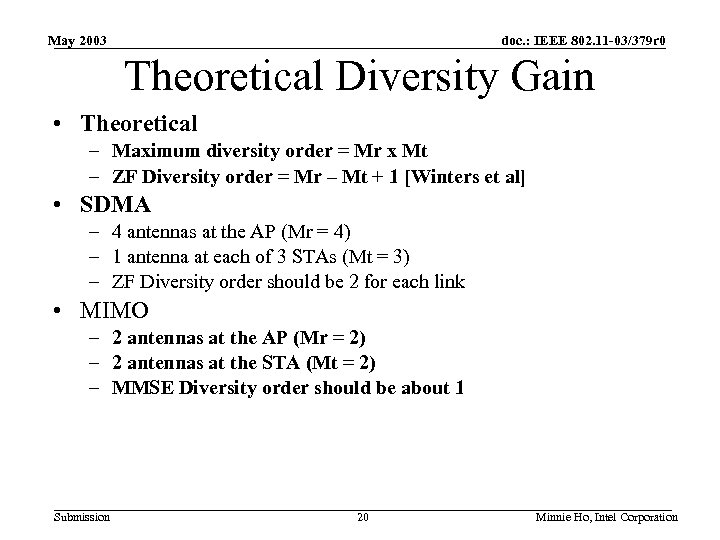
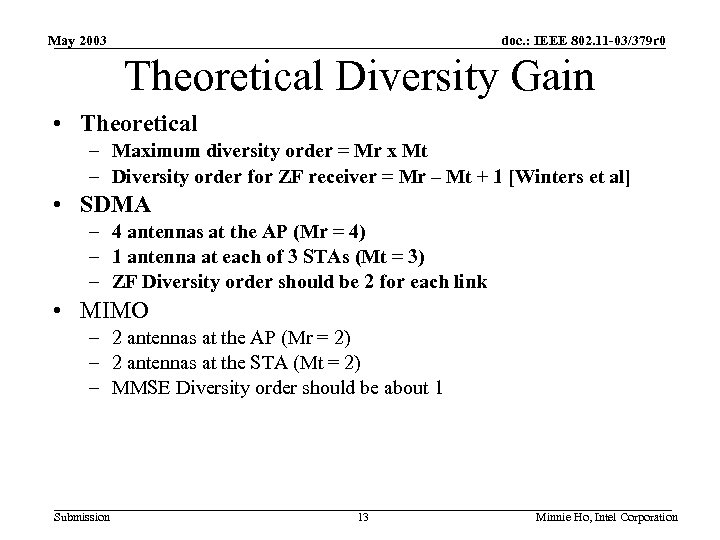 May 2003 doc. : IEEE 802. 11 -03/379 r 0 Theoretical Diversity Gain • Theoretical – Maximum diversity order = Mr x Mt – Diversity order for ZF receiver = Mr – Mt + 1 [Winters et al] • SDMA – 4 antennas at the AP (Mr = 4) – 1 antenna at each of 3 STAs (Mt = 3) – ZF Diversity order should be 2 for each link • MIMO – 2 antennas at the AP (Mr = 2) – 2 antennas at the STA (Mt = 2) – MMSE Diversity order should be about 1 Submission 13 Minnie Ho, Intel Corporation
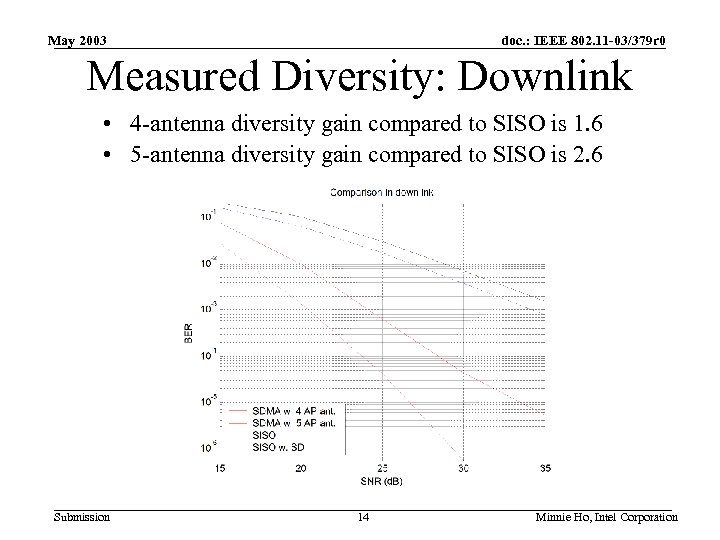 May 2003 doc. : IEEE 802. 11 -03/379 r 0 Measured Diversity: Downlink • 4 -antenna diversity gain compared to SISO is 1. 6 • 5 -antenna diversity gain compared to SISO is 2. 6 Submission 14 Minnie Ho, Intel Corporation
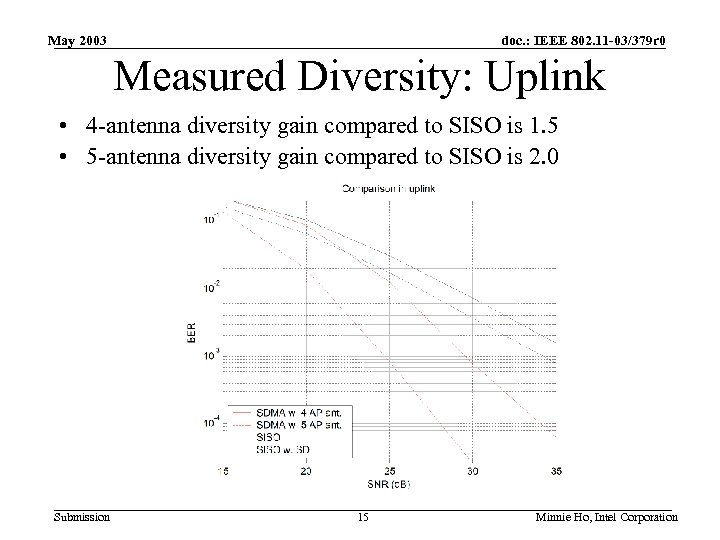 May 2003 doc. : IEEE 802. 11 -03/379 r 0 Measured Diversity: Uplink • 4 -antenna diversity gain compared to SISO is 1. 5 • 5 -antenna diversity gain compared to SISO is 2. 0 Submission 15 Minnie Ho, Intel Corporation
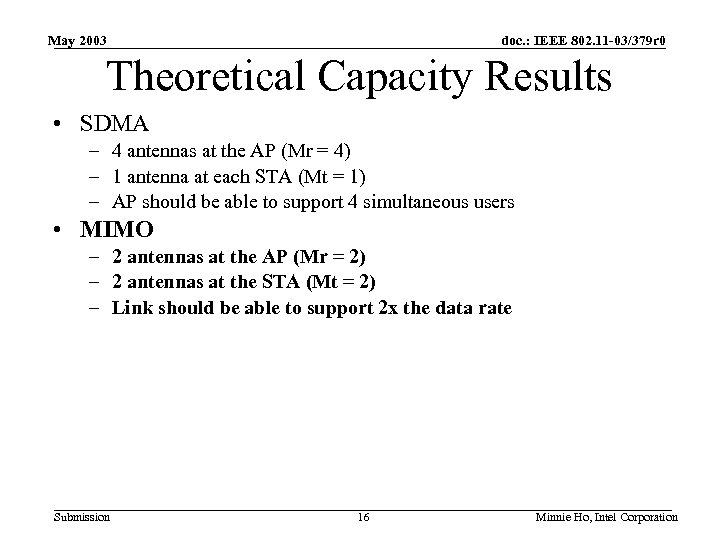 May 2003 doc. : IEEE 802. 11 -03/379 r 0 Theoretical Capacity Results • SDMA – 4 antennas at the AP (Mr = 4) – 1 antenna at each STA (Mt = 1) – AP should be able to support 4 simultaneous users • MIMO – 2 antennas at the AP (Mr = 2) – 2 antennas at the STA (Mt = 2) – Link should be able to support 2 x the data rate Submission 16 Minnie Ho, Intel Corporation
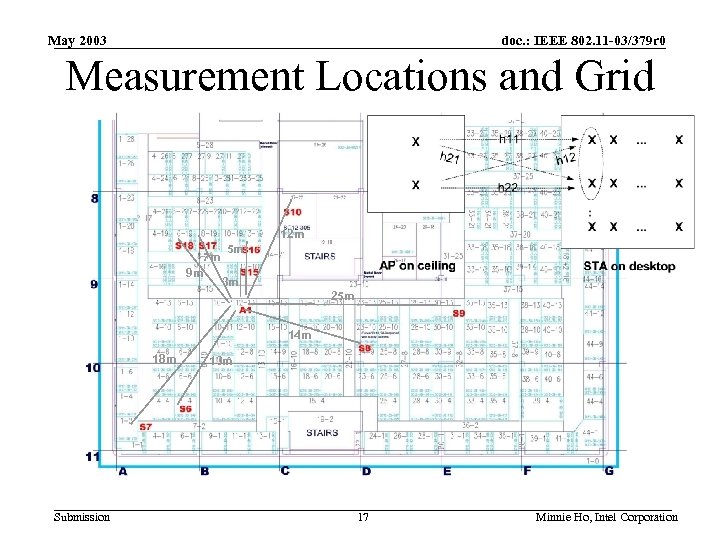 May 2003 doc. : IEEE 802. 11 -03/379 r 0 Measurement Locations and Grid 12 m 7 m 9 m 5 m 3 m 25 m 14 m 18 m Submission 13 m 17 Minnie Ho, Intel Corporation
 May 2003 doc. : IEEE 802. 11 -03/379 r 0 Measured Capacity Submission 18 Minnie Ho, Intel Corporation
 May 2003 Submission doc. : IEEE 802. 11 -03/379 r 0 19 Minnie Ho, Intel Corporation
 May 2003 doc. : IEEE 802. 11 -03/379 r 0 Theoretical Diversity Gain • Theoretical – Maximum diversity order = Mr x Mt – ZF Diversity order = Mr – Mt + 1 [Winters et al] • SDMA – 4 antennas at the AP (Mr = 4) – 1 antenna at each of 3 STAs (Mt = 3) – ZF Diversity order should be 2 for each link • MIMO – 2 antennas at the AP (Mr = 2) – 2 antennas at the STA (Mt = 2) – MMSE Diversity order should be about 1 Submission 20 Minnie Ho, Intel Corporation
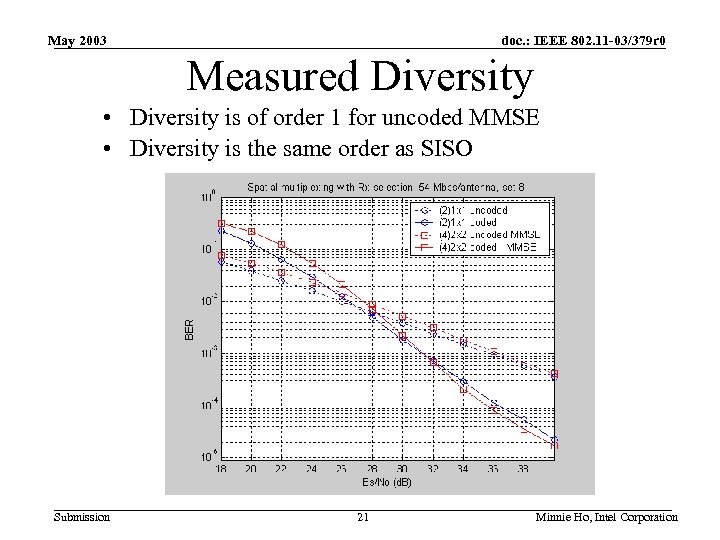 May 2003 doc. : IEEE 802. 11 -03/379 r 0 Measured Diversity • Diversity is of order 1 for uncoded MMSE • Diversity is the same order as SISO Submission 21 Minnie Ho, Intel Corporation
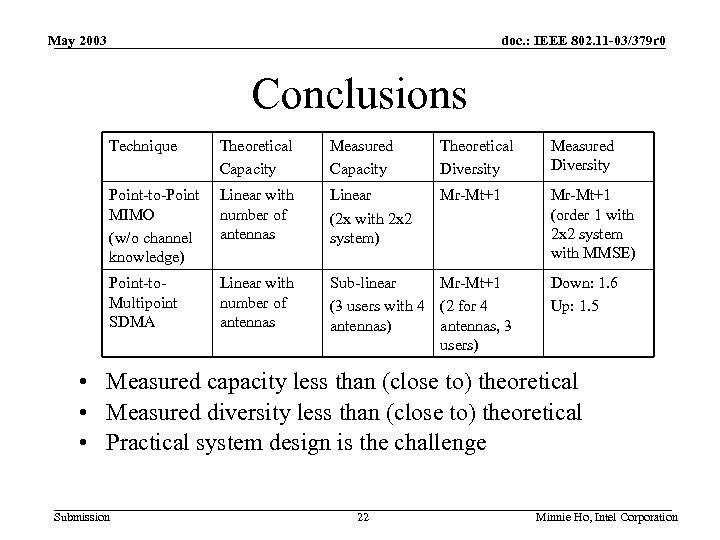 May 2003 doc. : IEEE 802. 11 -03/379 r 0 Conclusions Technique Theoretical Capacity Measured Capacity Theoretical Diversity Measured Diversity Point-to-Point MIMO (w/o channel knowledge) Linear with number of antennas Linear (2 x with 2 x 2 system) Mr-Mt+1 (order 1 with 2 x 2 system with MMSE) Point-to. Multipoint SDMA Linear with number of antennas Sub-linear Mr-Mt+1 (3 users with 4 (2 for 4 antennas) antennas, 3 users) Down: 1. 6 Up: 1. 5 • Measured capacity less than (close to) theoretical • Measured diversity less than (close to) theoretical • Practical system design is the challenge Submission 22 Minnie Ho, Intel Corporation
 May 2003 doc. : IEEE 802. 11 -03/379 r 0 For further information Send e-mail to Minnie Ho • To: minnie. ho@intel. com • Subject: Smant. Intel Submission 23 Minnie Ho, Intel Corporation
 May 2003 doc. : IEEE 802. 11 -03/379 r 0 Backup Slides Submission 24 Minnie Ho, Intel Corporation
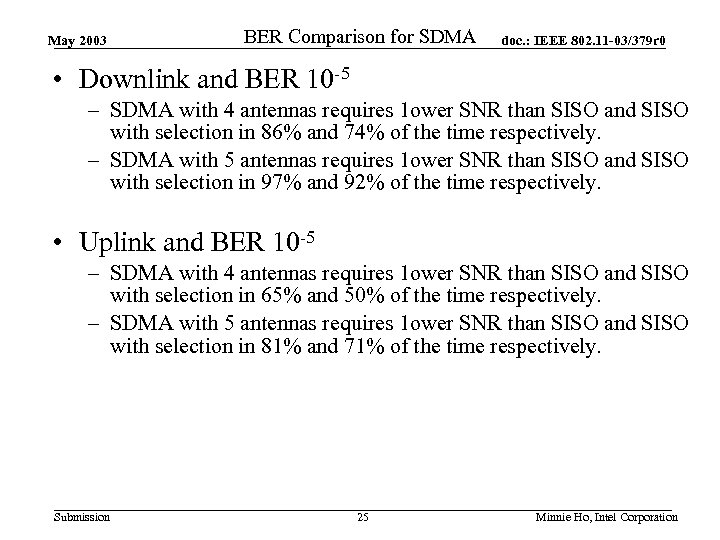 May 2003 BER Comparison for SDMA doc. : IEEE 802. 11 -03/379 r 0 • Downlink and BER 10 -5 – SDMA with 4 antennas requires 1 ower SNR than SISO and SISO with selection in 86% and 74% of the time respectively. – SDMA with 5 antennas requires 1 ower SNR than SISO and SISO with selection in 97% and 92% of the time respectively. • Uplink and BER 10 -5 – SDMA with 4 antennas requires 1 ower SNR than SISO and SISO with selection in 65% and 50% of the time respectively. – SDMA with 5 antennas requires 1 ower SNR than SISO and SISO with selection in 81% and 71% of the time respectively. Submission 25 Minnie Ho, Intel Corporation