


 Скачать презентацию May 2002 doc IEEE 802 11 -02 310
46d0ed1ca93da81f9e42014edbd88c53.ppt
- Количество слайдов: 10
 May 2002 doc. : IEEE 802. 11 -02/310 r 1 Requirements for Home Networking Chris Ware, Eryk Dutkiewicz, Alistair Buttar Marc de Courville, Sebastien Simoens Motorola Contact: Eryk. Dutkiewicz@motorola. com Submission Slide 1 C. Ware, et. al, Motorola
 May 2002 doc. : IEEE 802. 11 -02/310 r 1 Overview • • • Current WLAN environment Home Network environment Requirements for NG – MAC/PHY Zero Configuration How should WNG contribute to the development of 802. 11 Submission Slide 2 C. Ware, et. al, Motorola
 May 2002 doc. : IEEE 802. 11 -02/310 r 1 WLAN Application Environment • Many new WLAN applications are currently being proposed and developed • One significant area is the Home Network • Can WNG produce a PHY/MAC combination that is flexible, extensible and suitable for use in a future home network? Submission Slide 3 C. Ware, et. al, Motorola
 May 2002 doc. : IEEE 802. 11 -02/310 r 1 The Home Network 1/2 • Three types of home network: – Low bandwidth (command control) – High bandwidth without Qo. S (Basic data) – High bandwidth with Qo. S (Multimedia / Entertainment) • Characteristics: – Many different types of devices – Guaranteed service levels required • Home networks will be installed by consumers not technicians – Easy to install, maintain and use – Must support large, not-trivial topologies including multiple wireless hops Submission Slide 4 C. Ware, et. al, Motorola
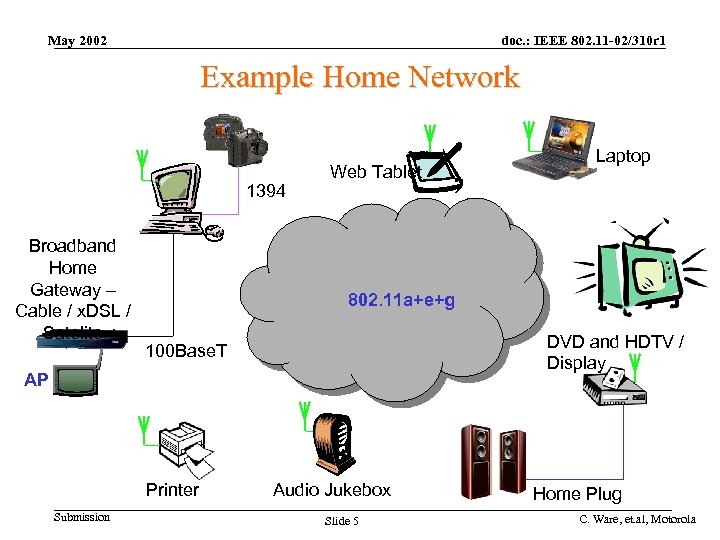 May 2002 doc. : IEEE 802. 11 -02/310 r 1 Example Home Network 1394 Broadband Home Gateway – Cable / x. DSL / Satelite Web Tablet 802. 11 a+e+g DVD and HDTV / Display 100 Base. T AP Printer Submission Laptop Audio Jukebox Slide 5 Home Plug C. Ware, et. al, Motorola
 May 2002 doc. : IEEE 802. 11 -02/310 r 1 The Home Network 2/2 • 802. 11 will be one of many technologies in the home – E. g. Home. Plug, Ethernet, 1394, Home. PNA, BT, 802. 15. x – Each has different transmission rates, Qo. S mechanisms, target applications etc. • HDR will allow many new application opportunities in the home • Co-existence (fairness, efficiency) mechanisms with existing and future wireless standards will be required Submission Slide 6 C. Ware, et. al, Motorola
 May 2002 doc. : IEEE 802. 11 -02/310 r 1 MAC Requirements for High Rate PHY • Scalability – Increasing bandwidth applications – Higher rate PHY requires a more efficient MAC • Current MAC has large overhead • Integration of Qo. S has not been settled – Higher frequency PHY smaller cell size • Power Constraints – Battery powered handheld devices • Multiple Hops – Efficient channel access mechanism to support multiple hop networks – Qo. S in multihop scenarios Submission Slide 7 C. Ware, et. al, Motorola
 May 2002 doc. : IEEE 802. 11 -02/310 r 1 MAC Requirements for High Rate PHY • Hybrid ARQ – – A tighter integration of MAC and PHY « see 02/312 r 0 HARQ can be combined with Link Adaptation An optimized MAC can take advantage of HARQ Memory requirements in STA need to be optimized » • A TDD/TDMA approach seems appealing – Enables simpler Qo. S – Isochronous stream support – Challenge is to be able to combine centralized TDD/TDMA scheme with a multihop network while preserving Qo. S Submission Slide 8 C. Ware, et. al, Motorola
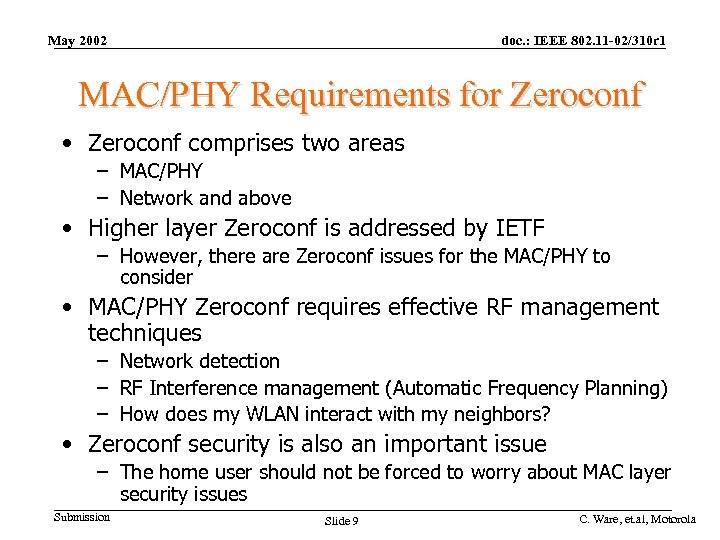 May 2002 doc. : IEEE 802. 11 -02/310 r 1 MAC/PHY Requirements for Zeroconf • Zeroconf comprises two areas – MAC/PHY – Network and above • Higher layer Zeroconf is addressed by IETF – However, there are Zeroconf issues for the MAC/PHY to consider • MAC/PHY Zeroconf requires effective RF management techniques – Network detection – RF Interference management (Automatic Frequency Planning) – How does my WLAN interact with my neighbors? • Zeroconf security is also an important issue – The home user should not be forced to worry about MAC layer security issues Submission Slide 9 C. Ware, et. al, Motorola
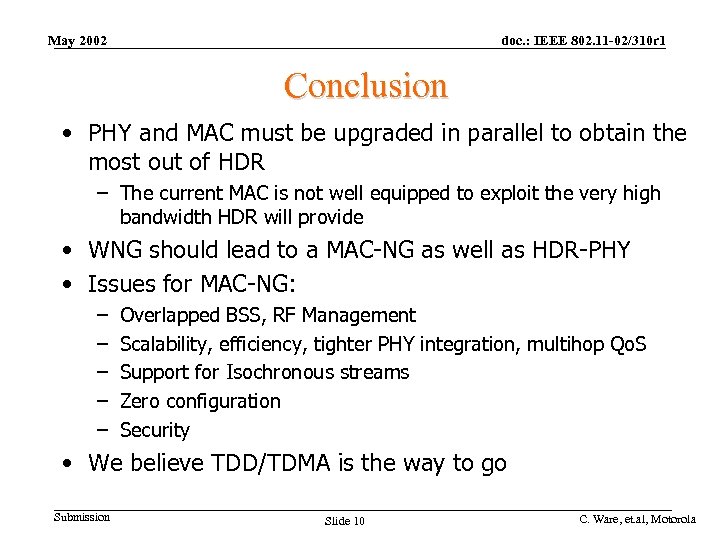 May 2002 doc. : IEEE 802. 11 -02/310 r 1 Conclusion • PHY and MAC must be upgraded in parallel to obtain the most out of HDR – The current MAC is not well equipped to exploit the very high bandwidth HDR will provide • WNG should lead to a MAC-NG as well as HDR-PHY • Issues for MAC-NG: – – – Overlapped BSS, RF Management Scalability, efficiency, tighter PHY integration, multihop Qo. S Support for Isochronous streams Zero configuration Security • We believe TDD/TDMA is the way to go Submission Slide 10 C. Ware, et. al, Motorola