


 Скачать презентацию May 12 2017 Impact of Tax Reform on
4e90730863e32eb293908689649c7c08.ppt
- Количество слайдов: 34
 May 12, 2017 Impact of Tax Reform on the Investment Management Industry 2017 ABA Tax Section May Meeting
 Benjamin Allensworth Managed Funds Association Mary Baker K&L Gates, LLP Karen Lau Gibian Investment Company Institute Jeff Levey EY 1
 Impact of Tax Reform on the Investment Management Industry » Legislative Landscape » Tax Proposals » Impact of Proposals on Investment Management Industry • Business Tax Reform • International Tax Reform • Taxation of Derivatives » Other Issues 2
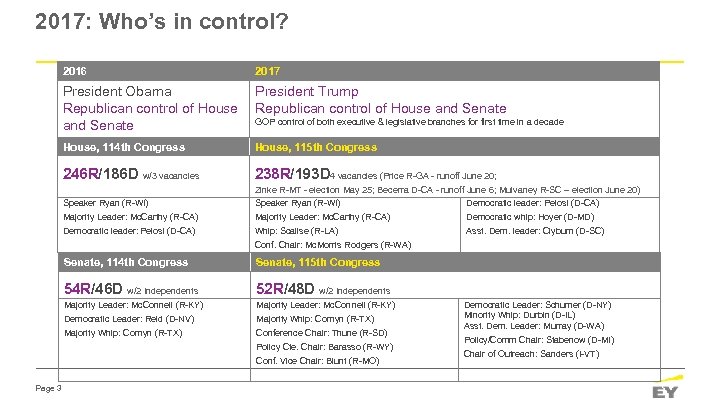 2017: Who’s in control? 2016 2017 President Obama President Trump Republican control of House and Senate GOP control of both executive & legislative branches for first time in a decade and Senate House, 114 th Congress House, 115 th Congress 246 R/186 D w/3 vacancies 238 R/193 D 4 vacancies (Price R-GA - runoff June 20; Speaker Ryan (R-WI) Zinke R-MT - election May 25; Becerra D-CA - runoff June 6; Mulvaney R-SC – election June 20) Speaker Ryan (R-WI) Democratic leader: Pelosi (D-CA) Majority Leader: Mc. Carthy (R-CA) Democratic whip: Hoyer (D-MD) Democratic leader: Pelosi (D-CA) Whip: Scalise (R-LA) Asst. Dem. leader: Clyburn (D-SC) Conf. Chair: Mc. Morris Rodgers (R-WA) Senate, 114 th Congress Senate, 115 th Congress 54 R/46 D w/2 Independents 52 R/48 D w/2 Independents Majority Leader: Mc. Connell (R-KY) Democratic Leader: Reid (D-NV) Majority Whip: Cornyn (R-TX) Conference Chair: Thune (R-SD) Policy Cte. Chair: Barasso (R-WY) Conf. Vice Chair: Blunt (R-MO) Page 3 Democratic Leader: Schumer (D-NY) Minority Whip: Durbin (D-IL) Asst. Dem. Leader: Murray (D-WA) Policy/Comm Chair: Stabenow (D-MI) Chair of Outreach: Sanders (I-VT)
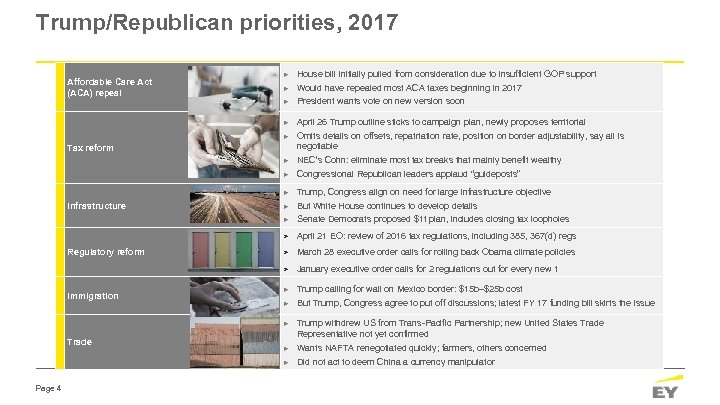 Trump/Republican priorities, 2017 ► House bill initially pulled from consideration due to insufficient GOP support ► Would have repealed most ACA taxes beginning in 2017 ► President wants vote on new version soon ► April 26 Trump outline sticks to campaign plan, newly proposes territorial ► Omits details on offsets, repatriation rate, position on border adjustability, say all is negotiable ► NEC’s Cohn: eliminate most tax breaks that mainly benefit wealthy ► Congressional Republican leaders applaud “guideposts” ► Trump, Congress align on need for large infrastructure objective ► But White House continues to develop details ► Senate Democrats proposed $1 t plan, includes closing tax loopholes Ø April 21 EO: review of 2016 tax regulations, including 385, 367(d) regs Ø March 28 executive order calls for rolling back Obama climate policies Ø January executive order calls for 2 regulations out for every new 1 ► Trump calling for wall on Mexico border: $15 b–$25 b cost ► But Trump, Congress agree to put off discussions; latest FY 17 funding bill skirts the issue ► Trump withdrew US from Trans-Pacific Partnership; new United States Trade Representative not yet confirmed ► Wants NAFTA renegotiated quickly; farmers, others concerned ► Affordable Care Act (ACA) repeal Did not act to deem China a currency manipulator Tax reform Infrastructure Regulatory reform Immigration Trade Page 4
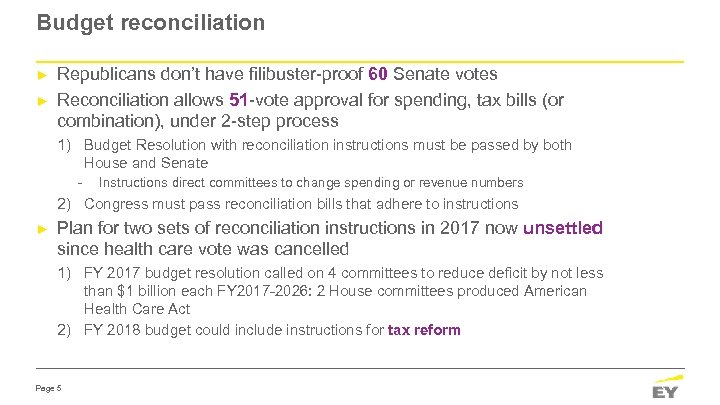 Budget reconciliation ► ► Republicans don’t have filibuster-proof 60 Senate votes Reconciliation allows 51 -vote approval for spending, tax bills (or combination), under 2 -step process 1) Budget Resolution with reconciliation instructions must be passed by both House and Senate - Instructions direct committees to change spending or revenue numbers 2) Congress must pass reconciliation bills that adhere to instructions ► Plan for two sets of reconciliation instructions in 2017 now unsettled since health care vote was cancelled 1) FY 2017 budget resolution called on 4 committees to reduce deficit by not less than $1 billion each FY 2017 -2026: 2 House committees produced American Health Care Act 2) FY 2018 budget could include instructions for tax reform Page 5
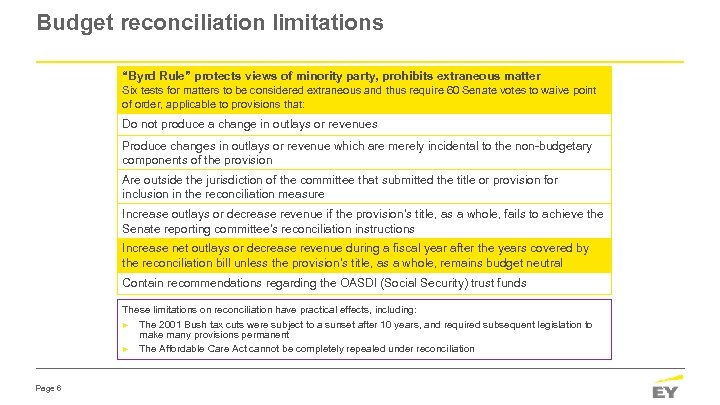 Budget reconciliation limitations “Byrd Rule” protects views of minority party, prohibits extraneous matter Six tests for matters to be considered extraneous and thus require 60 Senate votes to waive point of order, applicable to provisions that: Do not produce a change in outlays or revenues Produce changes in outlays or revenue which are merely incidental to the non-budgetary components of the provision Are outside the jurisdiction of the committee that submitted the title or provision for inclusion in the reconciliation measure Increase outlays or decrease revenue if the provision's title, as a whole, fails to achieve the Senate reporting committee's reconciliation instructions Increase net outlays or decrease revenue during a fiscal year after the years covered by the reconciliation bill unless the provision's title, as a whole, remains budget neutral Contain recommendations regarding the OASDI (Social Security) trust funds These limitations on reconciliation have practical effects, including: ► The 2001 Bush tax cuts were subject to a sunset after 10 years, and required subsequent legislation to make many provisions permanent ► The Affordable Care Act cannot be completely repealed under reconciliation Page 6
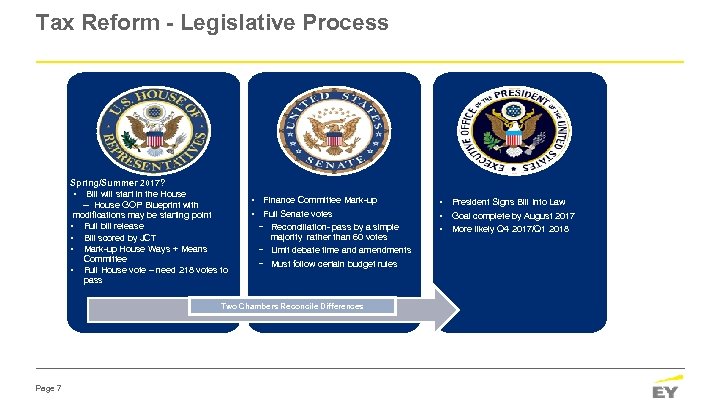 Tax Reform - Legislative Process Spring/Summer 2017? • Bill will start in the House -- House GOP Blueprint with modifications may be starting point • Full bill release • Bill scored by JCT • Mark-up House Ways + Means Committee • Full House vote – need 218 votes to pass • Finance Committee Mark-up • Full Senate votes − Reconciliation- pass by a simple majority rather than 60 votes − Limit debate time and amendments − Must follow certain budget rules Two Chambers Reconcile Differences Page 7 • President Signs Bill Into Law • Goal complete by August 2017 • More likely Q 4 2017/Q 1 2018
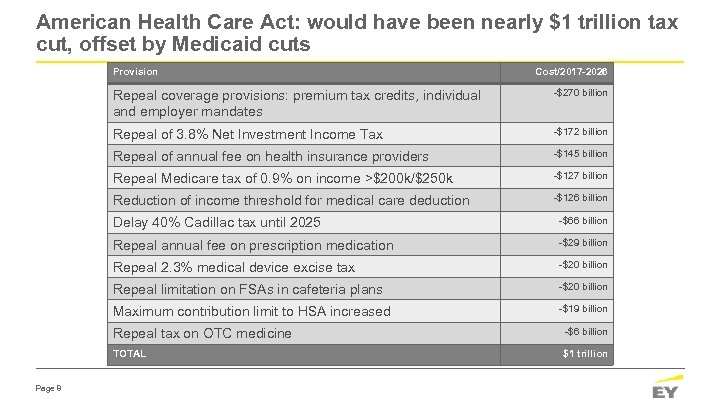 American Health Care Act: would have been nearly $1 trillion tax cut, offset by Medicaid cuts Provision Cost/2017 -2026 Repeal coverage provisions: premium tax credits, individual and employer mandates -$270 billion Repeal of 3. 8% Net Investment Income Tax -$172 billion Repeal of annual fee on health insurance providers -$145 billion Repeal Medicare tax of 0. 9% on income >$200 k/$250 k -$127 billion Reduction of income threshold for medical care deduction -$126 billion Delay 40% Cadillac tax until 2025 -$66 billion Repeal annual fee on prescription medication -$29 billion Repeal 2. 3% medical device excise tax -$20 billion Repeal limitation on FSAs in cafeteria plans -$20 billion Maximum contribution limit to HSA increased -$19 billion Repeal tax on OTC medicine TOTAL Page 8 -$6 billion $1 trillion
 What does comprehensive tax reform look like? ► Lower corporate and individual tax rates ► Lower tax rates on investment income ► Broader tax base, individuals and corporations: ► ► Many deductions, exclusions, credits will go away New international tax system: ► ► Move from global tax system to territorial system Anti-base erosion provisions ► ► Page 9 Border adjustment/minimum tax among the options Mandatory tax on accumulated foreign earnings
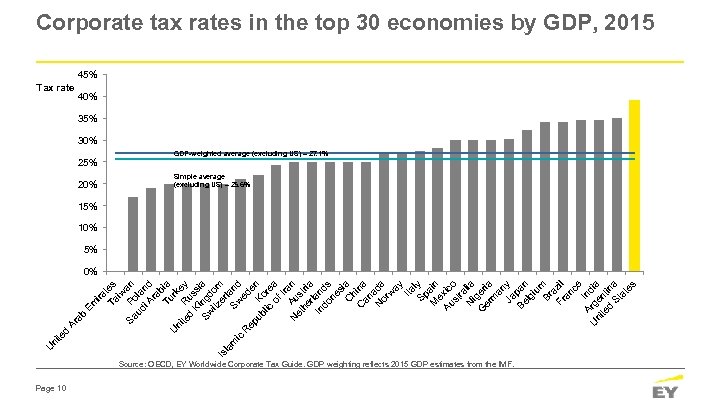 Tax rate Page 10 ira Ta tes iw Sa P an ud ola i A nd ra b Tu ia U rk ni te R ey d us K s Sw ing ia itz dom er Is la l m Sw and ic ed R ep e ub Ko n lic re o a f I r Au an N et s he tri r a In lan do ds ne s C ia hi C na an a N da or w ay Ita l Sp y M ain e Au xic st o ra N lia ig G er er ia m an Ja y Be pan lg iu m Br az Fr il an ce Ar Ind U g ia ni en te ti d na St at es m E ab Ar d te ni U Corporate tax rates in the top 30 economies by GDP, 2015 45% 40% 35% 30% 25% 20% GDP-weighted average (excluding US) – 27. 1% Simple average (excluding US) – 25. 6% 15% 10% 5% 0% Source: OECD, EY Worldwide Corporate Tax Guide. GDP weighting reflects 2015 GDP estimates from the IMF.
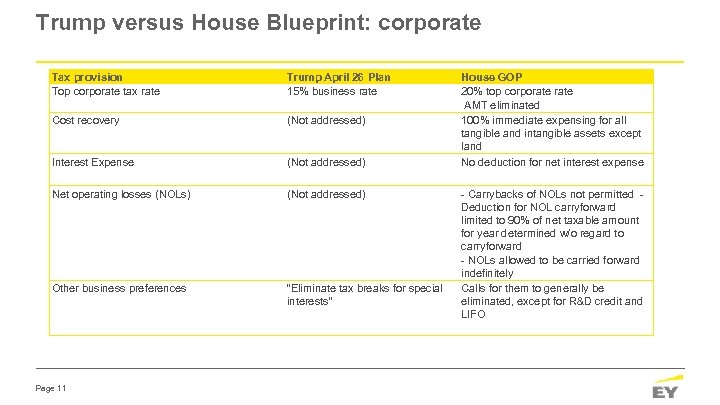 Trump versus House Blueprint: corporate Tax provision Top corporate tax rate Cost recovery Trump April 26 Plan 15% business rate (Not addressed) Interest Expense (Not addressed) Net operating losses (NOLs) (Not addressed) Other business preferences “Eliminate tax breaks for special interests” Page 11 House GOP 20% top corporate AMT eliminated 100% immediate expensing for all tangible and intangible assets except land No deduction for net interest expense - Carrybacks of NOLs not permitted - Deduction for NOL carryforward limited to 90% of net taxable amount for year determined w/o regard to carryforward - NOLs allowed to be carried forward indefinitely Calls for them to generally be eliminated, except for R&D credit and LIFO
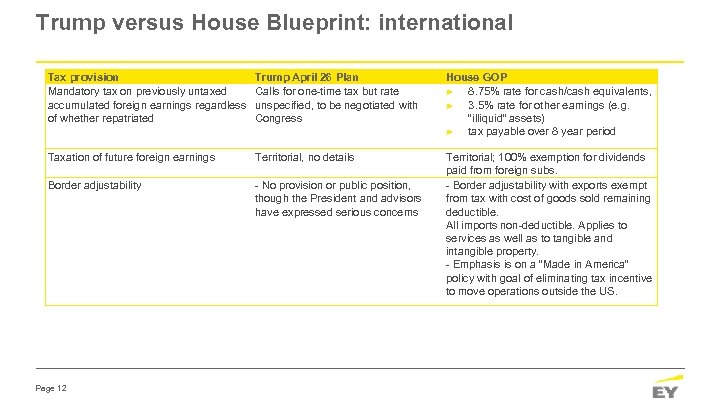 Trump versus House Blueprint: international Tax provision Mandatory tax on previously untaxed accumulated foreign earnings regardless of whether repatriated Trump April 26 Plan Calls for one-time tax but rate unspecified, to be negotiated with Congress House GOP ► 8. 75% rate for cash/cash equivalents, ► 3. 5% rate for other earnings (e. g. “illiquid” assets) ► tax payable over 8 year period Taxation of future foreign earnings Territorial, no details Border adjustability - No provision or public position, though the President and advisors have expressed serious concerns Territorial; 100% exemption for dividends paid from foreign subs. - Border adjustability with exports exempt from tax with cost of goods sold remaining deductible. All imports non-deductible. Applies to services as well as to tangible and intangible property. - Emphasis is on a “Made in America” policy with goal of eliminating tax incentive to move operations outside the US. Page 12
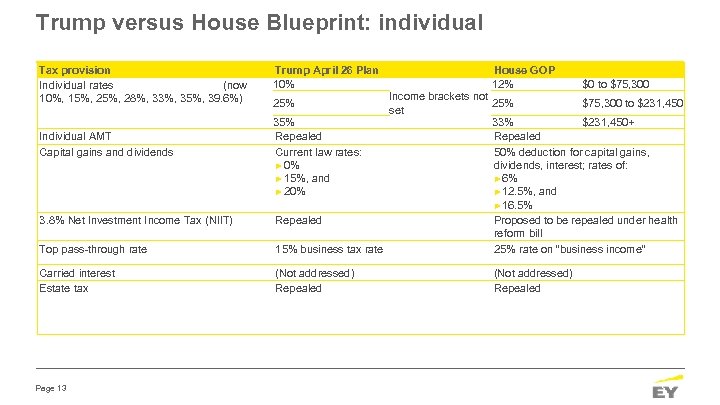 Trump versus House Blueprint: individual Tax provision Individual rates (now 10%, 15%, 28%, 33%, 35%, 39. 6%) Trump April 26 Plan 10% House GOP 12% $0 to $75, 300 Top pass-through rate Income brackets not 25% $75, 300 to $231, 450 set 35% 33% $231, 450+ Repealed Current law rates: 50% deduction for capital gains, ► 0% dividends, interest; rates of: ► 15%, and ► 6% ► 20% ► 12. 5%, and ► 16. 5% Repealed Proposed to be repealed under health reform bill 15% business tax rate 25% rate on “business income” Carried interest Estate tax (Not addressed) Repealed Individual AMT Capital gains and dividends 3. 8% Net Investment Income Tax (NIIT) Page 13 25% (Not addressed) Repealed
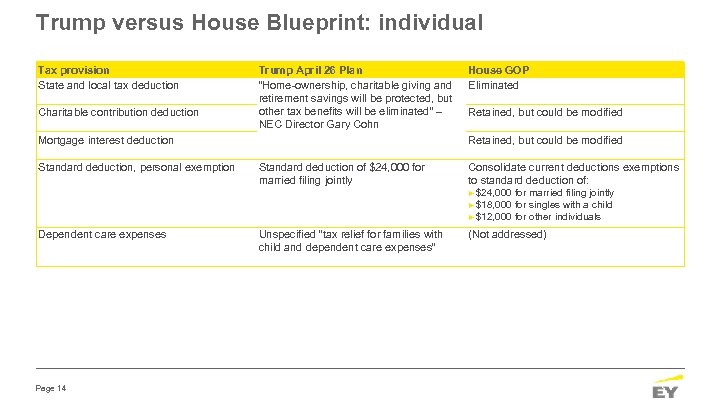 Trump versus House Blueprint: individual Tax provision State and local tax deduction Charitable contribution deduction Trump April 26 Plan “Home-ownership, charitable giving and retirement savings will be protected, but other tax benefits will be eliminated” – NEC Director Gary Cohn Mortgage interest deduction Standard deduction, personal exemption House GOP Eliminated Retained, but could be modified Standard deduction of $24, 000 for married filing jointly Consolidate current deductions exemptions to standard deduction of: ►$24, 000 for married filing jointly ►$18, 000 for singles with a child ►$12, 000 for other individuals Dependent care expenses Page 14 Unspecified “tax relief for families with child and dependent care expenses” (Not addressed)
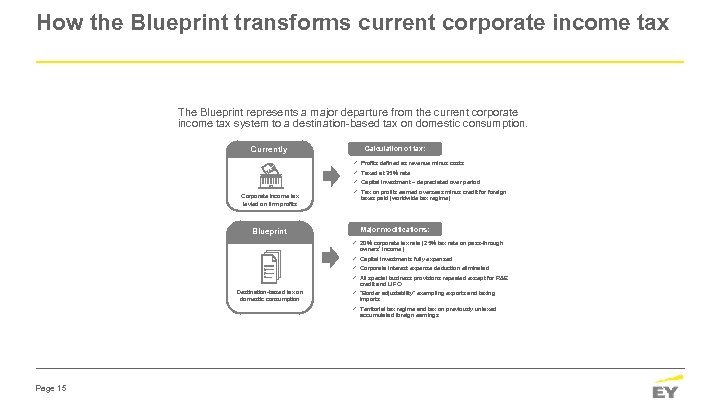 How the Blueprint transforms current corporate income tax The Blueprint represents a major departure from the current corporate income tax system to a destination-based tax on domestic consumption. Currently Calculation of tax: ü Profits defined as revenue minus costs ü Taxed at 35% rate ü Capital investment – depreciated over period Corporate income tax levied on firm profits Blueprint ü Tax on profits earned overseas minus credit foreign taxes paid (worldwide tax regime) Major modifications: ü 20% corporate tax rate (25% tax rate on pass-through owners’ income) ü Capital investments fully expensed ü Corporate interest expense deduction eliminated ü All special business provisions repealed except for R&E credit and LIFO Destination-based tax on domestic consumption ü “Border adjustability” exempting exports and taxing imports ü Territorial tax regime and tax on previously untaxed accumulated foreign earnings Page 15
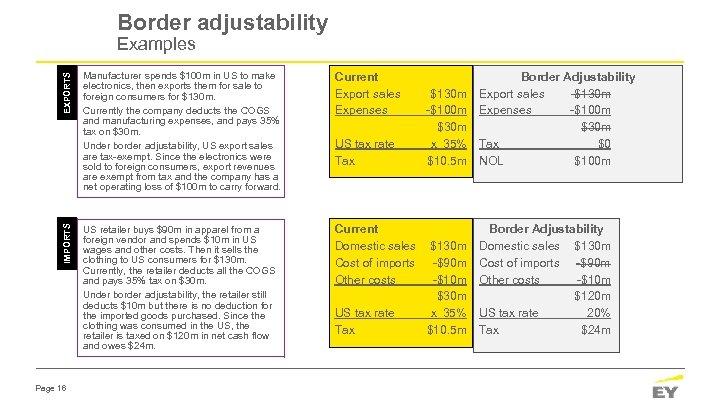 Border adjustability EXPORTS Manufacturer spends $100 m in US to make electronics, then exports them for sale to foreign consumers for $130 m. Currently the company deducts the COGS and manufacturing expenses, and pays 35% tax on $30 m. Under border adjustability, US export sales are tax-exempt. Since the electronics were sold to foreign consumers, export revenues are exempt from tax and the company has a net operating loss of $100 m to carry forward. Current Export sales Expenses $130 m -$100 m $30 m US tax rate x 35% Tax $10. 5 m Border Adjustability Export sales $130 m Expenses -$100 m $30 m Tax $0 NOL $100 m IMPORTS Examples US retailer buys $90 m in apparel from a foreign vendor and spends $10 m in US wages and other costs. Then it sells the clothing to US consumers for $130 m. Currently, the retailer deducts all the COGS and pays 35% tax on $30 m. Under border adjustability, the retailer still deducts $10 m but there is no deduction for the imported goods purchased. Since the clothing was consumed in the US, the retailer is taxed on $120 m in net cash flow and owes $24 m. Current Domestic sales $130 m Cost of imports -$90 m Other costs -$10 m $30 m US tax rate x 35% Tax $10. 5 m Border Adjustability Domestic sales $130 m Cost of imports -$90 m Other costs -$10 m $120 m US tax rate 20% Tax $24 m Page 16
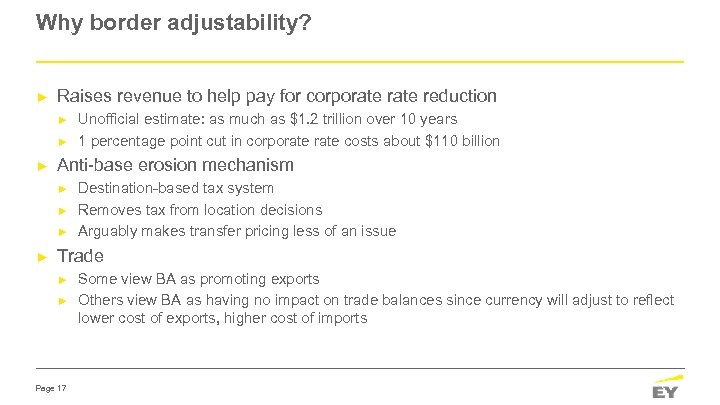 Why border adjustability? ► Raises revenue to help pay for corporate reduction ► ► ► Anti-base erosion mechanism ► ► Unofficial estimate: as much as $1. 2 trillion over 10 years 1 percentage point cut in corporate costs about $110 billion Destination-based tax system Removes tax from location decisions Arguably makes transfer pricing less of an issue Trade ► ► Page 17 Some view BA as promoting exports Others view BA as having no impact on trade balances since currency will adjust to reflect lower cost of exports, higher cost of imports
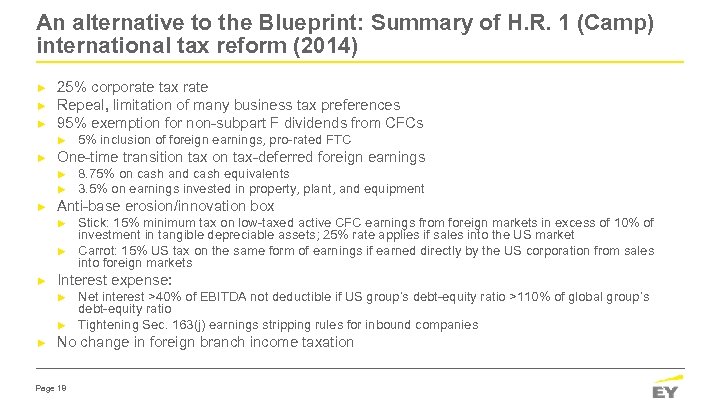 An alternative to the Blueprint: Summary of H. R. 1 (Camp) international tax reform (2014) ► ► ► 25% corporate tax rate Repeal, limitation of many business tax preferences 95% exemption for non-subpart F dividends from CFCs ► ► One-time transition tax-deferred foreign earnings ► ► Stick: 15% minimum tax on low-taxed active CFC earnings from foreign markets in excess of 10% of investment in tangible depreciable assets; 25% rate applies if sales into the US market Carrot: 15% US tax on the same form of earnings if earned directly by the US corporation from sales into foreign markets Interest expense: ► ► ► 8. 75% on cash and cash equivalents 3. 5% on earnings invested in property, plant, and equipment Anti-base erosion/innovation box ► ► 5% inclusion of foreign earnings, pro-rated FTC Net interest >40% of EBITDA not deductible if US group’s debt-equity ratio >110% of global group’s debt-equity ratio Tightening Sec. 163(j) earnings stripping rules for inbound companies No change in foreign branch income taxation Page 18
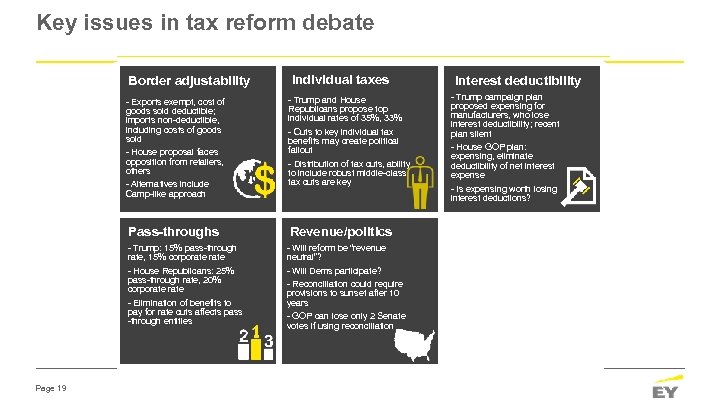 Key issues in tax reform debate Border adjustability - Exports exempt, cost of goods sold deductible; imports non-deductible, including costs of goods sold - House proposal faces opposition from retailers, others - Alternatives include Camp-like approach Pass-throughs Individual taxes - Trump and House Republicans propose top individual rates of 35%, 33% - Cuts to key individual tax benefits may create political fallout - Distribution of tax cuts, ability to include robust middle-class tax cuts are key Revenue/politics - Trump: 15% pass-through rate, 15% corporate - Will reform be “revenue neutral”? - House Republicans: 25% pass-through rate, 20% corporate - Will Dems participate? - Elimination of benefits to pay for rate cuts affects pass -through entities Page 19 - Reconciliation could require provisions to sunset after 10 years - GOP can lose only 2 Senate votes if using reconciliation Interest deductibility - Trump campaign plan proposed expensing for manufacturers, who lose interest deductibility; recent plan silent - House GOP plan: expensing, eliminate deductibility of net interest expense - Is expensing worth losing interest deductions?
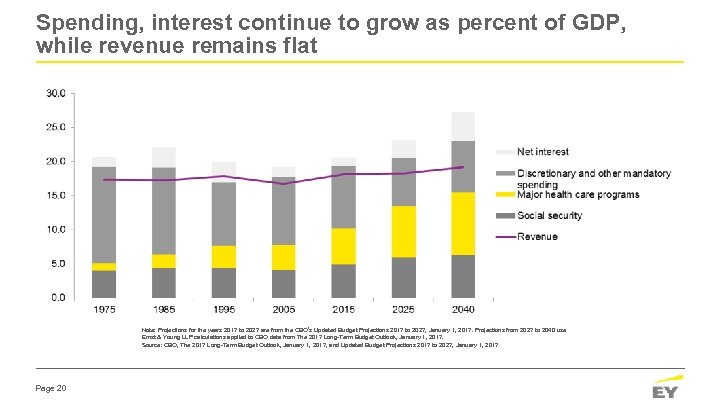 Spending, interest continue to grow as percent of GDP, while revenue remains flat Note: Projections for the years 2017 to 2027 are from the CBO’s Updated Budget Projections 2017 to 2027, January 1, 2017. Projections from 2027 to 2040 use Ernst & Young LLP calculations applied to CBO data from The 2017 Long-Term Budget Outlook, January 1, 2017. Source: CBO, The 2017 Long-Term Budget Outlook, January 1, 2017, and Updated Budget Projections 2017 to 2027, January 1, 2017 Page 20
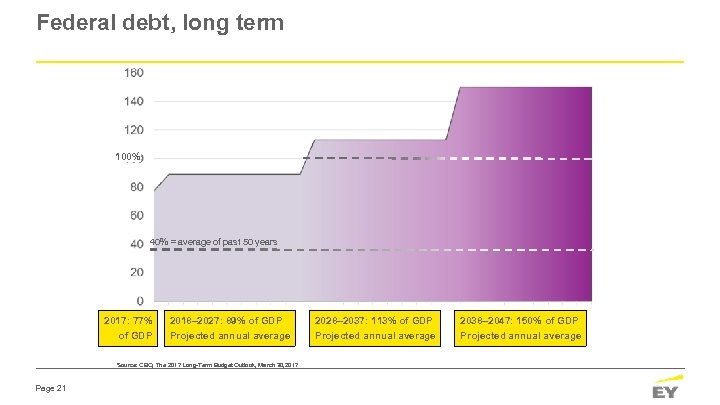 Federal debt, long term 100% 40% = average of past 50 years 2017: 77% of GDP 2018– 2027: 89% of GDP Projected annual average Source: CBO, The 2017 Long-Term Budget Outlook, March 30, 2017 Page 21 2028– 2037: 113% of GDP Projected annual average 2038– 2047: 150% of GDP Projected annual average
 Business Tax Reform – Impact on Funds and Investment Managers » Reduced corporate/pass-through tax rates – good for investment managers » Possible repeal of business interest expense deduction » Possible repeal of municipal bond interest exemption » Border adjustment needed to pay for lower business tax rates – without it, may look to other pay-fors 22
 Pass-Through Entities • Impact on pass-through investment funds • Impact on asset management companies o Reasonable compensation rules 23
 Interest Deductibility and Investment Funds • Treatment of entities that do not get benefit from capital expensing changes • Impact on investment funds o Taxation on gross receipts o Impact on strategies using leverage; potential market impact 24
 Other Key Principles for Investment Funds • Harmonized treatment of investment income • Promote investment from all investors o Non-U. S. Investors o U. S. tax exempt investors o U. S. taxable investors 25
 International Tax Reform » Border Adjustable Tax (BAT) • No deduction for imports; no tax on exports • Blueprint does not address financial services • Impact on investment managers • Impact on funds » Other International Issues • Deemed Repatriation • Treaties 26
 International Tax Reform » What does a territorial system mean for Subpart F? » If BAT is dropped, what replaces it? • How to prevent base erosion • Minimum tax on foreign source earnings (Camp) 27
 Taxation of Derivatives » Camp Tax Reform Bill (February 2014) • Mark-to-market for all “derivatives, ” ordinary gain/loss • Would require all taxpayers to use FIFO (average cost permitted for RIC shares) » Sen. Wyden (D-OR) Discussion Draft (May 2016) and Bill (May 2017) • Mark-to-market for all “derivatives, ” ordinary gain/loss • New “Investment Hedging Unit” Regime » Rep. Reed (R-NY) • Working on language to be included in broader tax reform bill. 28
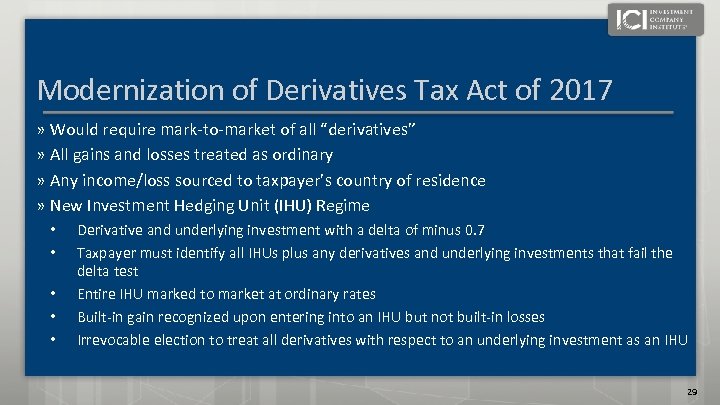 Modernization of Derivatives Tax Act of 2017 » Would require mark-to-market of all “derivatives” » All gains and losses treated as ordinary » Any income/loss sourced to taxpayer’s country of residence » New Investment Hedging Unit (IHU) Regime • • • Derivative and underlying investment with a delta of minus 0. 7 Taxpayer must identify all IHUs plus any derivatives and underlying investments that fail the delta test Entire IHU marked to market at ordinary rates Built-in gain recognized upon entering into an IHU but not built-in losses Irrevocable election to treat all derivatives with respect to an underlying investment as an IHU 29
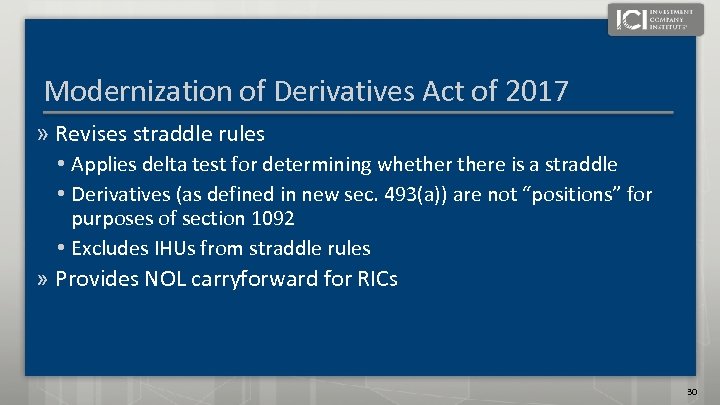 Modernization of Derivatives Act of 2017 » Revises straddle rules • Applies delta test for determining whethere is a straddle • Derivatives (as defined in new sec. 493(a)) are not “positions” for purposes of section 1092 • Excludes IHUs from straddle rules » Provides NOL carryforward for RICs 30
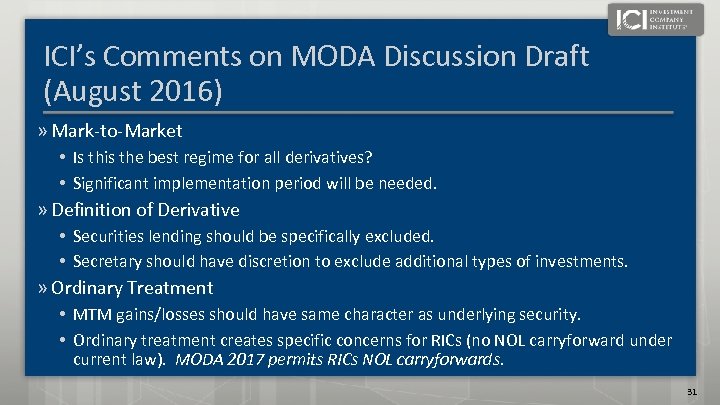 ICI’s Comments on MODA Discussion Draft (August 2016) » Mark-to-Market • Is this the best regime for all derivatives? • Significant implementation period will be needed. » Definition of Derivative • Securities lending should be specifically excluded. • Secretary should have discretion to exclude additional types of investments. » Ordinary Treatment • MTM gains/losses should have same character as underlying security. • Ordinary treatment creates specific concerns for RICs (no NOL carryforward under current law). MODA 2017 permits RICs NOL carryforwards. 31
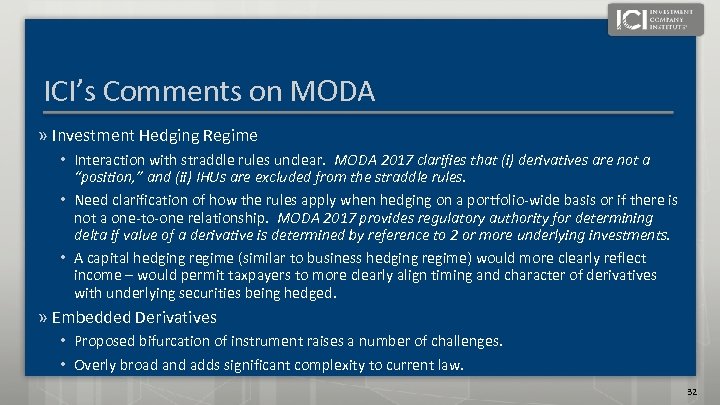 ICI’s Comments on MODA » Investment Hedging Regime • Interaction with straddle rules unclear. MODA 2017 clarifies that (i) derivatives are not a “position, ” and (ii) IHUs are excluded from the straddle rules. • Need clarification of how the rules apply when hedging on a portfolio-wide basis or if there is not a one-to-one relationship. MODA 2017 provides regulatory authority for determining delta if value of a derivative is determined by reference to 2 or more underlying investments. • A capital hedging regime (similar to business hedging regime) would more clearly reflect income – would permit taxpayers to more clearly align timing and character of derivatives with underlying securities being hedged. » Embedded Derivatives • Proposed bifurcation of instrument raises a number of challenges. • Overly broad and adds significant complexity to current law. 32
 Other Legislative Changes? » Retirement Savings Incentives » Municipal Bond Interest » “RIC Mod II” • NOL Carryforwards • Investment in Commodities • Excise tax fixes » GROWTH Act 33