


 Скачать презентацию Maximizing Our Potential What Do We Owe the
8c9436b38bb43ee0fcb73a2851b5a82a.ppt
- Количество слайдов: 25
 Maximizing Our Potential: What Do We Owe the 98%? Nancy Alvarado 2012 Mensa Annual Gathering
 Where we stand Gifted programs are being cut nationwide. ◦ Including programs for arts & athletics The rationale for education is: ◦ All children deserve to be educated to their maximum potential… ◦ Unless they are working at grade level… ◦ Beyond that, their education depends on what their parents can afford.
 National Association for Gifted Children State of the Nation – a report on the status of gifted education nationwide. Of 36 states reporting: ◦ 10 provided $0 for gifted education 2010 -11 ◦ 4 more spent less than $1 million ◦ 15 spent $10 million or more ◦ 14 have reduced state funding since the last report http: //www. nagc. org/Data. Mapby. State. aspx
 Times are Tough Gifted education has never been a priority. No Child Left Behind has made funding contingent on performance in ways that divert resources from gifted education. Education for ALL children has increasingly focused on job skills training not other traditional goals of education.
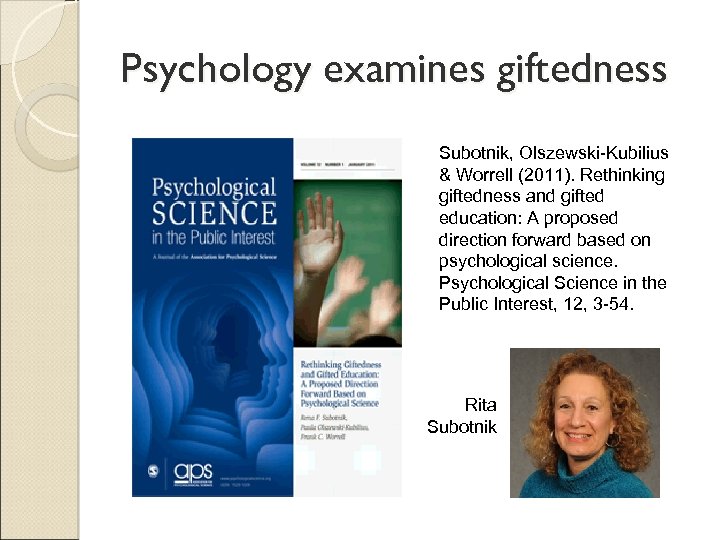 Psychology examines giftedness Subotnik, Olszewski-Kubilius & Worrell (2011). Rethinking giftedness and gifted education: A proposed direction forward based on psychological science. Psychological Science in the Public Interest, 12, 3 -54. Rita Subotnik
 Goals of Gifted Education Self-actualization versus Eminence Views of the gifted as qualitatively different stress developing the psyche. Subotnik, Kassan et al, 1993 asked: “Can gifted children grown up claim to be gifted adults without displaying markers of distinction associated with their abilities? ” To be labeled “gifted”, adults must display eminence – society has a right to expect this return on their investment.
 Eminence should be the goal Subotnik et al. state: “Increasing the number of individuals who make pathbreaking, field-altering discoveries and creative contributions by their products, innovations, and performance is the aim of…gifted education. ” “The world needs more of such individuals. . . ” “Aspiring to fulfillment…will lead to… personal satisfaction… and unimaginable benefits to society. ”
 What is Eminence? Contributing in a transcendent way to making societal life better and more beautiful. Maximizing one’s lifetime contributions to society. Outstanding accomplishment in the domain of talent is part of the selfactualization of gifted adults. Gifted education should remove barriers to eminence.
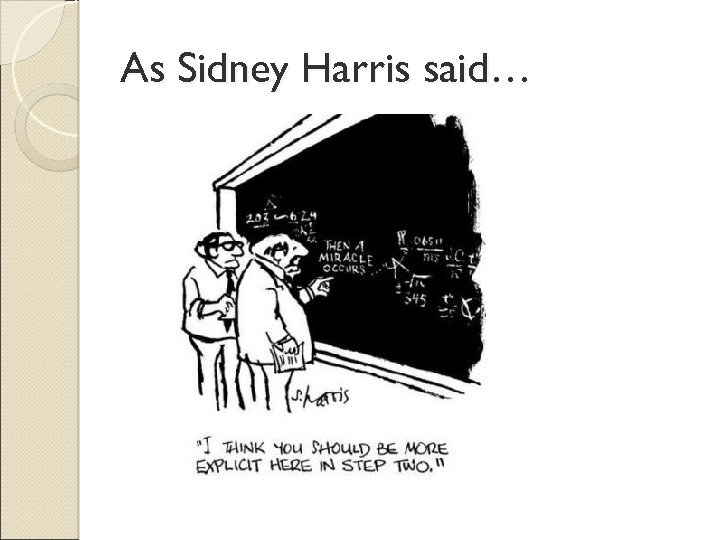 As Sidney Harris said…
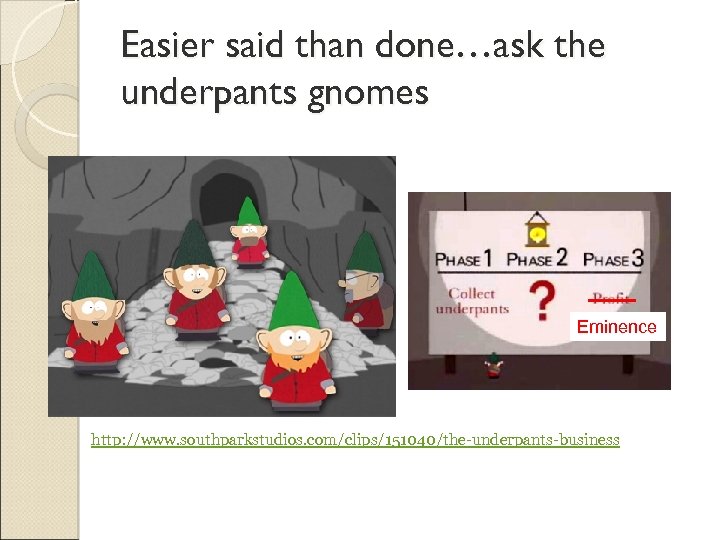 Easier said than done…ask the underpants gnomes Eminence http: //www. southparkstudios. com/clips/151040/the-underpants-business
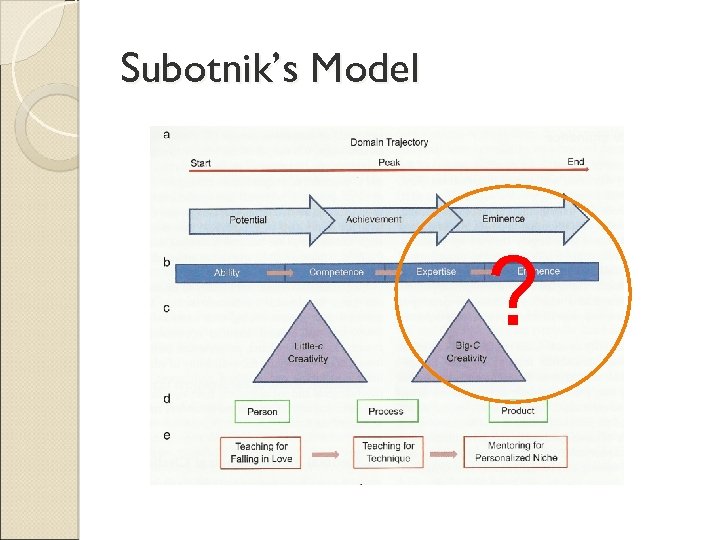 Subotnik’s Model ?
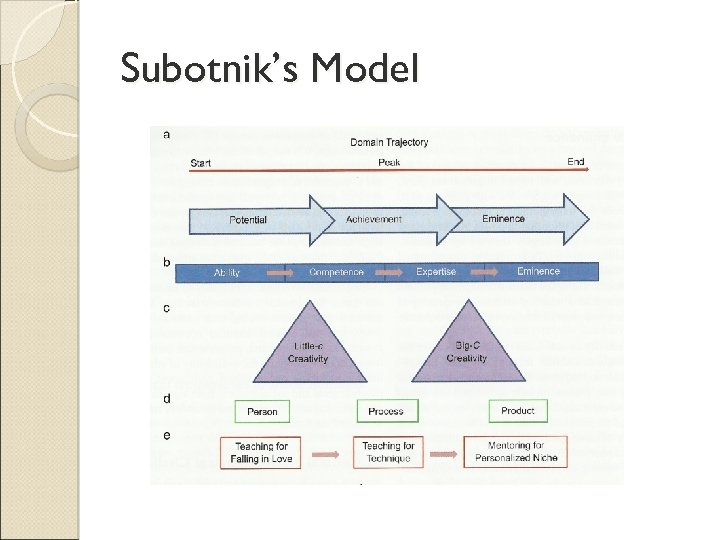 Subotnik’s Model
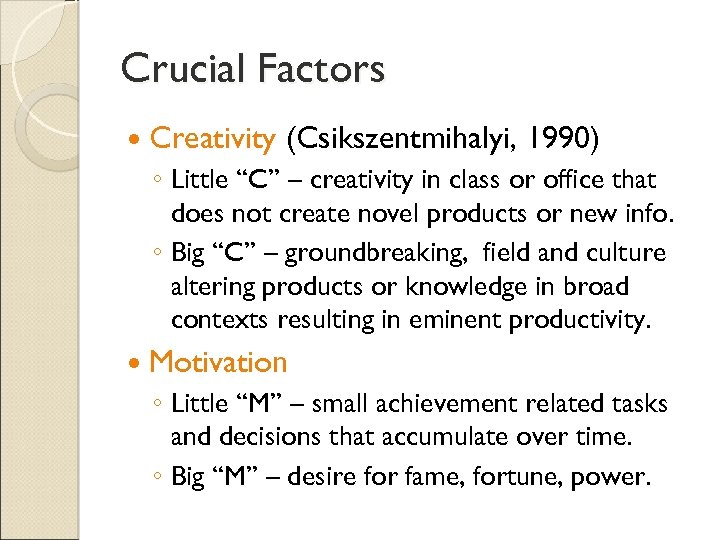 Crucial Factors Creativity (Csikszentmihalyi, 1990) ◦ Little “C” – creativity in class or office that does not create novel products or new info. ◦ Big “C” – groundbreaking, field and culture altering products or knowledge in broad contexts resulting in eminent productivity. Motivation ◦ Little “M” – small achievement related tasks and decisions that accumulate over time. ◦ Big “M” – desire for fame, fortune, power.
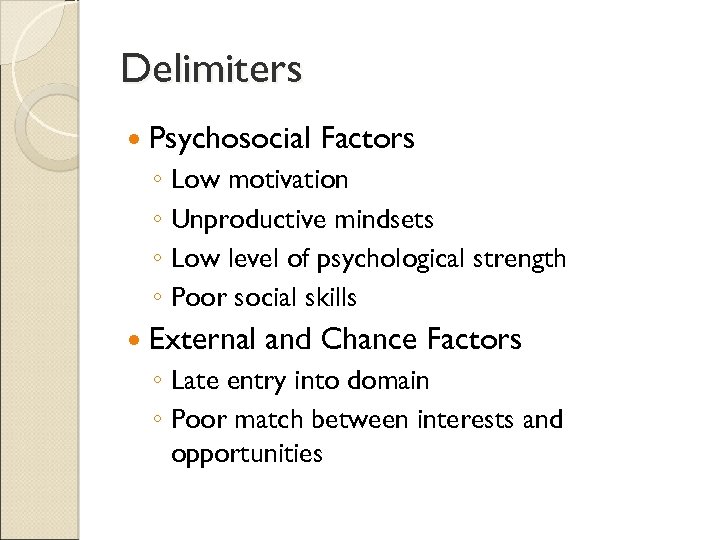 Delimiters Psychosocial Factors ◦ Low motivation ◦ Unproductive mindsets ◦ Low level of psychological strength ◦ Poor social skills External and Chance Factors ◦ Late entry into domain ◦ Poor match between interests and opportunities
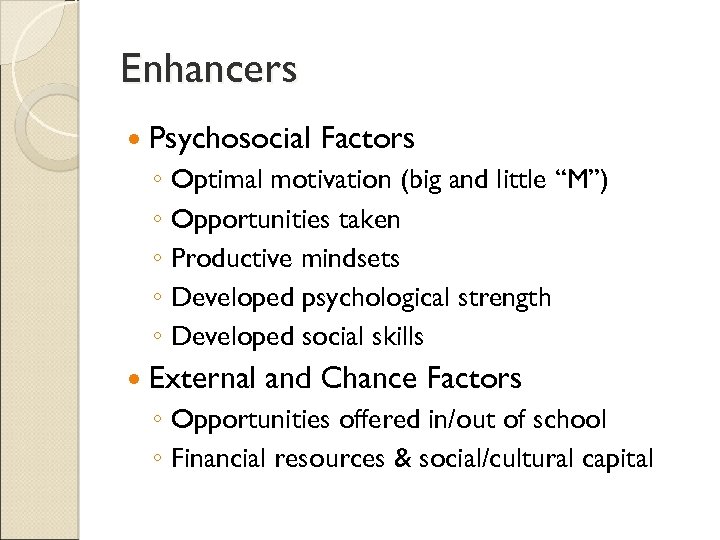 Enhancers Psychosocial Factors ◦ Optimal motivation (big and little “M”) ◦ Opportunities taken ◦ Productive mindsets ◦ Developed psychological strength ◦ Developed social skills External and Chance Factors ◦ Opportunities offered in/out of school ◦ Financial resources & social/cultural capital
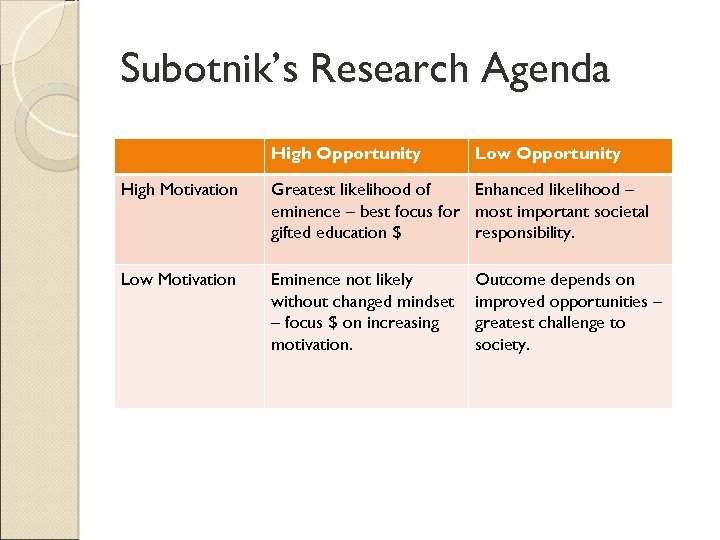 Subotnik’s Research Agenda High Opportunity Low Opportunity High Motivation Greatest likelihood of Enhanced likelihood – eminence – best focus for most important societal gifted education $ responsibility. Low Motivation Eminence not likely without changed mindset – focus $ on increasing motivation. Outcome depends on improved opportunities – greatest challenge to society.
 Questions for Mensans Is eminence our Goal for ourselves and/or our kids? ◦ Subotnik argues eminence leads to positive self-actualization and individual satisfaction. What does failure to achieve eminence lead to? Do some find the contemplated cost-benefit tradeoffs unacceptable? Does eminence require a buy-in to social values of a competitive culture?
 Identity as a Gifted Adult Does the Big-M motivation require an identity as a gifted or talented person? When that identity is in conflict with other aspects of identity can eminence be achieved? Is that identity fragile? ◦ Dweck’s “fixed mindset” found in stereotype threat may apply to the gifted. ◦ Is there a need to protect that identity.
 Personal and Social Identities Subotnik mentions BFLPE – big-fish littlepond effect. Does it hold in later life? Cultural ecological theory (Ogbu, 2003) may apply to any group that defines academic achievement as “not for us. ” ◦ Family may be the basis for exclusion, not simply income, race or ethnicity.
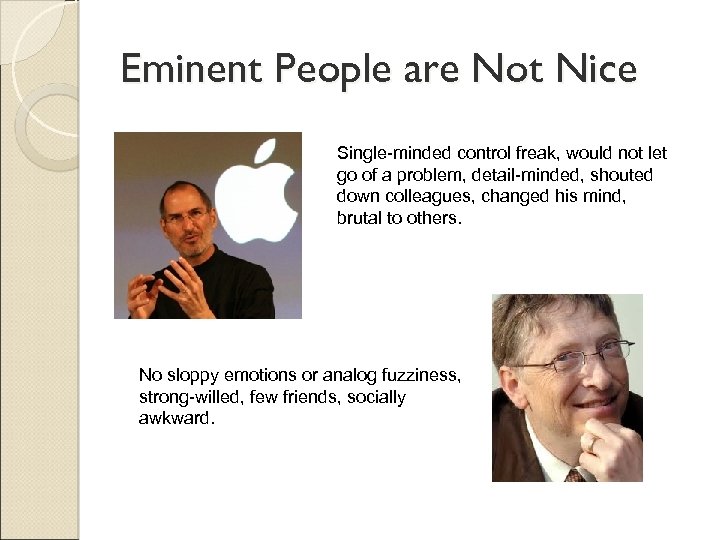 Eminent People are Not Nice Single-minded control freak, would not let go of a problem, detail-minded, shouted down colleagues, changed his mind, brutal to others. No sloppy emotions or analog fuzziness, strong-willed, few friends, socially awkward.
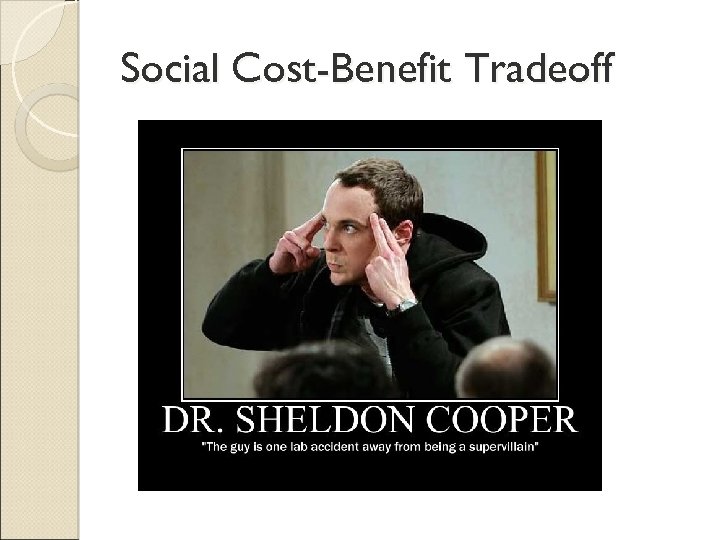 Social Cost-Benefit Tradeoff
 Social Difficulties in Highly Gifted • • • Young gifted children may seem quirky or awkward compared with their age peers. Have encompassing interests that are different from age peers. Have sensory issues due to Dabrowski's Overexcitabilities, similar to autistic children. Have unusual vocabulary and mature sentence structures for their age. Resent or even resist transitioning from an area of interest. Enjoy exploring learning topics in more detail than their age peers.
 The Autism Oddity Increased diagnosis of Asperger’s Syndrome may mistakenly include gifted adults and children. ◦ Some gifted adults self-diagnose. Several of the descriptive symptoms of giftedness/autism overlap – obsessive interests, social problems, perseverance. Focus needs to be on differentiating the two, not on the similarities.
 How to Tell Autism from Giftedness Asperger's kids have difficulty with social reciprocity whereas gifted kids enjoy sharing information. • A gifted child will link his or her multiple topics of interest to other areas of knowledge. • Gifted children are often more emotionally sensitive than same-age peers and will respond intensely to the emotions of others. • Gifted children have social difficulties with age peers but not those of similar intellectual ability. •
 Mensa’s Social Context When gifted adults become socially normal in the context of Mensa, they do not fit diagnostic criteria for autism. Mensa reinforces a social identity that accepts giftedness without compromise. ◦ Focus on identity instead of productivity goals undermines eminence. While Mensa does support Big “C” goals, it does not support Big “M” goals.