 Скачать презентацию Mauthausen A Protective Detention Camp Public Memorial and
fa4110f5ffbf76853c1b2125902fe9ea.ppt
- Количество слайдов: 15



Mauthausen “A Protective Detention Camp” Public Memorial and Museum Established by the Austrian Federal Government. Opened May, 1970 Admittance Feb. 1 -Dec. 16
In 1938, a few weeks after the occupation of Austria by German troops, German SS and police officers visited the Mauthausen quarries and found them to be a suitable location for a slave labor & extermination camp. It soon became a “mother camp” for all of Austria. Most of the prisoners there had been put into “protective custody as persons detrimental to the commonweal” because of their nationality, racial origin, political affiliation or religious beliefs. Mauthausen was synonymous with death through slave labor in the quarries. The soil of this vast stronghold is soaked with the blood of thousands of innocent people. I took photos @ this public memorial & museum in Aug. 1996 and in June, 2004.
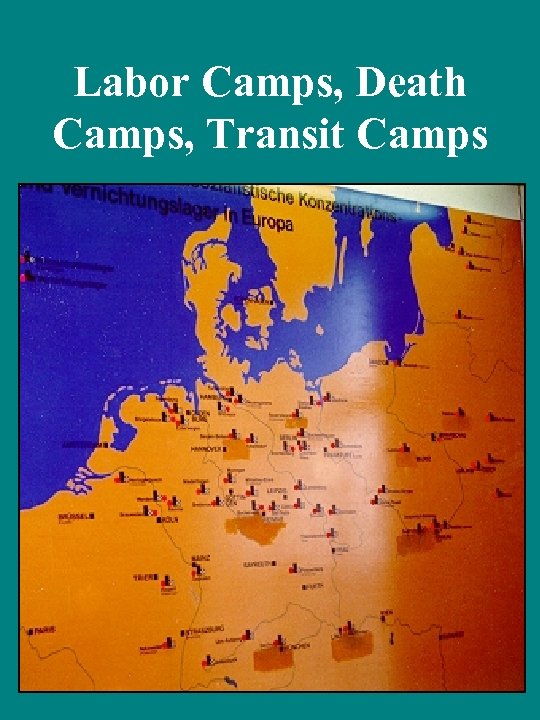
Labor Camps, Death Camps, Transit Camps
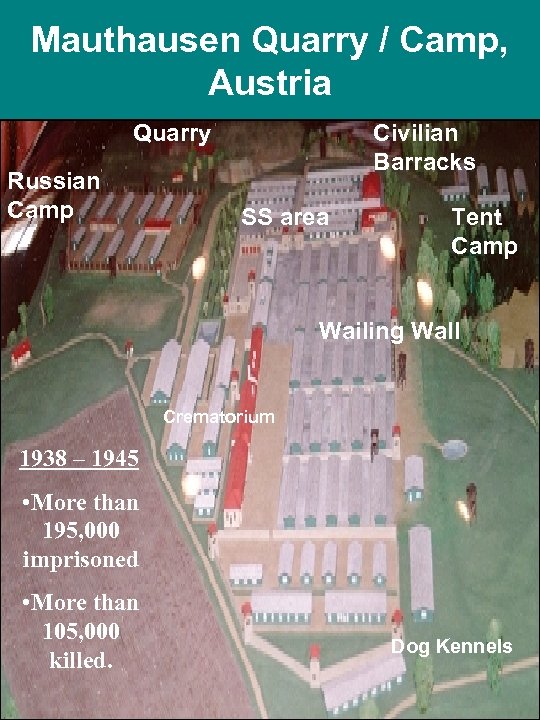
Mauthausen Quarry / Camp, Austria Quarry Russian Camp Civilian Barracks SS area Tent Camp Wailing Wall Crematorium 1938 – 1945 • More than 195, 000 imprisoned • More than 105, 000 killed. Dog Kennels
Mauthausen Central Camp is located 3 km east of its satellite camps, Gusen I & II were the biggest satellites of the Mauthausen system of 49 camps. At the end of 1944, these Gusen camps (pop. 25, 000) contained double the number of inmates of Mauthausen central camp. The largest group of victims (approx. 40, 000) died throughout the years at the Gusen camps. Today Mauthausen is a museum to commemorate the 120, 000 victims that died in a system of 49 different camps. In the war´s final phase, the stone quarries and most of the camp´s surrounding buildings were used to produce KZ Gusen II aircraft-parts, too.
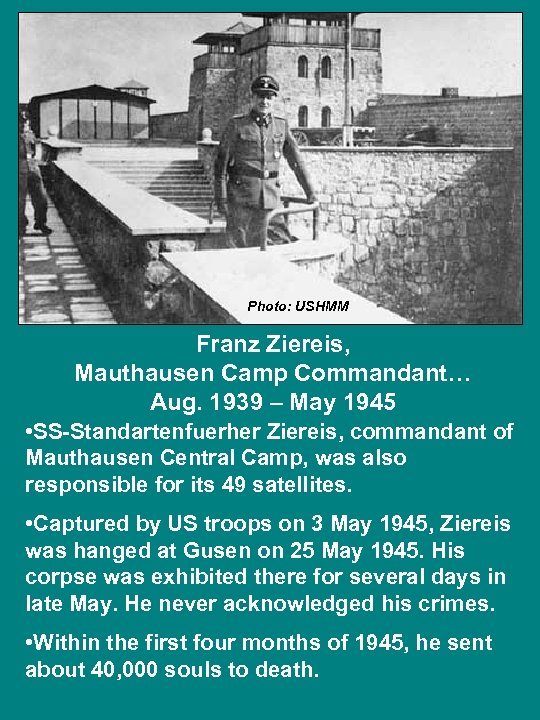
Photo: USHMM Franz Ziereis, Mauthausen Camp Commandant… Aug. 1939 – May 1945 • SS-Standartenfuerher Ziereis, commandant of Mauthausen Central Camp, was also responsible for its 49 satellites. • Captured by US troops on 3 May 1945, Ziereis was hanged at Gusen on 25 May 1945. His corpse was exhibited there for several days in late May. He never acknowledged his crimes. • Within the first four months of 1945, he sent about 40, 000 souls to death.
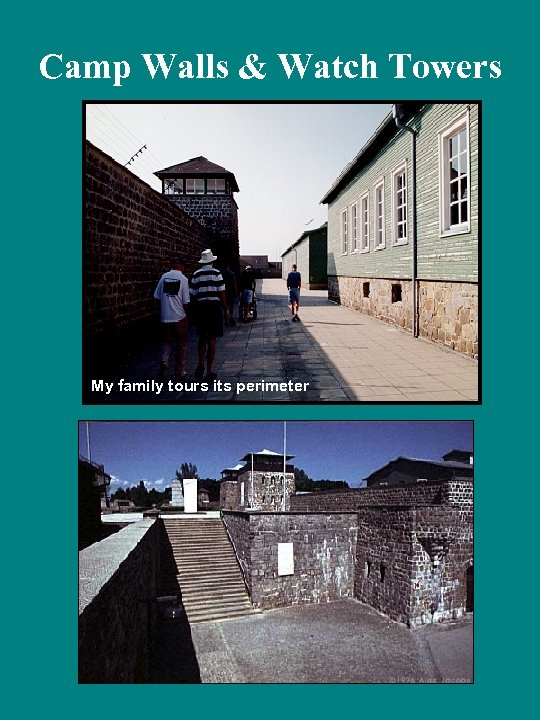
Camp Walls & Watch Towers My family tours its perimeter
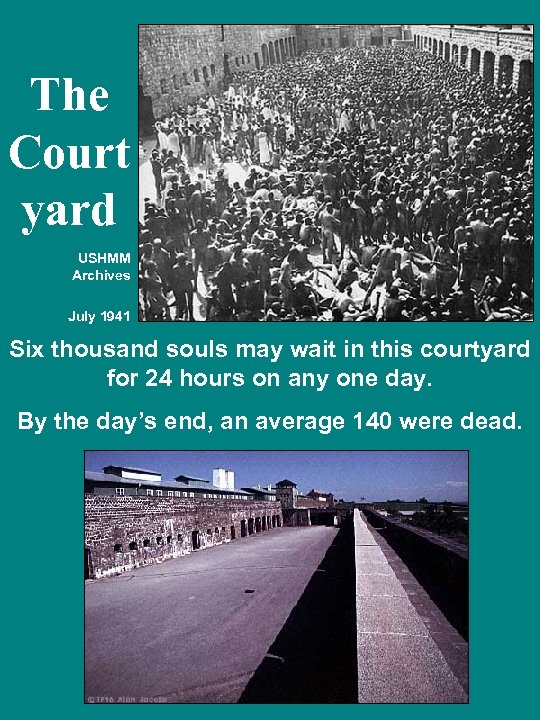
The Court yard USHMM Archives July 1941 Six thousand souls may wait in this courtyard for 24 hours on any one day. By the day’s end, an average 140 were dead.
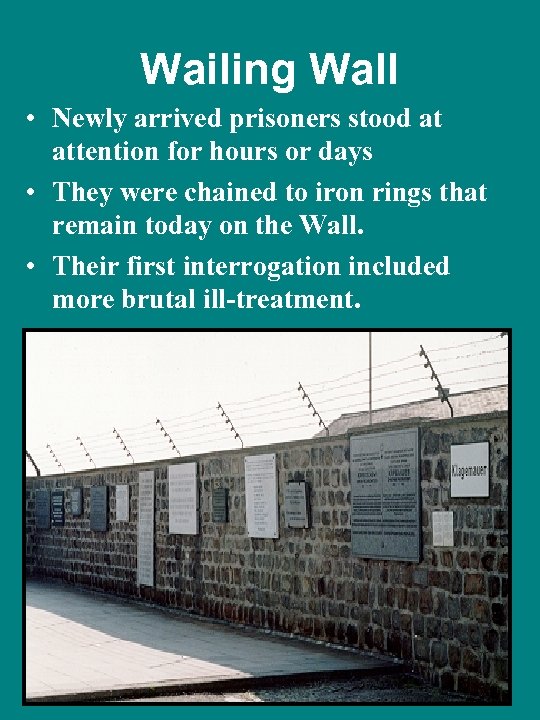
Wailing Wall • Newly arrived prisoners stood at attention for hours or days • They were chained to iron rings that remain today on the Wall. • Their first interrogation included more brutal ill-treatment.
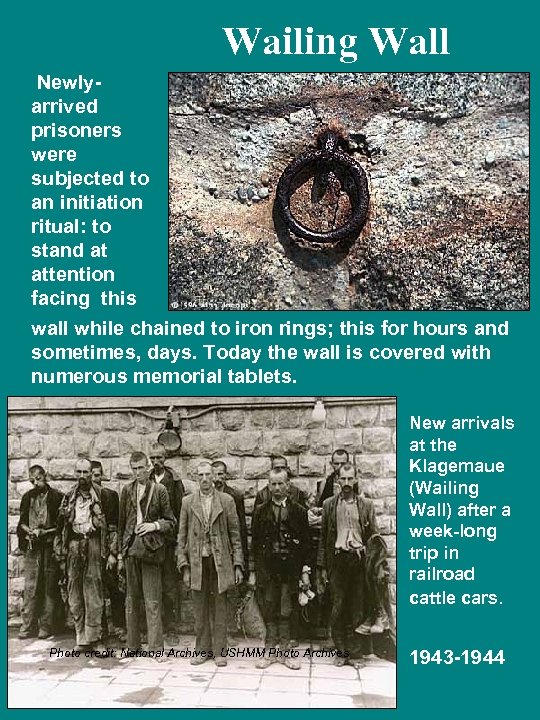
Wailing Wall Newlyarrived prisoners were subjected to an initiation ritual: to stand at attention facing this wall while chained to iron rings; this for hours and sometimes, days. Today the wall is covered with numerous memorial tablets. New arrivals at the Klagemaue (Wailing Wall) after a week-long trip in railroad cattle cars. Photo credit: National Archives, USHMM Photo Archives 1943 -1944
Until 1939, most prisoners built the camp and living quarters for SS troops. Later they worked in the quarries. Starting in 1943, prisoners also labored for the armaments industry. Prisoners worked 7 days a week. In summer, reveille was 4: 45 a. m. Working hours were from 6 a. m. to noon, followed by *lunch* from noon to 1 p. m. This hour included time to march in, roll call, queue up for “soup” and march back to work. Afternoon labor lasted from 1 pm-7 pm, followed by another roll call and food distribution. In winter, reveille was at 5: 15 a. m. Work in the quarries began at dawn and ended at dusk. In the armaments industry, prisoners worked 11 hours daily.
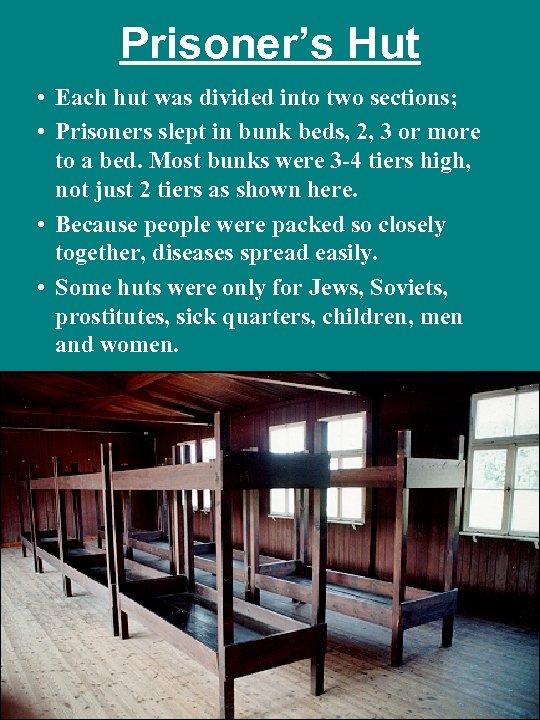
Prisoner’s Hut • Each hut was divided into two sections; • Prisoners slept in bunk beds, 2, 3 or more to a bed. Most bunks were 3 -4 tiers high, not just 2 tiers as shown here. • Because people were packed so closely together, diseases spread easily. • Some huts were only for Jews, Soviets, prostitutes, sick quarters, children, men and women.
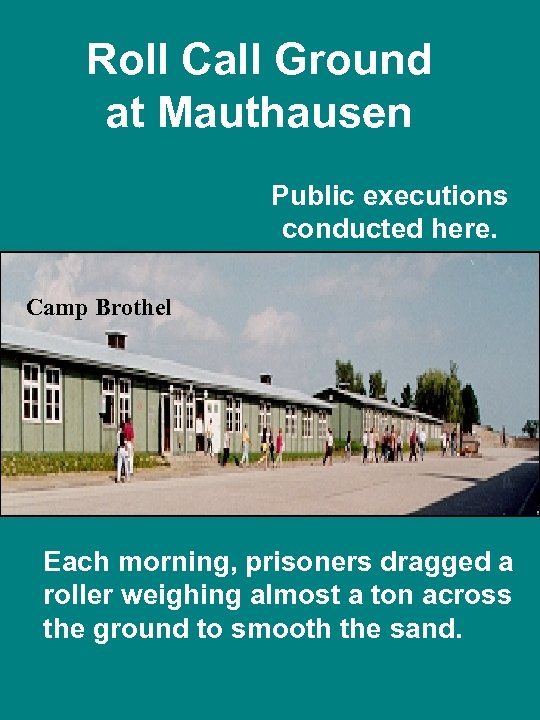
Roll Call Ground at Mauthausen Public executions conducted here. Camp Brothel Each morning, prisoners dragged a roller weighing almost a ton across the ground to smooth the sand.
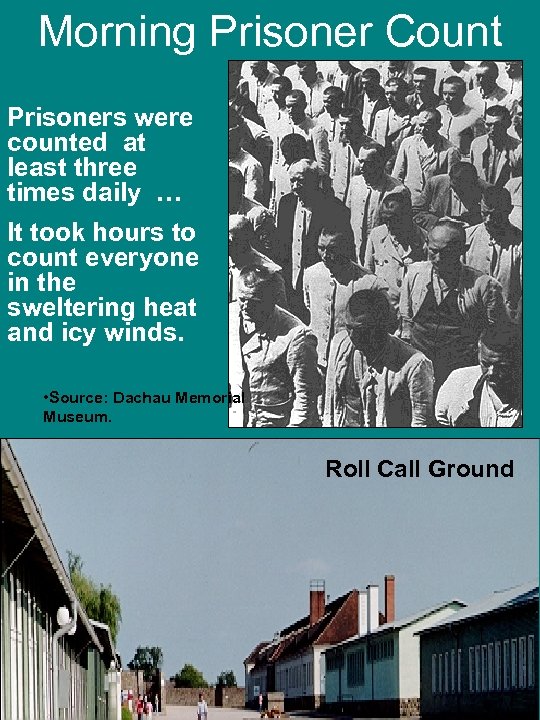
Morning Prisoner Count Prisoners were counted at least three times daily … It took hours to count everyone in the sweltering heat and icy winds. • Source: Dachau Memorial Museum. Roll Call Ground
History I visited the Mauthausen public memorial and museum in Aug. 1996 and in June 2004. I took most of these photos at that time. The information comes from pamphlets that I purchased at the site. For this Power. Point, I have added photos and archived materials from Remember. org and the Holocaust Memorial Museum I have also used photos and information from: - Alan Jacobs, a psychotherapist, author and independent researcher on issues related to genocide and the abuse of power. His film, which uses SS photos and survivors’ words and art , is used in universities, professional conferences and cultural centers. - Scott Sakansky - Krysia Jacobs, Brave New Web
Скачать презентацию Mauthausen A Protective Detention Camp Public Memorial and
fa4110f5ffbf76853c1b2125902fe9ea.ppt