


 Скачать презентацию Mathematics Rigor with Common Core State Standards CCSA
e8e532a2812530ee120da0026f458124.ppt
- Количество слайдов: 71
 Mathematics Rigor with Common Core State Standards CCSA Conference March, 2012 Kitty Rutherford kitty. rutherford@dpi. nc. gov Robin Barbour robin. barbour@dpi. nc. gov
 www. corestandards. org
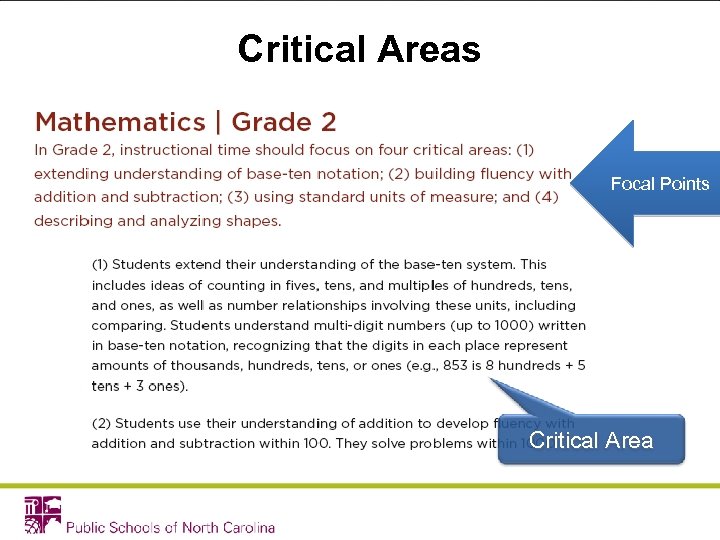 Critical Areas Focal Points Critical Area
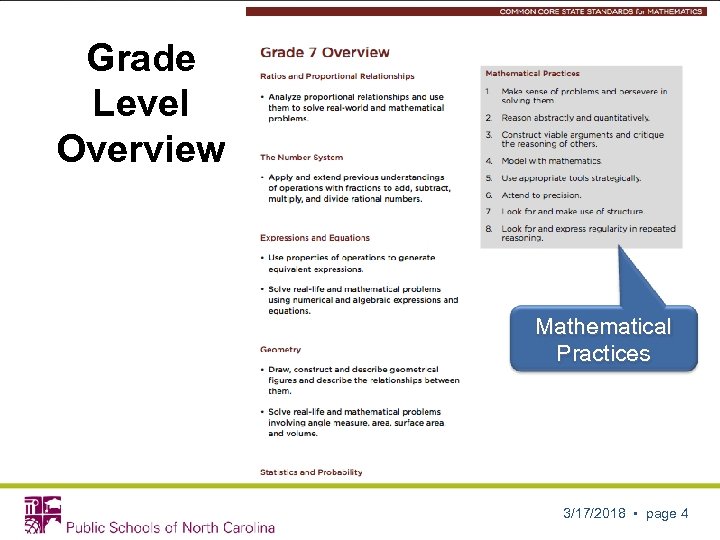 Grade Level Overview Mathematical Practices 3/17/2018 • page 4
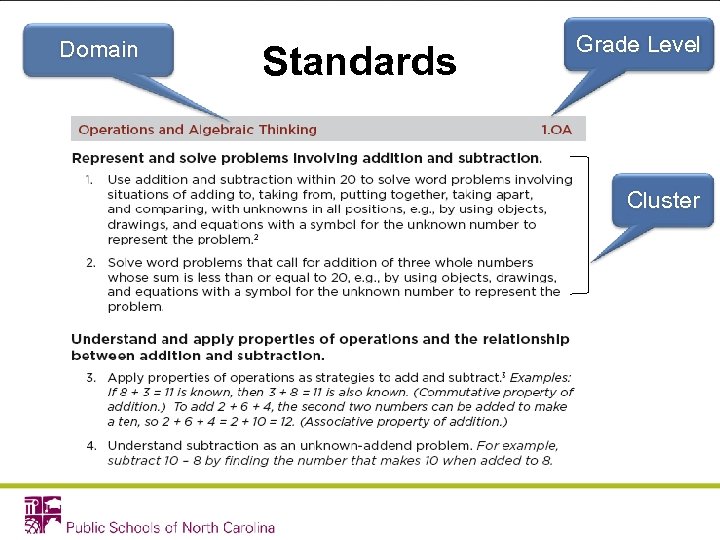 Domain Standards Grade Level Cluster
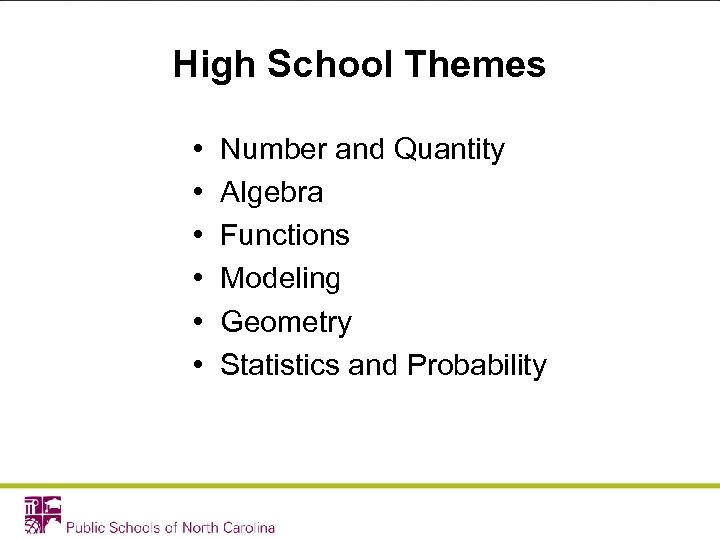 High School Themes • • • Number and Quantity Algebra Functions Modeling Geometry Statistics and Probability
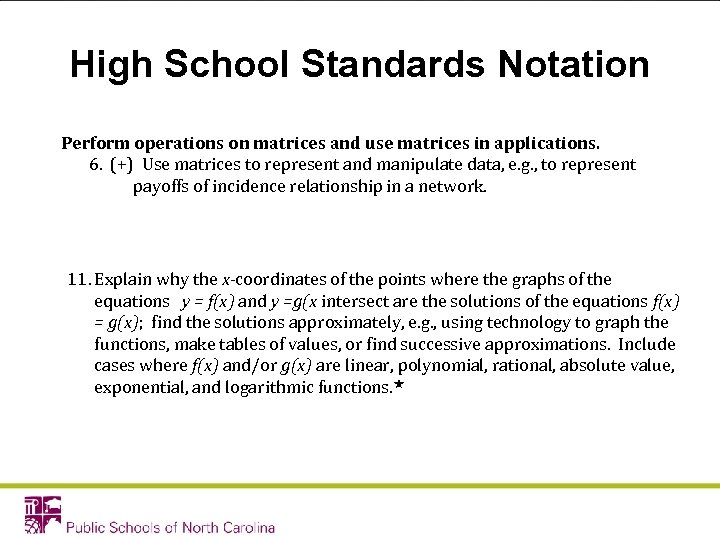 High School Standards Notation Perform operations on matrices and use matrices in applications. 6. (+) Use matrices to represent and manipulate data, e. g. , to represent payoffs of incidence relationship in a network. 11. Explain why the x-coordinates of the points where the graphs of the equations y = f(x) and y =g(x intersect are the solutions of the equations f(x) = g(x); find the solutions approximately, e. g. , using technology to graph the functions, make tables of values, or find successive approximations. Include cases where f(x) and/or g(x) are linear, polynomial, rational, absolute value, exponential, and logarithmic functions. ★
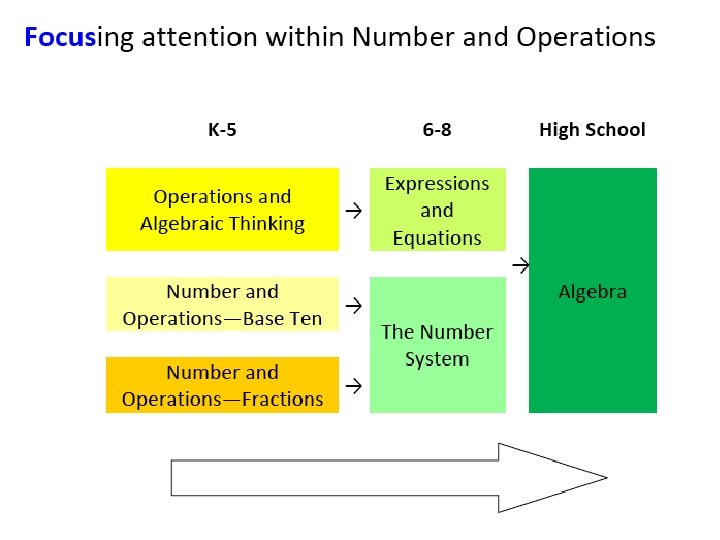
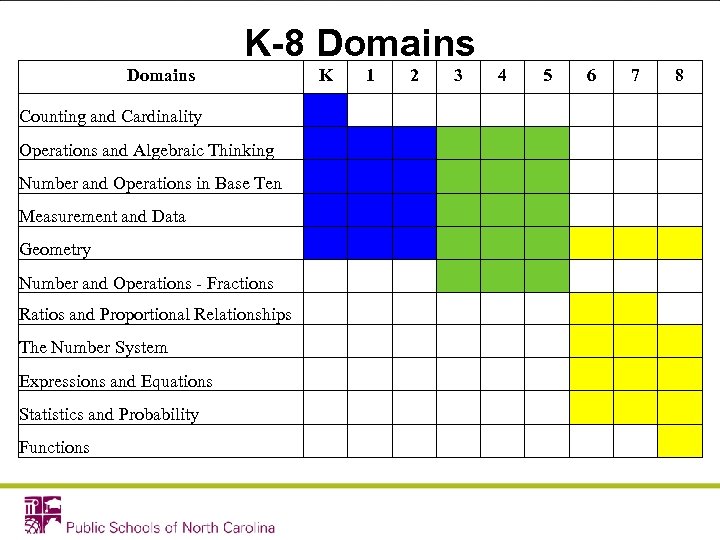 K-8 Domains K 1 2 3 4 5 6 7 8 Counting and Cardinality Operations and Algebraic Thinking Number and Operations in Base Ten Measurement and Data Geometry Number and Operations - Fractions Ratios and Proportional Relationships The Number System Expressions and Equations Statistics and Probability Functions
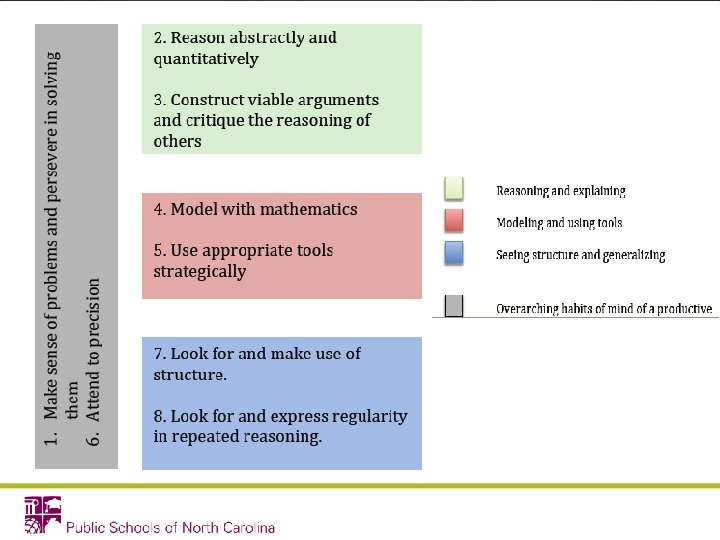
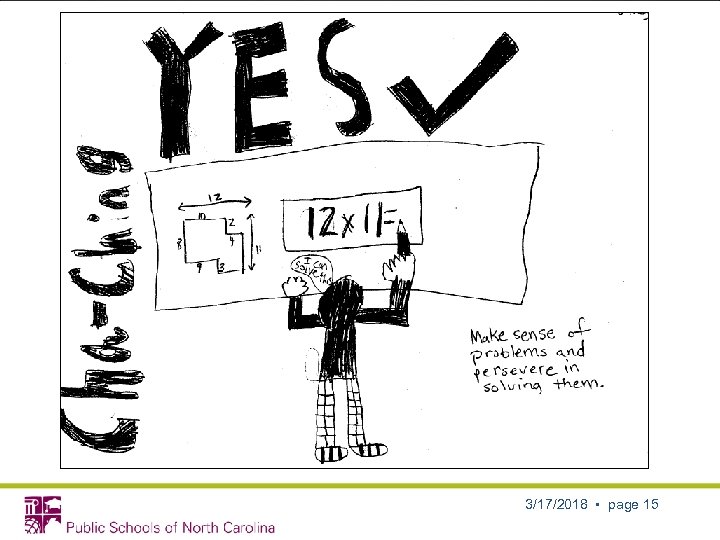
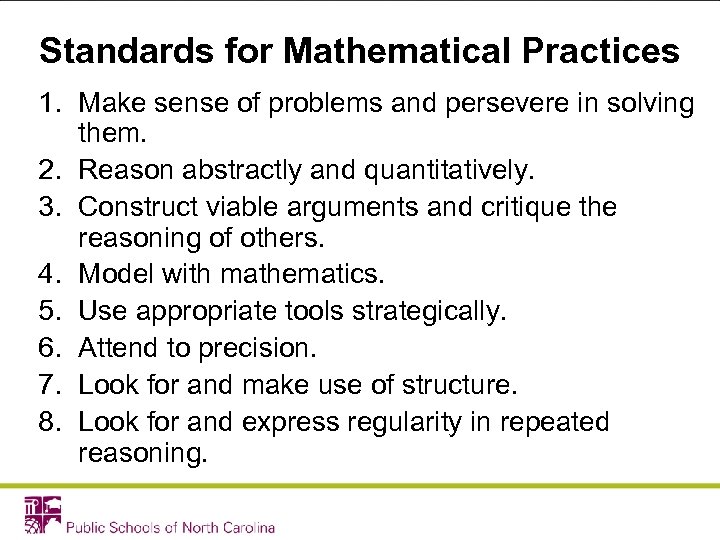 Standards for Mathematical Practices 1. Make sense of problems and persevere in solving them. 2. Reason abstractly and quantitatively. 3. Construct viable arguments and critique the reasoning of others. 4. Model with mathematics. 5. Use appropriate tools strategically. 6. Attend to precision. 7. Look for and make use of structure. 8. Look for and express regularity in repeated reasoning.
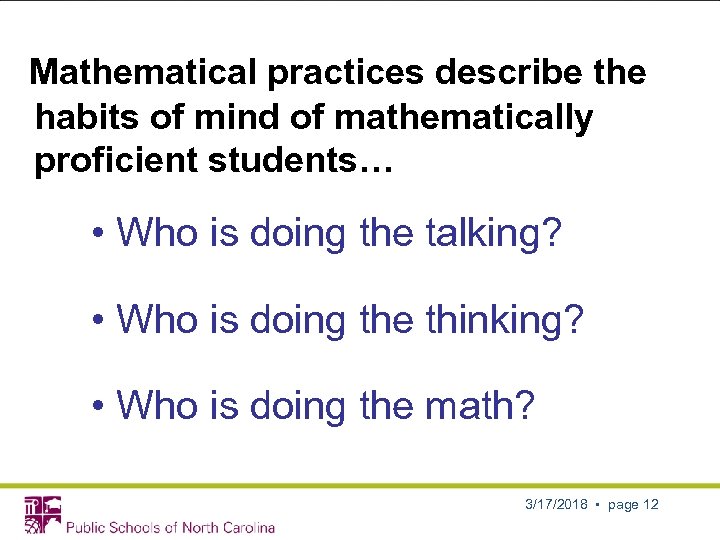 Mathematical practices describe the habits of mind of mathematically proficient students… • Who is doing the talking? • Who is doing the thinking? • Who is doing the math? 3/17/2018 • page 12
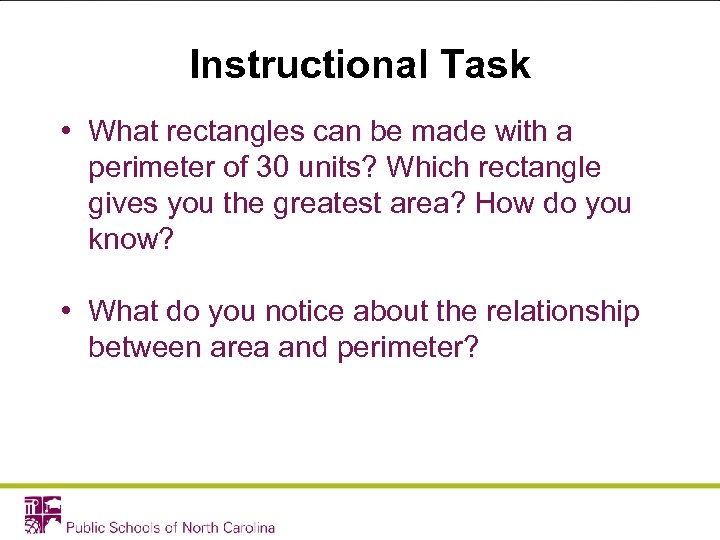 Instructional Task • What rectangles can be made with a perimeter of 30 units? Which rectangle gives you the greatest area? How do you know? • What do you notice about the relationship between area and perimeter?
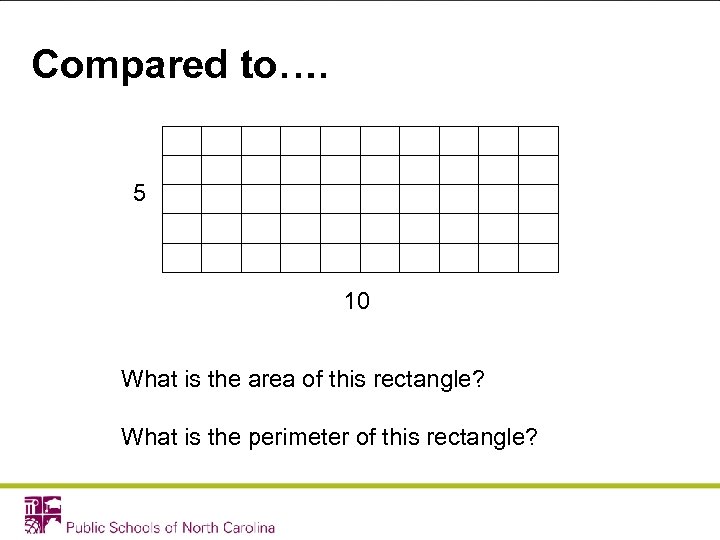 Compared to…. 5 10 What is the area of this rectangle? What is the perimeter of this rectangle?
 3/17/2018 • page 15
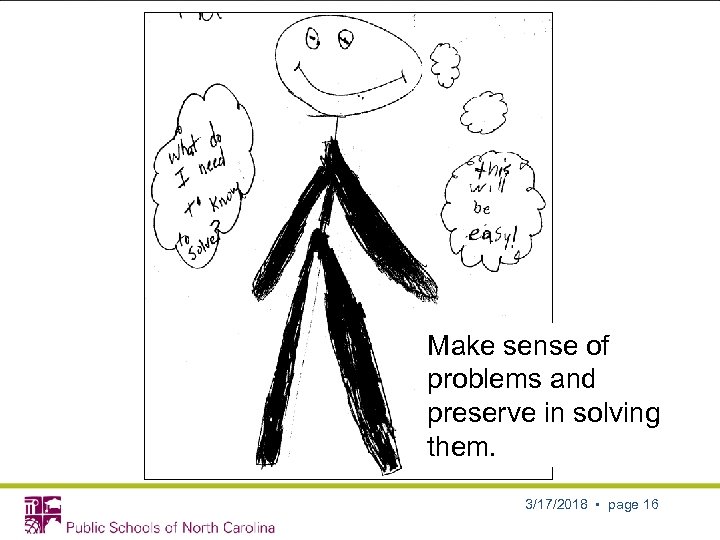 Make sense of problems and preserve in solving them. 3/17/2018 • page 16
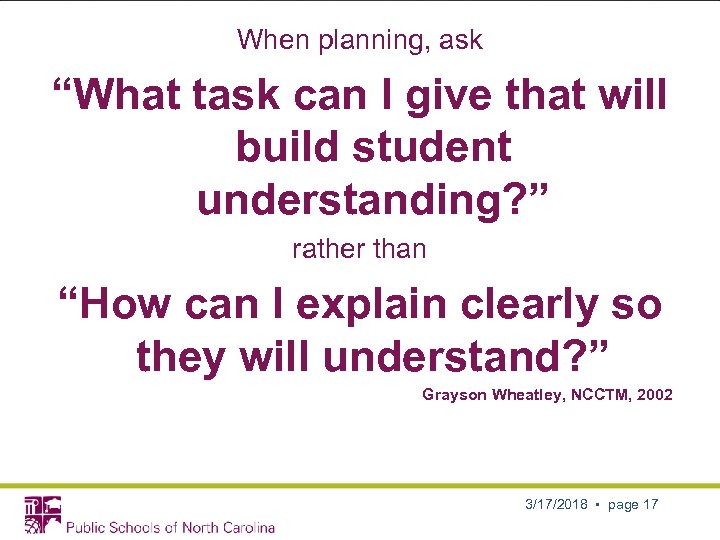 When planning, ask “What task can I give that will build student understanding? ” rather than “How can I explain clearly so they will understand? ” Grayson Wheatley, NCCTM, 2002 3/17/2018 • page 17
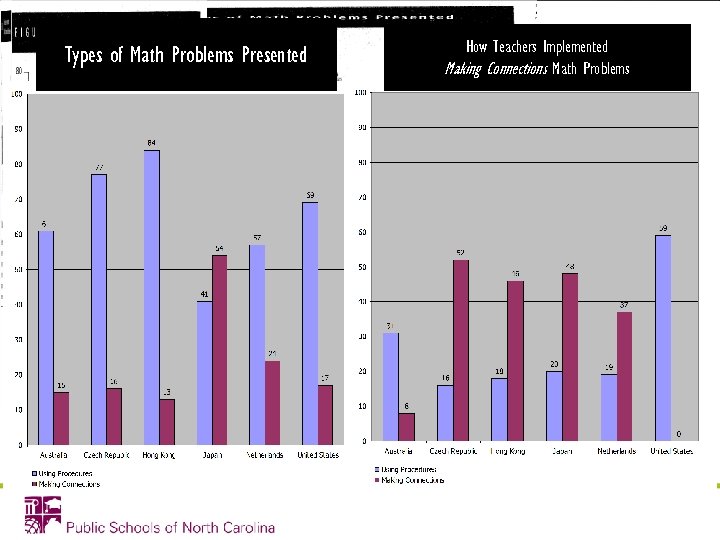 Types of Math Problems Presented How Teachers Implemented Making Connections Math Problems
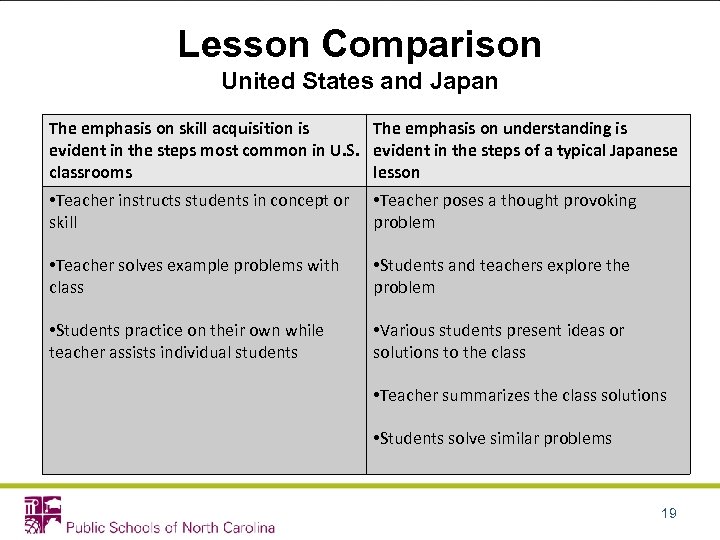 Lesson Comparison United States and Japan The emphasis on skill acquisition is The emphasis on understanding is evident in the steps most common in U. S. evident in the steps of a typical Japanese classrooms lesson • Teacher instructs students in concept or skill • Teacher poses a thought provoking problem • Teacher solves example problems with class • Students and teachers explore the problem • Students practice on their own while teacher assists individual students • Various students present ideas or solutions to the class • Teacher summarizes the class solutions • Students solve similar problems 19
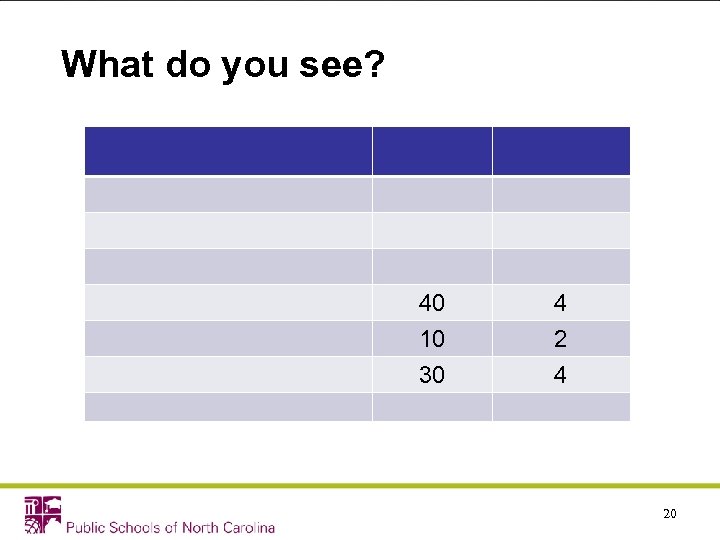 What do you see? 40 4 10 2 30 4 20
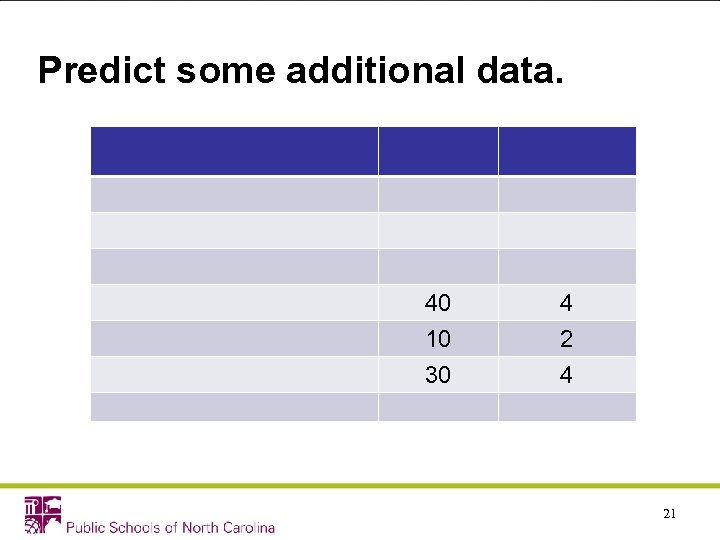 Predict some additional data. 40 4 10 2 30 4 21
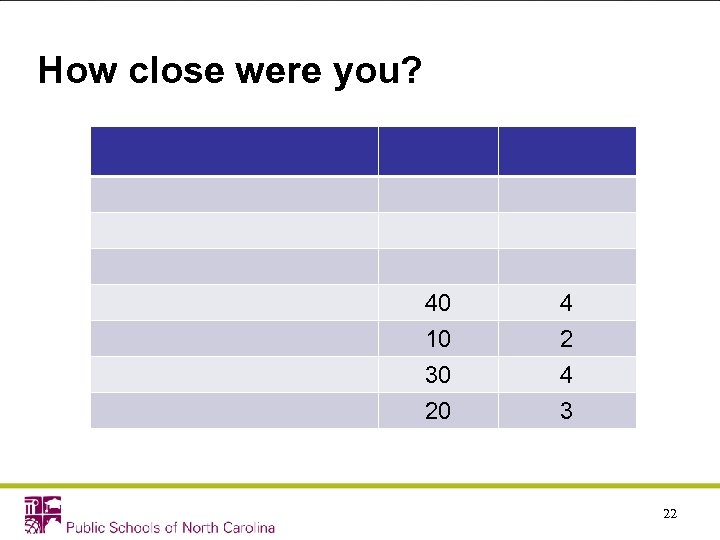 How close were you? 40 4 10 2 30 4 20 3 22
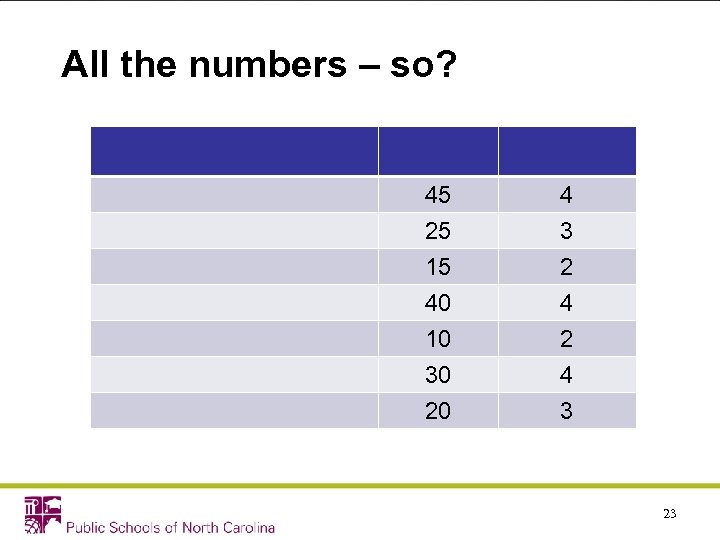 All the numbers – so? 45 25 15 40 10 30 20 4 3 23
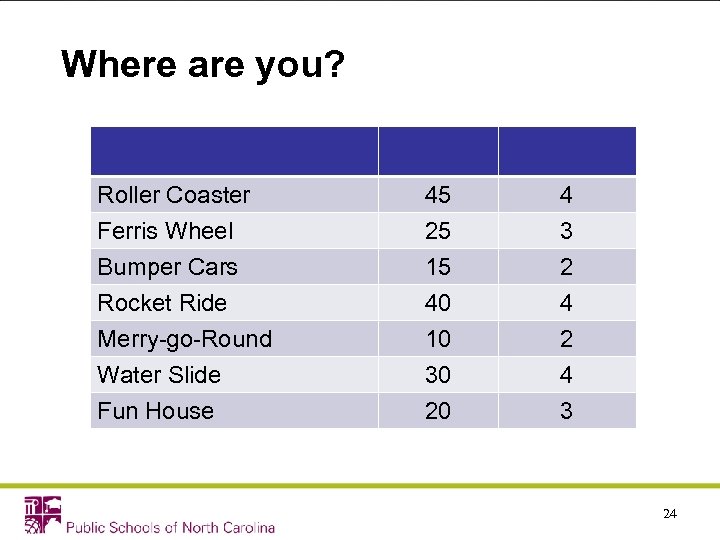 Where are you? Roller Coaster Ferris Wheel Bumper Cars Rocket Ride Merry-go-Round Water Slide Fun House 45 25 15 40 10 30 20 4 3 24
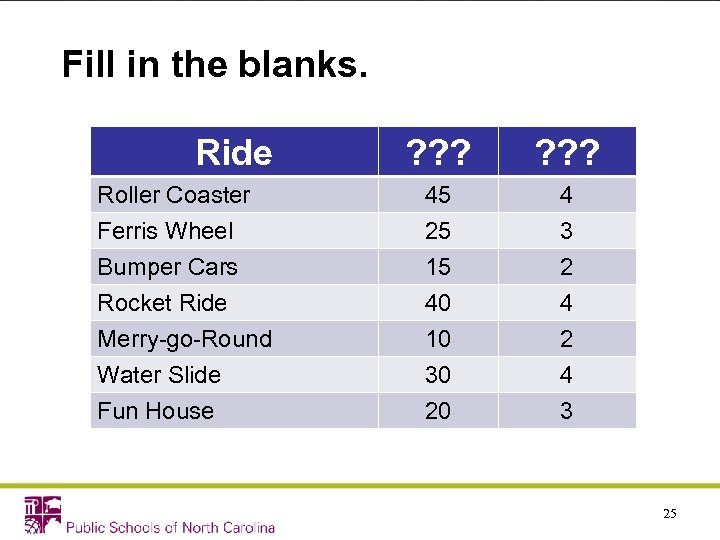 Fill in the blanks. Ride Roller Coaster Ferris Wheel Bumper Cars Rocket Ride Merry-go-Round Water Slide Fun House ? ? ? 45 25 15 40 10 30 20 4 3 25
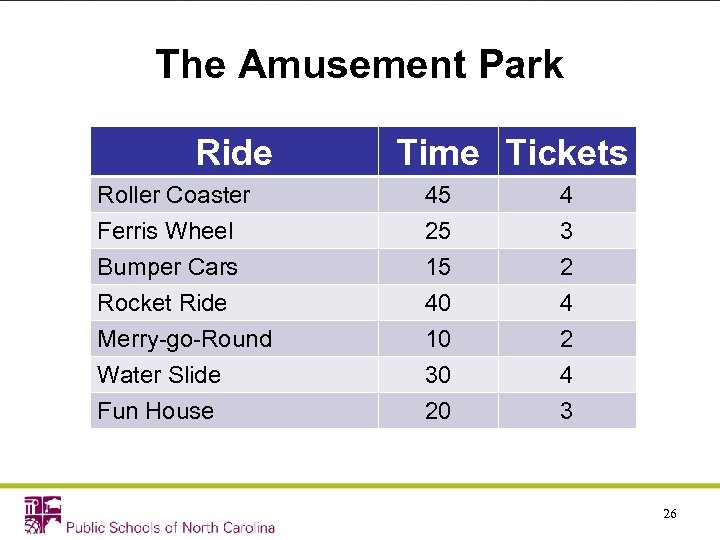 The Amusement Park Ride Roller Coaster Ferris Wheel Bumper Cars Rocket Ride Merry-go-Round Water Slide Fun House Time Tickets 45 25 15 40 10 30 20 4 3 26
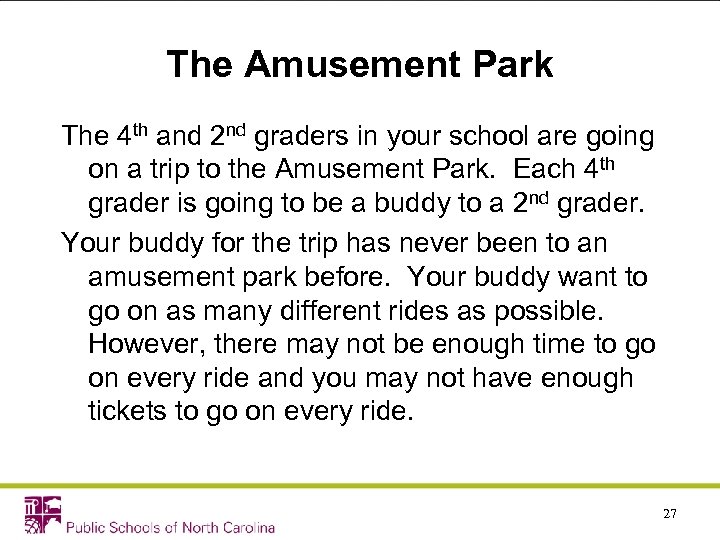 The Amusement Park The 4 th and 2 nd graders in your school are going on a trip to the Amusement Park. Each 4 th grader is going to be a buddy to a 2 nd grader. Your buddy for the trip has never been to an amusement park before. Your buddy want to go on as many different rides as possible. However, there may not be enough time to go on every ride and you may not have enough tickets to go on every ride. 27
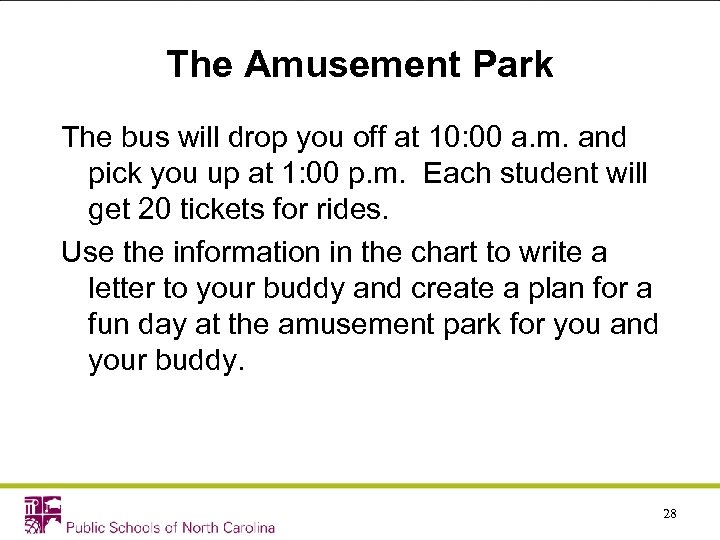 The Amusement Park The bus will drop you off at 10: 00 a. m. and pick you up at 1: 00 p. m. Each student will get 20 tickets for rides. Use the information in the chart to write a letter to your buddy and create a plan for a fun day at the amusement park for you and your buddy. 28
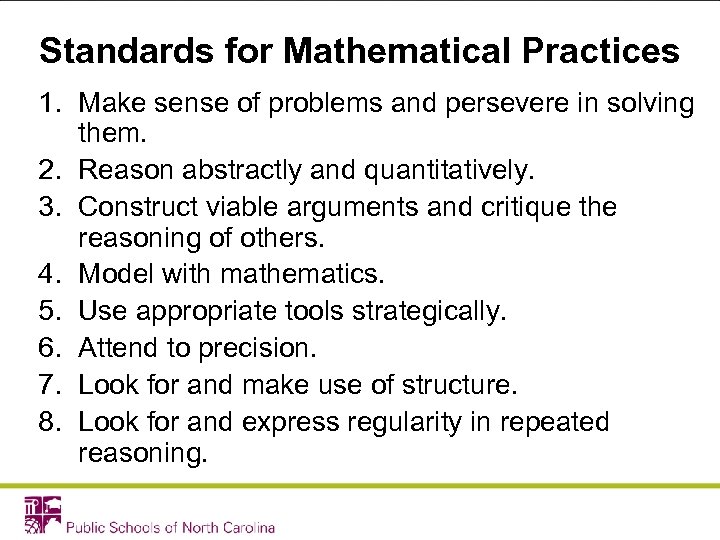 Standards for Mathematical Practices 1. Make sense of problems and persevere in solving them. 2. Reason abstractly and quantitatively. 3. Construct viable arguments and critique the reasoning of others. 4. Model with mathematics. 5. Use appropriate tools strategically. 6. Attend to precision. 7. Look for and make use of structure. 8. Look for and express regularity in repeated reasoning.
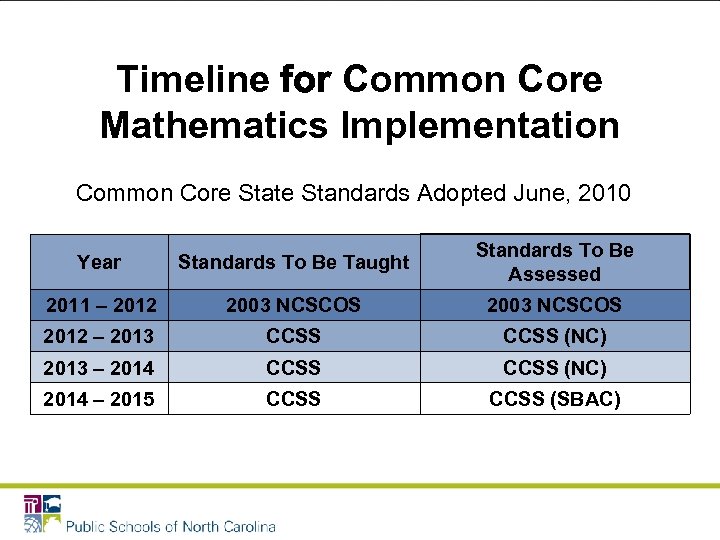 Timeline for Common Core Mathematics Implementation Common Core State Standards Adopted June, 2010 Year Standards To Be Taught Standards To Be Assessed 2011 – 2012 2003 NCSCOS 2012 – 2013 CCSS (NC) 2013 – 2014 CCSS (NC) 2014 – 2015 CCSS (SBAC)
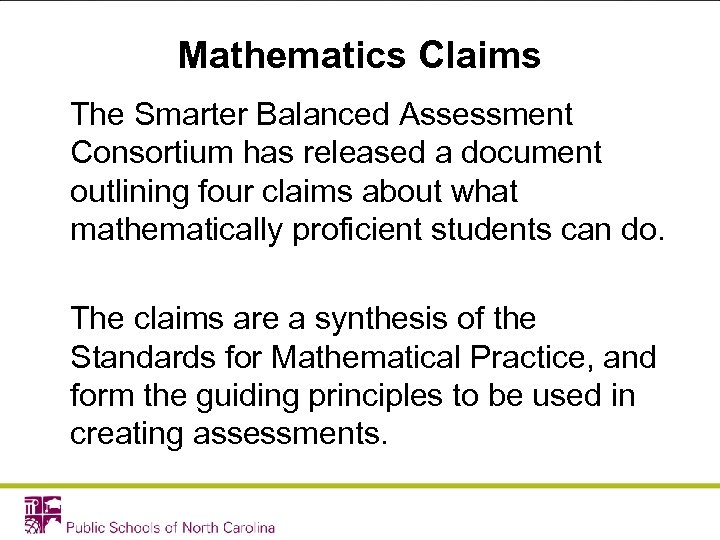 Mathematics Claims The Smarter Balanced Assessment Consortium has released a document outlining four claims about what mathematically proficient students can do. The claims are a synthesis of the Standards for Mathematical Practice, and form the guiding principles to be used in creating assessments.
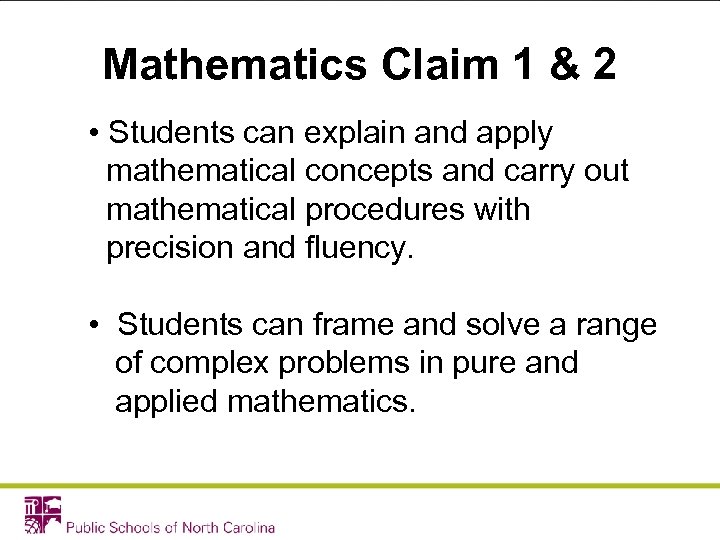 Mathematics Claim 1 & 2 • Students can explain and apply mathematical concepts and carry out mathematical procedures with precision and fluency. • Students can frame and solve a range of complex problems in pure and applied mathematics.
 Mathematics Claim 3 & 4 • Students can clearly and precisely construct viable arguments to support their own reasoning and to critique the reasoning of others. • Students can analyze complex, real-world scenarios and can use mathematical models to interpret and solve problems.
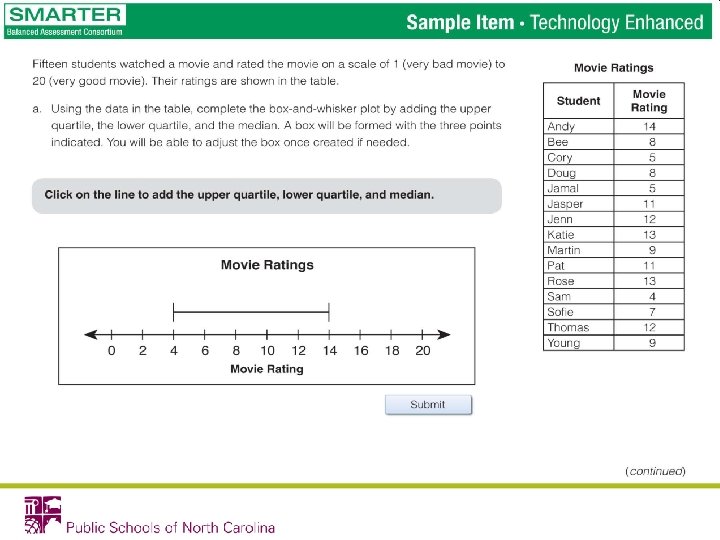
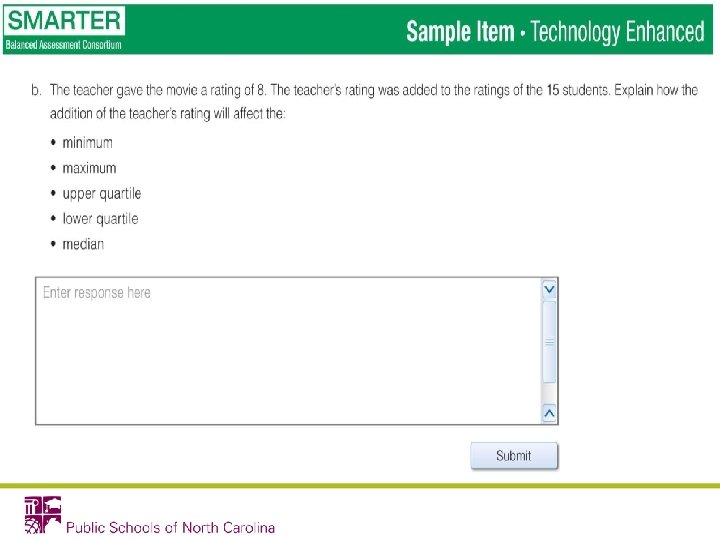
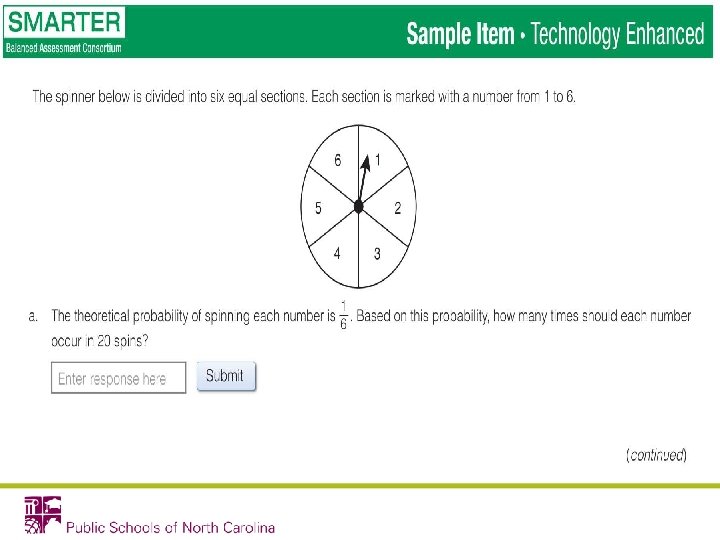
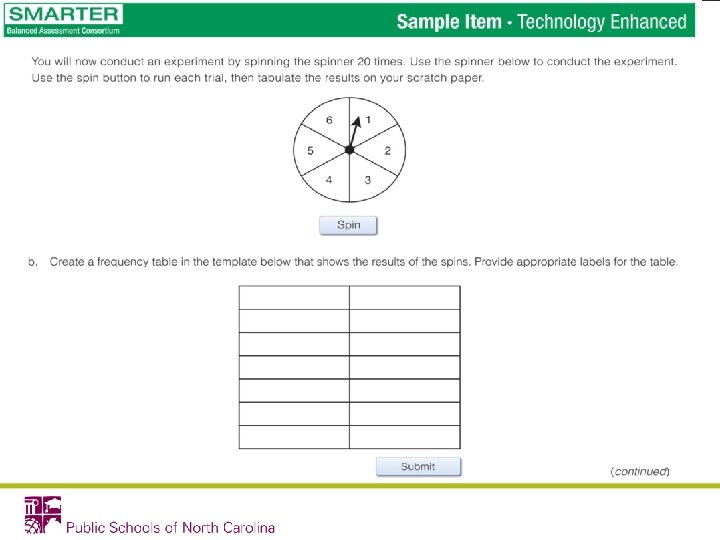
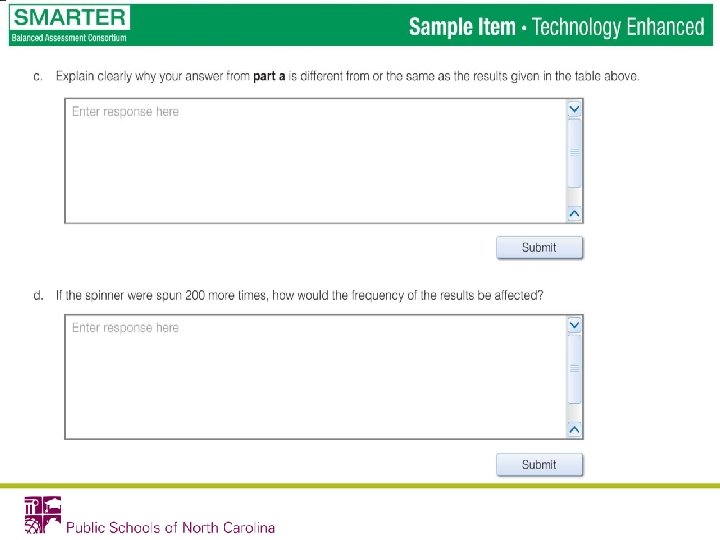
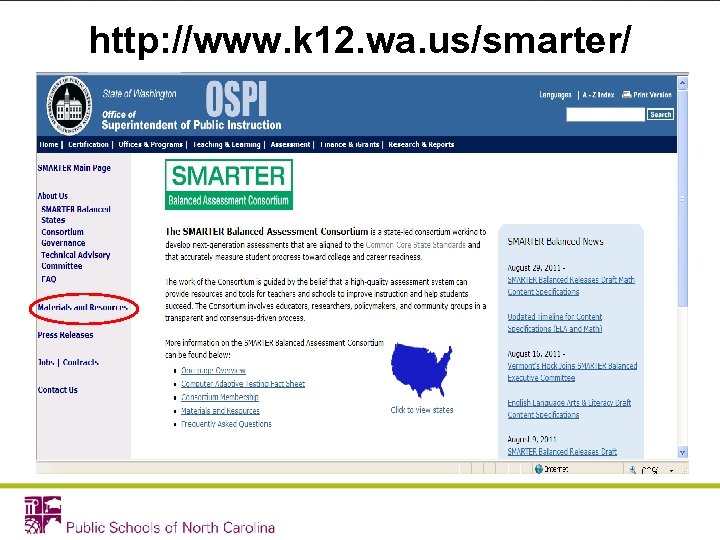 http: //www. k 12. wa. us/smarter/
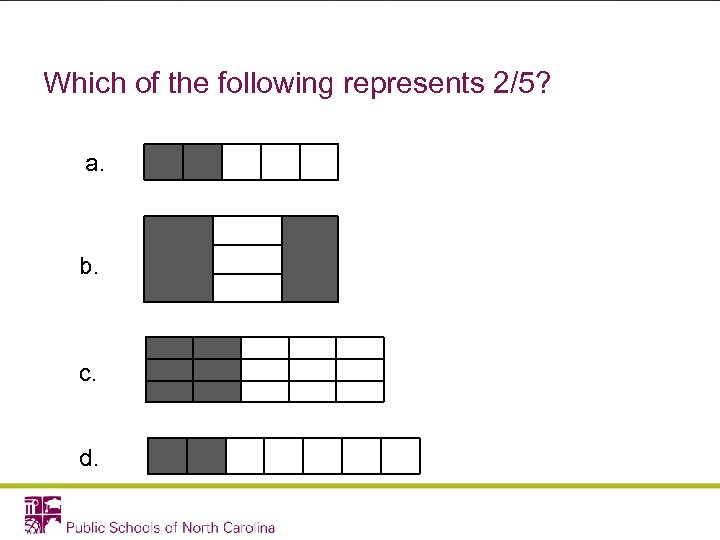 Which of the following represents 2/5? a. b. c. d.
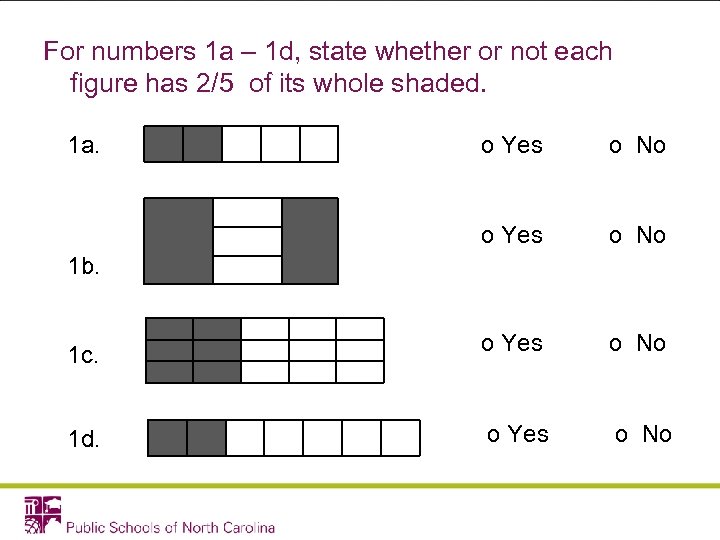 For numbers 1 a – 1 d, state whether or not each figure has 2/5 of its whole shaded. 1 a. ο Yes ο No 1 b. 1 c. ο Yes ο No 1 d. ο Yes ο No
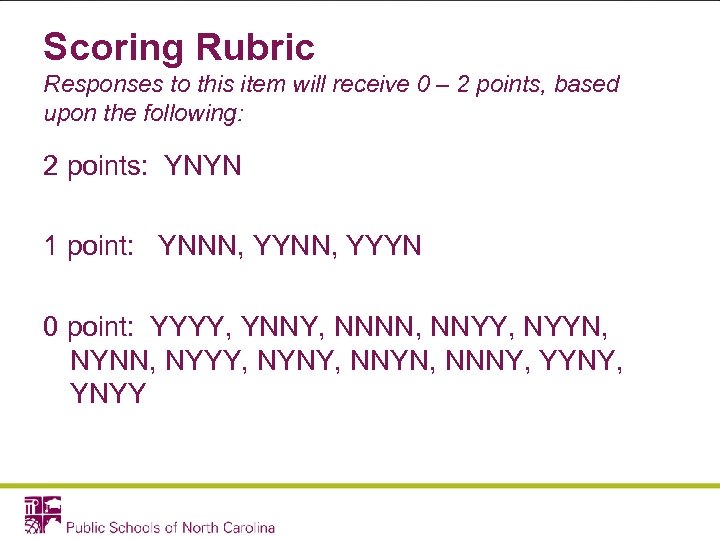 Scoring Rubric Responses to this item will receive 0 – 2 points, based upon the following: 2 points: YNYN 1 point: YNNN, YYYN 0 point: YYYY, YNNY, NNNN, NNYY, NYYN, NYNN, NYYY, NYNY, NNYN, NNNY, YYNY, YNYY
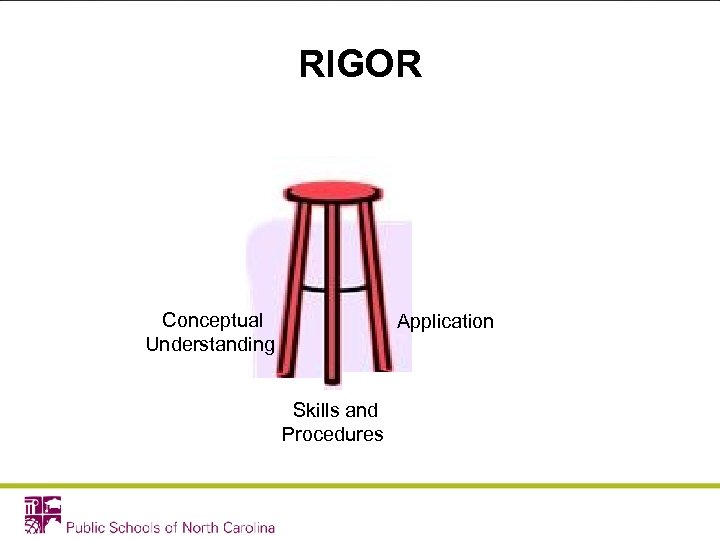 RIGOR Conceptual Understanding Application Skills and Procedures
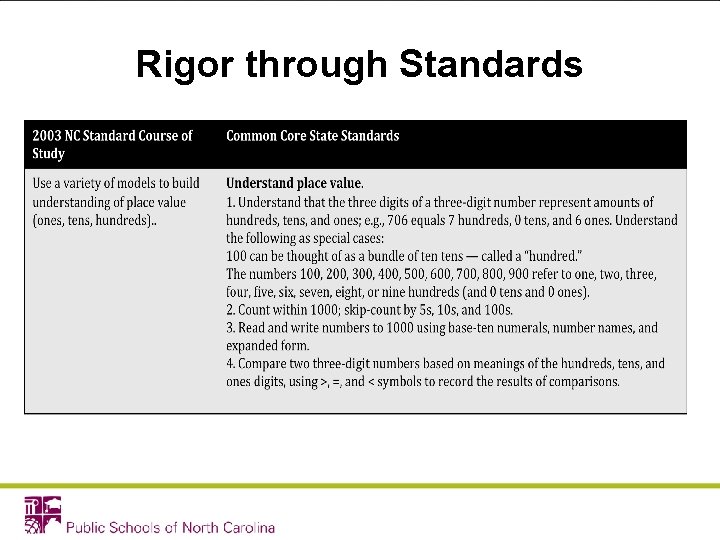 Rigor through Standards
 Rigor though Standards 6 th Grade Critical Area: Students use the meaning of fractions, the meanings of multiplication and division, and the relationship between multiplication and division to understand explain why the procedures for dividing fractions make sense. Students use these operations to solve problems.
 Content Acceleration • Skipping material will create gaps in learning which jeopardizes foundational content needed to maximize the likelihood of success in High School Mathematics • Compacting 3 years of content into 2 is supported by research; 2 years into 1 is considered too challenging • Considering high school courses is essential when making middle school recommendations
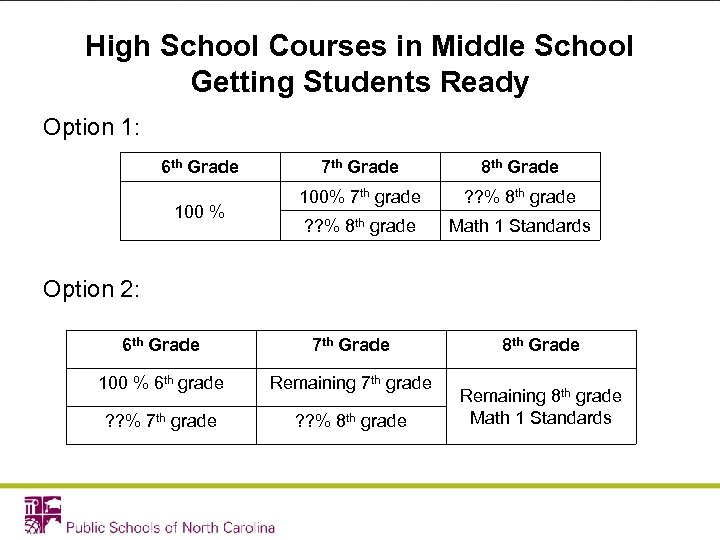 High School Courses in Middle School Getting Students Ready Option 1: 6 th Grade 100 % 7 th Grade 8 th Grade 100% 7 th grade ? ? % 8 th grade Math 1 Standards Option 2: 6 th Grade 7 th Grade 100 % 6 th grade Remaining 7 th grade ? ? % 8 th grade 8 th Grade Remaining 8 th grade Math 1 Standards
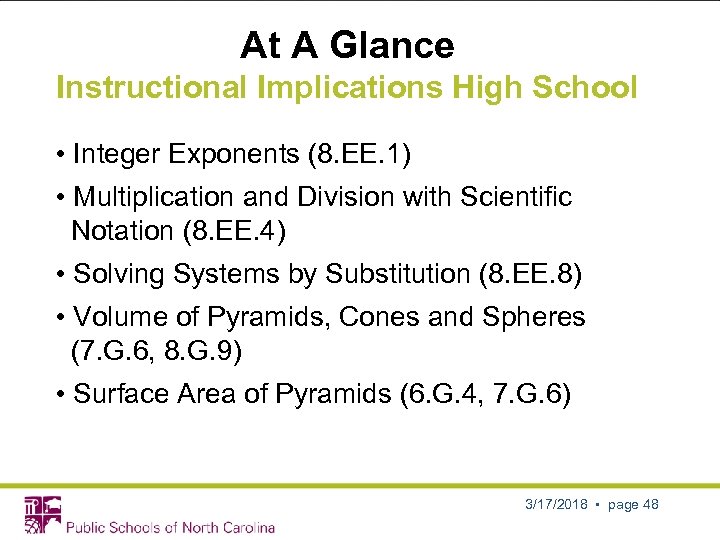 At A Glance Instructional Implications High School • Integer Exponents (8. EE. 1) • Multiplication and Division with Scientific Notation (8. EE. 4) • Solving Systems by Substitution (8. EE. 8) • Volume of Pyramids, Cones and Spheres (7. G. 6, 8. G. 9) • Surface Area of Pyramids (6. G. 4, 7. G. 6) 3/17/2018 • page 48
 At A Glance Instructional Implications Math One • Angles (7. G. 5, 8. G. 5) • Using Pythagorean Theorem in 3 -D Figures (8. G. 7) • Mean Absolute Deviation (6. SP. 5 c) • Two-way Tables (8. SP. 4) • Qualitative Graphs (8. F. 5) • Graphing Proportional Relationships (7. RP. 2 a, b, c, d, 8. EE. 5) 3/17/2018 • page 49
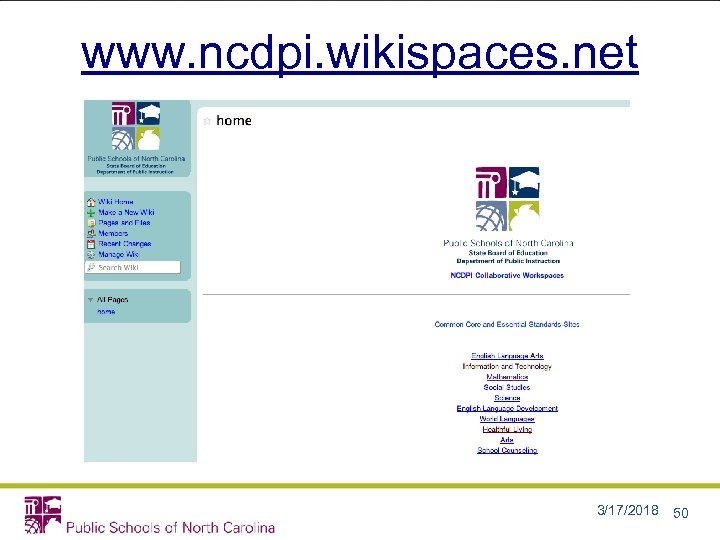 www. ncdpi. wikispaces. net 3/17/2018 50
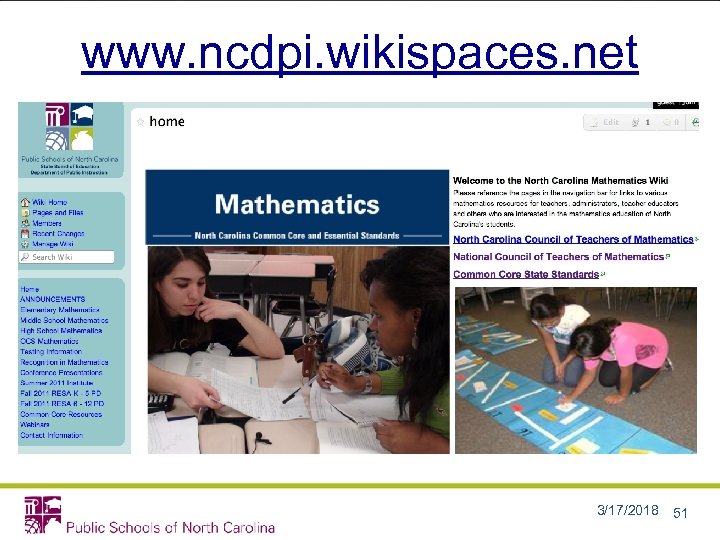 www. ncdpi. wikispaces. net 3/17/2018 51
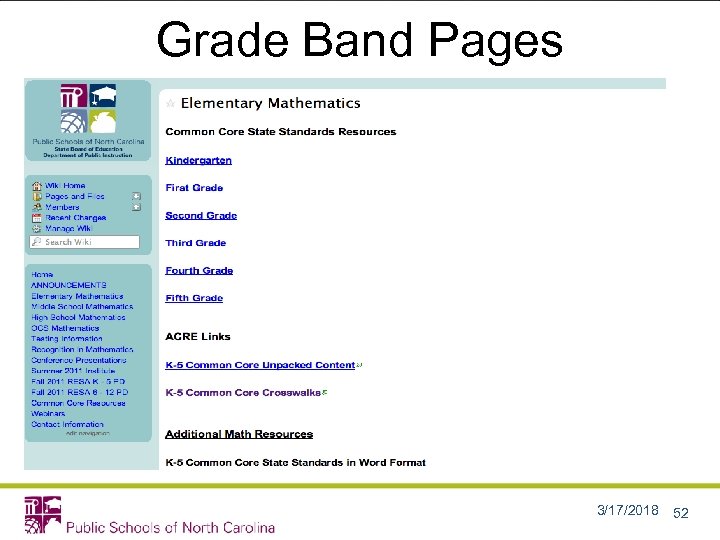 Grade Band Pages 3/17/2018 52
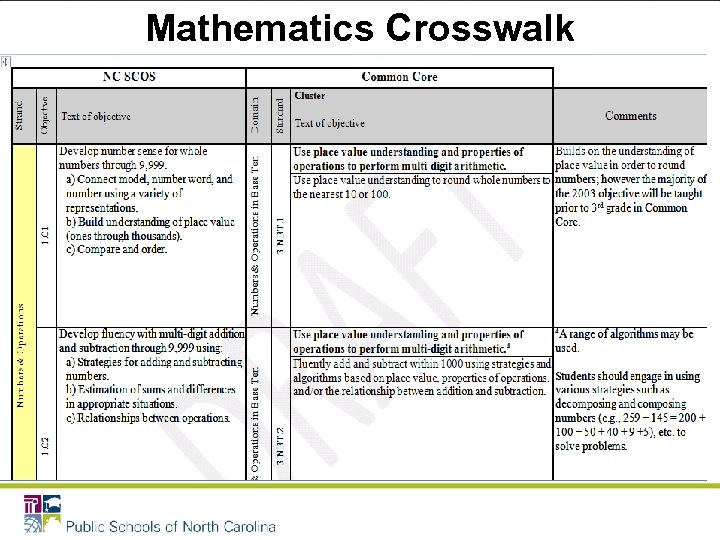
 Crosswalk Documents The crosswalks reflect a comparison between the Common Core State Standards and the North Carolina Standard Course of Study. They inform educators about how the current standards align with the CCSS Standards. 3/17/2018 • page 53
 Mathematics Crosswalk
 CAUTION!! CONTENT APPEARING TO BE THE SAME MAY ACTUALLY BE DIFFERENT!! The CCSS Requires CLOSE Reading!!! 3/17/2018 • page 55
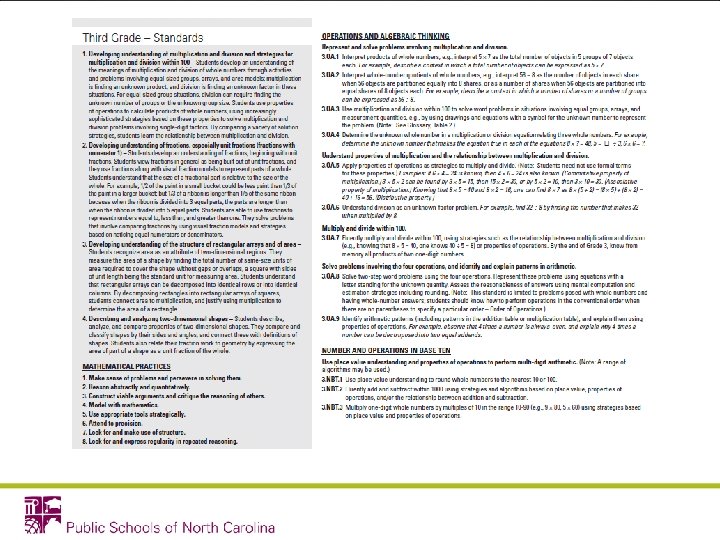
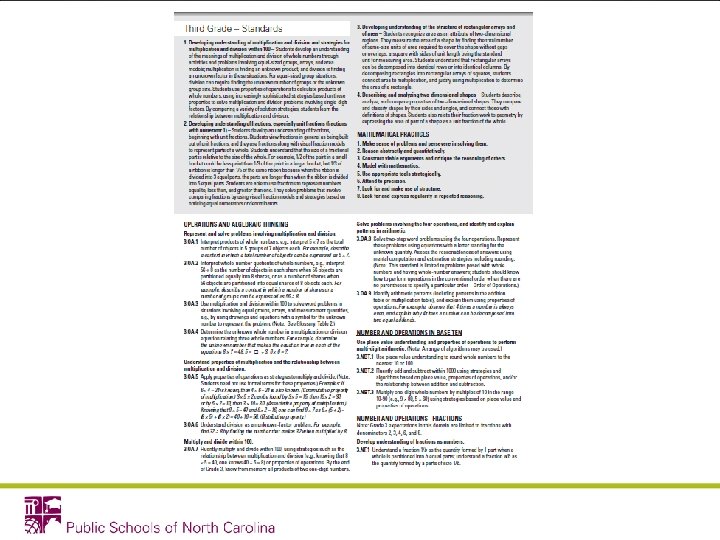
 Unpacking Documents The purpose of the Unpacking Documents is to increase student achievement by ensuring educators understand the new standards. The “unpacking” of the standards done in these documents is an effort to answer a simple question “What does this standard mean that a student must know and be able to do? ” and to ensure the description is helpful, specific and comprehensive for educators. 3/17/2018 • page 56
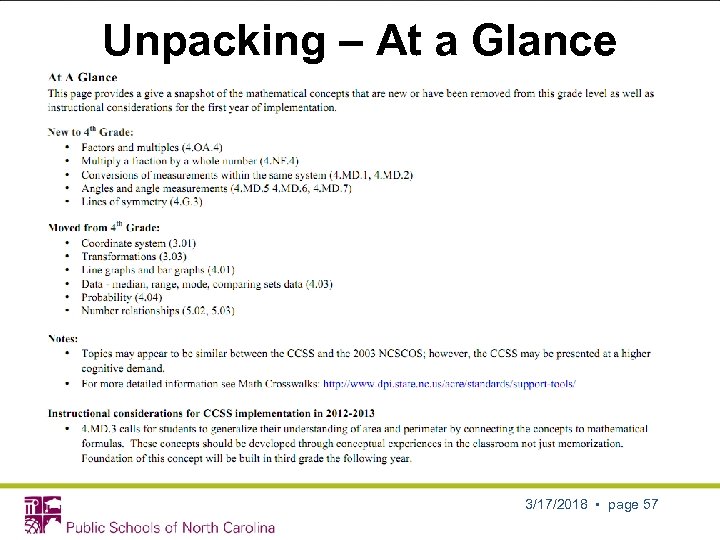 Unpacking – At a Glance 3/17/2018 • page 57
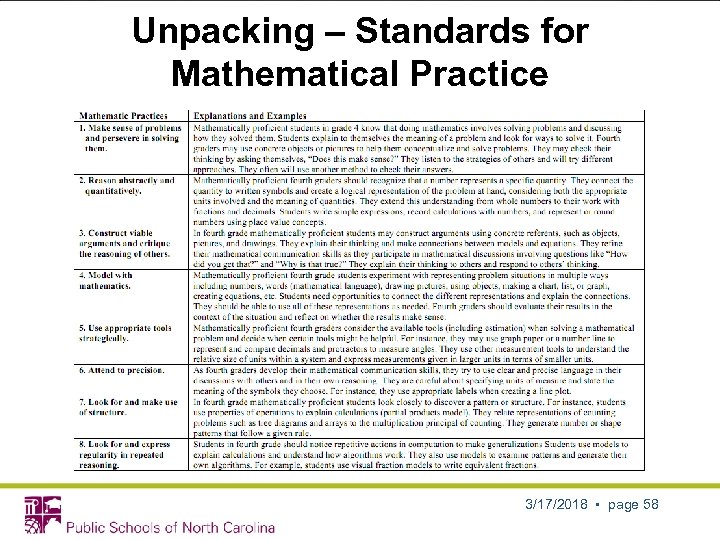 Unpacking – Standards for Mathematical Practice 3/17/2018 • page 58
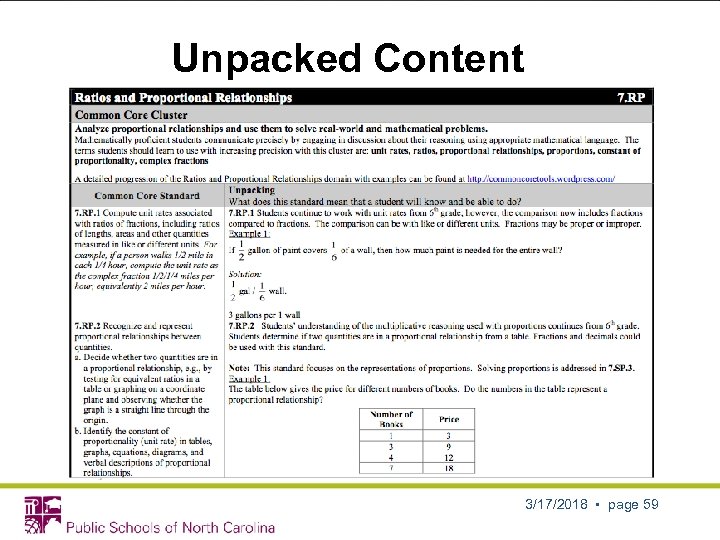 Unpacked Content 3/17/2018 • page 59
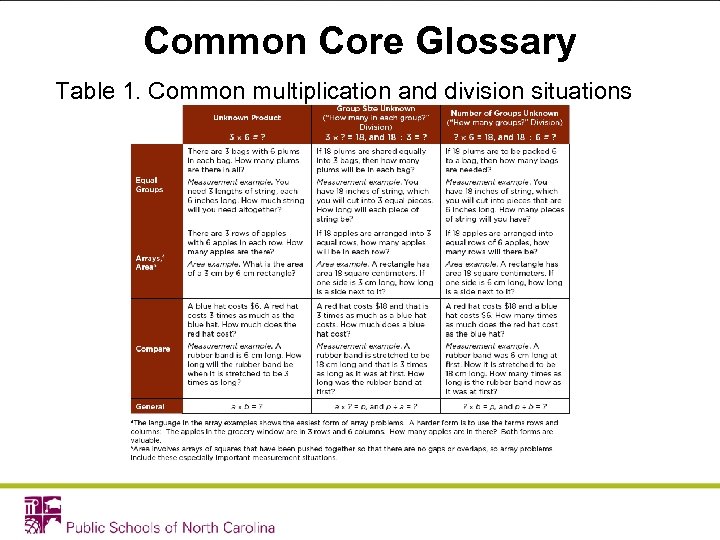 Common Core Glossary Table 1. Common multiplication and division situations
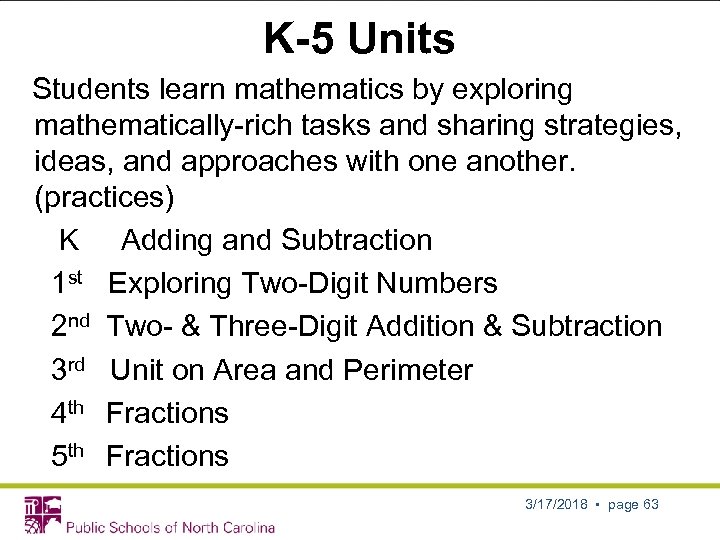 K-5 Units Students learn mathematics by exploring mathematically-rich tasks and sharing strategies, ideas, and approaches with one another. (practices) K Adding and Subtraction 1 st Exploring Two-Digit Numbers 2 nd Two- & Three-Digit Addition & Subtraction 3 rd Unit on Area and Perimeter 4 th Fractions 5 th Fractions 3/17/2018 • page 63
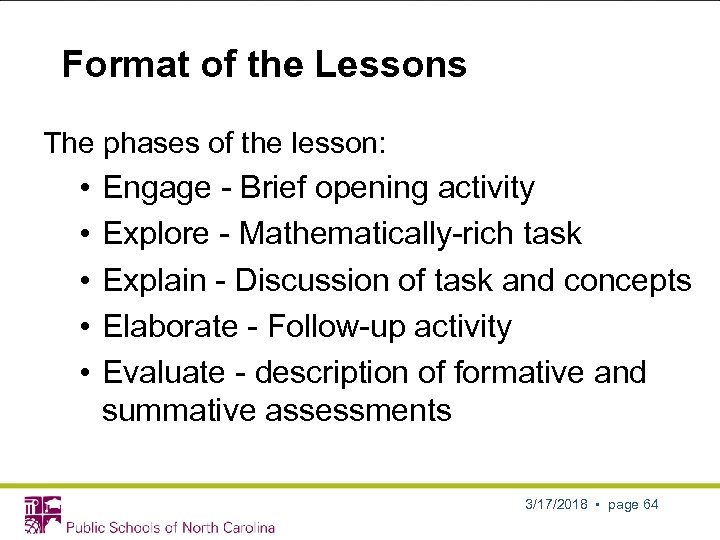 Format of the Lessons The phases of the lesson: • • • Engage - Brief opening activity Explore - Mathematically-rich task Explain - Discussion of task and concepts Elaborate - Follow-up activity Evaluate - description of formative and summative assessments 3/17/2018 • page 64
 Additional Wiki Information
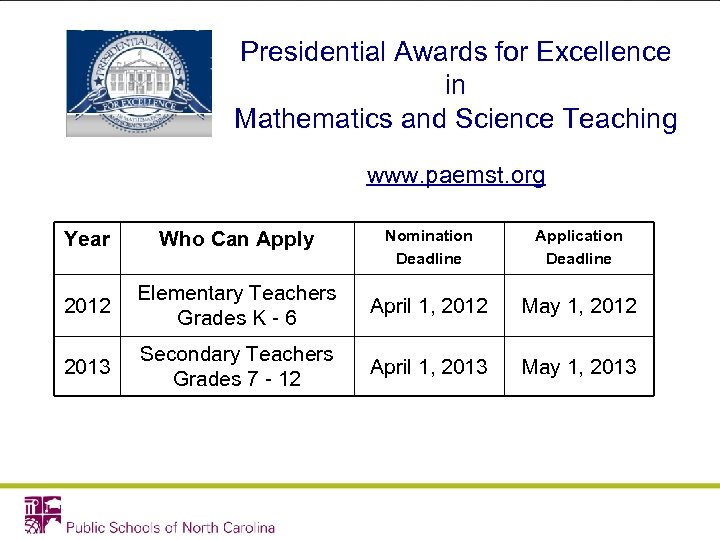 Presidential Awards for Excellence in Mathematics and Science Teaching www. paemst. org Nomination Deadline Application Deadline Elementary Teachers Grades K - 6 April 1, 2012 May 1, 2012 Secondary Teachers Grades 7 - 12 April 1, 2013 May 1, 2013 Year Who Can Apply 2012 2013
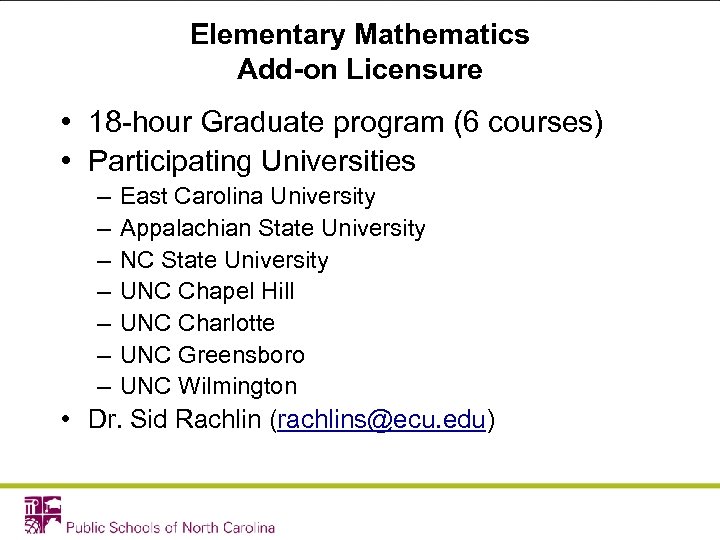 Elementary Mathematics Add-on Licensure • 18 -hour Graduate program (6 courses) • Participating Universities – – – – East Carolina University Appalachian State University NC State University UNC Chapel Hill UNC Charlotte UNC Greensboro UNC Wilmington • Dr. Sid Rachlin (rachlins@ecu. edu)
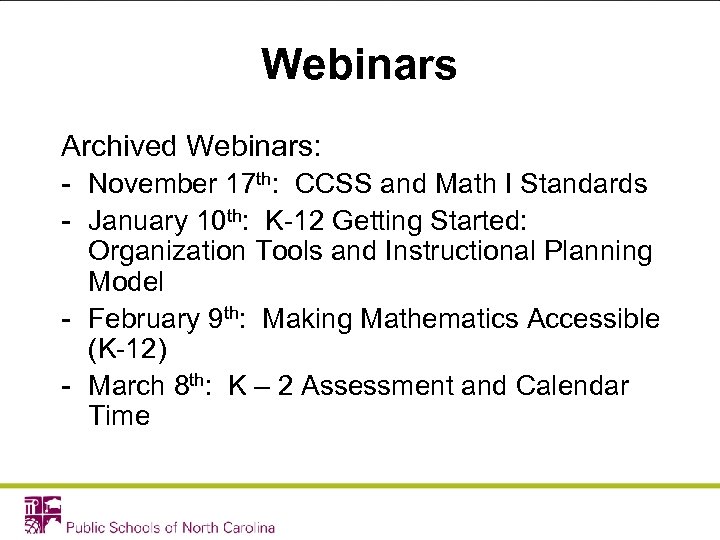 Webinars Archived Webinars: - November 17 th: CCSS and Math I Standards - January 10 th: K-12 Getting Started: Organization Tools and Instructional Planning Model - February 9 th: Making Mathematics Accessible (K-12) - March 8 th: K – 2 Assessment and Calendar Time
 ADDITIONAL RESOURCES: http: //illustrativemathematics. org/ http: //commoncoretools. wordpress. com K, Counting and Cardinality; K– 2, Operations and Algebraic Thinking K, Counting and Cardinality; K– 5, Operations and Algebraic Thinking K– 3, Categorical Data; Grades 2– 5, Measurement Data* (data part of the Measurement and Data Progression) 3 -5, Number and Operations – Fractions 6 -7, Ratio and Proportional Relationships 6 -8, Progression for Statistics and Probability 6– 8, Expressions and Equations
 QUESTIONS COMMENTS
 Contact Information Kitty Rutherford kitty. rutherford@dpi. nc. gov Robin Barbour robin. barbour@dpi. nc. gov Website: www. ncdpi. wikispaces. net