


 Скачать презентацию Mathematical Models in Finances Valentina Desnitskaya Val desnitskaya mail
13 Lec.3t.ppt
- Количество слайдов: 32
 Mathematical Models in Finances Valentina Desnitskaya Val. desnitskaya@mail. ru Lecture 3
 Cash flows o o Cash flow is the series of payments dated for certain points of time. Regular and irregular cash flows. Constant financial rent (annuity) and variable financial rents. Ordinary annuity, annuity due The characteristics of rent: - the values of payments - the intervals between the payments - the term of rent - interest rate
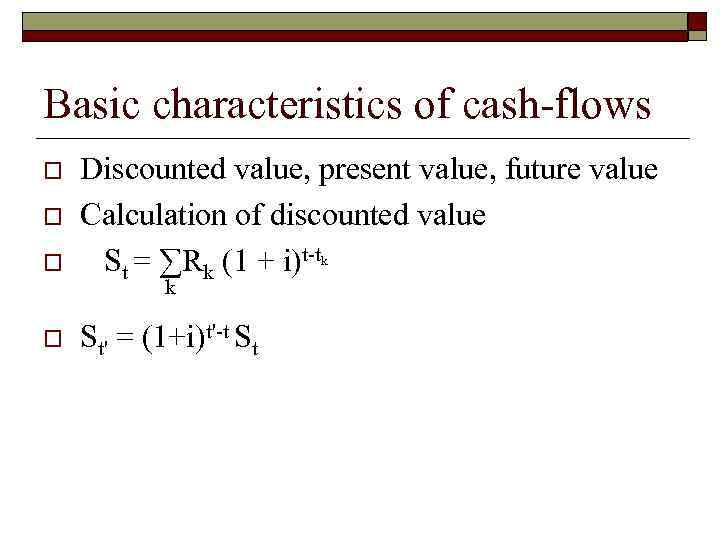 Basic characteristics of cash-flows o Discounted value, present value, future value Calculation of discounted value St = ∑Rk (1 + i)t-tk o St' = (1+i)t'-t St o o k
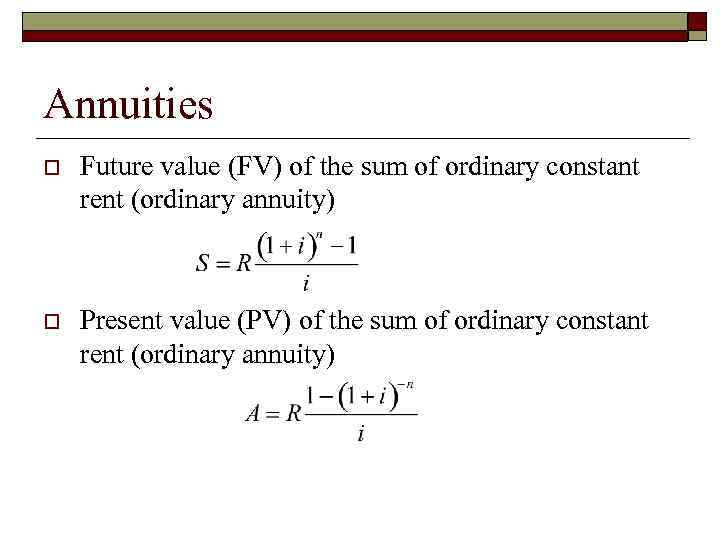 Annuities o Future value (FV) of the sum of ordinary constant rent (ordinary annuity) o Present value (PV) of the sum of ordinary constant rent (ordinary annuity)
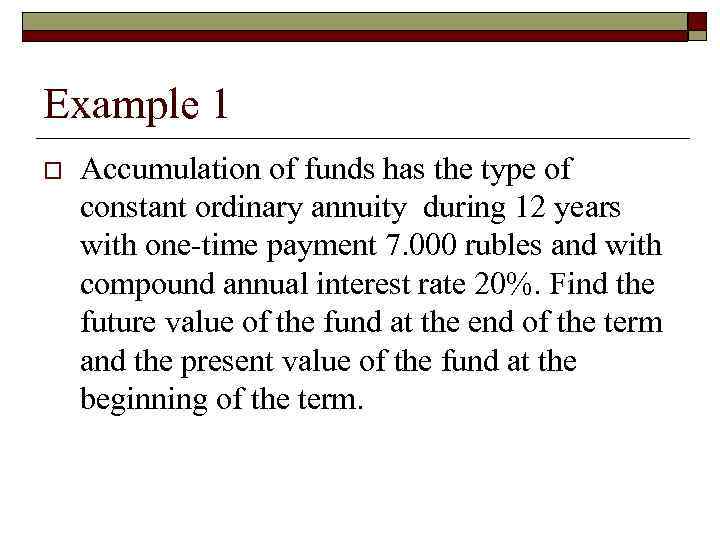 Example 1 o Accumulation of funds has the type of constant ordinary annuity during 12 years with one-time payment 7. 000 rubles and with compound annual interest rate 20%. Find the future value of the fund at the end of the term and the present value of the fund at the beginning of the term.
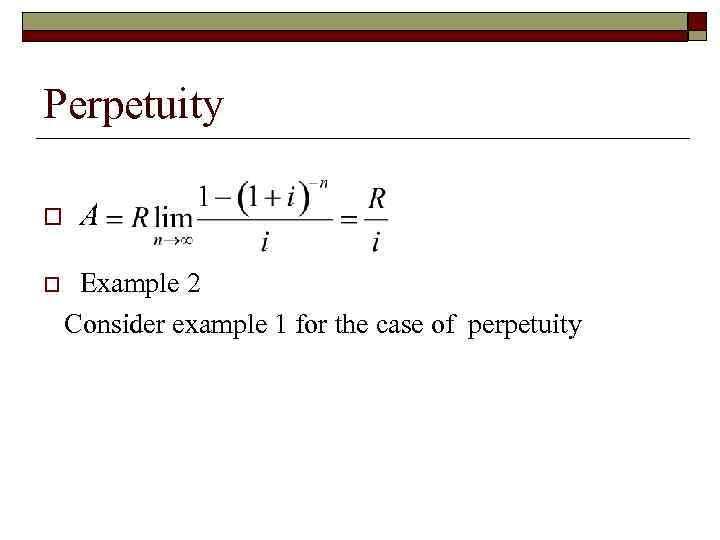 Perpetuity o o A Example 2 Consider example 1 for the case of perpetuity
 Examples 3, 4 o o Example 3. Accumulation of fund has the type of constant ordinary annuity with compound interest rate 20%. Annual payment is 20. 000 rubles. Present value of the fund is 60. 000 rubles. Find the term of rent. Example 4. In the example 3 let present value of the fund be 50. 000 rubles.
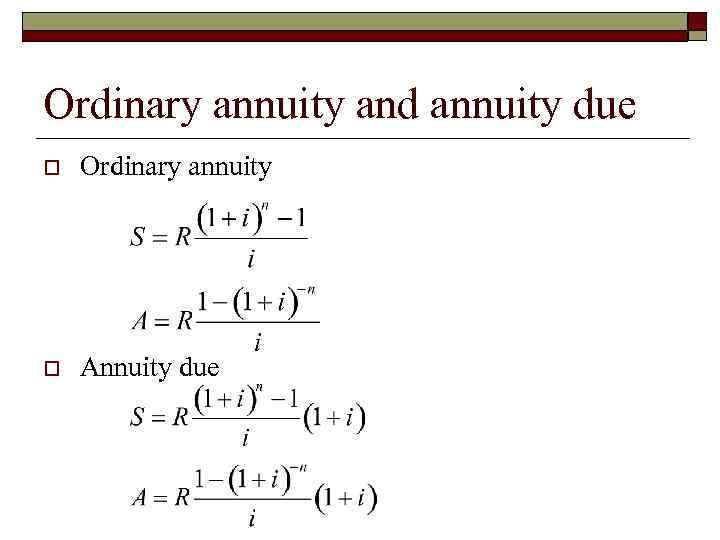 Ordinary annuity and annuity due o Ordinary annuity o Annuity due
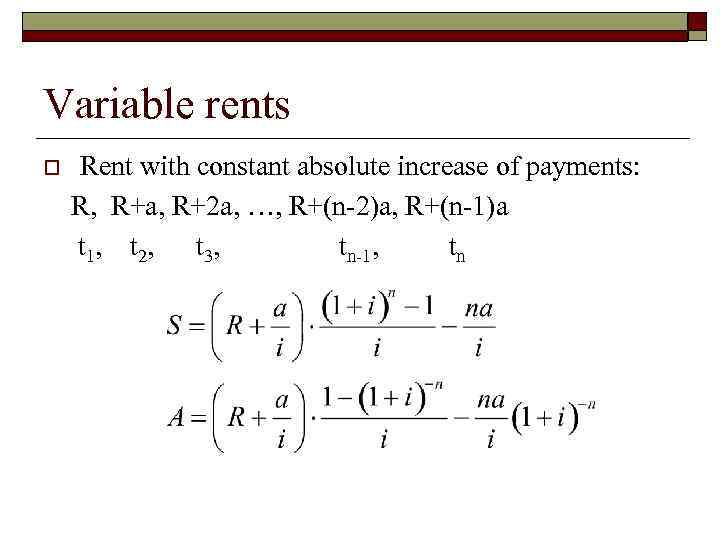 Variable rents o Rent with constant absolute increase of payments: R, R+a, R+2 a, …, R+(n-2)a, R+(n-1)a t 1, t 2, t 3, tn-1, tn
 Example 5 o Accumulation of fund has the type of ordinary variable rent with compound interest rate 20% and with constant absolute increase of payments during 12 years. The first payment is 7000 rubles and each next payment is 1000 rubles greater than the previous one. Find the future value and the present value of the fund
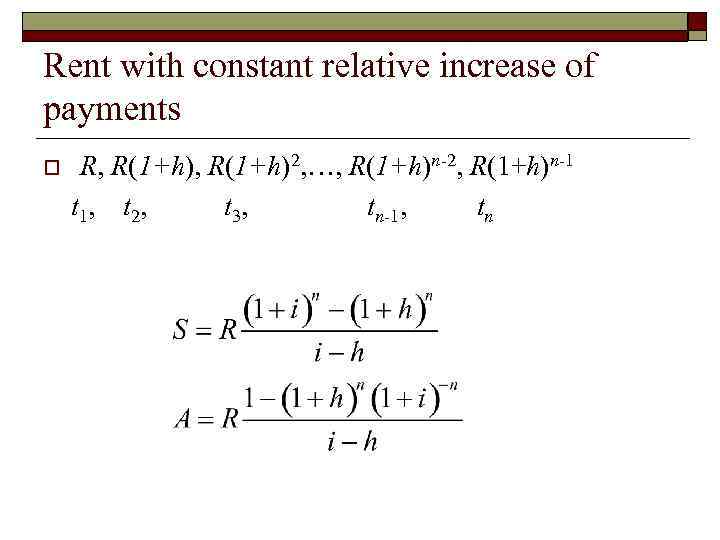 Rent with constant relative increase of payments o R, R(1+h)2, …, R(1+h)n-2, R(1+h)n-1 t 1, t 2, t 3, tn-1, tn
 Example 6 o Accumulation of fund has the type of ordinary variable rent with compound interest rate 20% and with constant relative increase of payments during 12 years. The first payment is 7000 rubles and each next payment is 10% greater than the previous one. Find the future value and the present value of the fund.
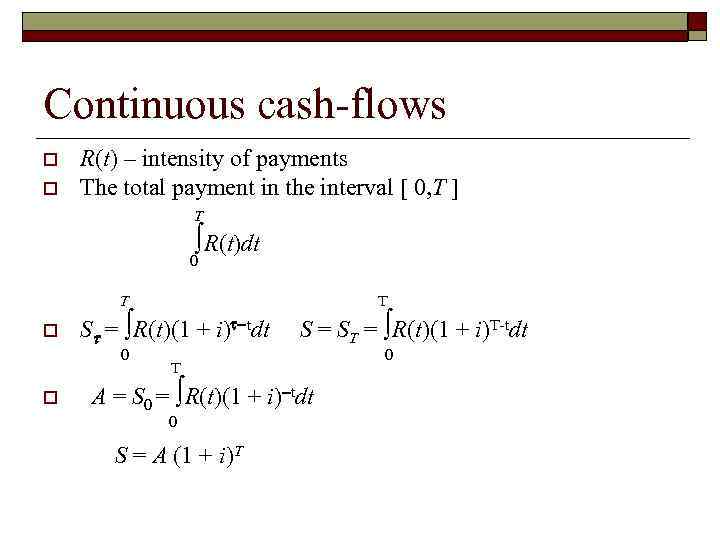 Continuous cash-flows o o R(t) – intensity of payments The total payment in the interval [ 0, T ] T ∫R(t)dt 0 T o St = ∫R(t)(1 + i)t-tdt 0 o T S = ST = ∫R(t)(1 + i)T-tdt A = S 0 = ∫R(t)(1 + i)-tdt 0 S = A (1 + i)T T 0
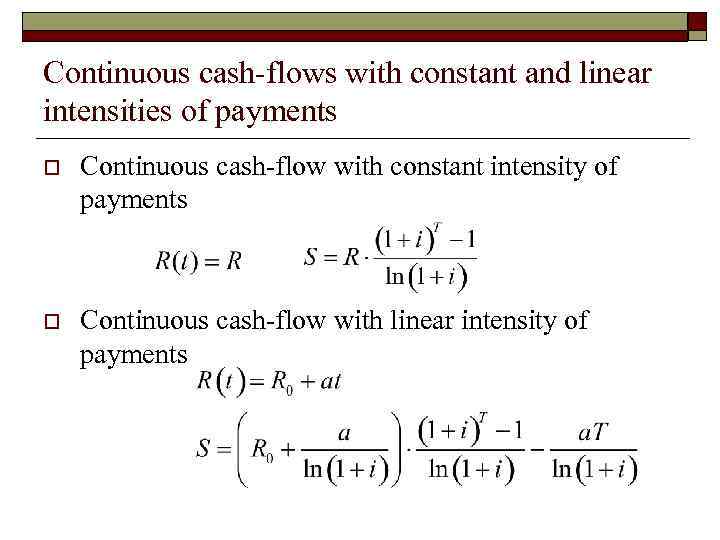 Continuous cash-flows with constant and linear intensities of payments o Continuous cash-flow with constant intensity of payments o Continuous cash-flow with linear intensity of payments
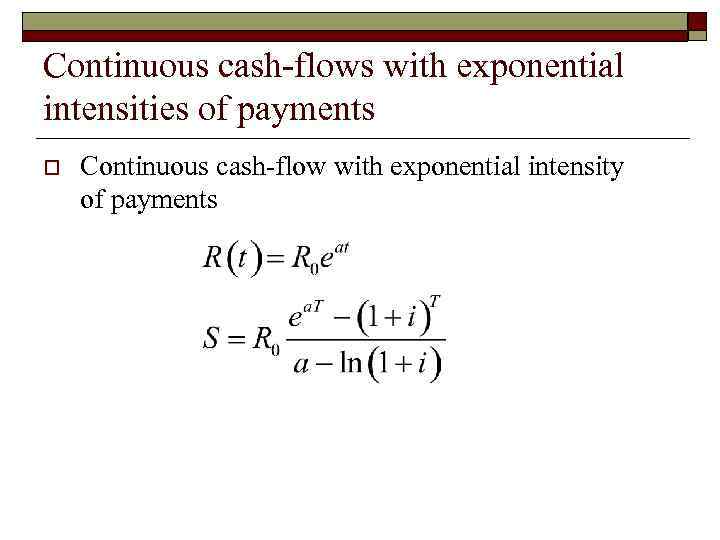 Continuous cash-flows with exponential intensities of payments o Continuous cash-flow with exponential intensity of payments
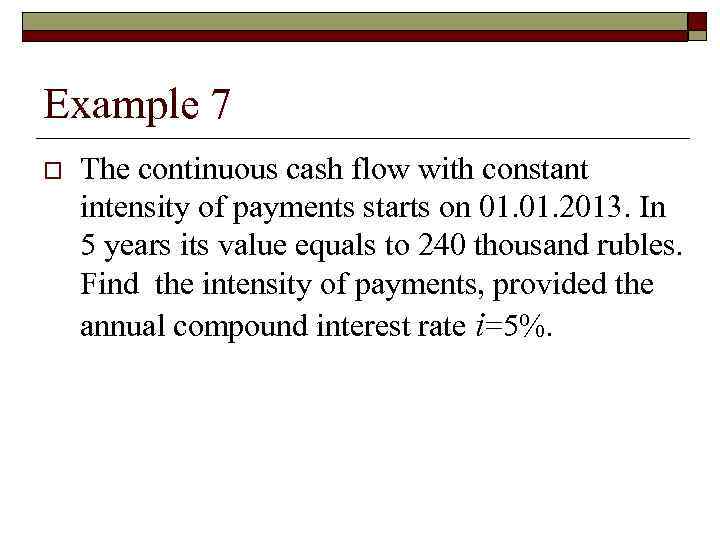 Example 7 o The continuous cash flow with constant intensity of payments starts on 01. 2013. In 5 years its value equals to 240 thousand rubles. Find the intensity of payments, provided the annual compound interest rate i=5%.
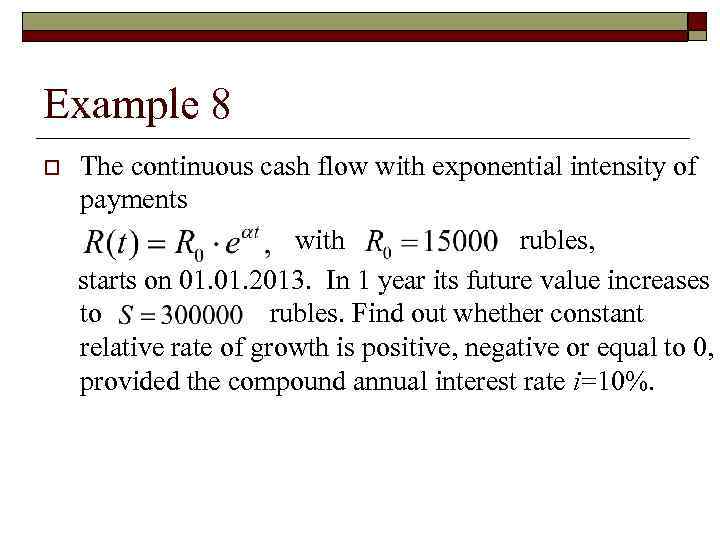 Example 8 o The continuous cash flow with exponential intensity of payments with rubles, starts on 01. 2013. In 1 year its future value increases to rubles. Find out whether constant relative rate of growth is positive, negative or equal to 0, provided the compound annual interest rate i=10%.
 Problems 1. 2. Accumulation of fund has the type of ordinary annuity with annual compound interest rate 15% and consists of 7 equal payments. The future value in the end of the term is 55. 334 rubles. Find the amount of each payment. Accumulation of fund has the type of ordinary variable rent with compound interest rate 15% and with constant absolute increase of payments. The first payment is 6000 rubles and annual increase is 1000 rubles. Find the future value of the fund for the period 12 years.
 Problem 3. Ordinary variable rent is paid annually during 10 years with compound annual interest rate 18%. Each payment is 6% greater then the previous one. The first payment is 8000 rubles. Find the future value of the total sum.
 Problem 4. The continuous cash flow with constant intensity of payments starts on March, 1. In 6 months its value equals to 20 thousand rubles. Find the present value of the cash flow, provided the monthly compound interest rate i=2%.
 Problem 5. The continuous cash flow with exponential intensity of payments starts in the beginning of 2005 and lasts to the end 2010. The annual compound interest rate. In the end of 2010 years its value equals to 190 thousand rubles. Find the value of the cash flow reduced to the beginning of 2008.
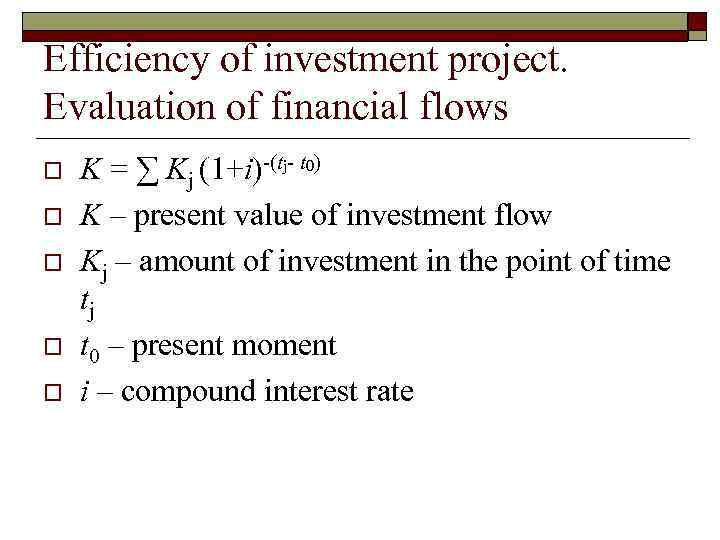 Efficiency of investment project. Evaluation of financial flows o o o K = ∑ Kj (1+i)-(tj- t 0) K – present value of investment flow Kj – amount of investment in the point of time tj t 0 – present moment i – compound interest rate
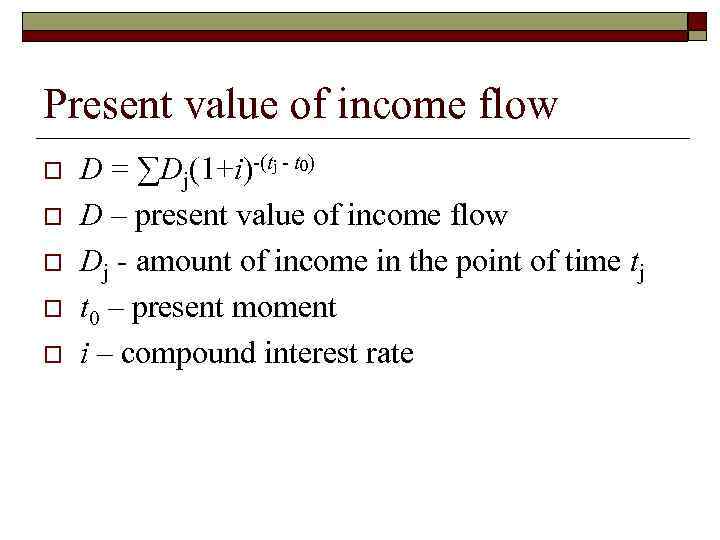 Present value of income flow o o o D = ∑Dj(1+i)-(tj - t 0) D – present value of income flow Dj - amount of income in the point of time tj t 0 – present moment i – compound interest rate
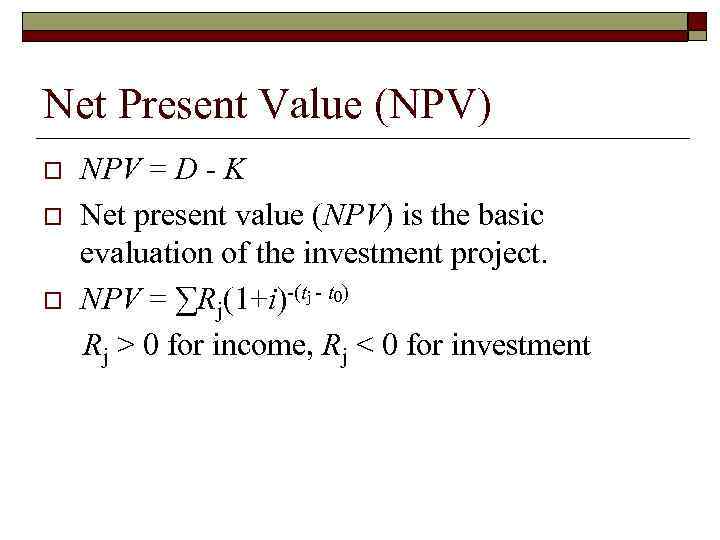 Net Present Value (NPV) o o o NPV = D - K Net present value (NPV) is the basic evaluation of the investment project. NPV = ∑Rj(1+i)-(tj - t 0) Rj > 0 for income, Rj < 0 for investment
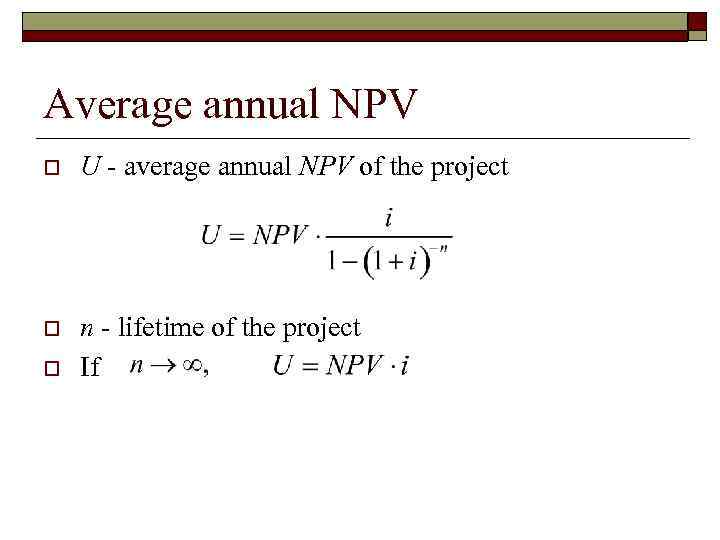 Average annual NPV o U - average annual NPV of the project o n - lifetime of the project If o
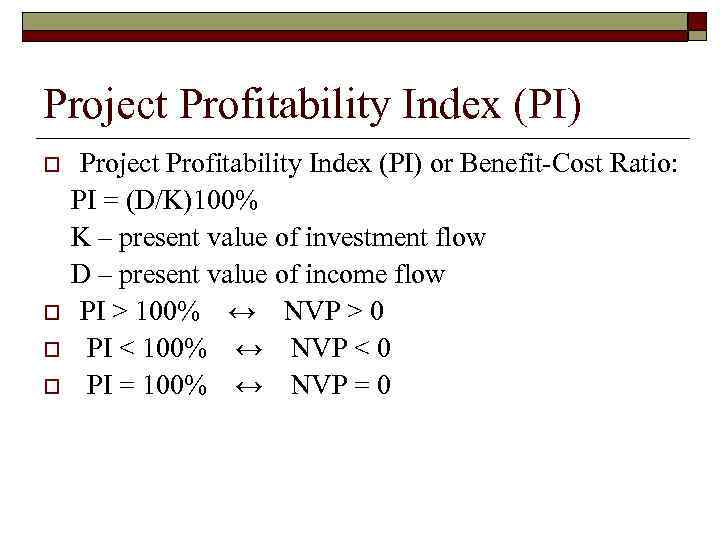 Project Profitability Index (PI) o o Project Profitability Index (PI) or Benefit-Cost Ratio: PI = (D/K)100% K – present value of investment flow D – present value of income flow PI > 100% ↔ NVP > 0 PI < 100% ↔ NVP < 0 PI = 100% ↔ NVP = 0
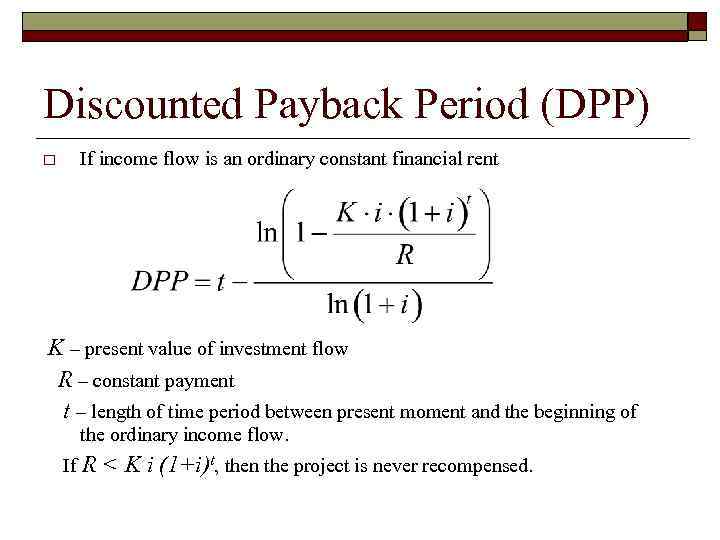 Discounted Payback Period (DPP) o If income flow is an ordinary constant financial rent K – present value of investment flow R – constant payment t – length of time period between present moment and the beginning of the ordinary income flow. If R < K i (1+i)t, then the project is never recompensed.
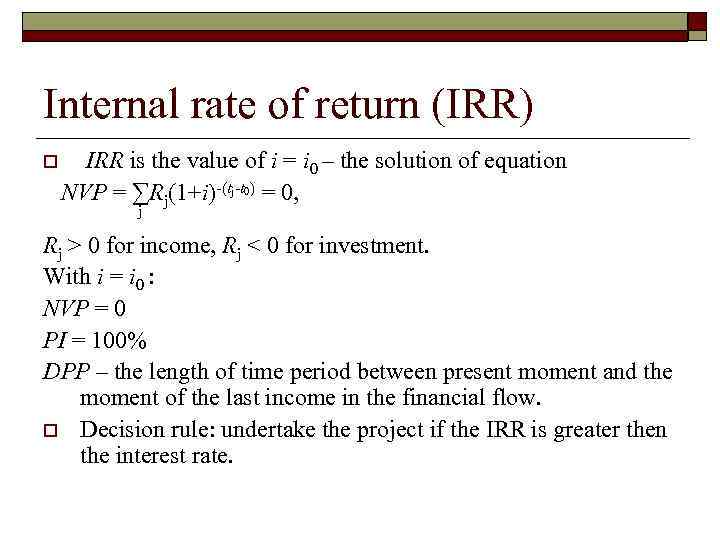 Internal rate of return (IRR) o IRR is the value of i = i 0 – the solution of equation NVP = ∑Rj(1+i)-(tj-t 0) = 0, j Rj > 0 for income, Rj < 0 for investment. With i = i 0 : NVP = 0 PI = 100% DPP – the length of time period between present moment and the moment of the last income in the financial flow. o Decision rule: undertake the project if the IRR is greater then the interest rate.
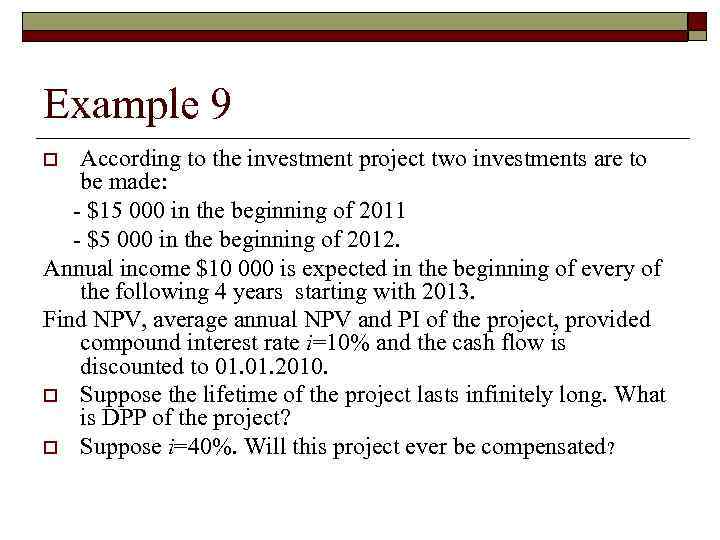 Example 9 According to the investment project two investments are to be made: - $15 000 in the beginning of 2011 - $5 000 in the beginning of 2012. Annual income $10 000 is expected in the beginning of every of the following 4 years starting with 2013. Find NPV, average annual NPV and PI of the project, provided compound interest rate i=10% and the cash flow is discounted to 01. 2010. o Suppose the lifetime of the project lasts infinitely long. What is DPP of the project? o Suppose i=40%. Will this project ever be compensated? o
 Example 10 o According to the investment project 40 000 rubles are supposed to be invested in the beginning of 2014. In the beginning of 2015 the expected income is 20 000 rubles and a year later the expected income is 60 000 rubles. Find the Internal Rate of Return (IRR) of the project.
 Problems 6. According to the investment project two investments are to be made: - 200 000 rubles on 01. 2010 - 500 000 rubles on 01. 2011. Annual income 350 000 rubles is expected in the beginning of every of the following 3 years starting in 2012. Find NPV, average annual NPV and PI of the project, provided compound interest rate i=30% and the cash flow is discounted to 01. 2010. Suppose the lifetime of the project lasts infinitely long. What is DPP of the project? With what minimum interest rate the project will never be compensated?
 Problems 7. According to the investment project three investments are to be made: - 50 000 rubles on February, 1 - 100 000 rubles on March, 1 - 60 000 rubles on April, 1. Monthly income in equal sums is expected during 6 months starting on May, 1. To October, 1 the project is compensated (NPV=0). Find monthly income provided compound interest rate i=10% and the cash flow is discounted to January. 1.