 Скачать презентацию Mathem Std VI atics A shopkeeper buys
1eeefe2e004f39c3857fd40c2714b7f4.ppt
- Количество слайдов: 25




Mathem Std: VI atics
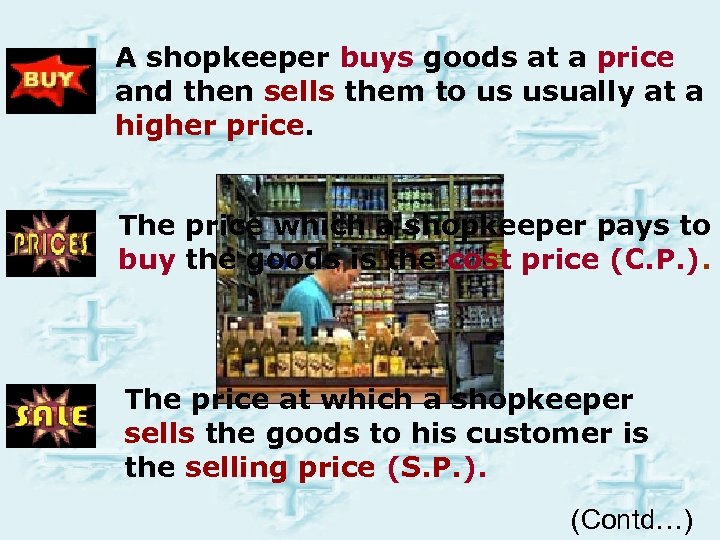
A shopkeeper buys goods at a price and then sells them to us usually at a higher price. The price which a shopkeeper pays to buy the goods is the cost price (C. P. ). The price at which a shopkeeper sells the goods to his customer is the selling price (S. P. ). (Contd…)
If the shopkeeper sells the goods at a price higher than the cost price he makes a gain or profit. If the shopkeeper sells the goods at a price lower than the cost price he suffers a loss.
Often before selling the goods a shopkeeper spends money in § transporting goods § keeping goods in good condition § Storing the goods in godowns The money he spends on the above are called overhead expenses. The shopkeeper adds these overhead expenses to the cost price before he sells the goods at the selling price. Therefore, Total Cost Price = Original Cost Price + Overhead expenses
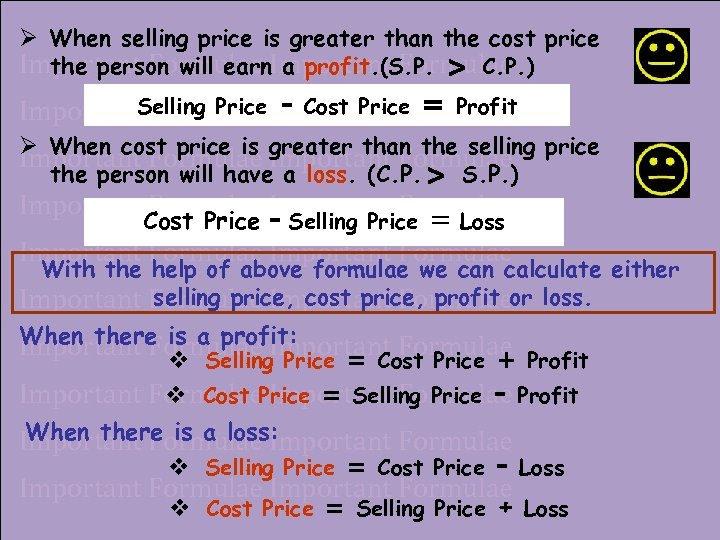
Ø When selling price is greater than the cost price Important Formulae the person will earn a profit. (S. P. > C. P. ) Important. Selling Price Important Formulae - Cost Price = Profit Ø When cost price is greater than the selling price Important Formulae the person will have a loss. (C. P. > S. P. ) Important Formulae Cost Price - Selling Price = Loss Important Formulae With the help of above formulae we can calculate either selling price, cost price, profit Important Formulaeor loss. When there is a profit: Important Formulae Profit v Selling Price = Cost Price + Important Formulae. Price = Selling Price - Profit v Cost Important Formulae When there is a loss: Important Formulae v Selling Price = Cost Price - Loss Important Formulae v Cost Price = Selling Price + Loss
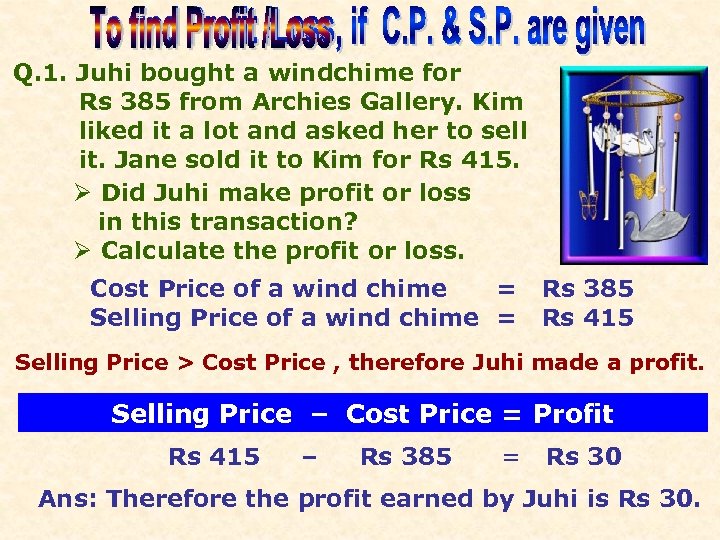
Q. 1. Juhi bought a windchime for Rs 385 from Archies Gallery. Kim liked it a lot and asked her to sell it. Jane sold it to Kim for Rs 415. Ø Did Juhi make profit or loss in this transaction? Ø Calculate the profit or loss. Cost Price of a wind chime = Selling Price of a wind chime = Rs 385 Rs 415 Selling Price > Cost Price , therefore Juhi made a profit. Selling Price – Cost Price = Profit Rs 415 – Rs 385 = Rs 30 Ans: Therefore the profit earned by Juhi is Rs 30.
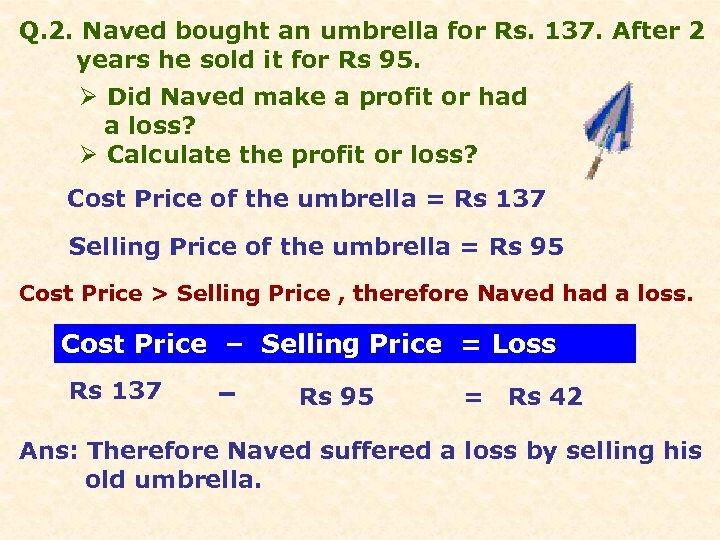
Q. 2. Naved bought an umbrella for Rs. 137. After 2 years he sold it for Rs 95. Ø Did Naved make a profit or had a loss? Ø Calculate the profit or loss? Cost Price of the umbrella = Rs 137 Selling Price of the umbrella = Rs 95 Cost Price > Selling Price , therefore Naved had a loss. Cost Price – Selling Price = Loss Rs 137 – Rs 95 = Rs 42 Ans: Therefore Naved suffered a loss by selling his old umbrella.
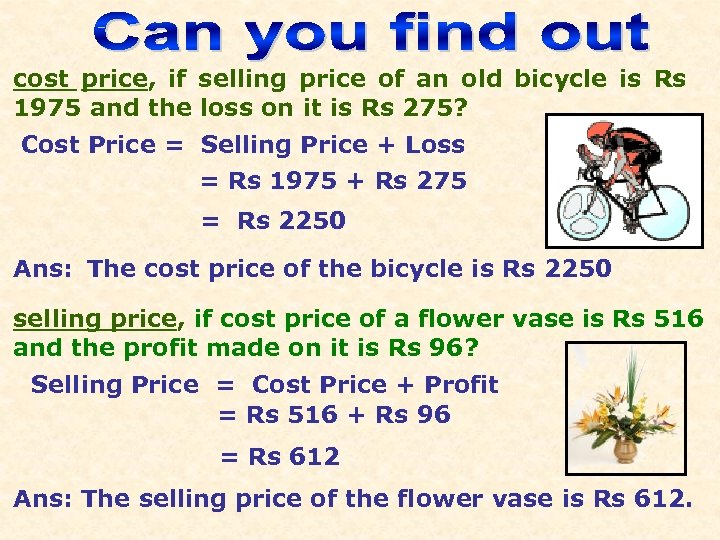
cost price, if selling price of an old bicycle is Rs 1975 and the loss on it is Rs 275? Cost Price = Selling Price + Loss = Rs 1975 + Rs 275 = Rs 2250 Ans: The cost price of the bicycle is Rs 2250 selling price, if cost price of a flower vase is Rs 516 and the profit made on it is Rs 96? Selling Price = Cost Price + Profit = Rs 516 + Rs 96 = Rs 612 Ans: The selling price of the flower vase is Rs 612.
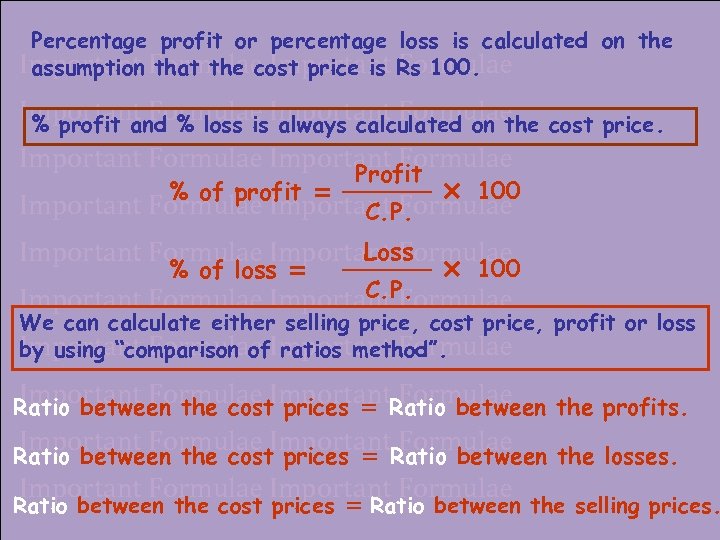
Percentage profit or percentage loss is calculated on the Important Formulae Important Rs 100. assumption that the cost price is Formulae Important Formulae % profit and % loss is always calculated on the cost price. Important Formulae Profit ´ 100 Important Formulae % of profit = C. P. Loss Important Formulae % of loss = ´ 100 C. P. Important Formulae We can calculate either selling price, cost price, profit or loss Important Formulae ratios method”. by using “comparison of. Important Formulae Ratio between the cost prices = Ratio between the profits. Important Formulae Ratio between the cost prices = Ratio between the losses. Important Formulae Ratio between the cost prices = Ratio between the selling prices.
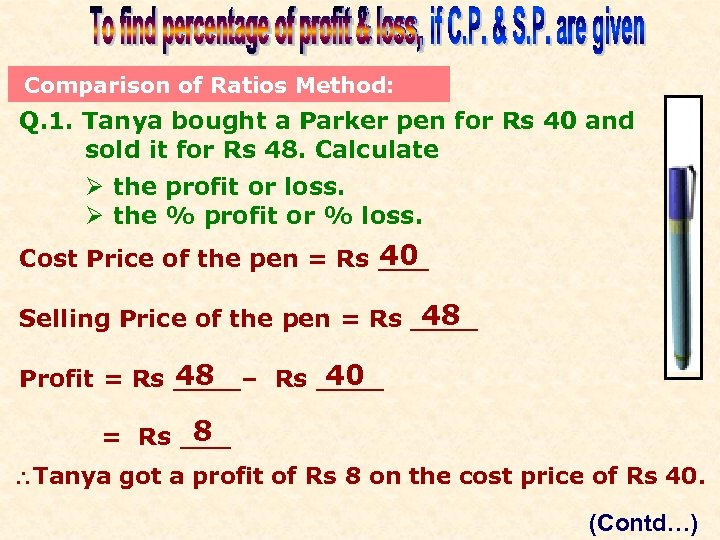
Comparison of Ratios Method: Q. 1. Tanya bought a Parker pen for Rs 40 and sold it for Rs 48. Calculate Ø the profit or loss. Ø the % profit or % loss. 40 Cost Price of the pen = Rs ___ 48 Selling Price of the pen = Rs ____ 48 40 Profit = Rs ____– Rs ____ 8 = Rs ___ Tanya got a profit of Rs 8 on the cost price of Rs 40. (Contd…)
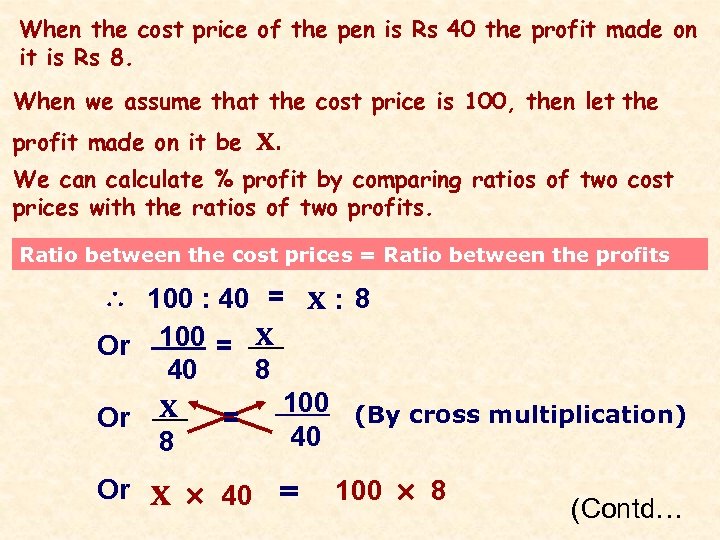
When the cost price of the pen is Rs 40 the profit made on it is Rs 8. When we assume that the cost price is 100, then let the profit made on it be x. We can calculate % profit by comparing ratios of two cost prices with the ratios of two profits. Ratio between the cost prices = Ratio between the profits 100 : 40 = x : 8 Or 100 = x 8 40 100 (By cross multiplication) Or x = 40 8 Or x ´ 40 = 100 ´ 8 (Contd…
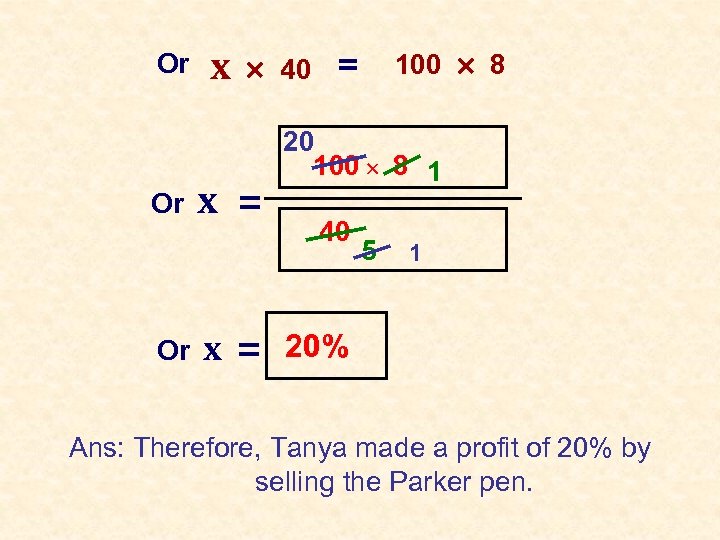
Or Or Or x x 100 ´ 8 ´ 40 = = 20 100 ´ 8 1 40 5 1 x = 20% Ans: Therefore, Tanya made a profit of 20% by selling the Parker pen.
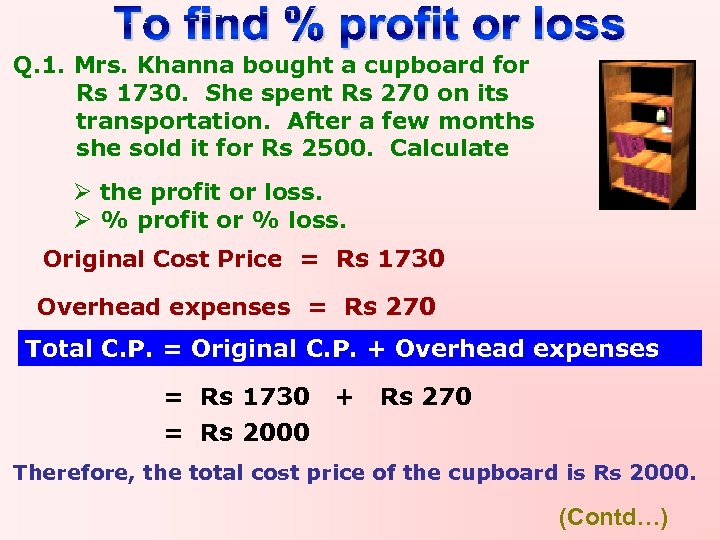
Q. 1. Mrs. Khanna bought a cupboard for Rs 1730. She spent Rs 270 on its transportation. After a few months she sold it for Rs 2500. Calculate Ø the profit or loss. Ø % profit or % loss. Original Cost Price = Rs 1730 Overhead expenses = Rs 270 Total C. P. = Original C. P. + Overhead expenses = Rs 1730 = Rs 2000 + Rs 270 Therefore, the total cost price of the cupboard is Rs 2000. (Contd…)
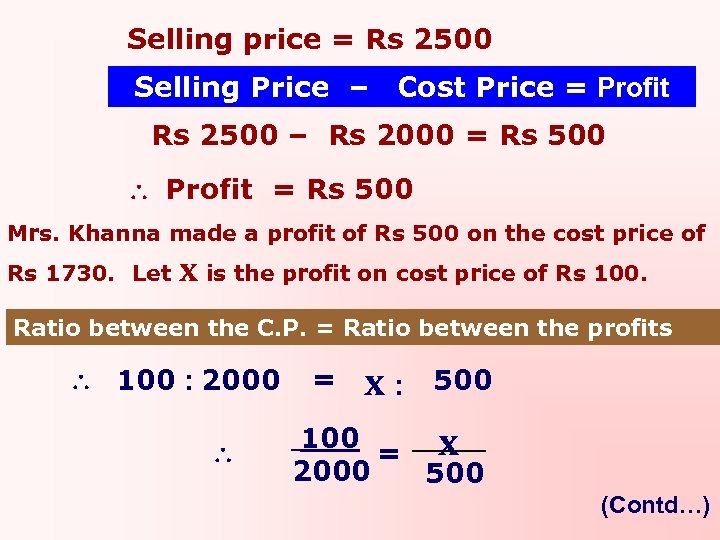
Selling price = Rs 2500 Selling Price – Cost Price = Profit Rs 2500 – Rs 2000 = Rs 500 Profit = Rs 500 Mrs. Khanna made a profit of Rs 500 on the cost price of Rs 1730. Let x is the profit on cost price of Rs 100. Ratio between the C. P. = Ratio between the profits 100 : 2000 = x: 500 100 = x 2000 500 (Contd…)
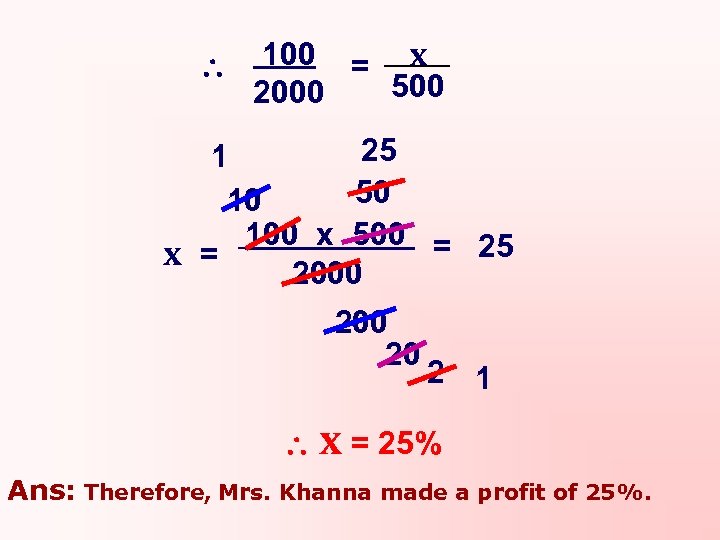
100 = x 500 2000 25 1 50 10 100 x 500 = 25 x = 2000 20 2 1 x = 25% Ans: Therefore, Mrs. Khanna made a profit of 25%.
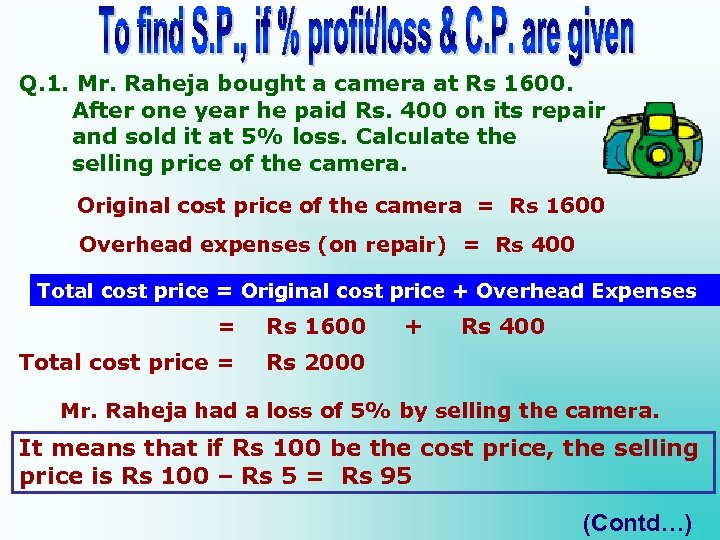
Q. 1. Mr. Raheja bought a camera at Rs 1600. After one year he paid Rs. 400 on its repair and sold it at 5% loss. Calculate the selling price of the camera. Original cost price of the camera = Rs 1600 Overhead expenses (on repair) = Rs 400 Total cost price = Original cost price + Overhead Expenses = Rs 1600 Total cost price = + Rs 400 Rs 2000 Mr. Raheja had a loss of 5% by selling the camera. It means that if Rs 100 be the cost price, the selling price is Rs 100 – Rs 5 = Rs 95 (Contd…)
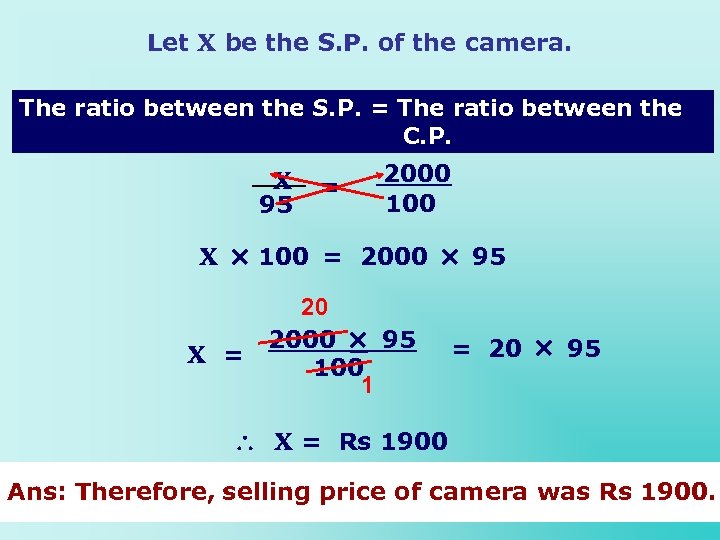
Let x be the S. P. of the camera. The ratio between the S. P. = The ratio between the C. P. x 95 = x ´ 100 x = 2000 100 = 2000 ´ 20 2000 ´ 95 100 1 x= 95 = 20 ´ 95 Rs 1900 Ans: Therefore, selling price of camera was Rs 1900.
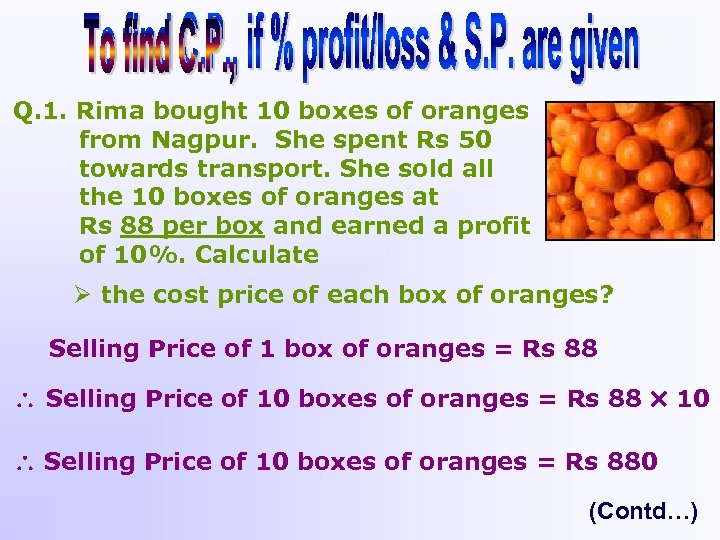
Q. 1. Rima bought 10 boxes of oranges from Nagpur. She spent Rs 50 towards transport. She sold all the 10 boxes of oranges at Rs 88 per box and earned a profit of 10%. Calculate Ø the cost price of each box of oranges? Selling Price of 1 box of oranges = Rs 88 Selling Price of 10 boxes of oranges = Rs 88 ´ 10 Selling Price of 10 boxes of oranges = Rs 880 (Contd…)
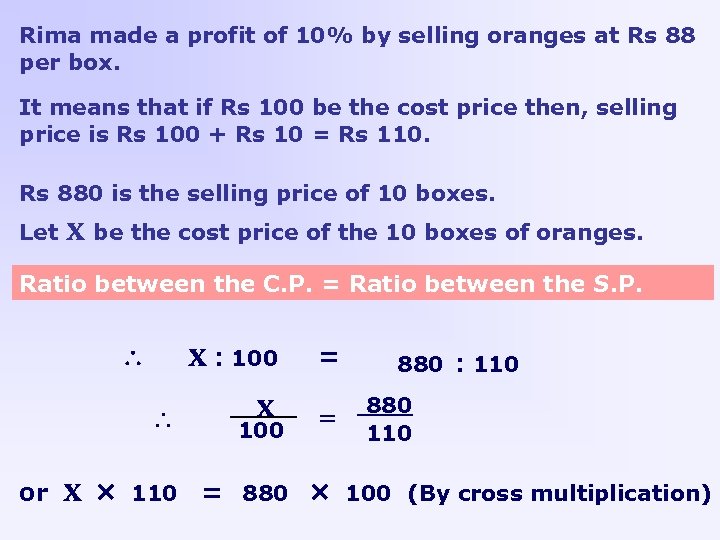
Rima made a profit of 10% by selling oranges at Rs 88 per box. It means that if Rs 100 be the cost price then, selling price is Rs 100 + Rs 10 = Rs 110. Rs 880 is the selling price of 10 boxes. Let x be the cost price of the 10 boxes of oranges. Ratio between the C. P. = Ratio between the S. P. or x ´ 110 x : 100 x 100 = 880 = = ´ 880 : 110 880 110 100 (By cross multiplication)
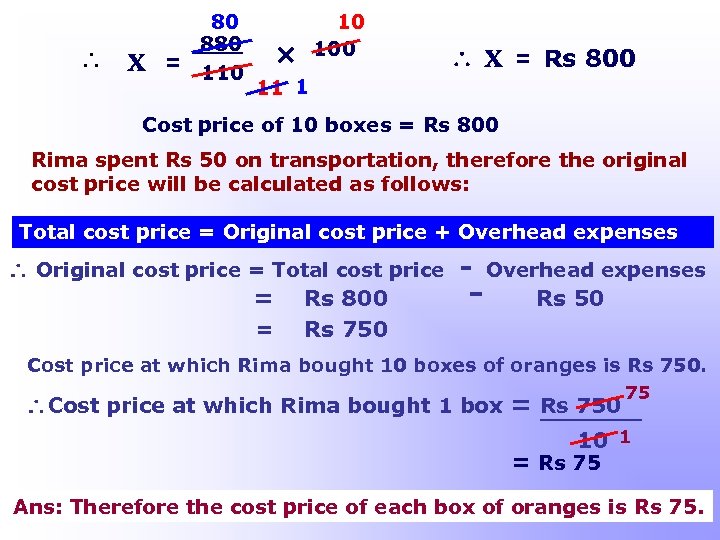
x = 80 880 110 10 100 ´ 11 1 x = Rs 800 Cost price of 10 boxes = Rs 800 Rima spent Rs 50 on transportation, therefore the original cost price will be calculated as follows: Total cost price = Original cost price + Overhead expenses Original cost price = Total cost price = = Rs 800 Rs 750 - Overhead expenses Rs 50 Cost price at which Rima bought 10 boxes of oranges is Rs 750. Cost price at which Rima bought 1 box = Rs 750 75 10 1 = Rs 75 Ans: Therefore the cost price of each box of oranges is Rs 75.

Test Yourself Jill brought home a poster from her trip to Himachal Pradesh. She had paid Rs 25 for it. Lina saw the poster and liked it. Jill gave it to Lina for Rs 35. Can you state? • For how many rupee did Jill buy the poster ? Ans: Rs 25 • For how many rupee did Jill sell the poster to Lina ? Ans: Rs. 35 • Did Jill make a profit on her transaction, or suffer a loss? Ans: Jill made a profit on her transactions.
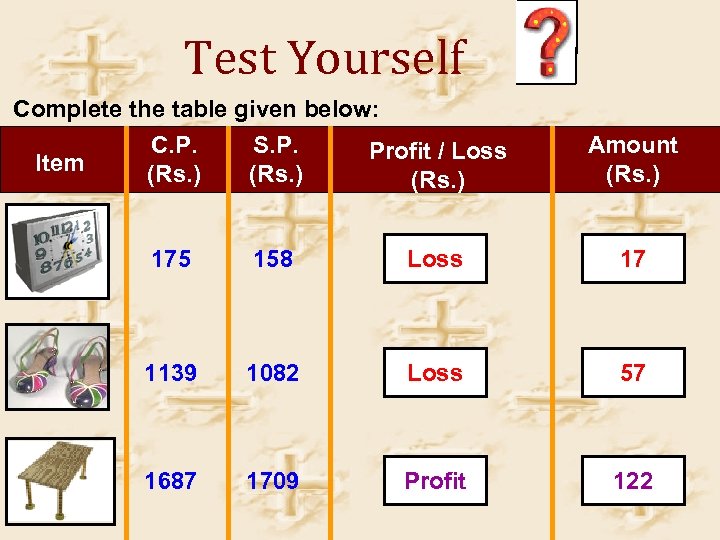
Test Yourself Complete the table given below: Item C. P. (Rs. ) S. P. (Rs. ) Profit / Loss (Rs. ) Amount (Rs. ) 175 158 Loss 17 1139 1082 Loss 57 1687 1709 Profit 122
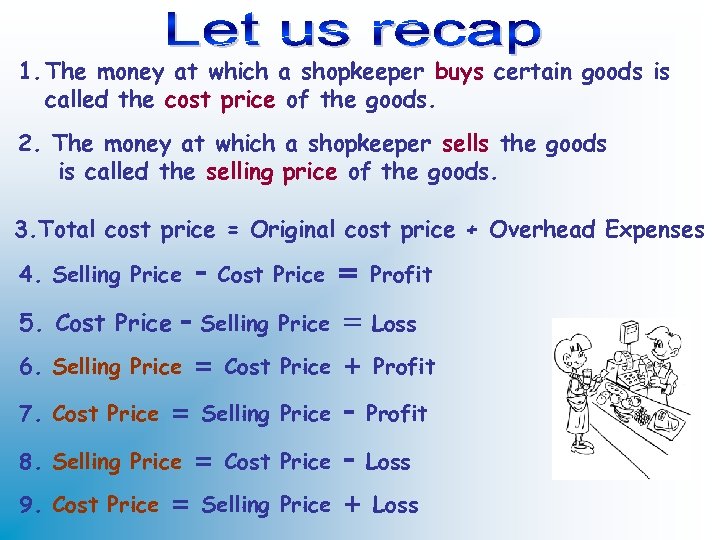
1. The money at which a shopkeeper buys certain goods is called the cost price of the goods. 2. The money at which a shopkeeper sells the goods is called the selling price of the goods. 3. Total cost price = Original cost price + Overhead Expenses 4. Selling Price - Cost Price = Profit 5. Cost Price - Selling Price = Loss 6. Selling Price = Cost Price + Profit 7. Cost Price = Selling Price - Profit 8. Selling Price = Cost Price - Loss 9. Cost Price = Selling Price + Loss
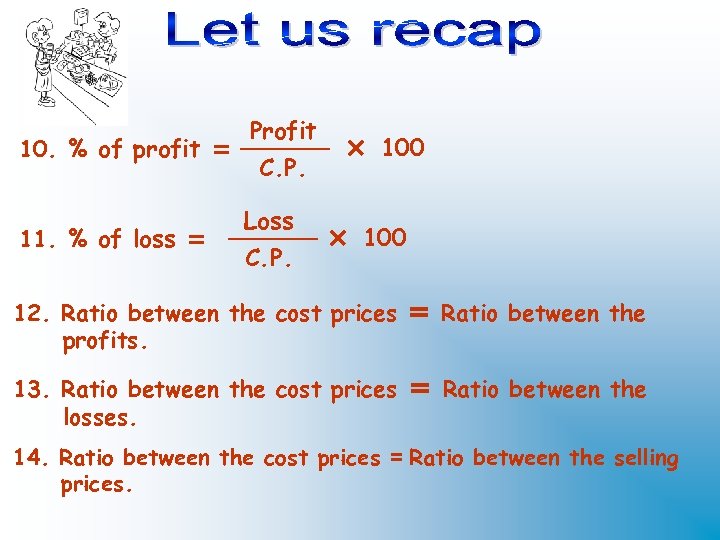
10. % of profit = 11. % of loss = Profit ´ C. P. Loss C. P. ´ 100 12. Ratio between the cost prices profits. = Ratio between the 13. Ratio between the cost prices losses. = Ratio between the 14. Ratio between the cost prices = Ratio between the selling prices.
The End Created by: Department of Research Bombay Cambridge Gurukul
Скачать презентацию Mathem Std VI atics A shopkeeper buys
1eeefe2e004f39c3857fd40c2714b7f4.ppt