 Скачать презентацию Maternal Mortality and Hemorrhage Gina M Brown MD
e49f790fc3ecbac38bfd591b582481f4.ppt
- Количество слайдов: 35



Maternal Mortality and Hemorrhage Gina M. Brown, MD NYC Department of Health and Mental Hygiene Bureau of Maternal, Infant and Reproductive Health
Special Thanks to: Candace Mulready, MPH Katrina Manzano, MPH Vani Bettegowda, MHS Office of Vital Statistics Office of the City Medical Examiner SPARCS Bureau of Maternal, Infant and Reproductive Health
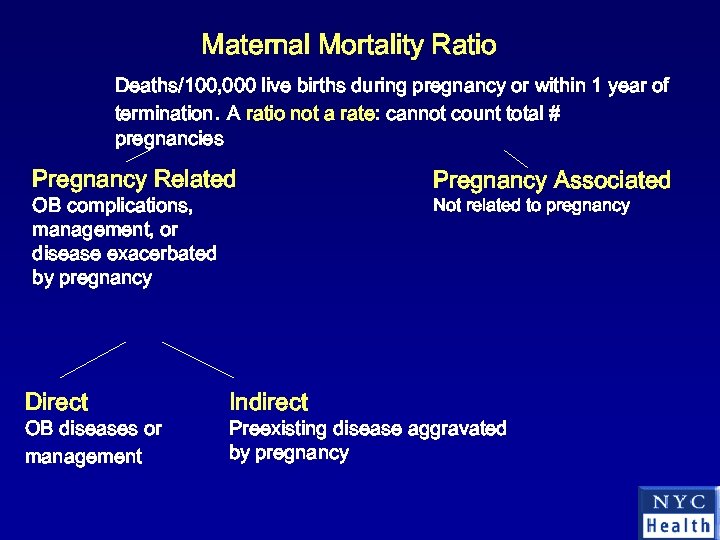
Maternal Mortality Ratio Deaths/100, 000 live births during pregnancy or within 1 year of termination. A ratio not a rate: cannot count total # pregnancies Pregnancy Related OB complications, management, or disease exacerbated by pregnancy Direct OB diseases or management Indirect Pregnancy Associated Not related to pregnancy Preexisting disease aggravated by pregnancy
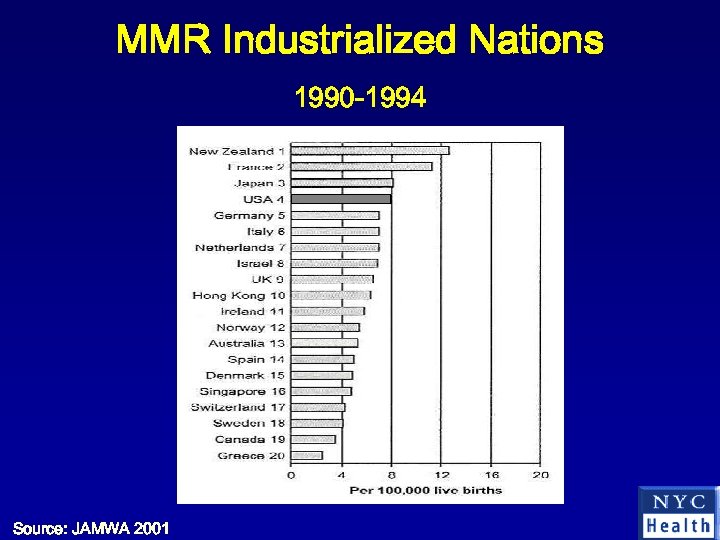
MMR Industrialized Nations 1990 -1994 Source: JAMWA 2001
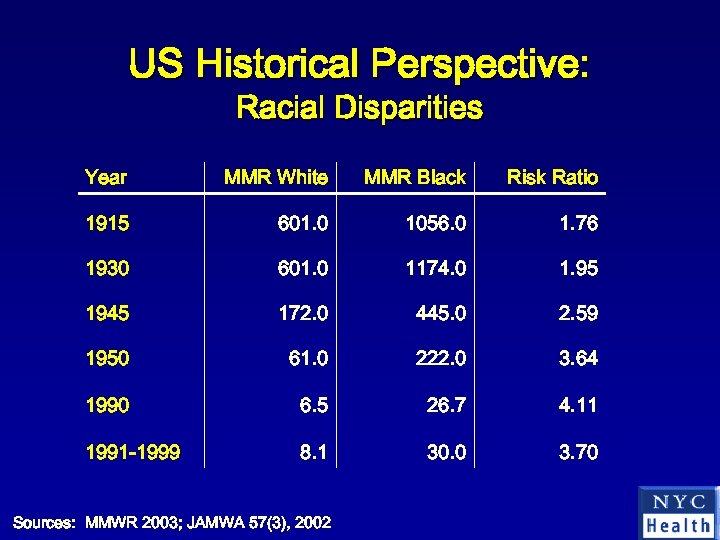
US Historical Perspective: Racial Disparities Year MMR White MMR Black Risk Ratio 1915 601. 0 1056. 0 1. 76 1930 601. 0 1174. 0 1. 95 1945 172. 0 445. 0 2. 59 1950 61. 0 222. 0 3. 64 1990 6. 5 26. 7 4. 11 1991 -1999 8. 1 30. 0 3. 70 Sources: MMWR 2003; JAMWA 57(3), 2002
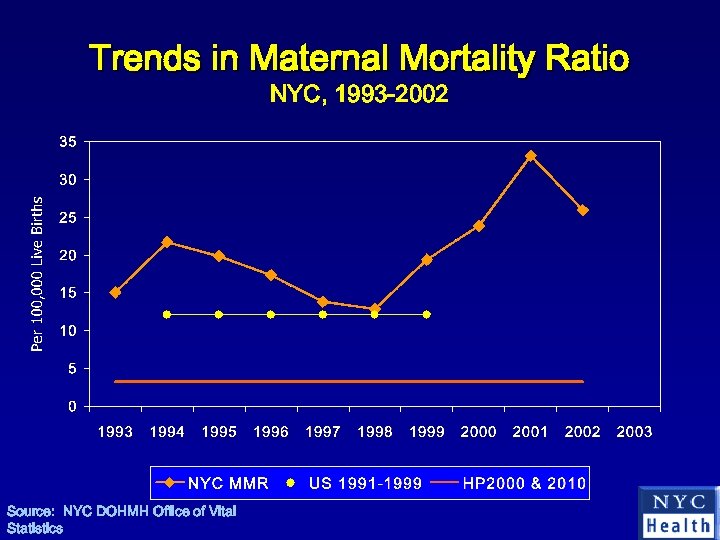
Trends in Maternal Mortality Ratio NYC, 1993 -2002 Source: NYC DOHMH Office of Vital Statistics
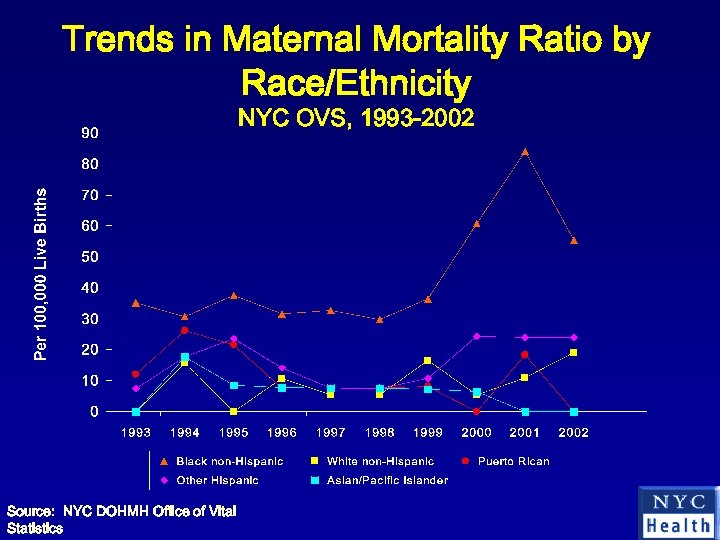
Trends in Maternal Mortality Ratio by Race/Ethnicity NYC OVS, 1993 -2002 Source: NYC DOHMH Office of Vital Statistics
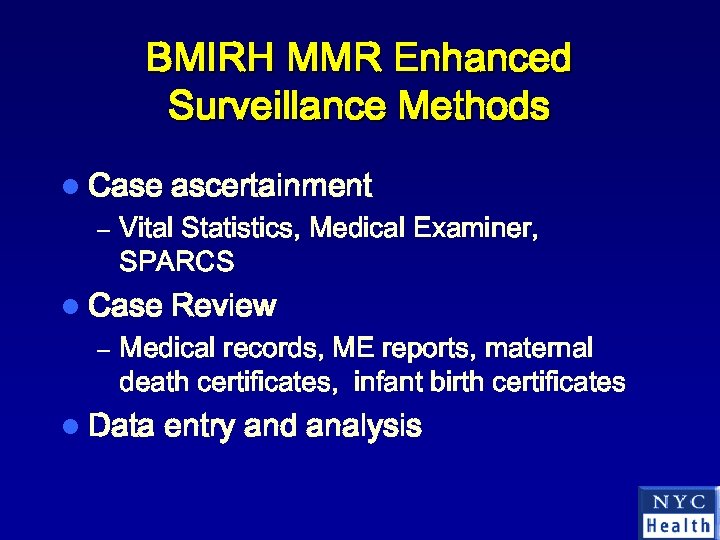
BMIRH MMR Enhanced Surveillance Methods l Case ascertainment – Vital Statistics, Medical Examiner, SPARCS l Case Review – Medical records, ME reports, maternal death certificates, infant birth certificates l Data entry and analysis
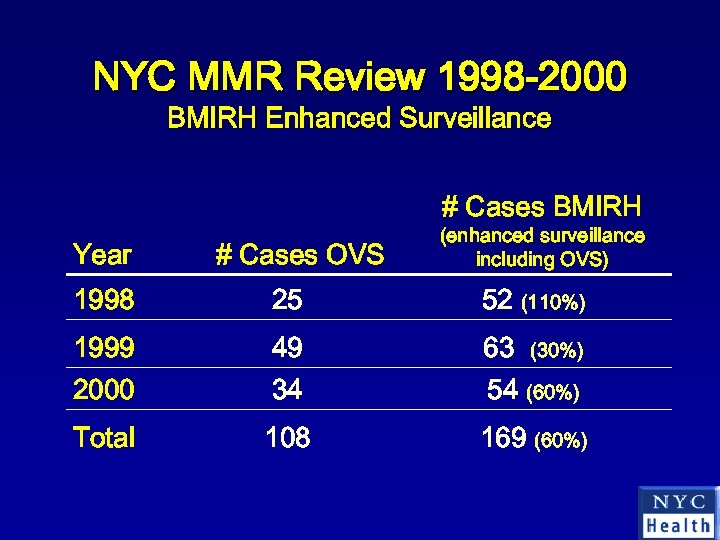
NYC MMR Review 1998 -2000 BMIRH Enhanced Surveillance # Cases BMIRH Year # Cases OVS (enhanced surveillance including OVS) 1998 25 52 (110%) 1999 2000 49 34 63 (30%) 54 (60%) Total 108 169 (60%)
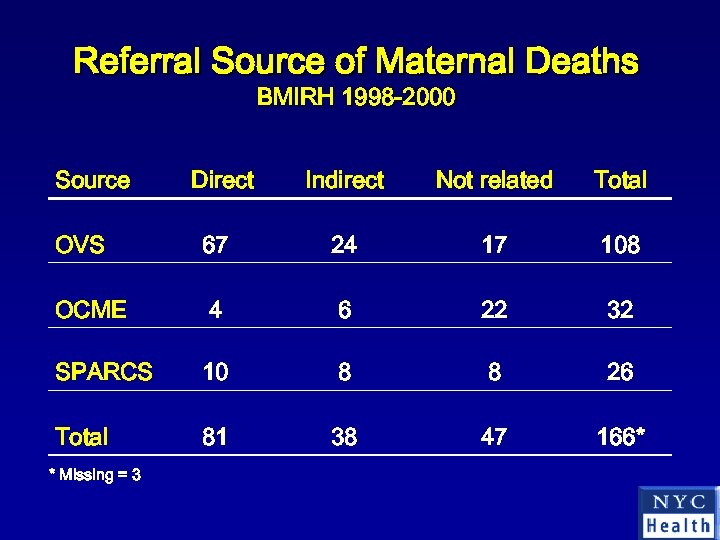
Referral Source of Maternal Deaths BMIRH 1998 -2000 Source Direct Indirect Not related Total OVS 67 24 17 108 OCME 4 6 22 32 SPARCS 10 8 8 26 Total 81 38 47 166* * Missing = 3
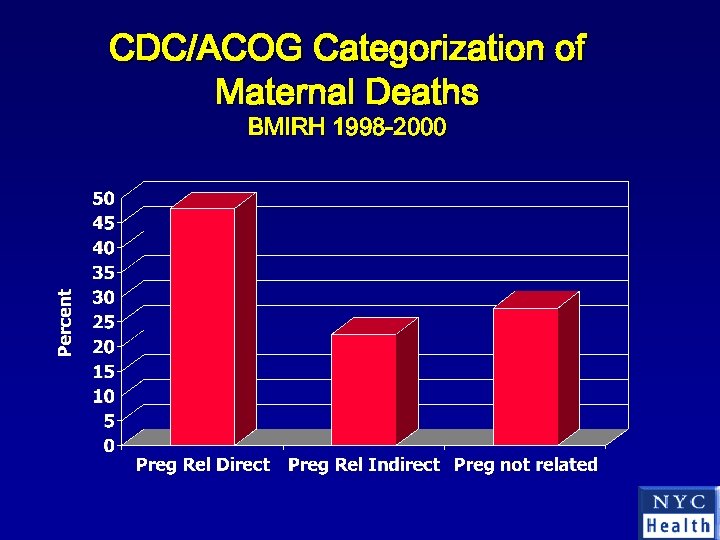
CDC/ACOG Categorization of Maternal Deaths BMIRH 1998 -2000
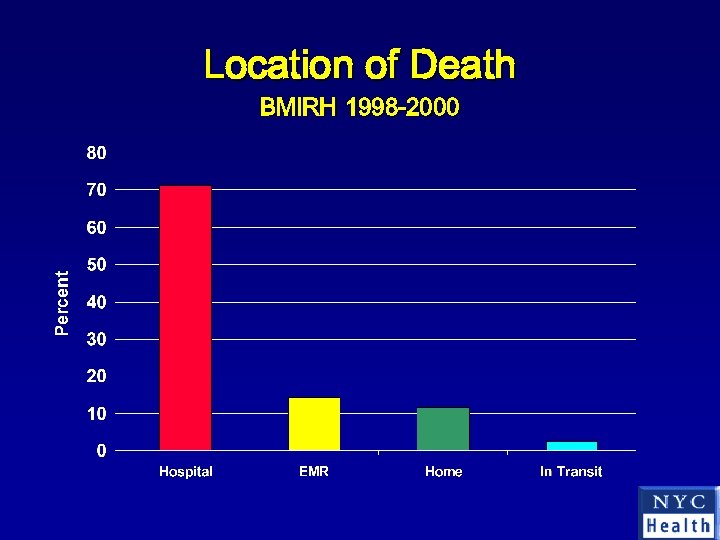
Location of Death BMIRH 1998 -2000
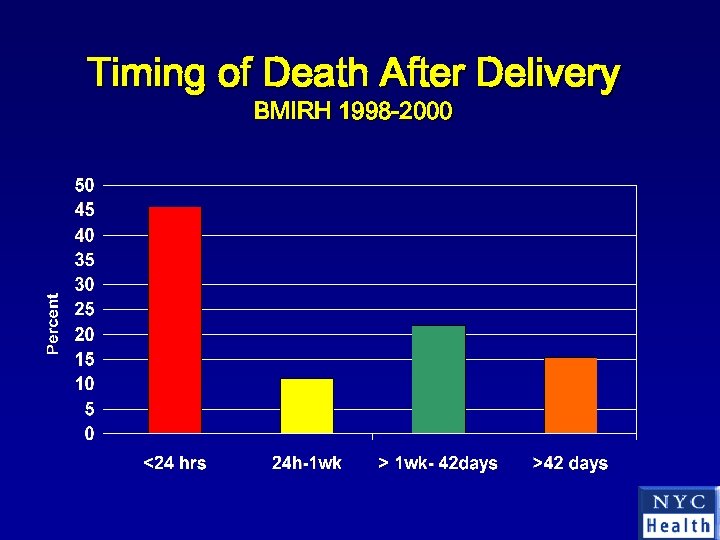
Timing of Death After Delivery BMIRH 1998 -2000
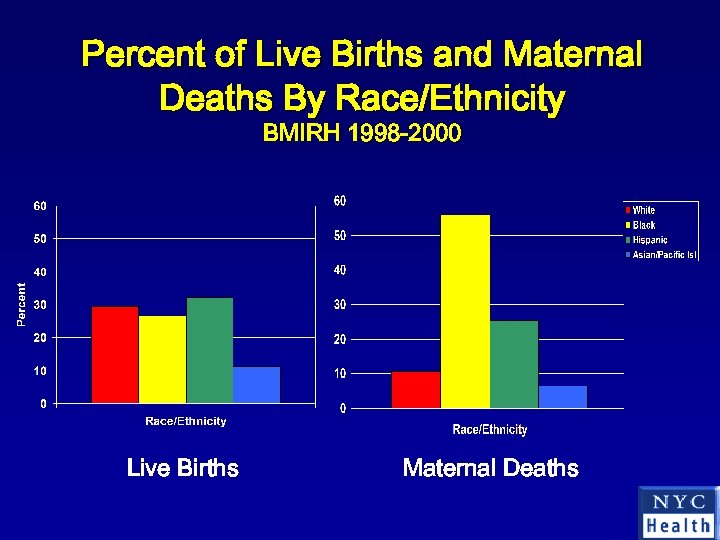
Percent of Live Births and Maternal Deaths By Race/Ethnicity BMIRH 1998 -2000 Live Births Maternal Deaths
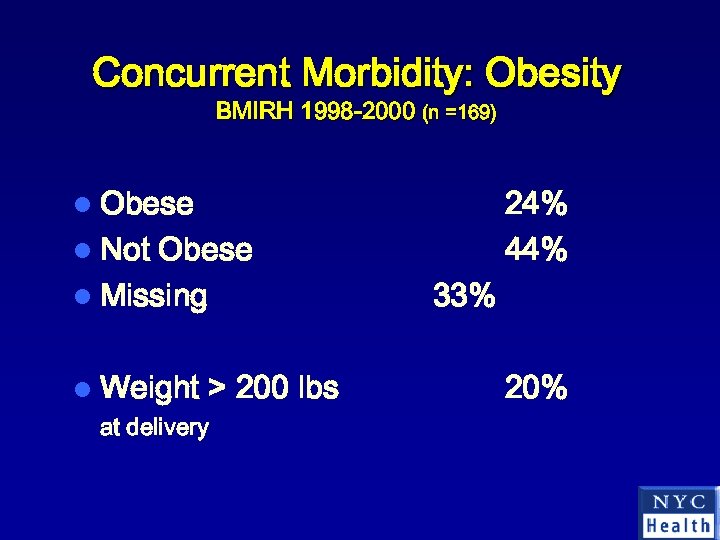
Concurrent Morbidity: Obesity BMIRH 1998 -2000 (n =169) l Obese l Missing 24% 44% l Not l Weight > 200 lbs at delivery 33% 20%
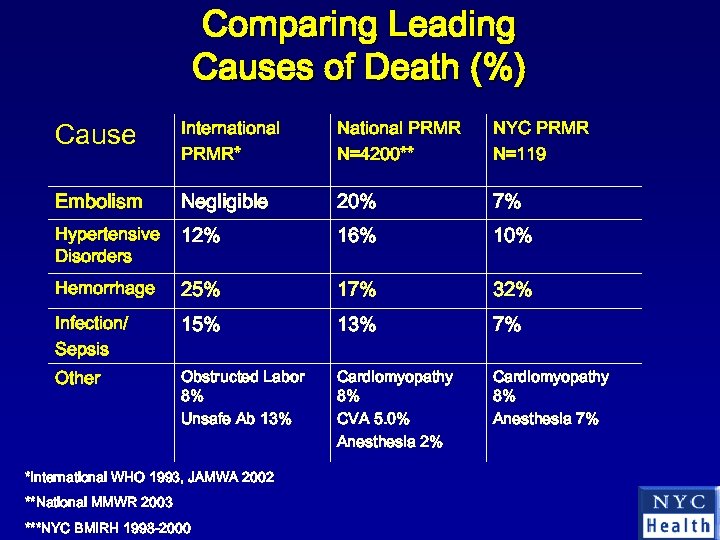
Comparing Leading Causes of Death (%) Cause International PRMR* National PRMR N=4200** NYC PRMR N=119 Embolism Negligible 20% 7% Hypertensive Disorders 12% 16% 10% Hemorrhage 25% 17% 32% Infection/ Sepsis 15% 13% 7% Other Obstructed Labor 8% Unsafe Ab 13% Cardiomyopathy 8% CVA 5. 0% Anesthesia 2% Cardiomyopathy 8% Anesthesia 7% *International WHO 1993, JAMWA 2002 **National MMWR 2003 ***NYC BMIRH 1998 -2000
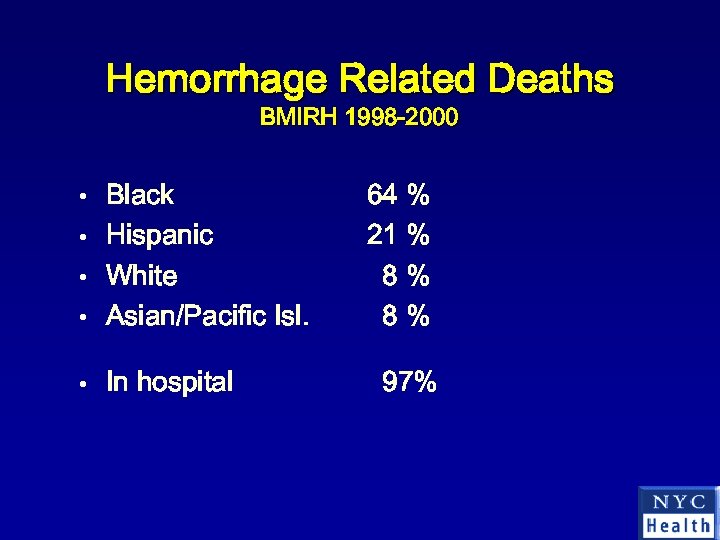
Hemorrhage Related Deaths BMIRH 1998 -2000 Black • Hispanic • White • Asian/Pacific Isl. • • In hospital 64 % 21 % 8% 8% 97%
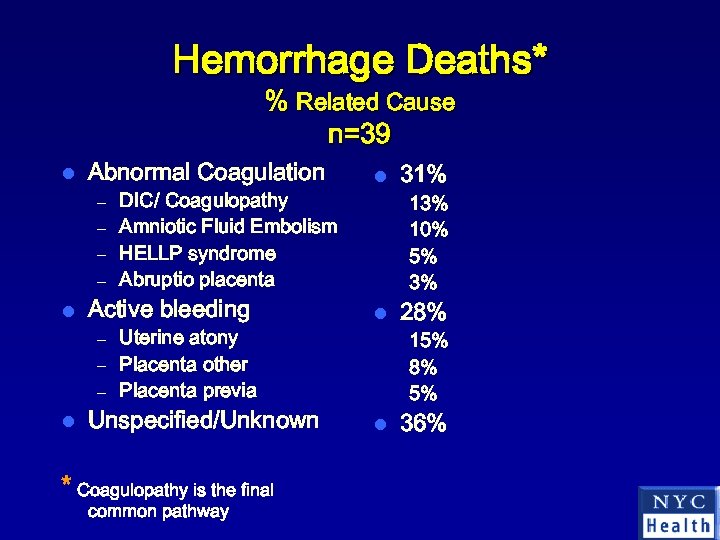
Hemorrhage Deaths* % Related Cause n=39 l Abnormal Coagulation – – l DIC/ Coagulopathy Amniotic Fluid Embolism HELLP syndrome Abruptio placenta Active bleeding – Uterine atony – Placenta other – Placenta previa l Unspecified/Unknown * Coagulopathy is the final common pathway l 31% 13% 10% 5% 3% l 28% 15% 8% 5% l 36%
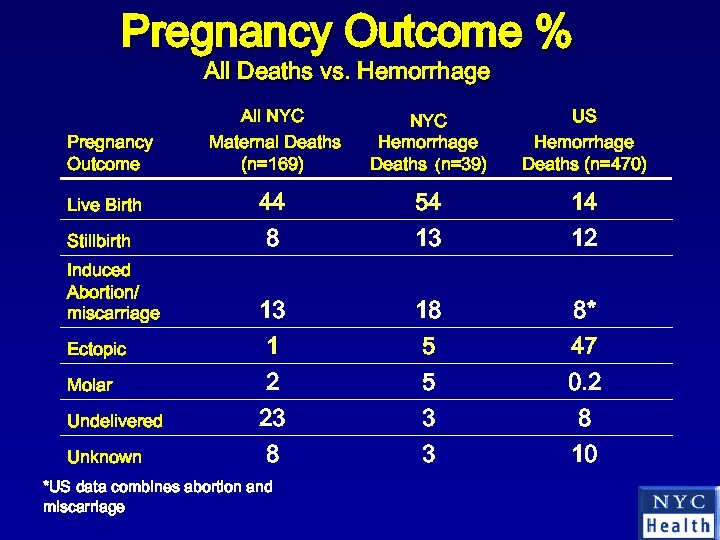
Pregnancy Outcome % All Deaths vs. Hemorrhage Pregnancy Outcome Live Birth Stillbirth Induced Abortion/ miscarriage Ectopic Molar Undelivered Unknown All NYC Maternal Deaths (n=169) NYC Hemorrhage Deaths (n=39) US Hemorrhage Deaths (n=470) 44 54 14 8 13 12 13 1 2 23 8 18 5 5 3 3 8* 47 0. 2 8 10 *US data combines abortion and miscarriage
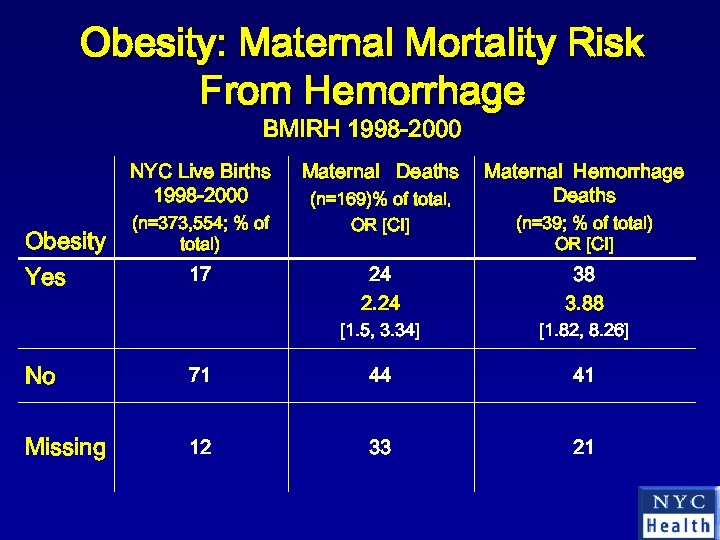
Obesity: Maternal Mortality Risk From Hemorrhage BMIRH 1998 -2000 NYC Live Births 1998 -2000 Obesity Yes (n=373, 554; % of total) 17 Maternal Deaths (n=169)% of total, OR [CI] Maternal Hemorrhage Deaths (n=39; % of total) OR [CI] 24 2. 24 38 3. 88 [1. 5, 3. 34] [1. 82, 8. 26] No 71 44 41 Missing 12 33 21
Hemorrhage • 1/ 1000 deliveries • Likely • Previa, Abruptio, uterine distension, previous history, Uterine rupture • Unanticipated • Uterine atony • Post partum
Physiologic Response to Pregnancy • • • Increased vascular volume Decreased systemic vascular resistance Increased HR Increased cardiac output Placental blood flow 500 -650 cc/minute Auto transfusion at delivery
Physiology of Hemorrhage • Decreased • MAP, CO, CVP, PCWP, SV, Stroke work, O 2 consumption, MVO 2 • Increased • SVR, A-V O 2 difference, Catecholamine release, HR, PVR, Myocardial contractility • Platelet aggregation • Small vessel occlusion • Impaired microcirculation • Embolization to lungs
Physiology of Hemorrhage • Adrenergic effect • constriction of venules and small veins • Increased venous return (preload) • Systemic hypotension • Decr capillary hydrostatic pressure • Fluid mobilizaton • decr blood viscosity
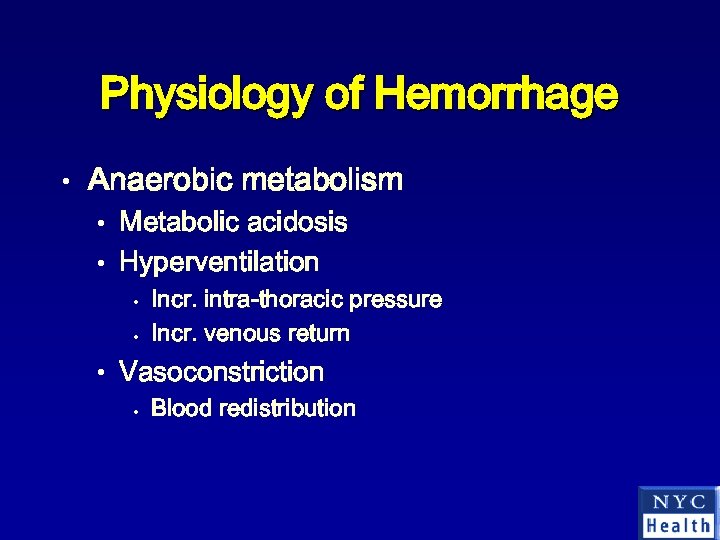
Physiology of Hemorrhage • Anaerobic metabolism • Metabolic acidosis • Hyperventilation • • Incr. intra-thoracic pressure Incr. venous return • Vasoconstriction • Blood redistribution
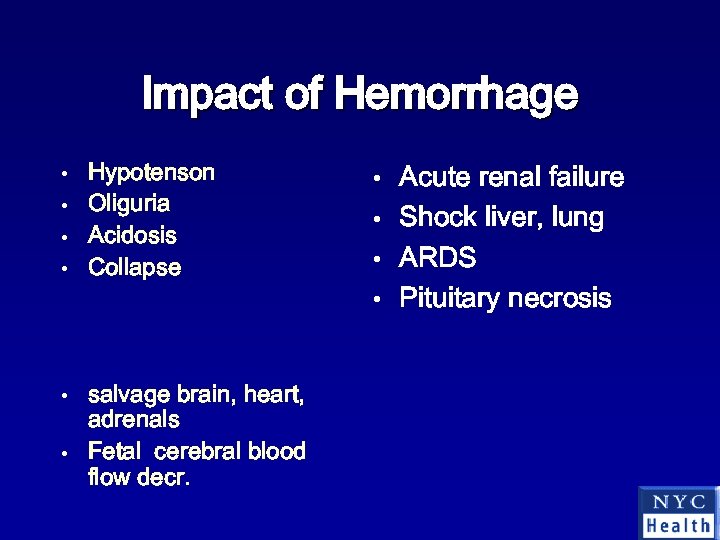
Impact of Hemorrhage Hypotenson • Oliguria • Acidosis • Collapse • salvage brain, heart, adrenals • Fetal cerebral blood flow decr. • Acute renal failure • Shock liver, lung • ARDS • Pituitary necrosis •
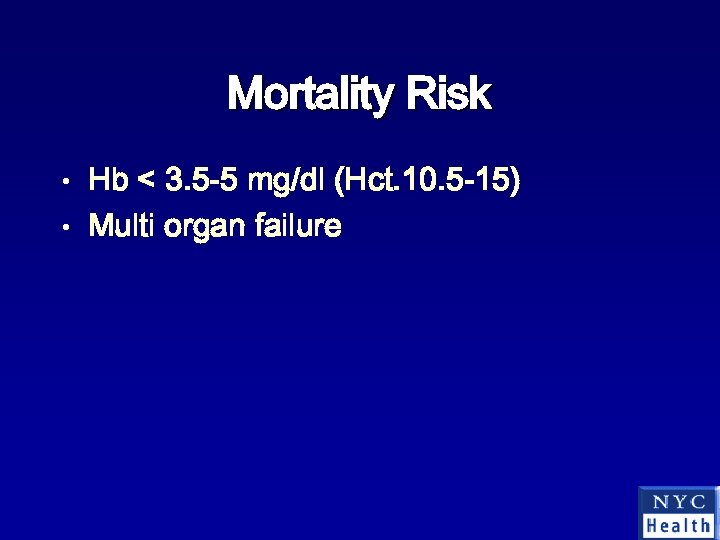
Mortality Risk Hb < 3. 5 -5 mg/dl (Hct. 10. 5 -15) • Multi organ failure •
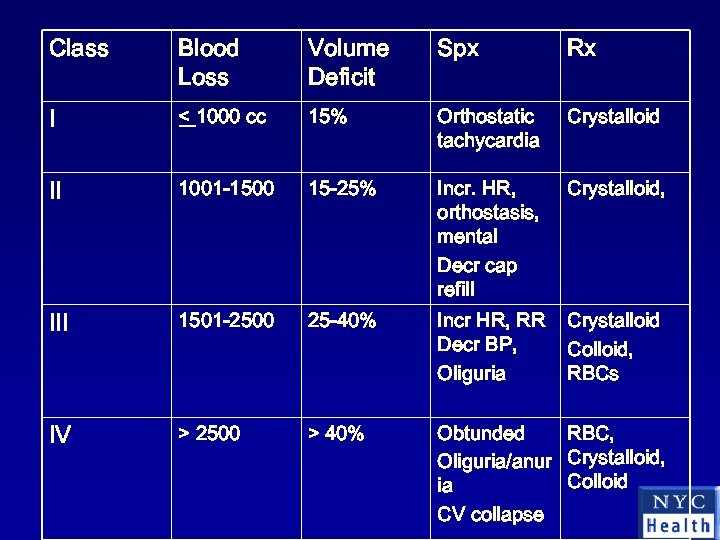
Class Blood Loss Volume Deficit Spx Rx I < 1000 cc 15% Orthostatic tachycardia Crystalloid II 1001 -1500 15 -25% Incr. HR, orthostasis, mental Decr cap refill Crystalloid, III 1501 -2500 25 -40% Incr HR, RR Decr BP, Oliguria Crystalloid Colloid, RBCs IV > 2500 > 40% Obtunded RBC, Oliguria/anur Crystalloid, Colloid ia CV collapse
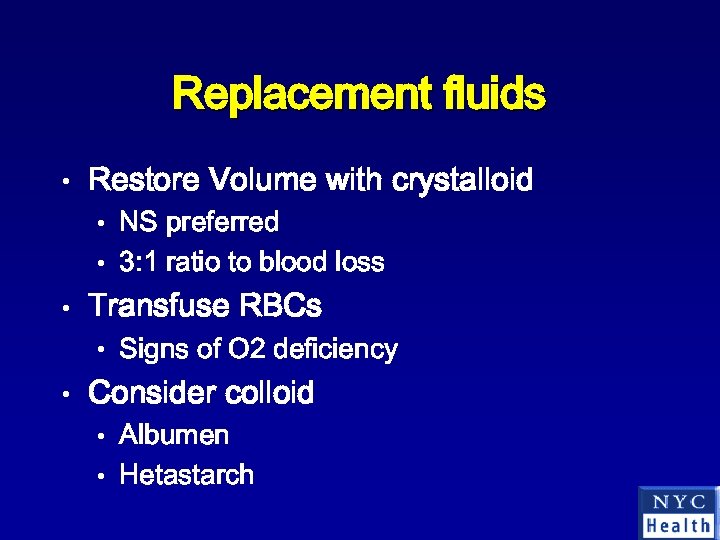
Replacement fluids • Restore Volume with crystalloid • NS preferred • 3: 1 ratio to blood loss • Transfuse RBCs • Signs of O 2 deficiency • Consider colloid • Albumen • Hetastarch
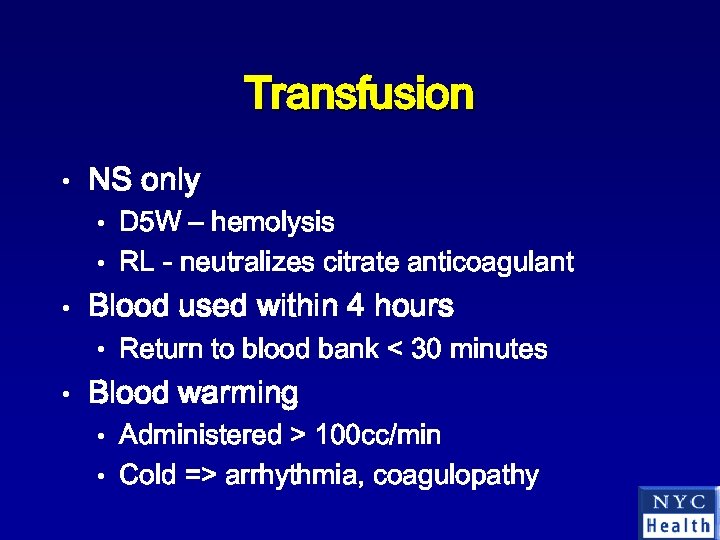
Transfusion • NS only • D 5 W – hemolysis • RL - neutralizes citrate anticoagulant • Blood used within 4 hours • Return to blood bank < 30 minutes • Blood warming • Administered > 100 cc/min • Cold => arrhythmia, coagulopathy
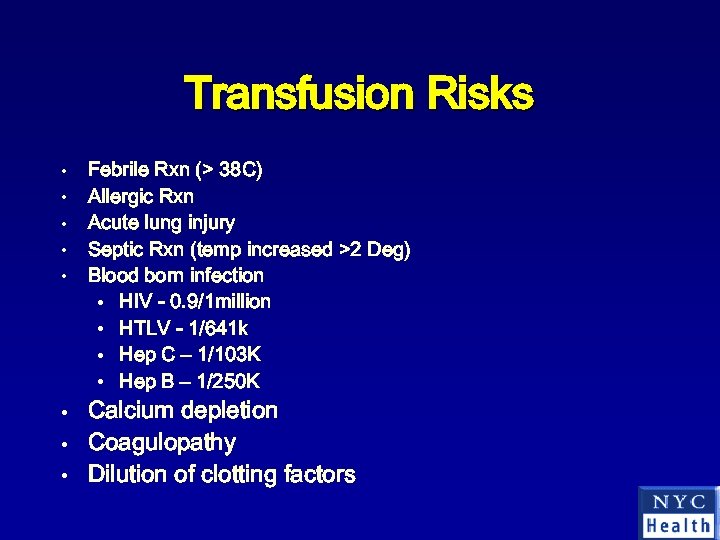
Transfusion Risks • • • Febrile Rxn (> 38 C) Allergic Rxn Acute lung injury Septic Rxn (temp increased >2 Deg) Blood born infection • HIV - 0. 9/1 million • HTLV - 1/641 k • Hep C – 1/103 K • Hep B – 1/250 K Calcium depletion • Coagulopathy • Dilution of clotting factors •
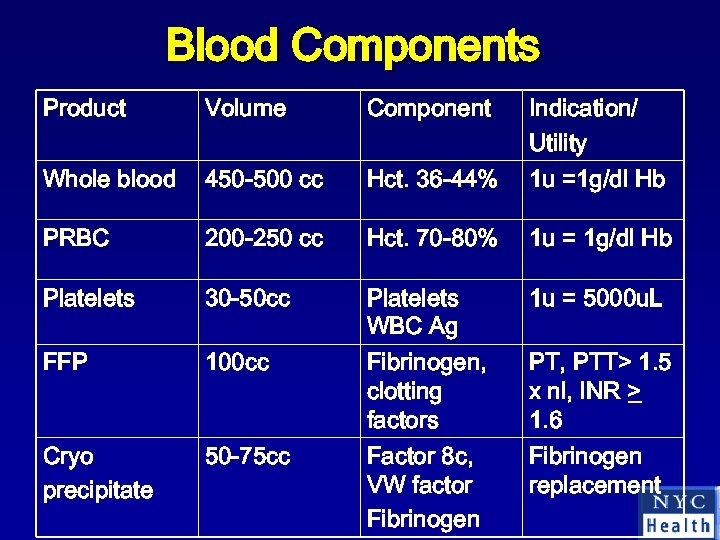
Blood Components Product Volume Component Whole blood 450 -500 cc Hct. 36 -44% Indication/ Utility 1 u =1 g/dl Hb PRBC 200 -250 cc Hct. 70 -80% 1 u = 1 g/dl Hb Platelets 30 -50 cc 1 u = 5000 u. L FFP 100 cc Platelets WBC Ag Fibrinogen, clotting factors Cryo precipitate 50 -75 cc Factor 8 c, VW factor Fibrinogen replacement PT, PTT> 1. 5 x nl, INR > 1. 6
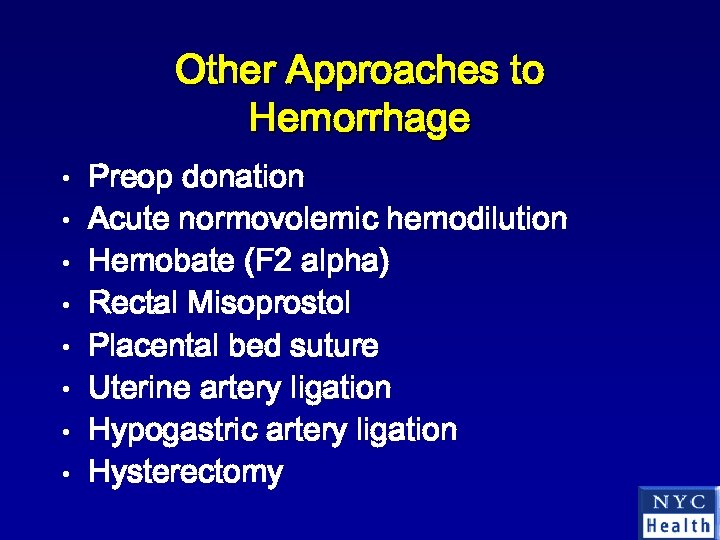
Other Approaches to Hemorrhage • • Preop donation Acute normovolemic hemodilution Hemobate (F 2 alpha) Rectal Misoprostol Placental bed suture Uterine artery ligation Hypogastric artery ligation Hysterectomy
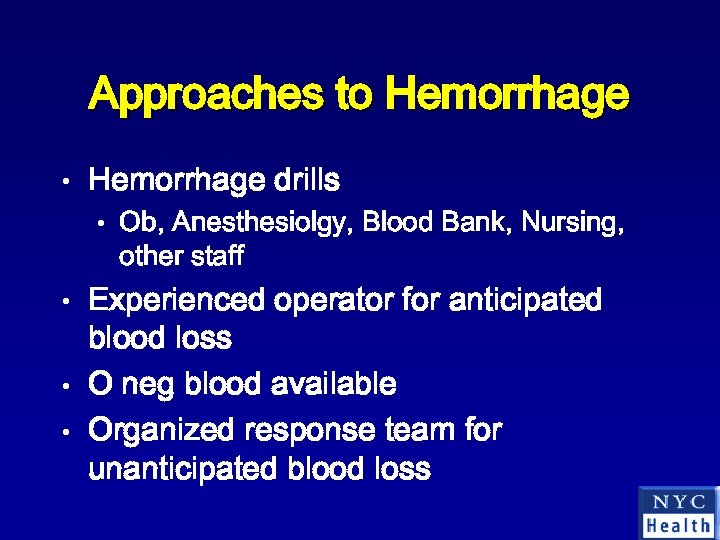
Approaches to Hemorrhage • Hemorrhage drills • Ob, Anesthesiolgy, Blood Bank, Nursing, other staff Experienced operator for anticipated blood loss • O neg blood available • Organized response team for unanticipated blood loss •
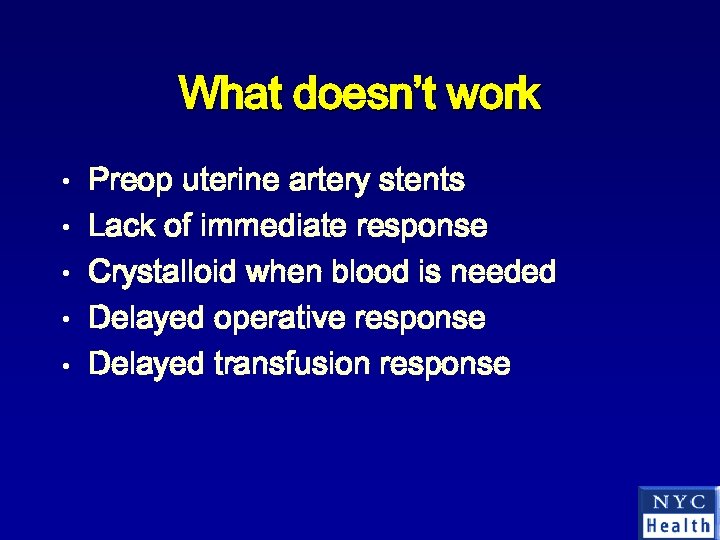
What doesn’t work • • • Preop uterine artery stents Lack of immediate response Crystalloid when blood is needed Delayed operative response Delayed transfusion response
Скачать презентацию Maternal Mortality and Hemorrhage Gina M Brown MD
e49f790fc3ecbac38bfd591b582481f4.ppt