


 Скачать презентацию Materials Resource Efficiency in Construction Mark Collinson WRAP
63d65e44c0d2347dfaa201361416eb3b.ppt
- Количество слайдов: 33
 Materials Resource Efficiency in Construction Mark Collinson, WRAP EAUC Annual Conference, 18 th April
 What is WRAP? n Waste and Resources Action Programme n funded by DEFRA n helps to minimise landfill, reduce carbon emissions and improve our environment n encourages and enables business and consumers to be more efficient in their use of materials
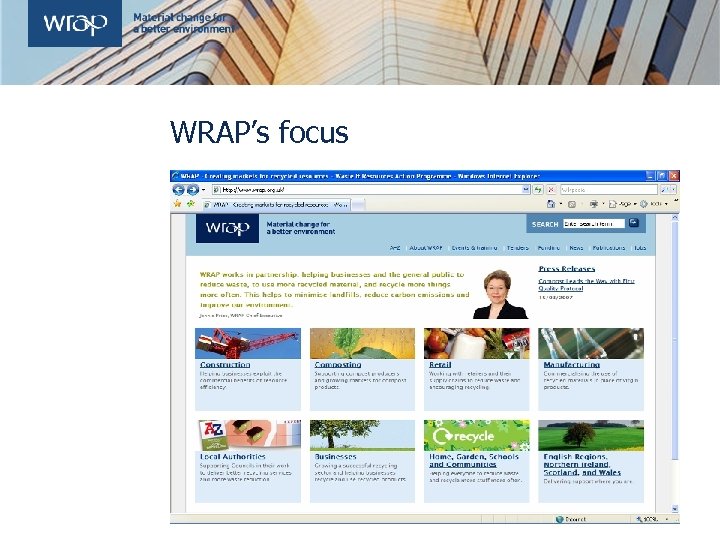 WRAP’s focus
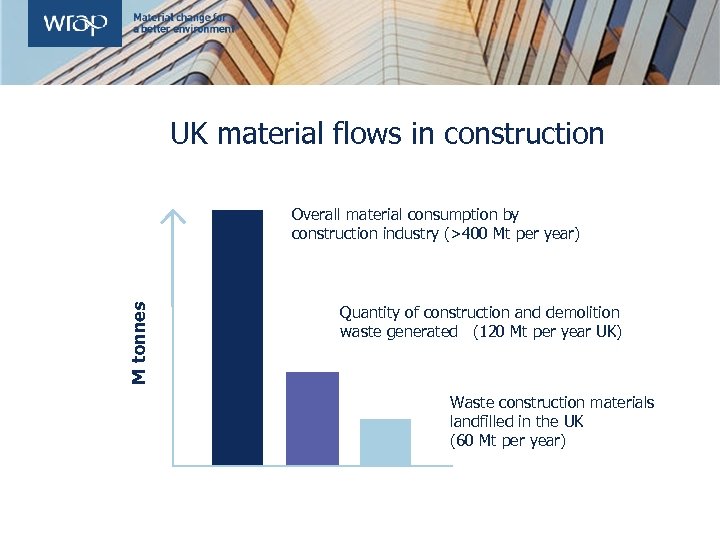 UK material flows in construction M tonnes Overall material consumption by construction industry (>400 Mt per year) Quantity of construction and demolition waste generated (120 Mt per year UK) Waste construction materials landfilled in the UK (60 Mt per year)
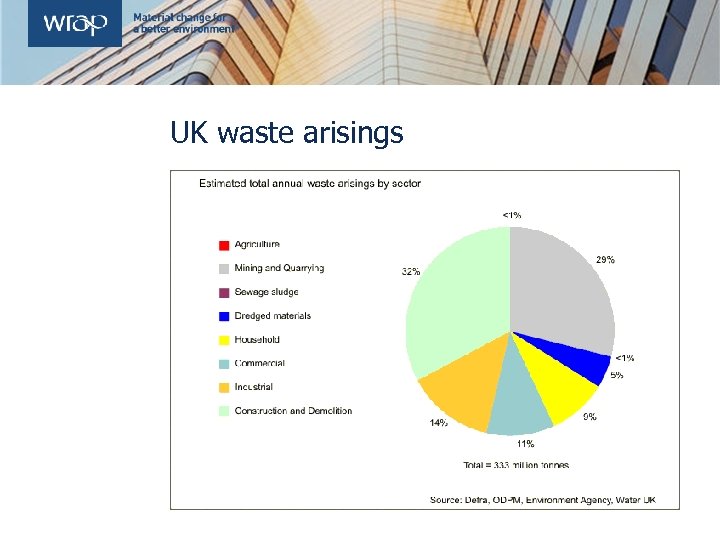 UK waste arisings
 Recycled content in construction
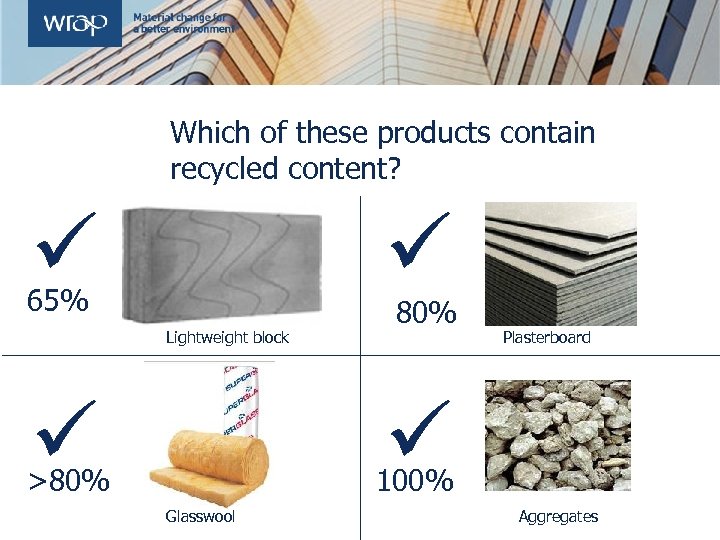 Which of these products contain recycled content? 65% Lightweight block 80% Plasterboard >80% 100% Glasswool Aggregates
 Perceived barriers n higher recycled content will cost more
 Identifying opportunities to increase recycled content WRAP maintain data on three benchmarks of recycled content for construction materials. n Standard: level of recycled material content likely to be used if no request for recycled content is made n Good: a higher level of recycled content than standard practice, but readily available at competitive cost (cost neutral) n Best: highest level of recycled material content currently available in the UK
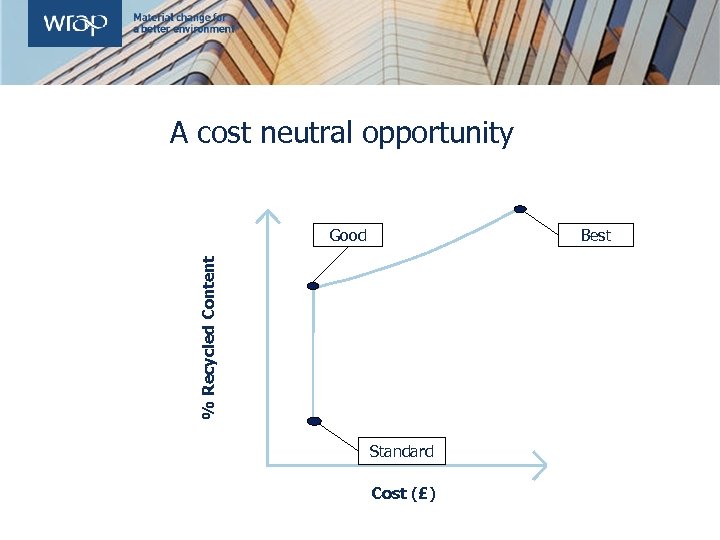 A cost neutral opportunity Good % Recycled Content Best Standard Cost (£)
 Perceived barriers n higher recycled content will cost more n products suffer from quality and performance issues
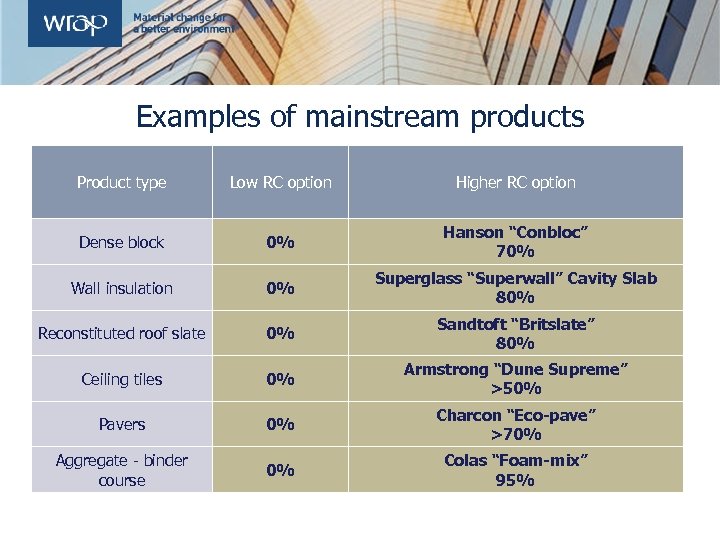 Examples of mainstream products Product type Low RC option Higher RC option Dense block 0% Hanson “Conbloc” 70% Wall insulation 0% Superglass “Superwall” Cavity Slab 80% Reconstituted roof slate 0% Sandtoft “Britslate” 80% Ceiling tiles 0% Armstrong “Dune Supreme” >50% Pavers 0% Charcon “Eco-pave” >70% Aggregate - binder course 0% Colas “Foam-mix” 95%
 Perceived barriers n higher recycled content will cost more n products suffer from quality and performance issues n availability problems
 Perceived barriers n higher recycled content will cost more n products suffer from quality and performance issues n availability problems n a 10% minimum requirement is difficult to achieve
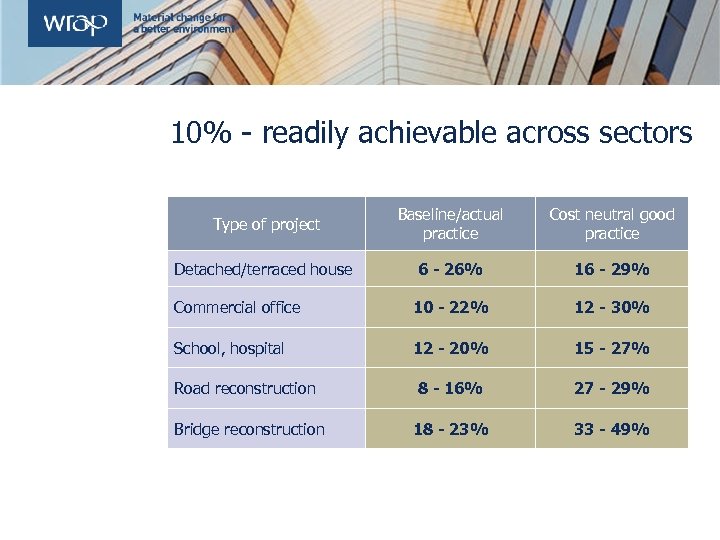 10% - readily achievable across sectors Type of project Baseline/actual practice Cost neutral good practice Detached/terraced house 6 - 26% 16 - 29% Commercial office 10 - 22% 12 - 30% School, hospital 12 - 20% 15 - 27% Road reconstruction 8 - 16% 27 - 29% Bridge reconstruction 18 - 23% 33 - 49%
 Perceived barriers n higher recycled content will cost more n products suffer from quality and performance issues n availability problems n a 10% minimum requirement is difficult to achieve n finding and measuring recycled content is onerous
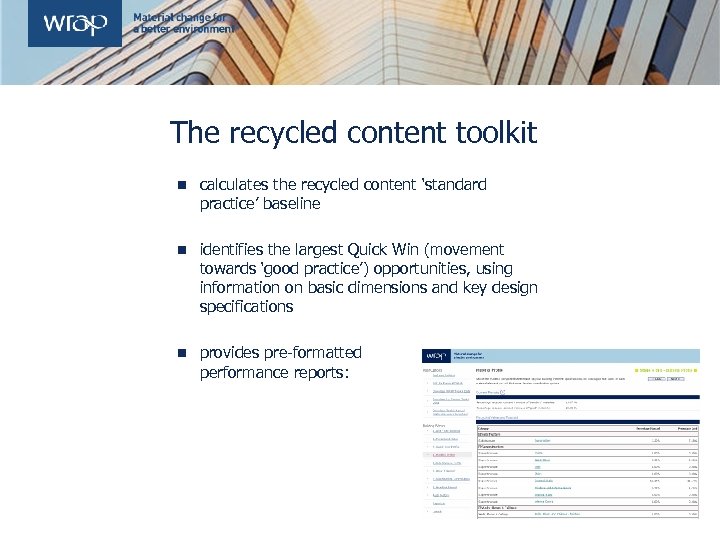 The recycled content toolkit n calculates the recycled content ‘standard practice’ baseline n identifies the largest Quick Win (movement towards ‘good practice’) opportunities, using information on basic dimensions and key design specifications n provides pre-formatted performance reports:
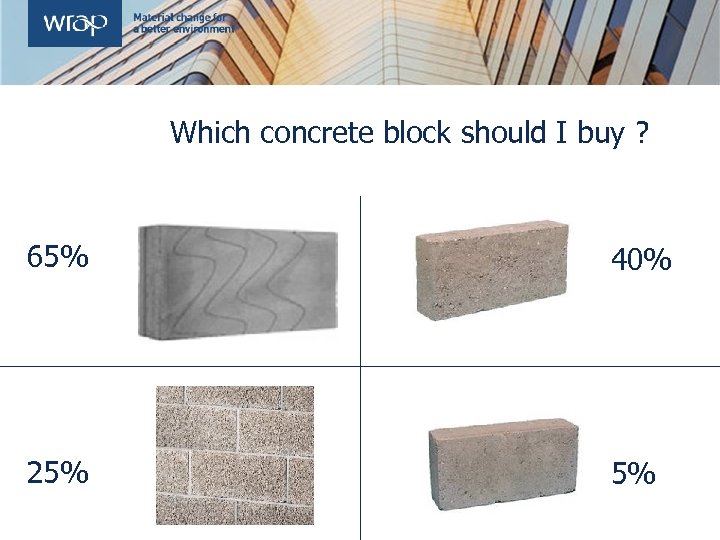 Which concrete block should I buy ? 65% 40% 25% 5%
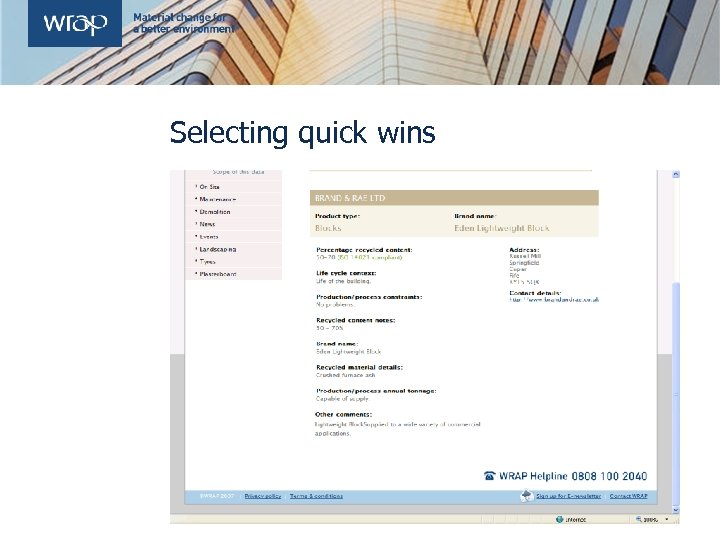
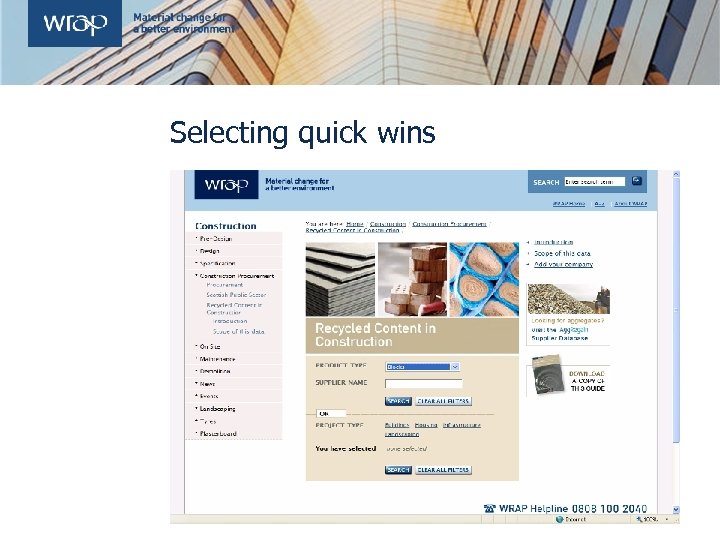 Selecting quick wins
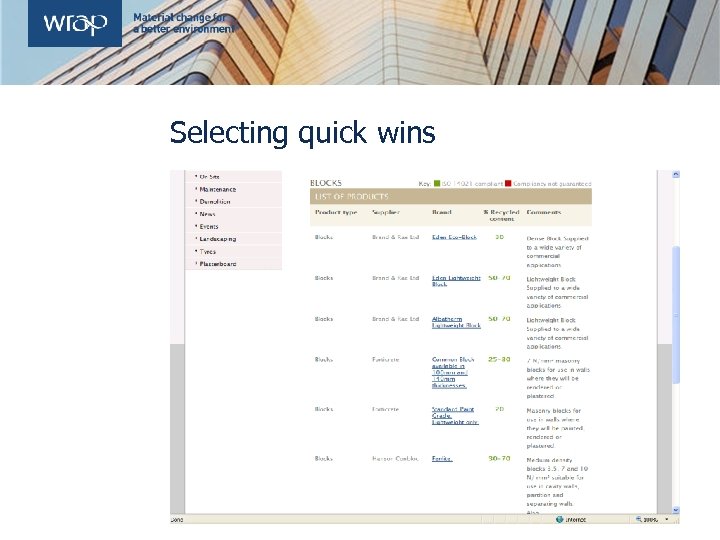 Selecting quick wins
 Selecting quick wins
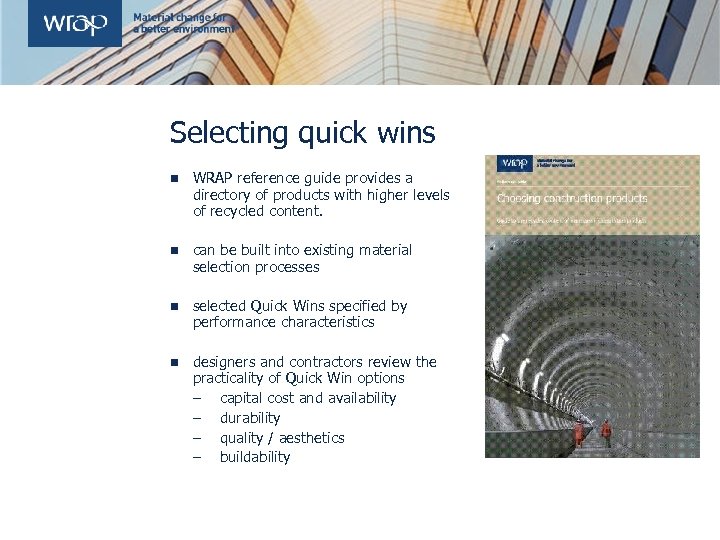 Selecting quick wins n WRAP reference guide provides a directory of products with higher levels of recycled content. n can be built into existing material selection processes n selected Quick Wins specified by performance characteristics n designers and contractors review the practicality of Quick Win options – capital cost and availability – durability – quality / aesthetics – buildability
 Recommended wording ‘…. at least 10% of the total value of materials used should derive from recycled and reused content in the products and materials selected. In addition, show that the most significant opportunities to increase the value of materials derived from recycled and reused content have been considered, such as the top ten Quick Wins or equivalent, and implement good practice where technically and commercially viable. ’
 Practical examples of recycled content usage
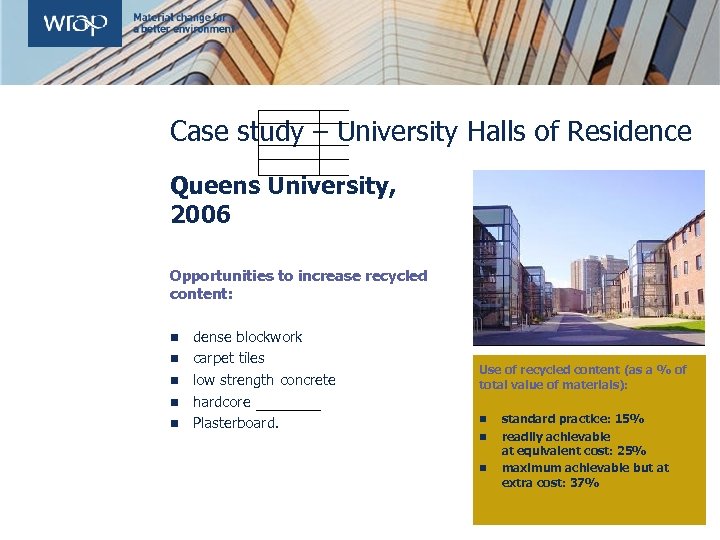 Case study – University Halls of Residence Queens University, 2006 Opportunities to increase recycled content: n n n dense blockwork carpet tiles low strength concrete hardcore Plasterboard. Use of recycled content (as a % of total value of materials): n n n standard practice: 15% readily achievable at equivalent cost: 25% maximum achievable but at extra cost: 37%
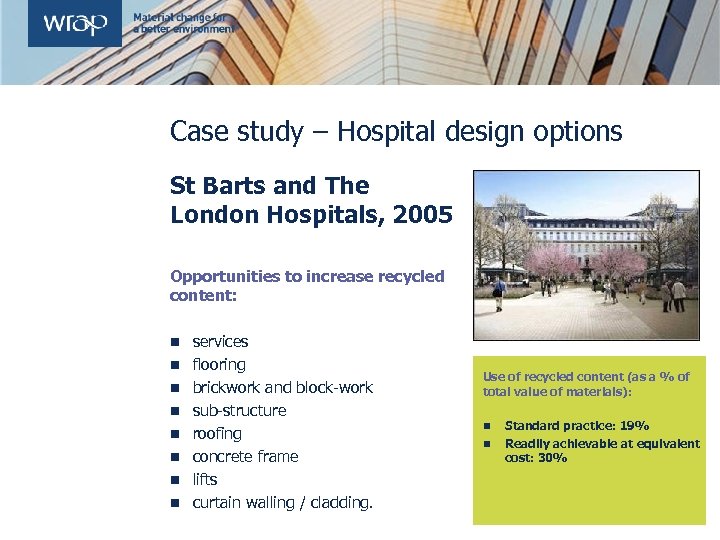 Case study – Hospital design options St Barts and The London Hospitals, 2005 Opportunities to increase recycled content: n n n n services flooring brickwork and block-work sub-structure roofing concrete frame lifts curtain walling / cladding. Use of recycled content (as a % of total value of materials): n n Standard practice: 19% Readily achievable at equivalent cost: 30%
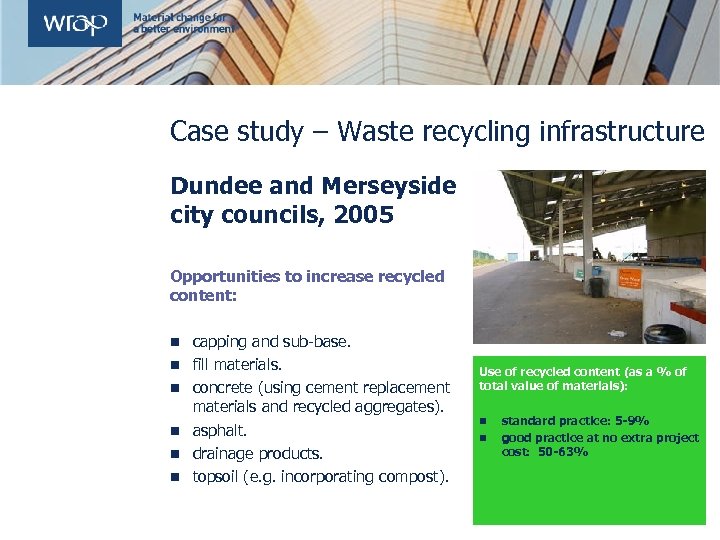 Case study – Waste recycling infrastructure Dundee and Merseyside city councils, 2005 Opportunities to increase recycled content: n n n capping and sub-base. fill materials. concrete (using cement replacement materials and recycled aggregates). asphalt. drainage products. topsoil (e. g. incorporating compost). Use of recycled content (as a % of total value of materials): n n standard practice: 5 -9% good practice at no extra project cost: 50 -63%
 Taking action in education Building Schools for the Future n minimum threshold for recycled content in model Output Specification Bradford University n minimum recycled content requirement in refurbishment programme Leeds Metropolitan University n corporate policy for minimum requirement for new buildings
 Who is taking action? Glasgow City Council Newcastle City Council Solihull MBC British Land Welsh Health Estates Greater London Authority Northern Ireland Procurement Directorate Defence Estates Building Schools for the Future (BSF) National Grid Raploch Urban Regeneration Company Skanska Scottish Executive NOMS … and many, many more
 Summary
 Summary n increasing recycled content has a tangible impact on resource efficiency n setting a requirement is easy to do n no impact on: – cost – design or specification – quality – other project goals n WRAP support for: – policy and project wording – calculating recycled content – identifying products n a quantifiable, demonstrable contribution to a sustainability or CSR strategy.
 Recycled paper advocacy team n 8 consultants covering the UK n paper and print related backgrounds n technical advice and support n recommended specification for recycled content n explain to organisations the environmental and business benefits of using recycled paper n FREE
 Thankyou Mark. Collinson@wrap. org. uk WRAP http: //www. wrap. org. uk/construction Recycled content toolkit http: //www. wrap. org. uk/rctoolkit Recycled products database http: //www. wrap. org. uk/rcproducts Aggregain http: //www. aggregain. org. uk