


 Скачать презентацию Material properties We ll focus on — Elasticity
Material properties.pptx
- Количество слайдов: 14
 Material properties
 We’ll focus on: - Elasticity and plasticity - Stages in elastic and plastic deformation(tensile testing) - Hardness - Fatigue , fracture toughness and creep(materials problems in aircraft construction) - Basic thermal properties(ex)
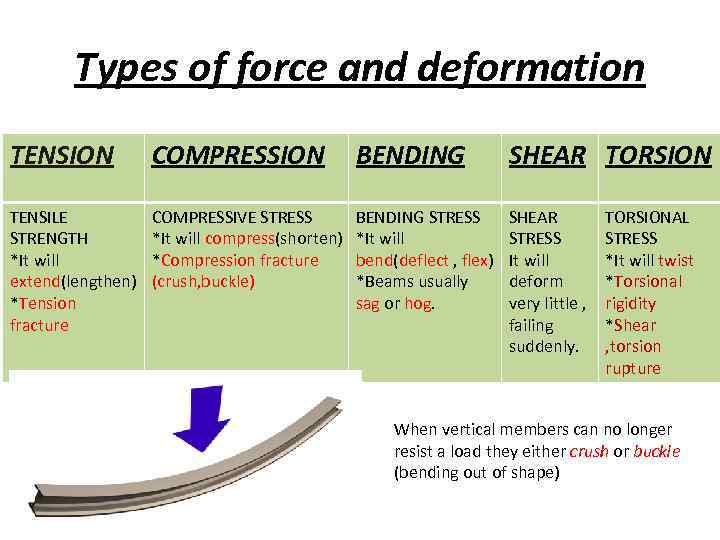 Types of force and deformation TENSION COMPRESSION BENDING SHEAR TORSION TENSILE STRENGTH *It will extend(lengthen) *Tension fracture COMPRESSIVE STRESS *It will compress(shorten) *Compression fracture (crush, buckle) BENDING STRESS *It will bend(deflect , flex) *Beams usually sag or hog. SHEAR STRESS It will deform very little , failing suddenly. TORSIONAL STRESS *It will twist *Torsional rigidity *Shear , torsion rupture When vertical members can no longer resist a load they either crush or buckle (bending out of shape)
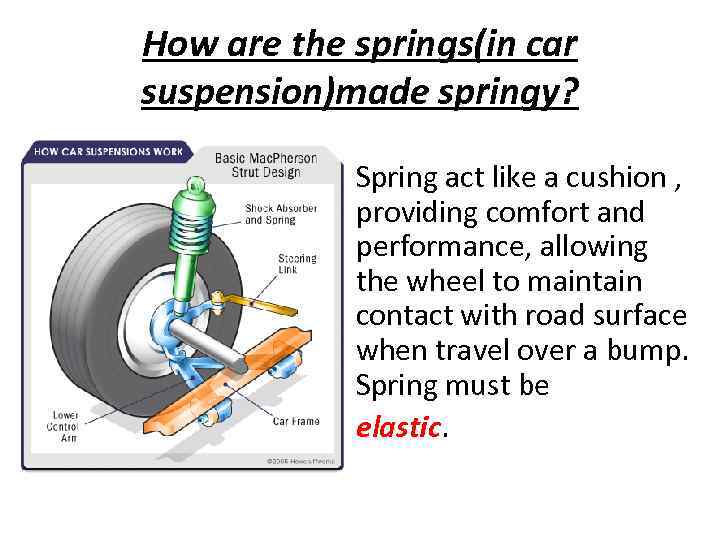 How are the springs(in car suspension)made springy? Spring act like a cushion , providing comfort and performance, allowing the wheel to maintain contact with road surface when travel over a bump. Spring must be elastic.
 Elasticity and plasticity Elasticity-ability to extend significantly, but still return to their original shape(rubber) Low elasticity , strong => stiff Low elasticity , weak => brittle (glass) Plasticity-ability to change shape significantly, but DO NOT return to their original shape Can be plastically deformed by hammering or rolling=> malleable(lead , Pb) Can be stretched into a long length=> ductile(Cu)
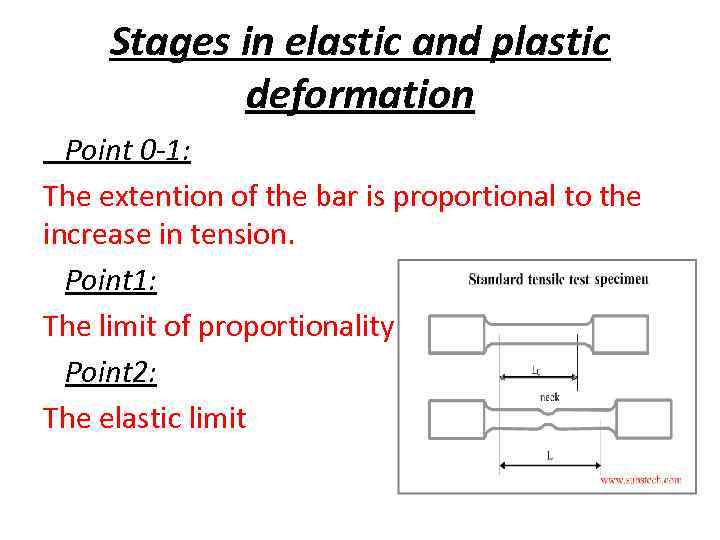 Stages in elastic and plastic deformation Point 0 -1: The extention of the bar is proportional to the increase in tension. Point 1: The limit of proportionality Point 2: The elastic limit
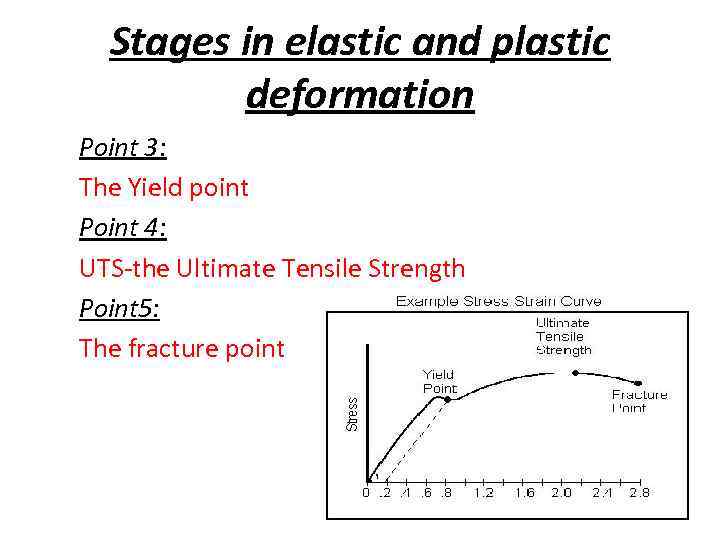 Stages in elastic and plastic deformation Point 3: The Yield point Point 4: UTS-the Ultimate Tensile Strength Point 5: The fracture point
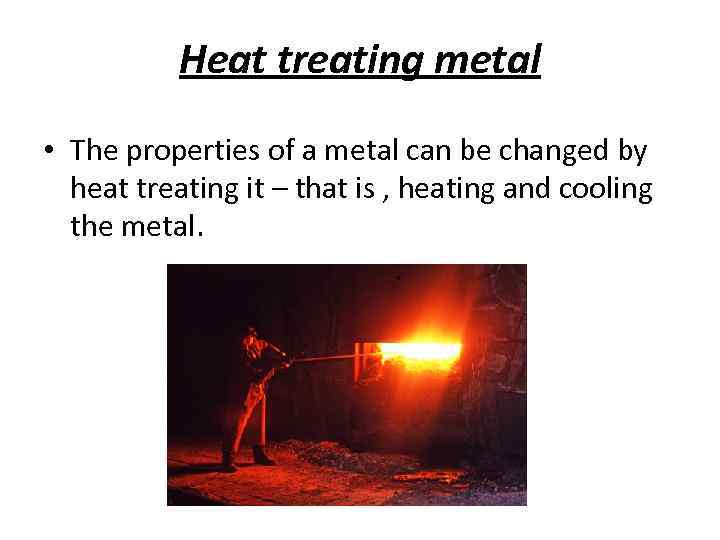 Heat treating metal • The properties of a metal can be changed by heat treating it – that is , heating and cooling the metal.
 The main types of heat treatment • Quenching(quenched metal is harder , but tends to be more brittle) • Annealing(annealed metal is generally softer and more elastic) • Tempering(tempered metal possesses a balance between hardness and elastisity) • Age hardening, surface hardening
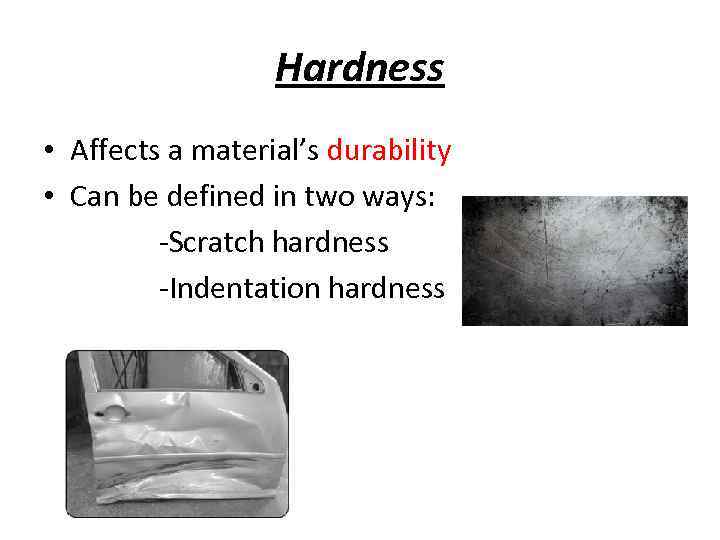 Hardness • Affects a material’s durability • Can be defined in two ways: -Scratch hardness -Indentation hardness
 Fatigue / creep There are two important problems: • Fatigue(caused by cyclic loads) • Creep(components Become permanently damaged)
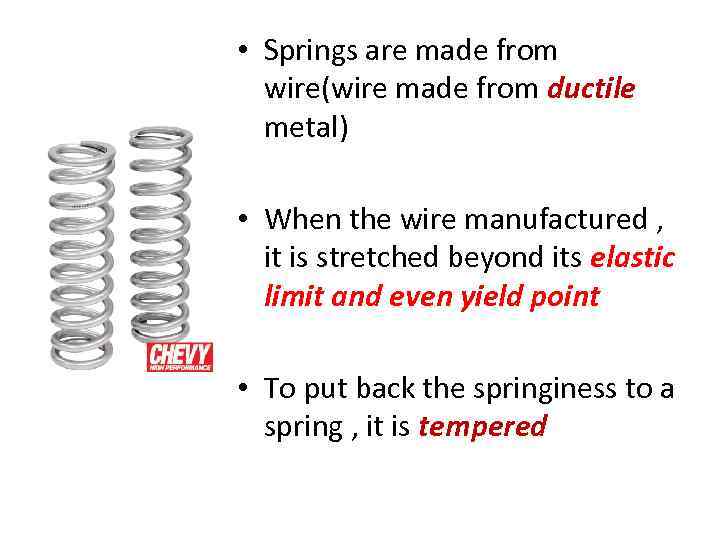 • Springs are made from wire(wire made from ductile metal) • When the wire manufactured , it is stretched beyond its elastic limit and even yield point • To put back the springiness to a spring , it is tempered
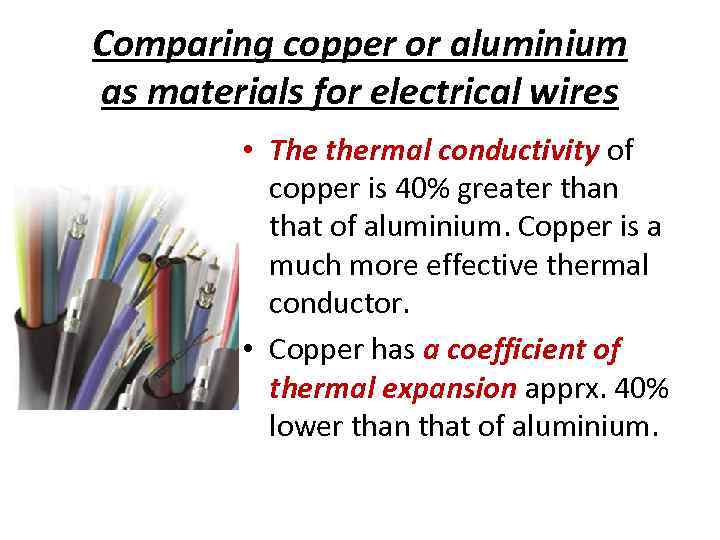 Comparing copper or aluminium as materials for electrical wires • The thermal conductivity of copper is 40% greater than that of aluminium. Copper is a much more effective thermal conductor. • Copper has a coefficient of thermal expansion apprx. 40% lower than that of aluminium.
 TO BE CONTINUED