


 Скачать презентацию Matching in 2 D Readings Ch 11 Sec
3e5bdb9888687c2791db898cee5e86bf.ppt
- Количество слайдов: 55
 Matching in 2 D Readings: Ch. 11: Sec. 11. 1 -11. 6 • alignment • point representations and 2 D transformations • solving for 2 D transformations from point correspondences • some methodologies for alignment • local-feature-focus method • pose clustering • geometric hashing • relational matching
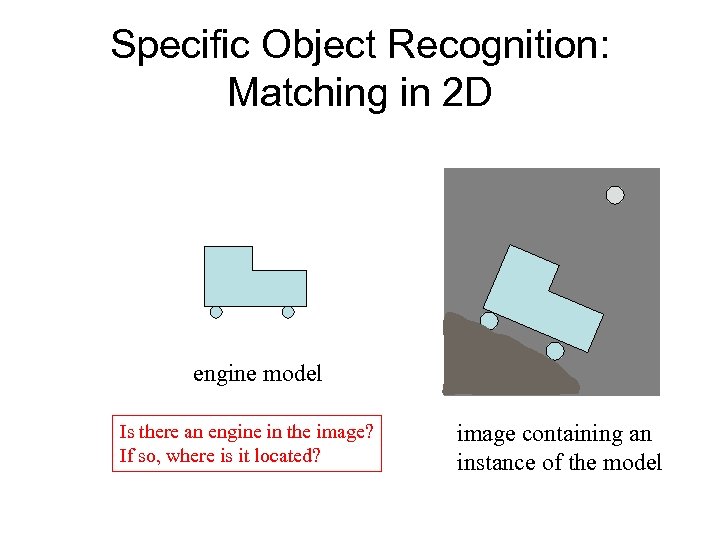 Specific Object Recognition: Matching in 2 D engine model Is there an engine in the image? If so, where is it located? image containing an instance of the model
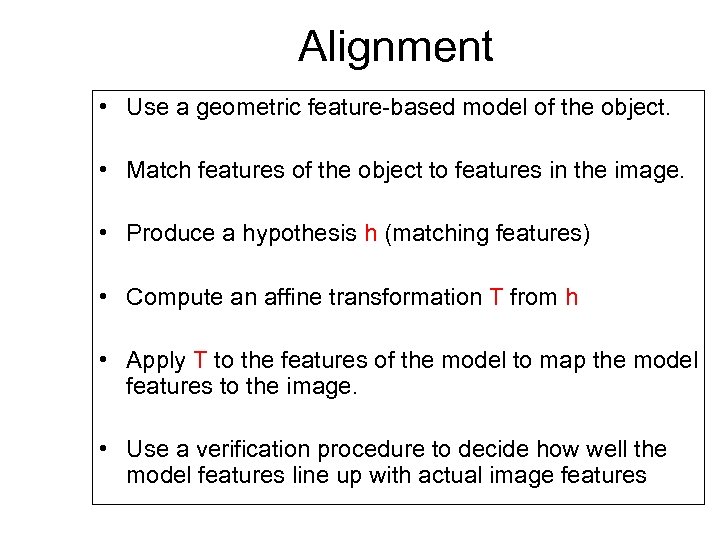 Alignment • Use a geometric feature-based model of the object. • Match features of the object to features in the image. • Produce a hypothesis h (matching features) • Compute an affine transformation T from h • Apply T to the features of the model to map the model features to the image. • Use a verification procedure to decide how well the model features line up with actual image features
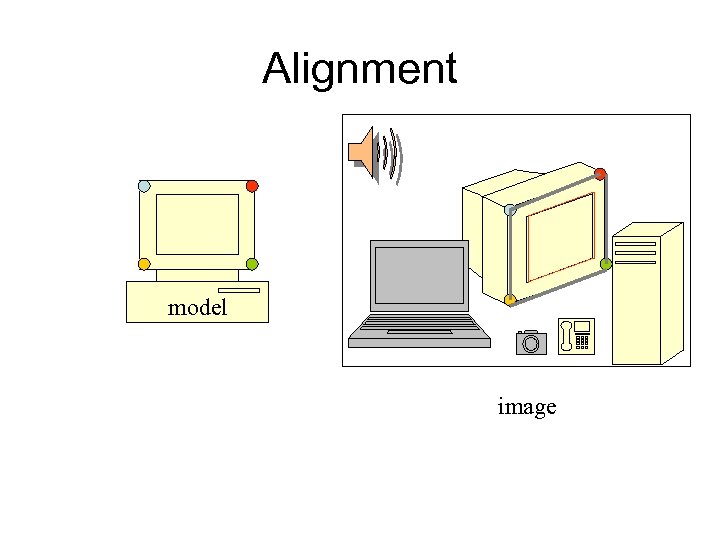 Alignment model image
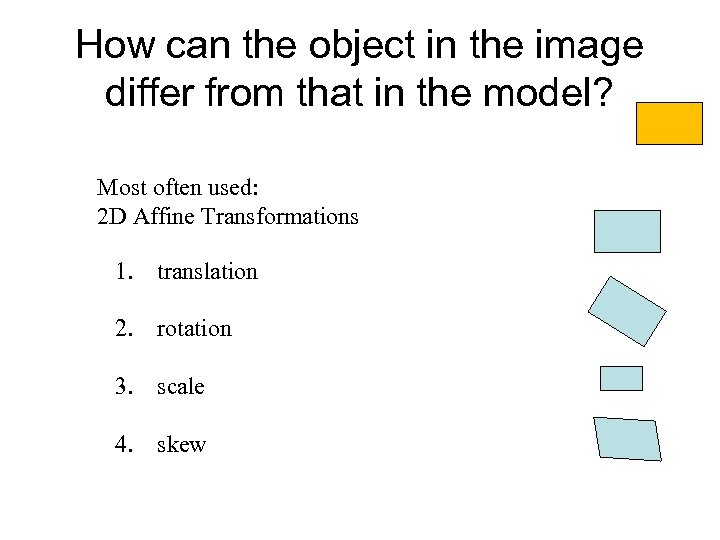 How can the object in the image differ from that in the model? Most often used: 2 D Affine Transformations 1. translation 2. rotation 3. scale 4. skew
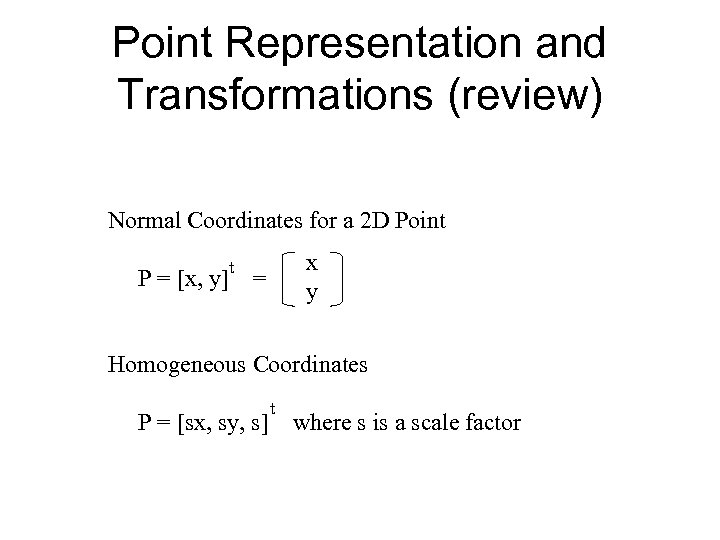 Point Representation and Transformations (review) Normal Coordinates for a 2 D Point P = [x, y] t x y = Homogeneous Coordinates t P = [sx, sy, s] where s is a scale factor
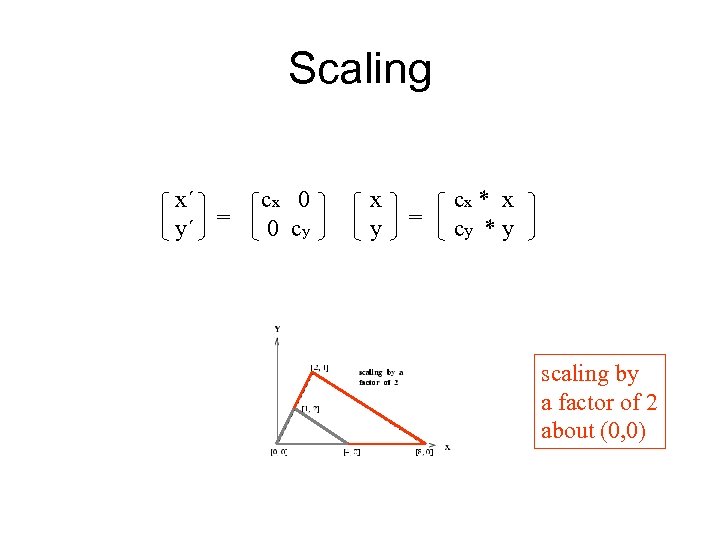 Scaling x´ y´ = cx 0 0 cy x y = cx * x cy * y scaling by a factor of 2 about (0, 0)
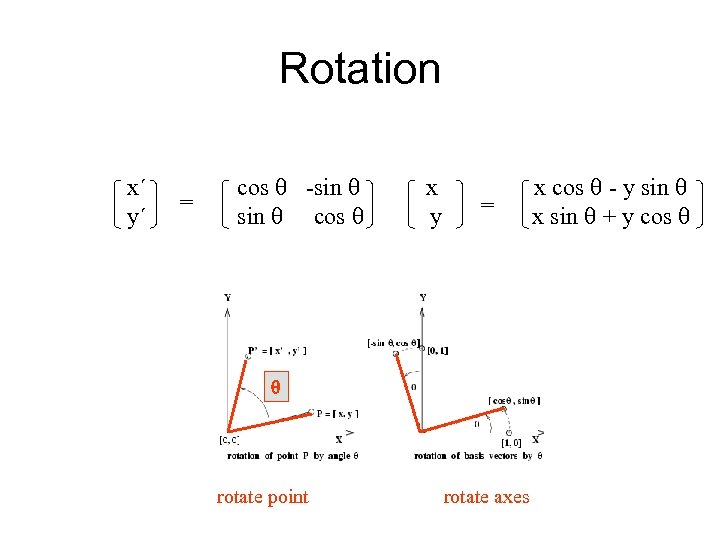 Rotation x´ y´ = cos -sin cos x y = rotate point rotate axes x cos - y sin x sin + y cos
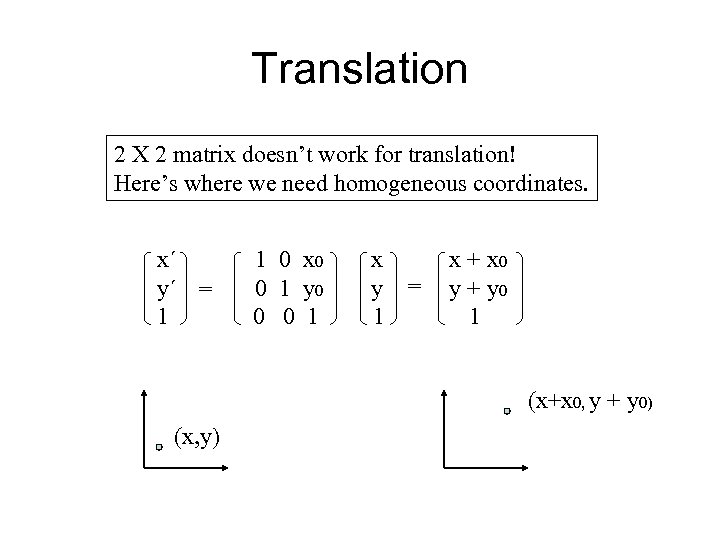 Translation 2 X 2 matrix doesn’t work for translation! Here’s where we need homogeneous coordinates. x´ y´ = 1 1 0 x 0 0 1 y 0 0 0 1 x y = 1 x + x 0 y + y 0 1 (x+x 0, y + y 0) (x, y)
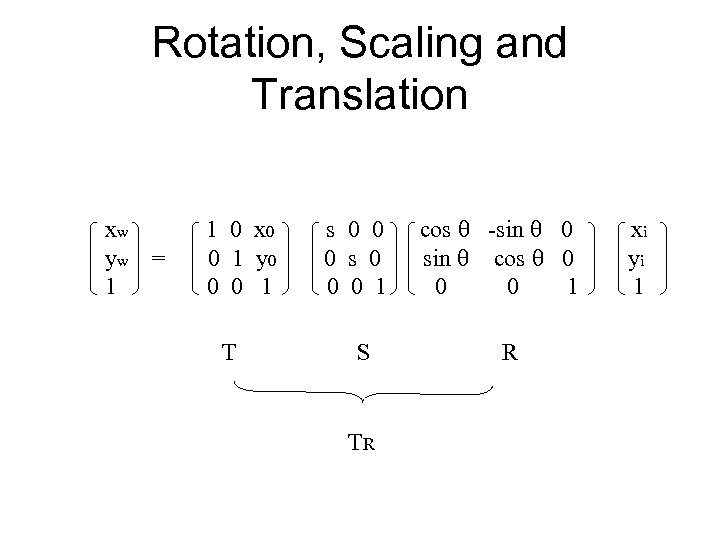 Rotation, Scaling and Translation xw yw 1 = 1 0 x 0 0 1 y 0 0 0 1 T s 0 0 0 1 S TR cos -sin 0 sin cos 0 0 0 1 R xi yi 1
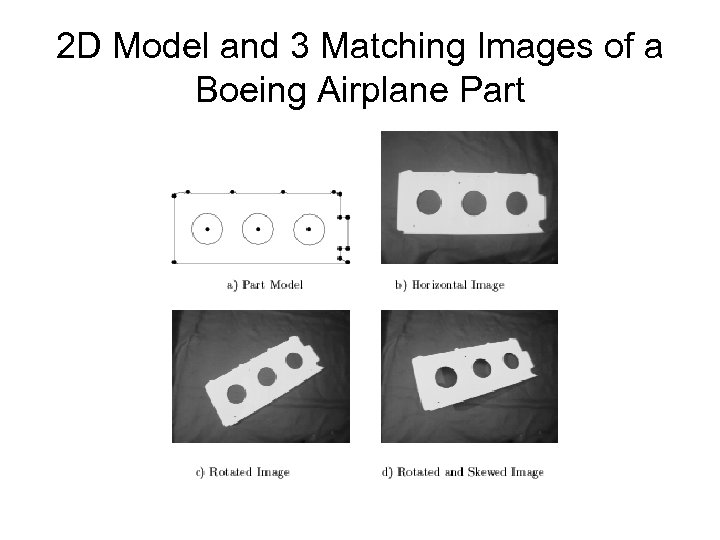 2 D Model and 3 Matching Images of a Boeing Airplane Part
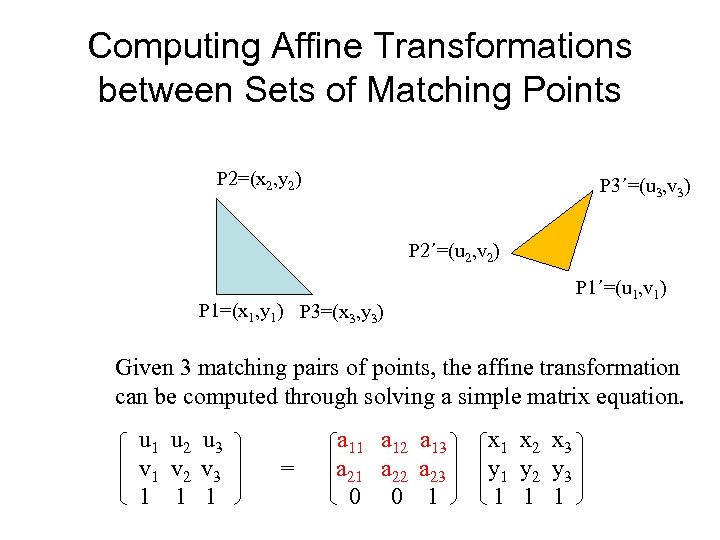 Computing Affine Transformations between Sets of Matching Points P 2=(x 2, y 2) P 3´=(u 3, v 3) P 2´=(u 2, v 2) P 1´=(u 1, v 1) P 1=(x 1, y 1) P 3=(x 3, y 3) Given 3 matching pairs of points, the affine transformation can be computed through solving a simple matrix equation. u 1 u 2 u 3 v 1 v 2 v 3 1 1 1 = a 11 a 12 a 13 a 21 a 22 a 23 0 0 1 x 2 x 3 y 1 y 2 y 3 1 1 1
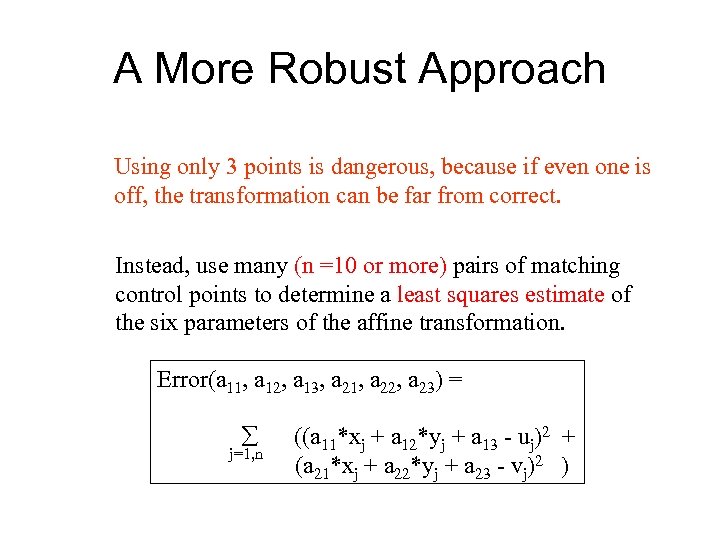 A More Robust Approach Using only 3 points is dangerous, because if even one is off, the transformation can be far from correct. Instead, use many (n =10 or more) pairs of matching control points to determine a least squares estimate of the six parameters of the affine transformation. Error(a 11, a 12, a 13, a 21, a 22, a 23) = j=1, n ((a 11*xj + a 12*yj + a 13 - uj)2 + (a 21*xj + a 22*yj + a 23 - vj)2 )
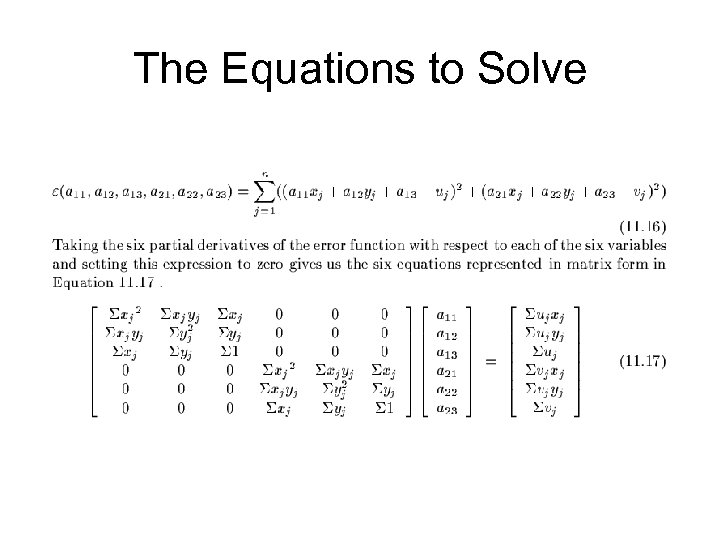 The Equations to Solve
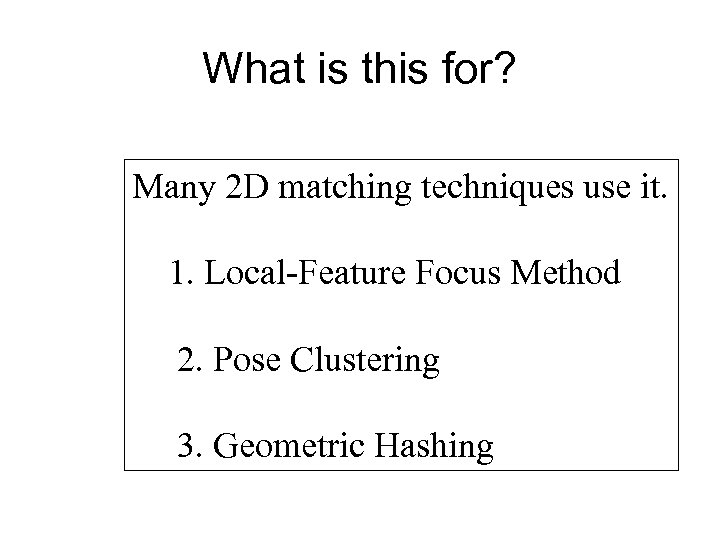 What is this for? Many 2 D matching techniques use it. 1. Local-Feature Focus Method 2. Pose Clustering 3. Geometric Hashing
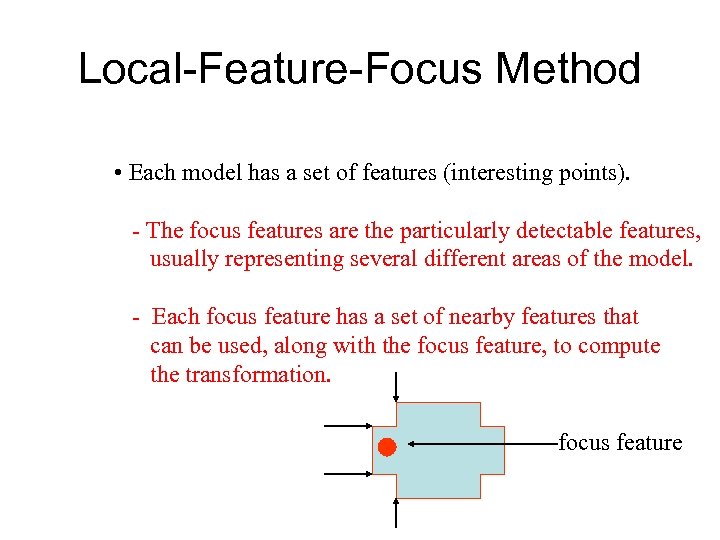 Local-Feature-Focus Method • Each model has a set of features (interesting points). - The focus features are the particularly detectable features, usually representing several different areas of the model. - Each focus feature has a set of nearby features that can be used, along with the focus feature, to compute the transformation. focus feature
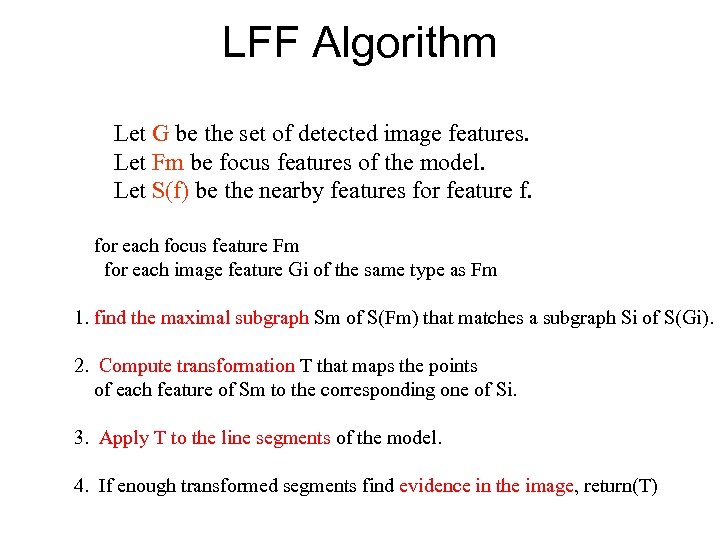 LFF Algorithm Let G be the set of detected image features. Let Fm be focus features of the model. Let S(f) be the nearby features for feature f. for each focus feature Fm for each image feature Gi of the same type as Fm 1. find the maximal subgraph Sm of S(Fm) that matches a subgraph Si of S(Gi). 2. Compute transformation T that maps the points of each feature of Sm to the corresponding one of Si. 3. Apply T to the line segments of the model. 4. If enough transformed segments find evidence in the image, return(T)
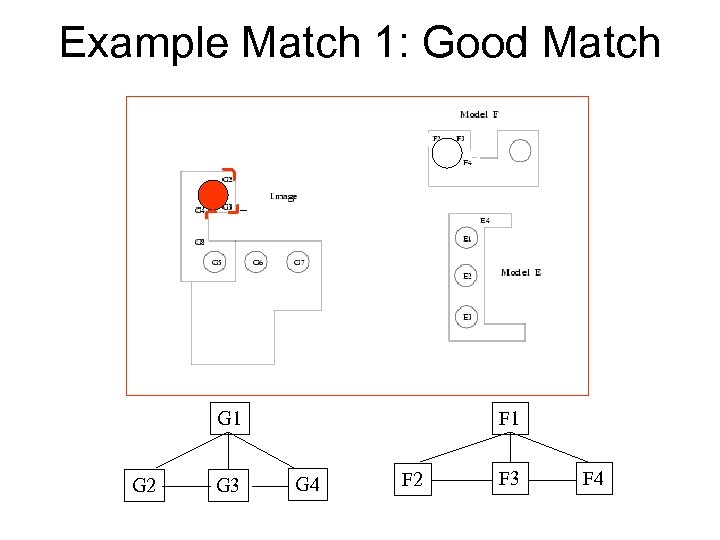 Example Match 1: Good Match G 1 G 2 G 3 F 1 G 4 F 2 F 3 F 4
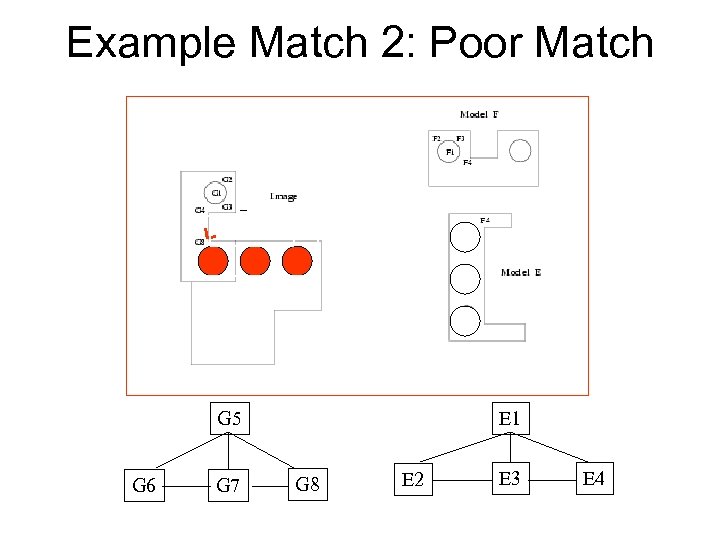 Example Match 2: Poor Match G 5 G 6 G 7 E 1 G 8 E 2 E 3 E 4
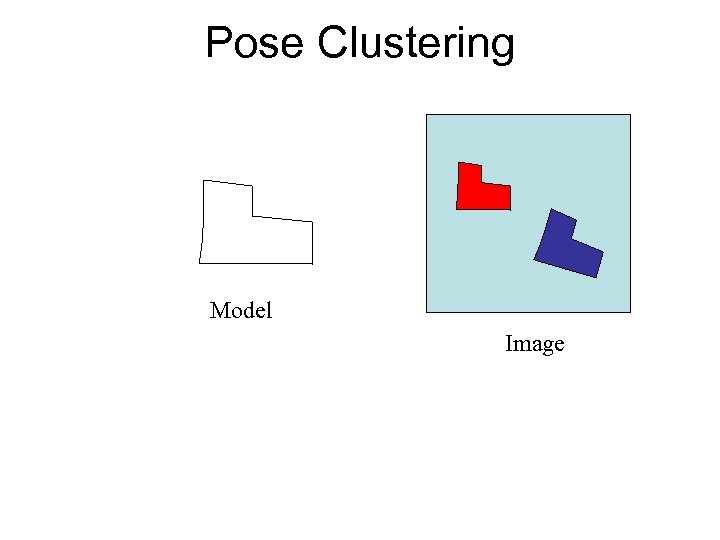
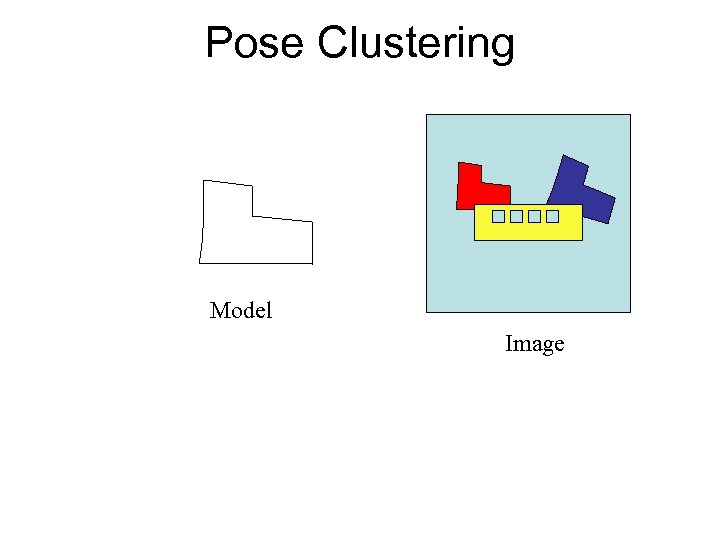
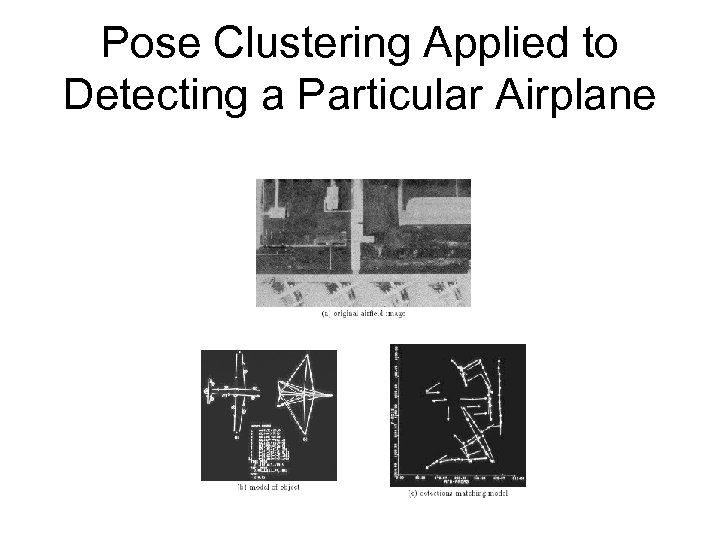
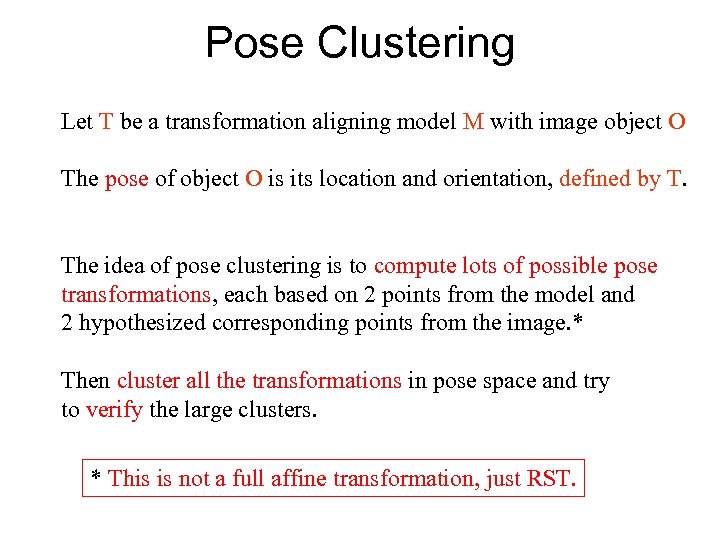 Pose Clustering Let T be a transformation aligning model M with image object O The pose of object O is its location and orientation, defined by T. The idea of pose clustering is to compute lots of possible pose transformations, each based on 2 points from the model and 2 hypothesized corresponding points from the image. * Then cluster all the transformations in pose space and try to verify the large clusters. * This is not a full affine transformation, just RST.
 Pose Clustering Model Image
 Pose Clustering Model Image
 Pose Clustering Applied to Detecting a Particular Airplane
 Geometric Hashing • This method was developed for the case where there is a whole database of models to try to find in an image. • It trades: a large amount of offline preprocessing and a large amount of space • for potentially fast online object recognition pose detection
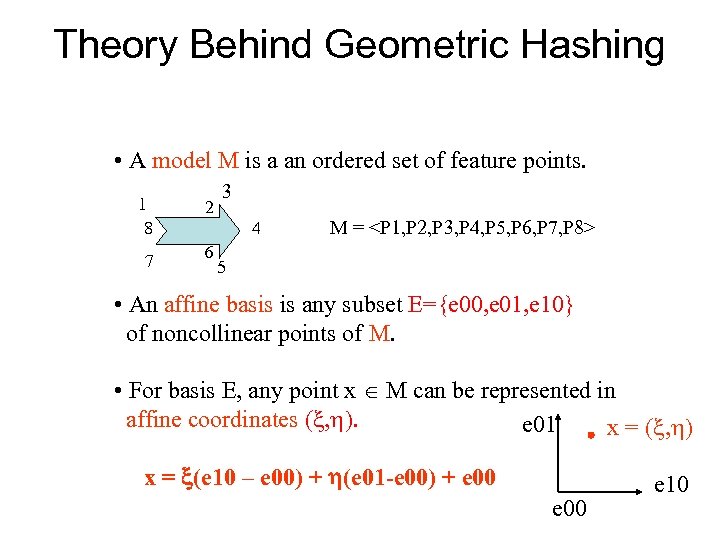 Theory Behind Geometric Hashing • A model M is a an ordered set of feature points. 1 8 2 7 6 3 4 M =
5 • An affine basis is any subset E={e 00, e 01, e 10} of noncollinear points of M. • For basis E, any point x M can be represented in affine coordinates ( , ). e 01 x = ( , ) x = (e 10 – e 00) + (e 01 -e 00) + e 00 e 10
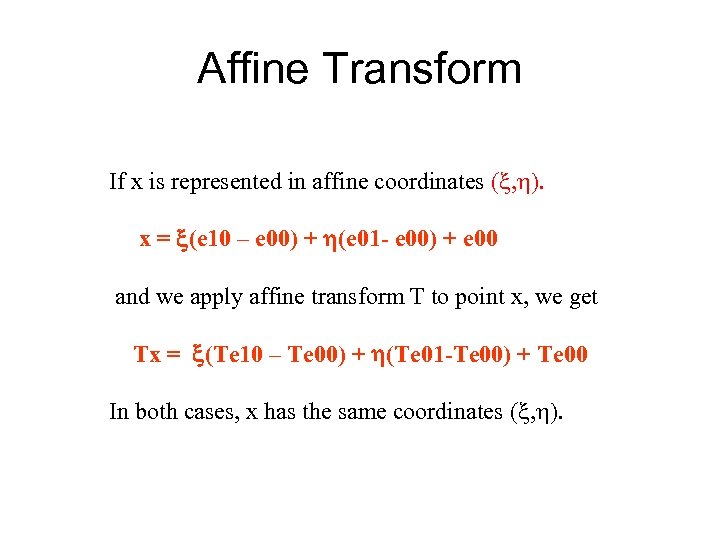 Affine Transform If x is represented in affine coordinates ( , ). x = (e 10 – e 00) + (e 01 - e 00) + e 00 and we apply affine transform T to point x, we get Tx = (Te 10 – Te 00) + (Te 01 -Te 00) + Te 00 In both cases, x has the same coordinates ( , ).
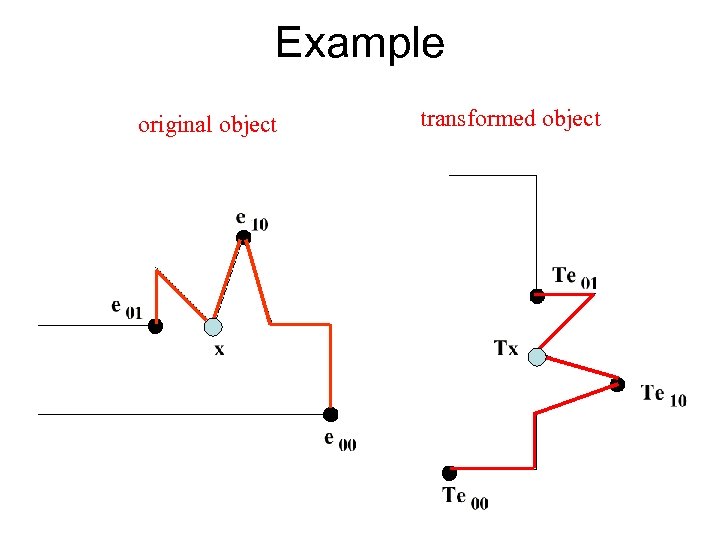 Example original object transformed object
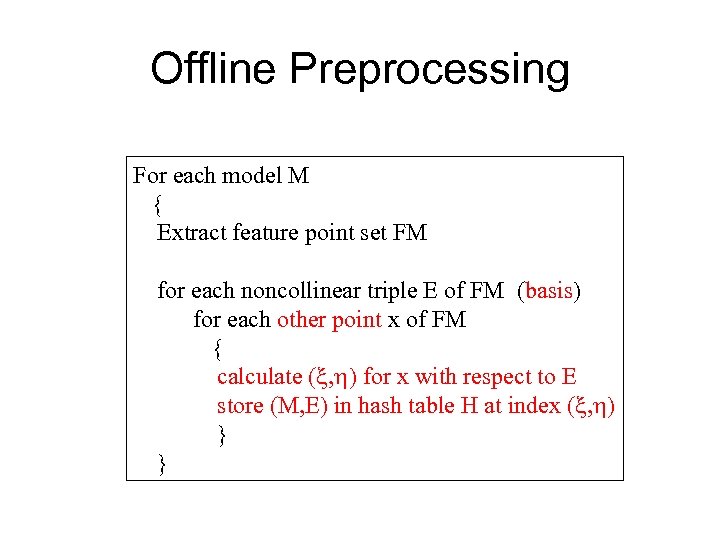 Offline Preprocessing For each model M { Extract feature point set FM for each noncollinear triple E of FM (basis) for each other point x of FM { calculate ( , ) for x with respect to E store (M, E) in hash table H at index ( , ) } }
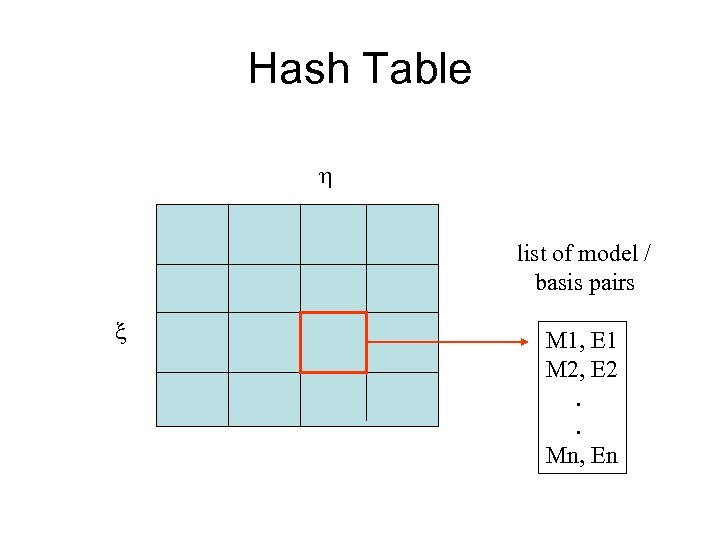 Hash Table list of model / basis pairs M 1, E 1 M 2, E 2. . Mn, En
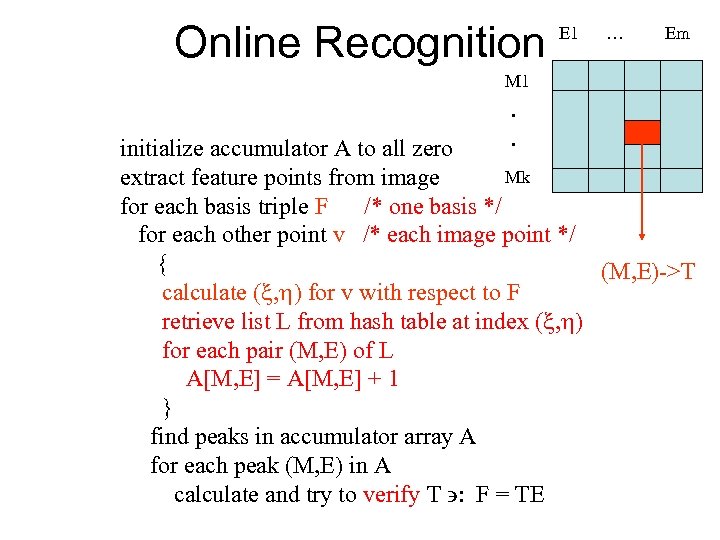 Online Recognition E 1 … Em M 1 . . initialize accumulator A to all zero Mk extract feature points from image for each basis triple F /* one basis */ for each other point v /* each image point */ { (M, E)->T calculate ( , ) for v with respect to F retrieve list L from hash table at index ( , ) for each pair (M, E) of L A[M, E] = A[M, E] + 1 } find peaks in accumulator array A for each peak (M, E) in A calculate and try to verify T : F = TE
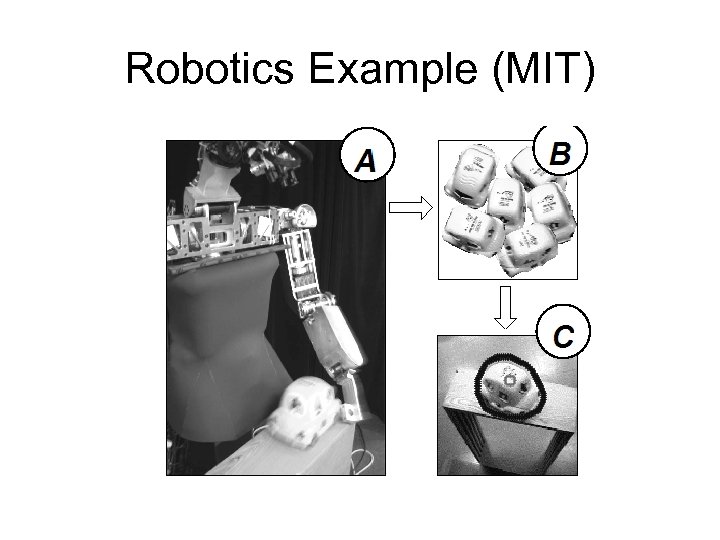 Robotics Example (MIT)
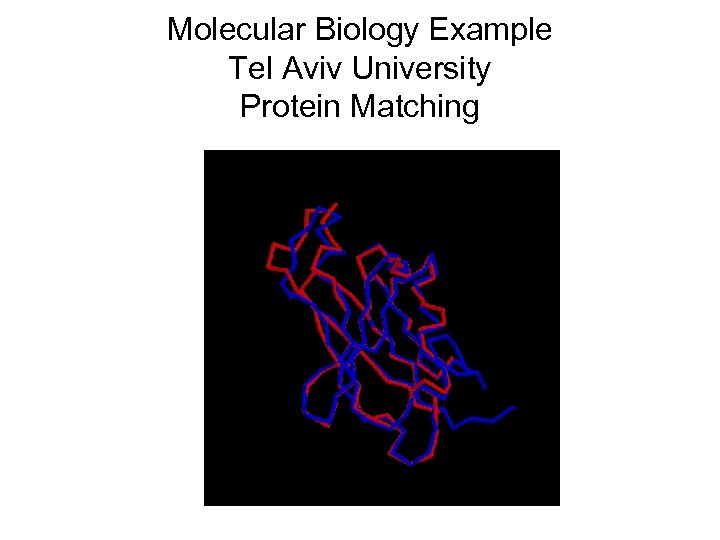 Molecular Biology Example Tel Aviv University Protein Matching
 Verification How well does the transformed model line up with the image. • compare positions of feature points • compare full line or curve segments Whole segments work better, allow less halucination, but there’s a higher cost in execution time.
 2 D Matching Mechanisms • We can formalize the recognition problem as finding a mapping from model structures to image structures. • Then we can look at different paradigms for solving it. - interpretation tree search - discrete relaxation - relational distance - continuous relaxation
 Formalism • A part (unit) is a structure in the scene, such as a region or segment or corner. • A label is a symbol assigned to identify the part. • An N-ary relation is a set of N-tuples defined over a set of parts or a set of labels. • An assignment is a mapping from parts to labels.
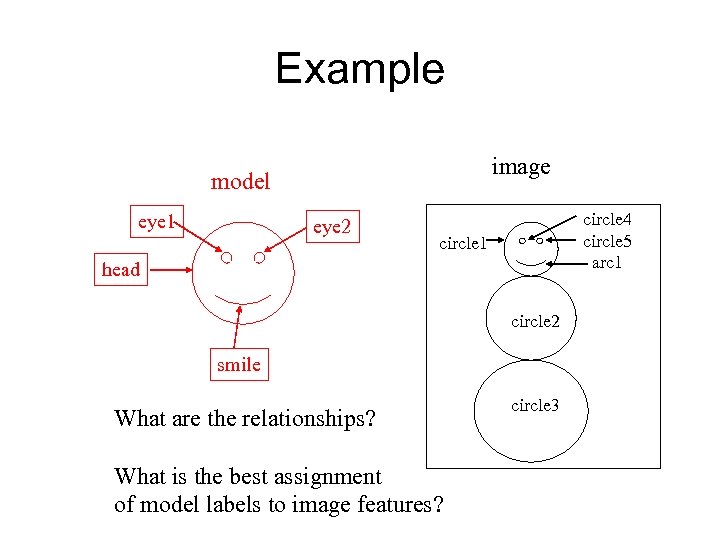 Example image model eye 1 eye 2 circle 4 circle 5 arc 1 circle 1 head circle 2 smile What are the relationships? What is the best assignment of model labels to image features? circle 3
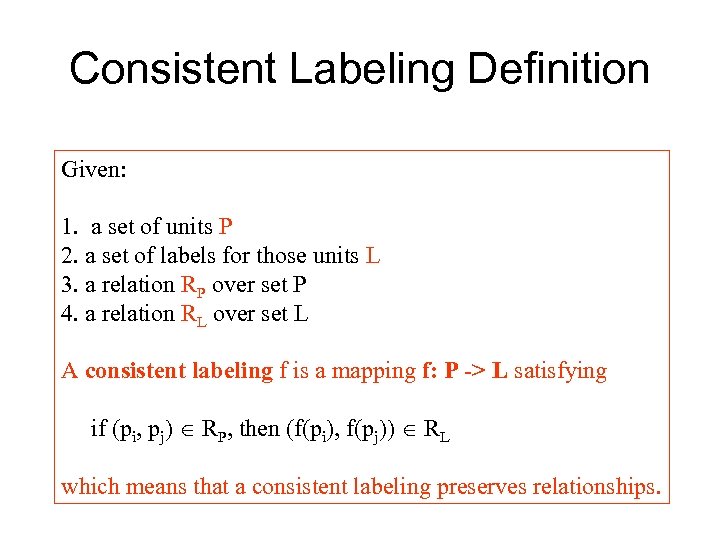 Consistent Labeling Definition Given: 1. a set of units P 2. a set of labels for those units L 3. a relation RP over set P 4. a relation RL over set L A consistent labeling f is a mapping f: P -> L satisfying if (pi, pj) RP, then (f(pi), f(pj)) RL which means that a consistent labeling preserves relationships.
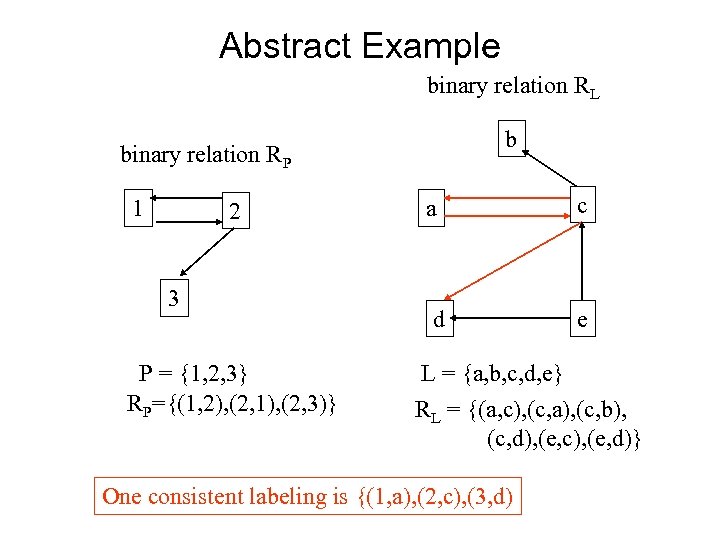 Abstract Example binary relation RL b binary relation RP 1 2 3 P = {1, 2, 3} RP={(1, 2), (2, 1), (2, 3)} a d c e L = {a, b, c, d, e} RL = {(a, c), (c, a), (c, b), (c, d), (e, c), (e, d)} One consistent labeling is {(1, a), (2, c), (3, d)
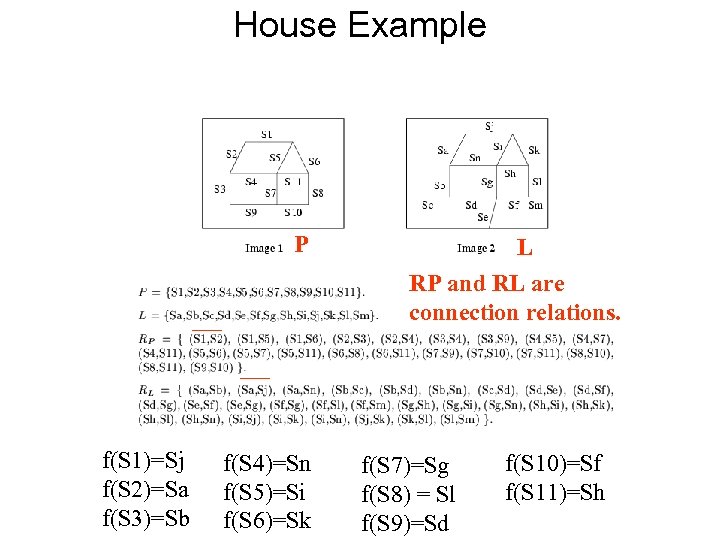 House Example P f(S 1)=Sj f(S 2)=Sa f(S 3)=Sb f(S 4)=Sn f(S 5)=Si f(S 6)=Sk L RP and RL are connection relations. f(S 7)=Sg f(S 8) = Sl f(S 9)=Sd f(S 10)=Sf f(S 11)=Sh
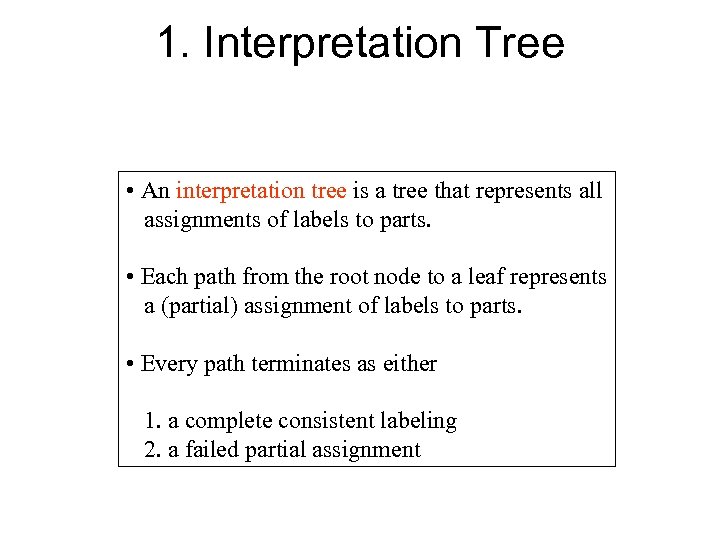 1. Interpretation Tree • An interpretation tree is a tree that represents all assignments of labels to parts. • Each path from the root node to a leaf represents a (partial) assignment of labels to parts. • Every path terminates as either 1. a complete consistent labeling 2. a failed partial assignment
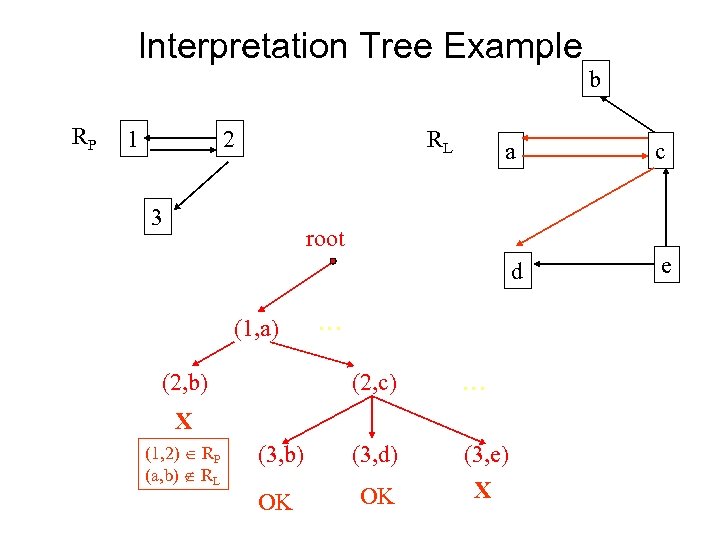 Interpretation Tree Example RP 1 2 RL b c d 3 a e root (1, a) (2, b) … (2, c) … (3, b) (3, d) OK OK (3, e) X X (1, 2) RP (a, b) RL
 2. Discrete Relaxation • Discrete relaxation is an alternative to (or addition to) the interpretation tree search. • Relaxation is an iterative technique with polynomial time complexity. • Relaxation uses local constraints at each iteration. • It can be implemented on parallel machines.
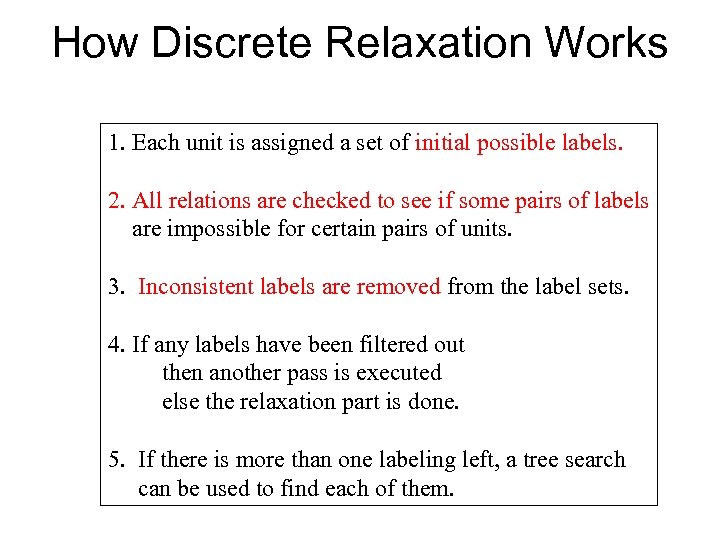 How Discrete Relaxation Works 1. Each unit is assigned a set of initial possible labels. 2. All relations are checked to see if some pairs of labels are impossible for certain pairs of units. 3. Inconsistent labels are removed from the label sets. 4. If any labels have been filtered out then another pass is executed else the relaxation part is done. 5. If there is more than one labeling left, a tree search can be used to find each of them.
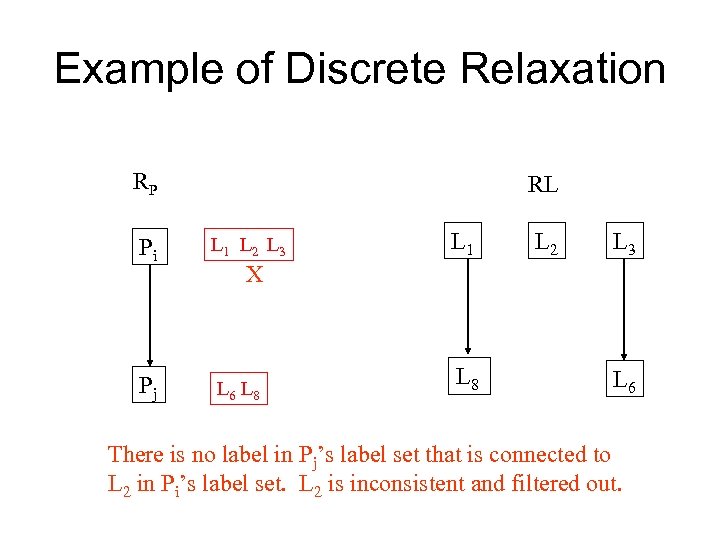 Example of Discrete Relaxation RP RL Pi L 1 L 2 L 3 Pj L 6 L 8 L 1 L 2 L 3 X L 8 L 6 There is no label in Pj’s label set that is connected to L 2 in Pi’s label set. L 2 is inconsistent and filtered out.
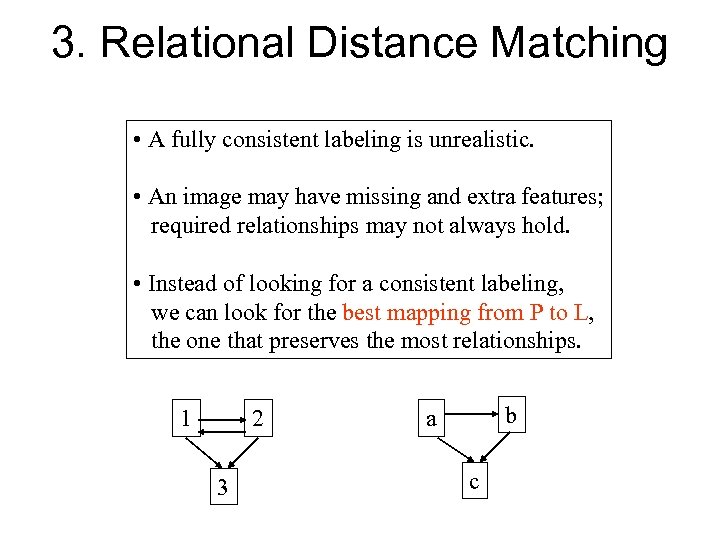 3. Relational Distance Matching • A fully consistent labeling is unrealistic. • An image may have missing and extra features; required relationships may not always hold. • Instead of looking for a consistent labeling, we can look for the best mapping from P to L, the one that preserves the most relationships. 1 2 3 b a c
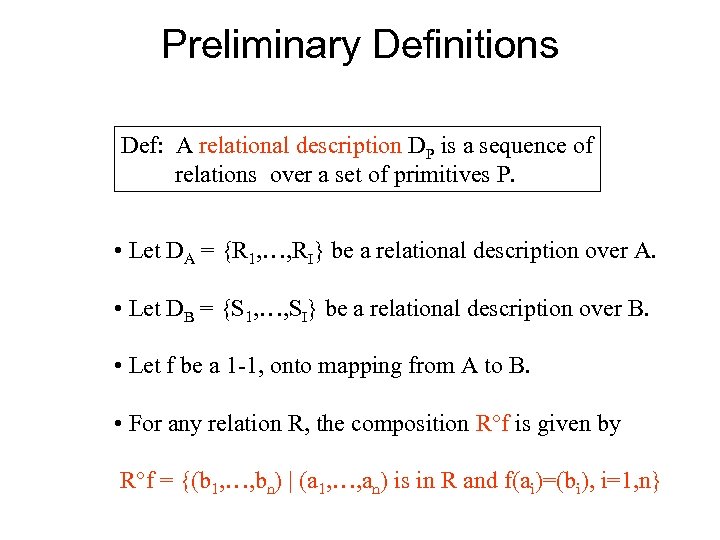 Preliminary Definitions Def: A relational description DP is a sequence of relations over a set of primitives P. • Let DA = {R 1, …, RI} be a relational description over A. • Let DB = {S 1, …, SI} be a relational description over B. • Let f be a 1 -1, onto mapping from A to B. • For any relation R, the composition R f is given by R f = {(b 1, …, bn) | (a 1, …, an) is in R and f(ai)=(bi), i=1, n}
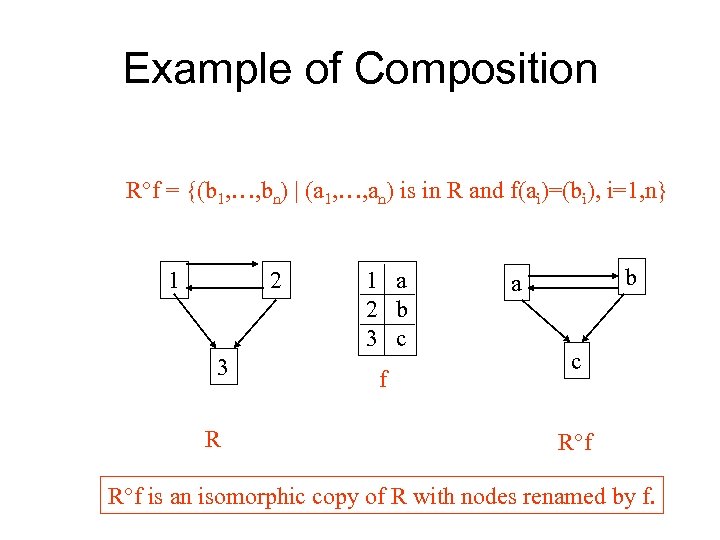 Example of Composition R f = {(b 1, …, bn) | (a 1, …, an) is in R and f(ai)=(bi), i=1, n} 1 2 3 R 1 a 2 b 3 c f b a c R f is an isomorphic copy of R with nodes renamed by f.
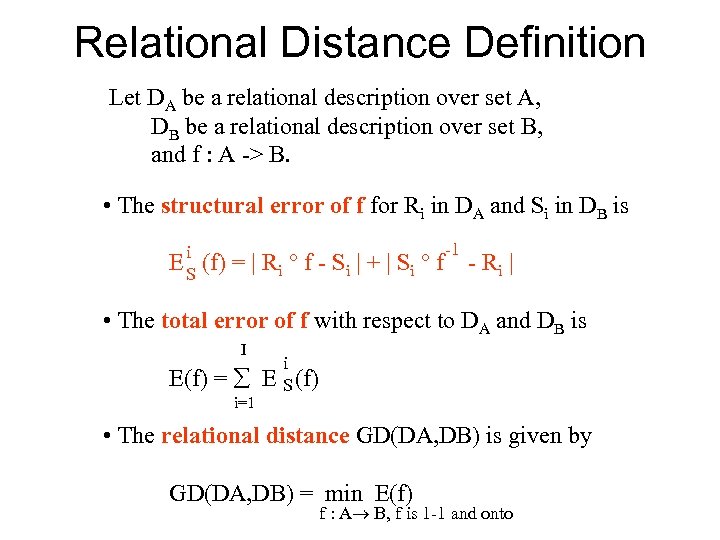 Relational Distance Definition Let DA be a relational description over set A, DB be a relational description over set B, and f : A -> B. • The structural error of f for Ri in DA and Si in DB is i ES (f) = | Ri f - Si | + | Si f -1 - Ri | • The total error of f with respect to DA and DB is I E(f) = E i=1 i S (f) • The relational distance GD(DA, DB) is given by GD(DA, DB) = min E(f) f : A B, f is 1 -1 and onto
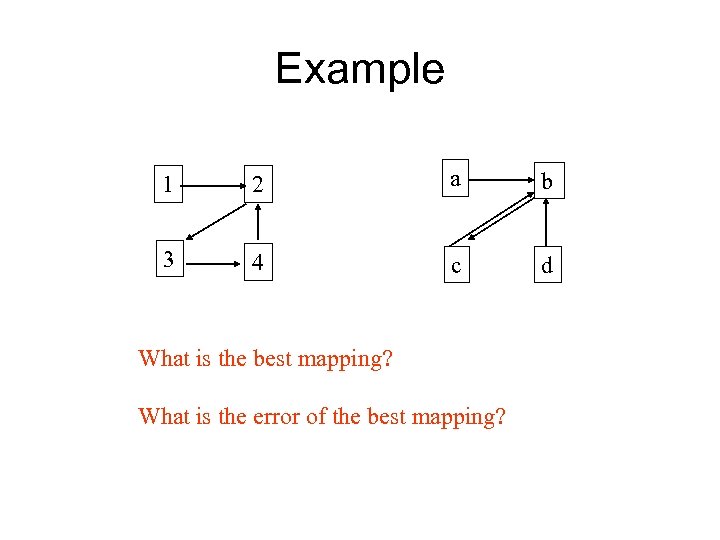 Example 1 2 a b 3 4 c d What is the best mapping? What is the error of the best mapping?
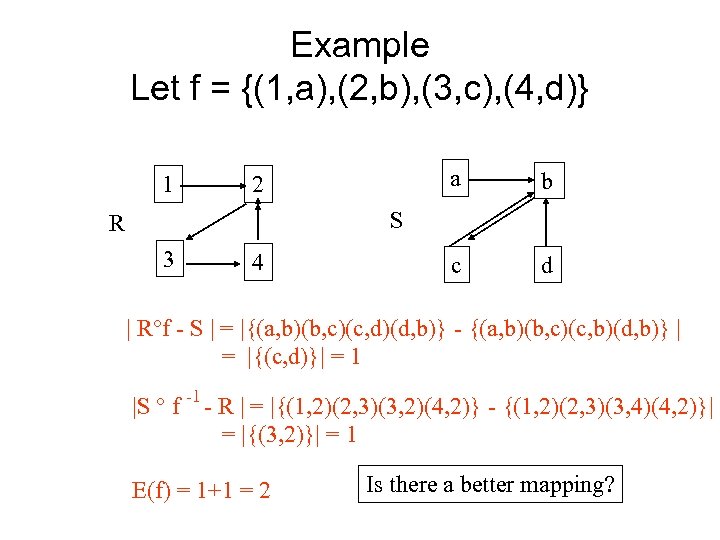 Example Let f = {(1, a), (2, b), (3, c), (4, d)} 1 a b c 2 d S R 3 4 | R f - S | = |{(a, b)(b, c)(c, d)(d, b)} - {(a, b)(b, c)(c, b)(d, b)} | = |{(c, d)}| = 1 |S f -1 - R | = |{(1, 2)(2, 3)(3, 2)(4, 2)} - {(1, 2)(2, 3)(3, 4)(4, 2)}| = |{(3, 2)}| = 1 E(f) = 1+1 = 2 Is there a better mapping?
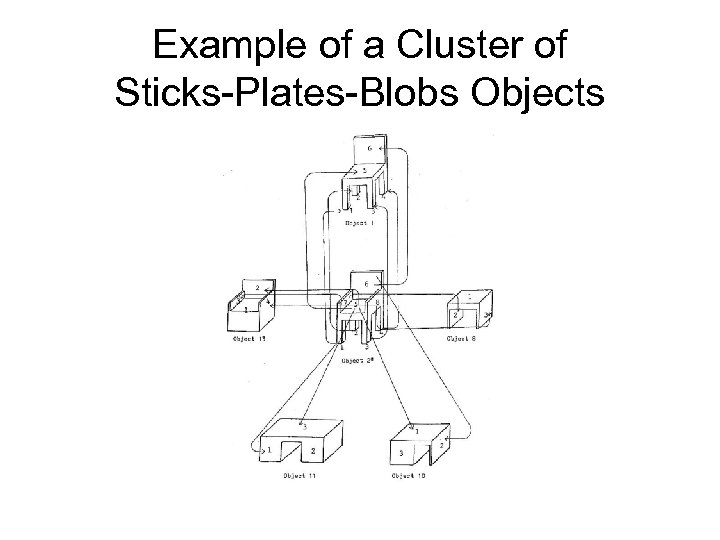 Example of a Cluster of Sticks-Plates-Blobs Objects
 Variations • Different weights on different relations • Normalize error by dividing by total possible • Attributed relational distance for attributed relations • Penalizing for NIL mappings
 Implementation • Relational distance requires finding the lowest cost mapping from object features to image features. • It is typically done using a branch and bound tree search. • The search keeps track of the error after each object part is assigned an image feature. • When the error becomes higher than the best mapping found so far, it backs up. • It can also use discrete relaxation or forward checking (see Russel AI book on Constraint Satisfaction) to prune the search.
 4. Continuous Relaxation • In discrete relaxation, a label for a unit is either possible or not. • In continuous relaxation, each (unit, label) pair has a probability. • Every label for unit i has a prior probability. • A set of compatibility coefficients C = {cij} gives the influence that the label of unit i has on the label of unit j. • The relationship R is replaced by a set of unit/label compatibilities where rij(l, l´) is the compatibility of label l for part i with label l´ for part j. • An iterative process updates the probability of each label for each unit in terms of its previous probability and the compatibilities of its current labels and those of other units that influence it.
 Summary • 2 D object recognition for specific objects (usually industrial) is done by alignment. -Affine transformations are usually powerful enough to handle objects that are mainly two-dimensional. -Matching can be performed by many different “graph-matching” methodologies. -Verification is a necessary part of the procedure. • Appearance-based recognition is another 2 D recognition paradigm that came from the need for recognizing specific instances of a general object class, motivated by face recognition. • Parts-based recognition combines appearance-based recognition with interest-region detection. It has been used to recognize multiple generic object classes.