 Скачать презентацию Matakuliah Tahun Versi F 0662 Web Based
86097cdafb403ad062a39982665e600d.ppt
- Количество слайдов: 135



Matakuliah Tahun Versi : F 0662/ Web Based Accounting : 2005 : 1/0 Pertemuan 12 e. Business-AIS: Order Fulfillment, Internet Banking, Web Based Fixed Assets Systems 1
Learning Outcomes Pada akhir pertemuan ini, diharapkan mahasiswa akan mampu : • Menjelaskan Order Fulfillment (TK-12) • Menjelaskan Internet Banking in Cyber-space systems ( (TIK-12) • Fixed Assets Web Based Systems (TIK-12) 2
Outline Materi • Materi 1 Order Fulfillment • Materi 2 Internet Banking Cyberspace • Materi 3 Web Based Fixed Assets systems 3
Order Fulfillment, Content Management, and Other Support Services 4
Learning Objectives 1. Define EC order fulfillment and describe its process. 2. Describe the major problems of EC order fulfillment. 3. Describe the role of support services in EC. 4. Describe various solutions to EC order fulfillment problems. 5. Describe content issues & management of EC sites. 6. Describe other EC support services. 7. Discuss the drivers of outsourcing support services and the use of ASPs. 5
How Bikeworld Fulfills Orders • The Problem – Bike. World is known for its high-quality bicycles and components, expert advice, and personalized service – The company opened its Web site (bikeworld. com) in February 1996, hoping it would keep customers from using out-of-state mail-order houses 6
How Bikeworld Fulfills Orders (cont. ) – Bike. World encountered the problems of fulfillment and after-sale customer service – Sales over the Internet steadily increased – The time spent processing orders, manually shipping packages, and responding to customers’ order status inquiries overwhelmed the small company 7
How Bikeworld Fulfills Orders (cont. ) • The Solution – Bike. World outsourced its order fulfillment to Fed. Ex – Fed. Ex offered: • Reasonably priced quality express delivery • Exceeded customer expectations • Automated the fulfillment process 8
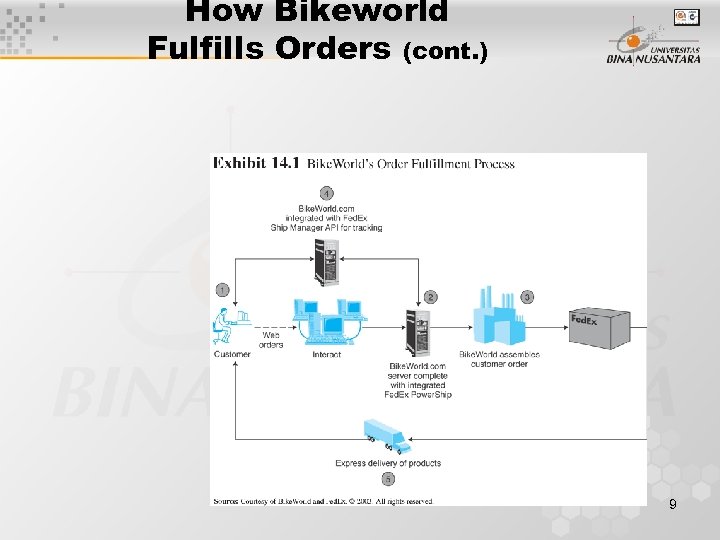
How Bikeworld Fulfills Orders (cont. ) 9
How Bikeworld Fulfills Orders (cont. ) • The Results – Four years after going online, sales volume has more than quadrupled and business is consistently profitable – Bike. World has: • A fully automated and scalable fulfillment system • Access to real-time order status, enhancing customer service and leading to greater customer retention • The ability to service customers around the globe 10
How Bikeworld Fulfills Orders (cont. ) • What we can learn… – Like many other e-tailers, Bike. World had neither the experience nor the resources to fulfill the orders it generated online – Its solution was to outsource the job to Fed. Ex, a major EC logistics company 11
Order Fulfillment and Logistics • Fulfillment and delivery to customers’ doors are the sticky parts of EC, factors responsible are: – an inability to accurately forecast demand – ineffective e-tailing supply chains – in “pull” operations (EC) orders are frequently a customized 12
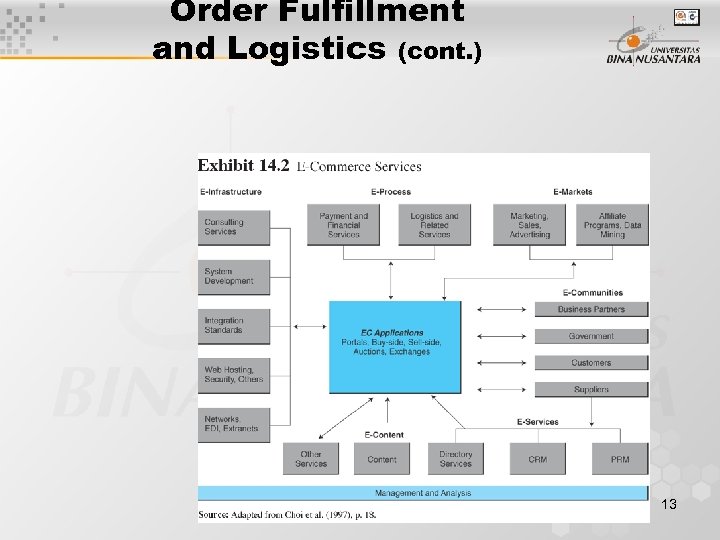
Order Fulfillment and Logistics (cont. ) 13
Order Fulfillment and Logistics (cont. ) • Order fulfillment: All the activities needed to provide customers with ordered goods and services, including related customer services 14
Order Fulfillment and Logistics (cont. ) • Back-office operations: The activities that support fulfillment of sales, such as accounting and logistics • Front-office operations: The business processes, such as sales and advertising, that are visible to customers 15
Order Fulfillment and Logistics (cont. ) • Logistics: The operations involved in the efficient and effective flow and storage of goods, services, and related information from point of origin to point of consumption 16
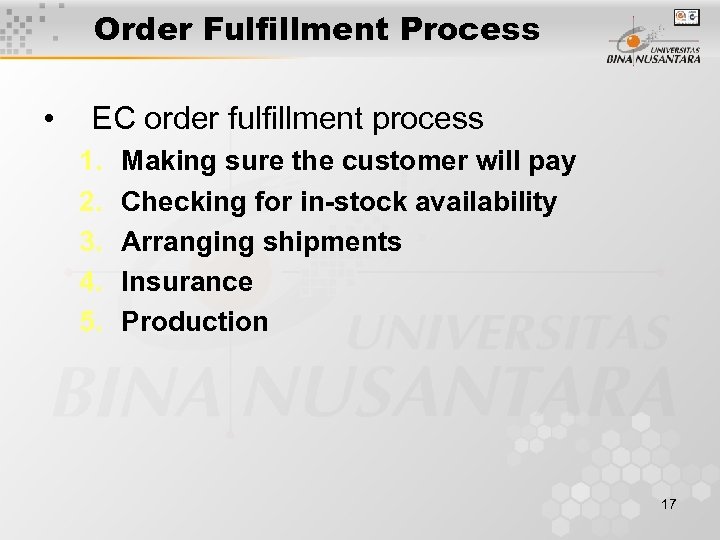
Order Fulfillment Process • EC order fulfillment process 1. 2. 3. 4. 5. Making sure the customer will pay Checking for in-stock availability Arranging shipments Insurance Production 17
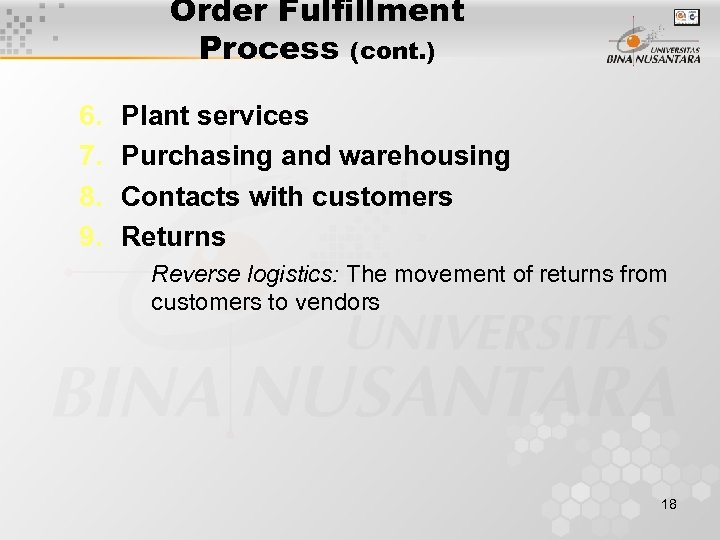
Order Fulfillment Process (cont. ) 6. 7. 8. 9. Plant services Purchasing and warehousing Contacts with customers Returns Reverse logistics: The movement of returns from customers to vendors 18
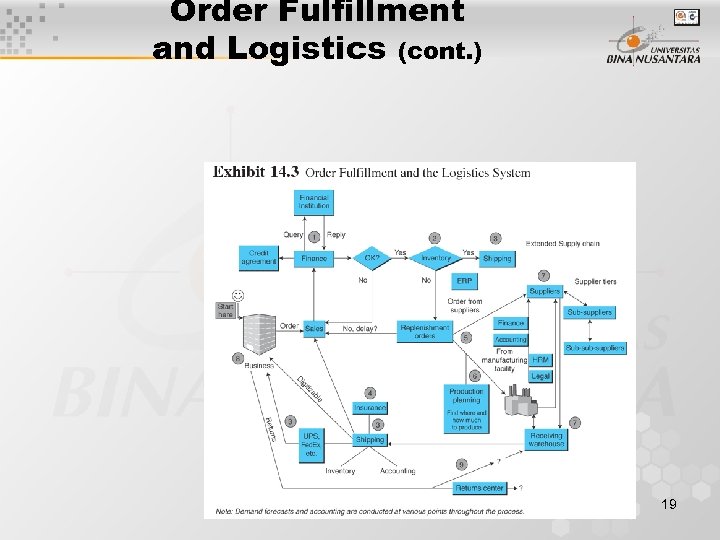
Order Fulfillment and Logistics (cont. ) 19
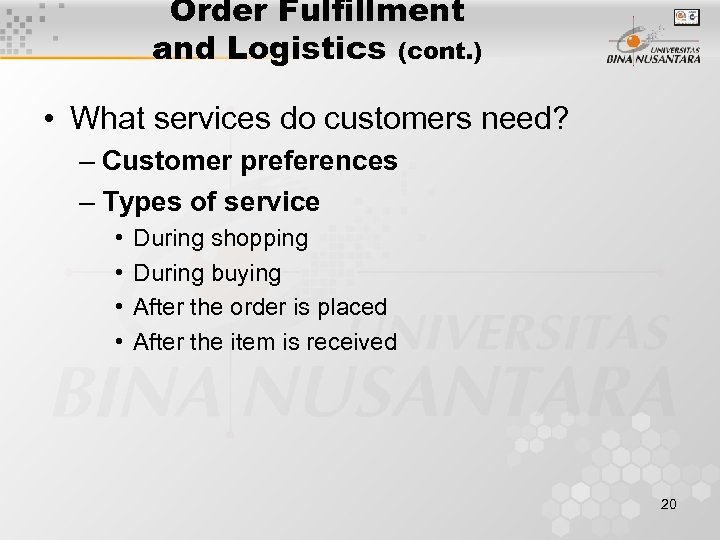
Order Fulfillment and Logistics (cont. ) • What services do customers need? – Customer preferences – Types of service • • During shopping During buying After the order is placed After the item is received 20
Order Fulfillment and Logistics (cont. ) – Problem resolution – Shipping options – Fraud protection – Order status tracking, order status, and updates – Developing customer relationships 21
Order Fulfillment and Logistics (cont. ) • E-logistics: The logistics of EC systems, typically involving small parcels sent to many customers’ homes • Traditional logistics deals with movement of large amounts of materials to a few destinations (retailers, stors) 22
Problems in Order Fulfillment • Typical supply chain problems – inability to deliver products on time – high inventory costs – quality problems – shipments of wrong products, materials, and parts – the cost to expedite operations or shipments is high 23
Problems in Order Fulfillment (cont. ) • Demand forecasting determines appropriate inventories of finished goods at various points in the supply chain It is necessary to forecast the demand for the components and materials required for fulfilling customized orders 24
Problems in Order Fulfillment (cont. ) • Why supply chain problems exist – Problems along the EC supply chain stem from uncertainties and from the need to coordinate several activities, internal units, and business partners – The major source of the uncertainties in EC is the demand forecast 25
Problems in Order Fulfillment (cont. ) • Demand is influenced by: – consumer behavior – economic conditions – competition – prices – weather conditions – technological developments – consumer confidence 26
Problems in Order Fulfillment (cont. ) • Demand is influenced by (cont. ): – variable delivery times depending on factors from machine failures to road conditions – quality problems of materials and parts – labor troubles 27
Solutions for Order Fulfillment Problems • Third-party logistics (3 PL) suppliers: External, rather than inhouse, providers of logistics services 28
Solutions for Order Fulfillment Problems (cont. ) • Improvements in the order process – Order taking can be done via EDI, EDI/Internet, or an extranet, and it may be fully automated – In B 2 B, orders are generated and transmitted automatically to suppliers when inventory levels fall below certain threshold resulting in: • fast, inexpensive, and more accurate order-taking process 29
Solutions for Order Fulfillment Problems (cont. ) – In B 2 C, Web-based ordering using electronic forms • expedites the process • makes the process more accurate (intelligent agents can check the input data and provide instant feedback) • reduces processing costs for sellers 30
Solutions for Order Fulfillment Problems (cont. ) – Order-taking improvements can also take place within an organization – Implementing linkages between ordertaking and payment systems can also be helpful in improving order fulfillment 31
Solutions for Order Fulfillment Problems (cont. ) • Inventory management improvements – Automated warehouses • Automated warehouses may include robots and other devices that expedite the pick-up of products • Example: Fingerhut 32
Solutions for Order Fulfillment Problems (cont. ) • Speeding deliveries – Same day, even same hour, delivery efulfillmentservice. com and owd. com • created networks for rapid distribution of products • offer a national distribution system across the U. S. in collaboration with shipping companies such as Fed. Ex and UPS 33
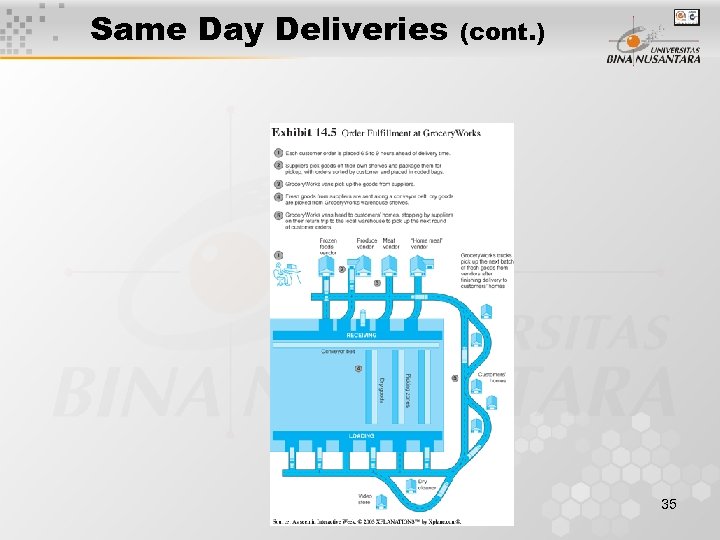
Same Day Deliveries – Supermarket deliveries • Buyers need to be home at certain times to accept the deliveries • Distribution systems for such enterprises are critical • Successful online grocers are Woolworths of Australia and Grocery. Works – Failed delivery company—Web. Van 34
Same Day Deliveries (cont. ) 35
Solutions for Order Fulfillment Problems (cont. ) • Partnering efforts and outsourcing logistics – EC companies partner with UPS or Fed. Ex – Mail. Boxes Etc. (now a subsidiary of UPS) with Innotrac Corp (fulfillment services), , Accu. Ship. com (logistics firm) 36
Solutions for Order Fulfillment Problems (cont. ) • Handling returns – Return the item to the place where it was purchased – Separate the logistics of returns from the logistics of delivery – Completely outsource returns – Allow the customer to physically drop the returned item at a collection station 37
Solutions for Order Fulfillment Problems (cont. ) 38
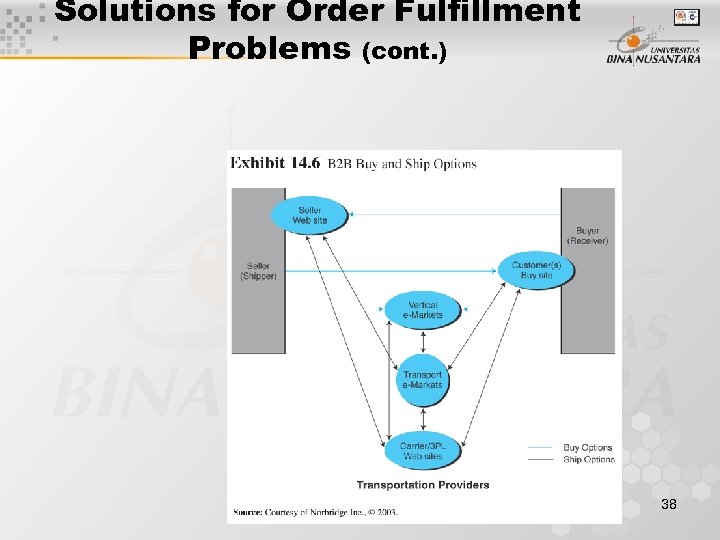
Solutions for Order Fulfillment Problems (cont. ) • Using e-marketplaces and exchanges to ease order fulfillment problems in B 2 B – Company-centric marketplace can solve several supply chain problems – An extranet smoothes the supply chain and delivers better customer service – A vertical exchange connects thousands of suppliers 39
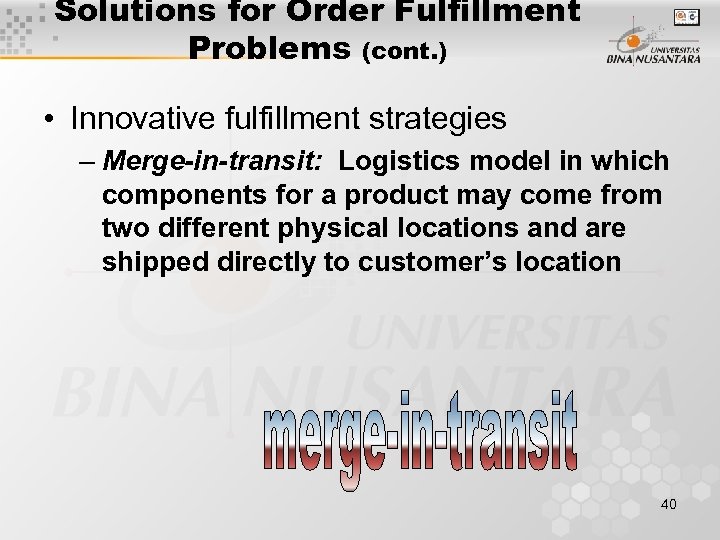
Solutions for Order Fulfillment Problems (cont. ) • Innovative fulfillment strategies – Merge-in-transit: Logistics model in which components for a product may come from two different physical locations and are shipped directly to customer’s location 40
Solutions for Order Fulfillment Problems (cont. ) – Rolling warehouse: Logistics method in which products on the delivery truck are not preassigned to a destination, but the decision about quantity to unload at each destination is made at the time of unloading 41
Solutions for Order Fulfillment Problems (cont. ) – Leveraged shipments: planning shipments based on a combination of size (or value) of the order and geographical location. – Delivery-value density: is a decision support tool that helps determine whether it is economical to deliver goods to a neighborhood area in one trip 42
Content Generation, Syndication, Delivery, and Management • Dynamic Web content: Content at a Web site that needs to be changed continually to keep it up to date • Measuring content quality – metrics to control the quality of online content – meet privacy requirements, copyright and other legal requirements, language translation needs 43
Content Generation, Syndication, Delivery, and Management (cont. ) • Pitfalls of content management – Picking content management software before developing solid requirements and business case – Not getting a clear mandate from the top to proceed – Underestimating integration and professional service needs 44
Content Generation, Syndication, Delivery, and Management (cont. ) – Hiring inexperienced developers to integrate and extend the software – Depending entirely on an outside company to make changes to the system – Thinking your migration will be painless despite what the content management system provider tells you 45
Content Generation, Syndication, Delivery, and Management (cont. ) • Web content management: The process of collecting, publishing, revising, and removing content from a Web site to keep content fresh, accurate, compelling, and credible 46
Content Generation, Syndication, Delivery, and Management (cont. ) • Content delivery networks Update content, improve the quality of the site, increase consistency, control content, and decrease the time needed to create or maintain a site 47
Content Generation, Syndication, Delivery, and Management (cont. ) • Catalog content management 1. 2. 3. 4. 5. Do it yourself Let the suppliers do it Buy the content from an aggregator Subscribe to a vertical exchange Outsource to a full-service Internet exchange 48
Content Generation, Syndication, Delivery, and Management (cont. ) • Content translation to other languages – The primary problems with language customization • cost • speed – It takes a human translator about a week to translate a medium-size Web site into just one language 49
Content Translation (cont. ) – World. Point Passport (worldpoint. com) solution allows Web developers to create a Web site in one language and to deploy it in several other languages – Automatic translation can be inaccurate 50
Content Generation, Syndication, Delivery, and Management (cont. ) • Content related vendors – Documentum (documentum. com) – Microsoft (microsoft. com) – Vignette (vignette. com) – Interwoven (interwoven. com) – Opentext (opentext. com) – Akamai (akamai. com) 51
Content Generation, Syndication, Delivery, Management (cont. ) • Content maximization and streaming services • • Media-rich content Video clips Music Flash media – Major concern is the download time 52
Other EC Support Services • Consulting services Experts in guiding their clients through the maze of legal, technical, strategic, and operational problems and decisions that must be addressed in order to ensure success 53
Consulting Services (cont. ) – Provide expertise in the area of EC, but not in traditional business (specialized expertise) – Traditional consulting company that maintains divisions that focus on EC – Select experienced and competent consulting firm, with sufficient synergies with the client firm 54
Other EC Support Services (cont. ) • Directory services – list companies by categories – provide links to companies – provide special search engines – value-added services like matching buyers and sellers are available 55
Other EC Support Services (cont. ) • Newsletters – Many companies (Ariba, Intel) issue corporate newsletters and e-mail them to people request them – Use software to send online press releases to thousands of editors 56
Other EC Support Services (cont. ) • Search engines and news aggregators Search engines can be used to find information about B 2 B • Moreover. com • directory. google. com • i. Entry. com 57
Other EC Support Services (cont. ) • More EC support services – Trust services – Trademark and domain names – Digital photos – Global business communities – Access to commercial databases 58
Other EC Support Services (cont. ) – Online consulting – Knowledge management – Client matching – E-business rating sites – Encryption sites – Web research services – Coupon-generating sites 59
Outsourcing EC Support Services • Why outsource EC support services? – Early businesses were vertically integrated, they: • owned or controlled their own sources of materials • manufactured components • performed final assembly • managed the distribution and sale of their products to consumers 60
Outsourcing EC Support Services (cont. ) • Major reasons for outsourcing – A desire to concentrate on the core business – The need to have services up and running rapidly – Lack of expertise for many of the required support services 61
Outsourcing EC Support Services (cont. ) – The inability to have the economy of scale enjoyed by outsourcers – Inability to keep up with rapidly fluctuating demands if an in-house option is used – Too many required services 62
Outsourcing EC Support Services (cont. ) • Typical process of developing and managing EC applications 1. 2. 3. 4. EC strategy formulation Application design Building (or buying) the application Hosting, operating, and maintaining the EC site 63
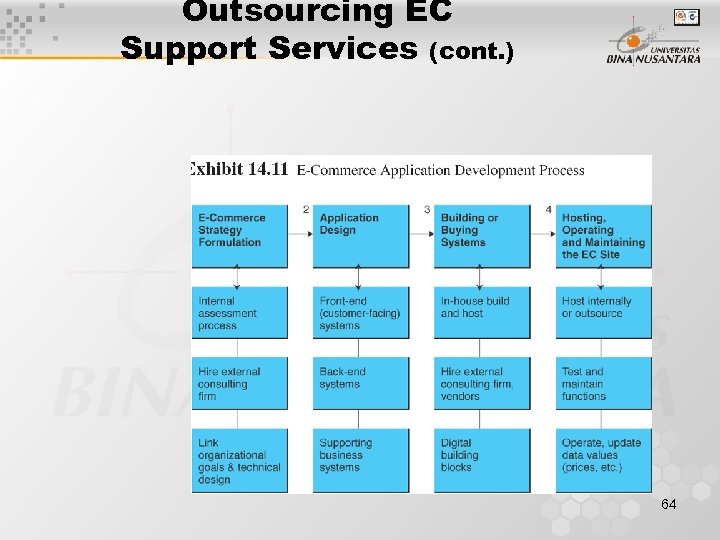
Outsourcing EC Support Services (cont. ) 64
Outsourcing EC Support Services (cont. ) • Services for creating and operating electronic storefronts: – Internet malls – ISPs – Telecommunication companies – Software houses – Outsourcers and others 65
Outsourcing EC Support Services (cont. ) • Application service provider (ASP): An agent or vendor who assembles the functions needed by enterprises and packages them with outsourced development, operation, maintenance, and other services 66
Outsourcing EC Support Services (cont. ) • Leasing from ASPs – SMEs in-house—development and operation of EC applications can be time-consuming and expensive – Concern about the adequacy of the protection offered by ASPs against hackers etc. – Leased software often does not provide the perfect fit for the desired application 67
Managerial Issues 1. Have we planned for order fulfillment? 2. How should we handle returns? 3. Do we want alliances in order fulfillment? 4. What EC logistics applications would be useful? 68
Managerial Issues (cont. ) 5. What is the best e-content strategy? 6. Should we provide content translation? 7. EC consultants are expensive. Should we use them? 8. Should we outsource EC services? 69
Summary 1. The order fulfillment process – – – – payment verification inventory checking shipping arrangement, insurance production (or assembly) plant services purchasing customer contacts return of products 70
Summary (cont. ) 2. Problems in order fulfillment Ø Uncertainties in demand potential delays in supply and deliveries Ø Lack of coordination and information sharing among business partners 71
Summary (cont. ) 3. Solutions to order fulfillment problems – Automating order taking – Smoothing the supply chain • • supported by software that facilitates correct inventories coordination along the supply chain appropriate planning and decision making 72
Summary (cont. ) 4. EC content issues and management – Critical for branding and advertising – Major content issues are: • • the use of vendors translation to other languages maintenance (keeping it up-to-date) maximization and streamlining of its delivery 73
Summary (cont. ) 5. Other support services – – Consulting services Directory services Infrastructure providers Support services should be coordinated and integrated 74
Summary (cont. ) 6. Outsourcing EC services and using ASPs – Lack of time and expertise forces companies to outsource – Using ASPs is not inexpensive nor risk-free 75

OASIS - A Web Based Fixed Assets System CAUSE 98 Annual Conference Patrick M. Benson Phone - 206. 685. 2938 Email - pbenson@cac. washington. edu Homepage - weber. u. washington. edu/~pbenson 76
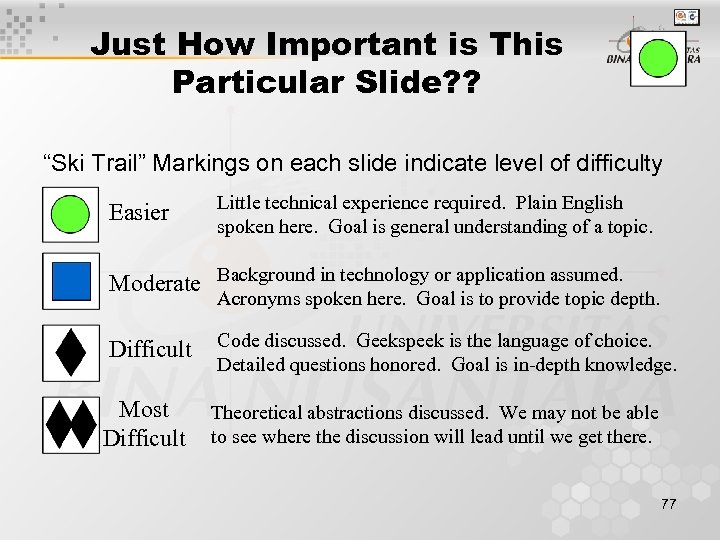
Just How Important is This Particular Slide? ? “Ski Trail” Markings on each slide indicate level of difficulty Easier Little technical experience required. Plain English spoken here. Goal is general understanding of a topic. Moderate Background in technology or application assumed. Acronyms spoken here. Goal is to provide topic depth. Difficult Most Difficult Code discussed. Geekspeek is the language of choice. Detailed questions honored. Goal is in-depth knowledge. Theoretical abstractions discussed. We may not be able to see where the discussion will lead until we get there. 77
Who, What, When, Where and Why • Replacement for Information Associates Fixed Assets (FFX) DEC VAX/VMS package – ONLY the Fixed Assets portion of the package installed, no direct interfaces to Financial or Purchasing Systems – Installed in 1992, support dropped in 1994 – Highly tailored for department access in 1994 – Numerous modifications and extensions • Replacement undertaken by UW Staff as a part of our Y 2 K conformance 78
Should Have Been Done. • • The Product Lifecycle Estimating the Cost of Development Committees, Steering and Other, the Key Players Dealing With Moving Technology Production Scheduling Tools Post Implementation Support Best Practices Model 79
The Product Lifecycle 80
Multiple Interrelated Projects In One – Business Use Project, the ‘real use’ determination and data access rules, the two extreme environments – Visual Design of the Business ‘Real Use’ Rules Project, the three spaces – Physical Deployment and Use Project, the four web environments and three architectures – Software Development Project, the five languages – Maintenance Projects, where success is measured, the ‘pay me now or pay me later’ part of the project 81
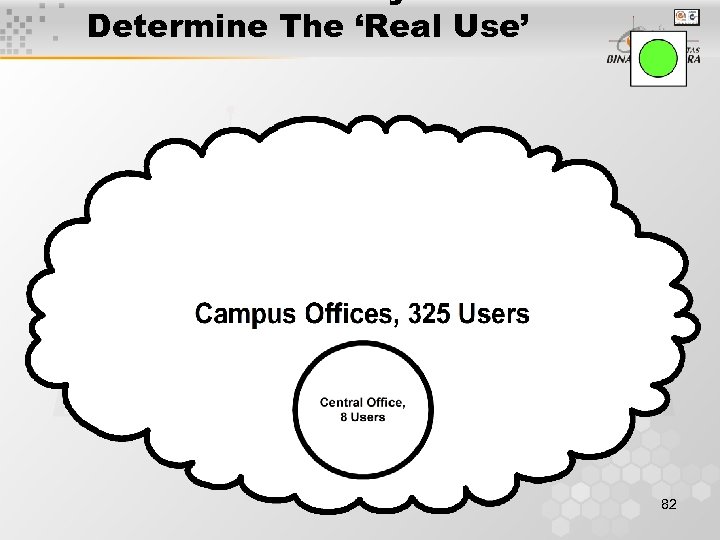
Determine The ‘Real Use’ 82
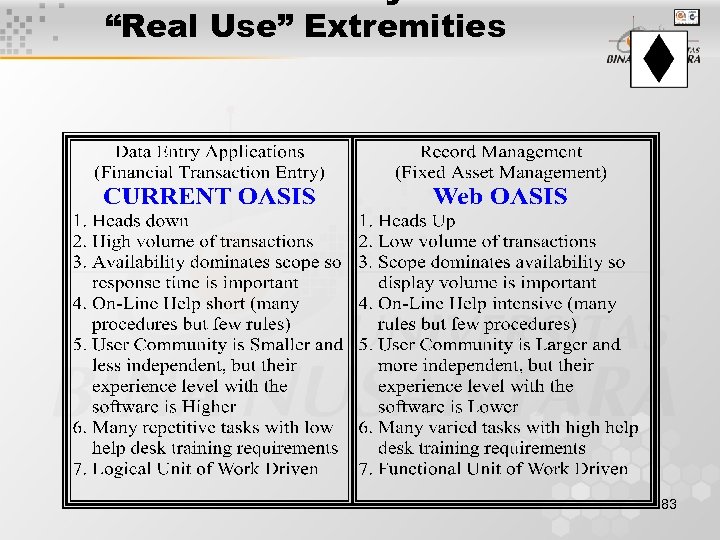
“Real Use” Extremities 83
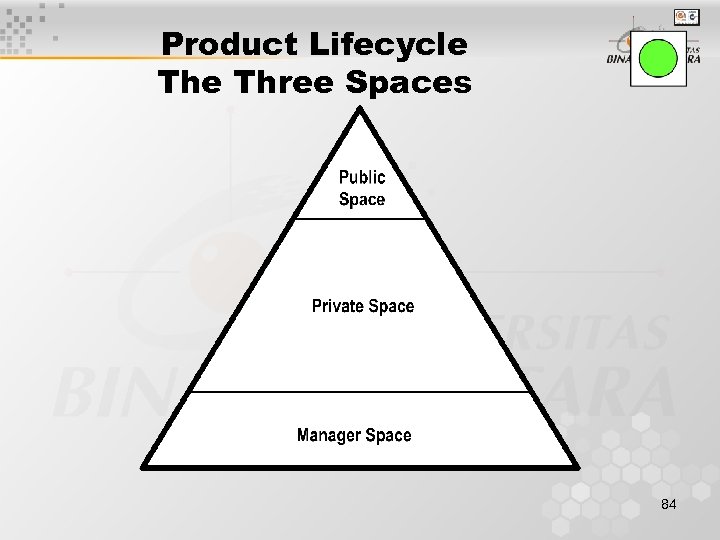
Product Lifecycle Three Spaces 84
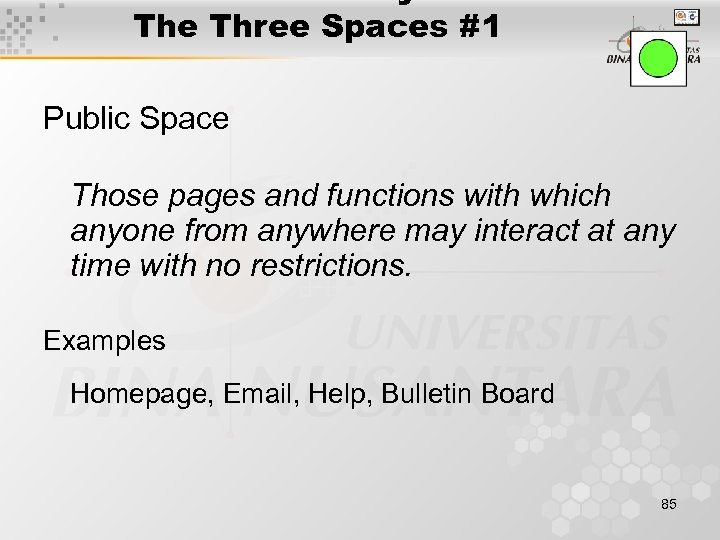
The Three Spaces #1 Public Space Those pages and functions with which anyone from anywhere may interact at any time with no restrictions. Examples Homepage, Email, Help, Bulletin Board 85
The Three Spaces #2 Private Space Those pages and functions with which any faculty or staff may interact when the system is available for general use. Examples Asset Management, Cataloged and Ad Hoc Reports, Asset Search, “My Profile” 86
The Three Spaces #3 Manager Space Those pages and functions with restricted access. Examples Turn the System On and Off, Add and Delete Users, Set User Access Permissions, Manage System Tables, Build Broadcast Messages, Request System Reports, Merge or Drop Assets 87
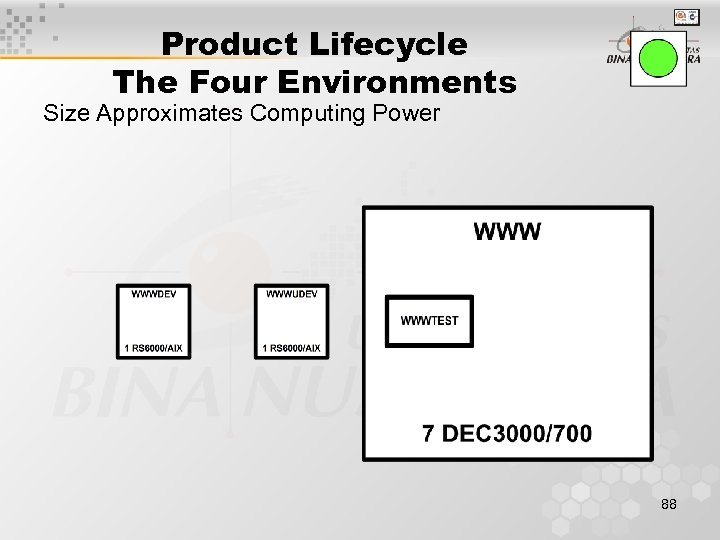
Product Lifecycle The Four Environments Size Approximates Computing Power 88
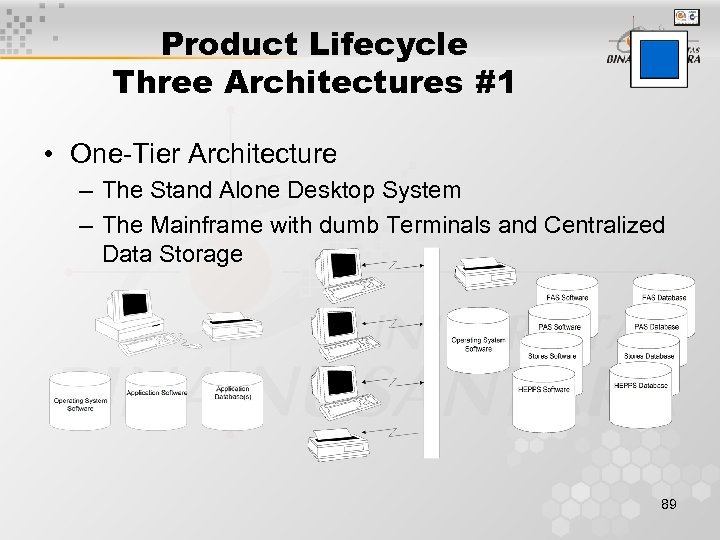
Product Lifecycle Three Architectures #1 • One-Tier Architecture – The Stand Alone Desktop System – The Mainframe with dumb Terminals and Centralized Data Storage 89
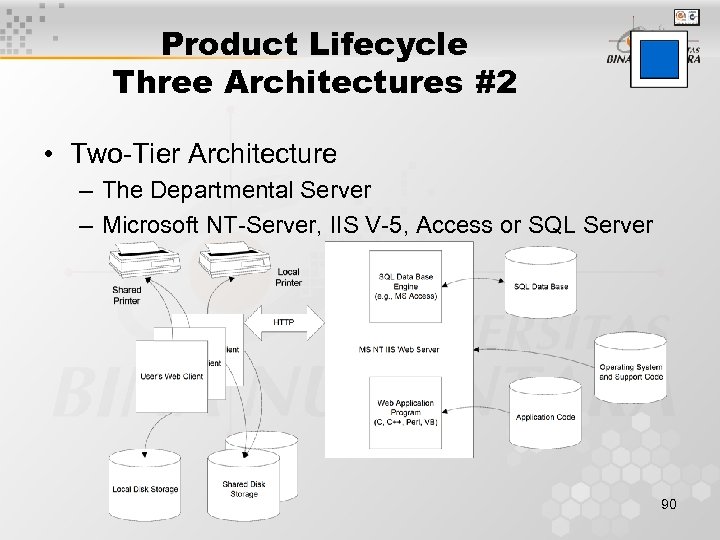
Product Lifecycle Three Architectures #2 • Two-Tier Architecture – The Departmental Server – Microsoft NT-Server, IIS V-5, Access or SQL Server 90
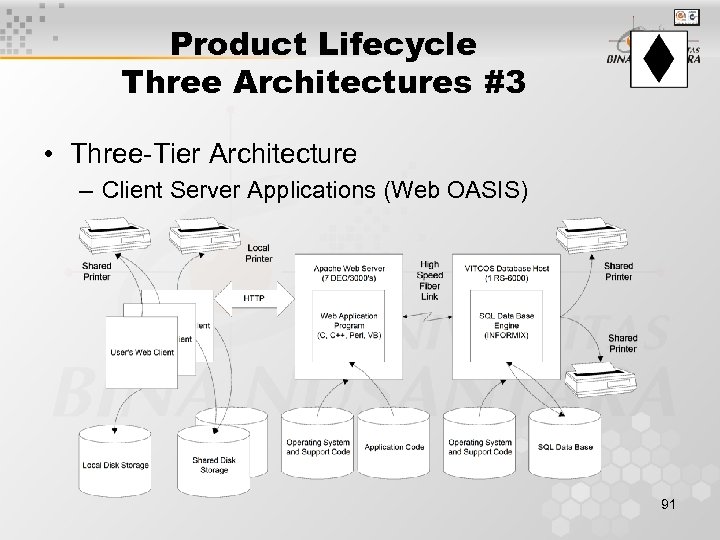
Product Lifecycle Three Architectures #3 • Three-Tier Architecture – Client Server Applications (Web OASIS) 91
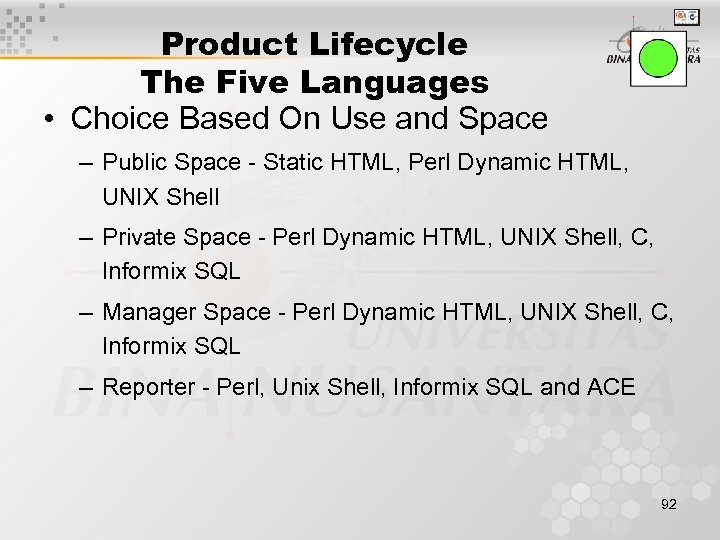
Product Lifecycle The Five Languages • Choice Based On Use and Space – Public Space - Static HTML, Perl Dynamic HTML, UNIX Shell – Private Space - Perl Dynamic HTML, UNIX Shell, C, Informix SQL – Manager Space - Perl Dynamic HTML, UNIX Shell, C, Informix SQL – Reporter - Perl, Unix Shell, Informix SQL and ACE 92
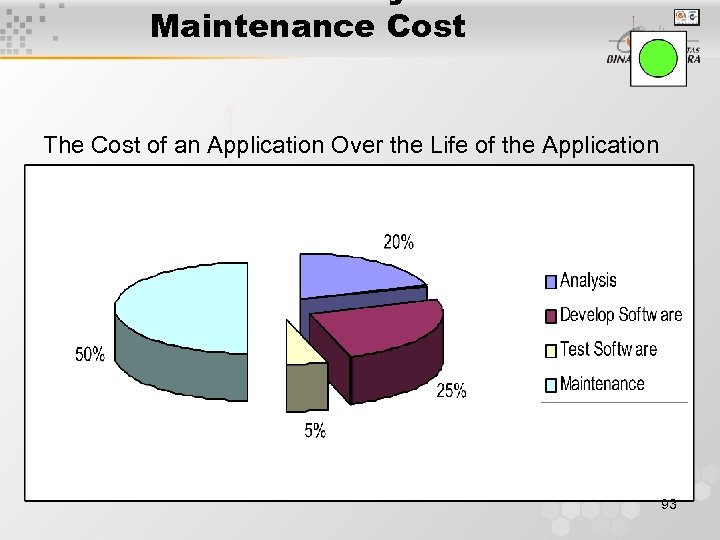
Maintenance Cost The Cost of an Application Over the Life of the Application 93
Should Have Been Done. • • • The Product Lifecycle Estimating the Cost of Development Committees, Steering and Other, the Key Players Dealing With Moving Technology Production Scheduling Tools Post Implementation Support Best Practices Model 94

Estimating the Cost of Development 95
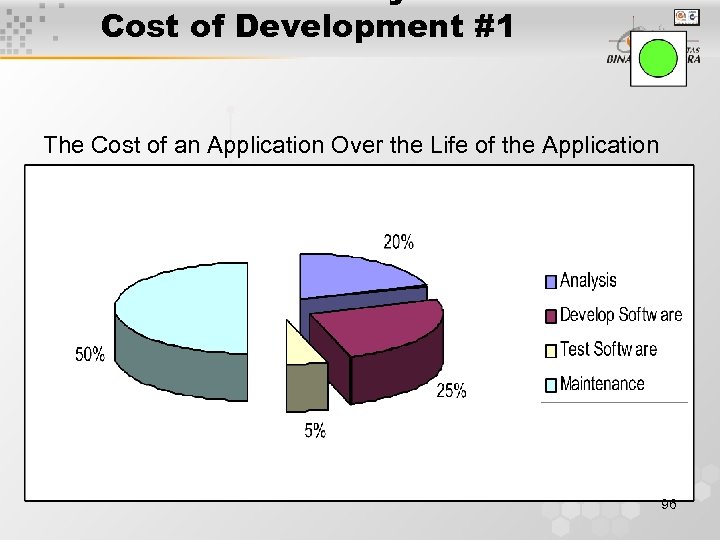
Cost of Development #1 The Cost of an Application Over the Life of the Application 96
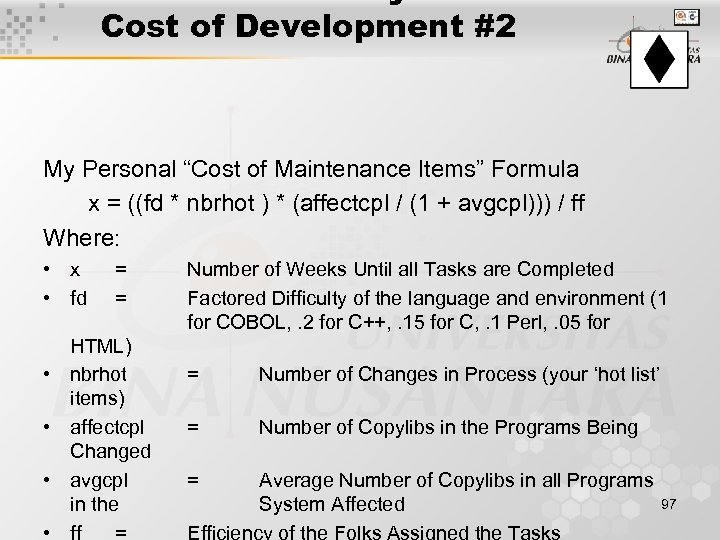
Cost of Development #2 My Personal “Cost of Maintenance Items” Formula x = ((fd * nbrhot ) * (affectcpl / (1 + avgcpl))) / ff Where: • x • fd • • = = HTML) nbrhot items) affectcpl Changed avgcpl in the ff = Number of Weeks Until all Tasks are Completed Factored Difficulty of the language and environment (1 for COBOL, . 2 for C++, . 15 for C, . 1 Perl, . 05 for = Number of Changes in Process (your ‘hot list’ = Number of Copylibs in the Programs Being = Average Number of Copylibs in all Programs System Affected Efficiency of the Folks Assigned the Tasks 97
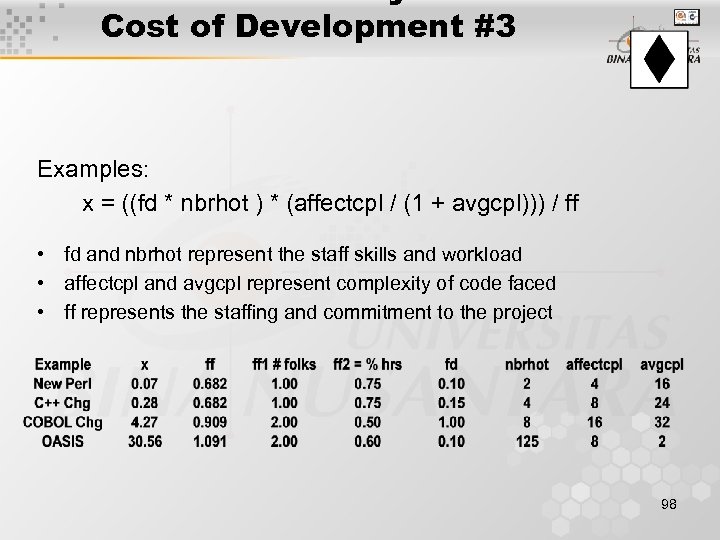
Cost of Development #3 Examples: x = ((fd * nbrhot ) * (affectcpl / (1 + avgcpl))) / ff • fd and nbrhot represent the staff skills and workload • affectcpl and avgcpl represent complexity of code faced • ff represents the staffing and commitment to the project 98
Should Have Been Done. • • • The Product Lifecycle Estimating the Cost of Development Committees, Steering and Other, the Key Players Dealing With Moving Technology Production Scheduling Tools Post Implementation Support Best Practices Model 99
Committees, Steering and Other, the Key Players 100
Steering Committees steering committee n, A committee that sets agendas and schedules business, as for a legislative body. Webster’s II, New Riverside University Dictionary, page 1136, The Riverside Publishing Company, 1984, Houghton Mifflin Company, Boston steering committee a committee, as of a legislative body, appointed to arrange the order of business Webster’s New World Dictionary of the American Language, page 1394, Simon and Schuster, 1982, Gulf & Western Corporation, New York 101
Other Committees Partial List of Committees and Groups Wanting a Say in Something OASIS Does – Fixed Assets Steering Committee – Beta Testing Work Group – Web GUI Standards Committee – Programming Standards Committee – Accessibility Working Group – Icon Standards Working Group – GUI Look-and-Feel Standards Committee (the Usability Group) – Client Services Management and Staff – EIO Manager’s Selected User Group – University Internal Auditor’s Staff – Medical Center Inventory Management Group – General Accounting Management Group – New Technologies Steering Committee 102
The Key Players Key Player’s Roles Change Over Time – Pre-Design – Development – Training and Implementation – Post Implementation Support 103
Pre-Design Phase Standards and Agreements That MUST be Set in Something Stronger than Jell-O ™ Before Design – IS Committees Security, Data and Application, Physical and Logical Web, DBMS Platforms and OS Standards – IS Management Languages Preferred and Prohibited, Development Standards and Environment, Tool Selection – IS Systems DBMS Selection, DB Server Access Methodology – IS Committees Accessibility, Usability and Functionality Guidelines – IS Committees Visual and Style Requirements and Policy – IS Aps, User Mgmt Data and System Access Agreements – IS and User Mgmt Minimum Equipment to Participate – IS and User Mgmt Staffing Agreements, Hardware, Software and 104 Staff Performance Agreements
Design Phase A More Traditional Phase – – – IS Systems Construct Development Web Environment IS Applications Develop and Proof the Design IS Management Acquire Physical Resources IS Aps, User Mgmt Approve Design IS Management Mediate IS Systems and Applications Conflicts User Group Mgmt Supply Functional Needs Support Statements 105
Development Phase The First Cooperative Development Phase – – – – – IS Systems Construct Testing Web Environment IS Applications Develop the Application Software IS Applications Develop Data Conversion Software IS Applications Develop Implementation Software User Group Mgmt Alpha and Beta Group Selection, Orientation and Management IS Management Mediate IS Systems and Applications Conflicts IS Management Monitor Costs and Progress IS Management Monitor Project Deliverable “Creep” IS Applications Test and Execute the Conversion and Implementation Software User Group Mgmt Conduct Alpha Group Introductory Sessions 106
Implementation & Training Another Cooperative Development Phase – – – – – User Group Mgmt Develop Institution Communications Plan IS Systems Construct Production Web Environment IS Systems Monitor and Modify DB Access and Schema IS Applications Modify Software Per Alpha and Beta Group Suggestions IS Applications Exercise Data Conversion Plan Many Times IS Applications Exercise System Implementation Plan Many Times User Group Mgmt Run Beta Group Testing Sessions IS Management Monitor Project Deliverable “Creep” User Group Mgmt Execute Institution-Wide Communications Plan User Group Mgmt Develop Institution-Wide Training Plan 107
Post Implementation Yet Another Cooperative Development Phase – – – – – User Group Mgmt Run Institution-Wide Training Sessions User Group Mgmt Monitor Institution-Wide Users’ Performance IS Systems Monitor Production Web Environment IS Systems Monitor and Tweak Production DB for Best Access Performance IS Applications Modify Software Per User Group Management Suggestions IS Applications Exercise Final Data Conversion Plan IS Applications Exercise Final System Implementation Plan IS Management Secure Project Acceptance User Group Mgmt Review Emerging Needs and Develop Enhancements List 108
Should Have Been Done. • • The Product Lifecycle Estimating the Cost of Development Committees, Steering and Other, the Key Players Dealing With Moving Technology Production Scheduling Tools Post Implementation Support Best Practices Model 109

Dealing With Moving Technology 110
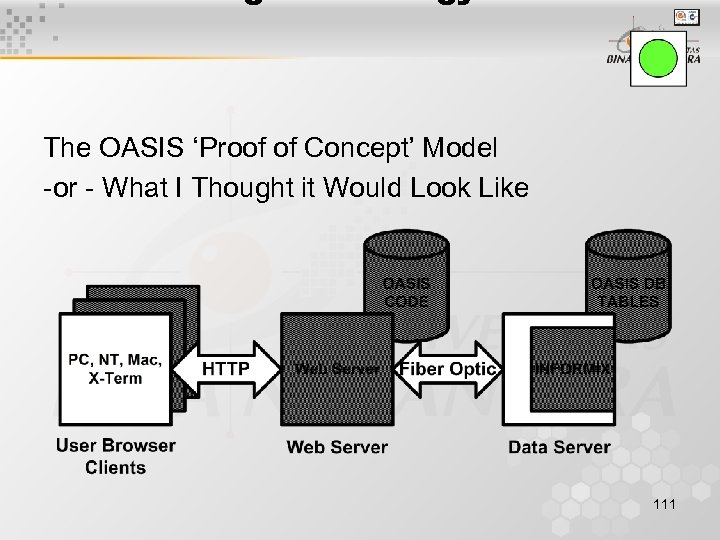
The OASIS ‘Proof of Concept’ Model -or - What I Thought it Would Look Like 111
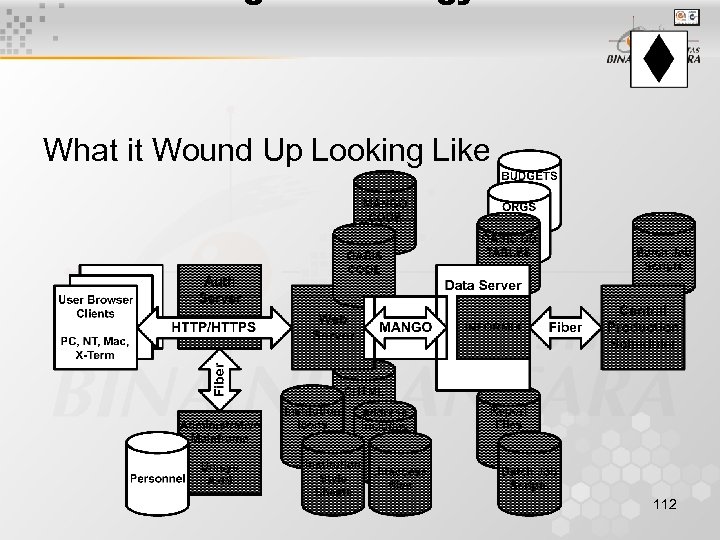
What it Wound Up Looking Like 112
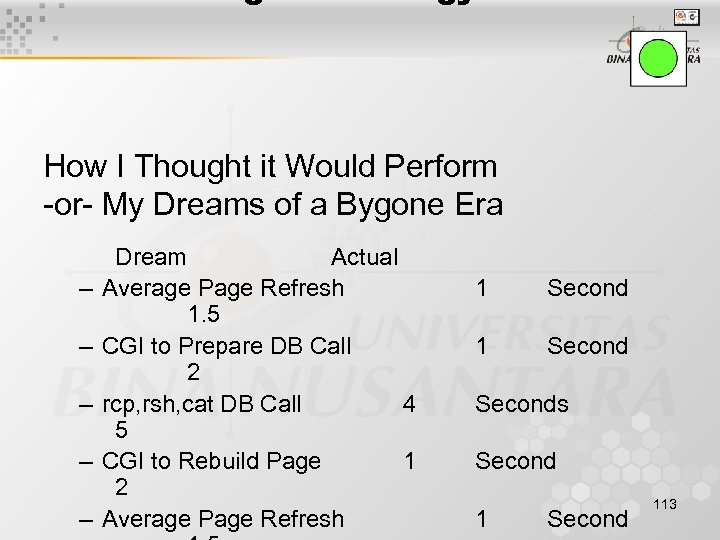
How I Thought it Would Perform -or- My Dreams of a Bygone Era – – – Dream Actual Average Page Refresh 1. 5 CGI to Prepare DB Call 2 rcp, rsh, cat DB Call 4 5 CGI to Rebuild Page 1 2 Average Page Refresh 1 Seconds Second 113
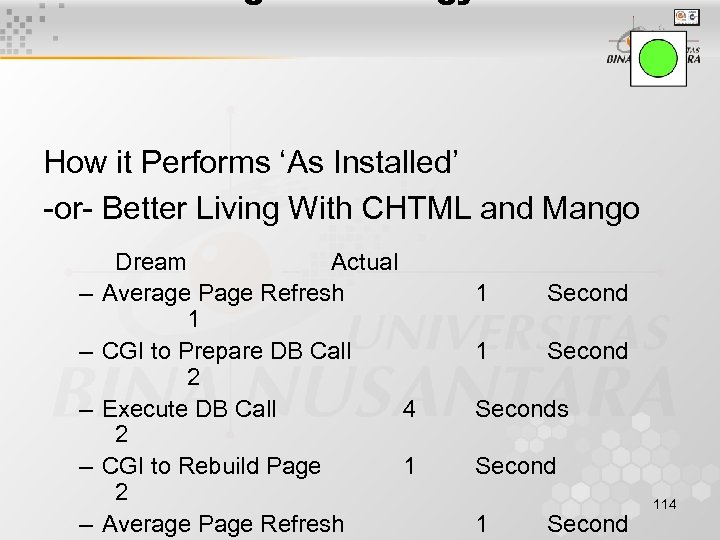
How it Performs ‘As Installed’ -or- Better Living With CHTML and Mango – – – Dream Actual Average Page Refresh 1 CGI to Prepare DB Call 2 Execute DB Call 4 2 CGI to Rebuild Page 1 2 Average Page Refresh 1 Seconds Second 114
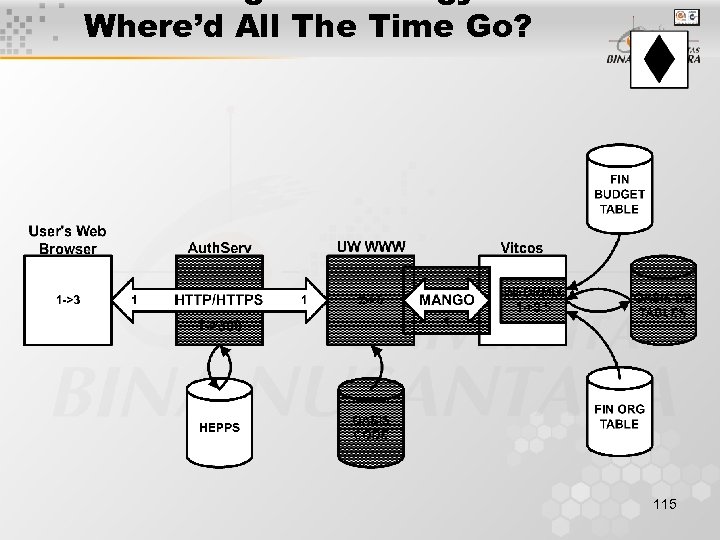
Where’d All The Time Go? 115
Should Have Been Done. The Product Lifecycle Estimating the Cost of Development Committees, Steering and Other, the Key Players Dealing With Moving Technology • Production Scheduling Tools • Post Implementation Support • Best Practices Model 116
Production Scheduling 117
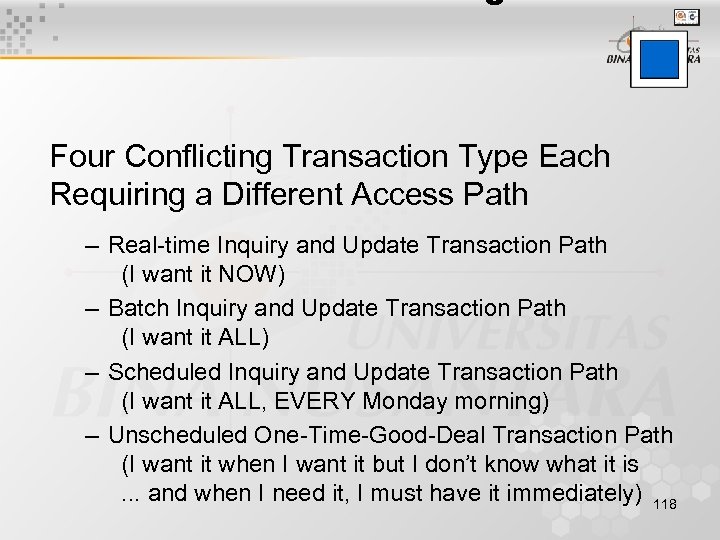
Four Conflicting Transaction Type Each Requiring a Different Access Path – Real-time Inquiry and Update Transaction Path (I want it NOW) – Batch Inquiry and Update Transaction Path (I want it ALL) – Scheduled Inquiry and Update Transaction Path (I want it ALL, EVERY Monday morning) – Unscheduled One-Time-Good-Deal Transaction Path (I want it when I want it but I don’t know what it is. . . and when I need it, I must have it immediately) 118
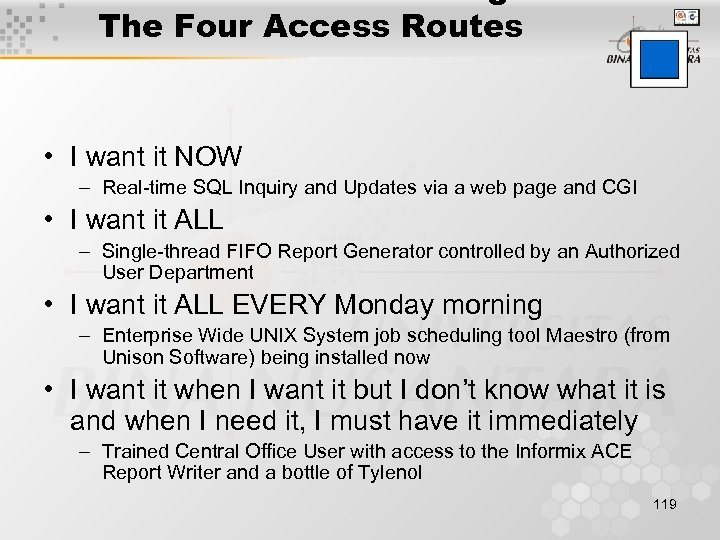
The Four Access Routes • I want it NOW – Real-time SQL Inquiry and Updates via a web page and CGI • I want it ALL – Single-thread FIFO Report Generator controlled by an Authorized User Department • I want it ALL EVERY Monday morning – Enterprise Wide UNIX System job scheduling tool Maestro (from Unison Software) being installed now • I want it when I want it but I don’t know what it is and when I need it, I must have it immediately – Trained Central Office User with access to the Informix ACE Report Writer and a bottle of Tylenol 119
Should Have Been Done. The Product Lifecycle Estimating the Cost of Development Committees, Steering and Other, the Key Players Dealing With Moving Technology Production Scheduling Tools • Post Implementation Support • Best Practices Model 120
Support So … you’ve finished analysis, design, development, coding and testing, the conversion and deployment plans are in place, and you’ve picked the cross over date … Congratulations, you’re half-way through. 121
Best Measure of Success The Intended Use Drives Application and Database Design, Hardware Selection and Environmental Specs • Environment ‘tuning’ to meet Enterprise needs and goals will affect Application, Database and Hardware. • Hardware ‘tuning’ will affect both Application and Database performance. • Application may be ‘tuned’, yet run too slowly in the real-world environment due to the database requests made by the real-world user community. • Database may be ‘tuned’ only after the application is in place and being stressed in real-world use. 122
The Application • Environment ‘tuning’ to meet Enterprise desires, needs and goals will affect Application, Database and Hardware. – Authentication Service Requirements added overhead on each transaction – CHTML Requirements to reduce network traffic added to development costs and time – Web Security and Hackers and the need for ‘C’ Wrappers on rsh processes increased complexity – Politically Motivated Data Access Limitations decreased apparent responsiveness 123
Both Application and DB • Any and all hardware ‘tuning’ will affect both Application and Database performance. – Additional processors added to database server improved performance. – Complex Development through Production web server arrangement adds to development and deployment costs … but provides great fall back and testing features and improves system throughput times! – CHTML to improve hardware and network throughput added to development time … but decreases network traffic and improves users perception of system responsiveness. 124
(Will Be? !) Ineffective • The application may be ‘tuned’, yet run too slowly in the real-world environment due to the database requests made by the real-world user community. – Anticipation led to development of the FIFO Report Writer to limit impact of report queries on Informix. – Experience with this during stress testing led to implementation of a two port - two thread Mango API - Server to separate quick from slow queries. – Emerging needs - Computer Equipment License information in an asset note 125
the Application’s Release • Database may be ‘tuned’ only after the application is being stressed in real-world use. – Physical grouping or clumping of records affects database access time (modulo and separation) – Physical storage sequence of index records – Record ‘Lock’ processes affected by web identified a vendor software glitch – Stress testing experience drove changes in the application’s Data Access API - Server structure – Web Statelessness and how STOPed and BACKed transactions cause SQL Rollbacks and Access 126 blocks
Should Have Been Done. The Product Lifecycle Estimating the Cost of Development Committees, Steering and Other, the Key Players Dealing With Moving Technology Production Scheduling Tools Post Implementation Support • Best Practices Model 127
Best Practices As a minimum goal, 30% of everything developed for a web application must be useable in another application. “Everything” includes standards, documentation, policy and procedure, utilities, code blocks, etc. Nineteen Documents help manage the project, and are transportable to the next project. 128
Best Practices #2 • • • Design Document Summary - This serves as a document management and summary tool. The author of each document and date completed are noted. Purpose - Here the purpose and level of commitment, both human and physical resource commitments, are detailed. The system owner, customer liaison and IS point of contract are identified. Architecture - The development approach and rational behind that approach, the challenges anticipated from the environment or goals, and an identification of feasibility or concept testing needed before the project can go forth are outlined here. Security - In this document, the various login groups are identified. This includes identification of users with special or extraordinary permissions. Access restrictions to databases or database elements (tables, rows or columns) are identified. Menus or pages with limited or controlled access are listed. ERD - This is a graphical image of the Entity Relationship Diagram. 129
Best Practices #3 • • • Data Tables Text versions of the SQL Server Code necessary to construct or reconstruct the database. DB Connect This document describes the connection mechanism between the web server and data server. This documentation lists the steps to generate any executables file and the commands to roll back the database. Data Conversion and Loading - Ideas and concepts for creating the SQL Server Code necessary to load the database. Samples are provided. Directories, Files, Subroutines and Objects - List of Directory Structure needed, Data Files (other than database files, needed, a List of Keys, Relationships and Unions involved. Every file, table and element, including global working-storage items, must be described. The deployed directory structure is identified. Navigation Model - Links to the navigation model for each "page". The general function and links that every page may follow are graphically shown in these documents. 130
Best Practices #4 • • • Object - Event - Action Matrix - This matrix lists every object (elements noted in the Data Tables and File Descriptions, all buttons that may be clicked, all anchors that may be selected) and all events. At the intersection of each object and event is the action to be taken for that instance. GUI Presentation Model - This document has three sections. The first lists all the graphics used, their source and geometry for every instance, and a sample of the image. A second section describes the layout of Public Pages; those anyone may access from the web. The third section describes the layout of Private pages; those only authorized users may access. Page Property Matrix - This set of pages notes, for every page, every object and its use. Objects are identified by the names used in the Data Tables and File Descriptions document. The use, default value, allowable values and comments about each object are found. 131
Best Practices #5 • • • Interfaces - Each interface is described in detail in these documents. It is intended that each instance of an interface will be listed in detail. For example, if there is one call to the Accounting Data Server for a Budget Number, another for an Organization Description, and a third for a Budget Status, there are three interfaces to define. For each the location, engine, performance criteria, elements, and ERD, a typical extraction request and any design implications resulting from using the interface, are listed. Functional Requirement Documents - Every requirement of the system, from limiting access to producing a report or sending an email, will have its own Requirement Document. This document will identify the business goal, software need, specific data problem to solve to meet the goal, an explanation of how success in meeting the requirement is determined, and any constraints upon the system imposed by the requirement. Deployment Instructions - Plans for installation of production software may be found here. The names and functions of support software, repository used (if applicable), naming conventions and information linking references in other sections for the production environment. 132
Best Practices #6 • • • Supporting Documentation Location - Here plans for post-implementation and change control are addressed. Included are locations of documentation necessary to support the user and system. Troubleshooting - Any time something odd happens it should be documented here so the next person to see that problem won't feel like a stranger in a strange land. Miscellaneous Stuff - I'll admit it, sometimes there is documentation that just doesn't fit anywhere. . . so here is where it goes. Chances are if you need it this is where you'll find it. If you don't find it somewhere else in the documentation, then put it here for everyone else. 133
Should Have Been Done. The Product Lifecycle Estimating the Cost of Development Committees, Steering and Other, the Key Players Dealing With Moving Technology Production Scheduling Tools Post Implementation Support Best Practices Model 134
Summary • Mahasiswa diwajibkan membuat summary 135
Скачать презентацию Matakuliah Tahun Versi F 0662 Web Based
86097cdafb403ad062a39982665e600d.ppt