


 Скачать презентацию Matakuliah T 0944 -Game Design and Programming
b1e03055b05afa0fa57bc5b14becf223.ppt
- Количество слайдов: 14

 Matakuliah : T 0944 -Game Design and Programming Tahun : 2010 Computer Game Development Pertemuan 2
 Game Development Phase • • • Pre-production phase Mainstream production phase Project milestones Testing Release to manufacturing Patch-based maintenance
 Pre-production Phase • • • General game idea or design Back-story Concept artwork Storyboards Game-play elements Working prototype demonstrating key game features.
 Mainstream production phase • • • Software designing Implementing the game engine, sound engine, or 3 D engine. Implementing networking components. Implementing input control. Creating game assets such as textures, interface elements, 3 D models. • Adding game-play elements such as artificial intelligence, cut scene, in-game dialog. • Producing game’s audio
 Project Milestone • Pre-alpha version – A lot of functional and asset/content-based decisions still have to be made. • Alpha version – Satisfies most of the project goals and requirements while still requiring extensive testing and debugging. • Beta version – Generally has numerous bugs, stability and compatibility issues. – Released to selected group (closed beta) as opposed to a larger community group (open beta) • Release Candidates – Very close to the final game release but still need some extensive testing to ensure that no fatal bugs are present.
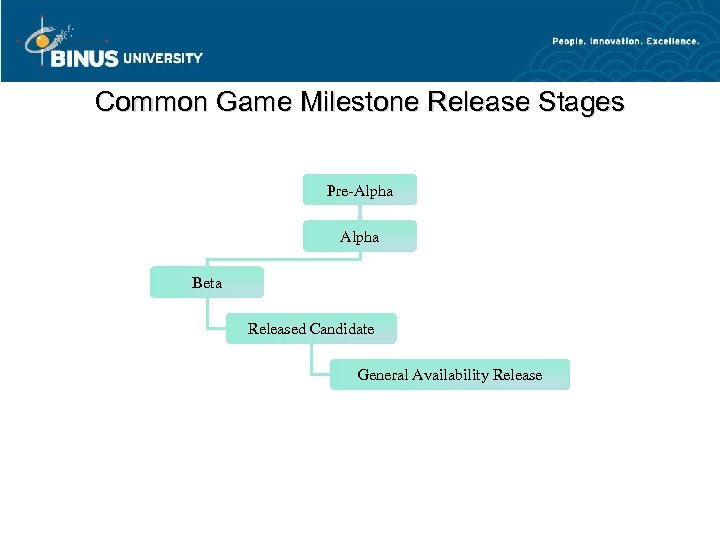 Common Game Milestone Release Stages Pre-Alpha Beta Released Candidate General Availability Release
 Testing • Unit testing – Primarily done by programmers themselves • Functional testing – Based on scripts targeted at groups of classes – Focus on user requirements and performance constraints. • Automated testing – Focus on the generation of test units reflecting the existing programming units. – Is conducted concurrently throughout the implementation phase.
 Software Patches • Patching is the most common form of maintaining and updating computer games. • Ensure that software regression doesn’t occur when patch is released. • Patches are not solely used for the correction of bugs and are often released to improve or change some game -play elements.
 Game Software Development Techniques and Methodologies • Sequential Software Development: Waterfall Model. • Iterative Software Development: The Rational Unified Process. • Extreme Programming: Agile Software Development.
 Game Development Tools • Design Document Templates • Development Tools Software – Rational Rose • 3 D Modeling Software – Autodesk’s 3 D Studio Max, Maya • 2 D Modeling Software – Adobe Photoshop.
 Game Development Tools • Sound sampling and digital processing – Sound Forge Xp • Music Sequencing Software – Cakewalk • Integrated Development Environment – Microsoft Visual Studio • Accelerators – Open. GL, Direct. X. • Programming utilities – FX Composers • Standard Development Kit (SDK)
 In-house Tools • Level Editors – Q 3 Radiant for Quake-3 by Id Software • Game Engine – Torque – Unreal Engine
 Discussion • Game engine license policies.