 Скачать презентацию Mastering Inventory American Institute of Professional Bookkeepers
7eb0c6a9b3d9b948787d45c1caaa1197.ppt
- Количество слайдов: 82



Mastering Inventory American Institute of Professional Bookkeepers © American Institute of Professional Bookkeepers, 2010 Mastering Inventory
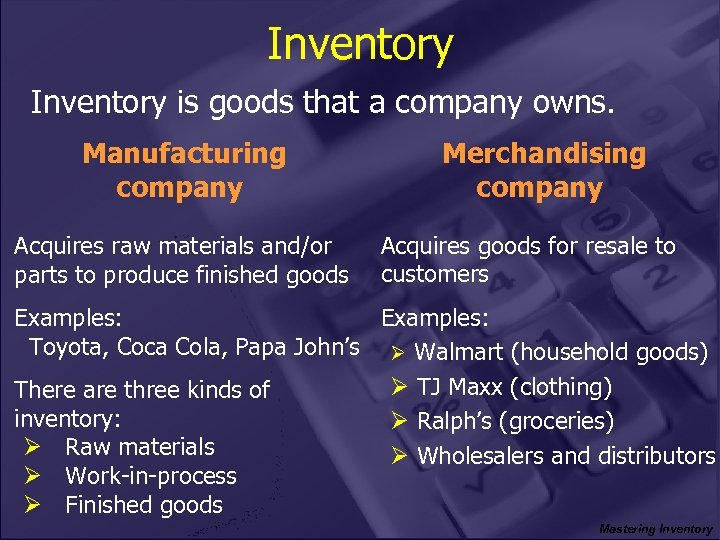
Inventory is goods that a company owns. Manufacturing company Acquires raw materials and/or parts to produce finished goods Merchandising company Acquires goods for resale to customers Examples: Toyota, Coca Cola, Papa John’s Ø Walmart (household goods) Ø TJ Maxx (clothing) There are three kinds of inventory: Ø Ralph’s (groceries) Ø Raw materials Ø Wholesalers and distributors Ø Work-in-process Ø Finished goods Mastering Inventory
Inventory is goods that a company owns. Manufacturing company Merchandising company This course covers merchandise inventory. The subject of manufacturing inventory is typically covered in “managerial” or “cost” accounting. Mastering Inventory
Recording Purchases are booked when legal title passes to the buyer. When title passes depends on the terms of the contract. Title is passed in one of two ways: v When goods leave the seller’s location FOB shipping point v When goods arrive at the buyer’s location FOB destination Mastering Inventory
Purchases in Transit Goods in transit must also be accounted for at the end of the period. In summary: v FOB shipping point—title passes when the goods have left the seller. Goods in transit belong to the purchaser and must be recorded as inventory on the purchaser’s books. v FOB Destination—title passes when the goods have arrived at the buyer’s purchaser’s location. Thus, goods in transit still belong to the seller and must remain on the seller’s books as inventory. Mastering Inventory
Recording Purchases Purchasers include in the cost of inventory: v The purchase amount (the actual amount paid – not the price in the catalog or on the purchase order) v Any transportation (freight) and insurance costs paid by the buyer (FOB shipping point) Mastering Inventory
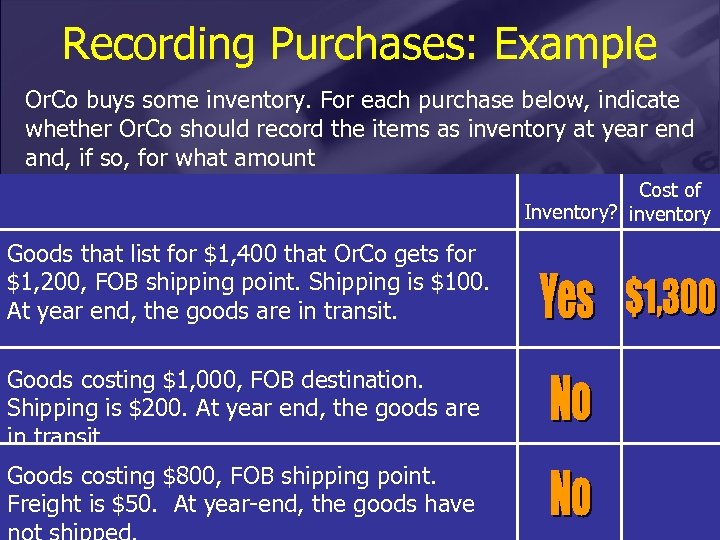
Recording Purchases: Example Or. Co buys some inventory. For each purchase below, indicate whether Or. Co should record the items as inventory at year end and, if so, for what amount Cost of Inventory? inventory Goods that list for $1, 400 that Or. Co gets for $1, 200, FOB shipping point. Shipping is $100. At year end, the goods are in transit. Goods costing $1, 000, FOB destination. Shipping is $200. At year end, the goods are in transit. Goods costing $800, FOB shipping point. Freight is $50. At year-end, the goods have Mastering Inventory
Where is Inventory Reported? Inventory is reported on the balance sheet as a current asset. Mastering Inventory
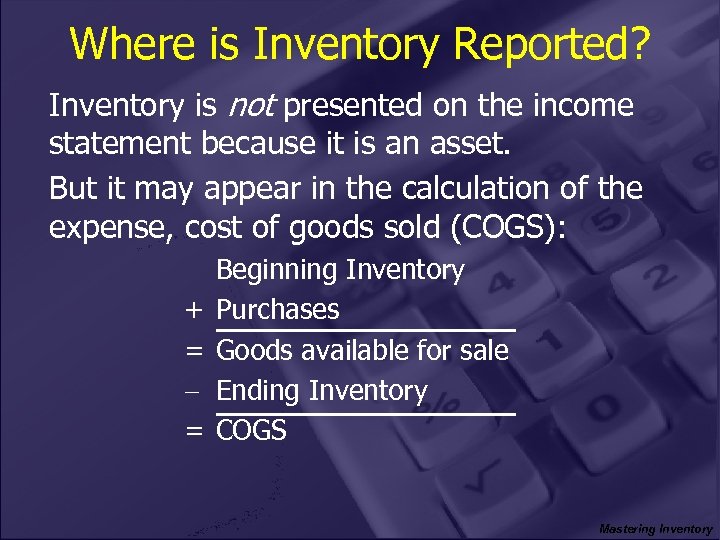
Where is Inventory Reported? Inventory is not presented on the income statement because it is an asset. But it may appear in the calculation of the expense, cost of goods sold (COGS): + = = Beginning Inventory Purchases Goods available for sale Ending Inventory COGS Mastering Inventory
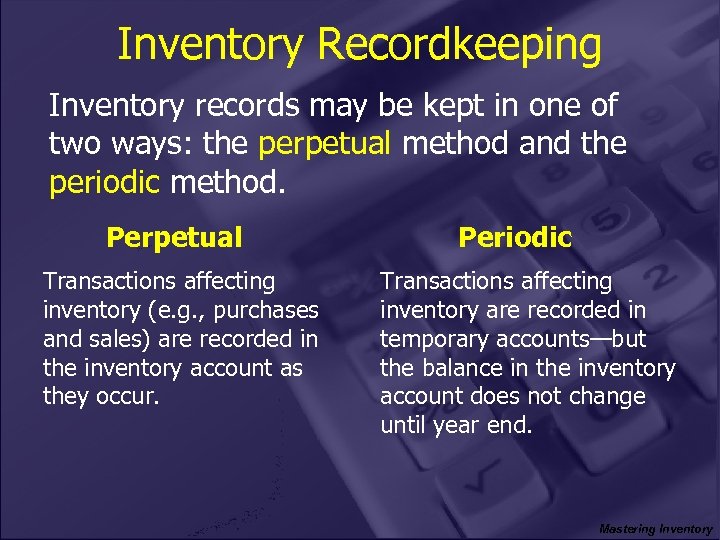
Inventory Recordkeeping Inventory records may be kept in one of two ways: the perpetual method and the periodic method. Perpetual Transactions affecting inventory (e. g. , purchases and sales) are recorded in the inventory account as they occur. Periodic Transactions affecting inventory are recorded in temporary accounts—but the balance in the inventory account does not change until year end. Mastering Inventory
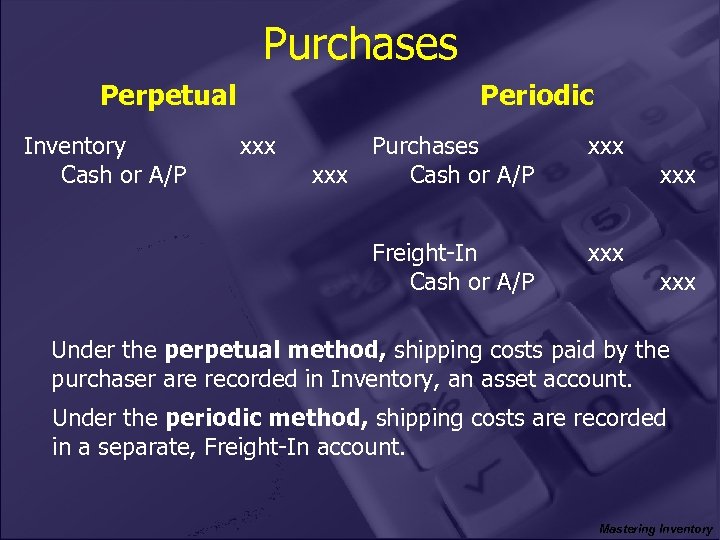
Purchases Perpetual Inventory Cash or A/P Periodic xxx Freight-In Cash or A/P xxx Purchases Cash or A/P xxx xxx Under the perpetual method, shipping costs paid by the purchaser are recorded in Inventory, an asset account. Under the periodic method, shipping costs are recorded in a separate, Freight-In account. Mastering Inventory
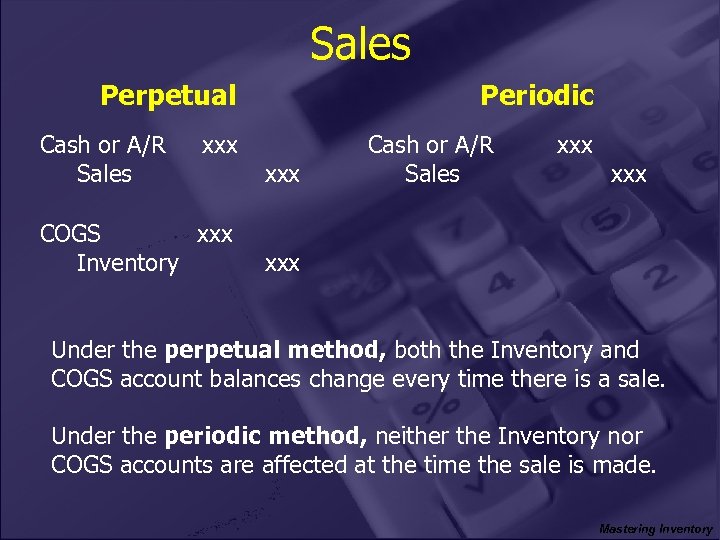
Sales Perpetual Cash or A/R Sales xxx COGS xxx Inventory Periodic xxx Cash or A/R Sales xxx xxx Under the perpetual method, both the Inventory and COGS account balances change every time there is a sale. Under the periodic method, neither the Inventory nor COGS accounts are affected at the time the sale is made. Mastering Inventory
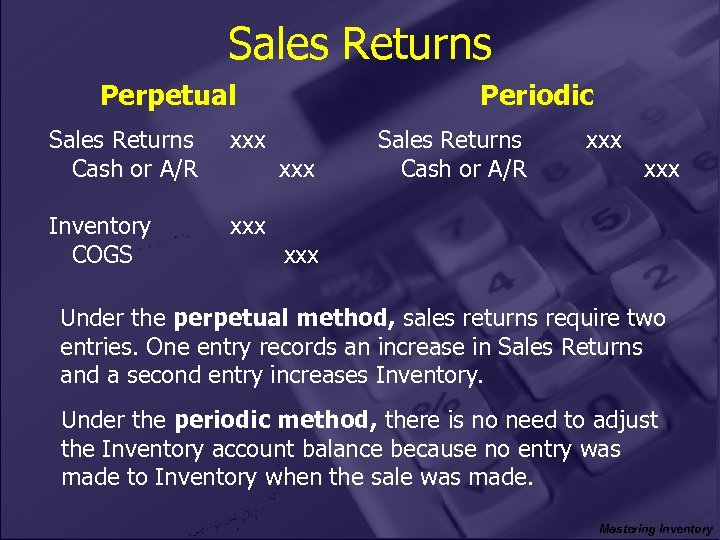
Sales Returns Perpetual Sales Returns Cash or A/R xxx Inventory COGS xxx Periodic xxx Sales Returns Cash or A/R xxx xxx Under the perpetual method, sales returns require two entries. One entry records an increase in Sales Returns and a second entry increases Inventory. Under the periodic method, there is no need to adjust the Inventory account balance because no entry was made to Inventory when the sale was made. Mastering Inventory
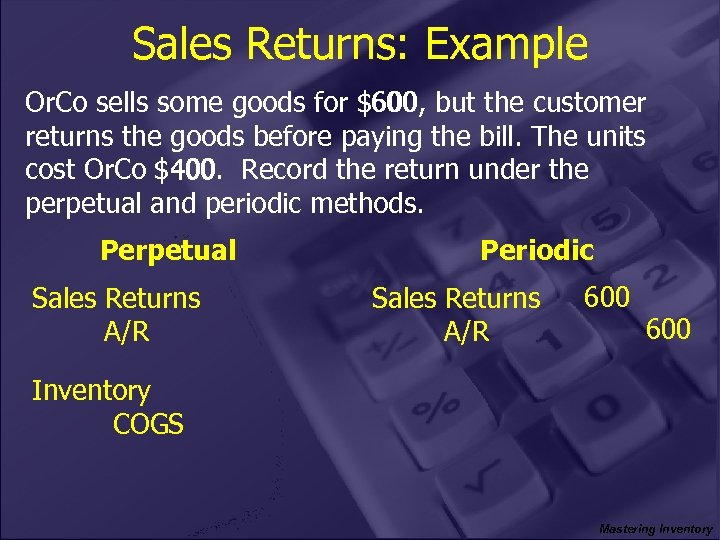
Sales Returns: Example 600 Or. Co sells some goods for $600, but the customer returns the goods before paying the bill. The units cost Or. Co $400. Record the return under the 400 perpetual and periodic methods. Perpetual Sales Returns A/R Periodic Sales Returns A/R 600 Inventory COGS Mastering Inventory
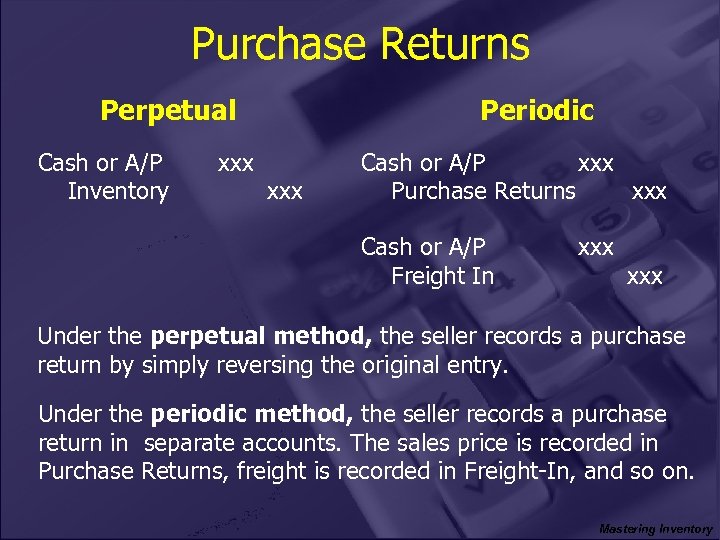
Purchase Returns Perpetual Cash or A/P Inventory xxx Periodic xxx Cash or A/P xxx Purchase Returns xxx Cash or A/P Freight In xxx Under the perpetual method, the seller records a purchase return by simply reversing the original entry. Under the periodic method, the seller records a purchase return in separate accounts. The sales price is recorded in Purchase Returns, freight is recorded in Freight-In, and so on. Mastering Inventory
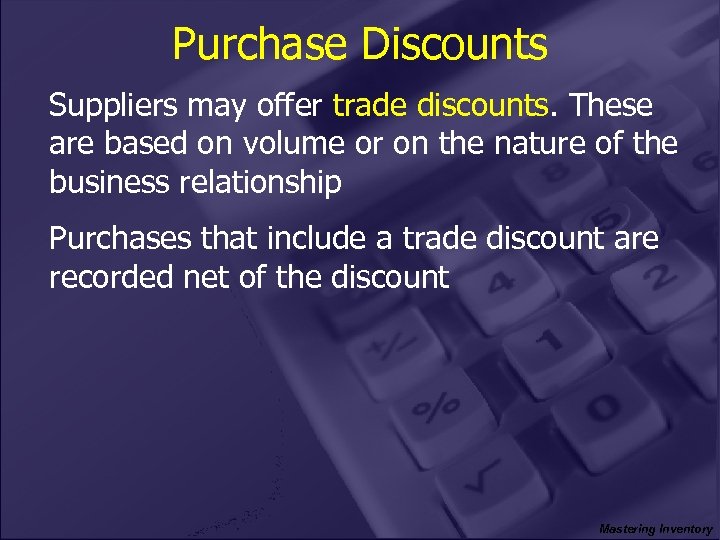
Purchase Discounts Suppliers may offer trade discounts. These are based on volume or on the nature of the business relationship Purchases that include a trade discount are recorded net of the discount Mastering Inventory
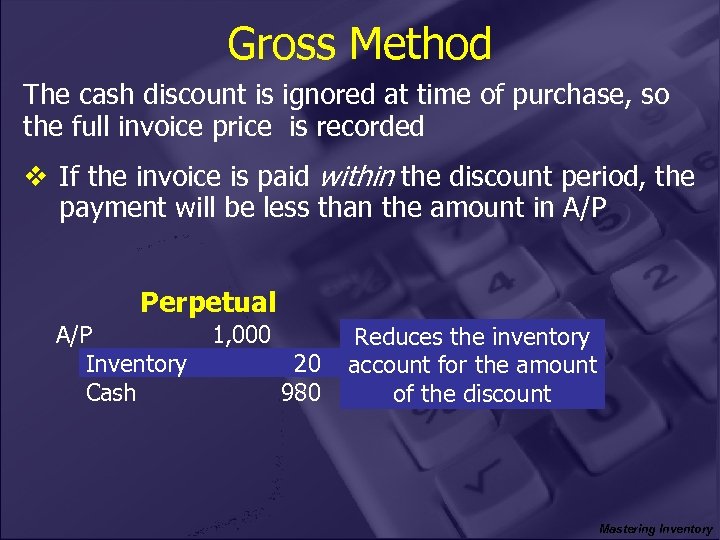
Gross Method The cash discount is ignored at time of purchase, so the full invoice price is recorded v If the invoice is paid within the discount period, the payment will be less than the amount in A/P Perpetual A/P Inventory Cash 1, 000 20 980 Reduces the inventory account for the amount of the discount Mastering Inventory
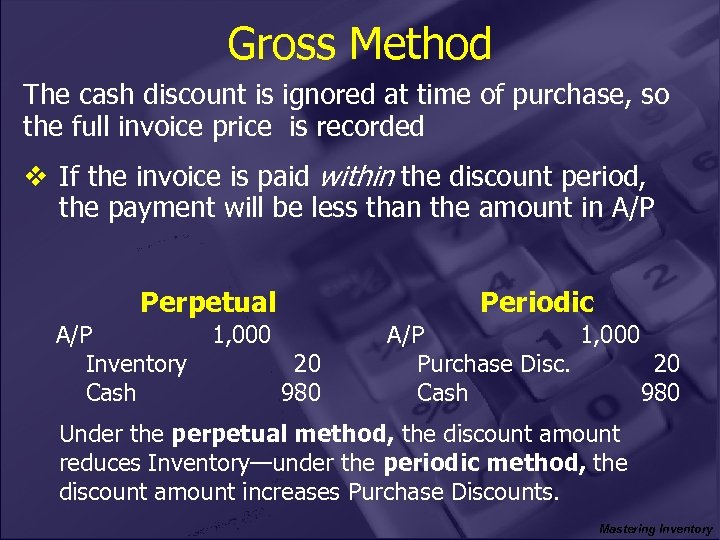
Gross Method The cash discount is ignored at time of purchase, so the full invoice price is recorded v If the invoice is paid within the discount period, the payment will be less than the amount in A/P Perpetual A/P Inventory Cash 1, 000 Periodic 20 980 A/P 1, 000 Purchase Disc. 20 Cash 980 Under the perpetual method, the discount amount reduces Inventory—under the periodic method, the discount amount increases Purchase Discounts. Mastering Inventory
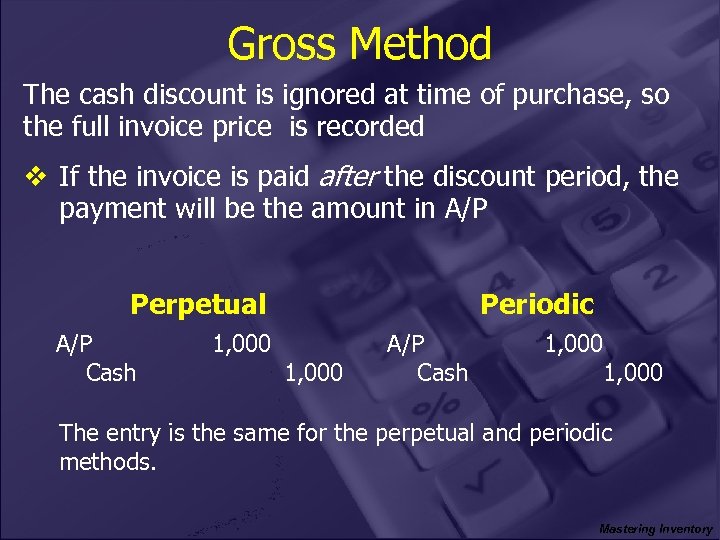
Gross Method The cash discount is ignored at time of purchase, so the full invoice price is recorded v If the invoice is paid after the discount period, the payment will be the amount in A/P Perpetual A/P Cash 1, 000 Periodic 1, 000 A/P Cash 1, 000 The entry is the same for the perpetual and periodic methods. Mastering Inventory
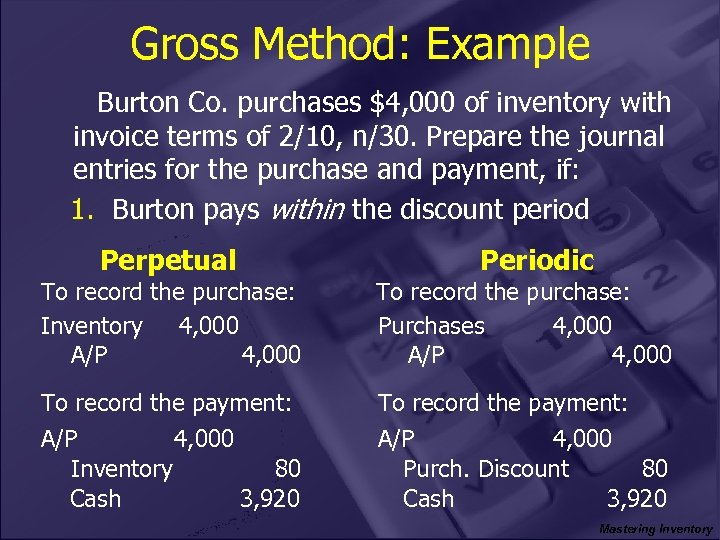
Gross Method: Example Burton Co. purchases $4, 000 of inventory with invoice terms of 2/10, n/30. Prepare the journal entries for the purchase and payment, if: 1. Burton pays within the discount period Perpetual Periodic To record the purchase: Inventory 4, 000 A/P 4, 000 To record the purchase: Purchases 4, 000 A/P 4, 000 To record the payment: A/P 4, 000 Inventory 80 Cash 3, 920 To record the payment: A/P 4, 000 Purch. Discount 80 Cash 3, 920 Mastering Inventory
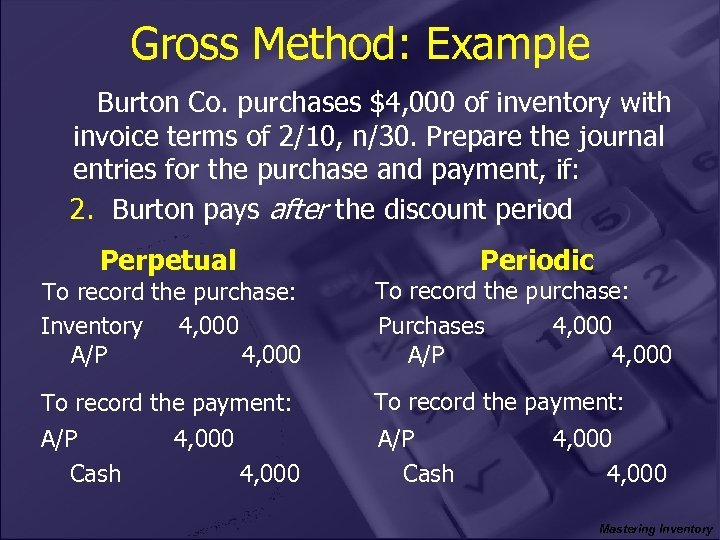
Gross Method: Example Burton Co. purchases $4, 000 of inventory with invoice terms of 2/10, n/30. Prepare the journal entries for the purchase and payment, if: 2. Burton pays after the discount period Perpetual Periodic To record the purchase: Inventory 4, 000 A/P 4, 000 To record the purchase: Purchases 4, 000 A/P 4, 000 To record the payment: A/P 4, 000 Cash 4, 000 To record the payment: A/P Cash 4, 000 Mastering Inventory
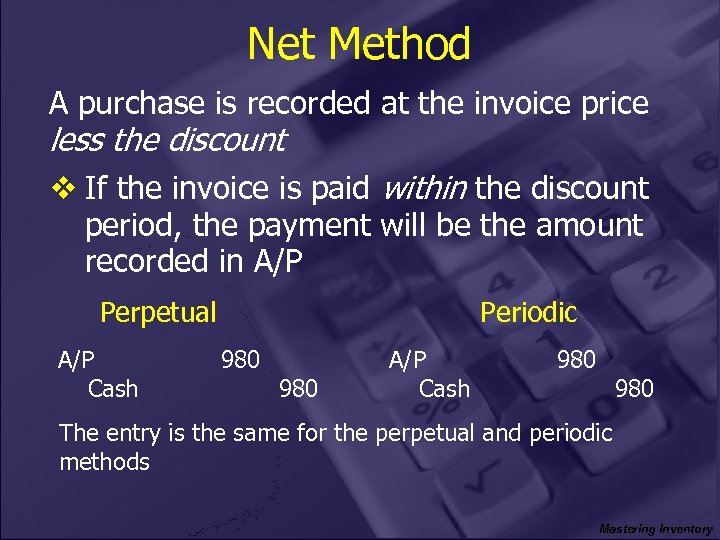
Net Method A purchase is recorded at the invoice price less the discount v If the invoice is paid within the discount period, the payment will be the amount recorded in A/P Perpetual A/P Cash Periodic 980 A/P Cash 980 The entry is the same for the perpetual and periodic methods Mastering Inventory
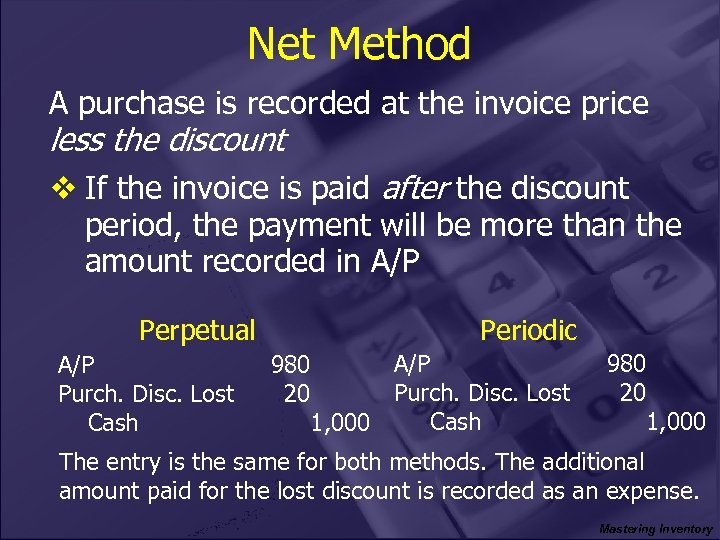
Net Method A purchase is recorded at the invoice price less the discount v If the invoice is paid after the discount period, the payment will be more than the amount recorded in A/P Perpetual A/P Purch. Disc. Lost Cash Periodic 980 20 A/P Purch. Disc. Lost Cash 1, 000 980 20 1, 000 The entry is the same for both methods. The additional amount paid for the lost discount is recorded as an expense. Mastering Inventory
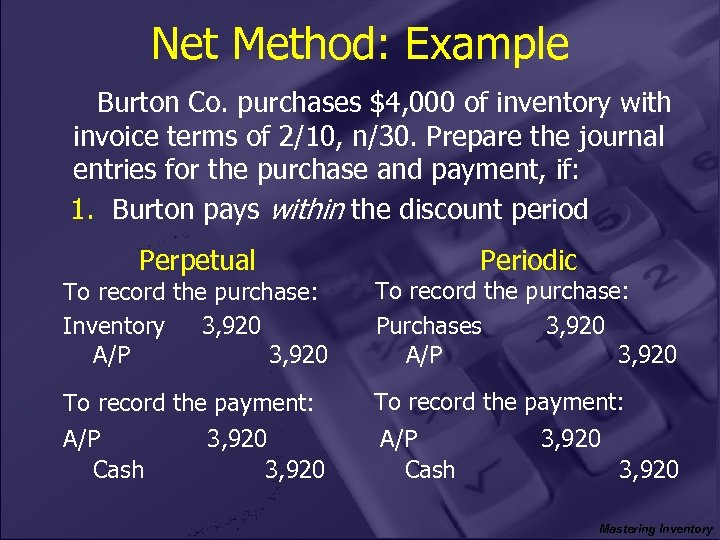
Net Method: Example Burton Co. purchases $4, 000 of inventory with invoice terms of 2/10, n/30. Prepare the journal entries for the purchase and payment, if: 1. Burton pays within the discount period Perpetual Periodic To record the purchase: Inventory 3, 920 A/P 3, 920 To record the purchase: Purchases 3, 920 A/P 3, 920 To record the payment: A/P 3, 920 Cash 3, 920 To record the payment: A/P Cash 3, 920 Mastering Inventory
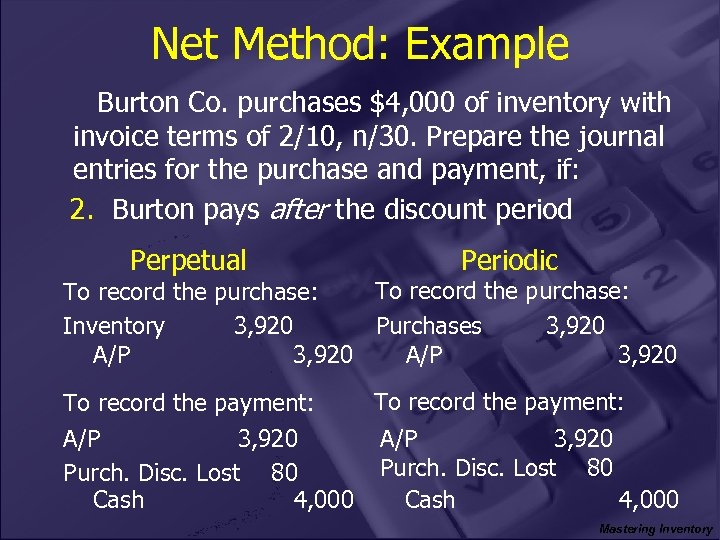
Net Method: Example Burton Co. purchases $4, 000 of inventory with invoice terms of 2/10, n/30. Prepare the journal entries for the purchase and payment, if: 2. Burton pays after the discount period Perpetual Periodic To record the purchase: Inventory 3, 920 Purchases 3, 920 A/P 3, 920 To record the payment: A/P 3, 920 Purch. Disc. Lost 80 Cash 4, 000 Mastering Inventory
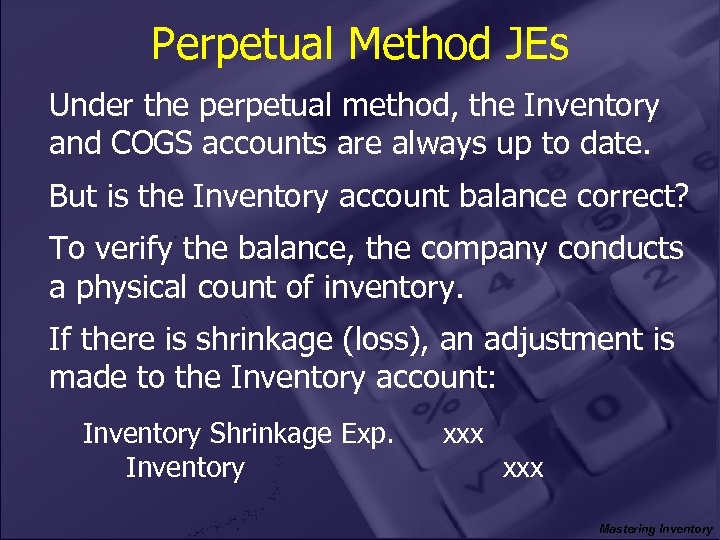
Perpetual Method JEs Under the perpetual method, the Inventory and COGS accounts are always up to date. But is the Inventory account balance correct? To verify the balance, the company conducts a physical count of inventory. If there is shrinkage (loss), an adjustment is made to the Inventory account: Inventory Shrinkage Exp. Inventory xxx Mastering Inventory
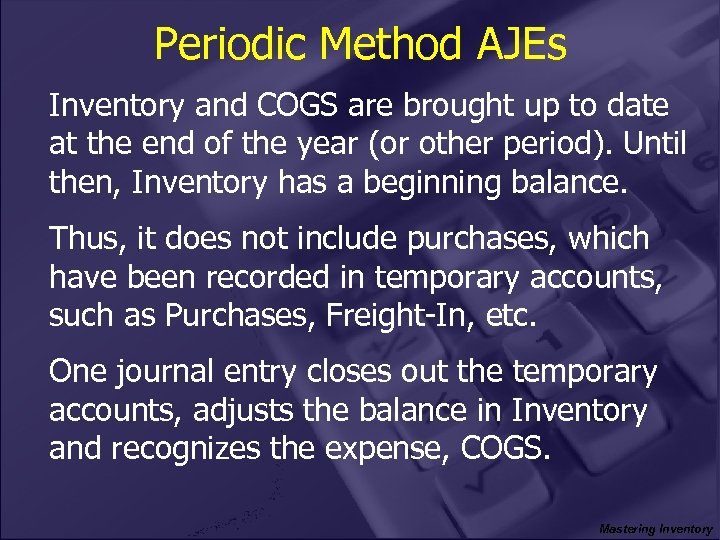
Periodic Method AJEs Inventory and COGS are brought up to date at the end of the year (or other period). Until then, Inventory has a beginning balance. Thus, it does not include purchases, which have been recorded in temporary accounts, such as Purchases, Freight-In, etc. One journal entry closes out the temporary accounts, adjusts the balance in Inventory and recognizes the expense, COGS. Mastering Inventory
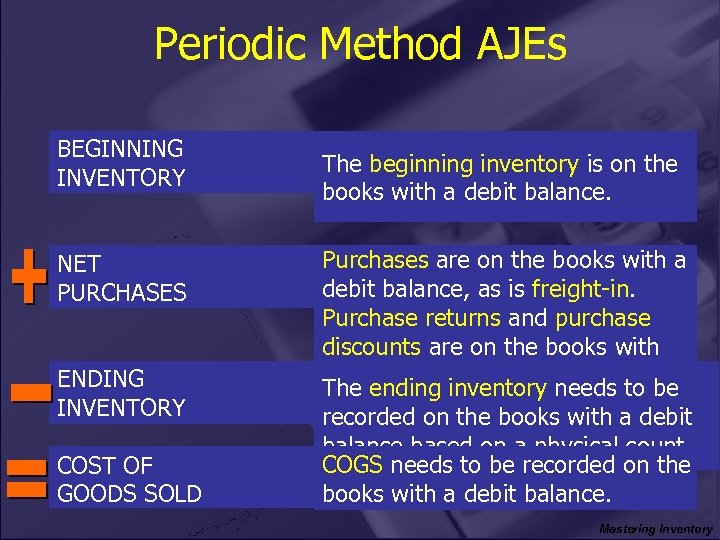
Periodic Method AJEs BEGINNING INVENTORY NET PURCHASES ENDING INVENTORY COST OF GOODS SOLD The beginning inventory is on the books with a debit balance. Purchases are on the books with a debit balance, as is freight-in. Purchase returns and purchase discounts are on the books with credit balances. The ending inventory needs to be recorded on the books with a debit balance based on a physical count. COGS needs to be recorded on the books with a debit balance. Mastering Inventory
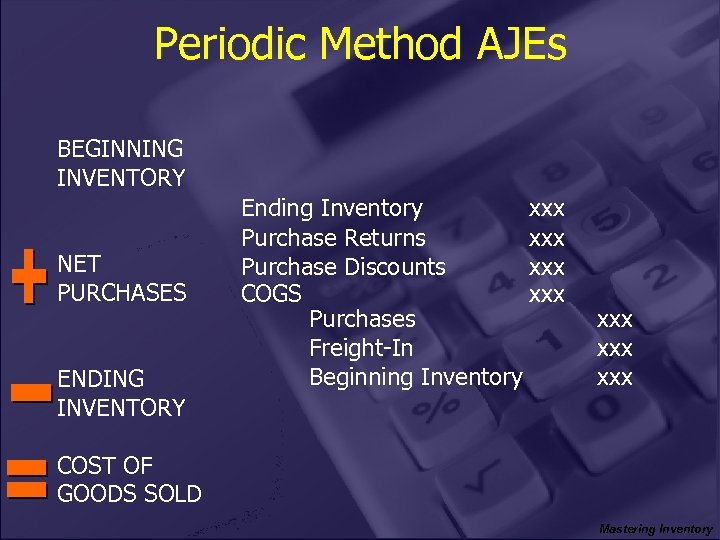
Periodic Method AJEs BEGINNING INVENTORY NET PURCHASES ENDING INVENTORY Ending Inventory xxx Purchase Returns xxx Purchase Discounts xxx COGS xxx Purchases Freight-In Beginning Inventory xxx xxx COST OF GOODS SOLD Mastering Inventory
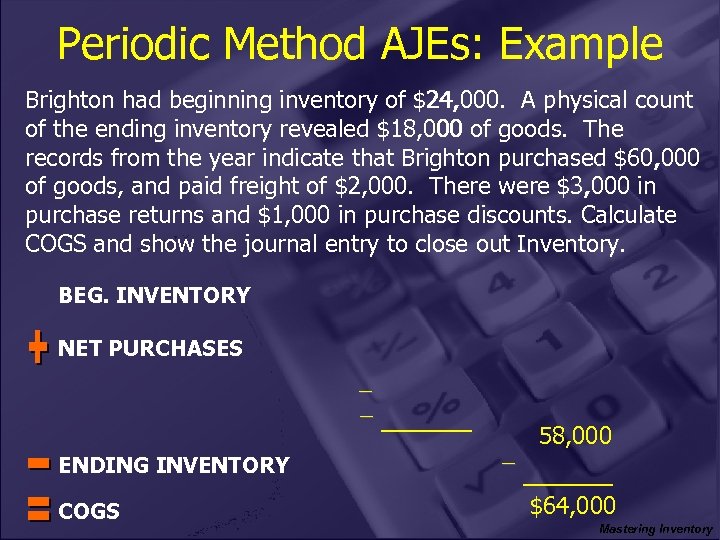
Periodic Method AJEs: Example Brighton had beginning inventory of $24, 000 A physical count $24, 000. of the ending inventory revealed $18, 000 of goods. The 18, 000 records from the year indicate that Brighton purchased $60, 000 of goods, and paid freight of $2, 000. There were $3, 000 in 2, 000 3, 000 purchase returns and $1, 000 in purchase discounts. Calculate 1, 000 COGS and show the journal entry to close out Inventory. BEG. INVENTORY NET PURCHASES ENDING INVENTORY COGS 58, 000 $64, 000 Mastering Inventory
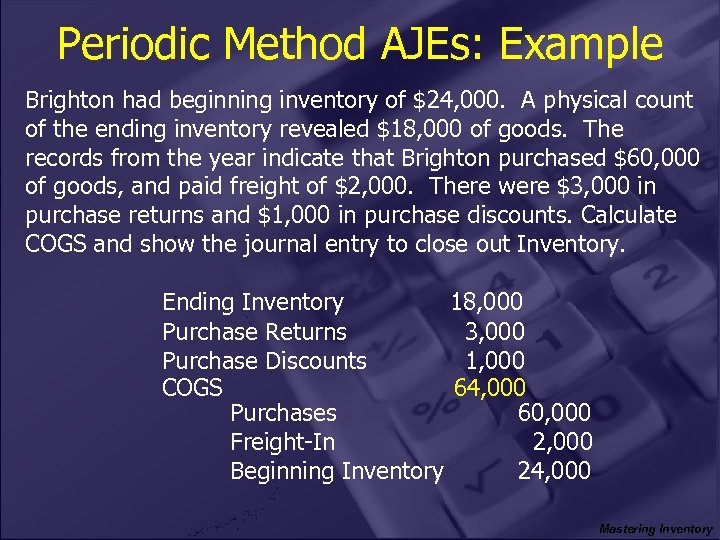
Periodic Method AJEs: Example Brighton had beginning inventory of $24, 000. A physical count of the ending inventory revealed $18, 000 of goods. The records from the year indicate that Brighton purchased $60, 000 of goods, and paid freight of $2, 000. There were $3, 000 in purchase returns and $1, 000 in purchase discounts. Calculate COGS and show the journal entry to close out Inventory. Ending Inventory 18, 000 Purchase Returns 3, 000 Purchase Discounts 1, 000 COGS 64, 000 Purchases 60, 000 Freight-In 2, 000 Beginning Inventory 24, 000 Mastering Inventory
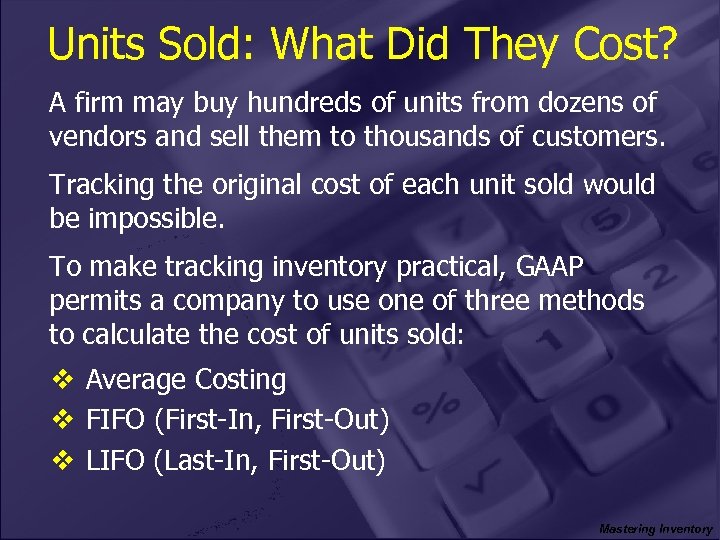
Units Sold: What Did They Cost? A firm may buy hundreds of units from dozens of vendors and sell them to thousands of customers. Tracking the original cost of each unit sold would be impossible. To make tracking inventory practical, GAAP permits a company to use one of three methods to calculate the cost of units sold: v Average Costing v FIFO (First-In, First-Out) v LIFO (Last-In, First-Out) Mastering Inventory
Average Costing This can be used to under the periodic or perpetual methods: v Periodic method. Because COGS is recorded only once a year, a weighted average is used to compute the of units sold. v Perpetual method. Because COGS is recorded at each sale, a moving average is used to compute the cost of each unit sold. After each purchase, the cost of the units sold “moves. ” Mastering Inventory
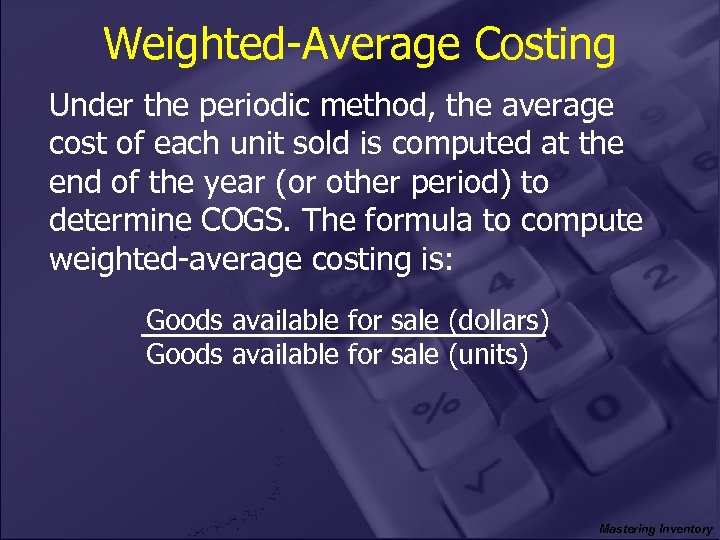
Weighted-Average Costing Under the periodic method, the average cost of each unit sold is computed at the end of the year (or other period) to determine COGS. The formula to compute weighted-average costing is: Goods available for sale (dollars) Goods available for sale (units) Mastering Inventory
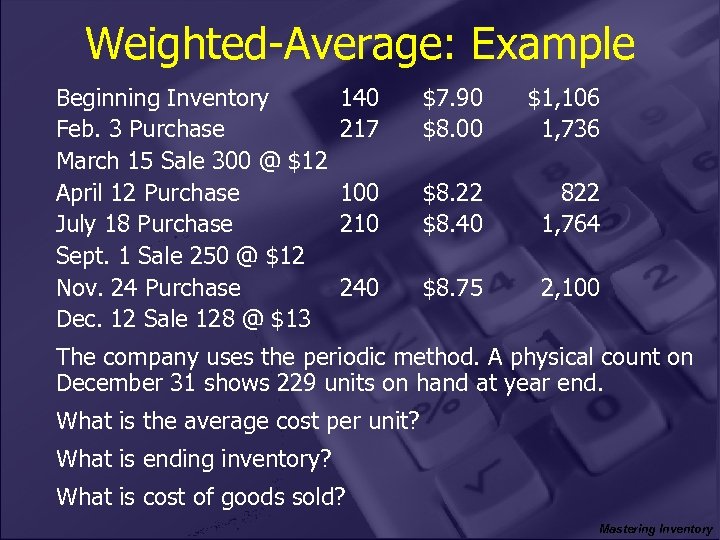
Weighted-Average: Example Beginning Inventory Feb. 3 Purchase March 15 Sale 300 @ $12 April 12 Purchase July 18 Purchase Sept. 1 Sale 250 @ $12 Nov. 24 Purchase Dec. 12 Sale 128 @ $13 140 217 $7. 90 $8. 00 $1, 106 1, 736 100 210 $8. 22 $8. 40 822 1, 764 240 $8. 75 2, 100 The company uses the periodic method. A physical count on December 31 shows 229 units on hand at year end. What is the average cost per unit? What is ending inventory? What is cost of goods sold? Mastering Inventory
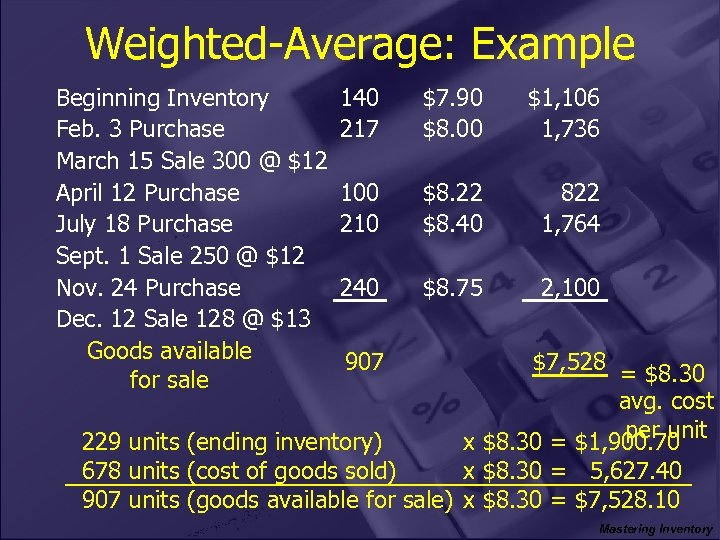
Weighted-Average: Example Beginning Inventory Feb. 3 Purchase March 15 Sale 300 @ $12 April 12 Purchase July 18 Purchase Sept. 1 Sale 250 @ $12 Nov. 24 Purchase Dec. 12 Sale 128 @ $13 Goods available for sale 140 217 $7. 90 $8. 00 $1, 106 1, 736 100 210 $8. 22 $8. 40 822 1, 764 240 $8. 75 2, 100 907 $7, 528 = $8. 30 avg. cost per unit 229 units (ending inventory) x $8. 30 = $1, 900. 70 678 units (cost of goods sold) x $8. 30 = 5, 627. 40 907 units (goods available for sale) x $8. 30 = $7, 528. 10 Mastering Inventory
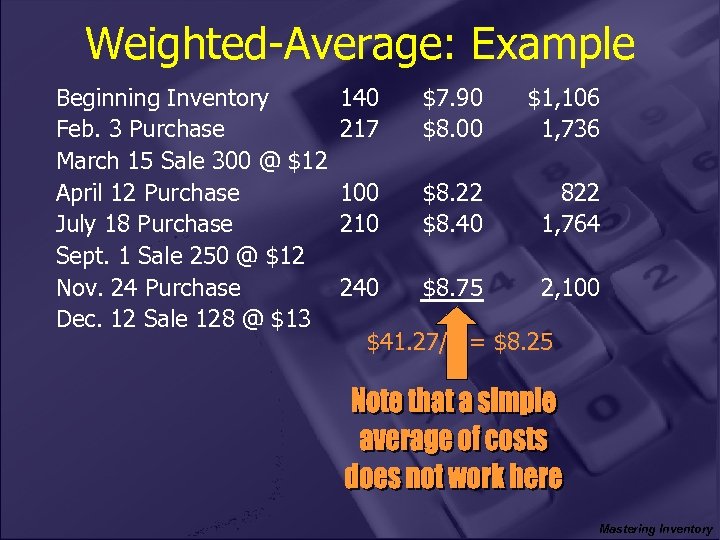
Weighted-Average: Example Beginning Inventory Feb. 3 Purchase March 15 Sale 300 @ $12 April 12 Purchase July 18 Purchase Sept. 1 Sale 250 @ $12 Nov. 24 Purchase Dec. 12 Sale 128 @ $13 140 217 $7. 90 $8. 00 $1, 106 1, 736 100 210 $8. 22 $8. 40 822 1, 764 240 $8. 75 2, 100 $41. 27/5 = $8. 25 Mastering Inventory
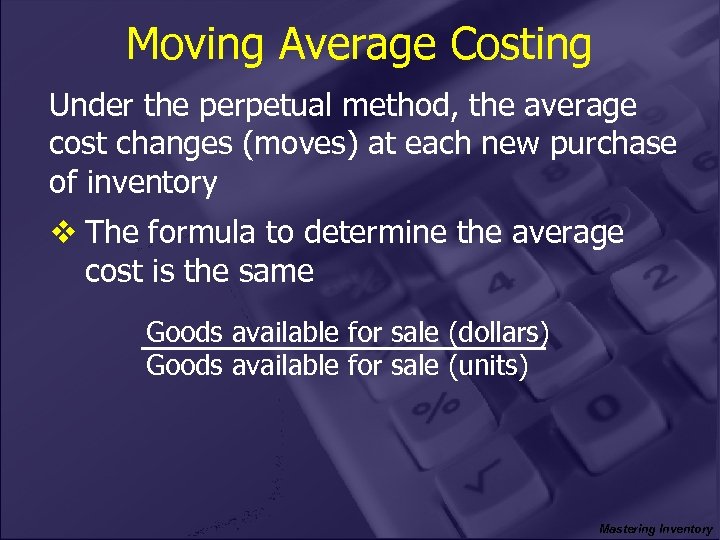
Moving Average Costing Under the perpetual method, the average cost changes (moves) at each new purchase of inventory v The formula to determine the average cost is the same Goods available for sale (dollars) Goods available for sale (units) Mastering Inventory
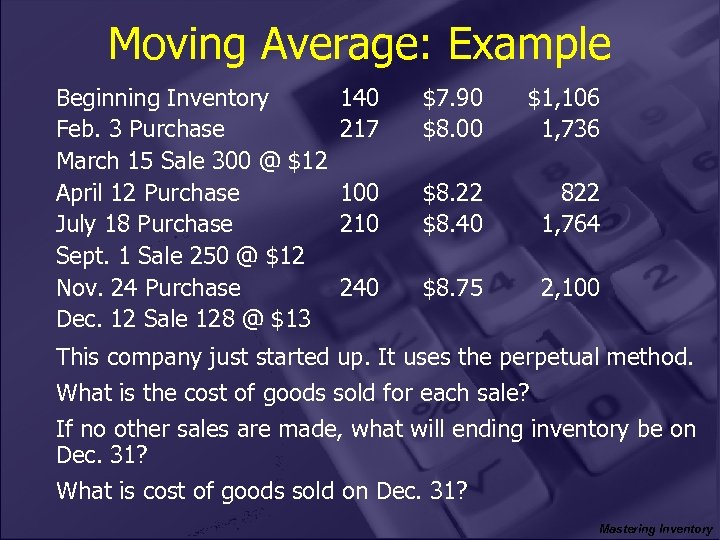
Moving Average: Example Beginning Inventory Feb. 3 Purchase March 15 Sale 300 @ $12 April 12 Purchase July 18 Purchase Sept. 1 Sale 250 @ $12 Nov. 24 Purchase Dec. 12 Sale 128 @ $13 140 217 $7. 90 $8. 00 $1, 106 1, 736 100 210 $8. 22 $8. 40 822 1, 764 240 $8. 75 2, 100 This company just started up. It uses the perpetual method. What is the cost of goods sold for each sale? If no other sales are made, what will ending inventory be on Dec. 31? What is cost of goods sold on Dec. 31? Mastering Inventory
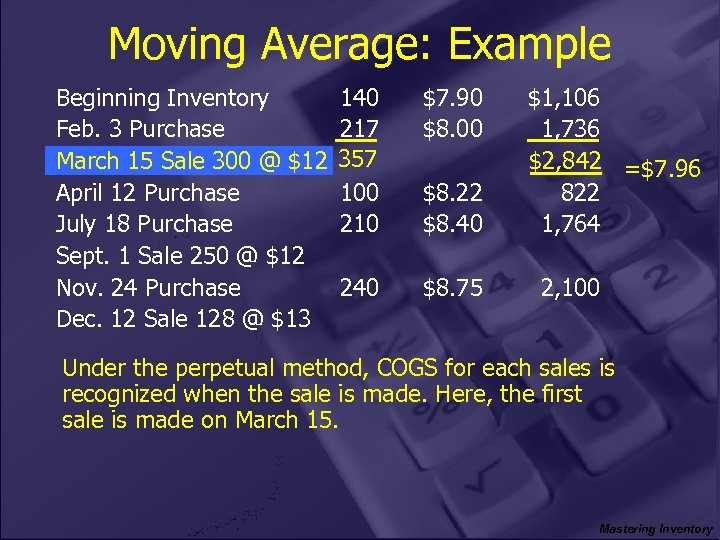
Moving Average: Example Beginning Inventory Feb. 3 Purchase March 15 Sale 300 @ $12 April 12 Purchase July 18 Purchase Sept. 1 Sale 250 @ $12 Nov. 24 Purchase Dec. 12 Sale 128 @ $13 140 217 357 100 210 $7. 90 $8. 00 240 $8. 75 $8. 22 $8. 40 $1, 106 1, 736 $2, 842 =$7. 96 822 1, 764 2, 100 Under the perpetual method, COGS for each sales is recognized when the sale is made. Here, the first sale is made on March 15. Mastering Inventory
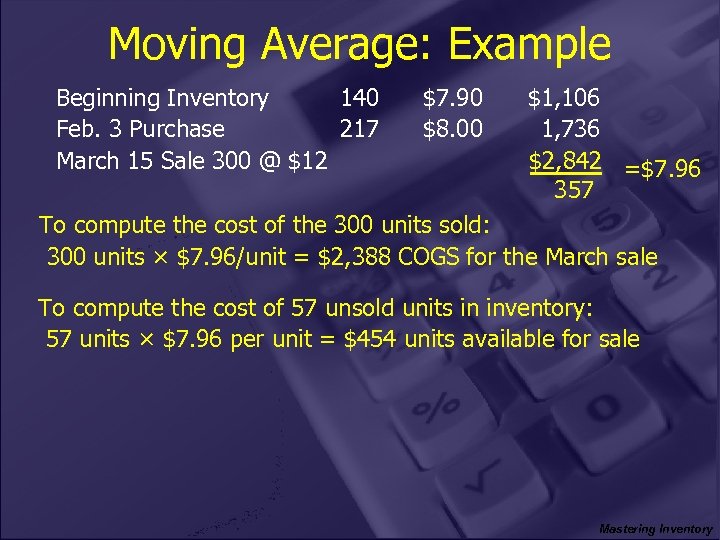
Moving Average: Example Beginning Inventory 140 Feb. 3 Purchase 217 March 15 Sale 300 @ $12 $7. 90 $8. 00 $1, 106 1, 736 $2, 842 =$7. 96 357 To compute the cost of the 300 units sold: 300 units × $7. 96/unit = $2, 388 COGS for the March sale To compute the cost of 57 unsold units in inventory: 57 units × $7. 96 per unit = $454 units available for sale Mastering Inventory
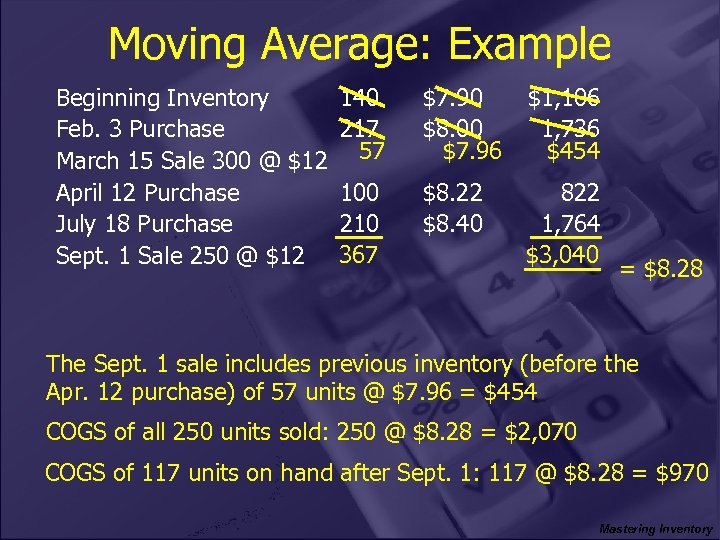
Moving Average: Example Beginning Inventory Feb. 3 Purchase March 15 Sale 300 @ $12 April 12 Purchase July 18 Purchase Sept. 1 Sale 250 @ $12 140 217 57 $7. 90 $8. 00 $7. 96 $1, 106 1, 736 $454 100 210 367 $8. 22 $8. 40 822 1, 764 $3, 040 = $8. 28 The Sept. 1 sale includes previous inventory (before the Apr. 12 purchase) of 57 units @ $7. 96 = $454 COGS of all 250 units sold: 250 @ $8. 28 = $2, 070 COGS of 117 units on hand after Sept. 1: 117 @ $8. 28 = $970 Mastering Inventory
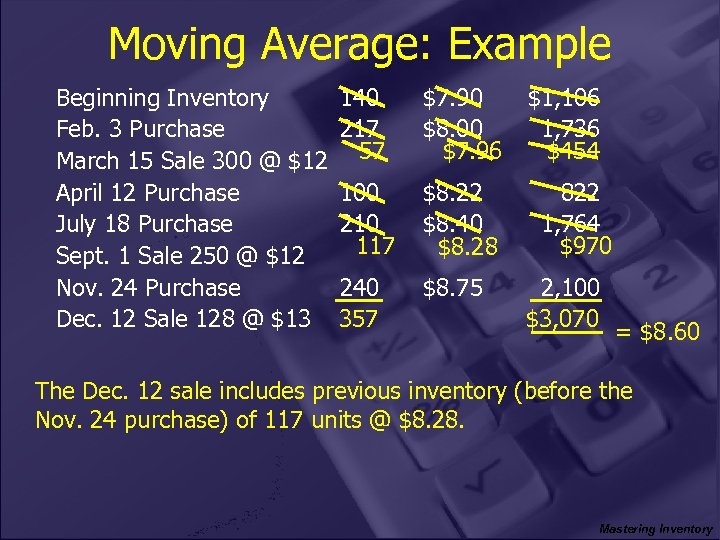
Moving Average: Example Beginning Inventory Feb. 3 Purchase March 15 Sale 300 @ $12 April 12 Purchase July 18 Purchase Sept. 1 Sale 250 @ $12 Nov. 24 Purchase Dec. 12 Sale 128 @ $13 140 217 57 $7. 90 $8. 00 $7. 96 100 210 117 $8. 22 $8. 40 $8. 28 240 357 $8. 75 $1, 106 1, 736 $454 822 1, 764 $970 2, 100 $3, 070 = $8. 60 The Dec. 12 sale includes previous inventory (before the Nov. 24 purchase) of 117 units @ $8. 28. Mastering Inventory
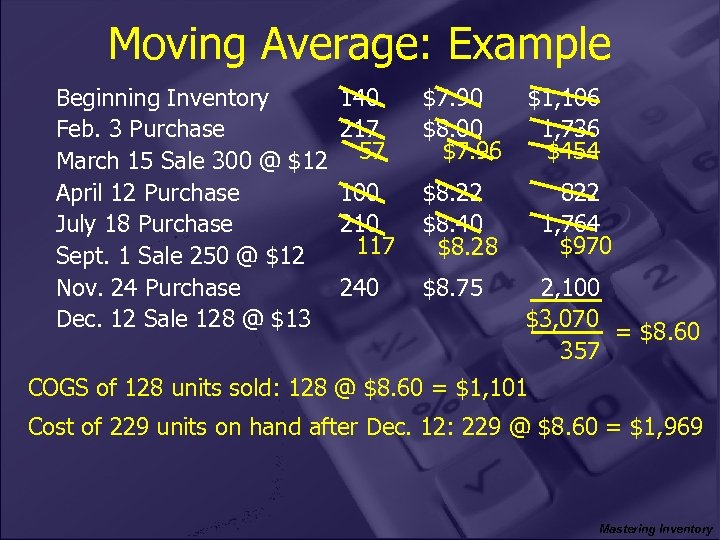
Moving Average: Example Beginning Inventory Feb. 3 Purchase March 15 Sale 300 @ $12 April 12 Purchase July 18 Purchase Sept. 1 Sale 250 @ $12 Nov. 24 Purchase Dec. 12 Sale 128 @ $13 140 217 57 $7. 90 $8. 00 $7. 96 100 210 117 $8. 22 $8. 40 $8. 28 240 $8. 75 $1, 106 1, 736 $454 822 1, 764 $970 2, 100 $3, 070 = $8. 60 357 COGS of 128 units sold: 128 @ $8. 60 = $1, 101 Cost of 229 units on hand after Dec. 12: 229 @ $8. 60 = $1, 969 Mastering Inventory
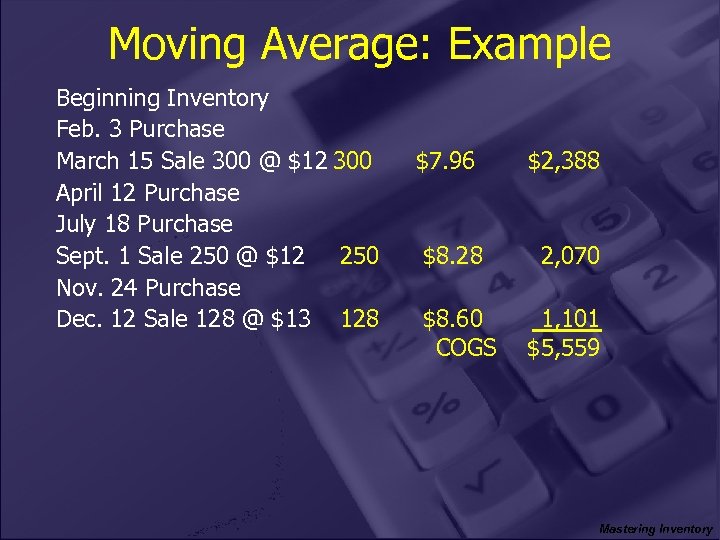
Moving Average: Example Beginning Inventory Feb. 3 Purchase March 15 Sale 300 @ $12 300 April 12 Purchase July 18 Purchase Sept. 1 Sale 250 @ $12 250 Nov. 24 Purchase Dec. 12 Sale 128 @ $13 128 $7. 96 $2, 388 $8. 28 2, 070 $8. 60 COGS 1, 101 $5, 559 Mastering Inventory
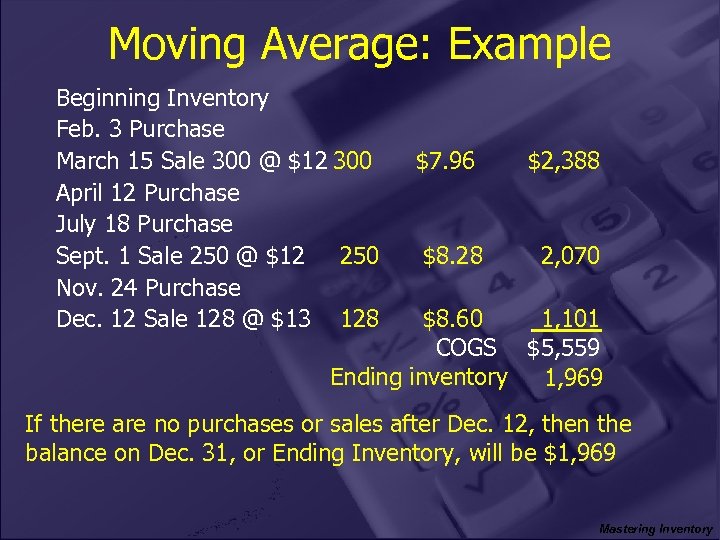
Moving Average: Example Beginning Inventory Feb. 3 Purchase March 15 Sale 300 @ $12 300 April 12 Purchase July 18 Purchase Sept. 1 Sale 250 @ $12 250 Nov. 24 Purchase Dec. 12 Sale 128 @ $13 128 $7. 96 $8. 28 $2, 388 2, 070 $8. 60 1, 101 COGS $5, 559 Ending inventory 1, 969 If there are no purchases or sales after Dec. 12, then the balance on Dec. 31, or Ending Inventory, will be $1, 969 Mastering Inventory
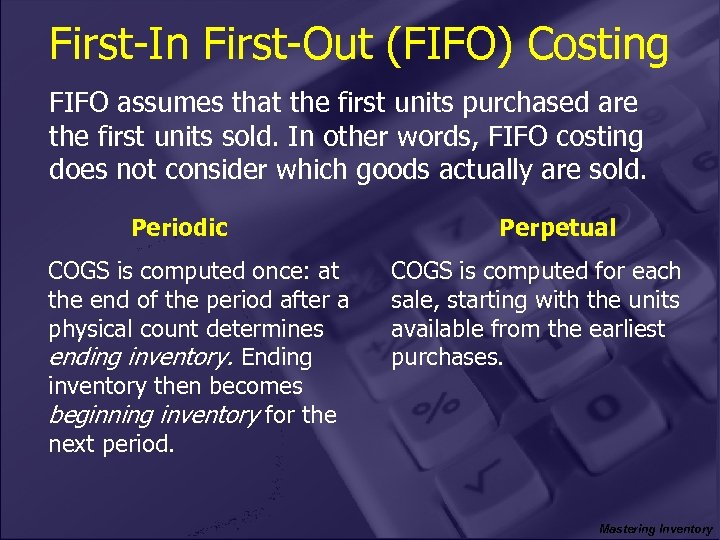
First-In First-Out (FIFO) Costing FIFO assumes that the first units purchased are the first units sold. In other words, FIFO costing does not consider which goods actually are sold. Periodic COGS is computed once: at the end of the period after a physical count determines ending inventory. Ending inventory then becomes beginning inventory for the next period. Perpetual COGS is computed for each sale, starting with the units available from the earliest purchases. Mastering Inventory
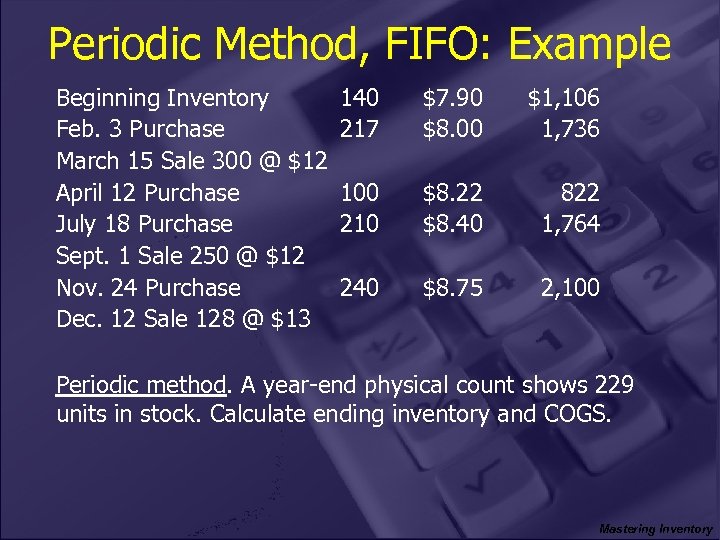
Periodic Method, FIFO: Example Beginning Inventory Feb. 3 Purchase March 15 Sale 300 @ $12 April 12 Purchase July 18 Purchase Sept. 1 Sale 250 @ $12 Nov. 24 Purchase Dec. 12 Sale 128 @ $13 140 217 $7. 90 $8. 00 $1, 106 1, 736 100 210 $8. 22 $8. 40 822 1, 764 240 $8. 75 2, 100 Periodic method. A year-end physical count shows 229 units in stock. Calculate ending inventory and COGS. Mastering Inventory
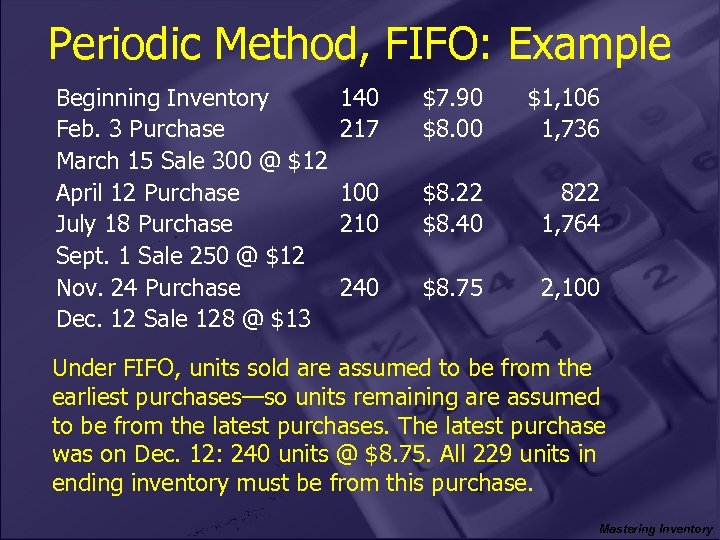
Periodic Method, FIFO: Example Beginning Inventory Feb. 3 Purchase March 15 Sale 300 @ $12 April 12 Purchase July 18 Purchase Sept. 1 Sale 250 @ $12 Nov. 24 Purchase Dec. 12 Sale 128 @ $13 140 217 $7. 90 $8. 00 $1, 106 1, 736 100 210 $8. 22 $8. 40 822 1, 764 240 $8. 75 2, 100 Under FIFO, units sold are assumed to be from the earliest purchases—so units remaining are assumed to be from the latest purchases. The latest purchase was on Dec. 12: 240 units @ $8. 75. All 229 units in ending inventory must be from this purchase. Mastering Inventory
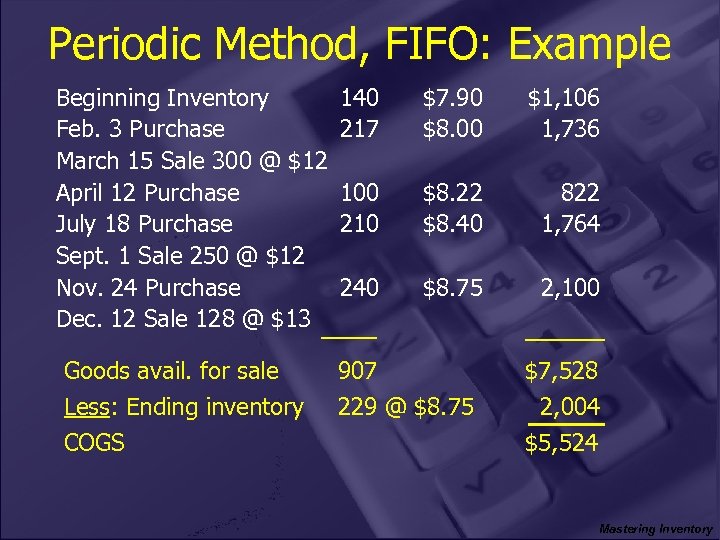
Periodic Method, FIFO: Example Beginning Inventory Feb. 3 Purchase March 15 Sale 300 @ $12 April 12 Purchase July 18 Purchase Sept. 1 Sale 250 @ $12 Nov. 24 Purchase Dec. 12 Sale 128 @ $13 Goods avail. for sale Less: Ending inventory COGS 140 217 $7. 90 $8. 00 $1, 106 1, 736 100 210 $8. 22 $8. 40 822 1, 764 240 $8. 75 2, 100 907 229 @ $8. 75 $7, 528 2, 004 $5, 524 Mastering Inventory
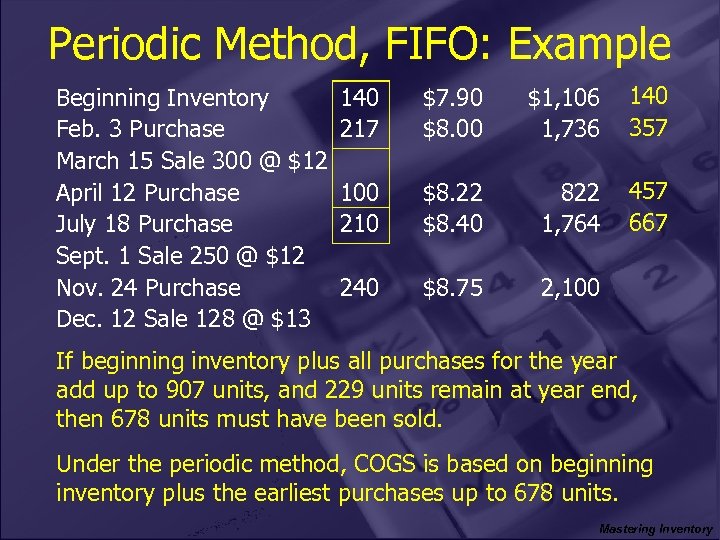
Periodic Method, FIFO: Example Beginning Inventory Feb. 3 Purchase March 15 Sale 300 @ $12 April 12 Purchase July 18 Purchase Sept. 1 Sale 250 @ $12 Nov. 24 Purchase Dec. 12 Sale 128 @ $13 140 217 $7. 90 $8. 00 $1, 106 1, 736 140 357 100 210 $8. 22 $8. 40 822 1, 764 457 667 240 $8. 75 2, 100 If beginning inventory plus all purchases for the year add up to 907 units, and 229 units remain at year end, then 678 units must have been sold. Under the periodic method, COGS is based on beginning inventory plus the earliest purchases up to 678 units. Mastering Inventory
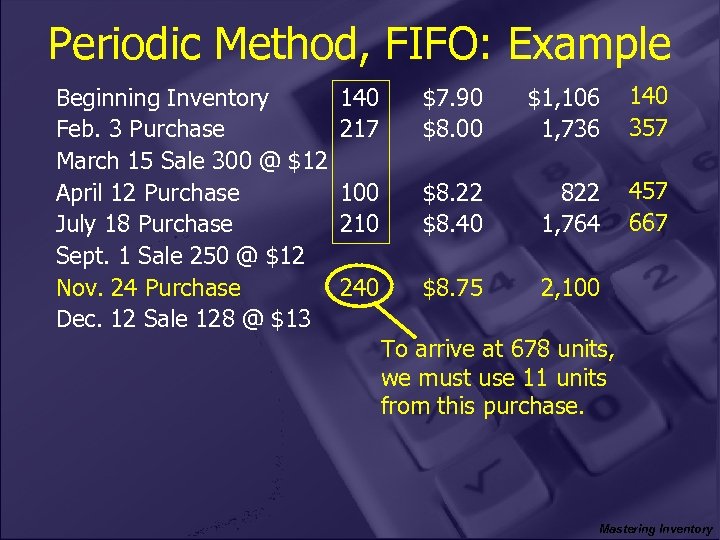
Periodic Method, FIFO: Example Beginning Inventory Feb. 3 Purchase March 15 Sale 300 @ $12 April 12 Purchase July 18 Purchase Sept. 1 Sale 250 @ $12 Nov. 24 Purchase Dec. 12 Sale 128 @ $13 140 217 $7. 90 $8. 00 $1, 106 1, 736 140 357 100 210 $8. 22 $8. 40 822 1, 764 457 667 240 $8. 75 2, 100 To arrive at 678 units, we must use 11 units from this purchase. Mastering Inventory
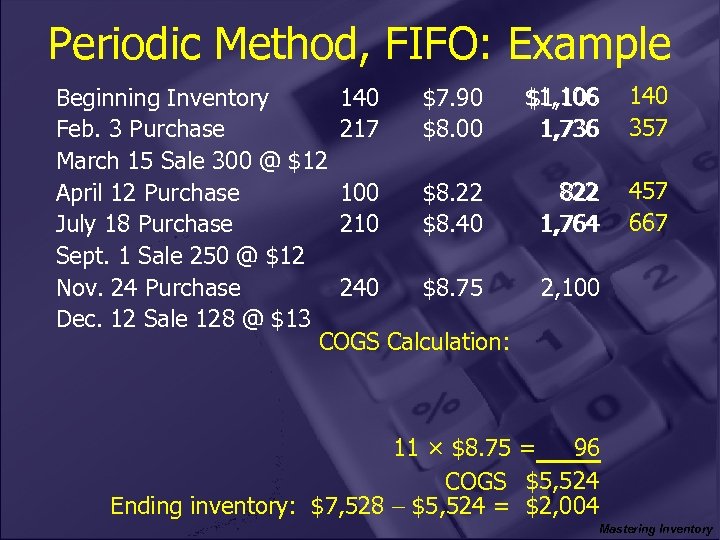
Periodic Method, FIFO: Example $1, 106 Beginning Inventory 140 $7. 90 $1, 106 1, 736 Feb. 3 Purchase 217 $8. 00 March 15 Sale 300 @ $12 822 April 12 Purchase 100 $8. 22 822 1, 764 July 18 Purchase 210 $8. 40 Sept. 1 Sale 250 @ $12 Nov. 24 Purchase 240 $8. 75 2, 100 Dec. 12 Sale 128 @ $13 COGS Calculation: 140 357 457 667 11 × $8. 75 = 96 COGS $5, 524 Ending inventory: $7, 528 $5, 524 = $2, 004 Mastering Inventory
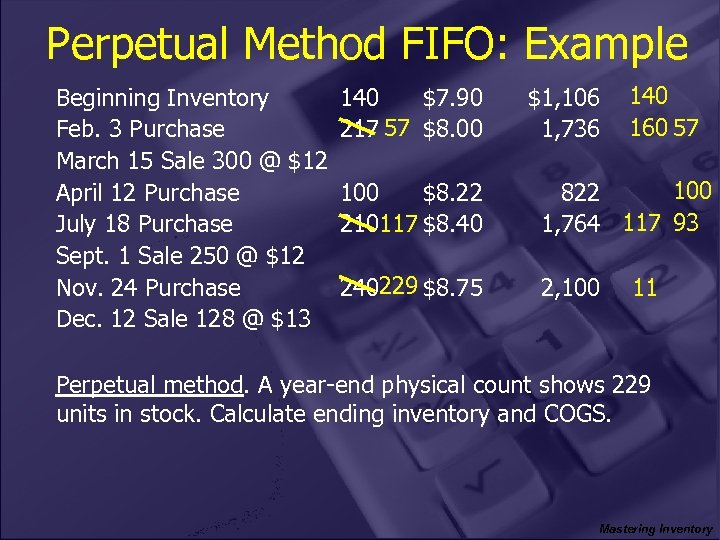
Perpetual Method FIFO: Example Beginning Inventory Feb. 3 Purchase March 15 Sale 300 @ $12 April 12 Purchase July 18 Purchase Sept. 1 Sale 250 @ $12 Nov. 24 Purchase Dec. 12 Sale 128 @ $13 140 $7. 90 217 57 $8. 00 $1, 106 1, 736 140 160 57 100 $8. 22 210117 $8. 40 100 822 1, 764 117 93 240229 $8. 75 2, 100 11 Perpetual method. A year-end physical count shows 229 units in stock. Calculate ending inventory and COGS. Mastering Inventory
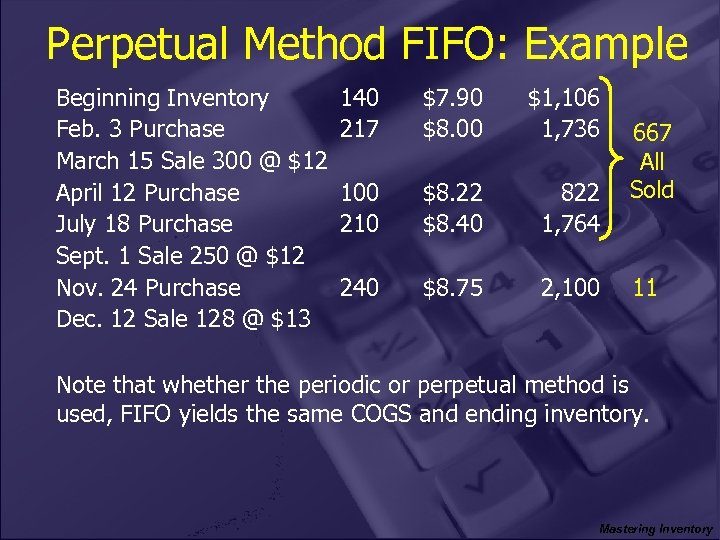
Perpetual Method FIFO: Example Beginning Inventory Feb. 3 Purchase March 15 Sale 300 @ $12 April 12 Purchase July 18 Purchase Sept. 1 Sale 250 @ $12 Nov. 24 Purchase Dec. 12 Sale 128 @ $13 140 217 $7. 90 $8. 00 $1, 106 1, 736 100 210 $8. 22 $8. 40 822 1, 764 240 $8. 75 2, 100 667 All Sold 11 Note that whether the periodic or perpetual method is used, FIFO yields the same COGS and ending inventory. Mastering Inventory
Last-In First-Out (LIFO) Costing LIFO assumes that the last units purchased are the first units sold. Like FIFO, LIFO costing does not consider which goods actually are sold. If the last units purchased are the first units sold, then any units remaining in inventory are from the earliest purchases. (FISH = first in, still here) Most companies that use LIFO use the periodic method. Mastering Inventory
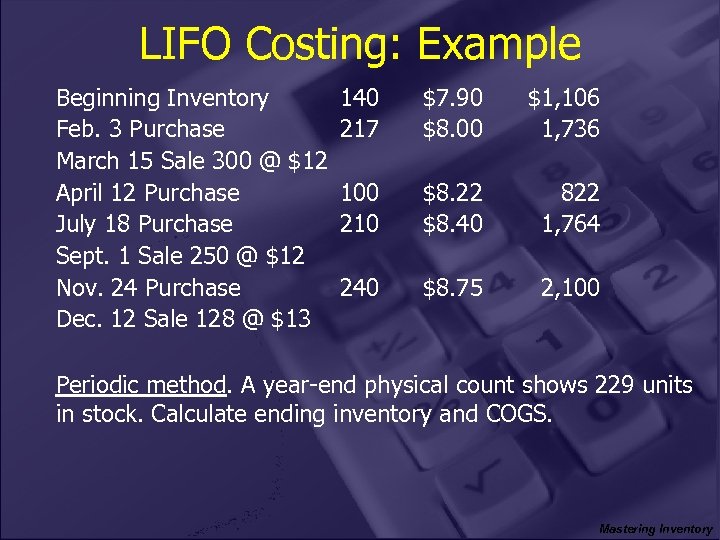
LIFO Costing: Example Beginning Inventory Feb. 3 Purchase March 15 Sale 300 @ $12 April 12 Purchase July 18 Purchase Sept. 1 Sale 250 @ $12 Nov. 24 Purchase Dec. 12 Sale 128 @ $13 140 217 $7. 90 $8. 00 $1, 106 1, 736 100 210 $8. 22 $8. 40 822 1, 764 240 $8. 75 2, 100 Periodic method. A year-end physical count shows 229 units in stock. Calculate ending inventory and COGS. Mastering Inventory
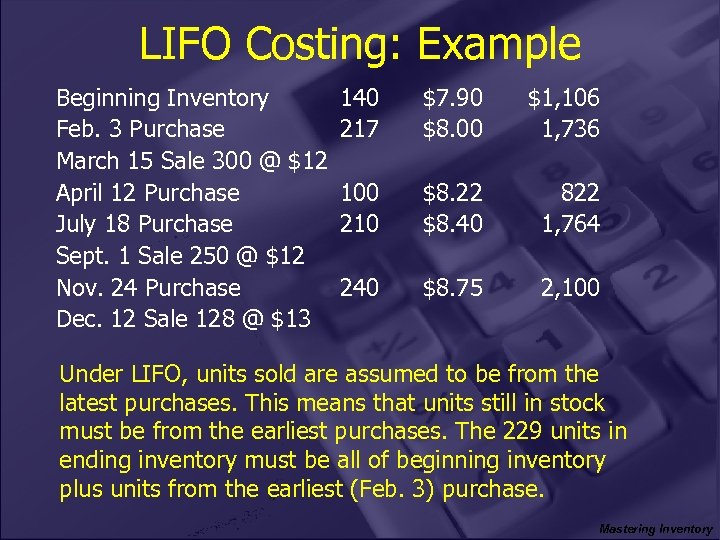
LIFO Costing: Example Beginning Inventory Feb. 3 Purchase March 15 Sale 300 @ $12 April 12 Purchase July 18 Purchase Sept. 1 Sale 250 @ $12 Nov. 24 Purchase Dec. 12 Sale 128 @ $13 140 217 $7. 90 $8. 00 $1, 106 1, 736 100 210 $8. 22 $8. 40 822 1, 764 240 $8. 75 2, 100 Under LIFO, units sold are assumed to be from the latest purchases. This means that units still in stock must be from the earliest purchases. The 229 units in ending inventory must be all of beginning inventory plus units from the earliest (Feb. 3) purchase. Mastering Inventory
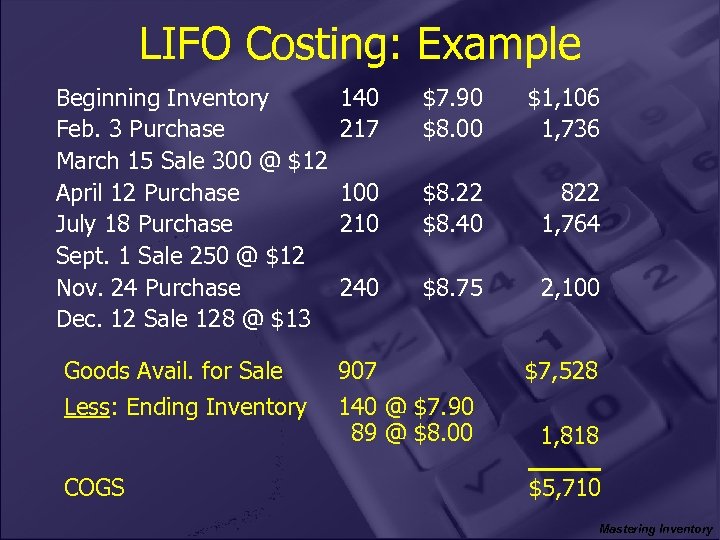
LIFO Costing: Example Beginning Inventory Feb. 3 Purchase March 15 Sale 300 @ $12 April 12 Purchase July 18 Purchase Sept. 1 Sale 250 @ $12 Nov. 24 Purchase Dec. 12 Sale 128 @ $13 Goods Avail. for Sale Less: Ending Inventory COGS 140 217 $7. 90 $8. 00 $1, 106 1, 736 100 210 $8. 22 $8. 40 822 1, 764 240 $8. 75 2, 100 907 140 @ $7. 90 89 @ $8. 00 $7, 528 1, 818 $5, 710 Mastering Inventory
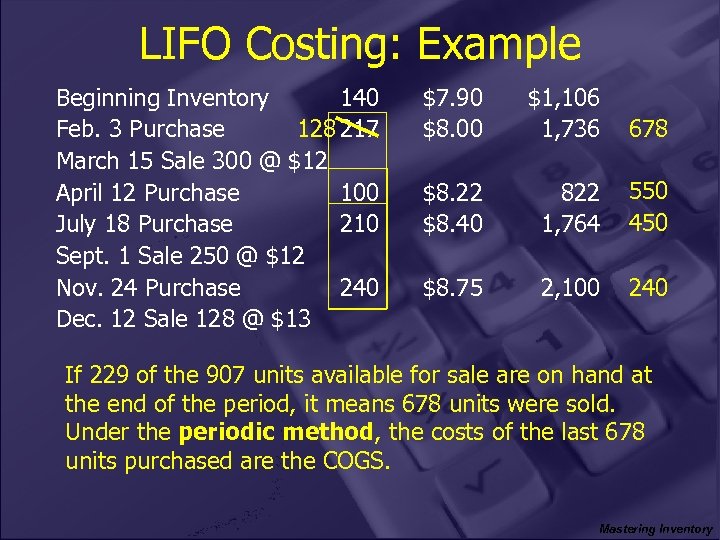
LIFO Costing: Example Beginning Inventory 140 128 217 Feb. 3 Purchase March 15 Sale 300 @ $12 April 12 Purchase 100 July 18 Purchase 210 Sept. 1 Sale 250 @ $12 Nov. 24 Purchase 240 Dec. 12 Sale 128 @ $13 $7. 90 $8. 00 $1, 106 1, 736 678 $8. 22 $8. 40 822 1, 764 550 450 $8. 75 2, 100 240 If 229 of the 907 units available for sale are on hand at the end of the period, it means 678 units were sold. Under the periodic method, the costs of the last 678 units purchased are the COGS. Mastering Inventory
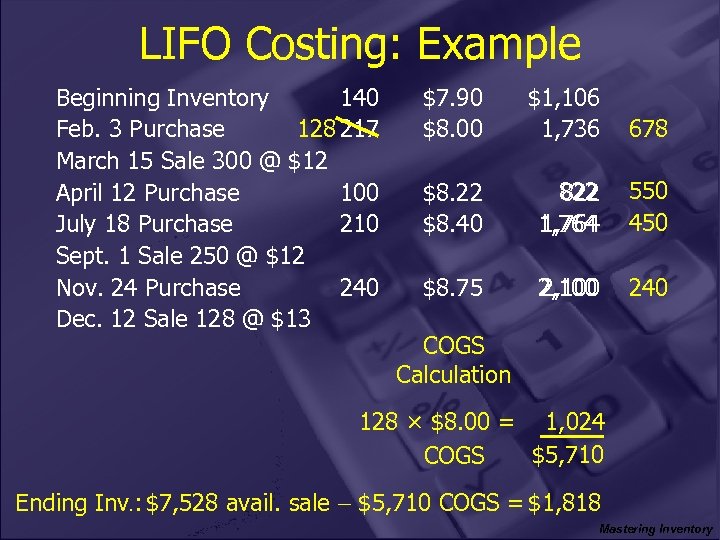
LIFO Costing: Example Beginning Inventory 140 128 217 Feb. 3 Purchase March 15 Sale 300 @ $12 April 12 Purchase 100 July 18 Purchase 210 Sept. 1 Sale 250 @ $12 Nov. 24 Purchase 240 Dec. 12 Sale 128 @ $13 $7. 90 $8. 00 $1, 106 1, 736 678 $8. 22 $8. 40 822 1, 764 550 450 $8. 75 2, 100 240 COGS Calculation 128 × $8. 00 = 1, 024 $5, 710 COGS Ending Inv. : $7, 528 avail. sale $5, 710 COGS = $1, 818 Mastering Inventory
LIFO Layers If a company adds inventory during the year (purchases more units than it sells), beginning inventory is unchanged. Instead, a new “layer” is created. Over time, inventory may have many layers. Mastering Inventory
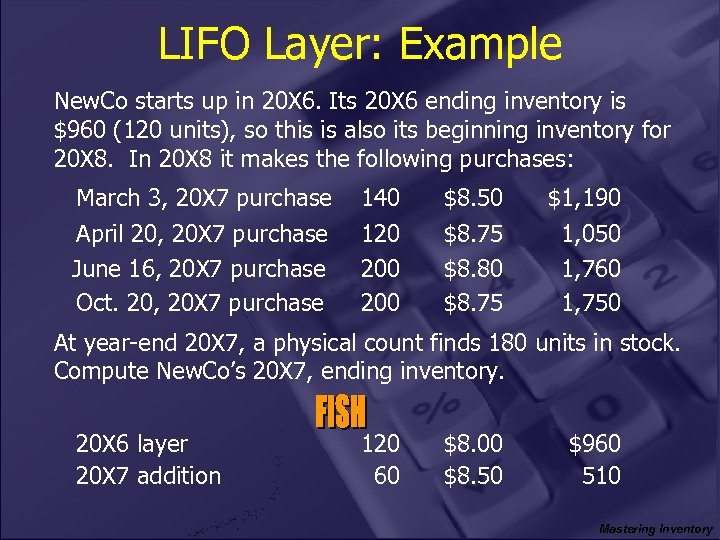
LIFO Layer: Example New. Co starts up in 20 X 6. Its 20 X 6 ending inventory is $960 (120 units), so this is also its beginning inventory for 20 X 8. In 20 X 8 it makes the following purchases: March 3, 20 X 7 purchase 140 $8. 50 $1, 190 April 20, 20 X 7 purchase June 16, 20 X 7 purchase Oct. 20, 20 X 7 purchase 120 200 $8. 75 $8. 80 $8. 75 1, 050 1, 760 1, 750 At year-end 20 X 7, a physical count finds 180 units in stock. Compute New. Co’s 20 X 7, ending inventory. 20 X 6 layer 20 X 7 addition 120 60 $8. 00 $8. 50 $960 510 Mastering Inventory
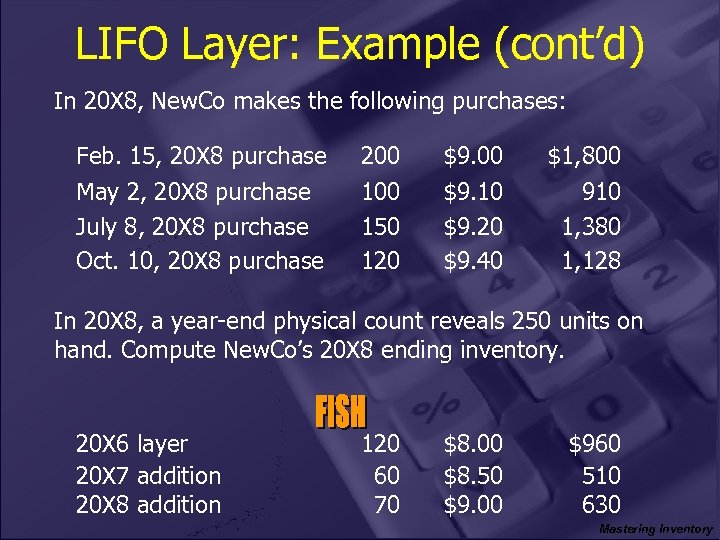
LIFO Layer: Example (cont’d) In 20 X 8, New. Co makes the following purchases: Feb. 15, 20 X 8 purchase 200 $9. 00 $1, 800 May 2, 20 X 8 purchase July 8, 20 X 8 purchase Oct. 10, 20 X 8 purchase 100 150 120 $9. 10 $9. 20 $9. 40 910 1, 380 1, 128 In 20 X 8, a year-end physical count reveals 250 units on hand. Compute New. Co’s 20 X 8 ending inventory. 20 X 6 layer 20 X 7 addition 20 X 8 addition 120 60 70 $8. 00 $8. 50 $9. 00 $960 510 630 Mastering Inventory
LIFO Liquidations How do LIFO layers work in practice? v When a company sells more units than it purchases during the year, it must invade beginning inventory—that is, liquidate (sell) LIFO layers from prior years. v Invading LIFO layers can have a substantial impact on net income because old units were probably purchased at lower costs—and new sales may be at higher prices. Mastering Inventory
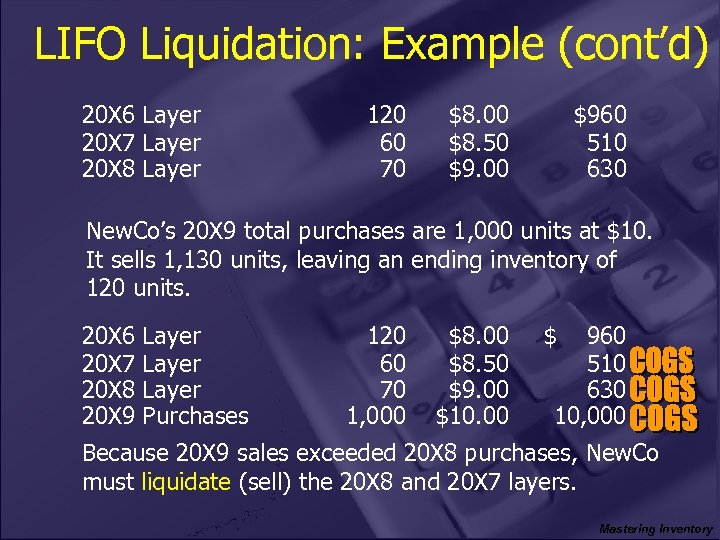
LIFO Liquidation: Example (cont’d) 20 X 6 Layer 20 X 7 Layer 20 X 8 Layer 120 60 70 $8. 00 $8. 50 $9. 00 $960 510 630 New. Co’s 20 X 9 total purchases are 1, 000 units at $10. It sells 1, 130 units, leaving an ending inventory of 120 units. 20 X 6 20 X 7 20 X 8 20 X 9 Layer Purchases 120 60 70 1, 000 $8. 50 $9. 00 $10. 00 $ 960 510 630 10, 000 Because 20 X 9 sales exceeded 20 X 8 purchases, New. Co must liquidate (sell) the 20 X 8 and 20 X 7 layers. Mastering Inventory
Lower of Cost or Market Rule GAAP requires companies to: v Recognize a decline in the value of any inventories. v Compute the decline by revaluing the affected inventory to the lower of cost or market. Mastering Inventory
Lower of Cost or Market Rule Cost – The amount at which the inventory is shown on the books Market – Normally, this is the replacement cost. But there are limits. The amount cannot exceed the ceiling or fall below a preset floor. Mastering Inventory
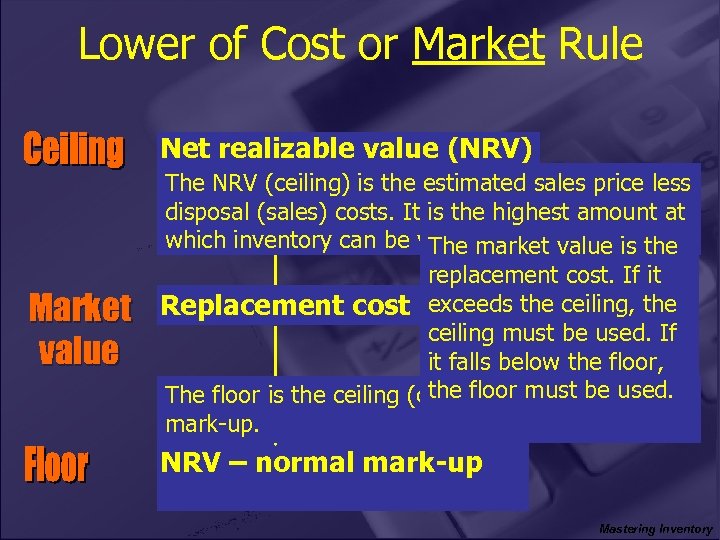
Lower of Cost or Market Rule Net realizable value (NRV) Market value The NRV (ceiling) is the estimated sales price less disposal (sales) costs. It is the highest amount at which inventory can be valued. The market value is the replacement cost. If it Replacement cost exceeds the ceiling, the ceiling must be used. If it falls below the floor, the floor must normal The floor is the ceiling (or NRV) less thebe used. mark-up. NRV – normal mark-up Mastering Inventory
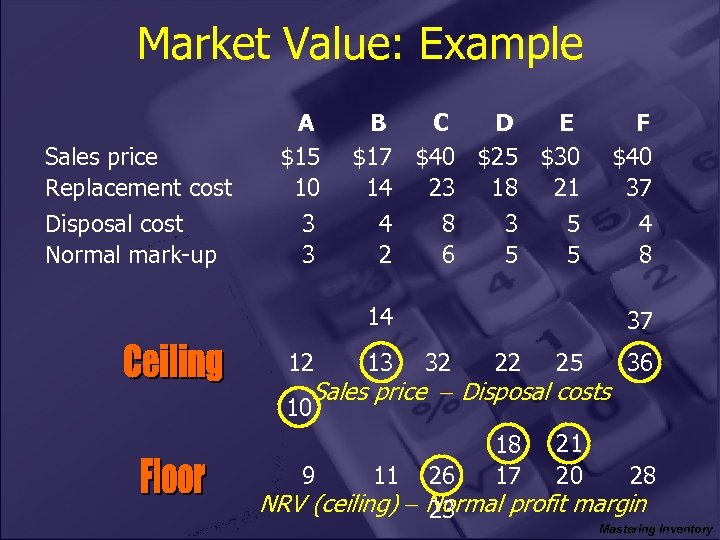
Market Value: Example Sales price Replacement cost Disposal cost Normal mark-up A $15 10 3 3 B C D E $17 $40 $25 $30 14 23 18 21 4 2 14 12 8 6 3 5 5 5 F $40 37 4 8 37 13 32 22 25 36 Sales price Disposal costs 10 18 21 9 11 26 17 20 28 NRV (ceiling) Normal profit margin 23 Mastering Inventory
Lower of Cost or Market Rule Once the current market value of inventory has been determined, it is compared to the cost recorded on the books GAAP requires that the lower of the two be used for ending inventory and reported on the balance sheet Mastering Inventory
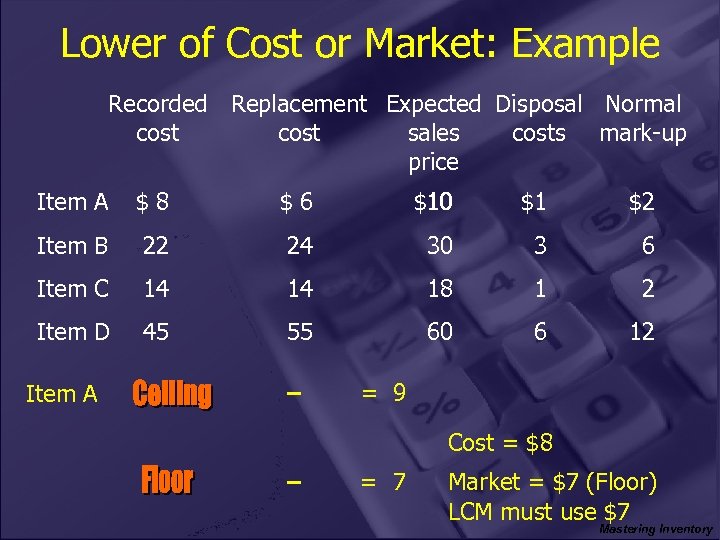
Lower of Cost or Market: Example Recorded Replacement Expected Disposal Normal cost sales costs mark-up price Item A $8 $6 $10 10 $1 1 2 $2 Item B 22 24 30 3 6 Item C 14 14 18 1 2 Item D 45 55 60 6 12 Item A = 9 Cost = $8 = 7 Market = $7 (Floor) LCM must use $7 Mastering Inventory
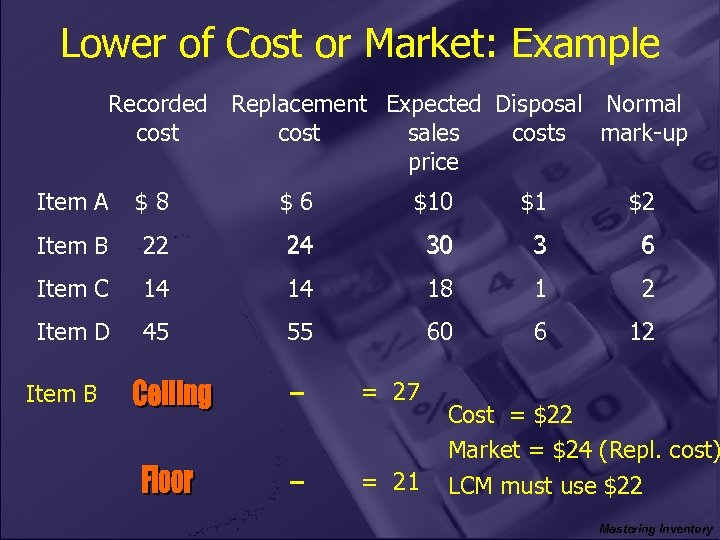
Lower of Cost or Market: Example Recorded Replacement Expected Disposal Normal cost sales costs mark-up price Item A $8 $6 $10 $1 $2 Item B 22 24 30 3 6 Item C 14 14 18 1 2 Item D 45 55 60 6 12 Item B = 27 = 21 Cost = $22 Market = $24 (Repl. cost) LCM must use $22 Mastering Inventory
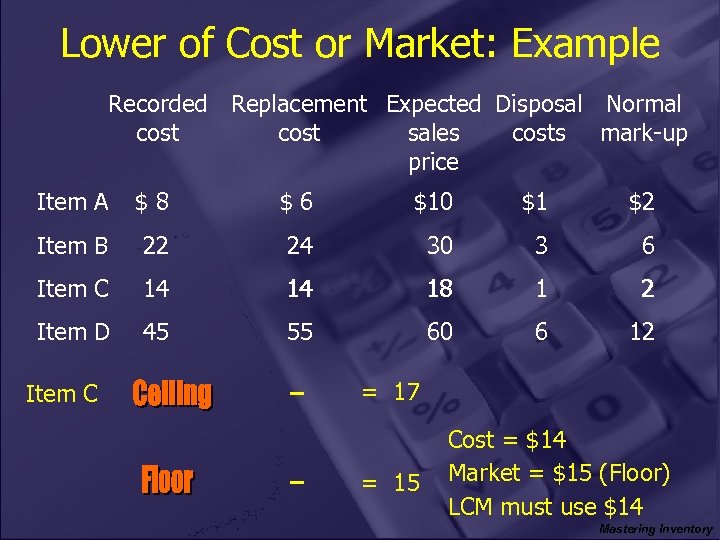
Lower of Cost or Market: Example Recorded Replacement Expected Disposal Normal cost sales costs mark-up price Item A $8 $6 $10 $1 $2 Item B 22 24 30 3 6 Item C 14 14 18 1 2 Item D 45 55 60 6 12 Item C = 17 = 15 Cost = $14 Market = $15 (Floor) LCM must use $14 Mastering Inventory
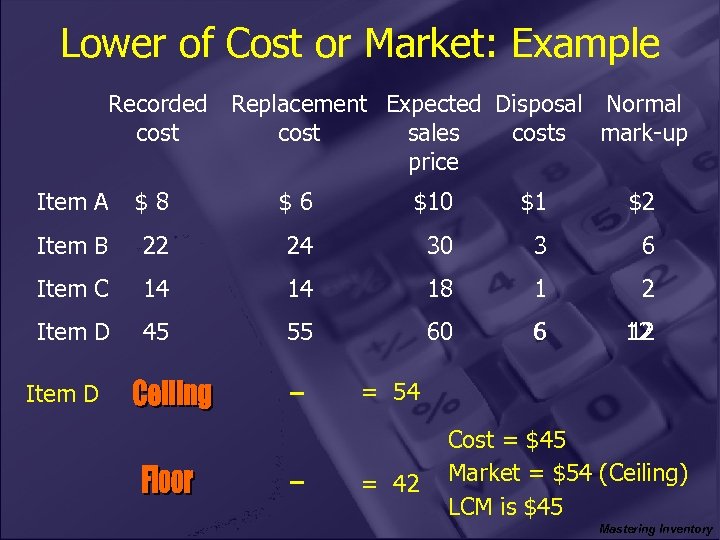
Lower of Cost or Market: Example Recorded Replacement Expected Disposal Normal cost sales costs mark-up price Item A $8 $6 $10 $1 $2 Item B 22 24 30 3 6 Item C 14 14 18 1 2 Item D 45 55 60 6 12 12 Item D = 54 = 42 Cost = $45 Market = $54 (Ceiling) LCM is $45 Mastering Inventory
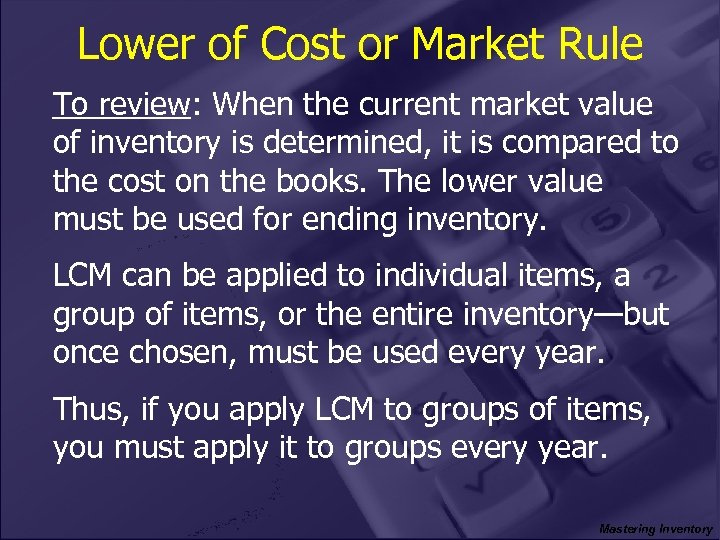
Lower of Cost or Market Rule To review: When the current market value of inventory is determined, it is compared to the cost on the books. The lower value must be used for ending inventory. LCM can be applied to individual items, a group of items, or the entire inventory—but once chosen, must be used every year. Thus, if you apply LCM to groups of items, you must apply it to groups every year. Mastering Inventory
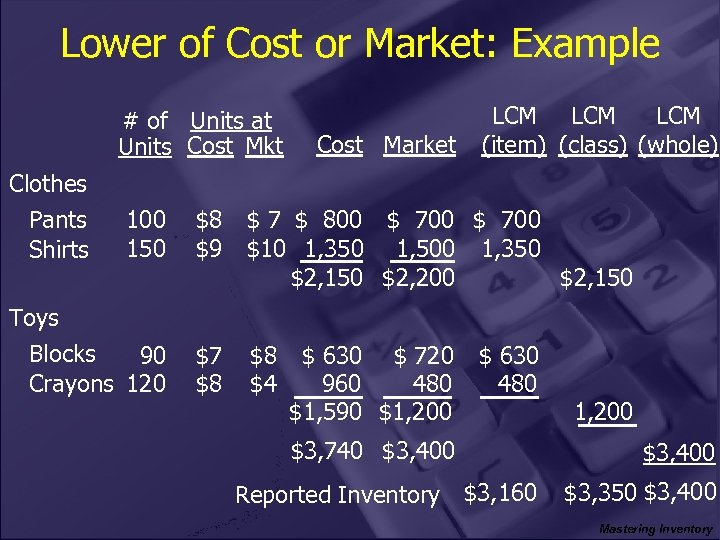
Lower of Cost or Market: Example # of Units at Units Cost Mkt Cost Market LCM LCM (item) (class) (whole) Clothes Pants Shirts 100 150 $8 $9 $ 7 $ 800 $ 700 $10 1, 350 1, 500 1, 350 $2, 150 $2, 200 $2, 150 Toys Blocks 90 Crayons 120 $7 $8 $8 $4 $ 630 $ 720 960 480 $1, 590 $1, 200 $ 630 480 $3, 740 $3, 400 Reported Inventory $3, 160 1, 200 $3, 400 $3, 350 $3, 400 Mastering Inventory
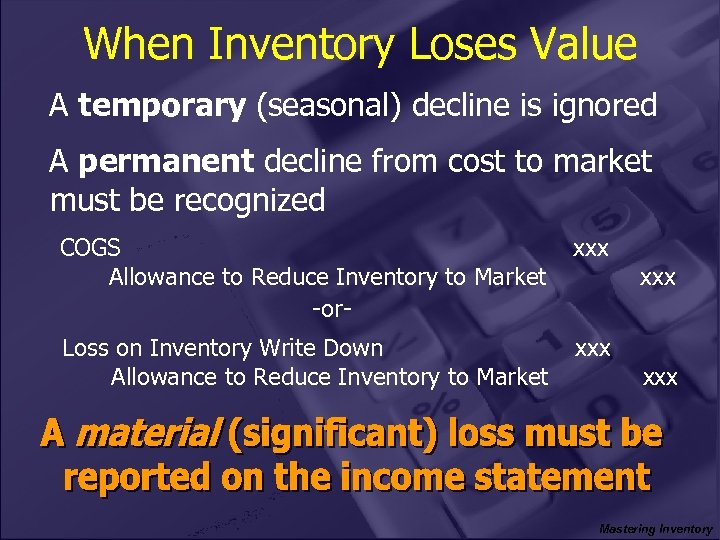
When Inventory Loses Value A temporary (seasonal) decline is ignored A permanent decline from cost to market must be recognized COGS Allowance to Reduce Inventory to Market -or- xxx Loss on Inventory Write Down Allowance to Reduce Inventory to Market xxx xxx Mastering Inventory
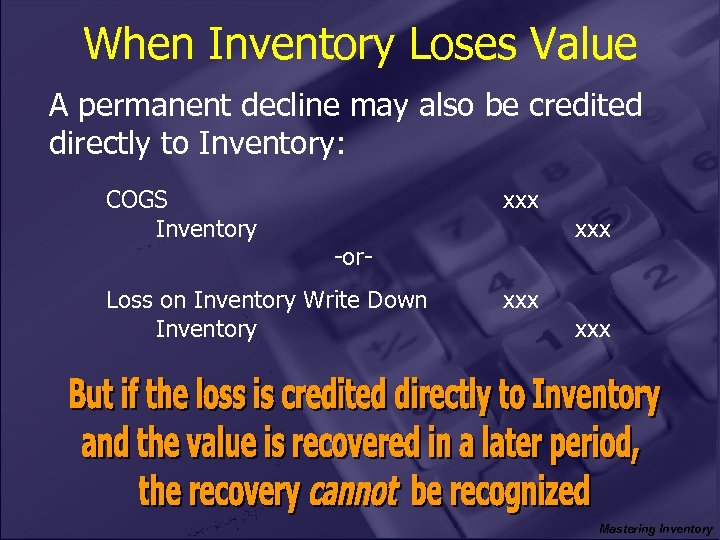
When Inventory Loses Value A permanent decline may also be credited directly to Inventory: COGS Inventory xxx -or- Loss on Inventory Write Down Inventory xxx xxx Mastering Inventory
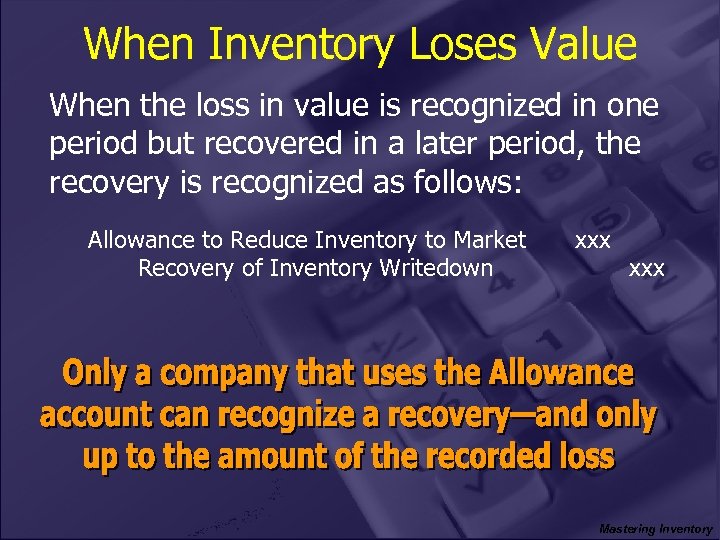
When Inventory Loses Value When the loss in value is recognized in one period but recovered in a later period, the recovery is recognized as follows: Allowance to Reduce Inventory to Market Recovery of Inventory Writedown xxx Mastering Inventory
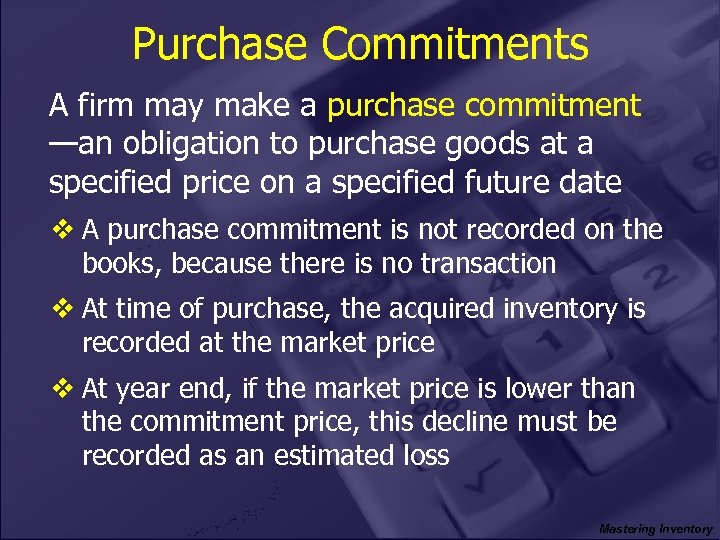
Purchase Commitments A firm may make a purchase commitment —an obligation to purchase goods at a specified price on a specified future date v A purchase commitment is not recorded on the books, because there is no transaction v At time of purchase, the acquired inventory is recorded at the market price v At year end, if the market price is lower than the commitment price, this decline must be recorded as an estimated loss Mastering Inventory
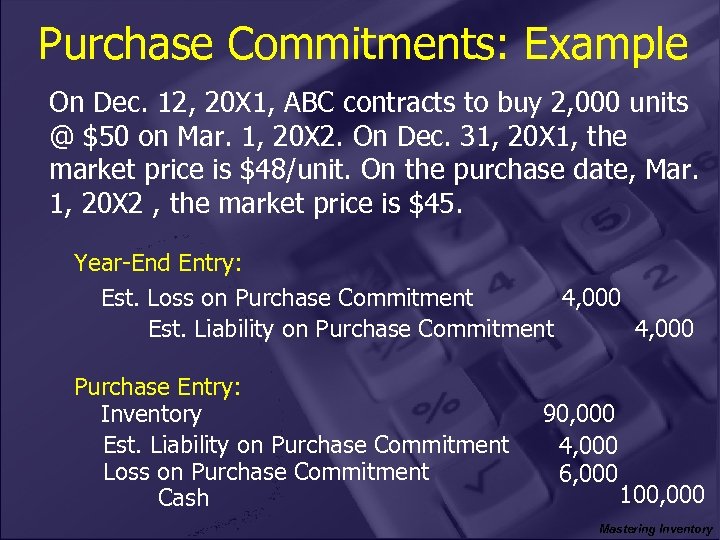
Purchase Commitments: Example On Dec. 12, 20 X 1, ABC contracts to buy 2, 000 units @ $50 on Mar. 1, 20 X 2. On Dec. 31, 20 X 1, the market price is $48/unit. On the purchase date, Mar. 1, 20 X 2 , the market price is $45. Year-End Entry: Est. Loss on Purchase Commitment 4, 000 Est. Liability on Purchase Commitment 4, 000 Purchase Entry: Inventory Est. Liability on Purchase Commitment Loss on Purchase Commitment Cash 90, 000 4, 000 6, 000 100, 000 Mastering Inventory
Скачать презентацию Mastering Inventory American Institute of Professional Bookkeepers
7eb0c6a9b3d9b948787d45c1caaa1197.ppt