


 Скачать презентацию Master of Project Management MPM Degree Programme Fundamentals
6214f70c030bd011ec805beeecf20fd8.ppt
- Количество слайдов: 68
 Master of Project Management (MPM) Degree Programme Fundamentals of Project Management PART I: OVERVIEW OF PROJECT MANAGEMENT Assistant Professor Dr. Aurangzeb Zulfiqar Khan Department of Management Sciences, COMSATS Institute of Information Technology, Islamabad, Pakistan 1
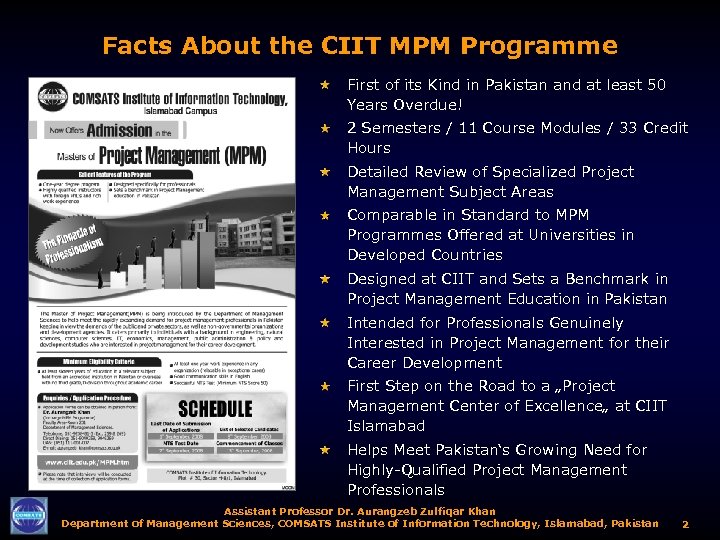 Facts About the CIIT MPM Programme First of its Kind in Pakistan and at least 50 Years Overdue! 2 Semesters / 11 Course Modules / 33 Credit Hours Detailed Review of Specialized Project Management Subject Areas Comparable in Standard to MPM Programmes Offered at Universities in Developed Countries Designed at CIIT and Sets a Benchmark in Project Management Education in Pakistan Intended for Professionals Genuinely Interested in Project Management for their Career Development First Step on the Road to a „Project Management Center of Excellence„ at CIIT Islamabad Helps Meet Pakistan‘s Growing Need for Highly-Qualified Project Management Professionals Assistant Professor Dr. Aurangzeb Zulfiqar Khan Department of Management Sciences, COMSATS Institute of Information Technology, Islamabad, Pakistan 2
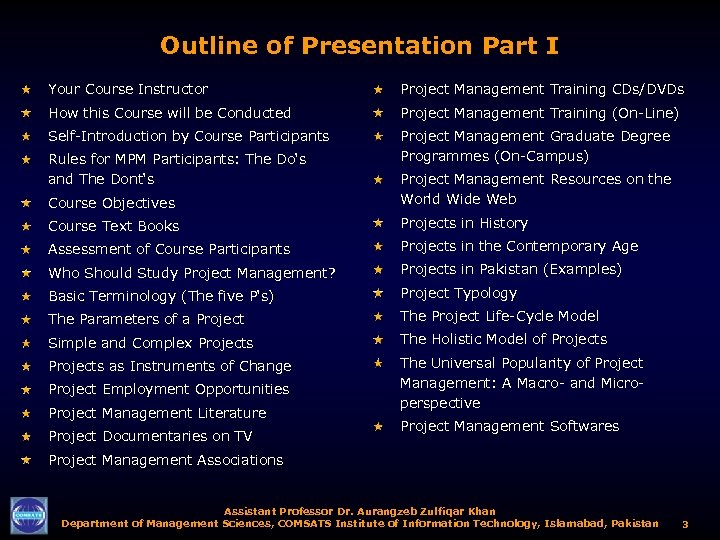 Outline of Presentation Part I Your Course Instructor Project Management Training CDs/DVDs How this Course will be Conducted Project Management Training (On-Line) Self-Introduction by Course Participants Project Management Graduate Degree Programmes (On-Campus) Rules for MPM Participants: The Do‘s and The Dont‘s Course Objectives Project Management Resources on the World Wide Web Course Text Books Projects in History Assessment of Course Participants Projects in the Contemporary Age Who Should Study Project Management? Projects in Pakistan (Examples) Basic Terminology (The five P‘s) Project Typology The Parameters of a Project The Project Life-Cycle Model Simple and Complex Projects The Holistic Model of Projects as Instruments of Change The Universal Popularity of Project Management: A Macro- and Microperspective Project Employment Opportunities Project Management Literature Project Documentaries on TV Project Management Softwares Project Management Associations Assistant Professor Dr. Aurangzeb Zulfiqar Khan Department of Management Sciences, COMSATS Institute of Information Technology, Islamabad, Pakistan 3
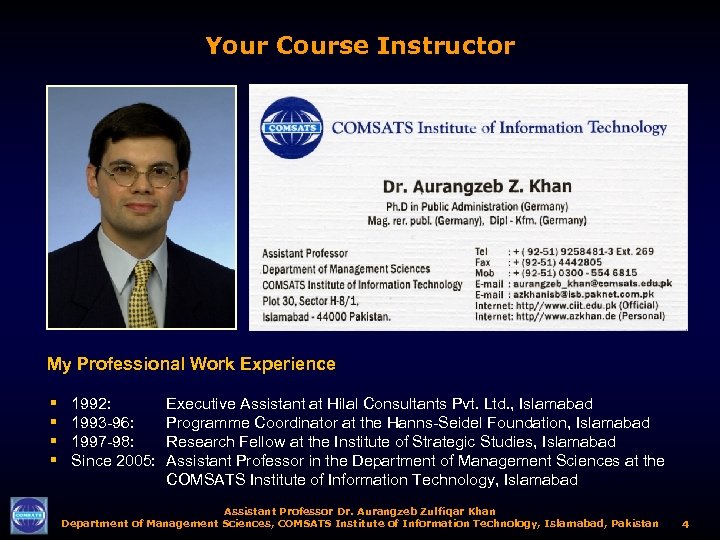 Your Course Instructor My Professional Work Experience § § 1992: 1993 -96: 1997 -98: Since 2005: Executive Assistant at Hilal Consultants Pvt. Ltd. , Islamabad Programme Coordinator at the Hanns-Seidel Foundation, Islamabad Research Fellow at the Institute of Strategic Studies, Islamabad Assistant Professor in the Department of Management Sciences at the COMSATS Institute of Information Technology, Islamabad Assistant Professor Dr. Aurangzeb Zulfiqar Khan Department of Management Sciences, COMSATS Institute of Information Technology, Islamabad, Pakistan 4
 Subjects I Taught at CIIT Islamabad Project Management (MBA, MS) Operations Management (MBA, MS) Total Quality Management (MS) Business Research Methods (MBA) International Human Resource Management (MBA) Seminar in Human Resource Management (MBO) Assistant Professor Dr. Aurangzeb Zulfiqar Khan Department of Management Sciences, COMSATS Institute of Information Technology, Islamabad, Pakistan 5
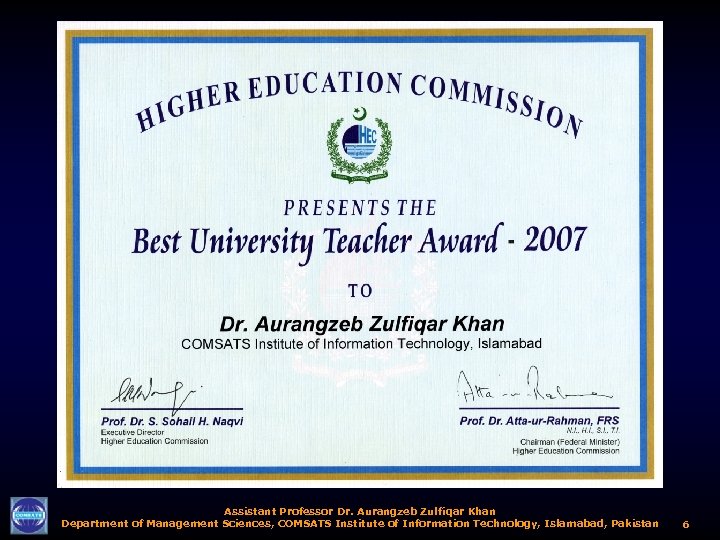 Assistant Professor Dr. Aurangzeb Zulfiqar Khan Department of Management Sciences, COMSATS Institute of Information Technology, Islamabad, Pakistan 6
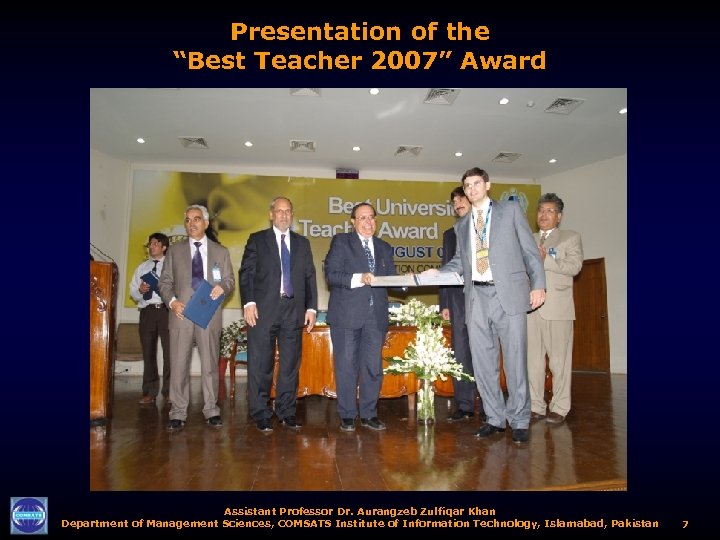 Presentation of the “Best Teacher 2007” Award Assistant Professor Dr. Aurangzeb Zulfiqar Khan Department of Management Sciences, COMSATS Institute of Information Technology, Islamabad, Pakistan 7
 How This Course Will Be Conducted 15 Classes @ 3 Hours = 45 Hours Holistic Subject Perspective Course Material Available at www. azkhan. de Detailed Exposure to all PM Subject Areas & Methodology Review of Case Studies Completion of Course Outline Weekly Assignments / Midterm & Final Examination Excellent Course Text Books Supplemented by Handouts Extensive Class Interaction Theme-Oriented MS Power. Point Presentations All Lectures and Communica-tions Exclusively in English Encourage Creative Thinking – Severely Penalize Cramming Guest Speaker and (Possible) Visit to a Project Site Assistant Professor Dr. Aurangzeb Zulfiqar Khan Department of Management Sciences, COMSATS Institute of Information Technology, Islamabad, Pakistan 8
 Self-Introduction by MPM Participants All MPM participants are requested to introduce themselves, individually and briefly, stating their: § Full Name § Higher Education Background § Designation and Name of Employing Organization § Project Management Courses Previously Attended § Experience with Managing or Working on Projects § Reasons for Interest in the MPM Programme § Expectations from the MPM Programme Assistant Professor Dr. Aurangzeb Zulfiqar Khan Department of Management Sciences, COMSATS Institute of Information Technology, Islamabad, Pakistan 9
 Rules for MPM Programme Participants Assistant Professor Dr. Aurangzeb Zulfiqar Khan Department of Management Sciences, COMSATS Institute of Information Technology, Islamabad, Pakistan 10
 Rules for MPM Course Participants: The DO‘s Do listen to my lectures very attentively and carefully. Listening is the basis for comprehension which is the prerequisite for performing well in this course. If you are having comprehension problems, inform me immediately. Do not hesitate otherwise it may be too late for me to help you. Do ask questions or bring up relevant points for discussion in the classroom. You will not be punished for this! There is no such thing as a stupid question or discussion and I am very patient with students. Be inquisitive, analytical, critical and creative in your approach to learning project management! Assistant Professor Dr. Aurangzeb Zulfiqar Khan Department of Management Sciences, COMSATS Institute of Information Technology, Islamabad, Pakistan 11
 Rules for MPM Course Participants: The DO‘s Do read the prescribed course literature. It is the basic requirement for comprehending project management and for you to perform well in this demanding course! Please note that using only my Power. Point slides for your exam preparation is NOT sufficient! YOU MAY FAIL IF YOU DO SO! The questions in your midterm and final examinations may relate to material contained in the recommended course text books and handouts which may not have been discussed in detail, or at all, in class! Some good advice for you: Read from the beginning of the course and NOT towards the end! You won‘t regret it. Assistant Professor Dr. Aurangzeb Zulfiqar Khan Department of Management Sciences, COMSATS Institute of Information Technology, Islamabad, Pakistan 12
 Rules for MPM Course Participants: The DO‘s Do visit me at my office on the second floor of the CIIT building, individually or as a group, if you have a courserelated problem or problems and seek counseling. I‘m usually in my office from Mondays to Fridays (9. 30 AM onwards). You can also contact me at my tel. extension 269 or by e. Mail at aurangzeb_khan@comsats. edu. pk. Do fill out the anonymous course evaluation form which will be distributed to all MPM participants at the end of the semester. Our department is striving hard to continuously and significantly improve the quality of all its undergraduate and graduate level courses and your critical feedback and constructive criticism in this connection is always welcome and very valuable to us. Assistant Professor Dr. Aurangzeb Zulfiqar Khan Department of Management Sciences, COMSATS Institute of Information Technology, Islamabad, Pakistan 13
 Rules for MPM Course Participants: The DONT‘s Don‘t be late to class. 6. 30 PM means 6. 30 PM sharp and not a second later! Two roll calls will be taken (at the beginning of class and after the break). Course participants who are late will be marked absent! Don‘t ask me to mark you present if you are going to be absent in that class. I don‘t care what events in your personal or professional lives prevent you from coming to my class. Visiting family and friends, engagements, weddings, hospitalizations, funerals, official committments etc. are your issues, not mine. If you are absent in my class, you‘ll simply be marked absent. Period! Don‘t come to class just to get marked present and then wander of to the canteen for gossip, meals or refreshments, or leave the campus, outside the 15 -minute customary pause. Anyone doing this will have their attendance revoked. Assistant Professor Dr. Aurangzeb Zulfiqar Khan Department of Management Sciences, COMSATS Institute of Information Technology, Islamabad, Pakistan 14
 Rules for MPM Course Participants: The DONT‘s Don‘t use cell phones in my class. They must be switched OFF prior to entering the classroom and no SMS messages may be sent while the class is in progress! Do not run in and out for making or answering calls. Such behaviour distracts the class and disrupts my presentation. If making or answering calls is so important to you, stay at your home or office and do them there, but do not come to my class! Don‘t chit-chat among yourselves, distract the attention of other MPM participants or behave immaturely in the class. You are only hurting yourself and your colleagues, not me. As educated adults, I expect you all without exception to behave as such from the minute you enter my class to the minute you leave it! Assistant Professor Dr. Aurangzeb Zulfiqar Khan Department of Management Sciences, COMSATS Institute of Information Technology, Islamabad, Pakistan 15
 Rules for MPM Course Participants: The DONT‘s Don‘t procrastinate on your weekly class assignments. Start work immediately after receiving your topics. Many students do nothing until the last day before the submission deadline and then run frantically to me at the eleventh hour complaining about the problems they are having in getting the required information. My usual response: Tough, Dear, Tough! You should have started work promptly and then you wouldn‘t need to stress yourself out. Don‘t pester me for more marks. I evaluate my students objectively and actually devote considerable time to read line by line through each examination paper and class assignment. From nothing comes nothing – if your work is crap, be prepared to get a crappy evaluation from me! And don‘t whine about it. Assistant Professor Dr. Aurangzeb Zulfiqar Khan Department of Management Sciences, COMSATS Institute of Information Technology, Islamabad, Pakistan 16
 Rules for Course Participants: The DONT‘s Don‘t miss out on your weekly assignments and examinations. Setting repeat examinations is a big nuisance for me and some marks are normally deducted by our department as a disincentive for being absent! In the event that MPM participants have missed out on their examinations due to compelling circumstances, I will schedule a single repeat examination, but NO second or third repeats. If the student also misses the repeat examination, he or she will be considered as having scored zero marks which will be final. It is the responsibility of the MPM participants concerned to immediately contact me if they have missed out on a weekly assignment or examination! Do so as soon as possible. Assistant Professor Dr. Aurangzeb Zulfiqar Khan Department of Management Sciences, COMSATS Institute of Information Technology, Islamabad, Pakistan 17
 Rules for MPM Course Participants: The DONT‘s Don‘t cheat in the sessional, midterm or final examinations. If caught, you may have your paper cancelled by the department or, at the very least, you may lose a percentage of your marks. NO CHEATING & PLAGIARISM! If I find that your class assignments have, in full or in part, been plagiarized or copypasted from the World Wide Web without referencing, I will give you zero marks and reassign you another topic. I routinely check to ensure that written material submitted to me for evaluation is not plagiarized. We at CIIT have the technical means for ensuring this and we don‘t hesitate to use it. ZERO TOLERANCE! Assistant Professor Dr. Aurangzeb Zulfiqar Khan Department of Management Sciences, COMSATS Institute of Information Technology, Islamabad, Pakistan 18
 Rules for MPM Course Participants: The DONT‘s Don‘t follow the „rote“ (Learning by Memorization) approach which you may have grown accustomed to since your schooldays. It is the WORST thing you can do in my class – apart from outright misbehaviour and cheating / plagiarism. My Power. Point slides are meant to serve as a subject guideline only and are NOT meant to be memorized. DO NOT reproduce the contents of the slides in any of your weekly assignments or in any examination. In case of reproduction, marks will be heavily deducted and your precious GPA will drop like a stone from the sky. Assistant Professor Dr. Aurangzeb Zulfiqar Khan Department of Management Sciences, COMSATS Institute of Information Technology, Islamabad, Pakistan 19
 Objectives of This Course Module « To acquaint the course participants comprehensively and at considerable depth with project management by using up-to -date literature and research on this highly interesting, challenging, and increasingly important field of management science. « To motivate the MPM participants to apply their acquired knowledge to projects which they will be directly or indirectly involved in professionally and to help them undertake their projects systematically and more effectively and efficiently. « To demonstrate the ubiquitousness of projects, which are a cornerstone of human civilization, and to convey an appreciation that the development of a country‘s economy and society is dependent in part on them. Assistant Professor Dr. Aurangzeb Zulfiqar Khan Department of Management Sciences, COMSATS Institute of Information Technology, Islamabad, Pakistan 20
 Objectives of This Course Module « To show that project management has, over the past five decades, evolved into a very substantive body of knowledge and that a good understanding of the subject is crucial for managing a modern organization sucessfully. « To stimulate interest among the MPM participants in project management as a full-time career option after graduation. « To promote networking between the MPM participants and to encourage them to share in and outside class their personal experiences working on projects. « To set a benchmark in project management education being taught at the introductory level at universities across Pakistan and to motivate teachers of this subject to continuously raise their standards of instruction. Assistant Professor Dr. Aurangzeb Zulfiqar Khan Department of Management Sciences, COMSATS Institute of Information Technology, Islamabad, Pakistan 21
 Objectives of This Course Module « To provide the course participants with the basic knowledge they would require for successfully qualifying certification examinations in project management being offered by the PMI and other professional associations. Students should please note, however, that this introductory course in project management is NOT intended to be a substitute for these certification examinations but merely as an aid which can help them acquire foundation knowledge which is required for attempting these certification examinations subsequently. Assistant Professor Dr. Aurangzeb Zulfiqar Khan Department of Management Sciences, COMSATS Institute of Information Technology, Islamabad, Pakistan 22
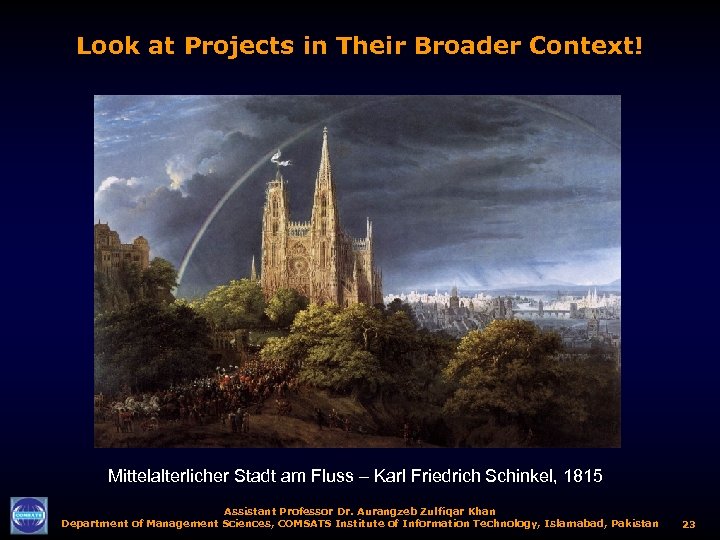 Look at Projects in Their Broader Context! Mittelalterlicher Stadt am Fluss – Karl Friedrich Schinkel, 1815 Assistant Professor Dr. Aurangzeb Zulfiqar Khan Department of Management Sciences, COMSATS Institute of Information Technology, Islamabad, Pakistan 23
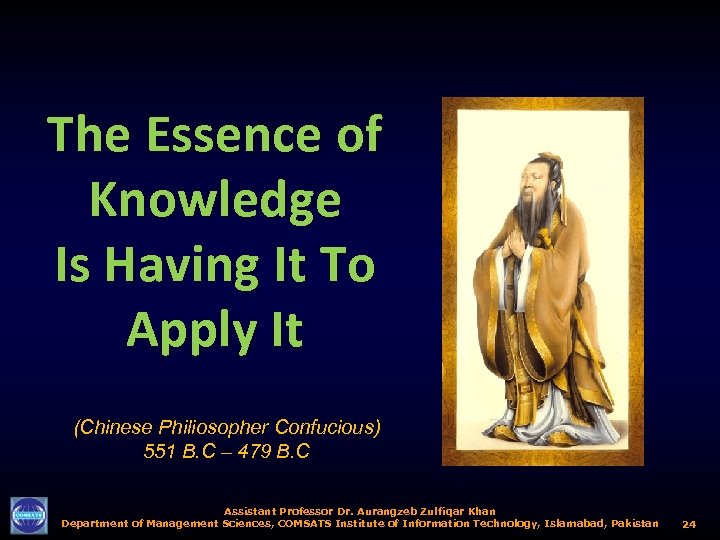 The Essence of Knowledge Is Having It To Apply It (Chinese Philiosopher Confucious) 551 B. C – 479 B. C Assistant Professor Dr. Aurangzeb Zulfiqar Khan Department of Management Sciences, COMSATS Institute of Information Technology, Islamabad, Pakistan 24
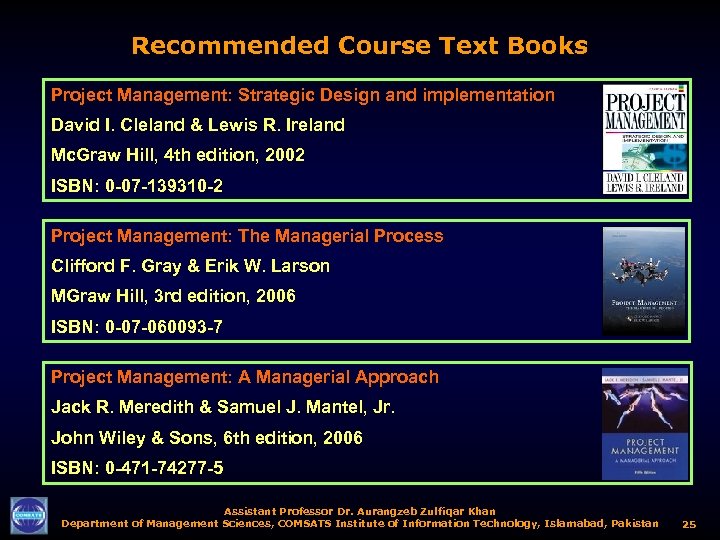 Recommended Course Text Books Project Management: Strategic Design and implementation David I. Cleland & Lewis R. Ireland Mc. Graw Hill, 4 th edition, 2002 ISBN: 0 -07 -139310 -2 Project Management: The Managerial Process Clifford F. Gray & Erik W. Larson MGraw Hill, 3 rd edition, 2006 ISBN: 0 -07 -060093 -7 Project Management: A Managerial Approach Jack R. Meredith & Samuel J. Mantel, Jr. John Wiley & Sons, 6 th edition, 2006 ISBN: 0 -471 -74277 -5 Assistant Professor Dr. Aurangzeb Zulfiqar Khan Department of Management Sciences, COMSATS Institute of Information Technology, Islamabad, Pakistan 25
 Assessment of the MPM Programme Participants Assistant Professor Dr. Aurangzeb Zulfiqar Khan Department of Management Sciences, COMSATS Institute of Information Technology, Islamabad, Pakistan 26
 Assessment of MPM Participants (The A-Student) The „A“-Student demonstrates a very high level of motivation to learn project management. Punctual and attentive, bright, ambitious and hardworking, he or she is an avid reader and grasps the subject matter easily. The „A“-Student is also inquisitive and often likes to discuss in detail issues raised by the teacher who finds it a pleasure and an inspiration to work with such students. The „A“-Students confidently acquire a holistic perspective and in-depth knowledge of project management concepts, display excellent analytical and critical thinking skills, are creative, and have the ability to easily apply theoretical knowledge they acquired from their teacher to real-life case situations which are presented to them in class or which they encounter at their workplaces. Assistant Professor Dr. Aurangzeb Zulfiqar Khan Department of Management Sciences, COMSATS Institute of Information Technology, Islamabad, Pakistan 27
 Assessment of MPM Participants (The Average Student) The „average“student is generally a good student whose work , though, does exhibit some noticeable qualitative deficiencies. Shortcomings may arise in different ways. For example, average students may understand the underlying concepts of project management and they may have familiarized themselves with most or all important aspects of the subject, but they encounter difficulty in applying their knowledge to real-life situations. They may also not properly comprehend the holistic perspective of project management on which this course is based. Assistant Professor Dr. Aurangzeb Zulfiqar Khan Department of Management Sciences, COMSATS Institute of Information Technology, Islamabad, Pakistan 28
 Assessment of MPM Participants (The Horror Student) These students are a BIG PAIN in my A**! Typical qualities of a „horror“ student are, among other irritants, disinterest in attending class and listening to the lectures, constant fidgeting, chatting and eagerness to run outside the lecture hall, poor command over the English language, unwillingness to read the recommended project management course literature and do his or her assignments, and a tendency to rote learn. Not surprisingly, these students have great difficulty grasping the subject course material – or may have understood virtually nothing of it at all by the end of semester. They usually find it highly challenging to apply the concepts and material they were exposed to in this course, both in class examinations and at their workplaces. I try to avoid this type of student like the plague! Assistant Professor Dr. Aurangzeb Zulfiqar Khan Department of Management Sciences, COMSATS Institute of Information Technology, Islamabad, Pakistan 29
 Assessment of MPM Participants (Distribution of Course Marks) Weekly Assignments (25 Marks) MPM participants are expected to show that they can convincingly relate concepts discussed in class with their project-related professional work. Assgnments can be written in typed form or By hand must be submitted in the next class. There is no limit on the length of pages to be submitted. Teamwork is strongly encouraged. Midterm Examination (25 Marks) MPM participants are expected to demonstrate a basic understanding of project management and all subject material covered in class until the time of the examination, which is of 2 hours duration. Three questions will be asked, all of which are mandatory and carry equal marks. Assistant Professor Dr. Aurangzeb Zulfiqar Khan Department of Management Sciences, COMSATS Institute of Information Technology, Islamabad, Pakistan 30
 Assessment of MPM Participants (Distribution of Course Marks) Final Examination (50 Marks) MPM participants will be required to creatively apply their project management knowledge to a real or fictitious case situation which is followed by five mandatory questions, each carrying equal marks. In preparing for this three-hour long examination, note that the entire course material is relevant and that the questions asked may relate to any part of it. MPM participants who demonstrate excellent command over all subject areas of project management and who can present innovative ideas and approaches to problem situations can expect to perform very well in this examination which, given its weightage, will primarily determine the MPM participant‘s overall GPA. Do not underestimate the difficulty level of this examination! Assistant Professor Dr. Aurangzeb Zulfiqar Khan Department of Management Sciences, COMSATS Institute of Information Technology, Islamabad, Pakistan 31
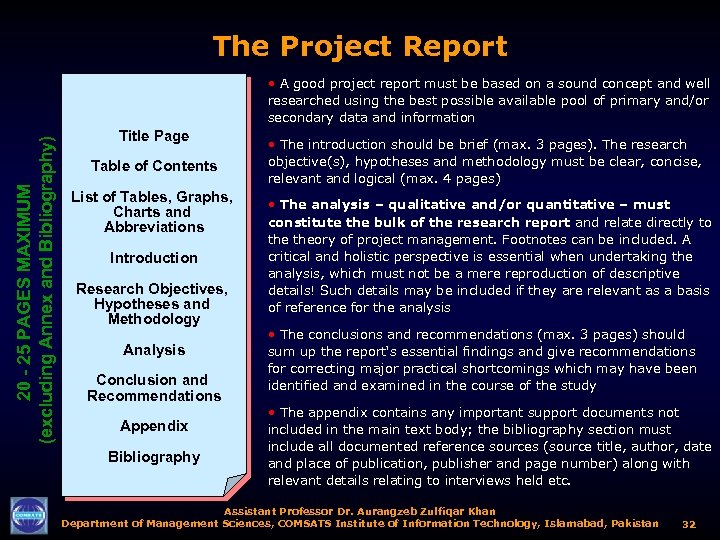 The Project Report 20 - 25 PAGES MAXIMUM (excluding Annex and Bibliography) • A good project report must be based on a sound concept and well researched using the best possible available pool of primary and/or secondary data and information Title Page Table of Contents List of Tables, Graphs, Charts and Abbreviations Introduction Research Objectives, Hypotheses and Methodology Analysis Conclusion and Recommendations Appendix Bibliography • The introduction should be brief (max. 3 pages). The research objective(s), hypotheses and methodology must be clear, concise, relevant and logical (max. 4 pages) • The analysis – qualitative and/or quantitative – must constitute the bulk of the research report and relate directly to theory of project management. Footnotes can be included. A critical and holistic perspective is essential when undertaking the analysis, which must not be a mere reproduction of descriptive details! Such details may be included if they are relevant as a basis of reference for the analysis • The conclusions and recommendations (max. 3 pages) should sum up the report‘s essential findings and give recommendations for correcting major practical shortcomings which may have been identified and examined in the course of the study • The appendix contains any important support documents not included in the main text body; the bibliography section must include all documented reference sources (source title, author, date and place of publication, publisher and page number) along with relevant details relating to interviews held etc. Assistant Professor Dr. Aurangzeb Zulfiqar Khan Department of Management Sciences, COMSATS Institute of Information Technology, Islamabad, Pakistan 32
 Samples of Examination Papers (MBA& MS Classes) MBA First Sessional Examination Sample 1 MBA First Sessional Examination Sample 2 MBA First Sessional Examination Sample 3 MBA Second Sessional Examination Sample 1 MBA Second Sessional Examination Sample 2 MBA Second Sessional Examination Sample 3 MS Midterm Examination 1 2 MS Final Examination 1 Project Management is also about using plain common Sense! 2 Assistant Professor Dr. Aurangzeb Zulfiqar Khan Department of Management Sciences, COMSATS Institute of Information Technology, Islamabad, Pakistan 33
 Who Should Study Project Management? Anyone who is directly or indirectly involved in initiating, planning, implementing, monitoring, evaluating and/or controlling a project in a position which involves a substantive level of decisionmaking, responsibility, communication and coordination, should be thoroughly familiar with all the subject areas and methodology, processes and tools and techniques of project management. A good and common project management knowledge platform will increase the likelihood of the project attaining its goal within time and budget. Assistant Professor Dr. Aurangzeb Zulfiqar Khan Department of Management Sciences, COMSATS Institute of Information Technology, Islamabad, Pakistan 34
 Who Should Study Project Management? At the very least a project‘s key stakeholders – i. e. , its sponsor, manager, team members, consultants, external suppliers and contractors, the senior and resource managers of the organization(s) which are implementing the project and the project customers / users - should all understand the methodology being used to undertake the project. Assistant Professor Dr. Aurangzeb Zulfiqar Khan Department of Management Sciences, COMSATS Institute of Information Technology, Islamabad, Pakistan 35
 Professionals Who Should Be Thoroughly Familiar With Project Management (Examples) Managers Architects Consultants Economists Development Officials Engineers Government Officials IT Professionals Natural & Social Scientists Public Administrators Policy Makers Researchers In the course of their professional lives, these persons would normally be directly involved in a large number of projects Assistant Professor Dr. Aurangzeb Zulfiqar Khan Department of Management Sciences, COMSATS Institute of Information Technology, Islamabad, Pakistan 36
 Terminology Assistant Professor Dr. Aurangzeb Zulfiqar Khan Department of Management Sciences, COMSATS Institute of Information Technology, Islamabad, Pakistan 37
 Basic Terminology § Projects § Subprojects § Programmes § Portfolios § Processes § Project Management Many definitions for these words have been proposed. Sample definitions along with practical examples are contained in the following slides. Assistant Professor Dr. Aurangzeb Zulfiqar Khan Department of Management Sciences, COMSATS Institute of Information Technology, Islamabad, Pakistan 38
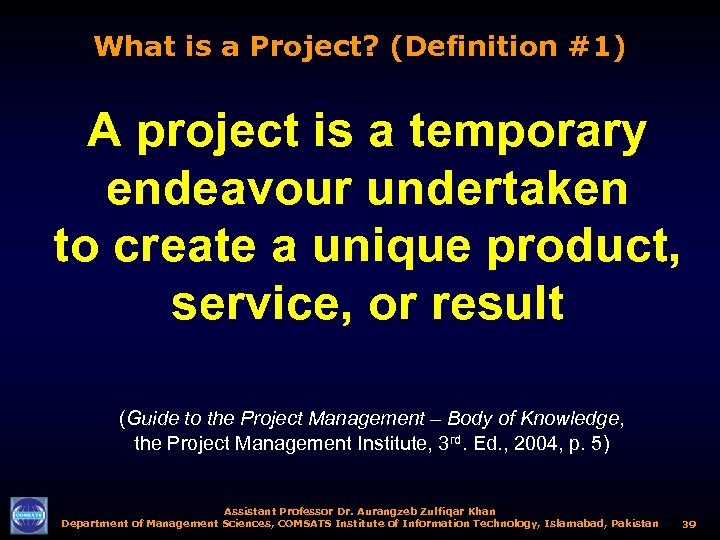 What is a Project? (Definition #1) A project is a temporary endeavour undertaken to create a unique product, service, or result (Guide to the Project Management – Body of Knowledge, the Project Management Institute, 3 rd. Ed. , 2004, p. 5) Assistant Professor Dr. Aurangzeb Zulfiqar Khan Department of Management Sciences, COMSATS Institute of Information Technology, Islamabad, Pakistan 39
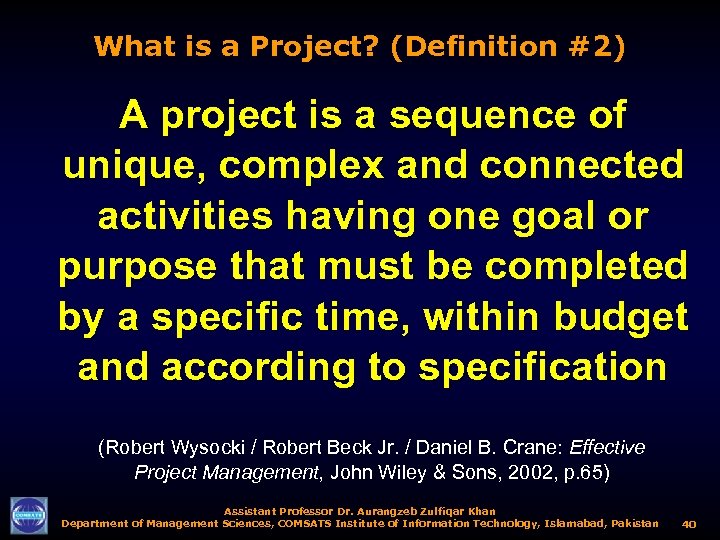 What is a Project? (Definition #2) A project is a sequence of unique, complex and connected activities having one goal or purpose that must be completed by a specific time, within budget and according to specification (Robert Wysocki / Robert Beck Jr. / Daniel B. Crane: Effective Project Management, John Wiley & Sons, 2002, p. 65) Assistant Professor Dr. Aurangzeb Zulfiqar Khan Department of Management Sciences, COMSATS Institute of Information Technology, Islamabad, Pakistan 40
 What is a Project? (Definition #3) A project is a complex, nonroutine, one-time effort limited by time, budget, resources, and performance specifications designed to meet customer needs (Clifford F. Gray / Erik W. Larson, Project Management: The Managerial Process, 2. ed. , p. 15) Assistant Professor Dr. Aurangzeb Zulfiqar Khan Department of Management Sciences, COMSATS Institute of Information Technology, Islamabad, Pakistan 41
 What is a Project? (Definition #4) A project is an endeavour in which human, material and financial resources are organized in a novel way, to undertake a unique scope of work of given specification, within constraints of cost and time, so as to achieve unitary, beneficial change, through the delivery of quantified and qualitative objectives (J. R. Turner, The Handbook of Project-Based Management: Improving Processes for Achieving Your Strategic Objectives, Mcgraw Hill: New York, 1992) Assistant Professor Dr. Aurangzeb Zulfiqar Khan Department of Management Sciences, COMSATS Institute of Information Technology, Islamabad, Pakistan 42
 What is a Project? (Definition #5) Projects are ad hoc, resourceconsuming activities used to implement organizational strategies, achieve enterprise goals and objectives, and contribute to the realization of the enterprise‘s mission (David I. Cleland / Lewis R. Ireland, Project Management: Design and Strategic Implementation, 4 th ed. , p. 10) Assistant Professor Dr. Aurangzeb Zulfiqar Khan Department of Management Sciences, COMSATS Institute of Information Technology, Islamabad, Pakistan 43
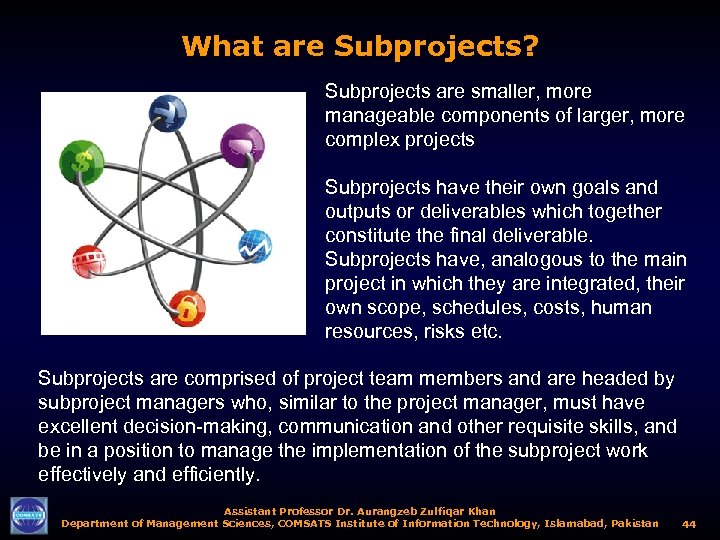 What are Subprojects? Subprojects are smaller, more manageable components of larger, more complex projects Subprojects have their own goals and outputs or deliverables which together constitute the final deliverable. Subprojects have, analogous to the main project in which they are integrated, their own scope, schedules, costs, human resources, risks etc. Subprojects are comprised of project team members and are headed by subproject managers who, similar to the project manager, must have excellent decision-making, communication and other requisite skills, and be in a position to manage the implementation of the subproject work effectively and efficiently. Assistant Professor Dr. Aurangzeb Zulfiqar Khan Department of Management Sciences, COMSATS Institute of Information Technology, Islamabad, Pakistan 44
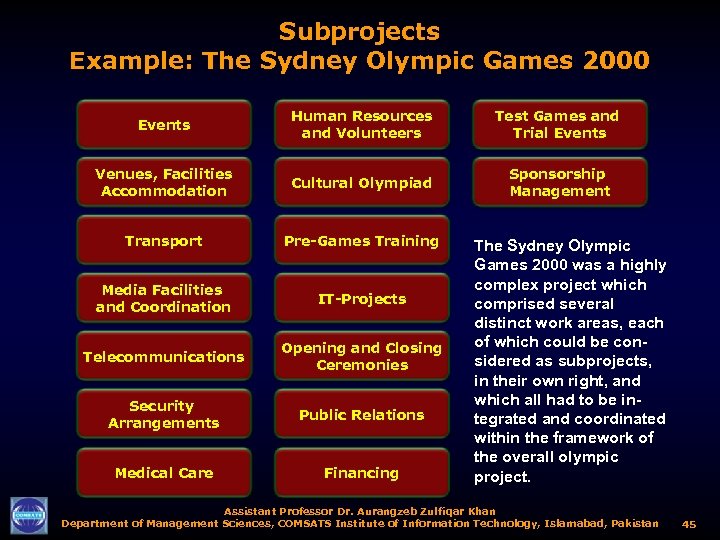 Subprojects Example: The Sydney Olympic Games 2000 Events Human Resources and Volunteers Test Games and Trial Events Venues, Facilities Accommodation Cultural Olympiad Sponsorship Management Transport Pre-Games Training Media Facilities and Coordination IT-Projects Telecommunications Opening and Closing Ceremonies Security Arrangements Public Relations Medical Care Financing The Sydney Olympic Games 2000 was a highly complex project which comprised several distinct work areas, each of which could be considered as subprojects, in their own right, and which all had to be integrated and coordinated within the framework of the overall olympic project. Assistant Professor Dr. Aurangzeb Zulfiqar Khan Department of Management Sciences, COMSATS Institute of Information Technology, Islamabad, Pakistan 45
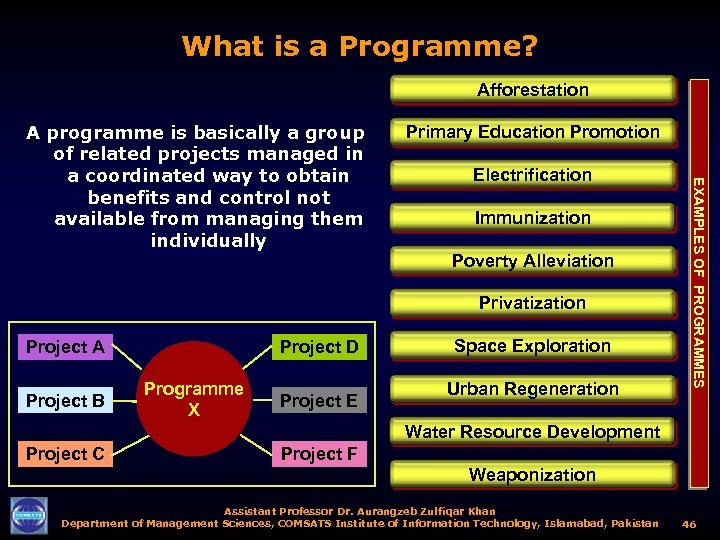 What is a Programme? Afforestation Primary Education Promotion Electrification Immunization Poverty Alleviation Privatization Project A Project B Project D Programme X Project E Space Exploration Urban Regeneration EXAMPLES OF PROGRAMMES A programme is basically a group of related projects managed in a coordinated way to obtain benefits and control not available from managing them individually Water Resource Development Project C Project F Weaponization Assistant Professor Dr. Aurangzeb Zulfiqar Khan Department of Management Sciences, COMSATS Institute of Information Technology, Islamabad, Pakistan 46
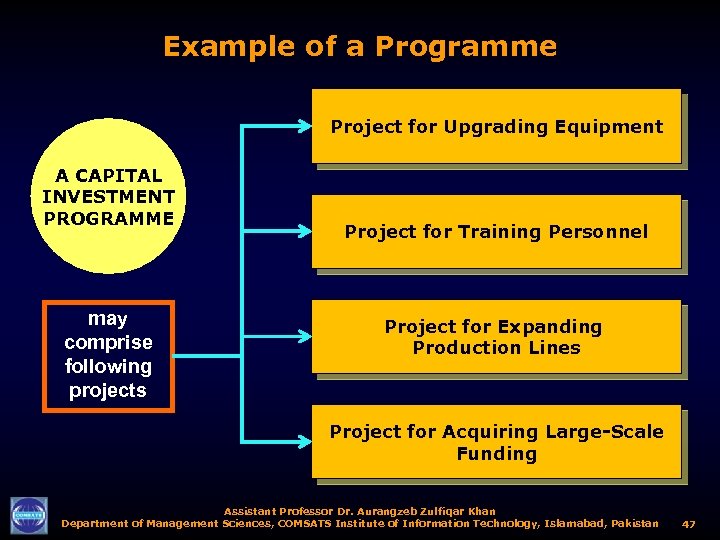 Example of a Programme Project for Upgrading Equipment A CAPITAL INVESTMENT PROGRAMME may comprise following projects Project for Training Personnel Project for Expanding Production Lines Project for Acquiring Large-Scale Funding Assistant Professor Dr. Aurangzeb Zulfiqar Khan Department of Management Sciences, COMSATS Institute of Information Technology, Islamabad, Pakistan 47
 Assistant Professor Dr. Aurangzeb Zulfiqar Khan Department of Management Sciences, COMSATS Institute of Information Technology, Islamabad, Pakistan 48
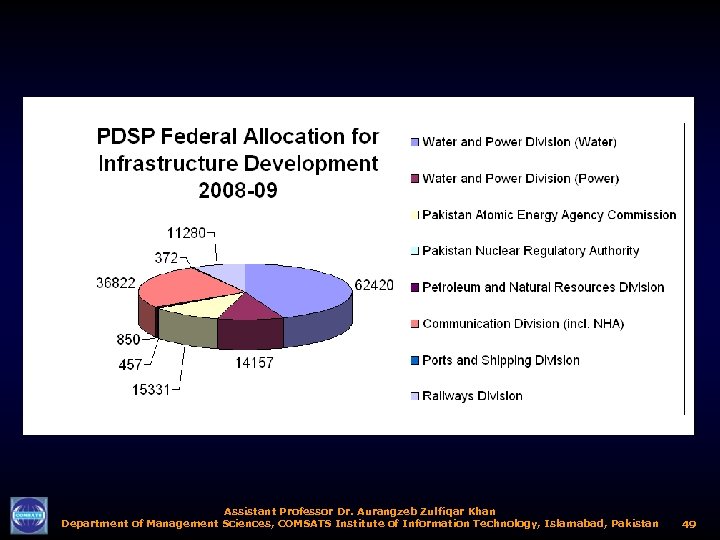 Assistant Professor Dr. Aurangzeb Zulfiqar Khan Department of Management Sciences, COMSATS Institute of Information Technology, Islamabad, Pakistan 49
 Programmes & Projects: Similarities ü Programmes and projects have goals and objectives which define their purpose of existence ü Programmes and projects have life-spans defining a starting and ending point in time ü Programmes and projects consume resources and necessarily incur a cost ü Programmes and projects require application of a methodology and must be managed properly to bolster their chances of success ü Programmes and projects aim at helping organizations achieve their mission and adding value to them. Assistant Professor Dr. Aurangzeb Zulfiqar Khan Department of Management Sciences, COMSATS Institute of Information Technology, Islamabad, Pakistan 50
 Programmes & Projects: Differences X Programmes may have multiple overarching goals whereas projects have one prime goal X A programme has a comparatively longer life-span, and obviously costs more than the combination of all the projects which constitute it X A programme is inherently more complex than a constituting project – it has a broader scope and may require extensive coordination between its various constituting projects X Whereas a project results in the creation of an output and is then ended, a programme must integrate and maintain the operationality of that output for a specified period of time Assistant Professor Dr. Aurangzeb Zulfiqar Khan Department of Management Sciences, COMSATS Institute of Information Technology, Islamabad, Pakistan 51
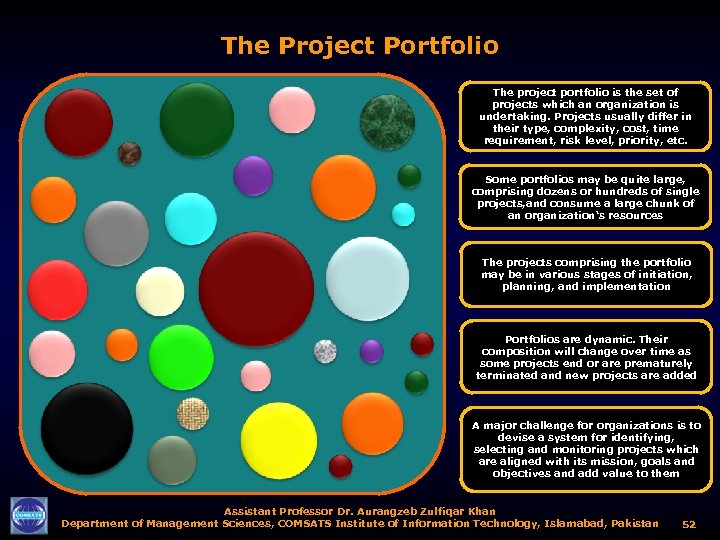 The Project Portfolio The project portfolio is the set of projects which an organization is undertaking. Projects usually differ in their type, complexity, cost, time requirement, risk level, priority, etc. Some portfolios may be quite large, comprising dozens or hundreds of single projects, and consume a large chunk of an organization‘s resources The projects comprising the portfolio may be in various stages of initiation, planning, and implementation Portfolios are dynamic. Their composition will change over time as some projects end or are prematurely terminated and new projects are added A major challenge for organizations is to devise a system for identifying, selecting and monitoring projects which are aligned with its mission, goals and objectives and add value to them Assistant Professor Dr. Aurangzeb Zulfiqar Khan Department of Management Sciences, COMSATS Institute of Information Technology, Islamabad, Pakistan 52
 What is a Process? „a system of operations in the design, development and production of something, whereby inherent in such a process is a series of actions, changes, or operations that bring about an end result“ Assistant Professor Dr. Aurangzeb Zulfiqar Khan Department of Management Sciences, COMSATS Institute of Information Technology, Islamabad, Pakistan 53
 What is a Process? According to the Project Management Institute, a process can be defined as: „a set of interrelated actions and activities that are performed to achieve a prespecified set of products, results, or services“ Assistant Professor Dr. Aurangzeb Zulfiqar Khan Department of Management Sciences, COMSATS Institute of Information Technology, Islamabad, Pakistan 54
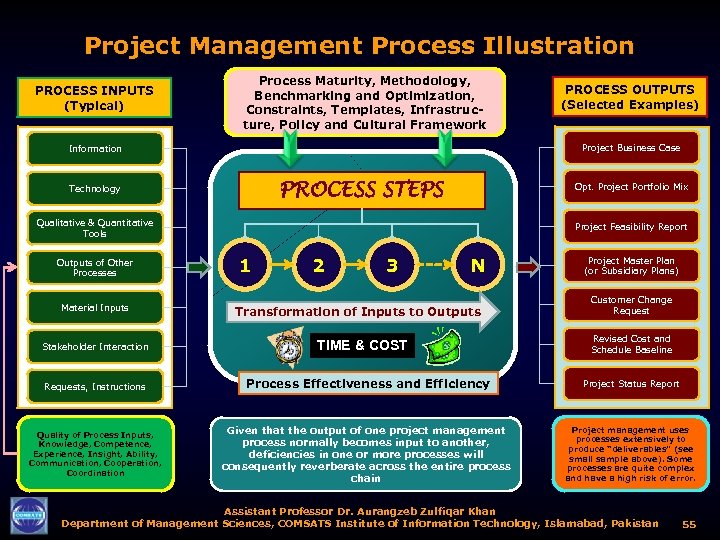 Project Management Process Illustration PROCESS INPUTS (Typical) Process Maturity, Methodology, Benchmarking and Optimization, Constraints, Templates, Infrastructure, Policy and Cultural Framework Project Business Case Information PROCESS STEPS Technology Opt. Project Portfolio Mix Qualitative & Quantitative Tools Outputs of Other Processes Material Inputs Stakeholder Interaction PROCESS OUTPUTS (Selected Examples) Project Feasibility Report 1 2 3 N Transformation of Inputs to Outputs TIME & COST Project Master Plan (or Subsidiary Plans) Customer Change Request Revised Cost and Schedule Baseline Requests, Instructions Process Effectiveness and Efficiency Project Status Report Quality of Process Inputs, Knowledge, Competence, Experience, Insight, Ability, Communication, Cooperation, Coordination Given that the output of one project management process normally becomes input to another, deficiencies in one or more processes will consequently reverberate across the entire process chain Project management uses processes extensively to produce “deliverables” (see small sample above). Some processes are quite complex and have a high risk of error. Assistant Professor Dr. Aurangzeb Zulfiqar Khan Department of Management Sciences, COMSATS Institute of Information Technology, Islamabad, Pakistan 55
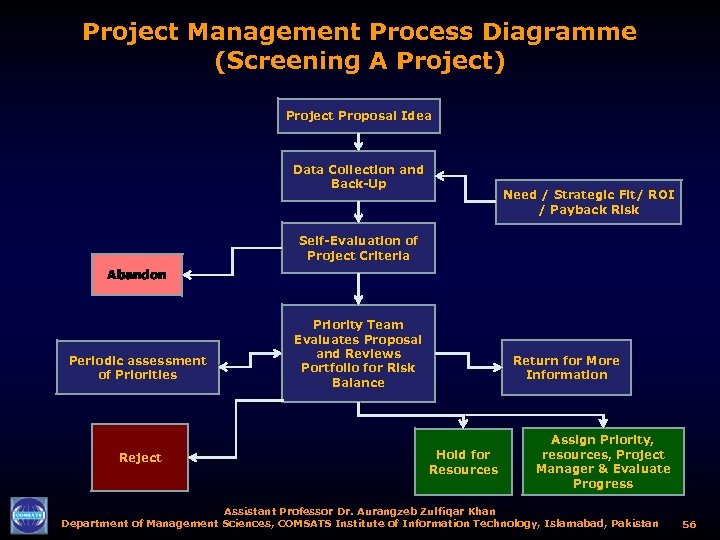 Project Management Process Diagramme (Screening A Project) Project Proposal Idea Data Collection and Back-Up Need / Strategic Fit/ ROI / Payback Risk Self-Evaluation of Project Criteria Abandon Periodic assessment of Priorities Reject Priority Team Evaluates Proposal and Reviews Portfolio for Risk Balance Return for More Information Hold for Resources Assign Priority, resources, Project Manager & Evaluate Progress Assistant Professor Dr. Aurangzeb Zulfiqar Khan Department of Management Sciences, COMSATS Institute of Information Technology, Islamabad, Pakistan 56
 Focus on Processes Systematically All project management processes should be identified and described, with each process task carefully analyzed in terms of its input(s) and output(s) plus its estimated cost, duration and risk factors, graphically illustrated and subsequently documented for reference by project stakeholders in a “project process directory”. This directory should be periodically revised and the processes therein modified, simplified or, where necessary, ‚reengineered‘ to improve their effectiveness and efficiency. Assistant Professor Dr. Aurangzeb Zulfiqar Khan Department of Management Sciences, COMSATS Institute of Information Technology, Islamabad, Pakistan 57
 What is Project Management? „a method and a set of techniques based on the accepted principles of management used for planning, estimating and controlling work activities to reach a desired end result on time – within budget and according to specification“ (Robert K. Wysocki / Robert Beck Jr. / David B. Crane, Effective Project Management, 2. ed. , John Wiley & Sons, 2002, p. 79). Assistant Professor Dr. Aurangzeb Zulfiqar Khan Department of Management Sciences, COMSATS Institute of Information Technology, Islamabad, Pakistan 58
 What is Project Management? „. . . unique process, consisting of a set of coordinated and controlled activities with start and finish dates, undertaken to achieve an objective conforming to specific requirements, including the constraints of time, cost and resources“ [ISO 9001: 2000] Assistant Professor Dr. Aurangzeb Zulfiqar Khan Department of Management Sciences, COMSATS Institute of Information Technology, Islamabad, Pakistan 59
 What is Project Management? „Project management is the planning, organizing, directing, and controlling of company resources for a relatively short -term objective that has been established to complete specific goals and objectives. “ (Harold Kerzner, Project Management: A Systems Approach to Planing, Scheduling and Controlling, John Wiley & Sons, Inc. , New York et. al. , 7. ed, 2001, p. 4) Assistant Professor Dr. Aurangzeb Zulfiqar Khan Department of Management Sciences, COMSATS Institute of Information Technology, Islamabad, Pakistan 60
 Essential Functions of Project Management helps organizations tackle the pressure of change in environments – global, economic, market, social, political, regulatory, technological and others – which are characterized by a high and increasing degree of complexity, dynamism and uncertainty Assistant Professor Dr. Aurangzeb Zulfiqar Khan Department of Management Sciences, COMSATS Institute of Information Technology, Islamabad, Pakistan 61
 Essential Functions of Project Management offers a focused, systematic, integrated and process-driven framework of application of an organization’s resources for effective and efficient realization of its projects, and therewith its goals, objectives and mission. It is, hence, an important “strategic tool” indispensible for an organization’s survival and growth. Assistant Professor Dr. Aurangzeb Zulfiqar Khan Department of Management Sciences, COMSATS Institute of Information Technology, Islamabad, Pakistan 62
 Essential Functions of Project Management is primarily about leadership, integrating work occurring in all project areas, steering the project in the right direction and effectively managing stakeholders and complexity. Specialized technical tasks and the tools used in project management - often the prime focus of interest by students of the subject and novice project managers - are of secondary concern. Assistant Professor Dr. Aurangzeb Zulfiqar Khan Department of Management Sciences, COMSATS Institute of Information Technology, Islamabad, Pakistan 63
 Essential Functions of Project Management teaches “best practices” based on years of experience with projects in diverse fields across the globe. It should be kept in mind, though, that works well in one project situation may not at all work well in another. Use good judgement and always be cognizant of the context-sensitivity of Project Management! Assistant Professor Dr. Aurangzeb Zulfiqar Khan Department of Management Sciences, COMSATS Institute of Information Technology, Islamabad, Pakistan 64
 Essential Functions of Project Management Using Project Management is no guarantee that the project will be sucessful – i. e. that it achieves its goal within time and allocated budget to the satisfaction of all stakeholders concerned. What Project Management essentially does, though, is offer a systematic but flexible framework which can increase the chances of the project suceeding or, conversely, decrease its chances of failing. Assistant Professor Dr. Aurangzeb Zulfiqar Khan Department of Management Sciences, COMSATS Institute of Information Technology, Islamabad, Pakistan 65
 Essential Functions of Project Management The intensity with which Project Management is applied must be proportional to the need and complexity of that project. Just as one wouldn’t commission a bazooka or a flame thrower to kill a cockroach, it would be an error of judgment to apply the full gamut of project management processes and tools to a project which can probably be successfully managed more effectively and efficiently using a simpler and intuitive approach. Assistant Professor Dr. Aurangzeb Zulfiqar Khan Department of Management Sciences, COMSATS Institute of Information Technology, Islamabad, Pakistan 66
 Essential Functions of Project Management seeks at least to meet - and preferably to exceed - stakeholder needs (i. e. the identified requirements) as well as stakeholder expectations (i. e. unidentified requirements) from a given project within the constraints of scope, cost, time and quality. Project Management is an evolving area of knowledge striving for continuous self-improvement over time. Assistant Professor Dr. Aurangzeb Zulfiqar Khan Department of Management Sciences, COMSATS Institute of Information Technology, Islamabad, Pakistan 67
 WEEKLY ASSIGNMENT #01 Does your organization use “process diagrammes” to document the relationship between, and the flow of tasks in the projects which it undertakes? If affirmative, outline and draw two examples of such diagrammes. If your organization does not use process diagrammes, then develop your own based on your experience working on projects. Assistant Professor Dr. Aurangzeb Zulfiqar Khan Department of Management Sciences, COMSATS Institute of Information Technology, Islamabad, Pakistan 68