


 Скачать презентацию Mass transfer process in chemical technologies Dr Dong-Guang
MODULE I INTRODUCTION лекция 1.ppt
- Количество слайдов: 36
 Mass transfer process in chemical technologies Dr. Dong-Guang Wang Zhejiang Ocean University
 My specialties n Chemical Reaction Engineering n Nanomaterial Engineering n Chemical Process Intensification All my specialties focus on the application of mass transfer theory. In this course, I will first give you a account of some basic mass transfer theories, then introduce some applications which I learned.
 Question 1: What specialized courses have you learned in chemical engineering? The answer of this question will let me know your current state. Please tell me your name and student number one by one, and everyone also answer one major one course.
 MODULE I: INTRODUCTION Tall buildings are constructed by building engineers using cement, bricks, sand steel bars. The task of chemical engineer is to build those microscopic molecular or crystal structures in large quantities with low cost. The raw materials of chemical industry come from air, coal, fossil oil, natural gas, seawater, various
 biomass and ores. The raw materials are purified and transformed into new substances through separation and reaction operations. Chemical products are essential for modern life. As microstructure engineers, we must have deep insight into chemical process mechanisms. During mechanisms. all chemical processes, mass and heat must be transported to specified positions in time by momentum transfer.
 1. Examples of transport process in our daily life Example 1: Traffic on the road A road is wide in some places but narrow in other places. The number of vehicles passed through the road per unit time is determined by the narrowest place, which is called the ratedetermining step.
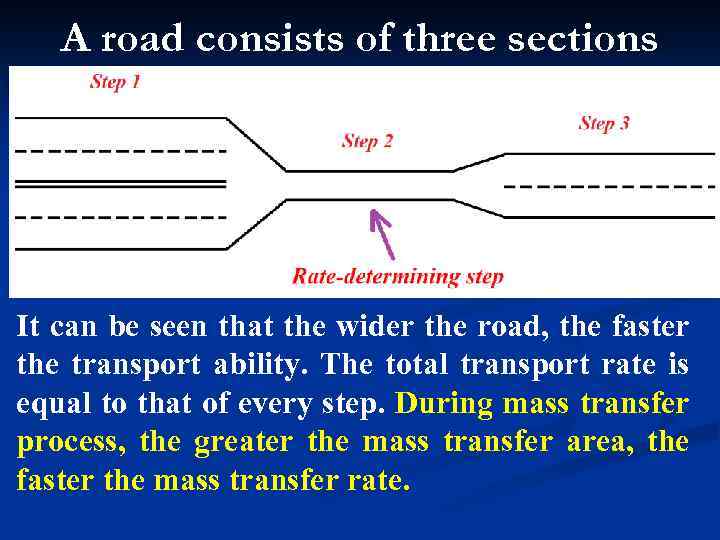 A road consists of three sections It can be seen that the wider the road, the faster the transport ability. The total transport rate is equal to that of every step. During mass transfer process, the greater the mass transfer area, the faster the mass transfer rate.
 Example 2: Transport of bricks Three people (including adult, young and old people) stand in a row to transport bricks. The total transfer rate is determined by the slowest person. The mass transfer rate of gas is much higher than that of liquid, which is much higher than that of solid. The higher the viscosity of fluid, the slower the mass transfer rate.
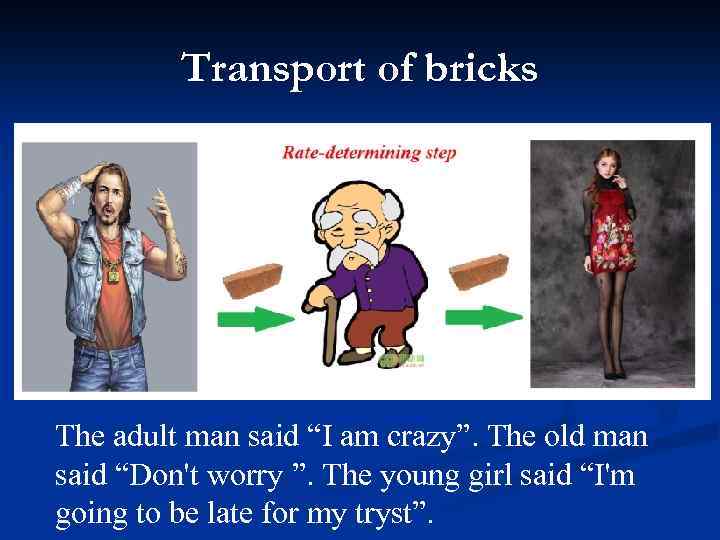 Transport of bricks The adult man said “I am crazy”. The old man said “Don't worry. ”. The young girl said “I'm going to be late for my tryst”.
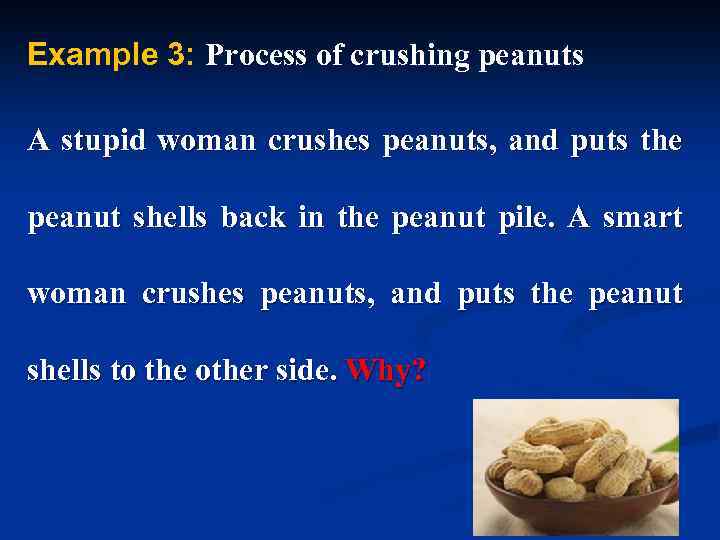 Example 3: Process of crushing peanuts Process of c A stupid woman crushes peanuts, and puts the peanut shells back in the peanut pile. A smart woman crushes peanuts, and puts the peanut shells to the other side. Why?
 The operation by the stupid woman is called “back-mixing”. Because she mixes the peanut shells with peanuts, the rate of shelling peanuts is markedly reduced by back-mixing. Back-mixing also can markedly lower the rate of mass transfer process.
 Example 4: Process of rinsing clothes When you have washed your clothes with your hands, you need to rinse the clothes with clean water. Do you know which rinse method is the most economical for tap water and saving effort?
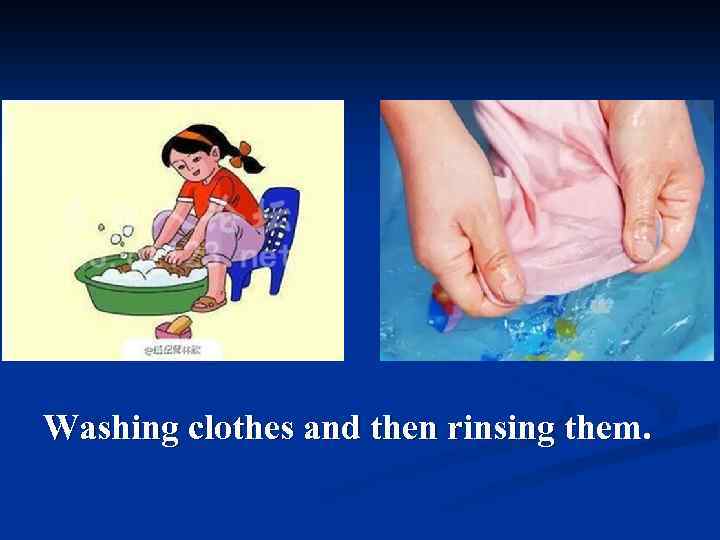 Washing clothes and then rinsing them.
 The easiest method is that when you rinse clothes at second and third times, you should rinse them in the order of the first time. Usually, if you follow the above rinsing sequence, you only need rinsing clothes three times, and your clothes will be very clean. Otherwise, if you disorganized the above order, you will waste your time, tap water and effort.
 The reason is that disrupting the sequence of rinsing clothes will cause severe back-mixing. The washing clothes process produces a lot of foams. The process of rinsing clothes is to remove the foams from the clothes. This is a typical mass transfer process. Back-mixing process will greatly reduce the rate of the mass transfer process. I hope you to experience this process one time, then you will know exactly what is back-mixing.
 2. What is mass transfer process? A component moves to the direction of reducing concentration gradient. The transport occurs from a region of higher concentration to lower concentration. Equilibrium is reached when the gradient is zero. This transport or migration is known as mass transfer. Mass transfer process in homogeneous phase is mixing process, but separation process usually involves
 heterogeneous mass transfer processes. In chemical engineering, mixing and separating operations are two contradictory unity. Mixing process is spontaneous process, but separation process requires external impetus. In a two-phase separation process, if the mixing processes in the two phases both are very weak, the efficiency of the separation process will be very low.
 3. Characteristics of mass transfer ① is stemming from the random continuous motion of molecules in fluids. ② is transport of components under chemical potential gradient. ③ is irreversible process of statistical nature; ④ belongs to physical process;
 4. Two modes of mass transfer ① Diffusion mass transfer (or single molecule diffusion) is about spontaneous dispersion of diffusion) mass. The rate of this movement is a function of temperature, viscosity of the fluid and the size of the molecules
 ② Convection mass transfer is the movement of groups of molecules within fluids, it is a passive mass transfer process. Convection includes natural convection and forced convection. Common convection modes include rotating convection and impinging convection. Compared with impinging convection, rotating convection is characterized by smaller energy dissipation and larger scale mixings.
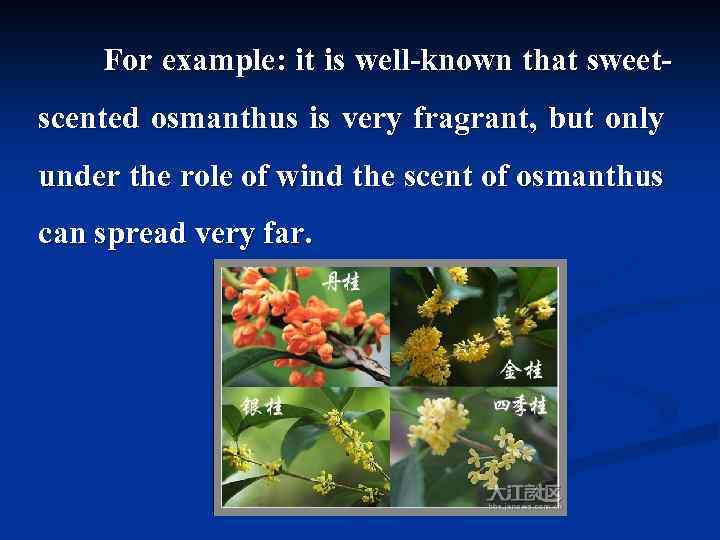 For example: it is well-known that sweetscented osmanthus is very fragrant, but only under the role of wind the scent of osmanthus can spread very far.
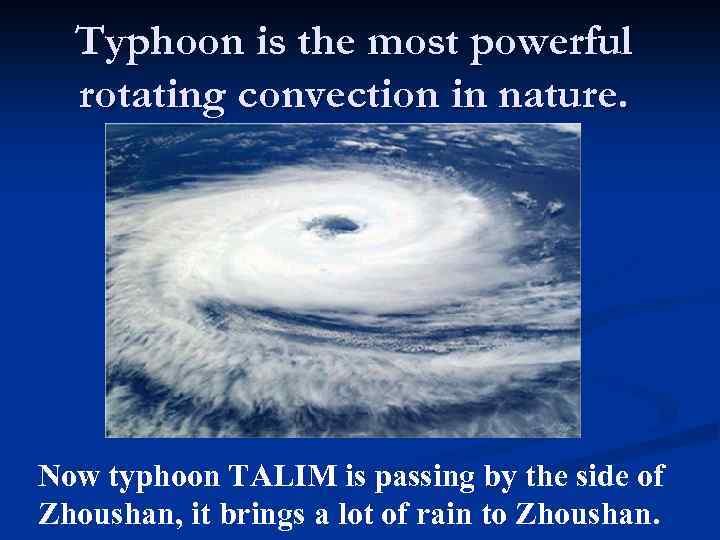 Typhoon is the most powerful rotating convection in nature. Now typhoon TALIM is passing by the side of Zhoushan, it brings a lot of rain to Zhoushan.
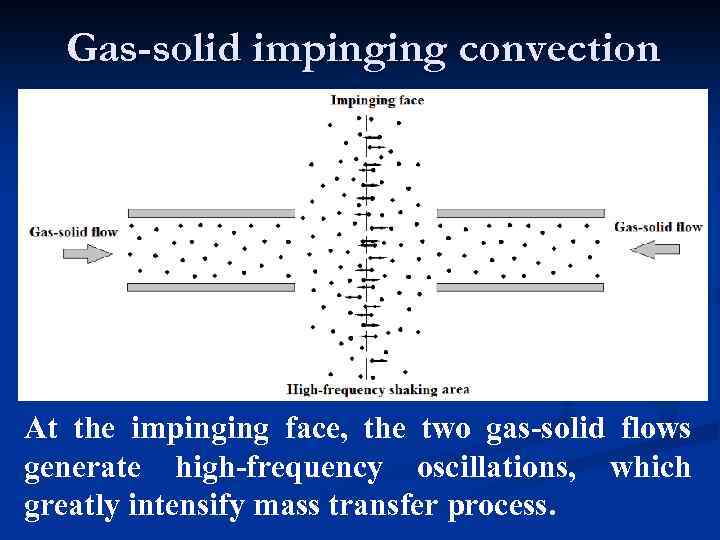 Gas-solid impinging convection At the impinging face, the two gas-solid flows generate high-frequency oscillations, which greatly intensify mass transfer process.
 Comparison of diffusion and convection mass transfer processes n The rate of diffusion mass transfer is very slow, and therefore greatly lowers the scale of mass transfer process. The rate of convection mass transfer can be very fast. So, it can realize large scale mass transfer process. Convection mass transfer process inevitably involves of diffusion process. This process is very like a high-speed train carrying a crawling turtle.
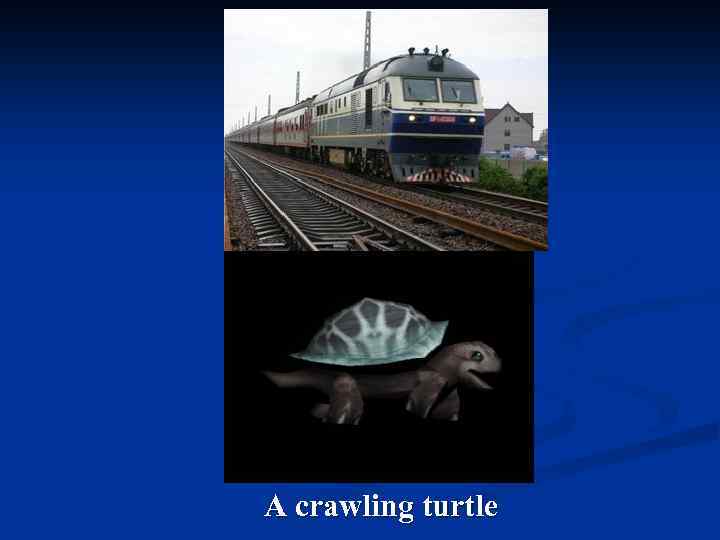 A crawling turtle
 5. Interphase mass transfer Interface mass transfer depends on molecules diffusing from one distinct phase to another and is based upon differences in the physico-chemical properties of the molecules, such as vapour pressure or solubility.
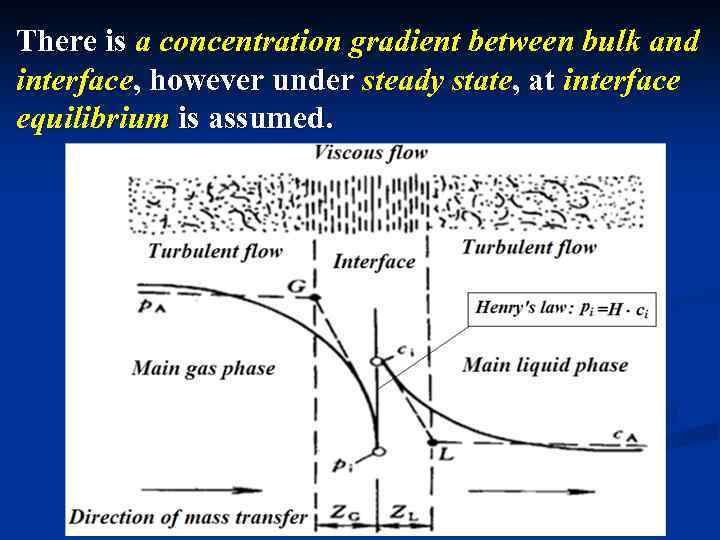 There is a concentration gradient between bulk and interface, however under steady state, at interface equilibrium is assumed.
 Double-film theory from Lewis-Whitman (1924) for the fluid-phase mass transfer mechanism. Two turbulent flows are located at the two sides of the contact surface, there are two effective fluid membrane; Two fluids of mass transfer between the resistance are all concentrated in the double membrane, solute diffusion to steady way through the film; at the two-phase interface, the two-phase concentration is balanced.
 A typical example: Your native language is Russian, but my native language is Chinese. We communicate with each other in English. Because of the two layers of language resistance, it is very difficult for us to communicate with each other. So we have to slow down communication. the speed of language
 6. Analogies between mass, heat, and momentum transfer n n There are notable similarities in the commonly used approximate differential equations for the three transport phenomena. At low Reynolds number (Stokes flow), the molecular transfer equations of Newton's law for fluid momentum, Fourier's law for heat, and Fick's law for mass are very similar. They are all linear approximations to transport of conserved quantities.
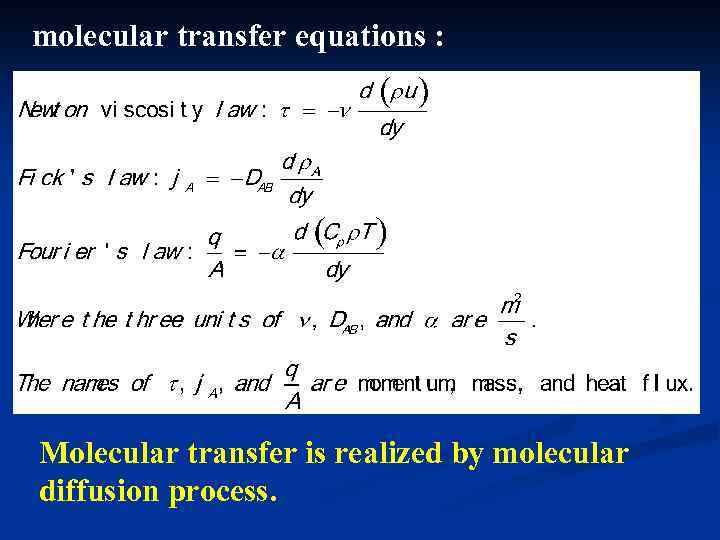 molecular transfer equations : Molecular transfer is realized by molecular diffusion process.
 Take the momentum transfer in laminar flow as an example: The unit of shear stress (τ) can be expressed as kg·(m/s)/(m 2·s), where kg·(m/s) is the unit of momentum. Therefore, shear stress means the momentum pass through 1 square meter in one second. Between two adjacent flow layers, due to the velocity gradients, molecules in the fast flow
 layer diffuse into the slow layer and collide with the slow molecules to accelerate them, and vice versa. The exchange of molecules causes the momentum transfer. From macro perspective, the fast layer is dragged back by the slow layer, and the slow layer is pulled forward by the fast layer. This is the shear stess between the two layers.
 At high Reynolds number, the analogy between mass, heat, and momentum transfer becomes less, but the analogy between heat and mass transfer remains good. A great deal of effort has been devoted to developing analogies among these three transport processes so as to allow prediction of one from any of the others.
 7. Mass transfer in separation operations Mass transfer plays an important role in chemical industry. A group of separation operations is based on the transfer of material from one homogeneous phase to another, such as gas absorption and stripping, liquid-liquid extraction, leaching, distillation, humidification, drying, crystallization, membrane separation, et al. crystallization,
 8. Mass transfer in reaction process From macroscopic point, chemical industry only consists of two opposite parts: mixing and separation. A reactor is a mixer. In a reactor, the purpose of mixing operation is to achieve more uniform distributions of concentration and temperature. Mixing operation is achieved by accelerating momentum transfer to achieve rapid mass and heat transfer process.