


 Скачать презентацию Mass Spectrometry in the analysis of Persistent Organic
50abbdb3361673db3b5c73c573b1ad5f.ppt
- Количество слайдов: 56
 Mass Spectrometry in the analysis of Persistent Organic Pollutants Anton Kočan, Jana Klánová
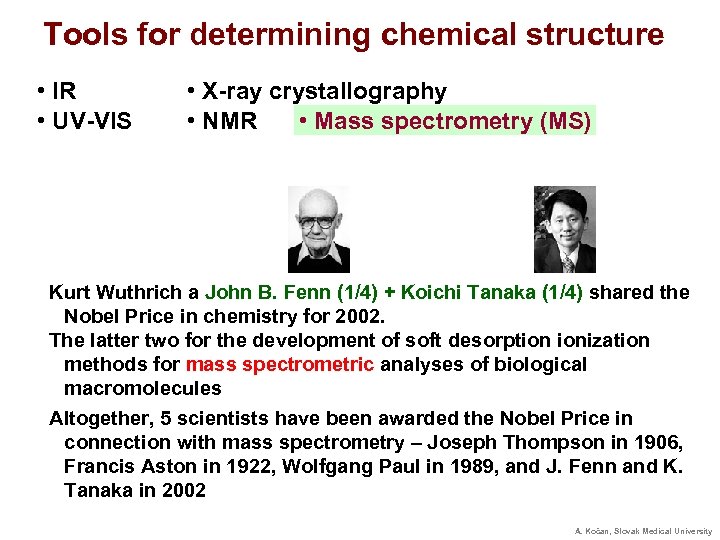 Tools for determining chemical structure • IR • UV-VIS • X-ray crystallography • NMR • Mass spectrometry (MS) Kurt Wuthrich a John B. Fenn (1/4) + Koichi Tanaka (1/4) shared the Nobel Price in chemistry for 2002. The latter two for the development of soft desorption ionization methods for mass spectrometric analyses of biological macromolecules Altogether, 5 scientists have been awarded the Nobel Price in connection with mass spectrometry – Joseph Thompson in 1906, Francis Aston in 1922, Wolfgang Paul in 1989, and J. Fenn and K. Tanaka in 2002 A. Kočan, Slovak Medical University
 Advantages of Mass Spectrometry • A small amount of substance is sufficient • Mixtures can be analyzed Disadvantages of Mass Spectrometry • It is a destructive method • The evaluation of mass spectra is demanding A. Kočan, Slovak Medical University
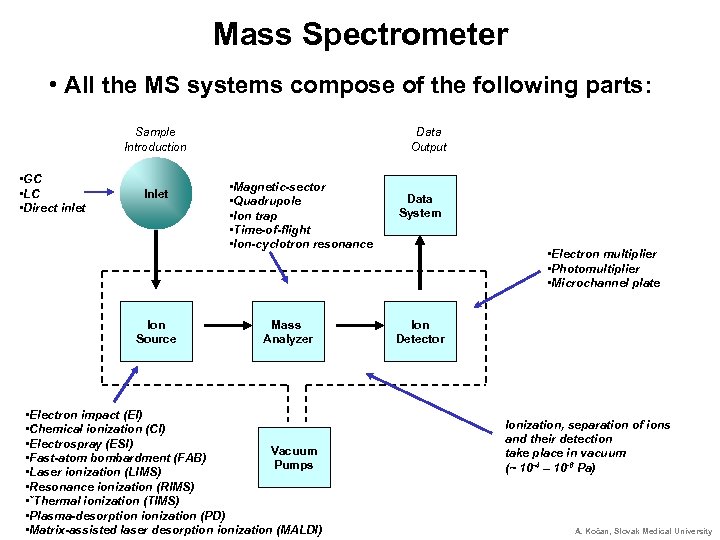 Mass Spectrometer • All the MS systems compose of the following parts: Sample Introduction • GC • LC • Direct inlet Ion Source Data Output • Magnetic-sector • Quadrupole • Ion trap • Time-of-flight • Ion-cyclotron resonance Mass Analyzer • Electron impact (EI) • Chemical ionization (CI) • Electrospray (ESI) Vacuum • Fast-atom bombardment (FAB) Pumps • Laser ionization (LIMS) • Resonance ionization (RIMS) • ˇThermal ionization (TIMS) • Plasma-desorption ionization (PD) • Matrix-assisted laser desorption ionization (MALDI) Data System • Electron multiplier • Photomultiplier • Microchannel plate Ion Detector Ionization, separation of ions and their detection take place in vacuum (~ 10 -4 – 10 -6 Pa) A. Kočan, Slovak Medical University
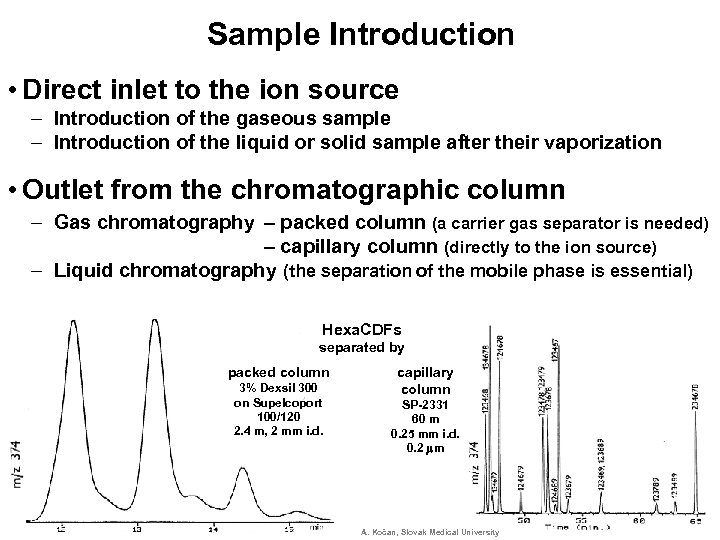 Sample Introduction • Direct inlet to the ion source – Introduction of the gaseous sample – Introduction of the liquid or solid sample after their vaporization • Outlet from the chromatographic column – Gas chromatography – packed column (a carrier gas separator is needed) – capillary column (directly to the ion source) – Liquid chromatography (the separation of the mobile phase is essential) Hexa. CDFs separated by packed column 3% Dexsil 300 on Supelcoport 100/120 2. 4 m, 2 mm i. d. capillary column SP-2331 60 m 0. 25 mm i. d. 0. 2 mm A. Kočan, Slovak Medical University
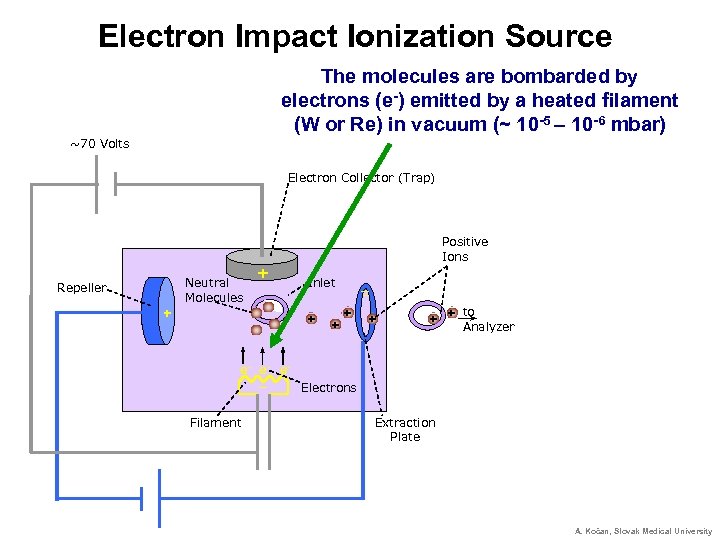 Electron Impact Ionization Source The molecules are bombarded by electrons (e-) emitted by a heated filament (W or Re) in vacuum (~ 10 -5 – 10 -6 mbar) ~70 Volts Electron Collector (Trap) Positive Ions Neutral Molecules Repeller + + Inlet + + _ _ + + to + + Analyzer e- e- e_ Electrons Filament Extraction Plate A. Kočan, Slovak Medical University
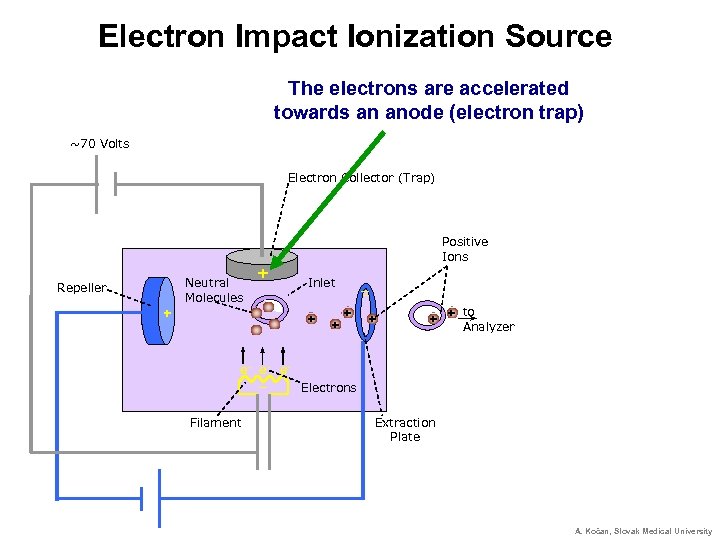 Electron Impact Ionization Source The electrons are accelerated towards an anode (electron trap) ~70 Volts Electron Collector (Trap) Positive Ions Neutral Molecules Repeller + + Inlet + + _ _ + + to + + Analyzer e- e- e_ Electrons Filament Extraction Plate A. Kočan, Slovak Medical University
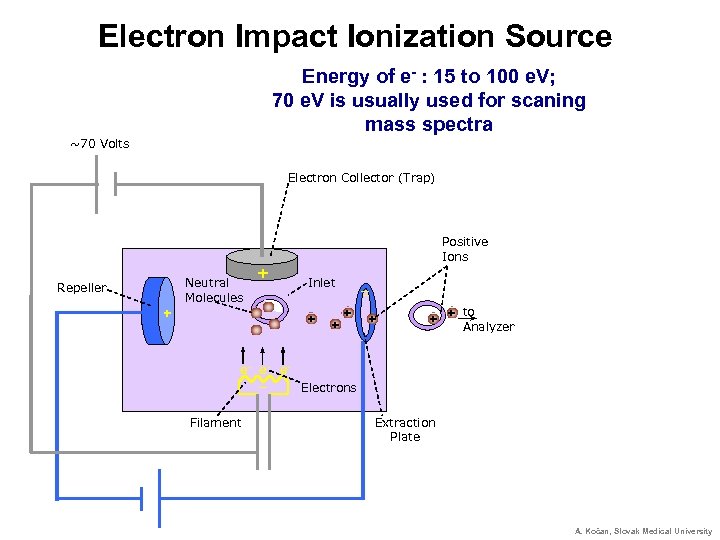 Electron Impact Ionization Source Energy of e- : 15 to 100 e. V; 70 e. V is usually used for scaning mass spectra ~70 Volts Electron Collector (Trap) Positive Ions Neutral Molecules Repeller + + Inlet + + _ _ + + to + + Analyzer e- e- e_ Electrons Filament Extraction Plate A. Kočan, Slovak Medical University
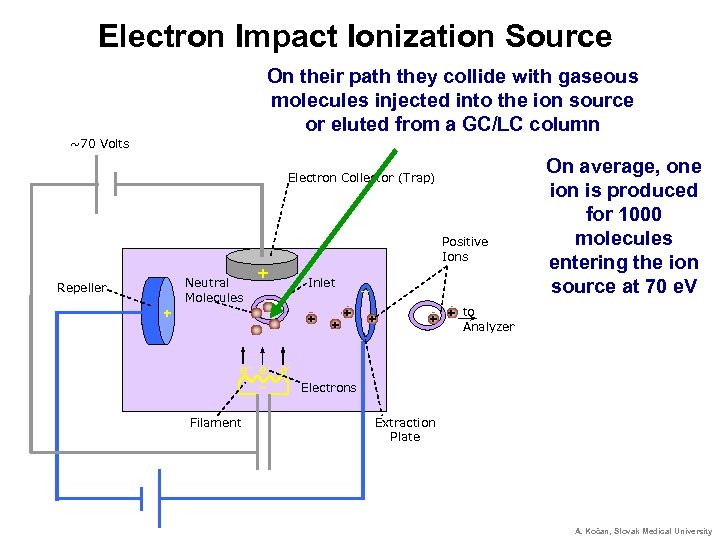 Electron Impact Ionization Source On their path they collide with gaseous molecules injected into the ion source or eluted from a GC/LC column ~70 Volts Electron Collector (Trap) Positive Ions Neutral Molecules Repeller + + Inlet + + _ _ + + On average, one ion is produced for 1000 molecules entering the ion source at 70 e. V to + + Analyzer e- e- e_ Electrons Filament Extraction Plate A. Kočan, Slovak Medical University
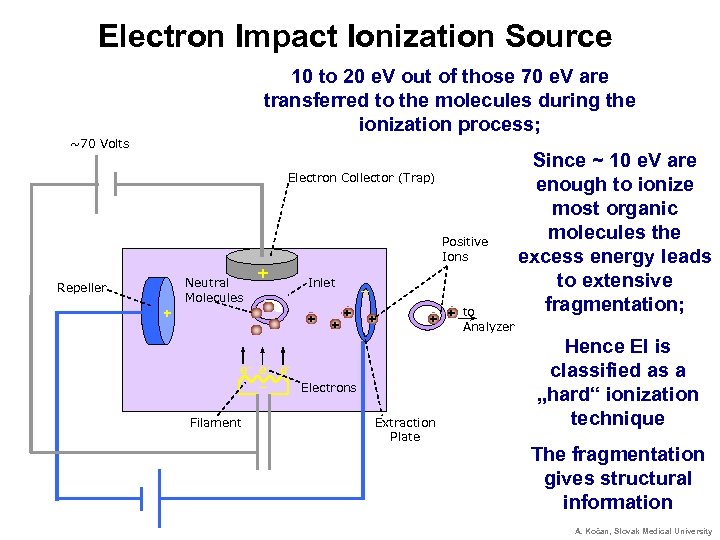 Electron Impact Ionization Source 10 to 20 e. V out of those 70 e. V are transferred to the molecules during the ionization process; ~70 Volts Electron Collector (Trap) Positive Ions Neutral Molecules Repeller + + Inlet + + _ _ + + to + + Analyzer e- e- e_ Electrons Filament Extraction Plate Since ~ 10 e. V are enough to ionize most organic molecules the excess energy leads to extensive fragmentation; Hence EI is classified as a „hard“ ionization technique The fragmentation gives structural information A. Kočan, Slovak Medical University
 Electron Ionization • One of the oldest and simplest methods (1930 – 1950) • Applicable for vaporizable samples only, e. g. compounds with low molecular weight (< 1000 Da), less polar organic molecules • Advantages: – Unimolecular fragmentation (ions spend 1 ms in EI source) – Reproducible technique • Disadvantages: – Sometimes M+. is not observed due to fragmentation – Almost impossible distinguish between isomers (GC separation needed) – Some compounds can undergo thermal decomposition before ionization because of high temperatures used to vaporize the sample – Inappropriate to too involatile compounds A. Kočan, Slovak Medical University
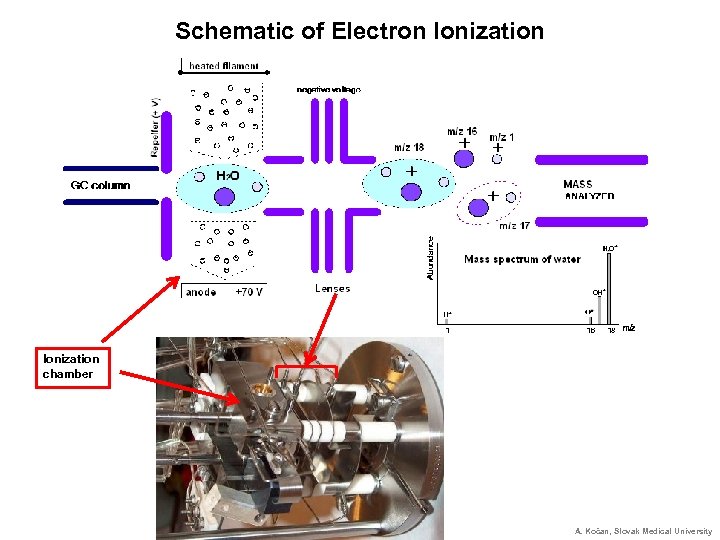 Schematic of Electron Ionization chamber A. Kočan, Slovak Medical University
 Positive Chemical Ionization • Developed in the 1960 s. • Gaseous ions such as CH 5+, C 2 H 5+, C 4 H 9+, NH 4+, H 3+ generated by electron impact from a large excess of a reagent gas, such as CH 4, NH 3, H 2, or i-C 4 H 10, interact with neutral molecules that may ionize. • Generally, the amount of fragments is much less than in EI since little internal energy is imparted on the ionized molecule; Thus, the important molecular ion can be determined. • Hence, CI is termed as „soft“ ionization technique. A. Kočan, Slovak Medical University
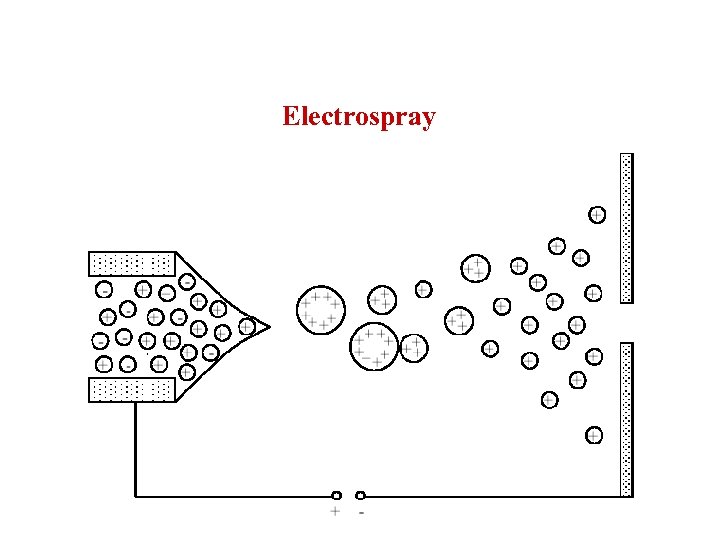 Electrospray
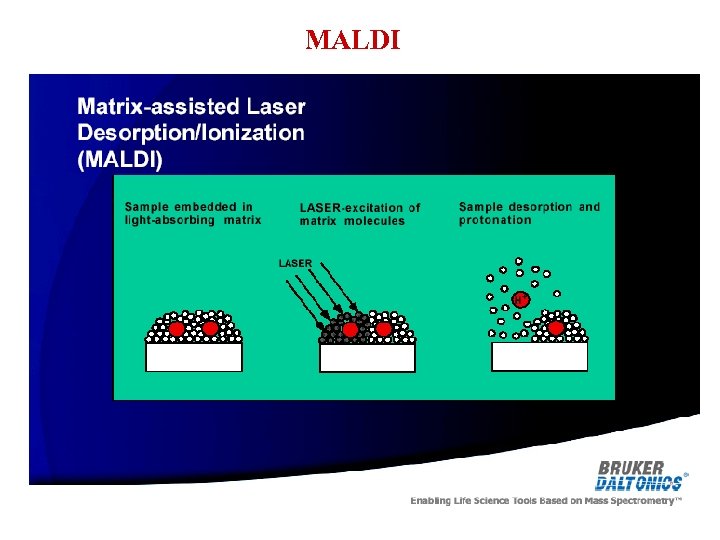 MALDI
MALDI
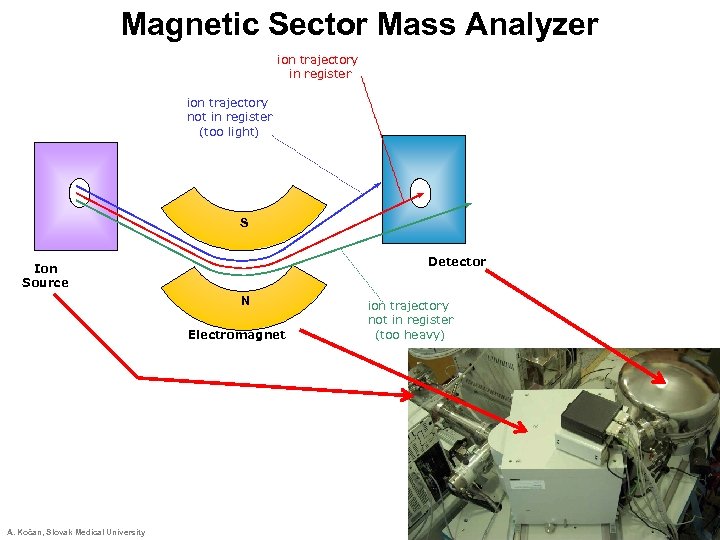 Magnetic Sector Mass Analyzer ion trajectory in register ion trajectory not in register (too light) S Detector Ion Source N Electromagnet A. Kočan, Slovak Medical University ion trajectory not in register (too heavy)
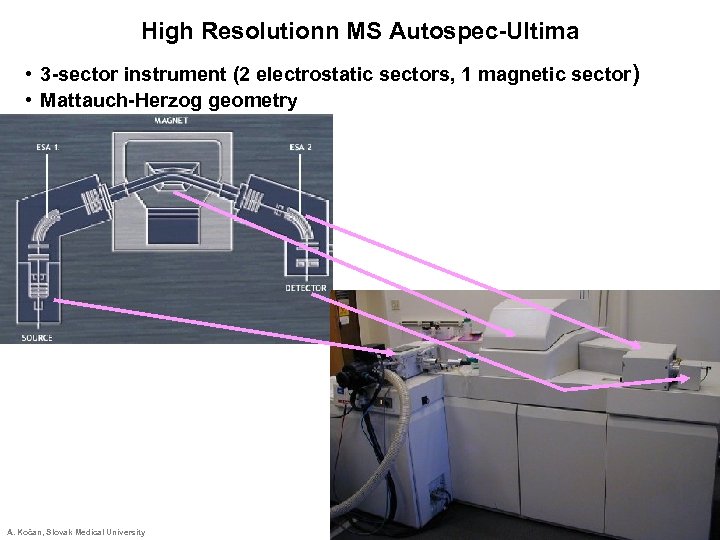 High Resolutionn MS Autospec-Ultima • 3 -sector instrument (2 electrostatic sectors, 1 magnetic sector) • Mattauch-Herzog geometry A. Kočan, Slovak Medical University
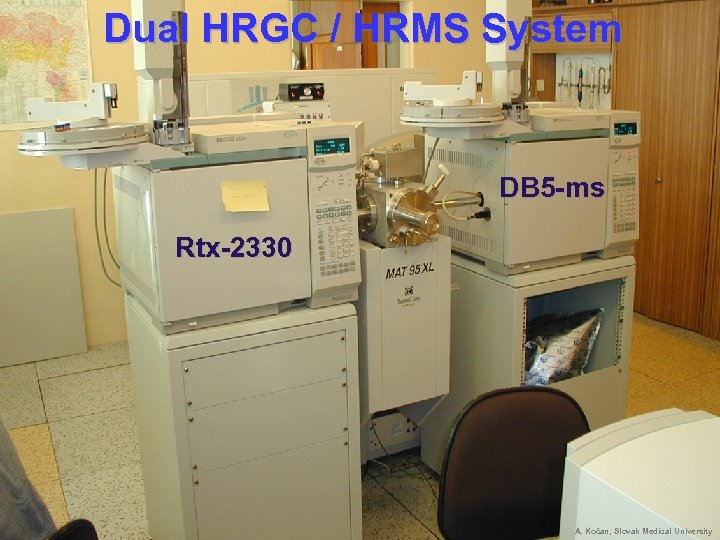 Dual HRGC / HRMS System DB 5 -ms Rtx-2330 A. Kočan, Slovak Medical University
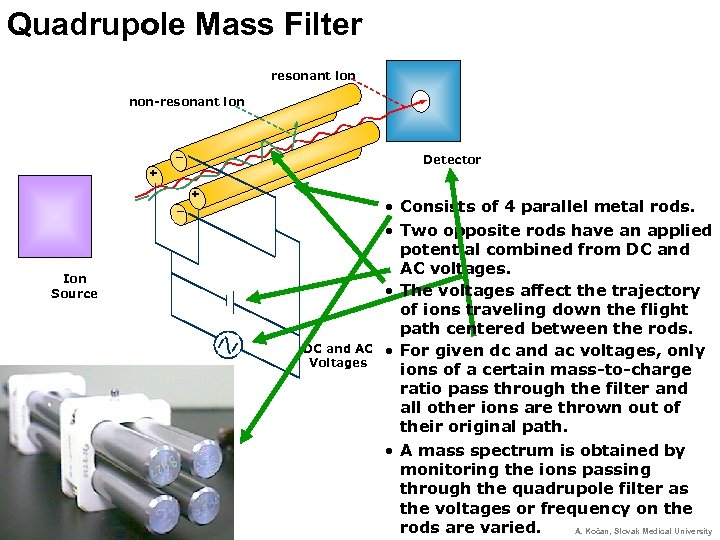 Quadrupole Mass Filter resonant ion non-resonant ion _ Detector + _ + Ion Source DC and AC Voltages • Consists of 4 parallel metal rods. • Two opposite rods have an applied potential combined from DC and AC voltages. • The voltages affect the trajectory of ions traveling down the flight path centered between the rods. • For given dc and ac voltages, only ions of a certain mass-to-charge ratio pass through the filter and all other ions are thrown out of their original path. • A mass spectrum is obtained by monitoring the ions passing through the quadrupole filter as the voltages or frequency on the rods are varied. A. Kočan, Slovak Medical University
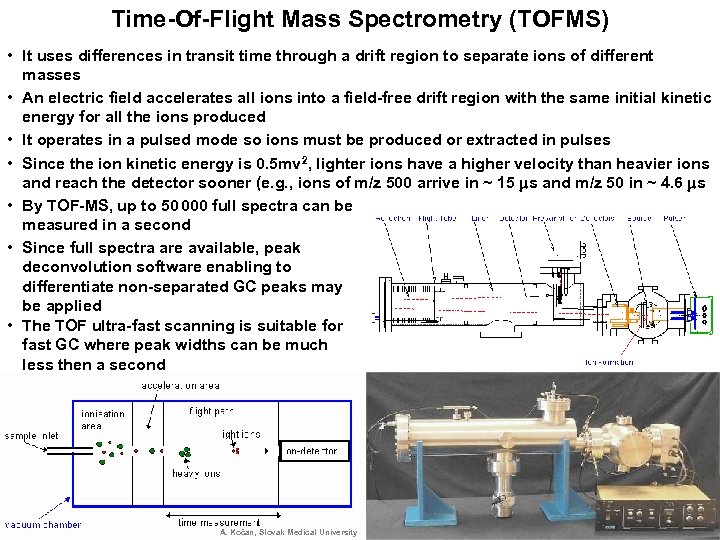 Time-Of-Flight Mass Spectrometry (TOFMS) • It uses differences in transit time through a drift region to separate ions of different masses • An electric field accelerates all ions into a field-free drift region with the same initial kinetic energy for all the ions produced • It operates in a pulsed mode so ions must be produced or extracted in pulses • Since the ion kinetic energy is 0. 5 mv 2, lighter ions have a higher velocity than heavier ions and reach the detector sooner (e. g. , ions of m/z 500 arrive in ~ 15 ms and m/z 50 in ~ 4. 6 ms • By TOF-MS, up to 50 000 full spectra can be measured in a second • Since full spectra are available, peak deconvolution software enabling to differentiate non-separated GC peaks may be applied • The TOF ultra-fast scanning is suitable for fast GC where peak widths can be much less then a second A. Kočan, Slovak Medical University
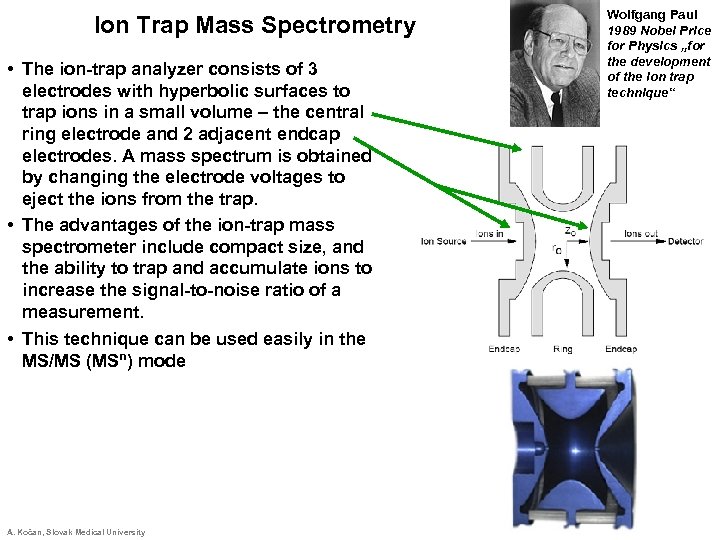 Ion Trap Mass Spectrometry • The ion-trap analyzer consists of 3 electrodes with hyperbolic surfaces to trap ions in a small volume – the central ring electrode and 2 adjacent endcap electrodes. A mass spectrum is obtained by changing the electrode voltages to eject the ions from the trap. • The advantages of the ion-trap mass spectrometer include compact size, and the ability to trap and accumulate ions to increase the signal-to-noise ratio of a measurement. • This technique can be used easily in the MS/MS (MSn) mode A. Kočan, Slovak Medical University Wolfgang Paul 1989 Nobel Price for Physics „for the development of the ion trap technique“
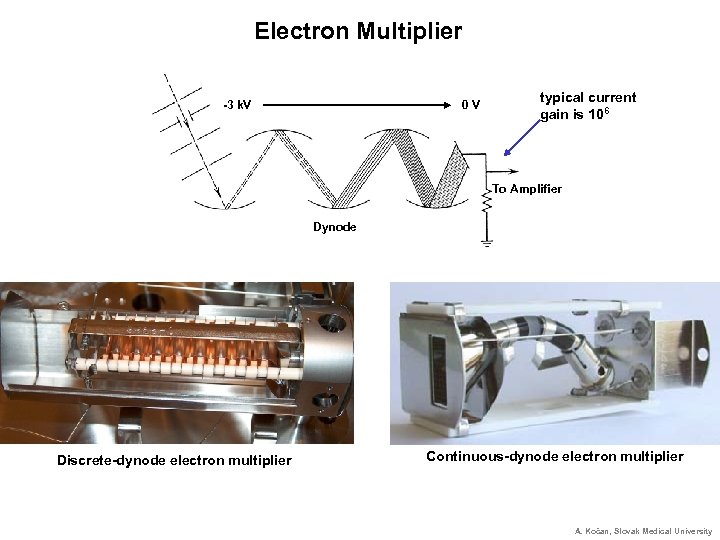 Electron Multiplier -3 k. V 0 V typical current gain is 106 To Amplifier Dynode Discrete-dynode electron multiplier Continuous-dynode electron multiplier A. Kočan, Slovak Medical University
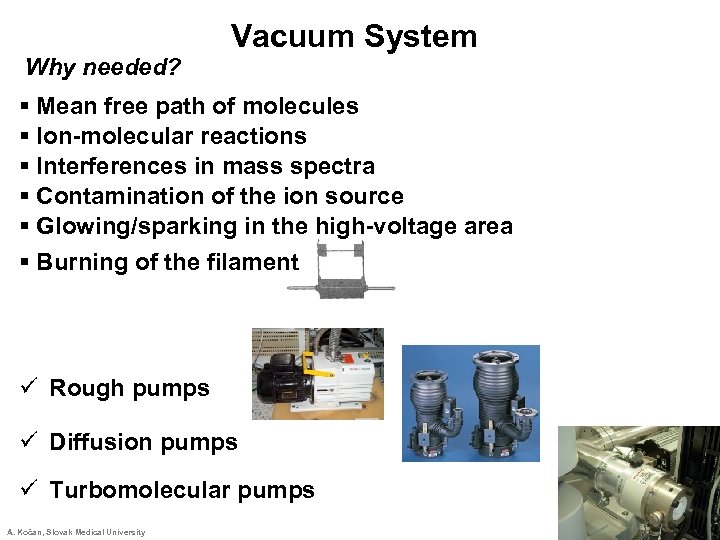 Why needed? Vacuum System § Mean free path of molecules § Ion-molecular reactions § Interferences in mass spectra § Contamination of the ion source § Glowing/sparking in the high-voltage area § Burning of the filament ü Rough pumps ü Diffusion pumps ü Turbomolecular pumps A. Kočan, Slovak Medical University
![Mass Spectrum 100 Relative abundance (%) Base peak [M-X]+. Fragment ion [M-Y]+. Molecular ion](https://present5.com/presentation/50abbdb3361673db3b5c73c573b1ad5f/image-24.jpg "Mass Spectrum 100 Relative abundance (%) Base peak [M-X]+. Fragment ion [M-Y]+. Molecular ion") Mass Spectrum 100 Relative abundance (%) Base peak [M-X]+. Fragment ion [M-Y]+. Molecular ion M+. m/z (mass-to-charge ratio) There are now Internet-accessible databases containing mass spectra of thousands of compounds, e. g. : http: //www. aist. go. jp/RIODB/SDBS/menu-e. html http: //webbook. nist. gov A. Kočan, Slovak Medical University
Mass Spectrum 100 Relative abundance (%) Base peak [M-X]+. Fragment ion [M-Y]+. Molecular ion M+. m/z (mass-to-charge ratio) There are now Internet-accessible databases containing mass spectra of thousands of compounds, e. g. : http: //www. aist. go. jp/RIODB/SDBS/menu-e. html http: //webbook. nist. gov A. Kočan, Slovak Medical University
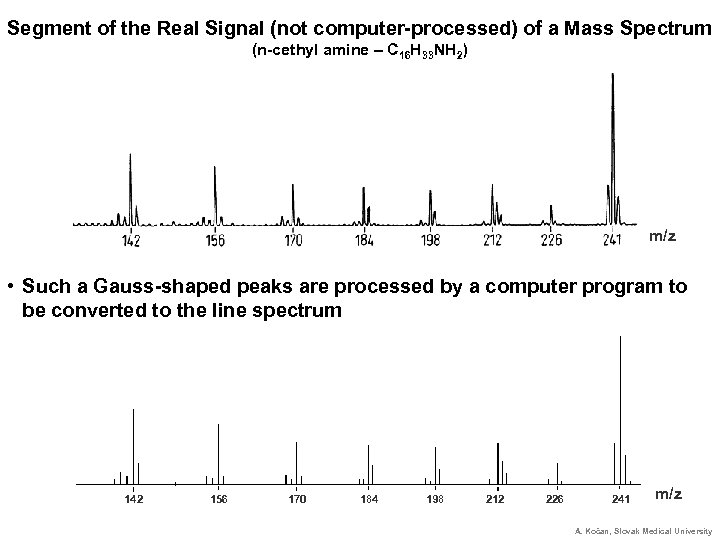 Segment of the Real Signal (not computer-processed) of a Mass Spectrum (n-cethyl amine – C 16 H 33 NH 2) m/z • Such a Gauss-shaped peaks are processed by a computer program to be converted to the line spectrum 142 156 170 184 198 212 226 241 m/z A. Kočan, Slovak Medical University
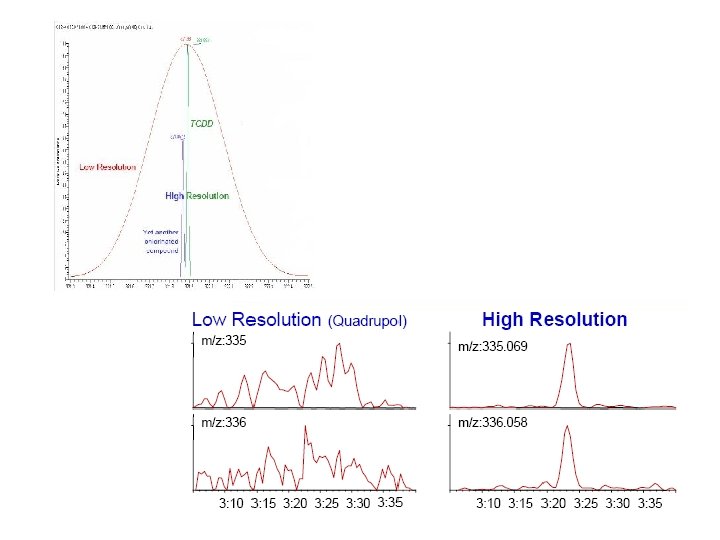
 GC-MS Uses • Identification and quantification of volatile and semivolatile organic compounds in complex mixtures • Determination of molecular weights and (sometimes) elemental composition of unknown organic compounds in complex mixtures • Structural determination of unknown organic compounds in complex mixtures both by matching their mass spectra with reference spectra and by a priori spectral interpretation When to Use HRMS ? • For the determination of the exact masses of ions in spectra (peak matching) – suitable for the determination of elemental composition • Decreasing interferences caused by the ions of co-extracted compounds or by GC column bleeding and thus, to improve considerably the signal-to-noise ratio A. Kočan, Slovak Medical University
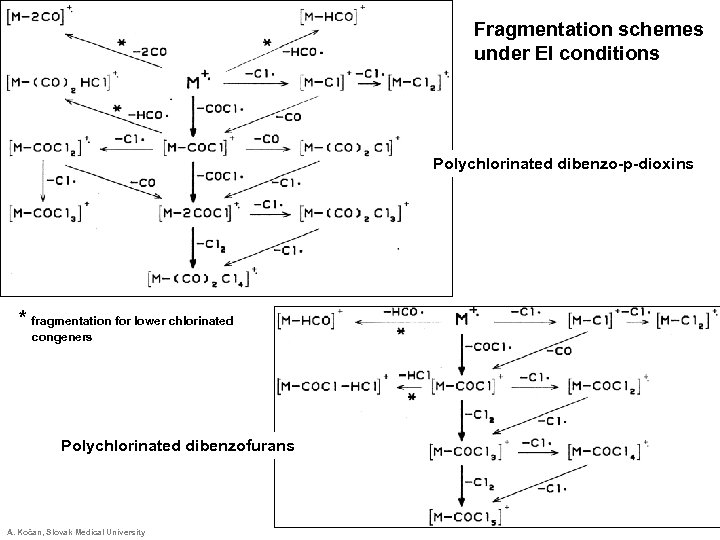 Fragmentation schemes under EI conditions Polychlorinated dibenzo-p-dioxins * fragmentation for lower chlorinated congeners Polychlorinated dibenzofurans A. Kočan, Slovak Medical University
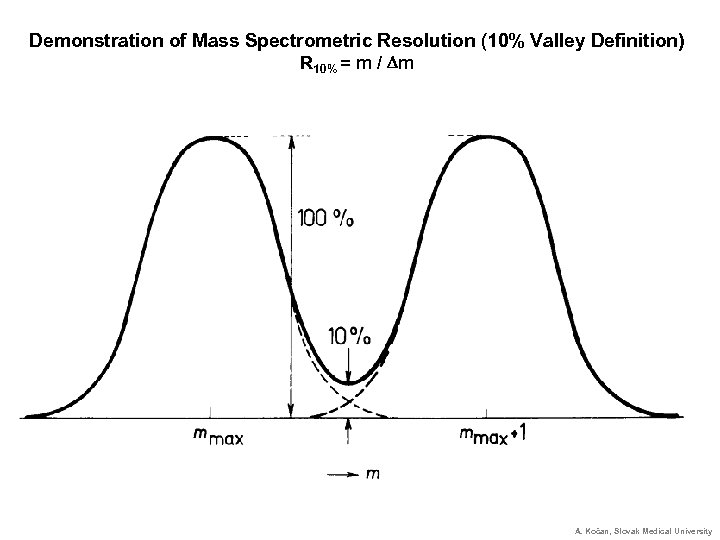 Demonstration of Mass Spectrometric Resolution (10% Valley Definition) R 10% = m / Dm A. Kočan, Slovak Medical University
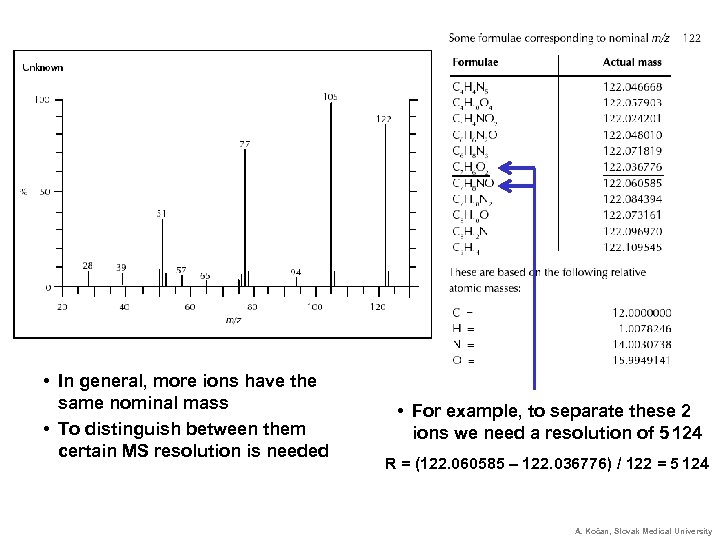 • In general, more ions have the same nominal mass • To distinguish between them certain MS resolution is needed • For example, to separate these 2 ions we need a resolution of 5 124 R = (122. 060585 – 122. 036776) / 122 = 5 124 A. Kočan, Slovak Medical University
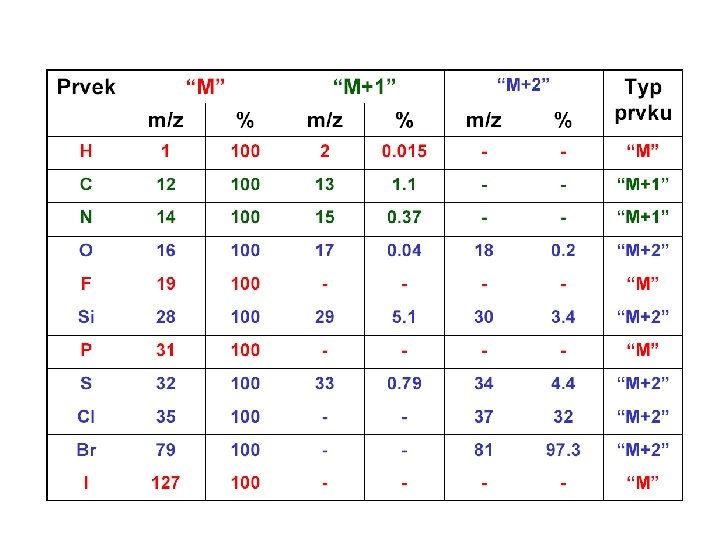
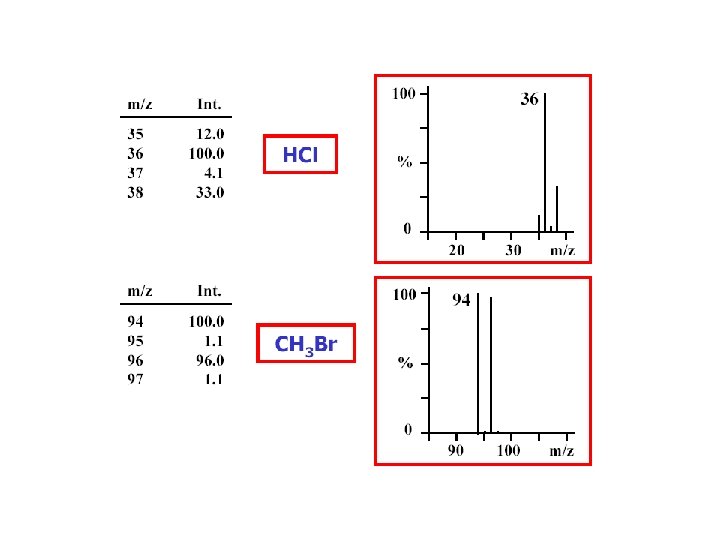
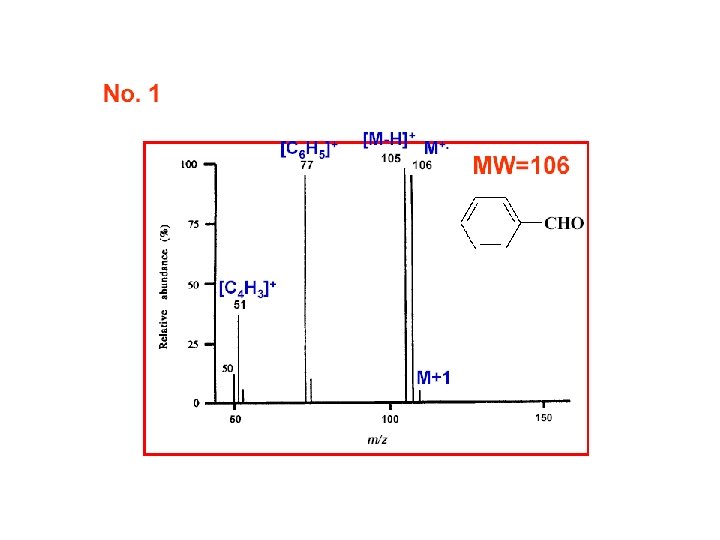
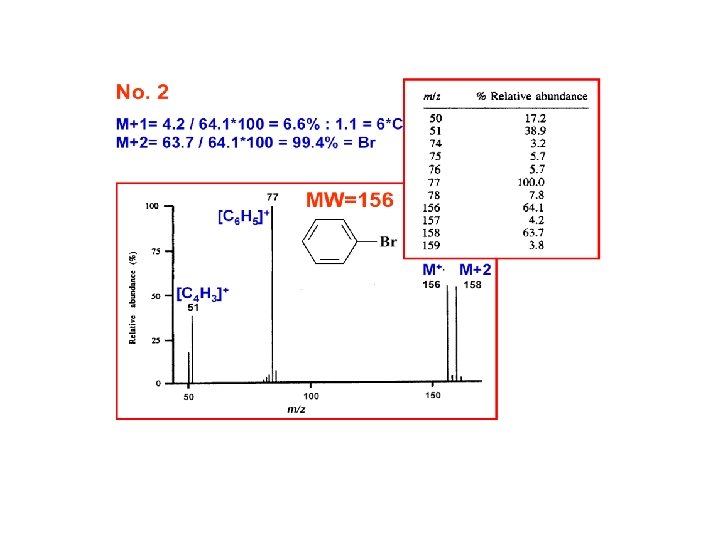
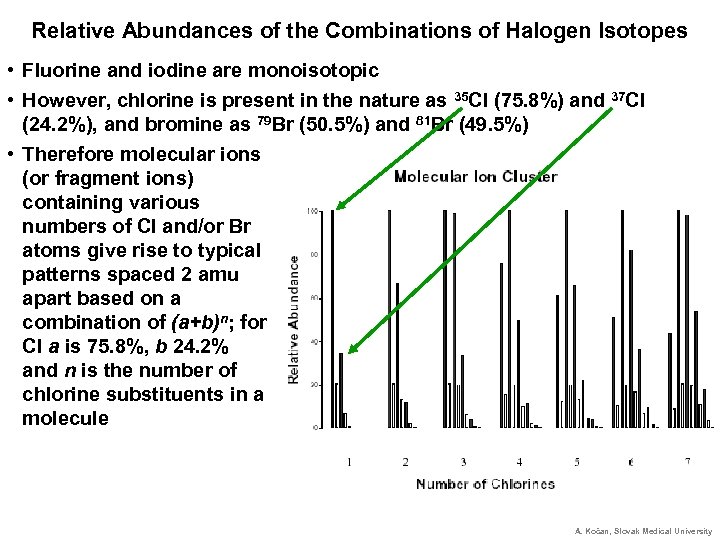 Relative Abundances of the Combinations of Halogen Isotopes • Fluorine and iodine are monoisotopic • However, chlorine is present in the nature as 35 Cl (75. 8%) and 37 Cl (24. 2%), and bromine as 79 Br (50. 5%) and 81 Br (49. 5%) • Therefore molecular ions (or fragment ions) containing various numbers of Cl and/or Br atoms give rise to typical patterns spaced 2 amu apart based on a combination of (a+b)n; for Cl a is 75. 8%, b 24. 2% and n is the number of chlorine substituents in a molecule A. Kočan, Slovak Medical University
![Upper Segment of 2378 -TCDD Mass Spectrum 3× 35 Cl 1× 37 Cl [M+2]+.](https://present5.com/presentation/50abbdb3361673db3b5c73c573b1ad5f/image-37.jpg "Upper Segment of 2378 -TCDD Mass Spectrum 3× 35 Cl 1× 37 Cl [M+2]+.") Upper Segment of 2378 -TCDD Mass Spectrum 3× 35 Cl 1× 37 Cl [M+2]+. 4× 35 Cl M+. A cluster created by four Clsubstituents 2× 35 Cl 2× 37 Cl 320 [M+4]+. 1× 35 Cl 3× 37 Cl [M-COCl]+. [M-Cl]+. 4× 37 Cl [M+6]+. A. Kočan, Slovak Medical University
Upper Segment of 2378 -TCDD Mass Spectrum 3× 35 Cl 1× 37 Cl [M+2]+. 4× 35 Cl M+. A cluster created by four Clsubstituents 2× 35 Cl 2× 37 Cl 320 [M+4]+. 1× 35 Cl 3× 37 Cl [M-COCl]+. [M-Cl]+. 4× 37 Cl [M+6]+. A. Kočan, Slovak Medical University
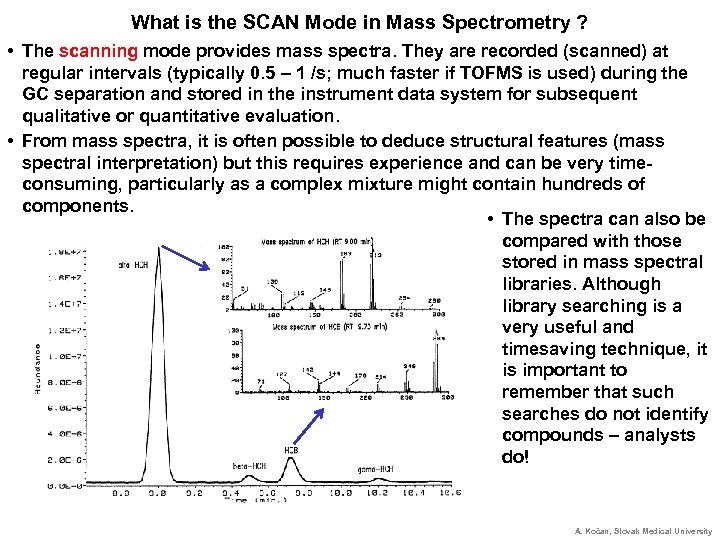 What is the SCAN Mode in Mass Spectrometry ? • The scanning mode provides mass spectra. They are recorded (scanned) at regular intervals (typically 0. 5 – 1 /s; much faster if TOFMS is used) during the GC separation and stored in the instrument data system for subsequent qualitative or quantitative evaluation. • From mass spectra, it is often possible to deduce structural features (mass spectral interpretation) but this requires experience and can be very timeconsuming, particularly as a complex mixture might contain hundreds of components. • The spectra can also be compared with those stored in mass spectral libraries. Although library searching is a very useful and timesaving technique, it is important to remember that such searches do not identify compounds – analysts do! A. Kočan, Slovak Medical University
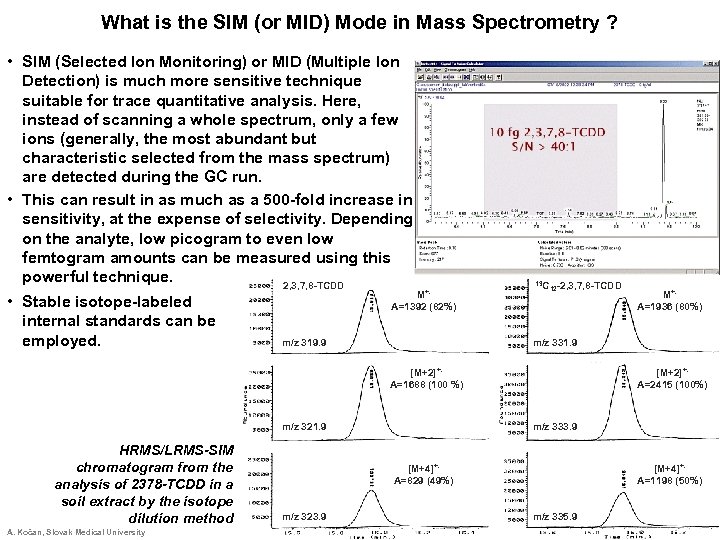 What is the SIM (or MID) Mode in Mass Spectrometry ? • SIM (Selected Ion Monitoring) or MID (Multiple Ion Detection) is much more sensitive technique suitable for trace quantitative analysis. Here, instead of scanning a whole spectrum, only a few ions (generally, the most abundant but characteristic selected from the mass spectrum) are detected during the GC run. • This can result in as much as a 500 -fold increase in sensitivity, at the expense of selectivity. Depending on the analyte, low picogram to even low femtogram amounts can be measured using this powerful technique. 2, 3, 7, 8 -TCDD • Stable isotope-labeled internal standards can be employed. M+. A=1392 (82%) m/z 319. 9 13 C 12 -2, 3, 7, 8 -TCDD m/z 331. 9 [M+2]+. A=1688 (100 %) m/z 321. 9 HRMS/LRMS-SIM chromatogram from the analysis of 2378 -TCDD in a soil extract by the isotope dilution method A. Kočan, Slovak Medical University [M+2]+. A=2415 (100%) m/z 333. 9 [M+4]+. A=829 (49%) m/z 323. 9 M+. A=1936 (80%) [M+4]+. A=1198 (50%) m/z 335. 9
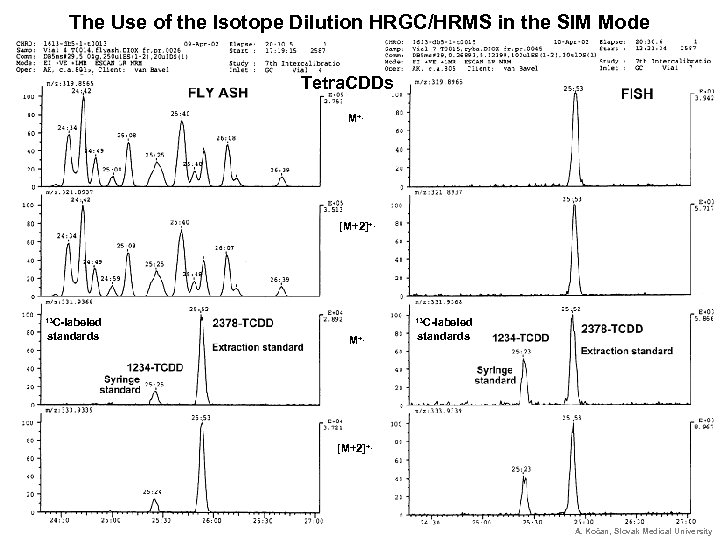 The Use of the Isotope Dilution HRGC/HRMS in the SIM Mode Tetra. CDDs M+. [M+2]+. 13 C-labeled standards 13 M+. C-labeled standards [M+2]+. A. Kočan, Slovak Medical University
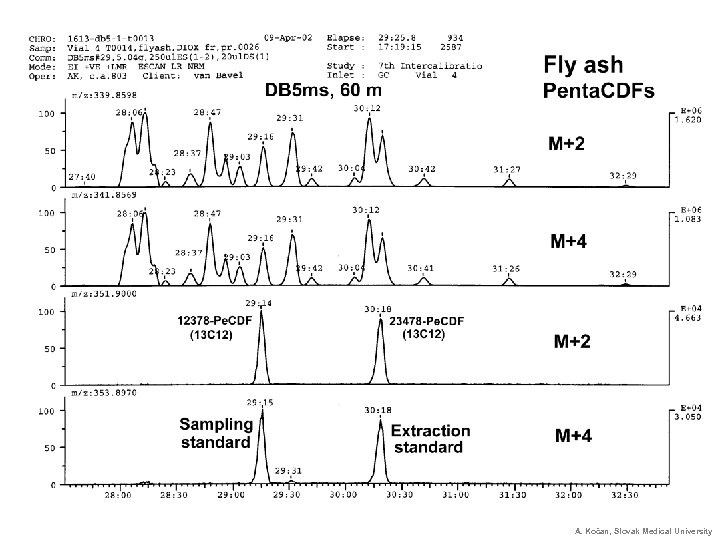 A. Kočan, Slovak Medical University
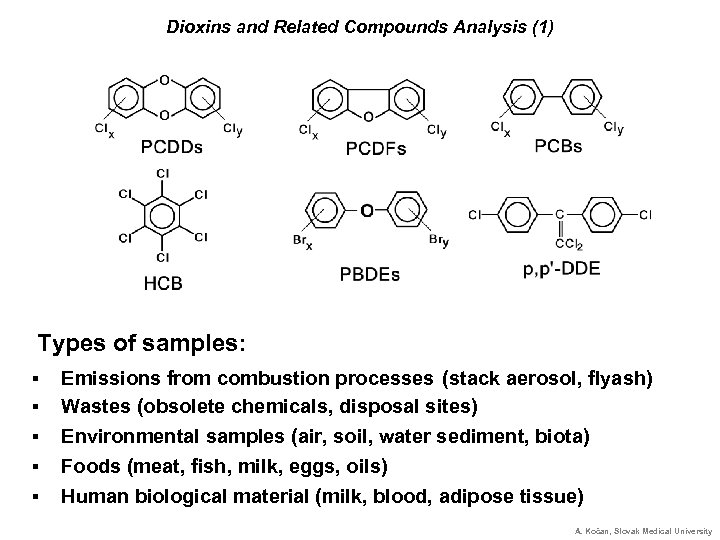 Dioxins and Related Compounds Analysis (1) Types of samples: § § § Emissions from combustion processes (stack aerosol, flyash) Wastes (obsolete chemicals, disposal sites) Environmental samples (air, soil, water sediment, biota) Foods (meat, fish, milk, eggs, oils) Human biological material (milk, blood, adipose tissue) A. Kočan, Slovak Medical University
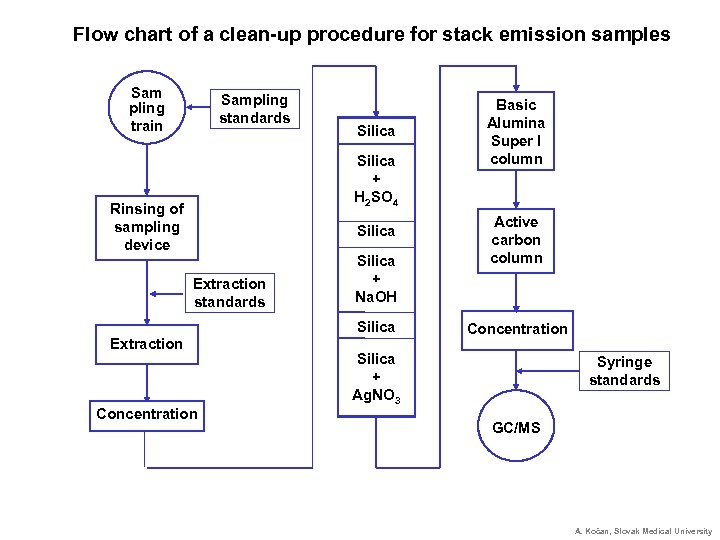 Flow chart of a clean-up procedure for stack emission samples Sam pling train Sampling standards Silica + H 2 SO 4 Rinsing of sampling device Silica Extraction standards Silica + Na. OH Silica Extraction Concentration Basic Alumina Super I column Active carbon column Concentration Silica + Ag. NO 3 Syringe standards GC/MS A. Kočan, Slovak Medical University
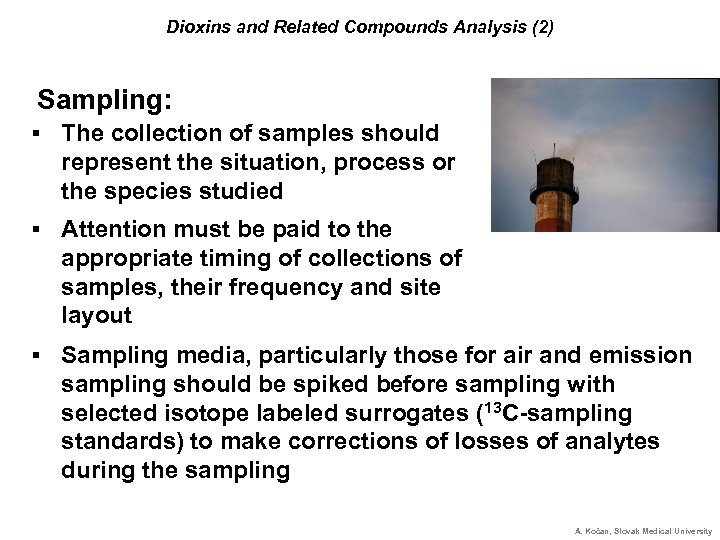 Dioxins and Related Compounds Analysis (2) Sampling: § The collection of samples should represent the situation, process or the species studied § Attention must be paid to the appropriate timing of collections of samples, their frequency and site layout § Sampling media, particularly those for air and emission sampling should be spiked before sampling with selected isotope labeled surrogates (13 C-sampling standards) to make corrections of losses of analytes during the sampling A. Kočan, Slovak Medical University
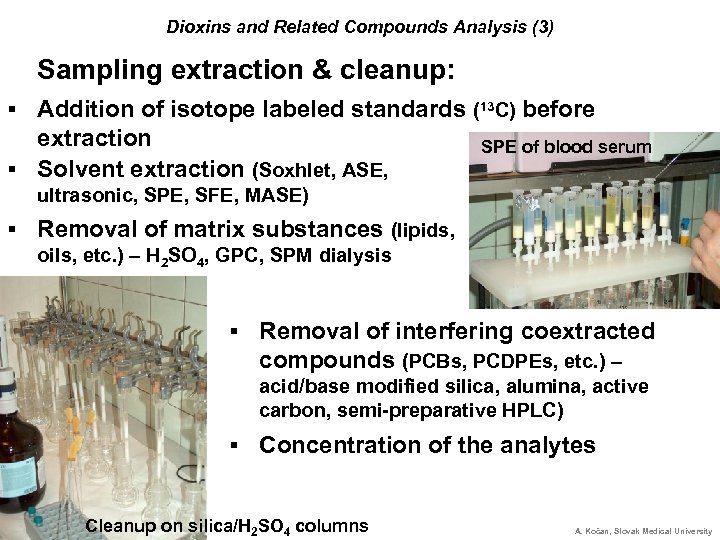 Dioxins and Related Compounds Analysis (3) Sampling extraction & cleanup: § Addition of isotope labeled standards (13 C) before extraction § Solvent extraction (Soxhlet, ASE, SPE of blood serum ultrasonic, SPE, SFE, MASE) § Removal of matrix substances (lipids, oils, etc. ) – H 2 SO 4, GPC, SPM dialysis § Removal of interfering coextracted compounds (PCBs, PCDPEs, etc. ) – acid/base modified silica, alumina, active carbon, semi-preparative HPLC) § Concentration of the analytes Cleanup on silica/H 2 SO 4 columns A. Kočan, Slovak Medical University
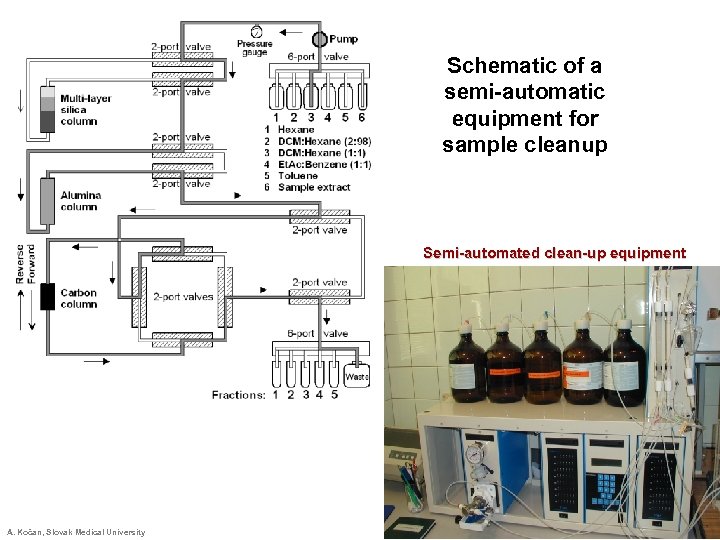 Schematic of a semi-automatic equipment for sample cleanup Semi-automated clean-up equipment A. Kočan, Slovak Medical University
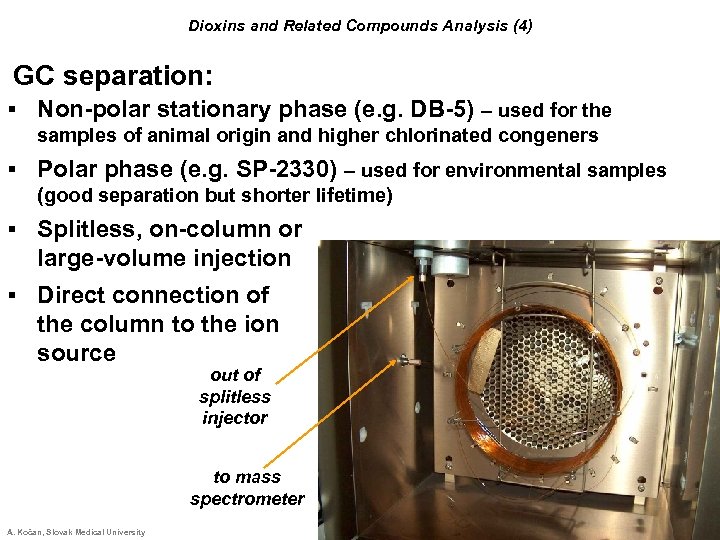 Dioxins and Related Compounds Analysis (4) GC separation: § Non-polar stationary phase (e. g. DB-5) – used for the samples of animal origin and higher chlorinated congeners § Polar phase (e. g. SP-2330) – used for environmental samples (good separation but shorter lifetime) § Splitless, on-column or large-volume injection § Direct connection of the column to the ion source out of splitless injector to mass spectrometer A. Kočan, Slovak Medical University
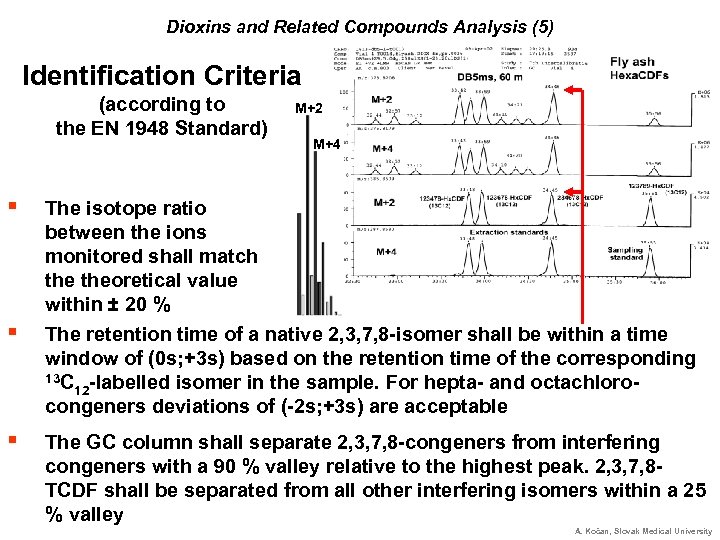 Dioxins and Related Compounds Analysis (5) Identification Criteria (according to the EN 1948 Standard) § § § M+2 M+4 The isotope ratio between the ions monitored shall match theoretical value within ± 20 % The retention time of a native 2, 3, 7, 8 -isomer shall be within a time window of (0 s; +3 s) based on the retention time of the corresponding 13 C -labelled isomer in the sample. For hepta- and octachloro 12 congeners deviations of (-2 s; +3 s) are acceptable The GC column shall separate 2, 3, 7, 8 -congeners from interfering congeners with a 90 % valley relative to the highest peak. 2, 3, 7, 8 TCDF shall be separated from all other interfering isomers within a 25 % valley A. Kočan, Slovak Medical University
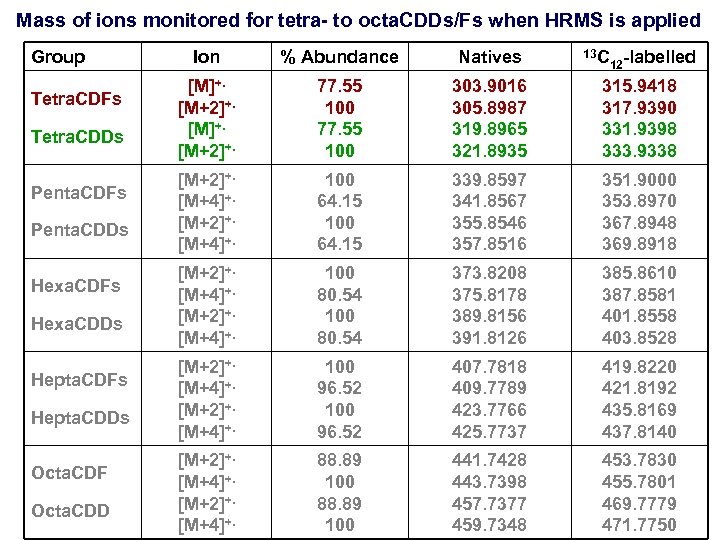 Mass of ions monitored for tetra- to octa. CDDs/Fs when HRMS is applied Group Tetra. CDFs Tetra. CDDs Penta. CDFs Penta. CDDs Hexa. CDFs Hexa. CDDs Hepta. CDFs Hepta. CDDs Octa. CDF Octa. CDD Ion % Abundance Natives 13 C 12 -labelled [M]+. [M+2]+. 77. 55 100 303. 9016 305. 8987 319. 8965 321. 8935 315. 9418 317. 9390 331. 9398 333. 9338 [M+2]+. [M+4]+. 100 64. 15 339. 8597 341. 8567 355. 8546 357. 8516 351. 9000 353. 8970 367. 8948 369. 8918 [M+2]+. [M+4]+. 100 80. 54 373. 8208 375. 8178 389. 8156 391. 8126 385. 8610 387. 8581 401. 8558 403. 8528 [M+2]+. [M+4]+. 100 96. 52 407. 7818 409. 7789 423. 7766 425. 7737 419. 8220 421. 8192 435. 8169 437. 8140 [M+2]+. [M+4]+. 88. 89 100 441. 7428 443. 7398 457. 7377 459. 7348 453. 7830 455. 7801 469. 7779 471. 7750
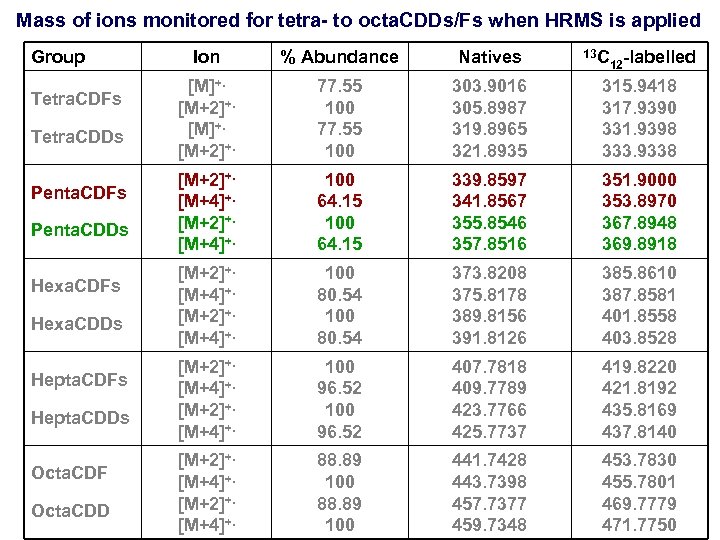 Mass of ions monitored for tetra- to octa. CDDs/Fs when HRMS is applied Group Tetra. CDFs Tetra. CDDs Penta. CDFs Penta. CDDs Hexa. CDFs Hexa. CDDs Hepta. CDFs Hepta. CDDs Octa. CDF Octa. CDD Ion % Abundance Natives 13 C 12 -labelled [M]+. [M+2]+. 77. 55 100 303. 9016 305. 8987 319. 8965 321. 8935 315. 9418 317. 9390 331. 9398 333. 9338 [M+2]+. [M+4]+. 100 64. 15 339. 8597 341. 8567 355. 8546 357. 8516 351. 9000 353. 8970 367. 8948 369. 8918 [M+2]+. [M+4]+. 100 80. 54 373. 8208 375. 8178 389. 8156 391. 8126 385. 8610 387. 8581 401. 8558 403. 8528 [M+2]+. [M+4]+. 100 96. 52 407. 7818 409. 7789 423. 7766 425. 7737 419. 8220 421. 8192 435. 8169 437. 8140 [M+2]+. [M+4]+. 88. 89 100 441. 7428 443. 7398 457. 7377 459. 7348 453. 7830 455. 7801 469. 7779 471. 7750
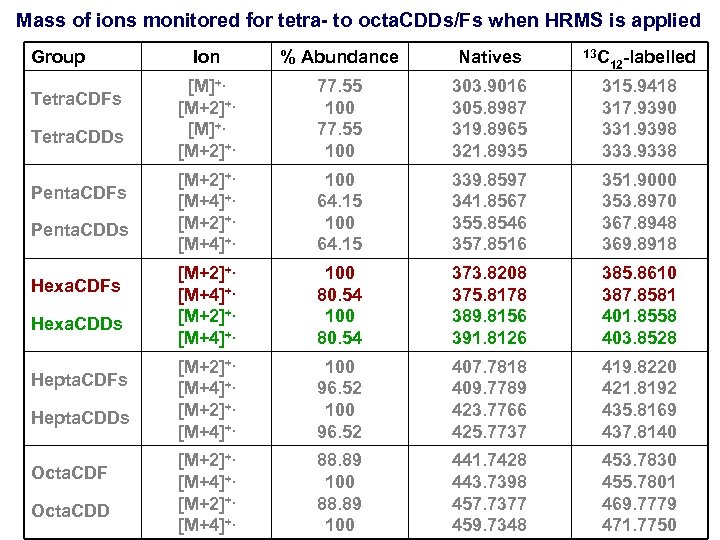 Mass of ions monitored for tetra- to octa. CDDs/Fs when HRMS is applied Group Tetra. CDFs Tetra. CDDs Penta. CDFs Penta. CDDs Hexa. CDFs Hexa. CDDs Hepta. CDFs Hepta. CDDs Octa. CDF Octa. CDD Ion % Abundance Natives 13 C 12 -labelled [M]+. [M+2]+. 77. 55 100 303. 9016 305. 8987 319. 8965 321. 8935 315. 9418 317. 9390 331. 9398 333. 9338 [M+2]+. [M+4]+. 100 64. 15 339. 8597 341. 8567 355. 8546 357. 8516 351. 9000 353. 8970 367. 8948 369. 8918 [M+2]+. [M+4]+. 100 80. 54 373. 8208 375. 8178 389. 8156 391. 8126 385. 8610 387. 8581 401. 8558 403. 8528 [M+2]+. [M+4]+. 100 96. 52 407. 7818 409. 7789 423. 7766 425. 7737 419. 8220 421. 8192 435. 8169 437. 8140 [M+2]+. [M+4]+. 88. 89 100 441. 7428 443. 7398 457. 7377 459. 7348 453. 7830 455. 7801 469. 7779 471. 7750
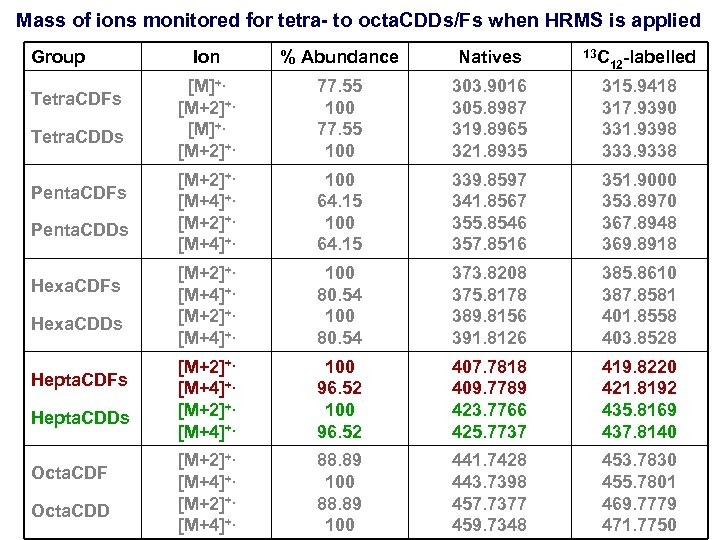 Mass of ions monitored for tetra- to octa. CDDs/Fs when HRMS is applied Group Tetra. CDFs Tetra. CDDs Penta. CDFs Penta. CDDs Hexa. CDFs Hexa. CDDs Hepta. CDFs Hepta. CDDs Octa. CDF Octa. CDD Ion % Abundance Natives 13 C 12 -labelled [M]+. [M+2]+. 77. 55 100 303. 9016 305. 8987 319. 8965 321. 8935 315. 9418 317. 9390 331. 9398 333. 9338 [M+2]+. [M+4]+. 100 64. 15 339. 8597 341. 8567 355. 8546 357. 8516 351. 9000 353. 8970 367. 8948 369. 8918 [M+2]+. [M+4]+. 100 80. 54 373. 8208 375. 8178 389. 8156 391. 8126 385. 8610 387. 8581 401. 8558 403. 8528 [M+2]+. [M+4]+. 100 96. 52 407. 7818 409. 7789 423. 7766 425. 7737 419. 8220 421. 8192 435. 8169 437. 8140 [M+2]+. [M+4]+. 88. 89 100 441. 7428 443. 7398 457. 7377 459. 7348 453. 7830 455. 7801 469. 7779 471. 7750
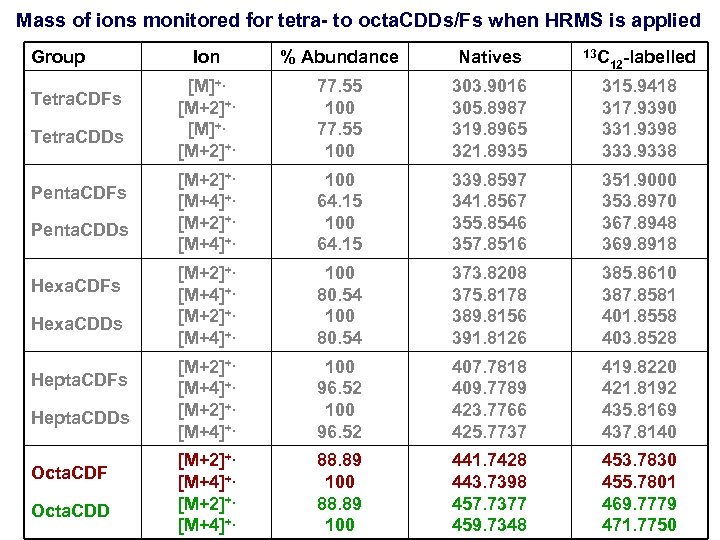 Mass of ions monitored for tetra- to octa. CDDs/Fs when HRMS is applied Group Tetra. CDFs Tetra. CDDs Penta. CDFs Penta. CDDs Hexa. CDFs Hexa. CDDs Hepta. CDFs Hepta. CDDs Octa. CDF Octa. CDD Ion % Abundance Natives 13 C 12 -labelled [M]+. [M+2]+. 77. 55 100 303. 9016 305. 8987 319. 8965 321. 8935 315. 9418 317. 9390 331. 9398 333. 9338 [M+2]+. [M+4]+. 100 64. 15 339. 8597 341. 8567 355. 8546 357. 8516 351. 9000 353. 8970 367. 8948 369. 8918 [M+2]+. [M+4]+. 100 80. 54 373. 8208 375. 8178 389. 8156 391. 8126 385. 8610 387. 8581 401. 8558 403. 8528 [M+2]+. [M+4]+. 100 96. 52 407. 7818 409. 7789 423. 7766 425. 7737 419. 8220 421. 8192 435. 8169 437. 8140 [M+2]+. [M+4]+. 88. 89 100 441. 7428 443. 7398 457. 7377 459. 7348 453. 7830 455. 7801 469. 7779 471. 7750
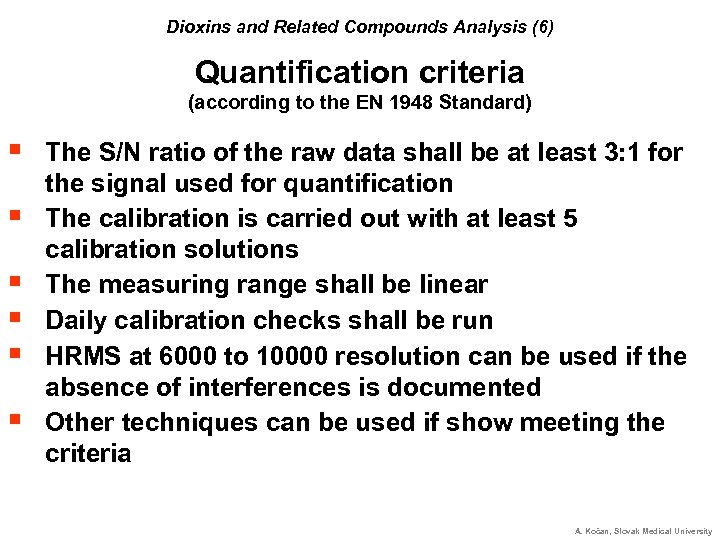 Dioxins and Related Compounds Analysis (6) Quantification criteria (according to the EN 1948 Standard) § § § The S/N ratio of the raw data shall be at least 3: 1 for the signal used for quantification The calibration is carried out with at least 5 calibration solutions The measuring range shall be linear Daily calibration checks shall be run HRMS at 6000 to 10000 resolution can be used if the absence of interferences is documented Other techniques can be used if show meeting the criteria A. Kočan, Slovak Medical University
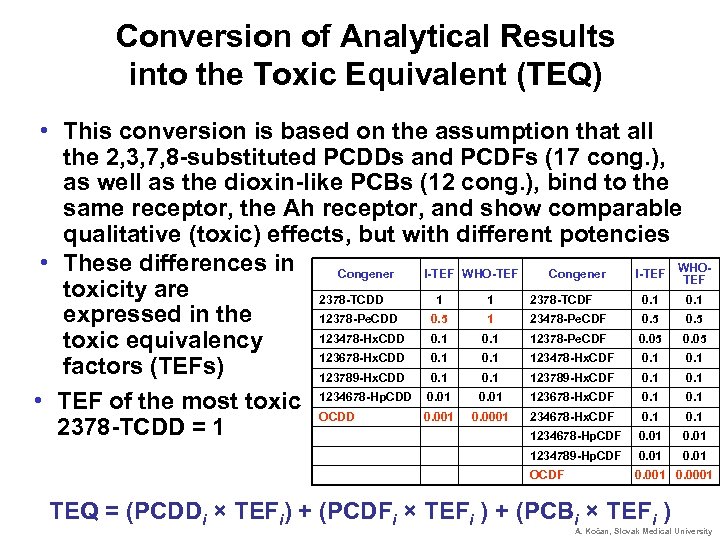 Conversion of Analytical Results into the Toxic Equivalent (TEQ) • This conversion is based on the assumption that all the 2, 3, 7, 8 -substituted PCDDs and PCDFs (17 cong. ), as well as the dioxin-like PCBs (12 cong. ), bind to the same receptor, the Ah receptor, and show comparable qualitative (toxic) effects, but with different potencies • These differences in WHOCongener I-TEF WHO-TEF Congener I-TEF toxicity are 2378 -TCDD 1 1 2378 -TCDF 0. 1 expressed in the 12378 -Pe. CDD 0. 5 1 23478 -Pe. CDF 0. 5 123478 -Hx. CDD 0. 1 12378 -Pe. CDF 0. 05 toxic equivalency 123678 -Hx. CDD 0. 1 123478 -Hx. CDF 0. 1 factors (TEFs) 123789 -Hx. CDD 0. 1 123789 -Hx. CDF 0. 1 0. 01 • TEF of the most toxic 1234678 -Hp. CDD 0. 001 0. 0001 123678 -Hx. CDF 0. 1 OCDD 234678 -Hx. CDF 0. 1 2378 -TCDD = 1 1234678 -Hp. CDF 0. 01 1234789 -Hp. CDF 0. 01 OCDF 0. 001 0. 0001 TEQ = (PCDDi × TEFi) + (PCDFi × TEFi ) + (PCBi × TEFi ) 0. 01 A. Kočan, Slovak Medical University
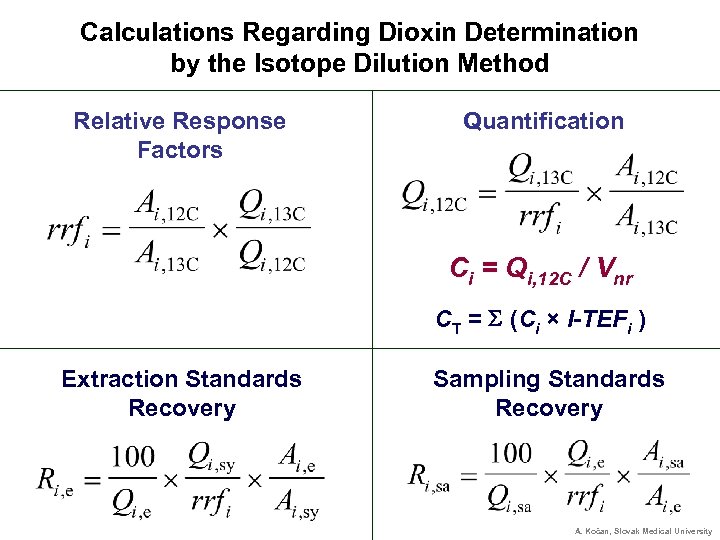 Calculations Regarding Dioxin Determination by the Isotope Dilution Method Relative Response Factors Quantification Ci = Qi, 12 C / Vnr CT = S (Ci × I-TEFi ) Extraction Standards Recovery Sampling Standards Recovery A. Kočan, Slovak Medical University