


 Скачать презентацию Marzia Rosati mrosati iastate edu Iowa State University Marzia
2f83185161701c0275b75b0ec7a1c353.ppt
- Количество слайдов: 32
 Marzia Rosati mrosati@iastate. edu Iowa State University Marzia Rosati - ISU 1
 u Why Heavy Ion Collisions? u QCD and the QGP Phase Transition u Quarkonium in Media Measurements at the SPS I u New Quarkonium Measurements at RHIC u Future Prospects at RHIC and LHC II Marzia Rosati - ISU 2
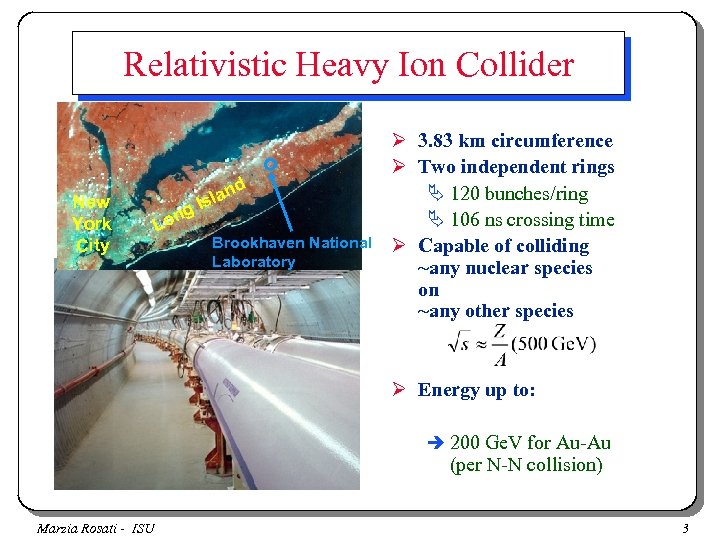 Relativistic Heavy Ion Collider New York City ng Lo d lan Is Brookhaven National Laboratory Ø 3. 83 km circumference Ø Two independent rings Ä 120 bunches/ring Ä 106 ns crossing time Ø Capable of colliding ~any nuclear species on ~any other species Ø Energy up to: è 200 Ge. V for Au-Au (per N-N collision) Marzia Rosati - ISU 3
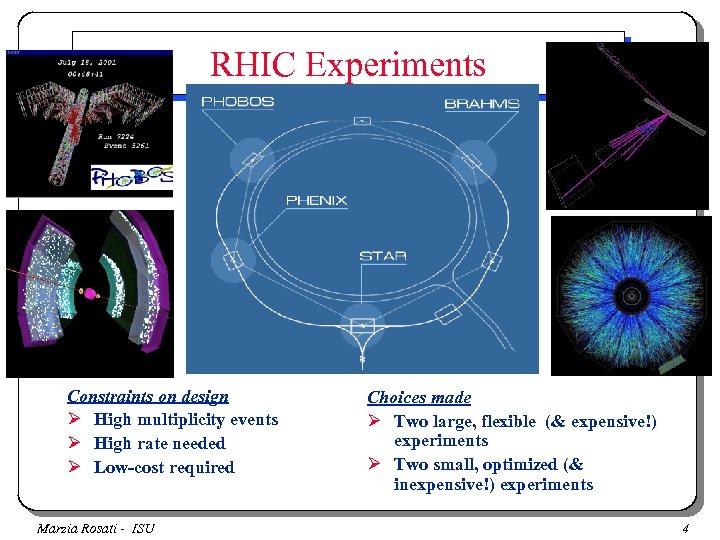 RHIC Experiments Constraints on design Ø High multiplicity events Ø High rate needed Ø Low-cost required Marzia Rosati - ISU Choices made Ø Two large, flexible (& expensive!) experiments Ø Two small, optimized (& inexpensive!) experiments 4
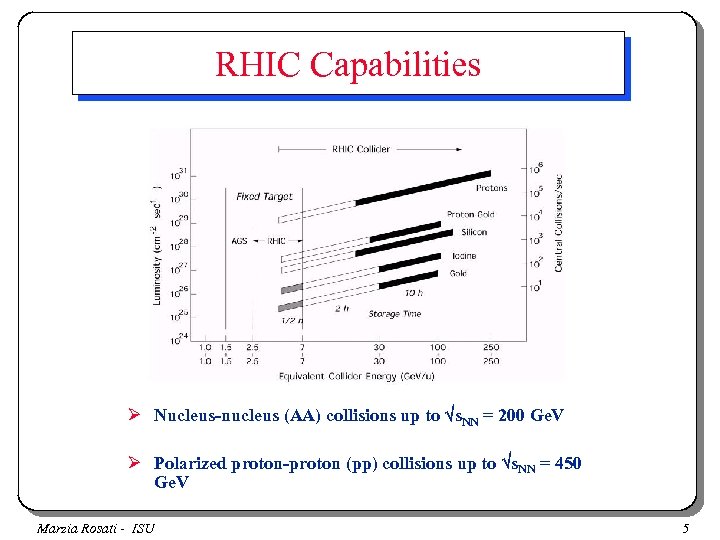 RHIC Capabilities Ø Nucleus-nucleus (AA) collisions up to s. NN = 200 Ge. V Ø Polarized proton-proton (pp) collisions up to s. NN = 450 Ge. V Marzia Rosati - ISU 5
 How is RHIC Different? Ø It’s a collider ÄDetector systematics independent of ECM Ø It’s dedicated ÄHeavy ions will run 20 -30 weeks/year Ø It’s high energy ÄAccess to perturbative phenomena ðJets ðNon-linear d. E/dx Ø Its detectors are comprehensive Ä~All final state species measured with a suite of detectors that nonetheless have significant overlap for comparisons Marzia Rosati - ISU 6
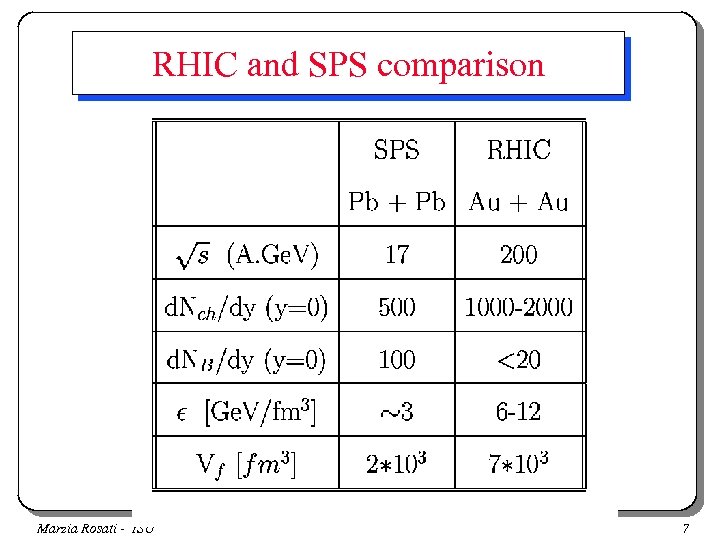 RHIC and SPS comparison Marzia Rosati - ISU 7
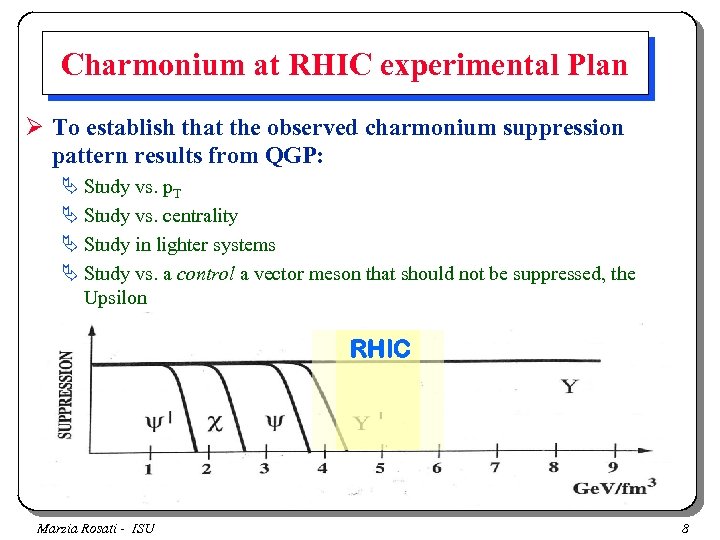 Charmonium at RHIC experimental Plan Ø To establish that the observed charmonium suppression pattern results from QGP: Ä Study vs. p. T Ä Study vs. centrality Ä Study in lighter systems Ä Study vs. a control a vector meson that should not be suppressed, the Upsilon RHIC Marzia Rosati - ISU 8
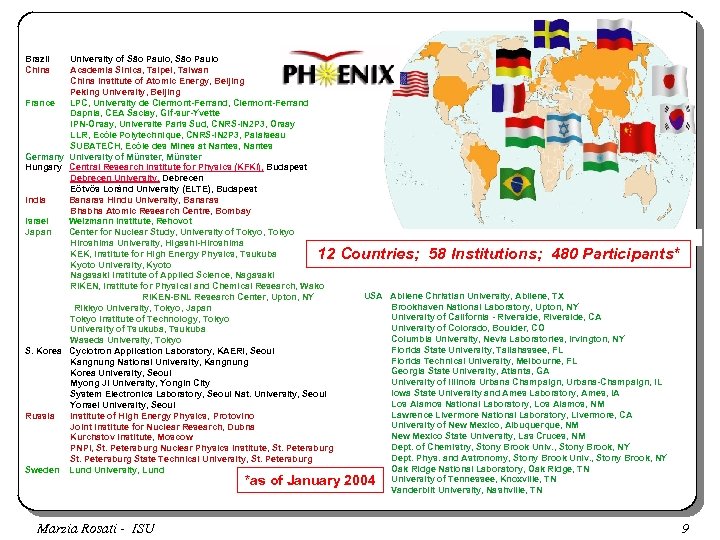 Brazil China University of São Paulo, São Paulo Academia Sinica, Taipei, Taiwan China Institute of Atomic Energy, Beijing Peking University, Beijing France LPC, University de Clermont-Ferrand, Clermont-Ferrand Dapnia, CEA Saclay, Gif-sur-Yvette IPN-Orsay, Universite Paris Sud, CNRS-IN 2 P 3, Orsay LLR, Ecòle Polytechnique, CNRS-IN 2 P 3, Palaiseau SUBATECH, Ecòle des Mines at Nantes, Nantes Germany University of Münster, Münster Hungary Central Research Institute for Physics (KFKI), Budapest Debrecen University, Debrecen Eötvös Loránd University (ELTE), Budapest India Banaras Hindu University, Banaras Bhabha Atomic Research Centre, Bombay Israel Weizmann Institute, Rehovot Japan Center for Nuclear Study, University of Tokyo, Tokyo Hiroshima University, Higashi-Hiroshima KEK, Institute for High Energy Physics, Tsukuba Kyoto University, Kyoto Nagasaki Institute of Applied Science, Nagasaki RIKEN, Institute for Physical and Chemical Research, Wako RIKEN-BNL Research Center, Upton, NY Rikkyo University, Tokyo, Japan Tokyo Institute of Technology, Tokyo University of Tsukuba, Tsukuba Waseda University, Tokyo S. Korea Cyclotron Application Laboratory, KAERI, Seoul Kangnung National University, Kangnung Korea University, Seoul Myong Ji University, Yongin City System Electronics Laboratory, Seoul Nat. University, Seoul Yonsei University, Seoul Russia Institute of High Energy Physics, Protovino Joint Institute for Nuclear Research, Dubna Kurchatov Institute, Moscow PNPI, St. Petersburg Nuclear Physics Institute, St. Petersburg State Technical University, St. Petersburg Sweden Lund University, Lund 12 Countries; 58 Institutions; 480 Participants* *as of January Marzia Rosati - ISU USA Abilene Christian University, Abilene, TX Brookhaven National Laboratory, Upton, NY University of California - Riverside, CA University of Colorado, Boulder, CO Columbia University, Nevis Laboratories, Irvington, NY Florida State University, Tallahassee, FL Florida Technical University, Melbourne, FL Georgia State University, Atlanta, GA University of Illinois Urbana Champaign, Urbana-Champaign, IL Iowa State University and Ames Laboratory, Ames, IA Los Alamos National Laboratory, Los Alamos, NM Lawrence Livermore National Laboratory, Livermore, CA University of New Mexico, Albuquerque, NM New Mexico State University, Las Cruces, NM Dept. of Chemistry, Stony Brook Univ. , Stony Brook, NY Dept. Phys. and Astronomy, Stony Brook Univ. , Stony Brook, NY Oak Ridge National Laboratory, Oak Ridge, TN 2004 University of Tennessee, Knoxville, TN Vanderbilt University, Nashville, TN 9
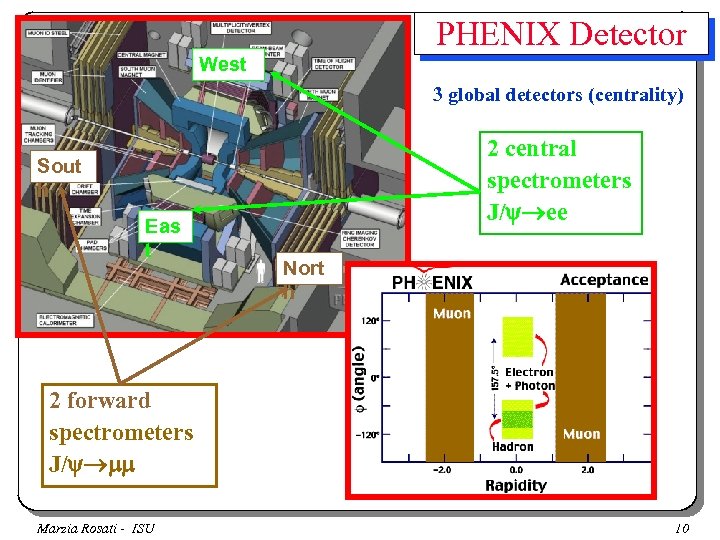 PHENIX Detector West 3 global detectors (centrality) 2 central spectrometers J/ ee Sout h Eas t 2 forward spectrometers J/ mm Marzia Rosati - ISU Nort h Ä 3 global detectors 10
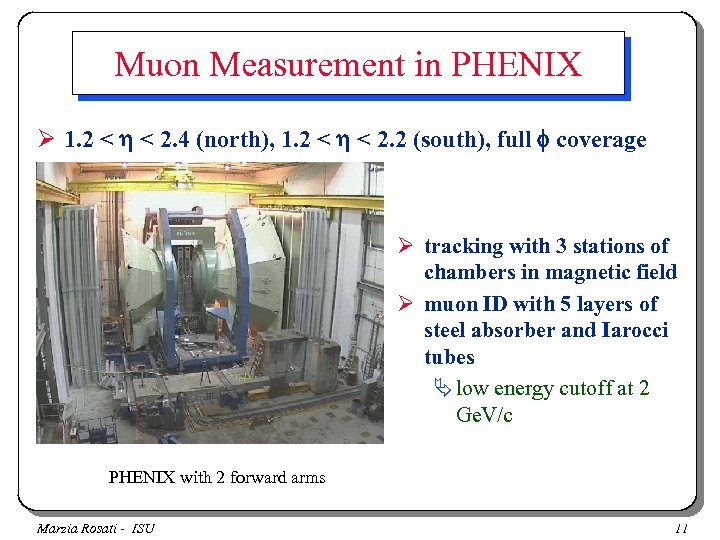 Muon Measurement in PHENIX Ø 1. 2 < h < 2. 4 (north), 1. 2 < h < 2. 2 (south), full f coverage Ø tracking with 3 stations of chambers in magnetic field Ø muon ID with 5 layers of steel absorber and Iarocci tubes Ä low energy cutoff at 2 Ge. V/c PHENIX with 2 forward arms Marzia Rosati - ISU 11
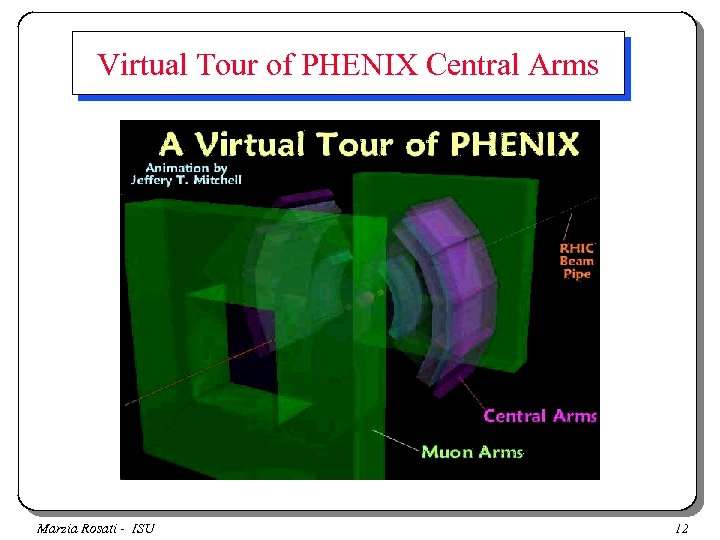 Virtual Tour of PHENIX Central Arms Marzia Rosati - ISU 12
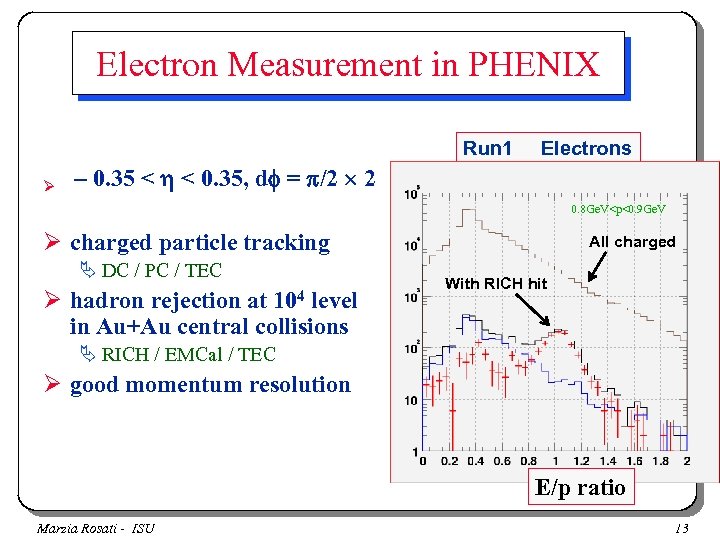 Electron Measurement in PHENIX Run 1 Ø Electrons - 0. 35 < h < 0. 35, df = p/2 2 0. 8 Ge. V
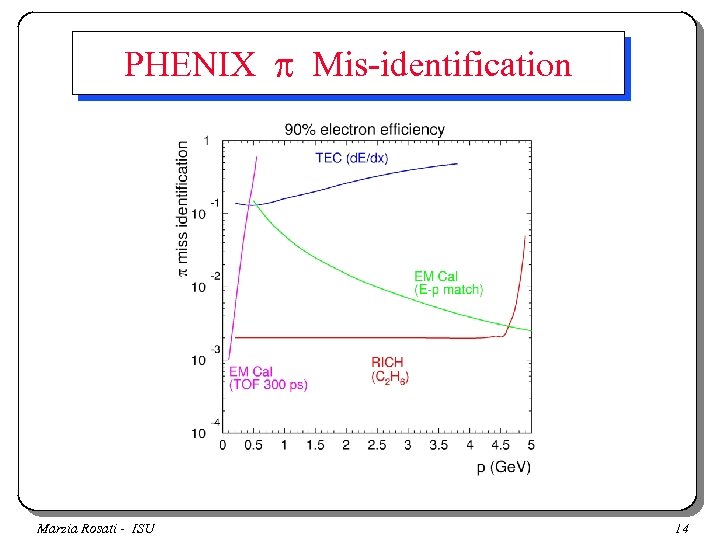 PHENIX p Mis-identification Marzia Rosati - ISU 14
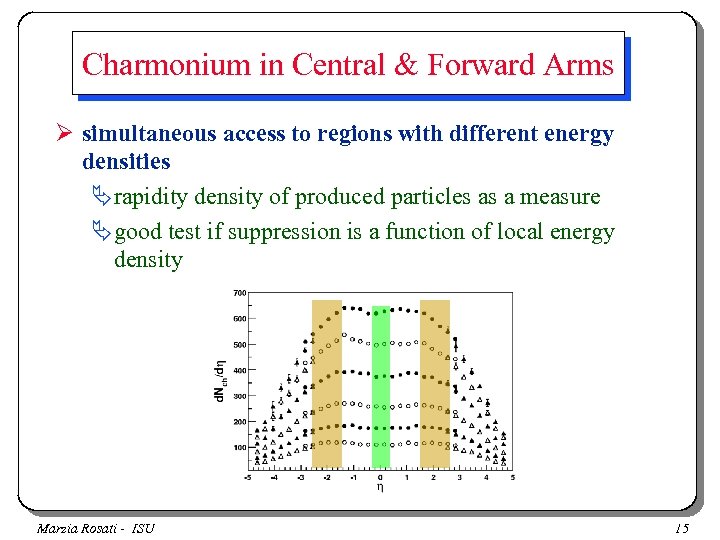 Charmonium in Central & Forward Arms Ø simultaneous access to regions with different energy densities Ärapidity density of produced particles as a measure Ägood test if suppression is a function of local energy density Marzia Rosati - ISU 15
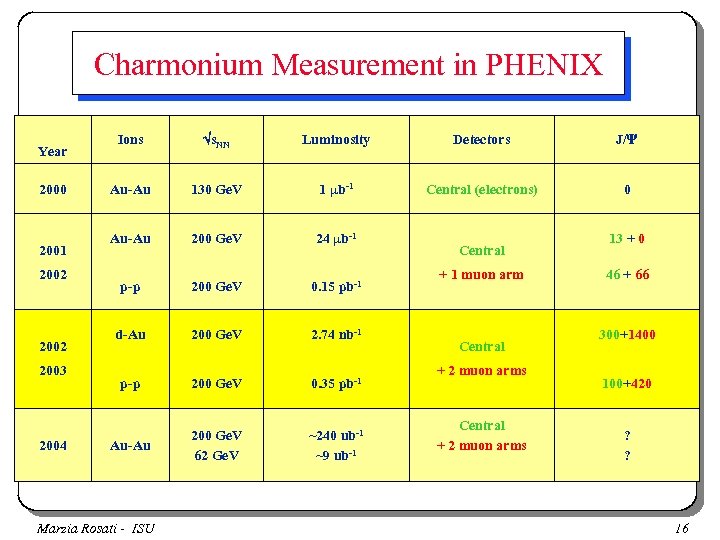 Charmonium Measurement in PHENIX Year 2000 2001 2002 2003 2004 Ions s. NN Luminosity Detectors J/ Au-Au 130 Ge. V 1 b-1 Central (electrons) 0 Au-Au 200 Ge. V 24 b-1 p-p 200 Ge. V 0. 15 pb-1 d-Au 200 Ge. V 2. 74 nb-1 p-p 200 Ge. V 0. 35 pb-1 Au-Au 200 Ge. V 62 Ge. V ~240 ub-1 ~9 ub-1 Marzia Rosati - ISU Central + 1 muon arm Central + 2 muon arms 13 + 0 46 + 66 300+1400 100+420 ? ? 16
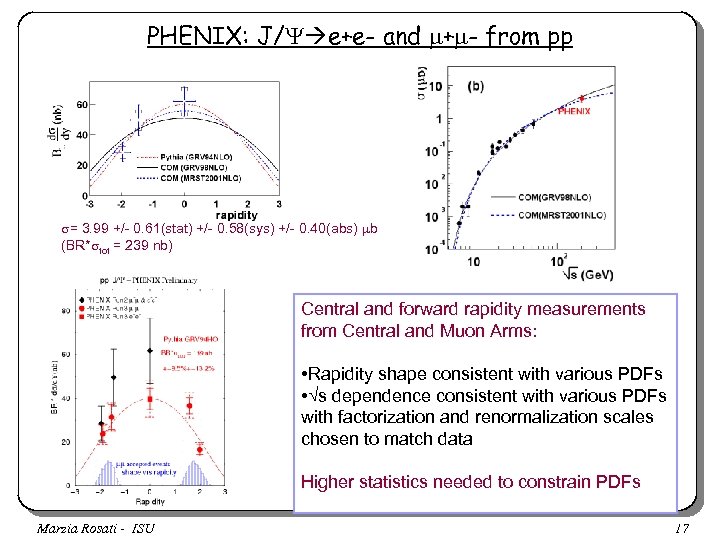 PHENIX: J/Y e+e- and + - from pp s= 3. 99 +/- 0. 61(stat) +/- 0. 58(sys) +/- 0. 40(abs) b (BR*stot = 239 nb) Central and forward rapidity measurements from Central and Muon Arms: • Rapidity shape consistent with various PDFs • √s dependence consistent with various PDFs with factorization and renormalization scales chosen to match data Higher statistics needed to constrain PDFs Marzia Rosati - ISU 17
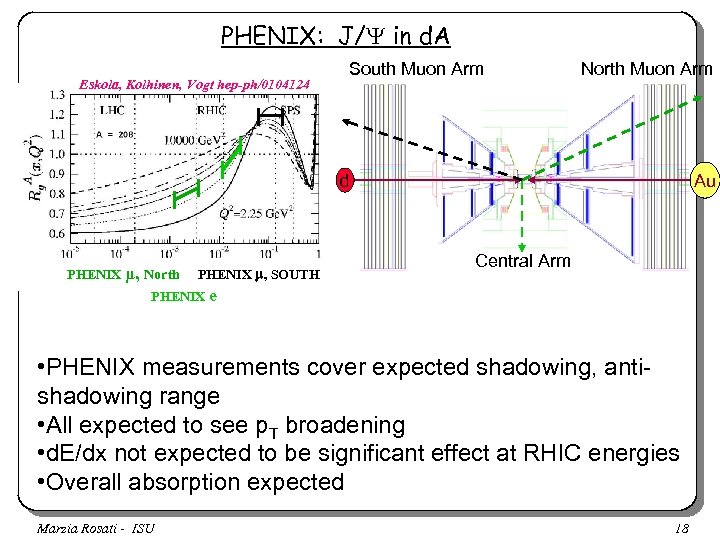 PHENIX: J/Y in d. A Eskola, Kolhinen, Vogt hep-ph/0104124 South Muon Arm North Muon Arm Au d PHENIX μ, North PHENIX m, SOUTH Central Arm PHENIX e • PHENIX measurements cover expected shadowing, antishadowing range • All expected to see p. T broadening • d. E/dx not expected to be significant effect at RHIC energies • Overall absorption expected Marzia Rosati - ISU 18
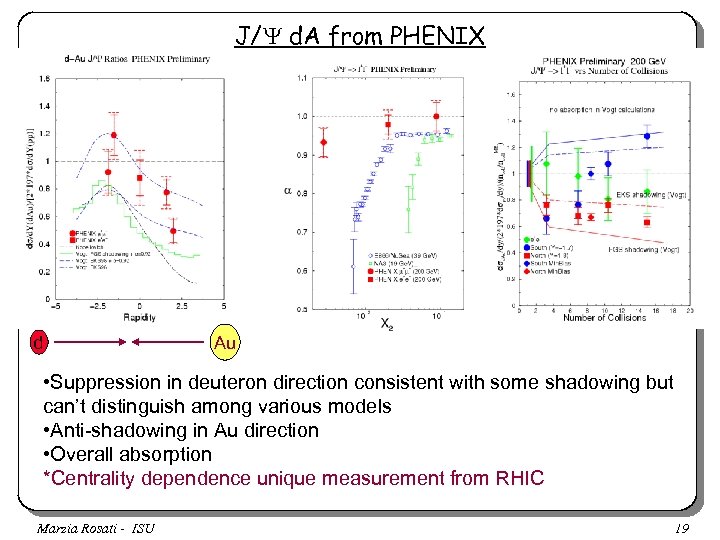 J/Y d. A from PHENIX d Au • Suppression in deuteron direction consistent with some shadowing but can’t distinguish among various models • Anti-shadowing in Au direction • Overall absorption *Centrality dependence unique measurement from RHIC Marzia Rosati - ISU 19
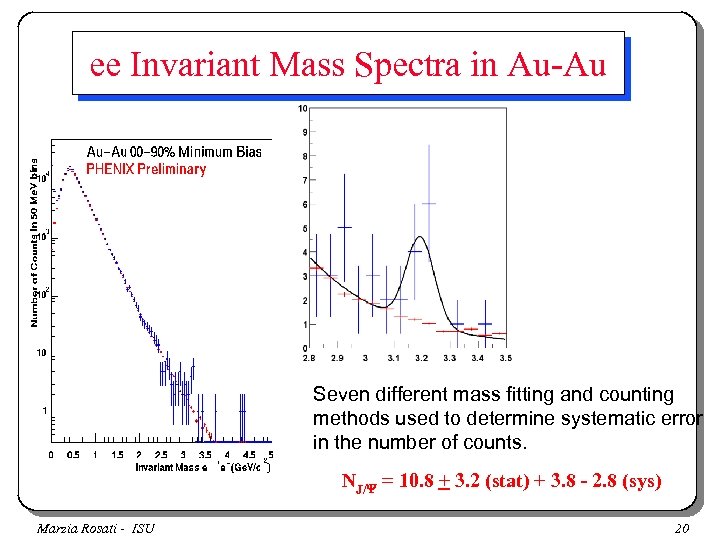 ee Invariant Mass Spectra in Au-Au Seven different mass fitting and counting methods used to determine systematic error in the number of counts. NJ/ = 10. 8 + 3. 2 (stat) + 3. 8 - 2. 8 (sys) Marzia Rosati - ISU 20
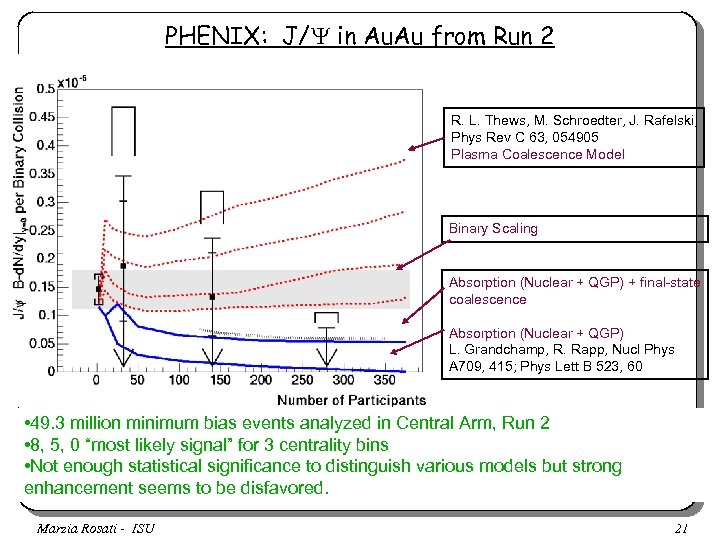 PHENIX: J/Y in Au. Au from Run 2 R. L. Thews, M. Schroedter, J. Rafelski, Phys Rev C 63, 054905 Plasma Coalescence Model Binary Scaling Absorption (Nuclear + QGP) + final-state coalescence Absorption (Nuclear + QGP) L. Grandchamp, R. Rapp, Nucl Phys A 709, 415; Phys Lett B 523, 60 • 49. 3 million minimum bias events analyzed in Central Arm, Run 2 • 8, 5, 0 “most likely signal” for 3 centrality bins • Not enough statistical significance to distinguish various models but strong enhancement seems to be disfavored. Marzia Rosati - ISU 21
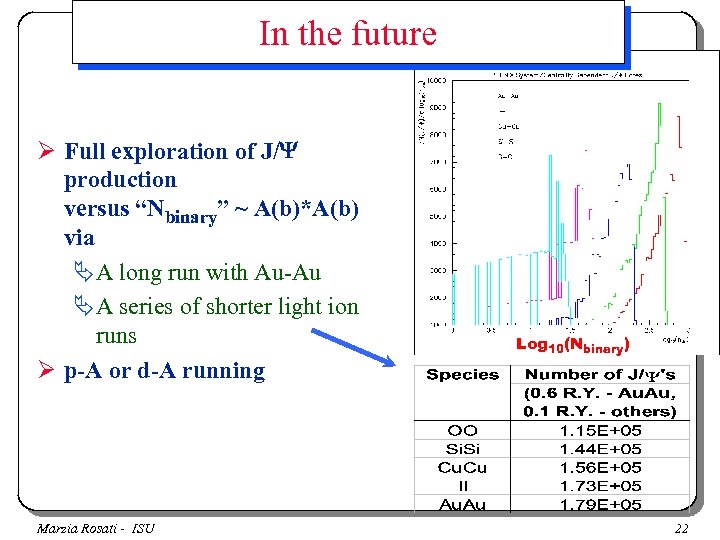 In the future Ø Full exploration of J/ production versus “Nbinary” ~ A(b)*A(b) via ÄA long run with Au-Au ÄA series of shorter light ion runs Ø p-A or d-A running Marzia Rosati - ISU Log 10(Nbinary) 22
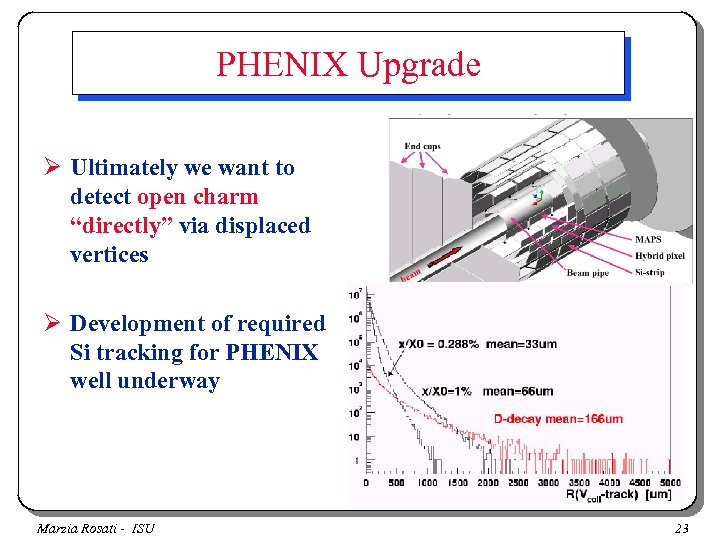 PHENIX Upgrade Ø Ultimately we want to detect open charm “directly” via displaced vertices Ø Development of required Si tracking for PHENIX well underway Marzia Rosati - ISU 23
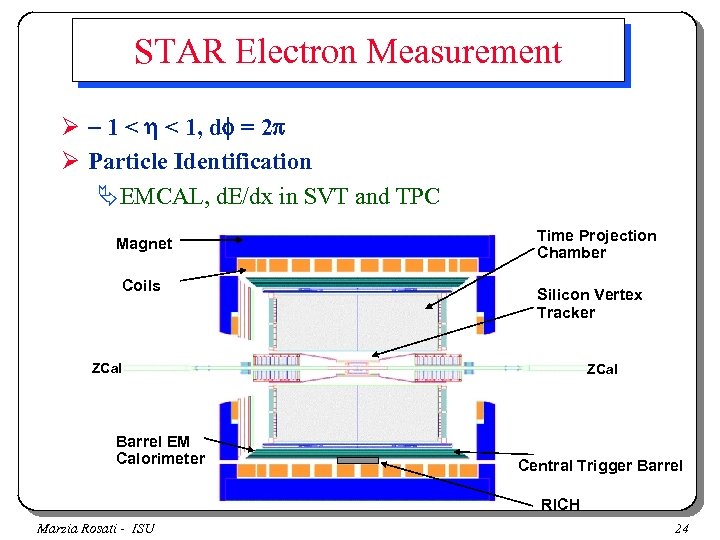 STAR Electron Measurement Ø - 1 < h < 1, df = 2 p Ø Particle Identification ÄEMCAL, d. E/dx in SVT and TPC Magnet Coils Time Projection Chamber Silicon Vertex Tracker ZCal Barrel EM Calorimeter ZCal Central Trigger Barrel RICH Marzia Rosati - ISU 24
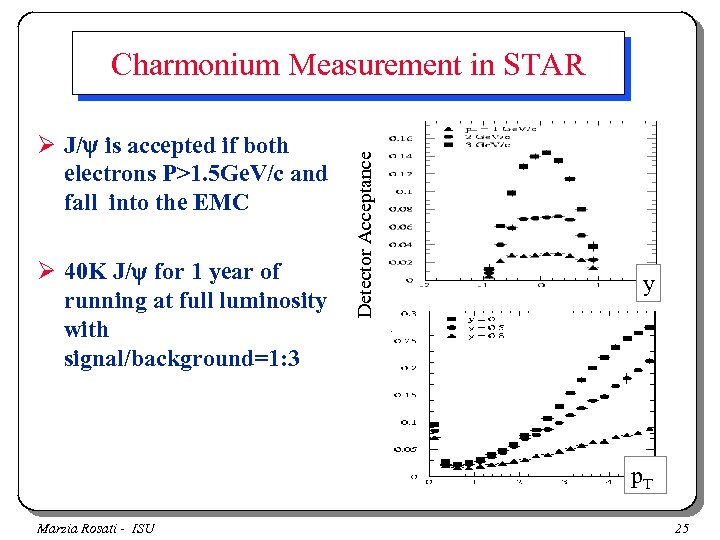 Ø J/ is accepted if both electrons P>1. 5 Ge. V/c and fall into the EMC Ø 40 K J/ for 1 year of running at full luminosity with signal/background=1: 3 Detector Acceptance Charmonium Measurement in STAR y p. T Marzia Rosati - ISU 25
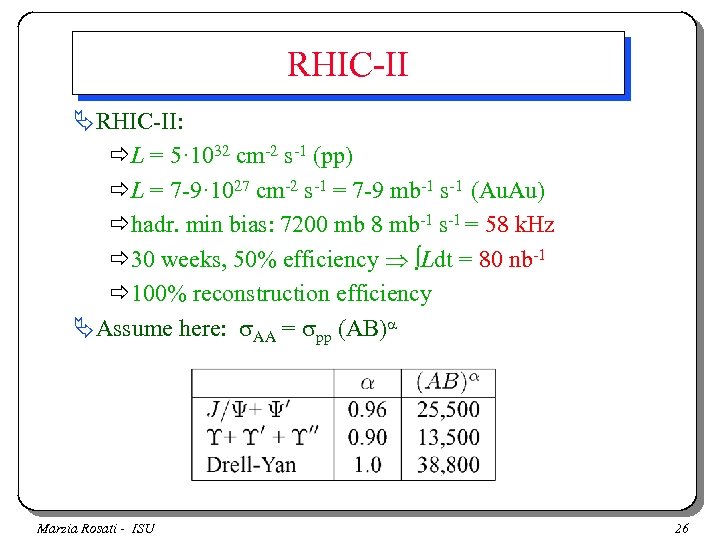 RHIC-II ÄRHIC-II: ðL = 5· 1032 cm-2 s-1 (pp) ðL = 7 -9· 1027 cm-2 s-1 = 7 -9 mb-1 s-1 (Au. Au) ðhadr. min bias: 7200 mb 8 mb-1 s-1 = 58 k. Hz ð 30 weeks, 50% efficiency Ldt = 80 nb-1 ð 100% reconstruction efficiency ÄAssume here: s. AA = spp (AB)a Marzia Rosati - ISU 26
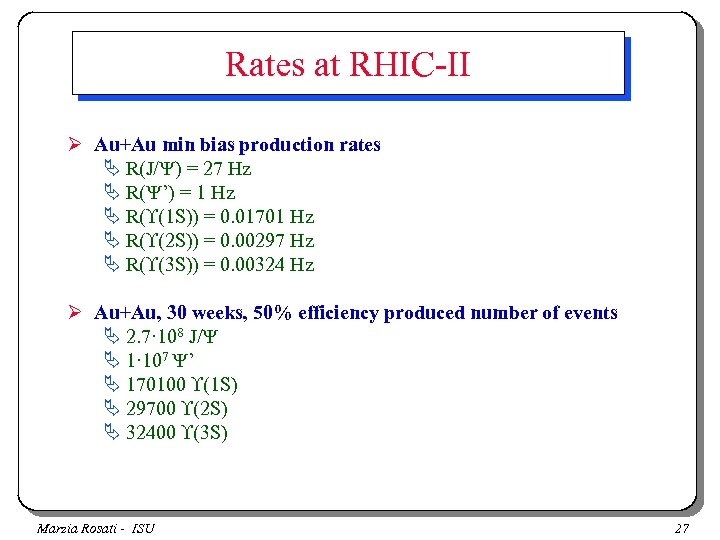 Rates at RHIC-II Ø Au+Au min bias production rates Ä R(J/Y) = 27 Hz Ä R(Y’) = 1 Hz Ä R( (1 S)) = 0. 01701 Hz Ä R( (2 S)) = 0. 00297 Hz Ä R( (3 S)) = 0. 00324 Hz Ø Au+Au, 30 weeks, 50% efficiency produced number of events Ä 2. 7· 108 J/Y Ä 1· 107 Y’ Ä 170100 (1 S) Ä 29700 (2 S) Ä 32400 (3 S) Marzia Rosati - ISU 27
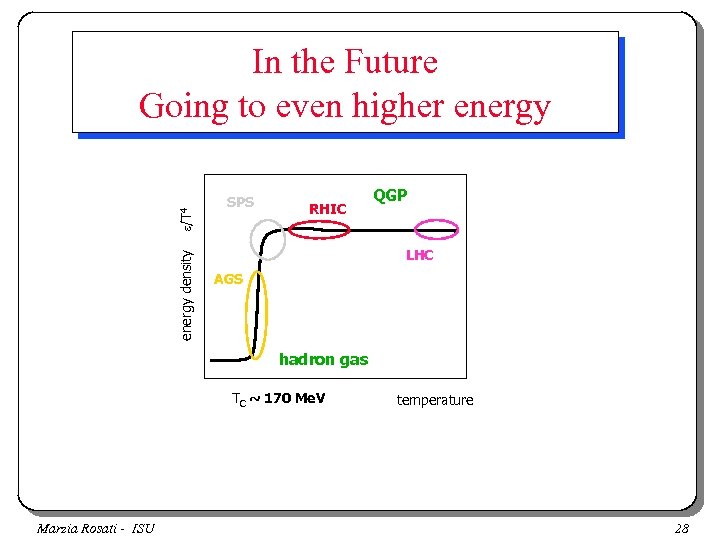 energy density e/T 4 In the Future Going to even higher energy SPS RHIC QGP LHC AGS hadron gas TC ~ 170 Me. V Marzia Rosati - ISU temperature 28
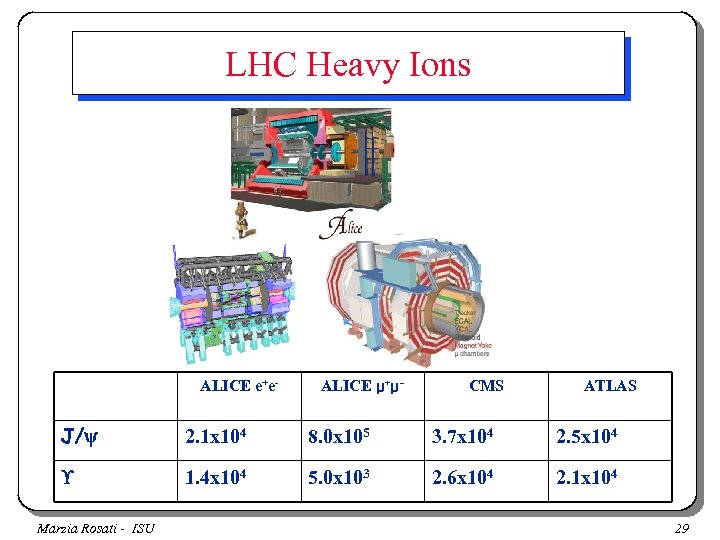 LHC Heavy Ions ALICE e+e- ALICE μ+μ- CMS ATLAS J/ 2. 1 x 10⁴ 8. 0 x 105 3. 7 x 10⁴ 2. 5 x 10⁴ 1. 4 x 10⁴ 5. 0 x 103 2. 6 x 10⁴ 2. 1 x 10⁴ Marzia Rosati - ISU 29
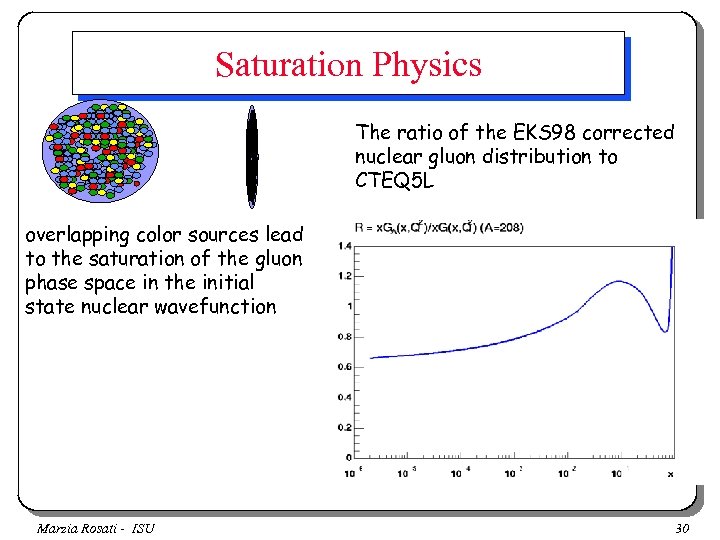 Saturation Physics The ratio of the EKS 98 corrected nuclear gluon distribution to CTEQ 5 L overlapping color sources lead to the saturation of the gluon phase space in the initial state nuclear wavefunction Marzia Rosati - ISU 30
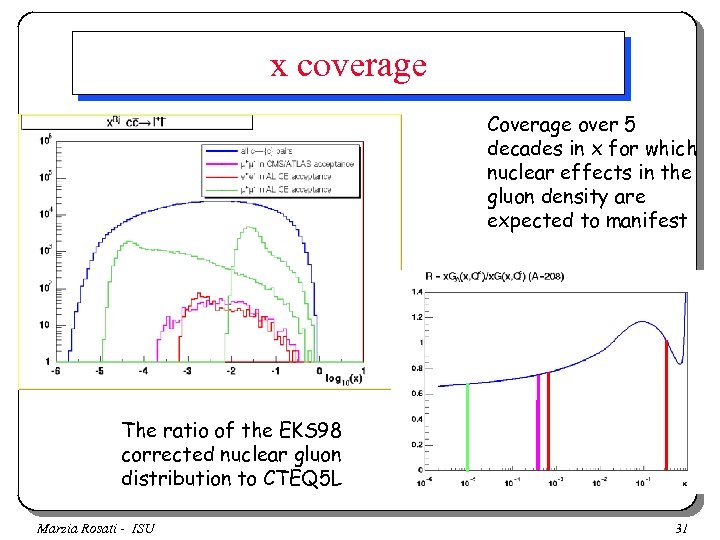 x coverage Coverage over 5 decades in x for which nuclear effects in the gluon density are expected to manifest The ratio of the EKS 98 corrected nuclear gluon distribution to CTEQ 5 L Marzia Rosati - ISU 31
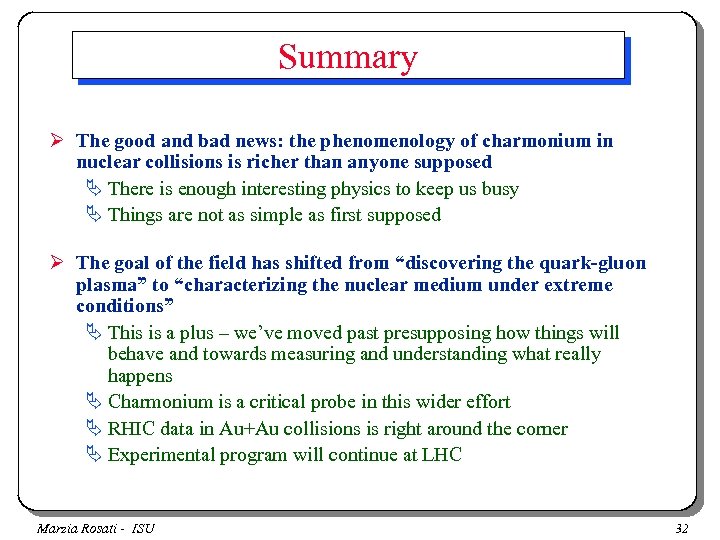 Summary Ø The good and bad news: the phenomenology of charmonium in nuclear collisions is richer than anyone supposed Ä There is enough interesting physics to keep us busy Ä Things are not as simple as first supposed Ø The goal of the field has shifted from “discovering the quark-gluon plasma” to “characterizing the nuclear medium under extreme conditions” Ä This is a plus – we’ve moved past presupposing how things will behave and towards measuring and understanding what really happens Ä Charmonium is a critical probe in this wider effort Ä RHIC data in Au+Au collisions is right around the corner Ä Experimental program will continue at LHC Marzia Rosati - ISU 32