 Скачать презентацию Martyrology and reconstructions technological objects and events
Martyrology and reconstructions.pptx
- Количество слайдов: 22



Martyrology and reconstructions technological objects and events
Martyrology monuments • The most tragic period of Polish history is connected with the World Wars I and II held in 20 th century. Both Russians and German exterminated people living in Poland. Polish, Jewish and Gipsys mostly suffered during World War II. German occupied Poland was a prison-like territory. It contained 457 camp complexes. Some of the major ones, such as Stutthof and Auschwitz consisted of dozens of subsidiary camps scattered over a broad area. • A number of camps were subsequently used by the Soviets or Polish communist regime as labor camps for Germans, Poles, Ukrainians, e. g. : Zgoda labour camp, Central Labour Camp Potulice, Łambinowice camp. • The areas of concentration camps are monuments of history now. Many of them are shrines to memorate the victims of war. • It is difficult to value those palces because they are strongly emotional and it is hard to estimated their value of attractiveness. It is not a good criteria to apply to those objects. Therefore their historical importance for the society and their military importance effect their value.
There abot 20 000 places regarded as monuments of people killed during 20 th century wars. Some of them are small graves with just a few murdered people and some huge objects where mass tourism concentrates. Thousands to millions people were killed in so called „death camps”. The biggest one is German concentration camp in Auschwitz-Birkenau where at least 1, 1 million people lost their lives.
Auschwitz-Birkenau • • • 1942 -1944 concentration camps Auschwitz-Birkenau where mass extermination of mostly Jewish men, women and children took place. Also Polish were killed there. The are of the camp was stated the monument of martyrology of Polish community and others by polish parliment 1947. The area of the museum contains 191 ha and there were 2 subcamps there (Auschwitz I Birkenau, Auschwitz II Birkenau). There are original buildings preserved there. Among them train station where transport trains delivered Jews to the camp's gas chambers from all over German-occupied Europe, where they were killed with the pesticide Zyklon B. You can also see original baracks, whatch towers and dozen of thousands artifacts belonging to the victims. Concentration Camp Auschwitz Birkenau even if it fullfill the definition of tourist attraction it can be regarded like that. It is strongly visited. There were more than 500 000 people in 2000. The number increased up to 1, 38 milions in 2010. 60% are foreign tourists. English, Italians, Germans, French, Israeli and South Koreans are the most numerous nations. See more www. auschwitz. org. pl
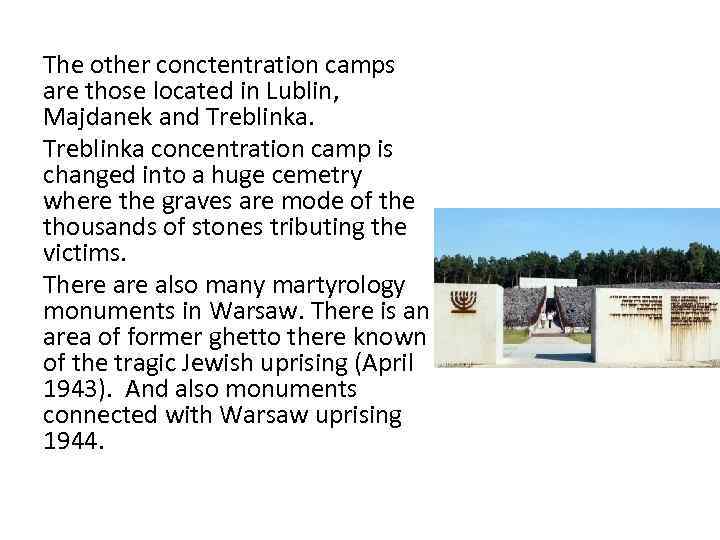
The other conctentration camps are those located in Lublin, Majdanek and Treblinka concentration camp is changed into a huge cemetry where the graves are mode of the thousands of stones tributing the victims. There also many martyrology monuments in Warsaw. There is an area of former ghetto there known of the tragic Jewish uprising (April 1943). And also monuments connected with Warsaw uprising 1944.
Strongholds, fortresses and other military objects The places of war battles and firtifications are quite of high tourist value. Many of them are frequently visited by tourists. They can be divided into 3 groups: 1. Military museums 2. Fortifications 3. War monuments and cemetries
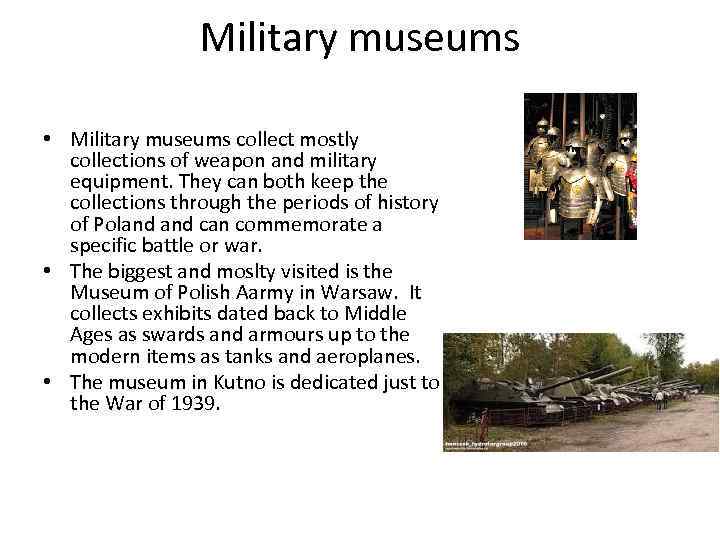
Military museums • Military museums collect mostly collections of weapon and military equipment. They can both keep the collections through the periods of history of Poland can commemorate a specific battle or war. • The biggest and moslty visited is the Museum of Polish Aarmy in Warsaw. It collects exhibits dated back to Middle Ages as swards and armours up to the modern items as tanks and aeroplanes. • The museum in Kutno is dedicated just to the War of 1939.
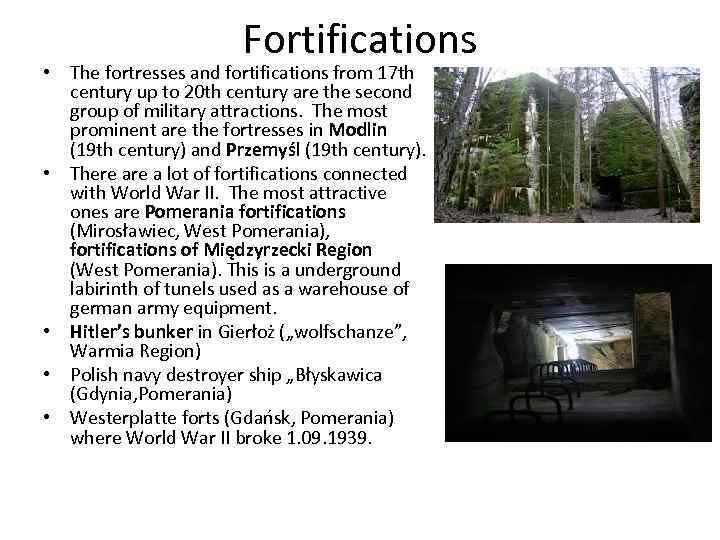
Fortifications • The fortresses and fortifications from 17 th century up to 20 th century are the second group of military attractions. The most prominent are the fortresses in Modlin (19 th century) and Przemyśl (19 th century). • There a lot of fortifications connected with World War II. The most attractive ones are Pomerania fortifications (Mirosławiec, West Pomerania), fortifications of Międzyrzecki Region (West Pomerania). This is a underground labirinth of tunels used as a warehouse of german army equipment. • Hitler’s bunker in Gierłoż („wolfschanze”, Warmia Region) • Polish navy destroyer ship „Błyskawica (Gdynia, Pomerania) • Westerplatte forts (Gdańsk, Pomerania) where World War II broke 1. 09. 1939.
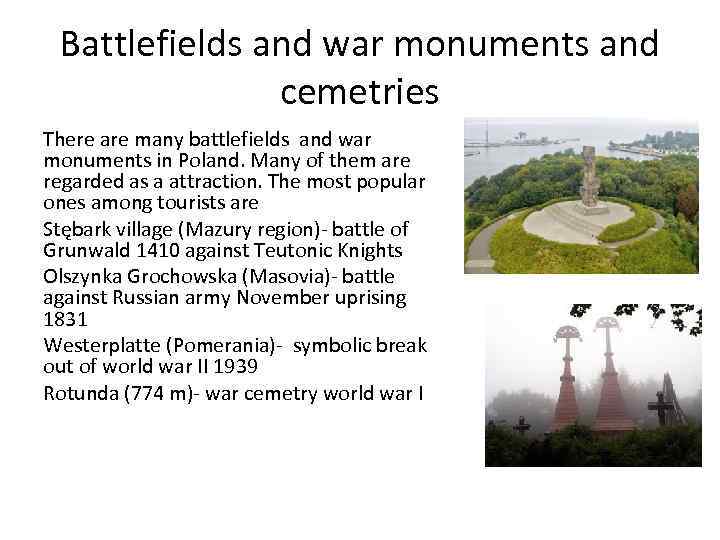
Battlefields and war monuments and cemetries There are many battlefields and war monuments in Poland. Many of them are regarded as a attraction. The most popular ones among tourists are Stębark village (Mazury region)- battle of Grunwald 1410 against Teutonic Knights Olszynka Grochowska (Masovia)- battle against Russian army November uprising 1831 Westerplatte (Pomerania)- symbolic break out of world war II 1939 Rotunda (774 m)- war cemetry world war I
Technology and technical objects Modern technological and economical developments not only in Poland are estimated of some tourist attractiveness. They are not ranked that high in order to regard them as the place of destinations. You can not see many tourists watching new buildings or factories. However those objects are additional tourist attractions. They are visitied on the way to the main destination.
Historical technology attractions Historical objects as factories, mills etc. are quite popular among tourists opposite to the modern ones. They are interested as examples of historical development of the economy of Poland The museums of old technology or former factories which are still functioning can be regarded as the attractions from tourist point of view. The most interesting is a technology museum in Warsaw. Salt mines in Wieliczka and Bochnia (Lesser Poland) Museum of farming in Ciechanowiec and Szreniawa (Kuyjavia. Pomerania) Museum of sea fishing in Hell (Pomerania)
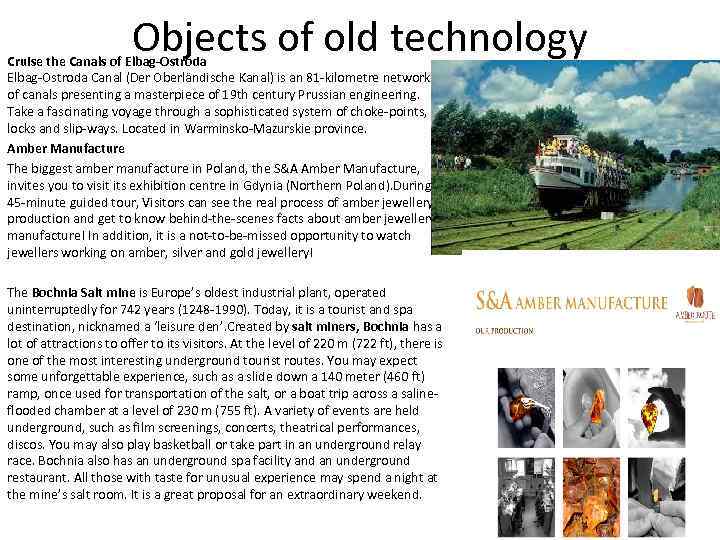
Objects of old technology Cruise the Canals of Elbag-Ostroda Canal (Der Oberländische Kanal) is an 81 -kilometre network of canals presenting a masterpiece of 19 th century Prussian engineering. Take a fascinating voyage through a sophisticated system of choke-points, locks and slip-ways. Located in Warminsko-Mazurskie province. Amber Manufacture The biggest amber manufacture in Poland, the S&A Amber Manufacture, invites you to visit its exhibition centre in Gdynia (Northern Poland). During a 45 -minute guided tour, Visitors can see the real process of amber jewellery production and get to know behind-the-scenes facts about amber jewellery manufacture! In addition, it is a not-to-be-missed opportunity to watch jewellers working on amber, silver and gold jewellery! The Bochnia Salt mine is Europe’s oldest industrial plant, operated uninterruptedly for 742 years (1248 -1990). Today, it is a tourist and spa destination, nicknamed a ‘leisure den’. Created by salt miners, Bochnia has a lot of attractions to offer to its visitors. At the level of 220 m (722 ft), there is one of the most interesting underground tourist routes. You may expect some unforgettable experience, such as a slide down a 140 meter (460 ft) ramp, once used for transportation of the salt, or a boat trip across a salineflooded chamber at a level of 230 m (755 ft). A variety of events are held underground, such as film screenings, concerts, theatrical performances, discos. You may also play basketball or take part in an underground relay race. Bochnia also has an underground spa facility and an underground restaurant. All those with taste for unusual experience may spend a night at the mine’s salt room. It is a great proposal for an extraordinary weekend.
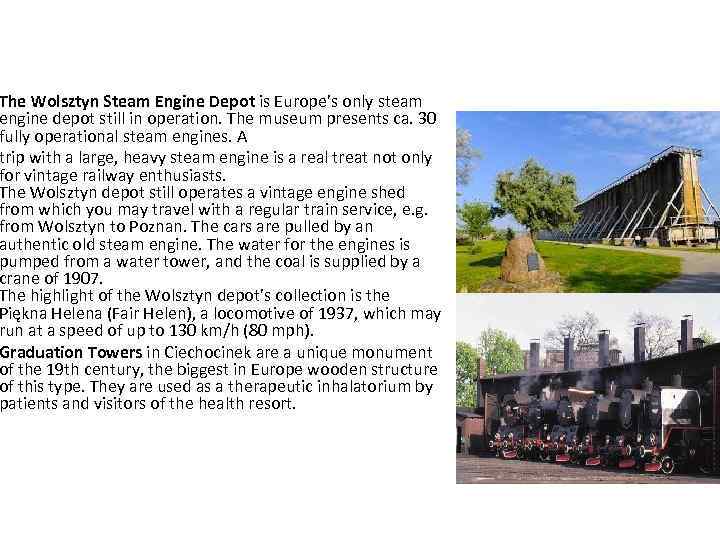
The Wolsztyn Steam Engine Depot is Europe’s only steam engine depot still in operation. The museum presents ca. 30 fully operational steam engines. A trip with a large, heavy steam engine is a real treat not only for vintage railway enthusiasts. The Wolsztyn depot still operates a vintage engine shed from which you may travel with a regular train service, e. g. from Wolsztyn to Poznan. The cars are pulled by an authentic old steam engine. The water for the engines is pumped from a water tower, and the coal is supplied by a crane of 1907. The highlight of the Wolsztyn depot’s collection is the Piękna Helena (Fair Helen), a locomotive of 1937, which may run at a speed of up to 130 km/h (80 mph). Graduation Towers in Ciechocinek are a unique monument of the 19 th century, the biggest in Europe wooden structure of this type. They are used as a therapeutic inhalatorium by patients and visitors of the health resort.
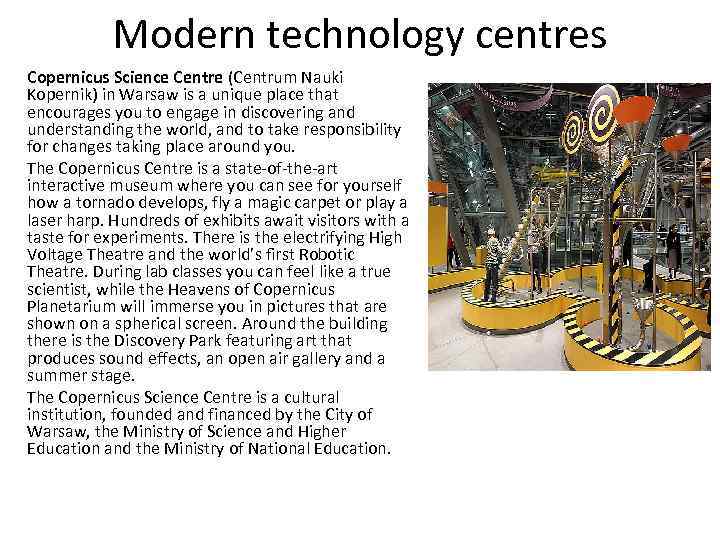
Modern technology centres Copernicus Science Centre (Centrum Nauki Kopernik) in Warsaw is a unique place that encourages you to engage in discovering and understanding the world, and to take responsibility for changes taking place around you. The Copernicus Centre is a state-of-the-art interactive museum where you can see for yourself how a tornado develops, fly a magic carpet or play a laser harp. Hundreds of exhibits await visitors with a taste for experiments. There is the electrifying High Voltage Theatre and the world’s first Robotic Theatre. During lab classes you can feel like a true scientist, while the Heavens of Copernicus Planetarium will immerse you in pictures that are shown on a spherical screen. Around the building there is the Discovery Park featuring art that produces sound effects, an open air gallery and a summer stage. The Copernicus Science Centre is a cultural institution, founded and financed by the City of Warsaw, the Ministry of Science and Higher Education and the Ministry of National Education.
Events are not typical tourist attractions. They are intagible. They are usually not available on standing exhibition and they are limited in their timing. Sometimes they are known as cultural attractions. Their timing is mostly between a few days up to 2 -3 weeks. The events are more popular due to taking palce during high tourist season. Not every event is a attractive from tourist point of view. The most popular ones are folk events. Many of the up-to-date events are periodicaly being held, mostly every year. Their timing, prices and themes are changing. There about 50 -70 events of intenational fame organized in Poland. And there about 250 events all over Poland. Many arrangements are taking place regionaly and locally. The largest once was European Football Championship in 2012 and Volleyball World Championship (2014). They have very wide range of theme. Music- pop, rock and classical, theater, film, dance, ballet, arts, even folk arts etc.
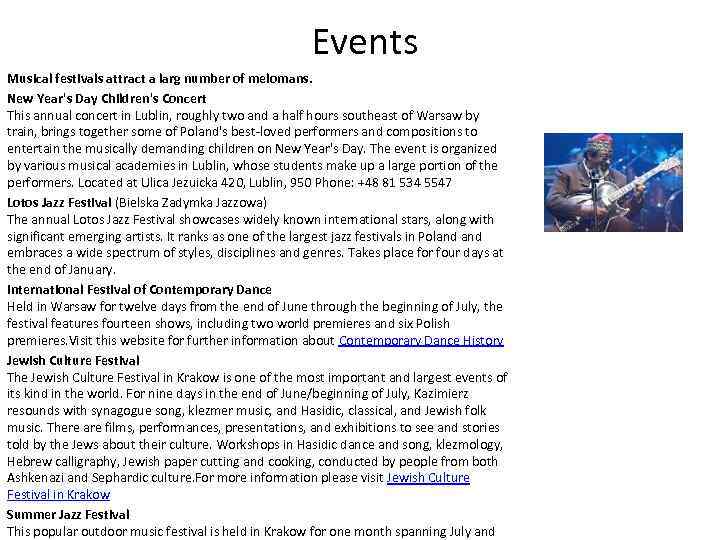
Events Musical festivals attract a larg number of melomans. New Year's Day Children's Concert This annual concert in Lublin, roughly two and a half hours southeast of Warsaw by train, brings together some of Poland's best-loved performers and compositions to entertain the musically demanding children on New Year's Day. The event is organized by various musical academies in Lublin, whose students make up a large portion of the performers. Located at Ulica Jezuicka 420, Lublin, 950 Phone: +48 81 534 5547 Lotos Jazz Festival (Bielska Zadymka Jazzowa) The annual Lotos Jazz Festival showcases widely known international stars, along with significant emerging artists. It ranks as one of the largest jazz festivals in Poland embraces a wide spectrum of styles, disciplines and genres. Takes place for four days at the end of January. International Festival of Contemporary Dance Held in Warsaw for twelve days from the end of June through the beginning of July, the festival features fourteen shows, including two world premieres and six Polish premieres. Visit this website for further information about Contemporary Dance History Jewish Culture Festival The Jewish Culture Festival in Krakow is one of the most important and largest events of its kind in the world. For nine days in the end of June/beginning of July, Kazimierz resounds with synagogue song, klezmer music, and Hasidic, classical, and Jewish folk music. There are films, performances, presentations, and exhibitions to see and stories told by the Jews about their culture. Workshops in Hasidic dance and song, klezmology, Hebrew calligraphy, Jewish paper cutting and cooking, conducted by people from both Ashkenazi and Sephardic culture. For more information please visit Jewish Culture Festival in Krakow Summer Jazz Festival This popular outdoor music festival is held in Krakow for one month spanning July and
International Chopin Festival There are two Chopin Festivals – one in Warsaw and one in Chopin’s manor in Duszniki Zdroj. The one in Duszniki Zdroj is Poland's oldest music festival, and the largest Chopin festival in the world. During its nine days, approximately 25 concerts and recitals are held, featuring the world's best pianists. The venue is Chopin’s manor, located within a lovely park and close proximity to the Stolowe Mountains National Park which surrounds the town of Duszniki Zdroj. Held in the beginning of August. The Chopin Festival in Warsaw is held for the entire month of August at the historical concert hall in Ostrogski Castle and at Stanisławowski Theatre in Royal Lazienki Park. Sopot International Song Festival This most popular music festival takes place in the Forest Opera - a beautiful amphitheatre with among forested hills. Each year, hundreds of people come to the town of Sopot to listen to various styles of music. Enthusiasts of theatre and art may attend various events and exhibitions on the Chamber stage of Wybrzeze Theatre, located in a house near the beach. The Sopot Song competition event is one of the oldest song contests in Europe. The festival takes place for two days at the end of August. Rawa Blues Festival Thousands of blues fans gather to enjoy popular Polish, American and European blues musicians. Among the highlights of past festivals were Luther Allison, Junior Wells, Koko Taylor and many others. Takes place in the beginning of October in Katowis. Warsaw International Film Festival Film This film festival screens over one hundred films from forty countries around October 7 -18. Wratislavia Cantans International Festival Concerts, symphonic and chamber music concerts, opera and ballet performances, concerts of sacred music of different religions, vocal and instrumental recitals, art exhibitions and many other attractions take place for several weeks in the most splendid historical interiors of Wroclaw and several other Lower Silesia cities' buildings. Dates for Wroclaw are around September 9 -16; followed by Lower Silesia around September 17 to October 1.
• • • Traveling to Poland during one of the many festivals or holidays can be one that encompasses the culture of Poland while giving you all kinds of fun with Polish events that are celebrated throughout the year. Whether you have chosen Poland as your vacation due to the events in Poland or just for a great getaway, you may wish to travel so you can arrive during one of the Poland festivals or other events. The following information for Poland events should help you plan your vacation. Constitution Day Even though May 3 is celebrated throughout Poland as the day that marks the signing of the Polish Constitution in 1791, this is not the exact day that Poland received their independence. The constitution of 1791 only lasted one short year prior to an invasion that divided Poland among Austria, Prussia, and Russia. Finally, in November of 1918, Poland received its independence. This day however, is still an important date that offers visitors a glimpse into the culture and pride of the Polish people with an array of Polish festivals and parades in the larger cities throughout Poland. Stanislaw Procession This Polish event takes place in Krakow on the first Sunday after May 8. This religious Polish festival is a gathering of all of Poland’s bishops and cardinals. During the festival the bishops and cardinals follow the relics of the patron saints beginning at the Wavel Cathedral and ending at the Skalka sanctuary. Residents from all over Poland join this Polish festival each year. Krakow Film Festival Another wonderful Poland festival found in Krakow is the Krakow Film Festival. Polish events occur in Krakow throughout the year however, this one normally occurs the end of May and on into the first week of June. This is the largest festival of this type in all of Poland has visitors from over Europe participating in the screening of shorts, animations, documentaries, and features. Mozart Festival Warsaw is the home of this fabulous Poland event that celebrates the life of this infamous artist. During the entire month, visitors can enjoy the various stage works of Mozart. The Warsaw Chamber of Opera Theatre hosts this tremendous Poland event, which is the world, ’s largest of its kind.
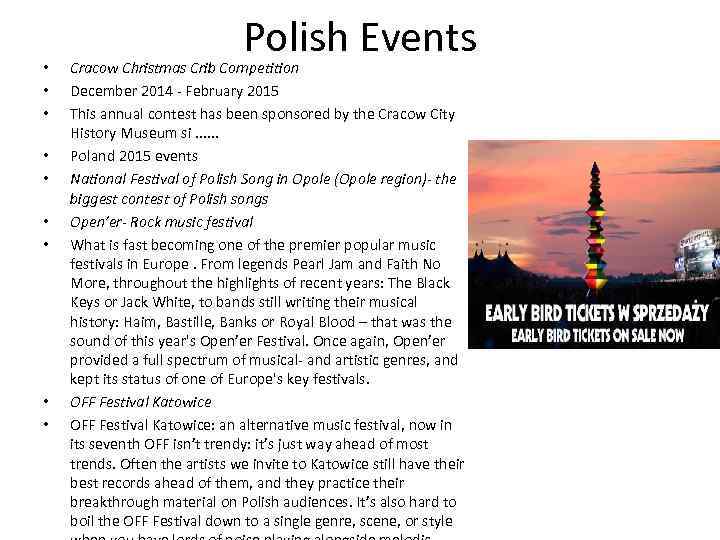
• • • Polish Events Cracow Christmas Crib Competition December 2014 - February 2015 This annual contest has been sponsored by the Cracow City History Museum si. . . Poland 2015 events National Festival of Polish Song in Opole (Opole region)- the biggest contest of Polish songs Open’er- Rock music festival What is fast becoming one of the premier popular music festivals in Europe. From legends Pearl Jam and Faith No More, throughout the highlights of recent years: The Black Keys or Jack White, to bands still writing their musical history: Haim, Bastille, Banks or Royal Blood – that was the sound of this year's Open’er Festival. Once again, Open’er provided a full spectrum of musical- and artistic genres, and kept its status of one of Europe's key festivals. OFF Festival Katowice: an alternative music festival, now in its seventh OFF isn’t trendy: it’s just way ahead of most trends. Often the artists we invite to Katowice still have their best records ahead of them, and they practice their breakthrough material on Polish audiences. It’s also hard to boil the OFF Festival down to a single genre, scene, or style
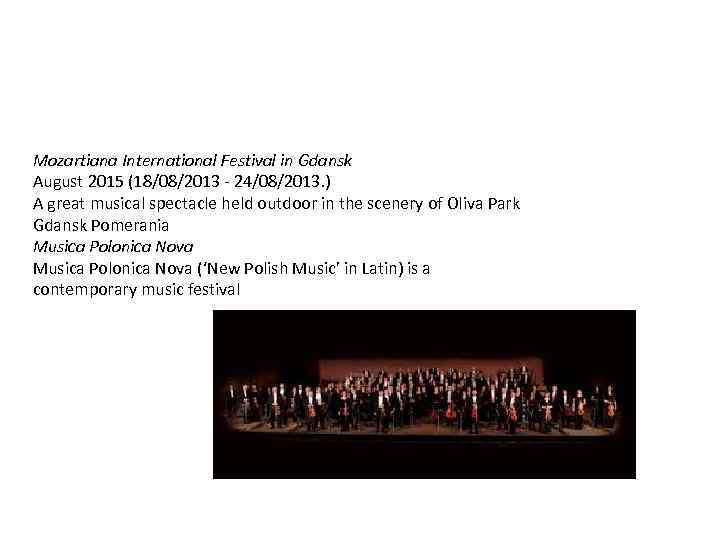
Mozartiana International Festival in Gdansk August 2015 (18/08/2013 - 24/08/2013. ) A great musical spectacle held outdoor in the scenery of Oliva Park Gdansk Pomerania Musica Polonica Nova (‘New Polish Music’ in Latin) is a contemporary music festival
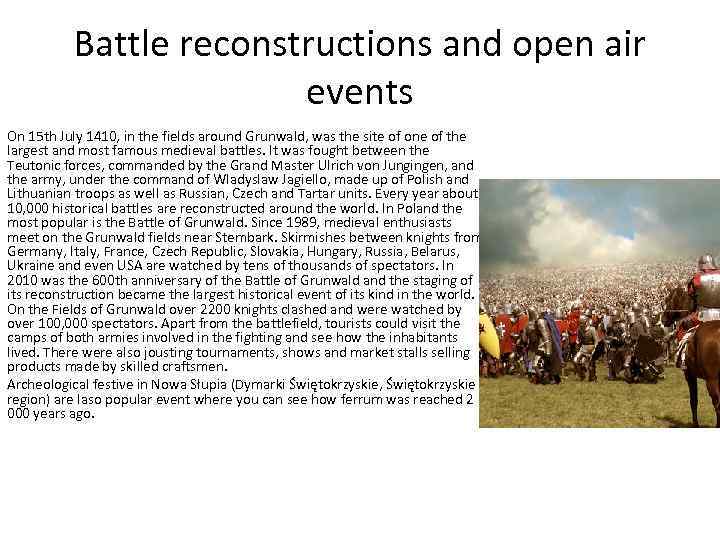
Battle reconstructions and open air events On 15 th July 1410, in the fields around Grunwald, was the site of one of the largest and most famous medieval battles. It was fought between the Teutonic forces, commanded by the Grand Master Ulrich von Jungingen, and the army, under the command of Wladyslaw Jagiello, made up of Polish and Lithuanian troops as well as Russian, Czech and Tartar units. Every year about 10, 000 historical battles are reconstructed around the world. In Poland the most popular is the Battle of Grunwald. Since 1989, medieval enthusiasts meet on the Grunwald fields near Stembark. Skirmishes between knights from Germany, Italy, France, Czech Republic, Slovakia, Hungary, Russia, Belarus, Ukraine and even USA are watched by tens of thousands of spectators. In 2010 was the 600 th anniversary of the Battle of Grunwald and the staging of its reconstruction became the largest historical event of its kind in the world. On the Fields of Grunwald over 2200 knights clashed and were watched by over 100, 000 spectators. Apart from the battlefield, tourists could visit the camps of both armies involved in the fighting and see how the inhabitants lived. There were also jousting tournaments, shows and market stalls selling products made by skilled craftsmen. Archeological festive in Nowa Słupia (Dymarki Świętokrzyskie, Świętokrzyskie region) are laso popular event where you can see how ferrum was reached 2 000 years ago.
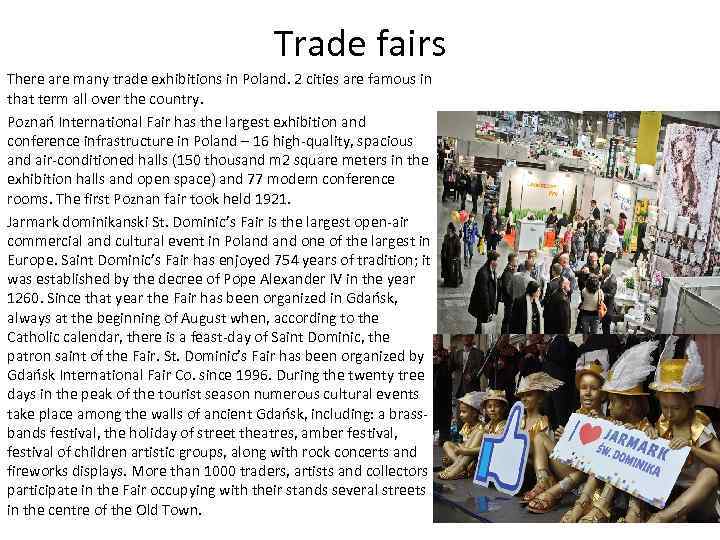
Trade fairs There are many trade exhibitions in Poland. 2 cities are famous in that term all over the country. Poznań International Fair has the largest exhibition and conference infrastructure in Poland – 16 high-quality, spacious and air-conditioned halls (150 thousand m 2 square meters in the exhibition halls and open space) and 77 modern conference rooms. The first Poznan fair took held 1921. Jarmark dominikanski St. Dominic’s Fair is the largest open-air commercial and cultural event in Poland one of the largest in Europe. Saint Dominic’s Fair has enjoyed 754 years of tradition; it was established by the decree of Pope Alexander IV in the year 1260. Since that year the Fair has been organized in Gdańsk, always at the beginning of August when, according to the Catholic calendar, there is a feast-day of Saint Dominic, the patron saint of the Fair. St. Dominic’s Fair has been organized by Gdańsk International Fair Co. since 1996. During the twenty tree days in the peak of the tourist season numerous cultural events take place among the walls of ancient Gdańsk, including: a brassbands festival, the holiday of street theatres, amber festival, festival of children artistic groups, along with rock concerts and fireworks displays. More than 1000 traders, artists and collectors participate in the Fair occupying with their stands several streets in the centre of the Old Town.
Скачать презентацию Martyrology and reconstructions technological objects and events
Martyrology and reconstructions.pptx