


 Скачать презентацию Martin Luther Starts the Reformation CH 17 3
0b973fd461658d64eb7c8cc846033fdb.ppt
- Количество слайдов: 56
 Martin Luther Starts the Reformation CH 17. 3
 Objectives • Describe the religious, political, intellectual and economic causes behind the Reformation • Describe the religious, political, and economic effects of the Reformation • Terms: Reformation, indulgence, recant, Lutheran, Protestant, annul
 Causes of the Reformation • Reform: to change – The REFORMATION: defined as a movement for religious change • The Reformation was both spiritually and politically motivated.
 Causes of the Reformation • Spiritual: many common folks and some rulers were tired of the Catholic Church’s abuse of power, inattention to the people’s needs • Political: Many rulers who were looking to take power away from the church
 Weakened Church authority (religious) • The church was unable to stop the plague • The Church focused much energy on infighting---the Great Schism
 Renaissance-Intellectual • Renaissance learning and thinking was source or evidence-based versus • Church science, philosophy, and theology based on Bible and Church writings (dogma). • Renaissance humanism focused more on the individuals and humans than on the spiritual • The renewed interest in Latin and Greek also enabled more people to read the Bible for themselves.
 Intellectual: Printing press • The invention of the printing press around 1450 allowed new and radical ideas to be mass produced and quickly widely distributed.
 Economics: Church decadence • The Popes who ruled during the Renaissance patronized the arts, spent extravagantly on personal pleasure, and fought wars. • Although this is OK for secular (nonreligious) leaders, it’s probably not what Jesus had in mind. • Also, the money they were spending were taxes (tithes) taken from the people
 Church decadence • In many places, the upper clergy had become more like secular rulers instead of religious authorities. • The Church owned massive amounts of land was part of the feudal system. • Immorality, simony (buying & selling of spiritual pardons), and non-celibacy had become commonplace in the higher clergy.
 Economics • The papacy (the position of being Pope) was also increasingly political as powerful families competed to put their members on the throne of St. Peter. • Pope Leo X (pope from 1513 -1521), for example, was Lorenzo the Magnificent’s (Lorenzo Medici) second son. • He continued the Medici ways of luxury and patronage, but with Church money. • Nearly bankrupted the Church.
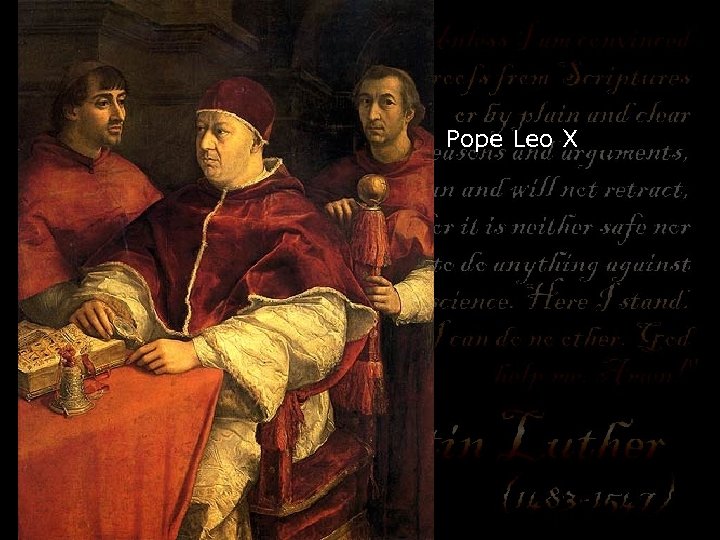 Pope Leo X
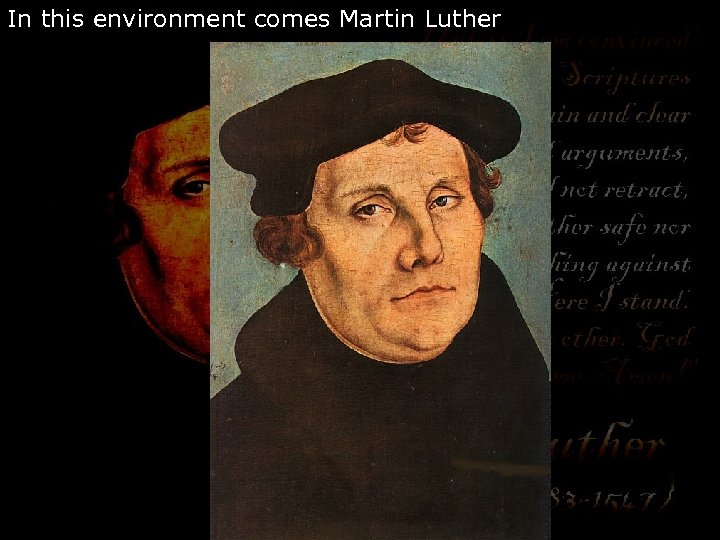 In this environment comes Martin Luther
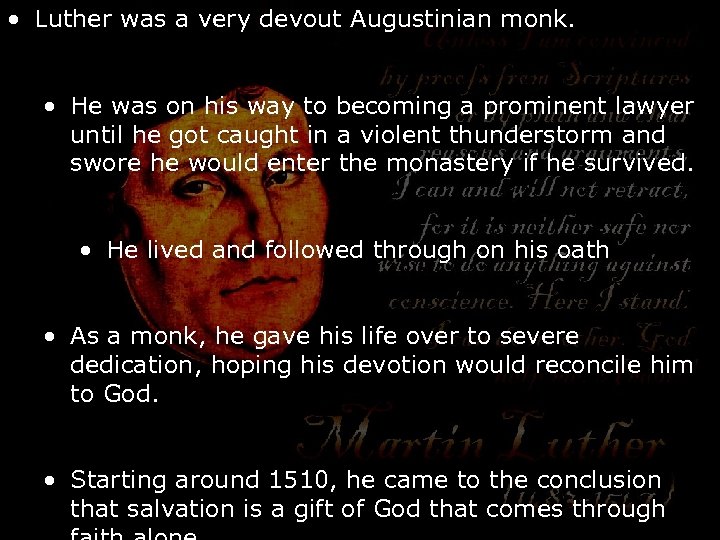 • Luther was a very devout Augustinian monk. • He was on his way to becoming a prominent lawyer until he got caught in a violent thunderstorm and swore he would enter the monastery if he survived. • He lived and followed through on his oath • As a monk, he gave his life over to severe dedication, hoping his devotion would reconcile him to God. • Starting around 1510, he came to the conclusion that salvation is a gift of God that comes through
 Your turn • Use your text, Chapter 17, Section 3, to fill in the following graphic organizer
 Thursday, May 19 • Describe the religious, political, intellectual and economic causes behind the Reformation • Describe the religious, political, and economic effects of the Reformation • Terms: Reformation, indulgence, recant, Lutheran, Protestant, annul
 Reviewing your graphic organizer-what you should have found
 #1—Cause: Luther was especially upset by the sale of indulgences. • According to Catholic Church at the time, if one sinned, you could repent and be given the sacrament of penance. • A penance is like a punishment, making up for your bad deed. • You could, however, lessen the amount of punishment by performing acts of merits.
 #1 -Cause • This is typically done through prayers and such, but the Church had a great idea for making some money. • SELL indulgences • Indulgence: Paying money to pardon a sin.
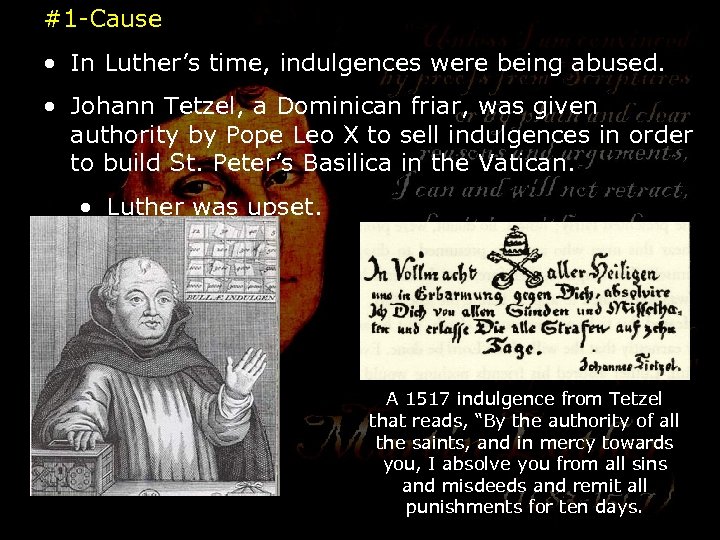 #1 -Cause • In Luther’s time, indulgences were being abused. • Johann Tetzel, a Dominican friar, was given authority by Pope Leo X to sell indulgences in order to build St. Peter’s Basilica in the Vatican. • Luther was upset. Tetzel A 1517 indulgence from Tetzel that reads, “By the authority of all the saints, and in mercy towards you, I absolve you from all sins and misdeeds and remit all punishments for ten days.
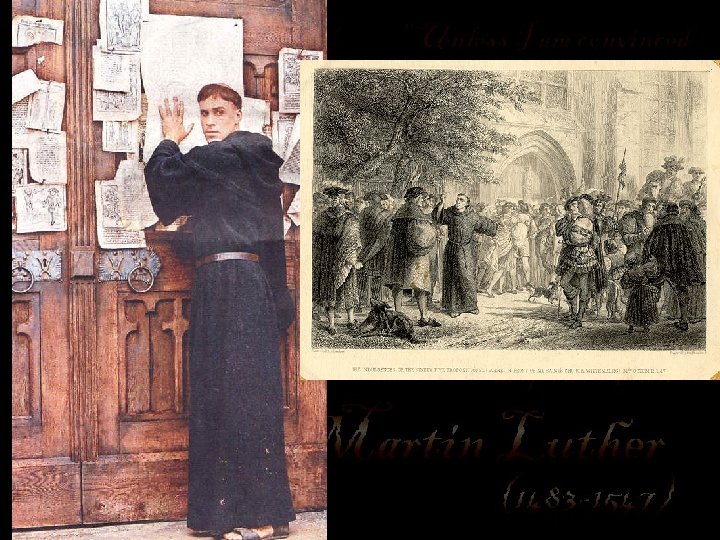
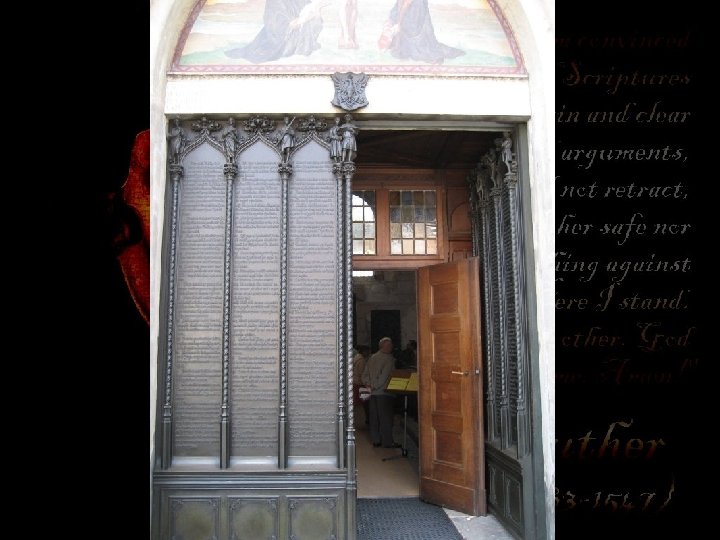
 #1 -Event: This motivates Martin Luther to post his famous 95 theses on the door to the Wittenberg chapel on October 31, 1517. • The 95 theses argued against the way indulgences were being used for profit and how they were being presented as a way of being able to buy your way into heaven. • #1 -Effect: The theses were copied and sent off to a printer who promptly made copies and then theses were getting distributed throughout Europe
 Luther’s 95 theses had 3 main points: • Salvation comes through faith alone and not through good works • The Bible is the sole authority and not Church dogma or the pope. • People of faith were equal and didn’t need others to interpret the Bible for them.
 Luther’s actions didn’t go over well with the Church, but they didn’t take him very seriously at first. • Pope Leo X sent some theologians north hoping to quell the disturbance. He referred to Luther as a drunken German who will change his mind when sober. • #2 -Cause: But, thanks to the printing press, The theses were copied and sent off to a printer who promptly made copies and then the distributed them to all regions of Europe. • Once word gets out, it’s too late to stop it. Now the Church has a big problem on their hands.
 • #2 -Event: The Church issues the Edict of Worms, which says that Luther was an outlaw and anyone who even gave him food or shelter was a criminal and excommunicated. • Prince Frederick the Wise of Saxony takes in Luther and gives him shelter in one of his castles • #2 -Effects: Here, Luther translates the Bible into German so that common people can understand it (they didn’t know Latin so well). • Now people can read the Bible for themselves • Luther eventually becomes the leader of the full-fledged movement of Lutheranism.
 • On the downside… • Luther was a big time anti-Semite who thought synagogues should be burned, Jews’ property and money seized, and the people forced into labor or expelled. Oh, those crazy Germans. • He actually did succeed in getting some Jews expelled and the pamphlet in which he made the claims is sometimes called the blueprint for the Nazi pogrom program.
 #3 -Cause: • The peasants try to apply Luther’s ideas of egalitarianism (equality for all) to the social sphere. • Revolt against Church & their rulers #3 -Effect: • Luther came out against peasants • German princes crushed the revolt, killing around 100, 000(!!!) peasants in the process. • The peasants didn’t much trust Luther after that.
 Political Supporters of the Reformation • Many German princes were looking for an excuse to take power away from the Church. • They welcomed Lutheranism, • Effects of Lutheranism: • Princes no longer had to pay money to the Church, which means more money for themselves • Princes no longer had to obey the Church’s laws—power away from Church • Their subjects (the people) still had Christianity-just a different kind
 Political Supporters of the Reformation • It was a Win/Win situation!!! • #4 -Cause: Many princes quickly decided what religion would be practiced in their realm: Lutheranism or Catholicism (and only those two). • Protestants: applied to Christians who belonged to non-Catholic Church
 Germany at War • #4 -Cause: The Pope & Holy Roman Emperor Charles V war against the German princes (Protestants) • Stalemate results in Peace of Augsburg, 1555: – #4 -Effect: Princes can decide for themselves which religion will be practiced in their region
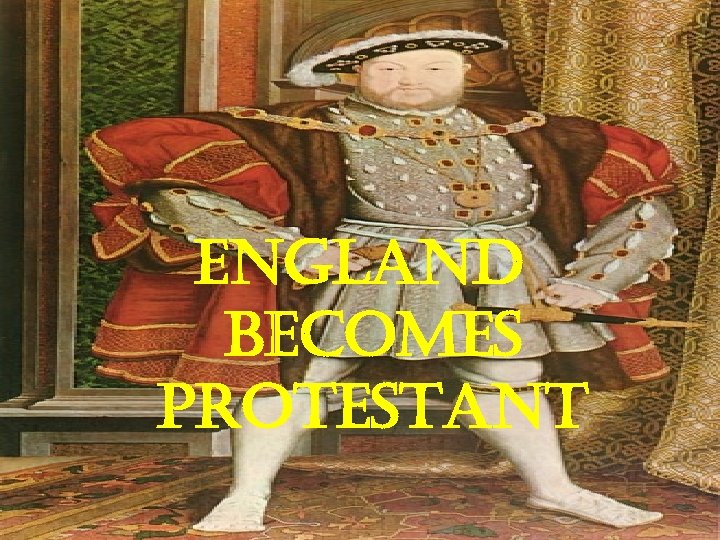 England also goes Protestant • It was done by this handsome devil: england Becomes Protestant
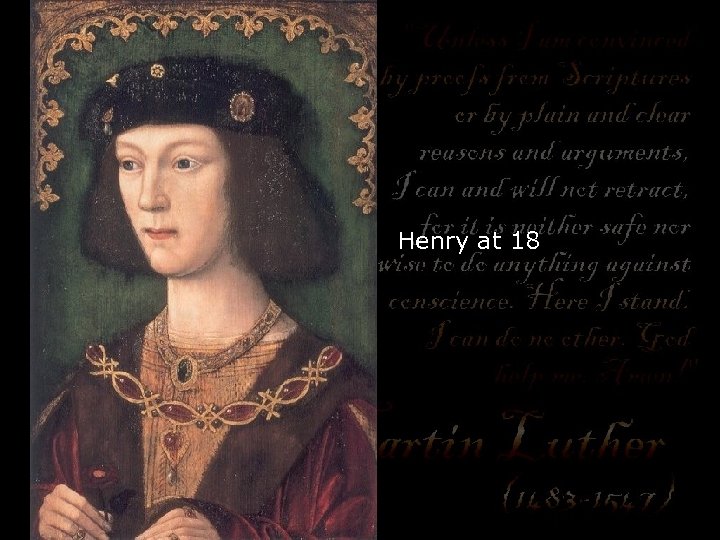 Henry at 18
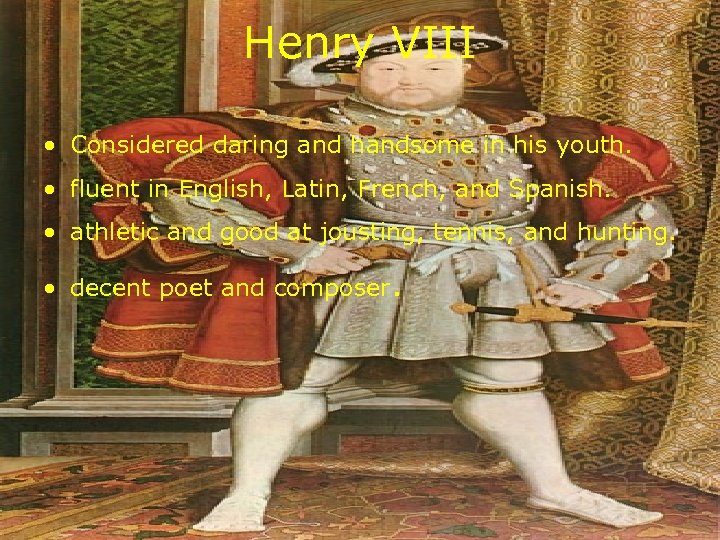 England also goes Protestant Henry VIII • It was done by this handsome devil: • Considered daring and handsome in his youth. • fluent in English, Latin, French, and Spanish. • athletic and good at jousting, tennis, and hunting. • decent poet and composer.
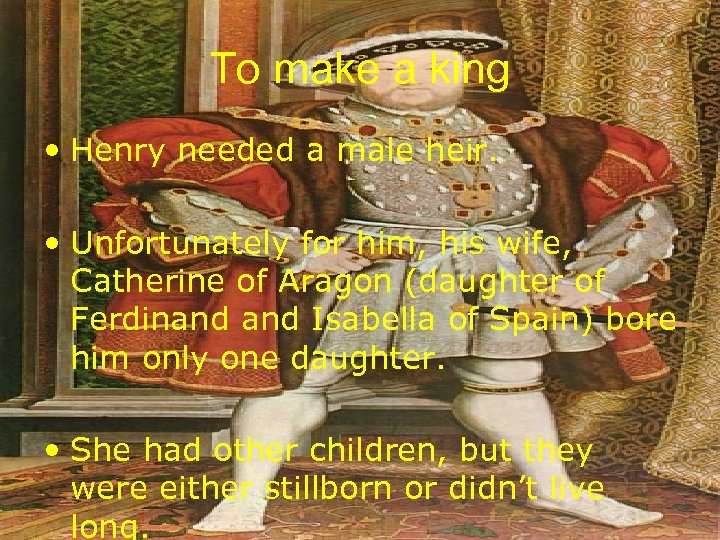 England also goes Protestant To make a king • It was done by this handsome devil: • Henry needed a male heir. • Unfortunately for him, his wife, Catherine of Aragon (daughter of Ferdinand Isabella of Spain) bore him only one daughter. • She had other children, but they were either stillborn or didn’t live long.
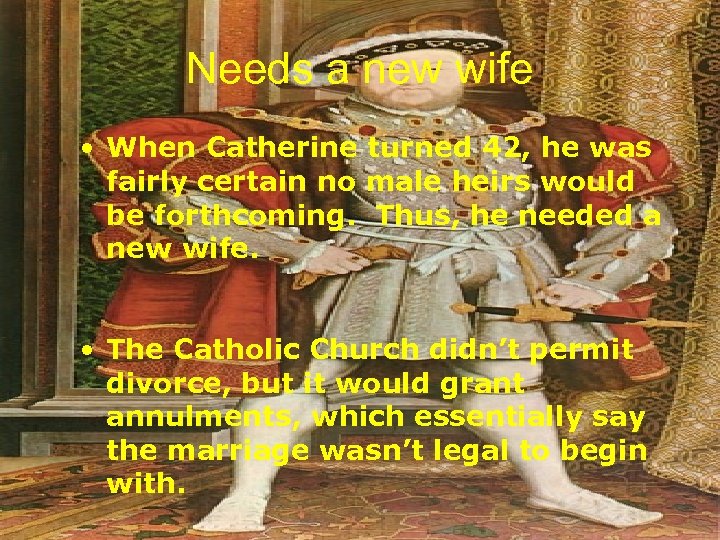 England also goes Protestant Needs a new wife • It was done by this handsome devil: • When Catherine turned 42, he was fairly certain no male heirs would be forthcoming. Thus, he needed a new wife. • The Catholic Church didn’t permit divorce, but it would grant annulments, which essentially say the marriage wasn’t legal to begin with.
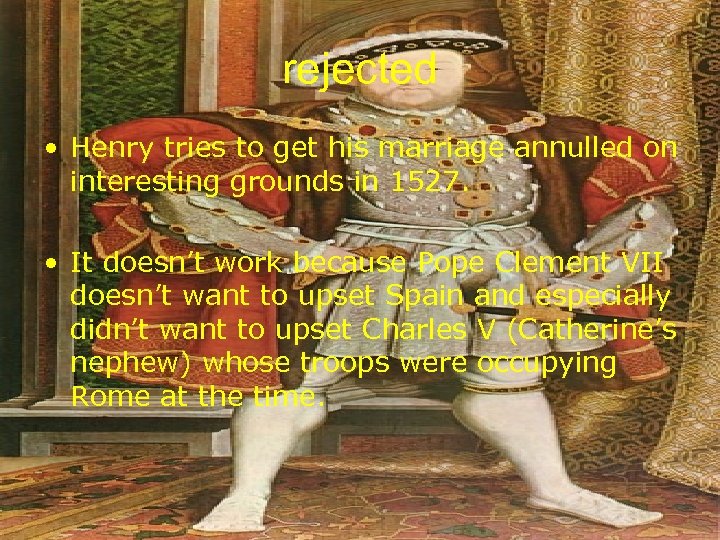 England also goes Protestant • It was done by this handsome devil: rejected • Henry tries to get his marriage annulled on interesting grounds in 1527. • It doesn’t work because Pope Clement VII doesn’t want to upset Spain and especially didn’t want to upset Charles V (Catherine’s nephew) whose troops were occupying Rome at the time.
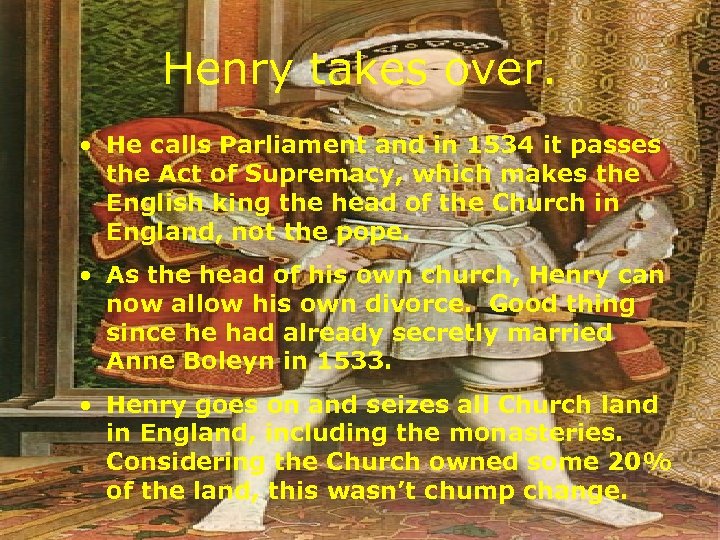 England also goes Protestant Henry takes over. • It was done by this handsome devil: • He calls Parliament and in 1534 it passes the Act of Supremacy, which makes the English king the head of the Church in England, not the pope. • As the head of his own church, Henry can now allow his own divorce. Good thing since he had already secretly married Anne Boleyn in 1533. • Henry goes on and seizes all Church land in England, including the monasteries. Considering the Church owned some 20% of the land, this wasn’t chump change.
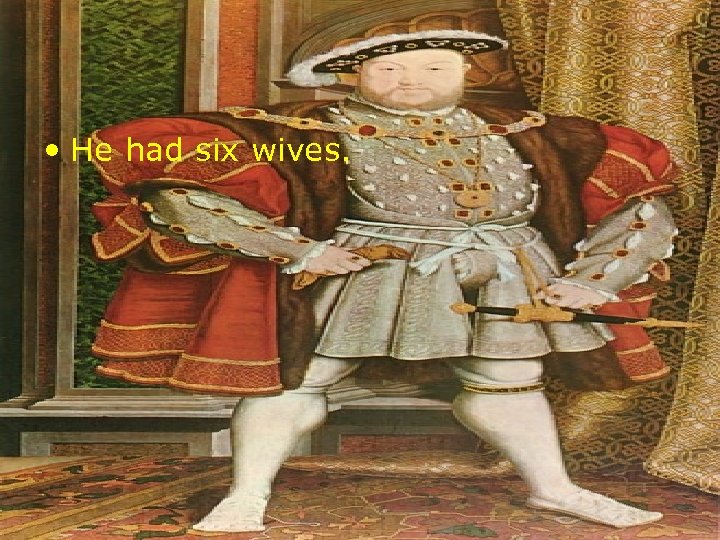 England also goes Protestant • It was done by this handsome devil: • He had six wives.
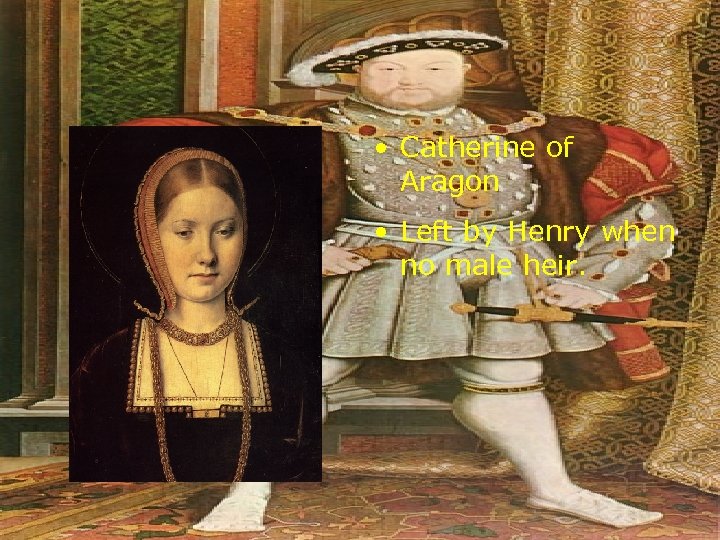 England also goes Protestant • It was done by this handsome devil: • Catherine of Aragon • Left by Henry when no male heir.
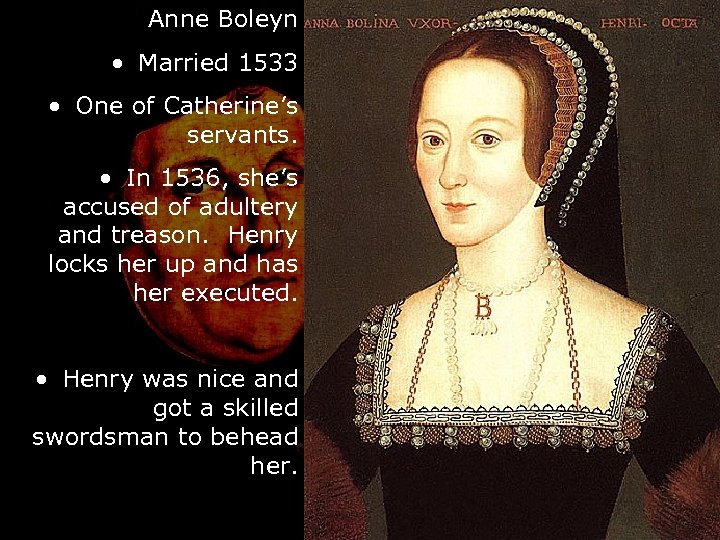 Anne Boleyn • Married 1533 • One of Catherine’s servants. • In 1536, she’s accused of adultery and treason. Henry locks her up and has her executed. • Henry was nice and got a skilled swordsman to behead her.
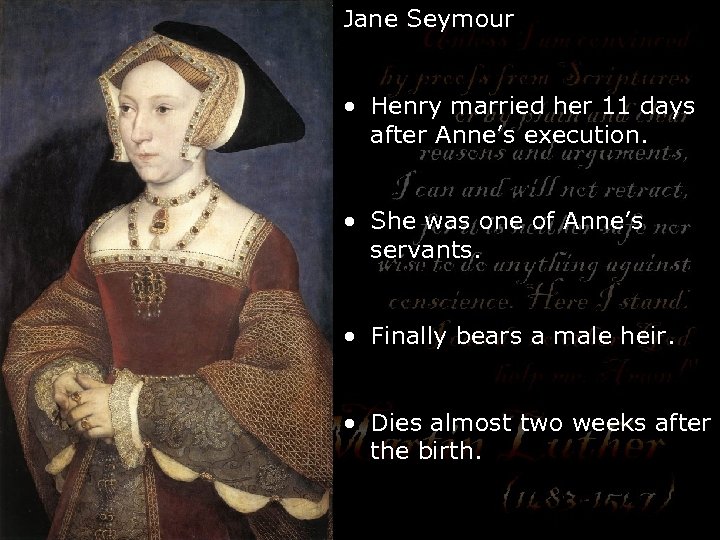 Jane Seymour • Henry married her 11 days after Anne’s execution. • She was one of Anne’s servants. • Finally bears a male heir. • Dies almost two weeks after the birth.
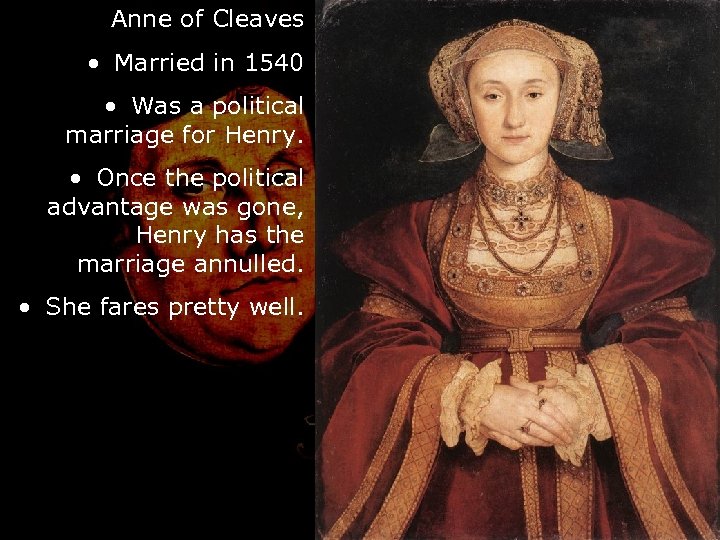 Anne of Cleaves • Married in 1540 • Was a political marriage for Henry. • Once the political advantage was gone, Henry has the marriage annulled. • She fares pretty well.
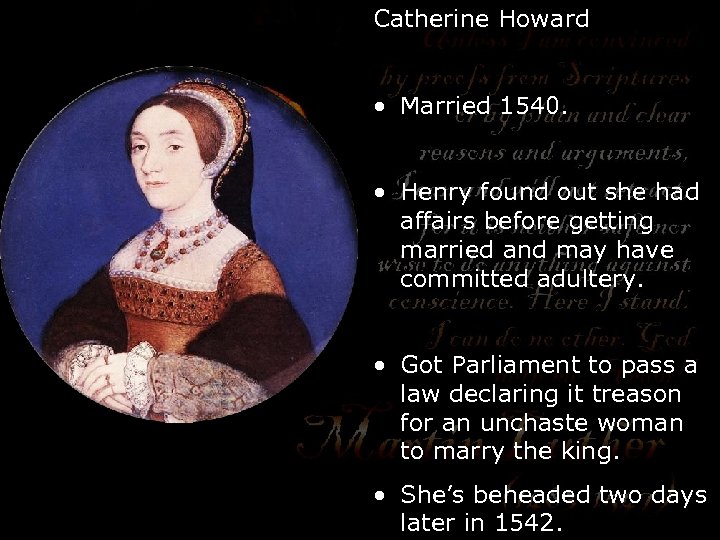 Catherine Howard • Married 1540. • Henry found out she had affairs before getting married and may have committed adultery. • Got Parliament to pass a law declaring it treason for an unchaste woman to marry the king. • She’s beheaded two days later in 1542.
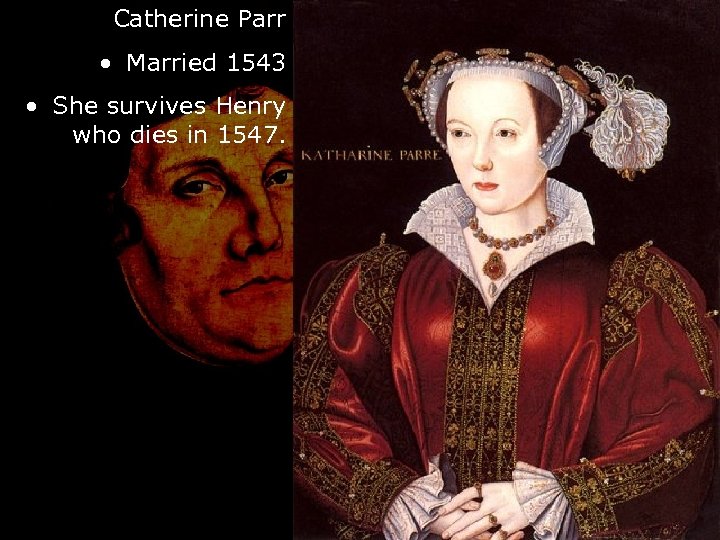 Catherine Parr • Married 1543 • She survives Henry who dies in 1547.
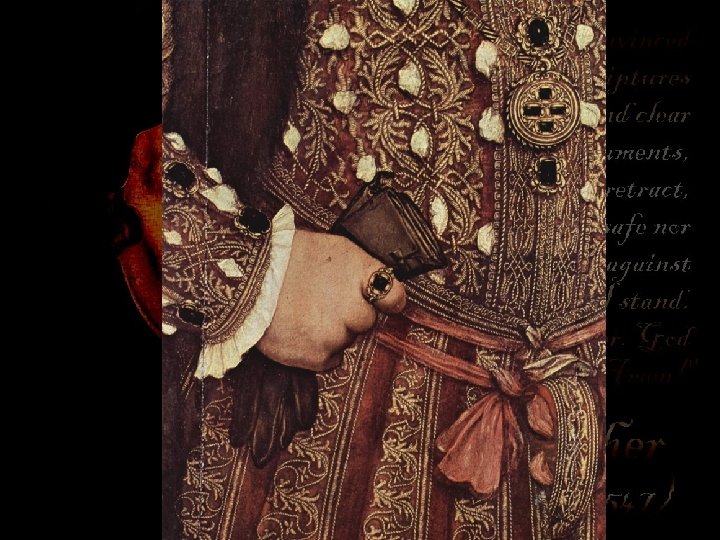
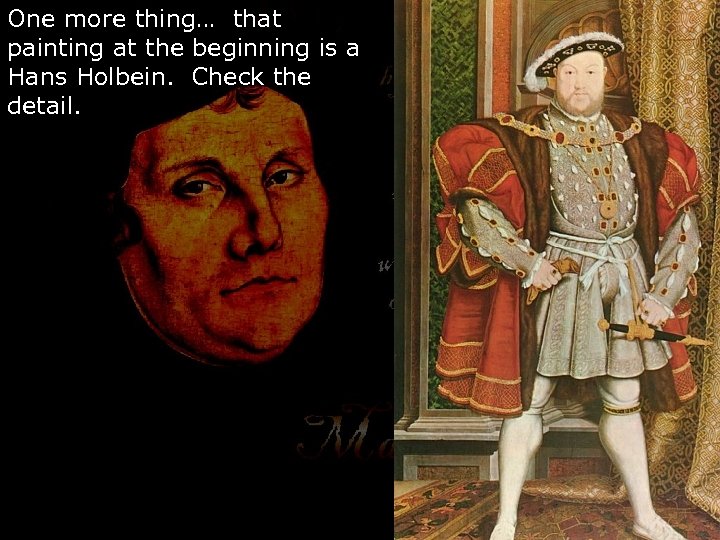 One more thing… that painting at the beginning is a Hans Holbein. Check the detail.
 His kids • So out of those six wives, Henry has three kids that make it out of infancy: • Mary by Catherine of Aragon • Elizabeth by Anne Boleyn • Edward by Jane Seymour. • This causes problems.
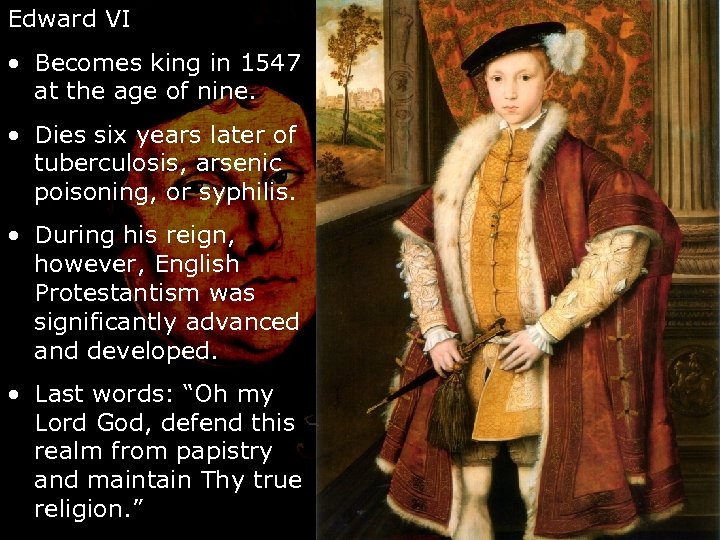 Edward VI • Becomes king in 1547 at the age of nine. • Dies six years later of tuberculosis, arsenic poisoning, or syphilis. • During his reign, however, English Protestantism was significantly advanced and developed. • Last words: “Oh my Lord God, defend this realm from papistry and maintain Thy true religion. ”
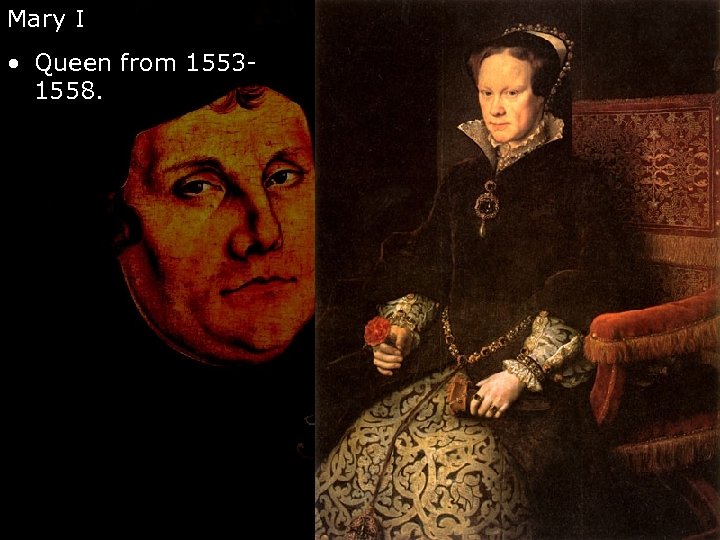 Mary I • Queen from 15531558.
 • Also known as Bloody Mary. • Or Mary, Queen of Scots • Mary was Catholic and she didn’t like the whole Protestant direction the country had been going in. • She turns England back toward Catholicism and has 300 dissenters executed. • She also considered herself the only legitimate child of Henry VIII. • Dies of probably ovarian cancer in 1558 at the age of 42.
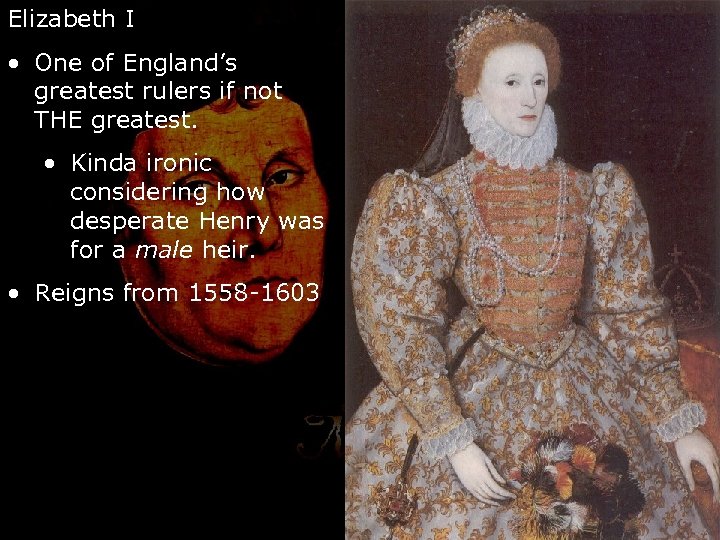 Elizabeth I • One of England’s greatest rulers if not THE greatest. • Kinda ironic considering how desperate Henry was for a male heir. • Reigns from 1558 -1603
 • She had a rough time of it early considering that her mother, Anne Boleyn, was beheaded when Elizabeth was only three. • The title of ‘princess’ was taken away from her. • Henry dies when she’s 13 and she goes to live with Catherine Parr. • She becomes fluent in English, Spanish, French, Italian, Latin, and Greek. • When she’s 21, she spends two months in the Tower of London (not a pleasant place) because she was implicated in an overthrow plot against Queen Mary.
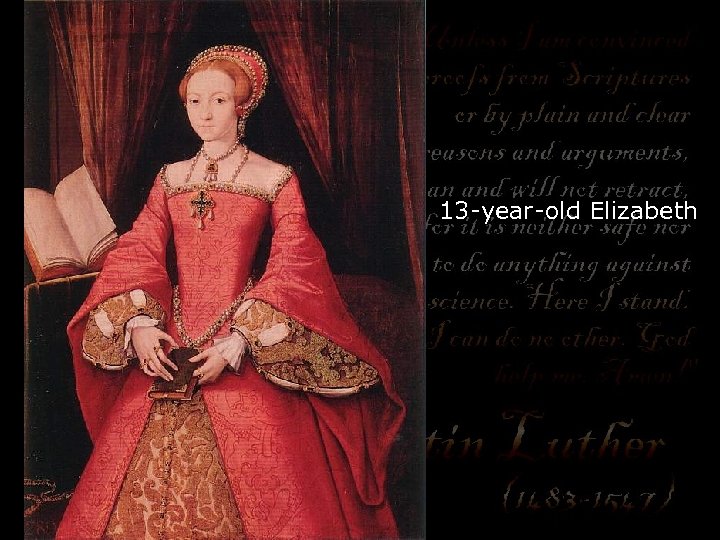 13 -year-old Elizabeth
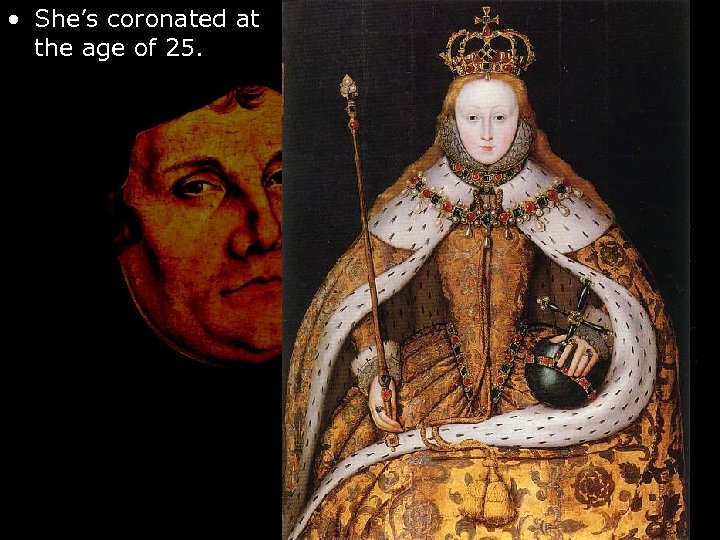 • She’s coronated at the age of 25.
 • Elizabeth steers the state back towards Protestantism and again breaks with the Roman Catholic Church. • Institutes various reforms, such as allowing priests to marry, services would be in English and not Latin, vestments were somewhat simplified.