


 Скачать презентацию Marquee Science Technology Courses A successful example
ebde4c0422d0fa39fbd3acd9cd2cbff3.ppt
- Количество слайдов: 74
 Marquee Science & Technology Courses A successful example of crossdisciplinary course development Jordan Goodman Department of Physics University of Maryland November 2009
 National need for an understanding of science, technology, engineering, and math (STEM) Cannot be addressed only by educating future scientists The problem is deeper, more systemic, and solutions must extend to improved education for non-science majors.
 Discussion in the early spring of 07 UG Dean Donna Hamilton, Jim Gates, and JG Donna was concerned that many of our best students on campus never took science Many would “AP” out of science when they came in Many would be in majors like Business where more science wouldn’t be required Donna organized a group (~15) of interested people who meet in the spring
 Call for Proposals from Undergraduate Studies: Signature program that: Engages senior faculty Creatively addresses the challenge “Teach” the process of science Elucidate how science addresses world problems Satisfies General Education (CORE) expectations Has departmental and college support Deans picked from proposals Engages 100+ students
 How does science attack problems to which the answer is not known Most (virtually all) science courses we teach are about subjects that the answers are known Controversy is only presented historically and often parenthetically Conclusions are offered as if any reasonable person would have figure it out themselves Even subjects like relativity
 Summer 2007 – full day workshop Fall 2007 -Present The Faculty became a Learning Community Met regularly over lunch Reviewed and discussed best practices Shared ideas for engaging students in process of science Agreed upon common attributes of courses Developed learning goals and assessment measures Met with advisors to foster full course enrollment
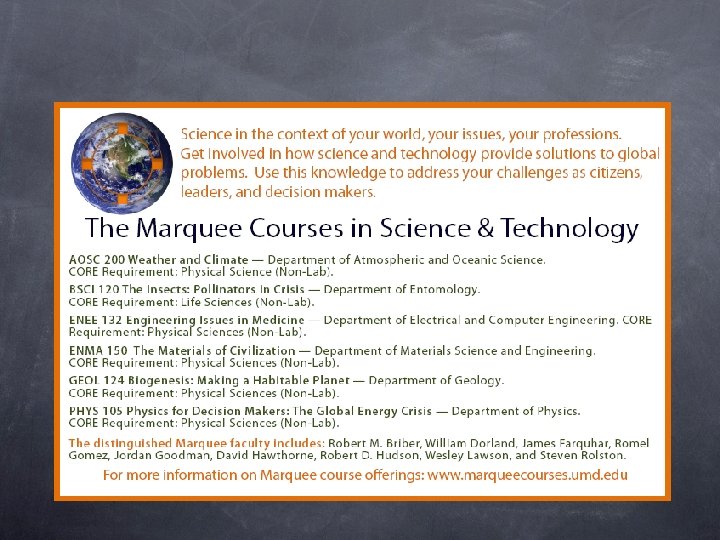
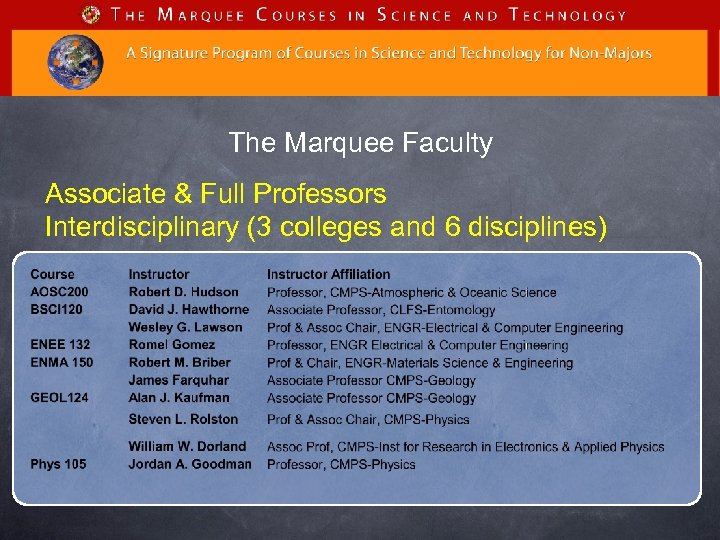 The Marquee Faculty Associate & Full Professors Interdisciplinary (3 colleges and 6 disciplines)
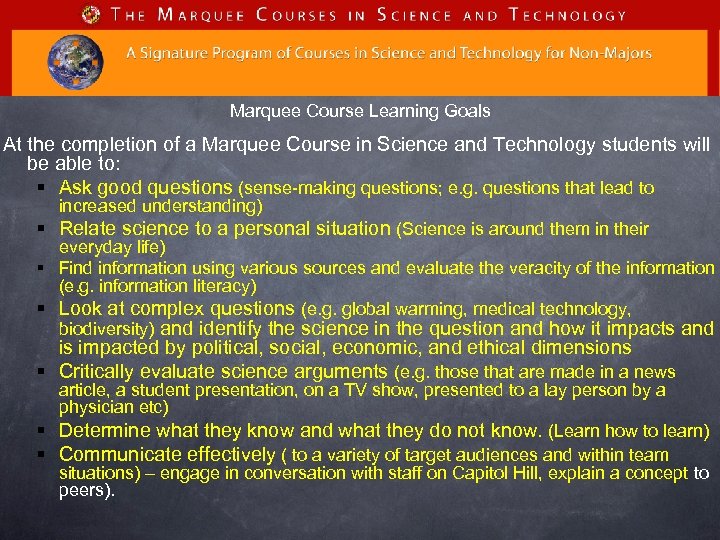 Marquee Course Learning Goals At the completion of a Marquee Course in Science and Technology students will be able to: § Ask good questions (sense-making questions; e. g. questions that lead to increased understanding) § Relate science to a personal situation (Science is around them in their § § § everyday life) Find information using various sources and evaluate the veracity of the information (e. g. information literacy) Look at complex questions (e. g. global warming, medical technology, biodiversity) and identify the science in the question and how it impacts and is impacted by political, social, economic, and ethical dimensions Critically evaluate science arguments (e. g. those that are made in a news article, a student presentation, on a TV show, presented to a lay person by a physician etc) Determine what they know and what they do not know. (Learn how to learn) Communicate effectively ( to a variety of target audiences and within team situations) – engage in conversation with staff on Capitol Hill, explain a concept to peers).
 Marquee Course Learning Goals At the completion of a Marquee Course in Science and Technology students will be able to: § Ask good questions (sense-making questions; e. g. questions that lead to increased understanding) § Relate science to a personal situation (Science is around them in their § § § everyday life) Find information using various sources and evaluate the veracity of the information (e. g. information literacy) Look at complex questions (e. g. global warming, medical technology, biodiversity) and identify the science in the question and how it impacts and is impacted by political, social, economic, and ethical dimensions Critically evaluate science arguments (e. g. those that are made in a news article, a student presentation, on a TV show, presented to a lay person by a physician etc) Determine what they know and what they do not know. (Learn how to learn) Communicate effectively ( to a variety of target audiences and within team situations) – engage in conversation with staff on Capitol Hill, explain a concept to peers).
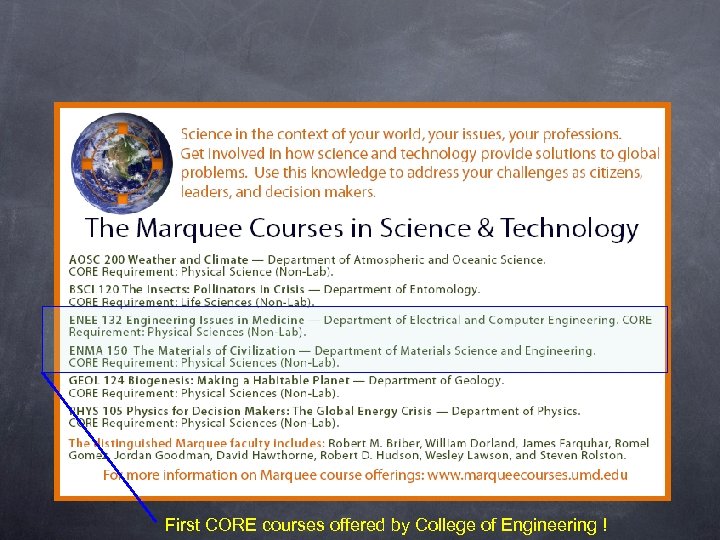 First CORE courses offered by College of Engineering !
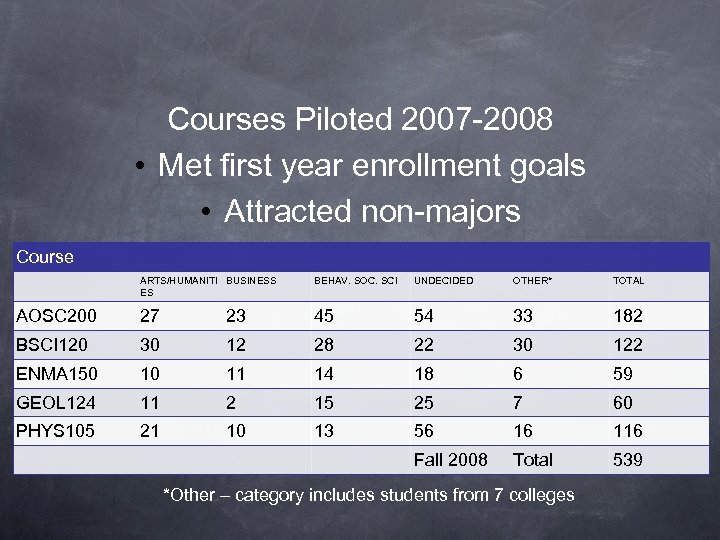 Courses Piloted 2007 -2008 • Met first year enrollment goals • Attracted non-majors Course ARTS/HUMANITI BUSINESS ES BEHAV. SOC. SCI UNDECIDED OTHER* TOTAL AOSC 200 27 23 45 54 33 182 BSCI 120 30 12 28 22 30 122 ENMA 150 10 11 14 18 6 59 GEOL 124 11 2 15 25 7 60 PHYS 105 21 10 13 56 16 116 Fall 2008 Total 539 *Other – category includes students from 7 colleges
 PHYS 105 Physics for Decision Makers: The Global Energy Crisis Steve Rolston Jordan Goodman Bill Dorland Dan Lathrop Department of Physics
 PHYS 105 Physics for Decision Makers: The Global Energy Crisis This topic could change: Energy Transportation Materials Space
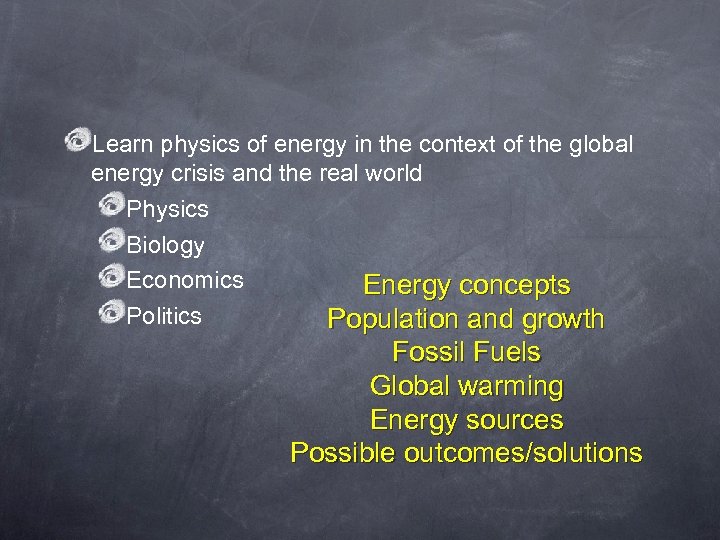 Learn physics of energy in the context of the global energy crisis and the real world Physics Biology Economics Energy concepts Politics Population and growth Fossil Fuels Global warming Energy sources Possible outcomes/solutions
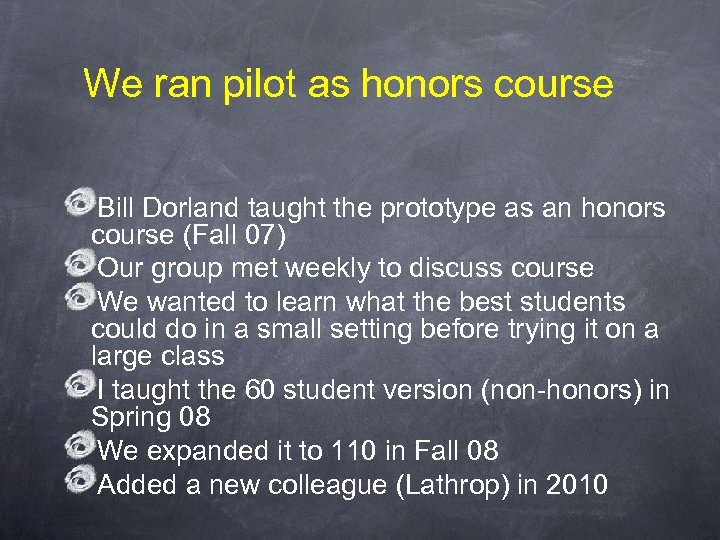 We ran pilot as honors course Bill Dorland taught the prototype as an honors course (Fall 07) Our group met weekly to discuss course We wanted to learn what the best students could do in a small setting before trying it on a large class I taught the 60 student version (non-honors) in Spring 08 We expanded it to 110 in Fall 08 Added a new colleague (Lathrop) in 2010
 Course structured with two 75 min. lectures and one 50 min. group (20 student) sections Extended group projects (4 -5 students) Expose students to technology Small group activities rather than traditional “recitation” sections
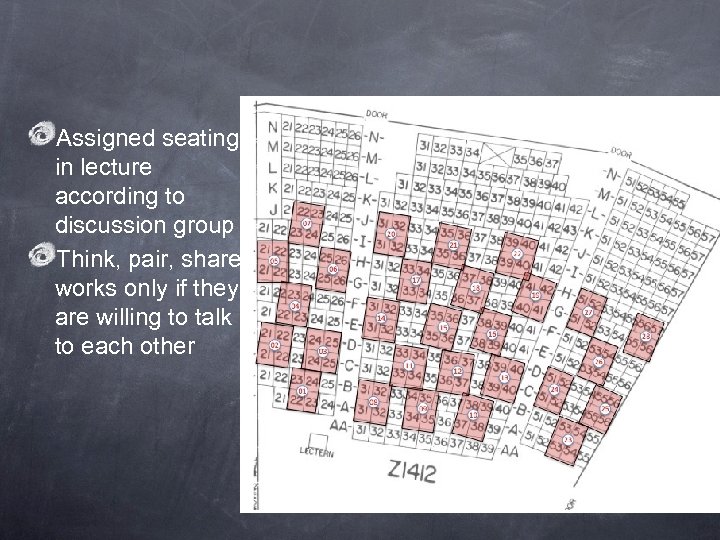 Assigned seating in lecture according to discussion group Think, pair, share works only if they are willing to talk to each other
 TA involvement and buy-in is essential This is a different kind of TA assignment I had two good TAs One got it The other… This was an excellent way for them to learn We are working on creating a Marquee TA program
 Energy Audit Project (major group activity) Students are given access to University web-based metering system for campus buildings Collect (real world) data Analyze a building usage with walkthrough Prepare a report for suggested energy savings Results are submitted onto a Wiki Power. Point final presentation
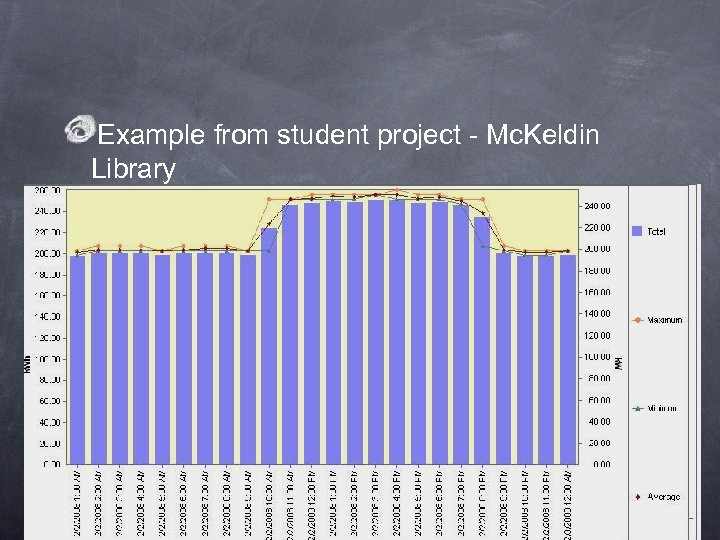 Example from student project - Mc. Keldin Library
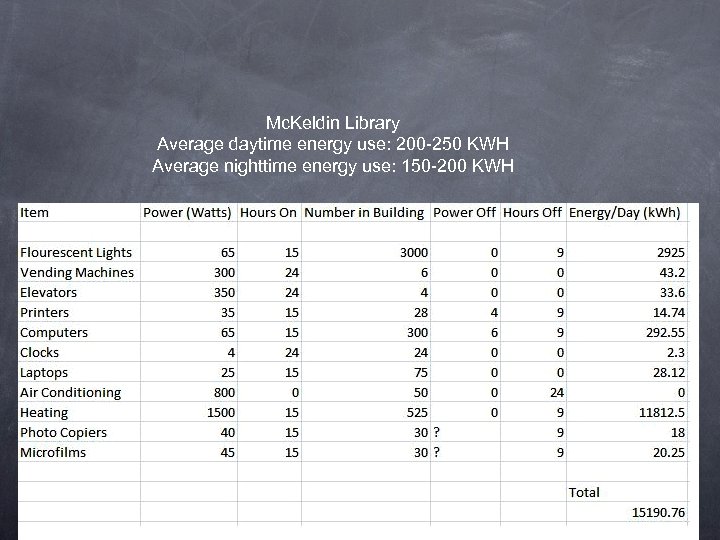 Mc. Keldin Library Average daytime energy use: 200 -250 KWH Average nighttime energy use: 150 -200 KWH
 Example discussion section activity Carbon Reduction Treaty Your challenge is to negotiate a treaty to reduce global carbon emissions by 50% by the year 2030. To simplify, we divide the world (and your class) into two groups, developed countries (represented by the US) and developing countries (represented by China). You should consider each other’s needs and consequences to quality of life as you negotiate (remember that negotiation is the art of compromise). Listed below are various facts about each country to help you in formulating your arguments. Of the 50% reduction, how much should come from the US and how much from China? Do the Chinese have the “right” to use as much energy person as we do in the US?
 Keep it current Homework included investigating Mc. Cain/Obama energy policies Visit campus Co-generation plant Discussion of current events Science Politics Read IPCC report Guest speakers Campus Conservation Manager House Science Committee Staffer
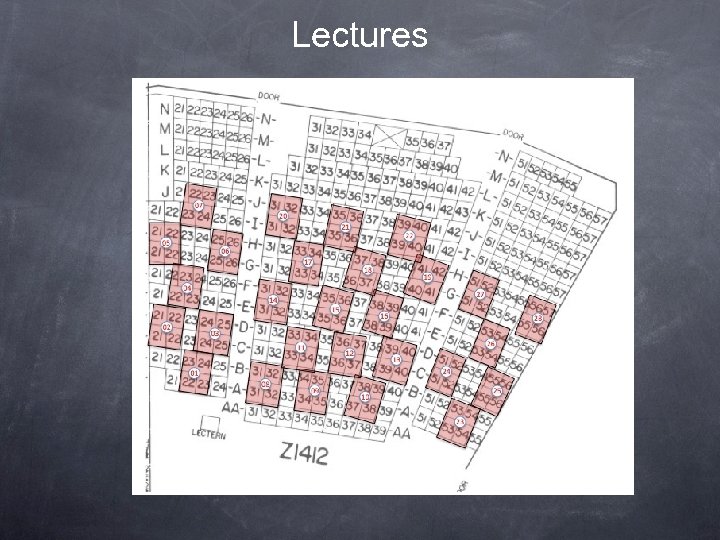 Lectures
 Sample lecture topic
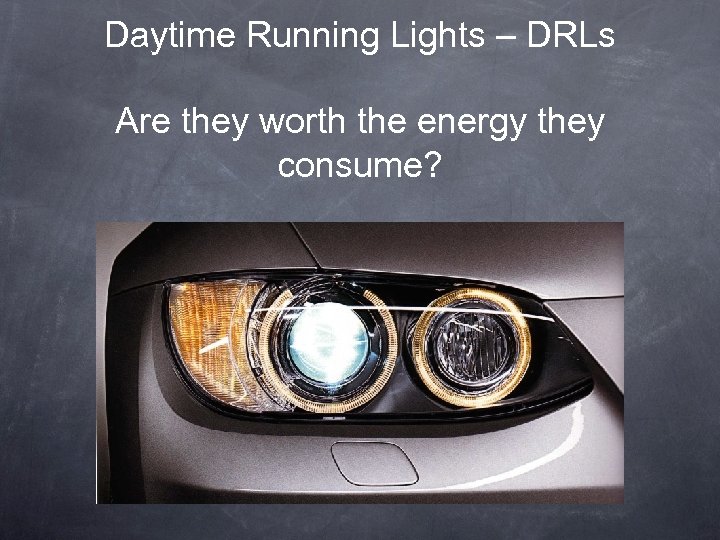 Daytime Running Lights – DRLs Are they worth the energy they consume?
 Energy Usage by Daytime Running Lights How do we figure it out? Estimate how much power 1 pair uses Then figure out how many cars there are Estimate how many hours DRLs would be on per car Put it together and get the energy usage Compare this to their benefits
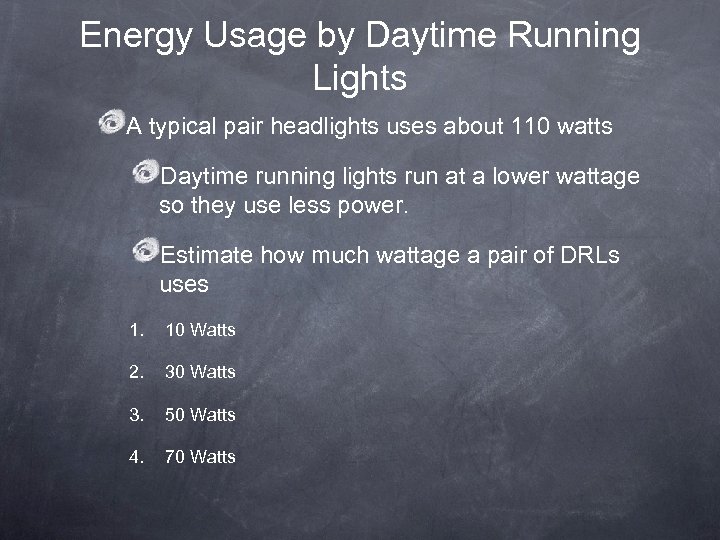 Energy Usage by Daytime Running Lights A typical pair headlights uses about 110 watts Daytime running lights run at a lower wattage so they use less power. Estimate how much wattage a pair of DRLs uses 1. 10 Watts 2. 30 Watts 3. 50 Watts 4. 70 Watts
 Energy Usage by Daytime Running Lights How many cars are there in the US? First we should ask: How many people are there in the US? 1. 100 Million 2. 300 Million 3. 500 Million 4. 700 Million 5. 1 Billion
 Energy Usage by Daytime Running Lights How many cars are there in the US? 300 Million People (adults and children) How many families? 1. 50 Million 2. 75 Million 3. 100 Million 4. 150 Million 5. 200 Million
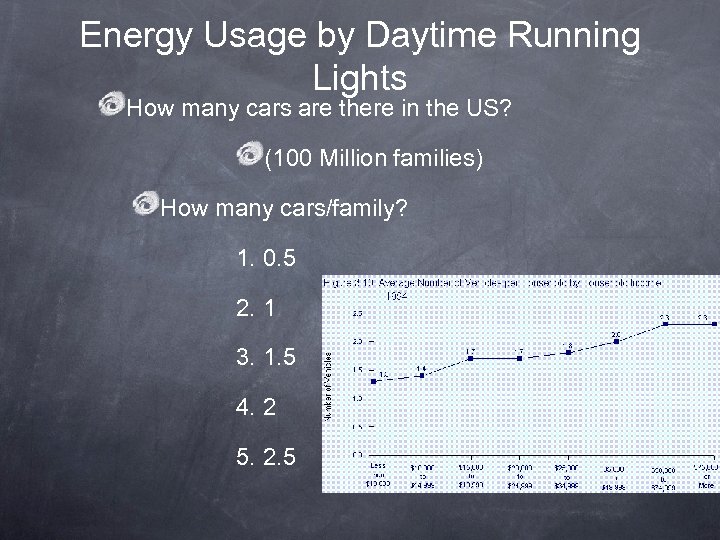 Energy Usage by Daytime Running Lights How many cars are there in the US? (100 Million families) How many cars/family? 1. 0. 5 2. 1 3. 1. 5 4. 2 5. 2. 5
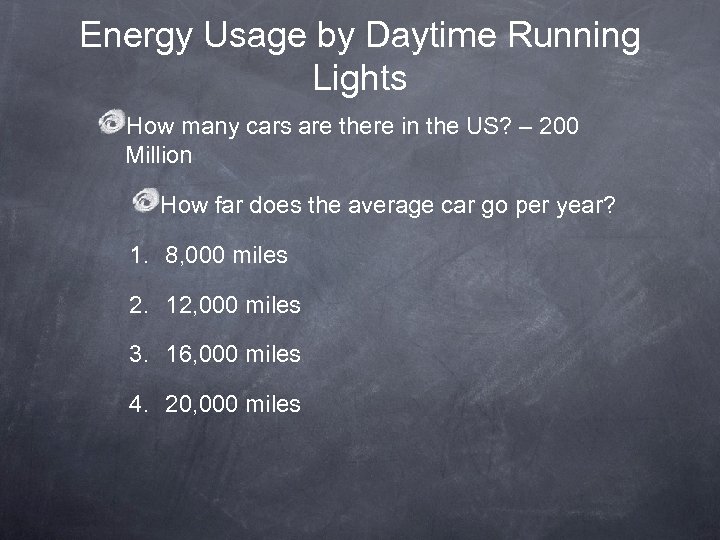 Energy Usage by Daytime Running Lights How many cars are there in the US? – 200 Million How far does the average car go per year? 1. 8, 000 miles 2. 12, 000 miles 3. 16, 000 miles 4. 20, 000 miles
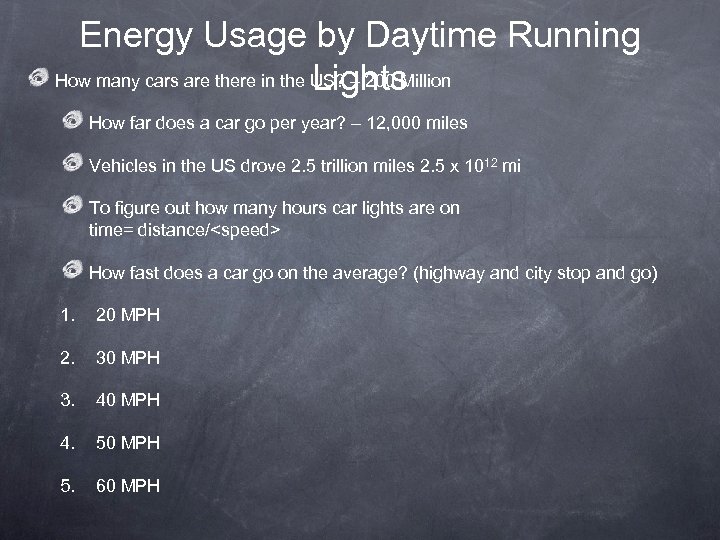 Energy Usage by Daytime Running How many cars are there in the US? – 200 Million Lights How far does a car go per year? – 12, 000 miles Vehicles in the US drove 2. 5 trillion miles 2. 5 x 10¹² mi To figure out how many hours car lights are on time= distance/
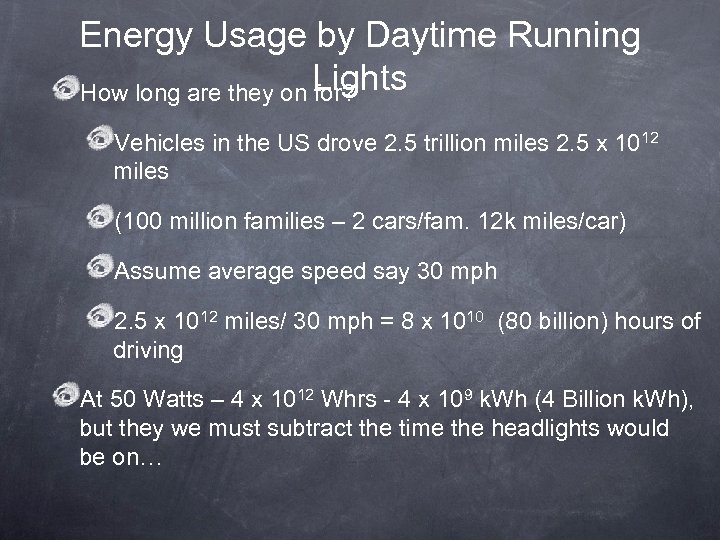 Energy Usage by Daytime Running Lights How long are they on for? Vehicles in the US drove 2. 5 trillion miles 2. 5 x 10¹² miles (100 million families – 2 cars/fam. 12 k miles/car) Assume average speed say 30 mph 2. 5 x 10¹² miles/ 30 mph = 8 x 10¹⁰ (80 billion) hours of driving At 50 Watts – 4 x 10¹² Whrs - 4 x 10⁹ k. Wh (4 Billion k. Wh), but they we must subtract the time the headlights would be on…
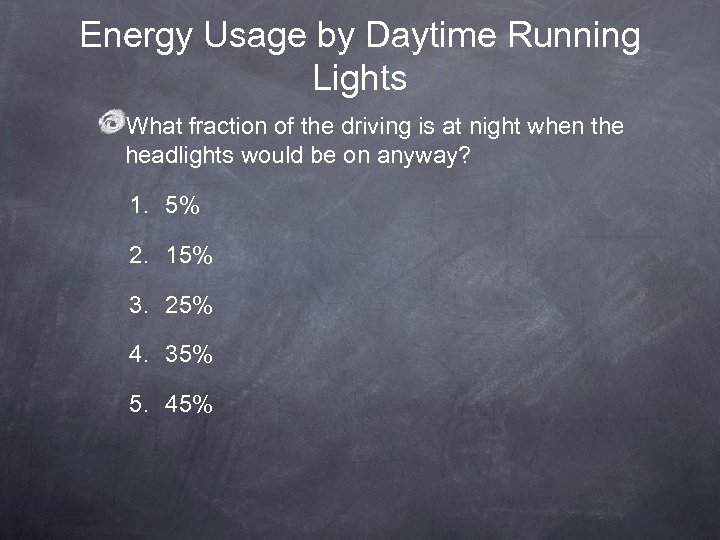 Energy Usage by Daytime Running Lights What fraction of the driving is at night when the headlights would be on anyway? 1. 5% 2. 15% 3. 25% 4. 35% 5. 45%
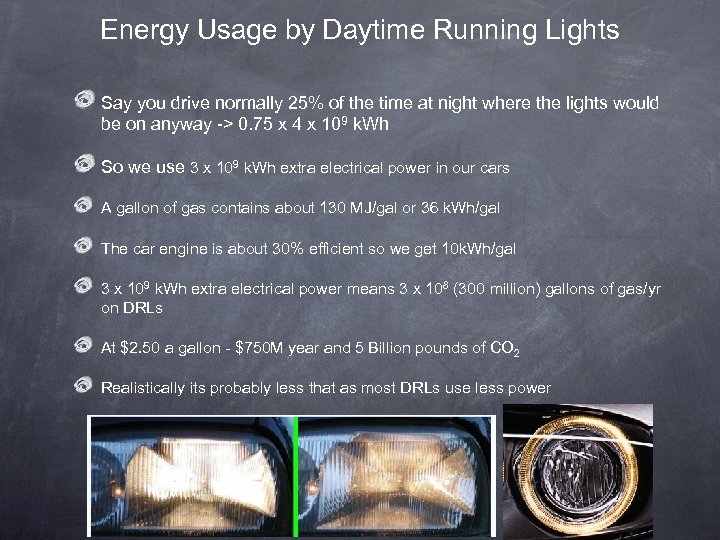 Energy Usage by Daytime Running Lights Say you drive normally 25% of the time at night where the lights would be on anyway -> 0. 75 x 4 x 109 k. Wh So we use 3 x 10⁹ k. Wh extra electrical power in our cars A gallon of gas contains about 130 MJ/gal or 36 k. Wh/gal The car engine is about 30% efficient so we get 10 k. Wh/gal 3 x 10⁹ k. Wh extra electrical power means 3 x 10⁸ (300 million) gallons of gas/yr on DRLs At $2. 50 a gallon - $750 M year and 5 Billion pounds of CO 2 Realistically its probably less that as most DRLs use less power
 Are they worth it?
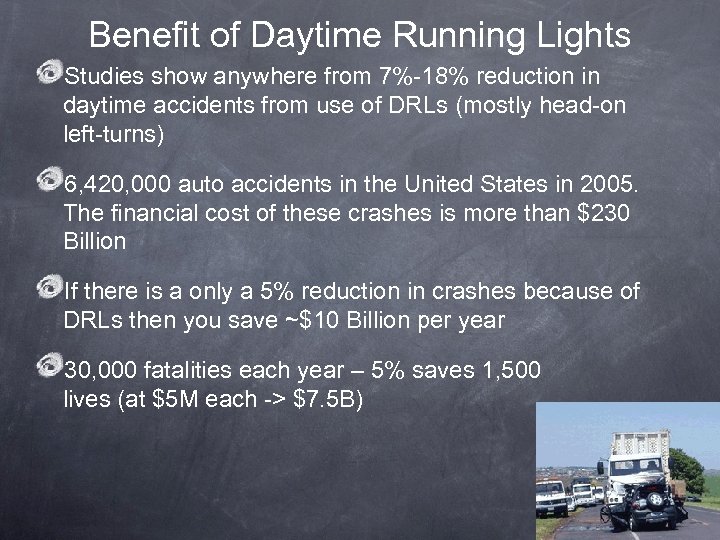 Benefit of Daytime Running Lights Studies show anywhere from 7%-18% reduction in daytime accidents from use of DRLs (mostly head-on left-turns) 6, 420, 000 auto accidents in the United States in 2005. The financial cost of these crashes is more than $230 Billion If there is a only a 5% reduction in crashes because of DRLs then you save ~$10 Billion per year 30, 000 fatalities each year – 5% saves 1, 500 lives (at $5 M each -> $7. 5 B)
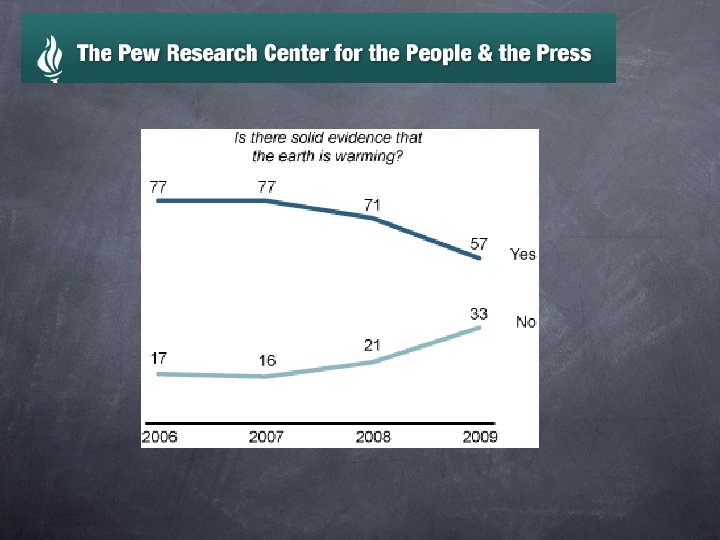
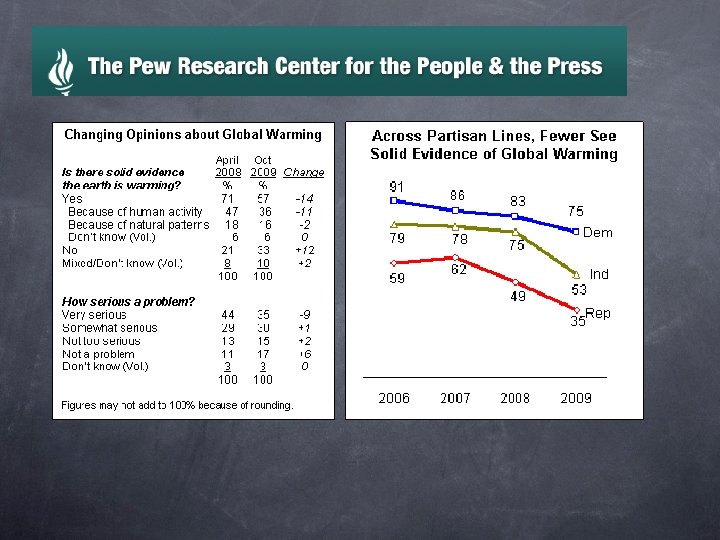
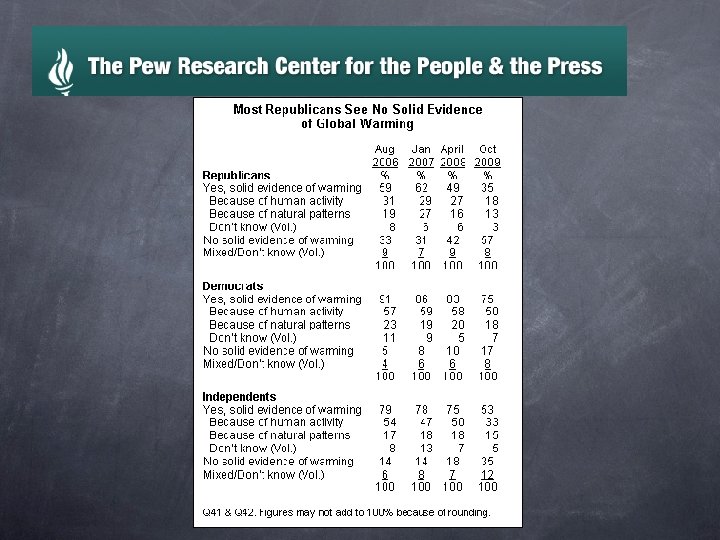
 Students were asked: Why the trend? “The economy has displaced global warming from the news” “It’s the scientists fault for not being definitive enough” Why, since this is a scientific question, do the responses break down on party lines? Dems want green industries Republicans want to protect big business They get their news from different sources
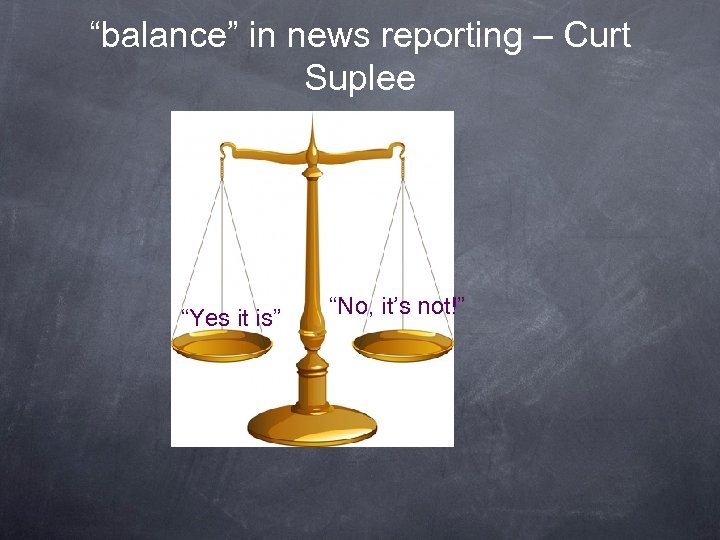 “balance” in news reporting – Curt Suplee “Yes it is” “No, it’s not!”
 One nut = biased coverage
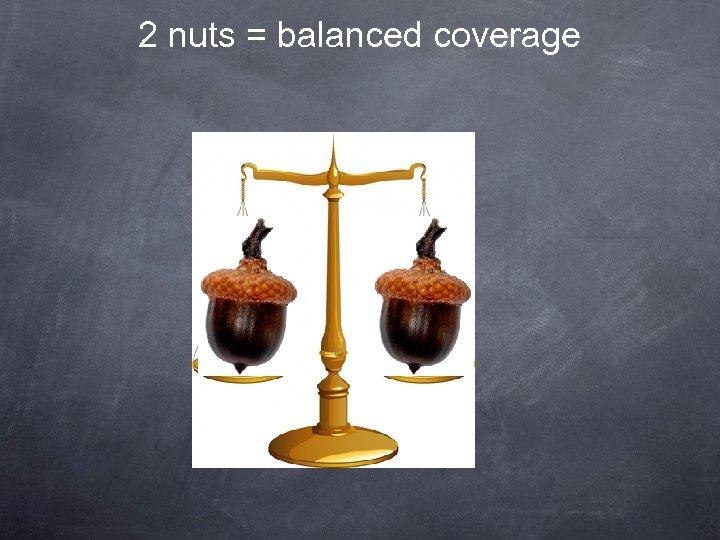 2 nuts = balanced coverage
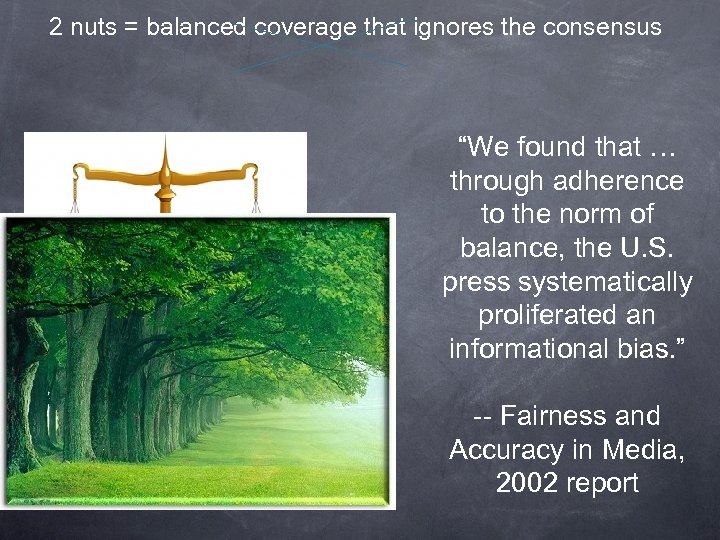 2 nuts = balanced coverage that ignores the consensus “We found that … through adherence to the norm of balance, the U. S. press systematically proliferated an informational bias. ” -- Fairness and Accuracy in Media, 2002 report
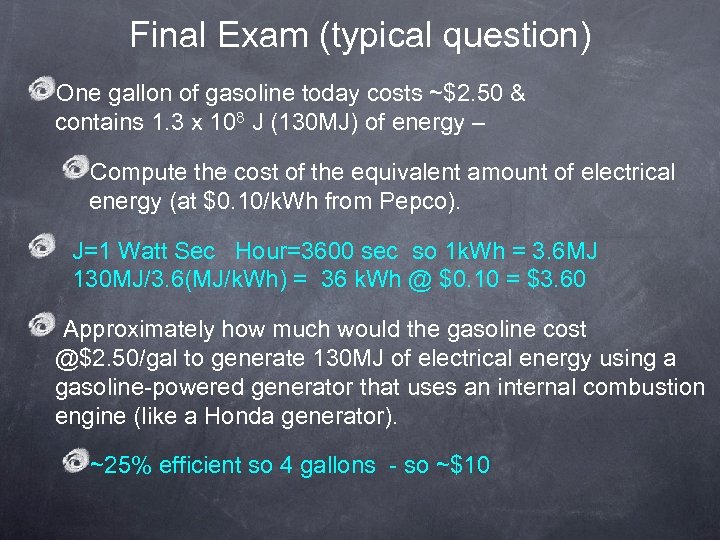 Final Exam (typical question) One gallon of gasoline today costs ~$2. 50 & contains 1. 3 x 10⁸ J (130 MJ) of energy – Compute the cost of the equivalent amount of electrical energy (at $0. 10/k. Wh from Pepco). J=1 Watt Sec Hour=3600 sec so 1 k. Wh = 3. 6 MJ 130 MJ/3. 6(MJ/k. Wh) = 36 k. Wh @ $0. 10 = $3. 60 Approximately how much would the gasoline cost @$2. 50/gal to generate 130 MJ of electrical energy using a gasoline-powered generator that uses an internal combustion engine (like a Honda generator). ~25% efficient so 4 gallons - so ~$10
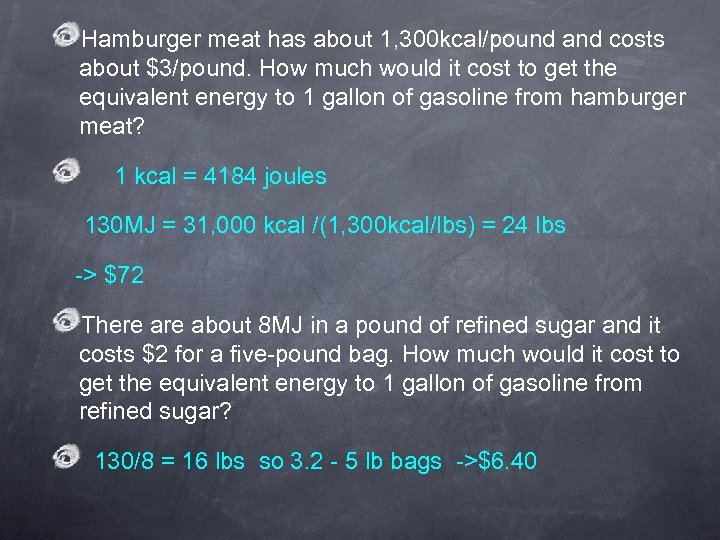 Hamburger meat has about 1, 300 kcal/pound and costs about $3/pound. How much would it cost to get the equivalent energy to 1 gallon of gasoline from hamburger meat? 1 kcal = 4184 joules 130 MJ = 31, 000 kcal /(1, 300 kcal/lbs) = 24 lbs -> $72 There about 8 MJ in a pound of refined sugar and it costs $2 for a five-pound bag. How much would it cost to get the equivalent energy to 1 gallon of gasoline from refined sugar? 130/8 = 16 lbs so 3. 2 - 5 lb bags ->$6. 40
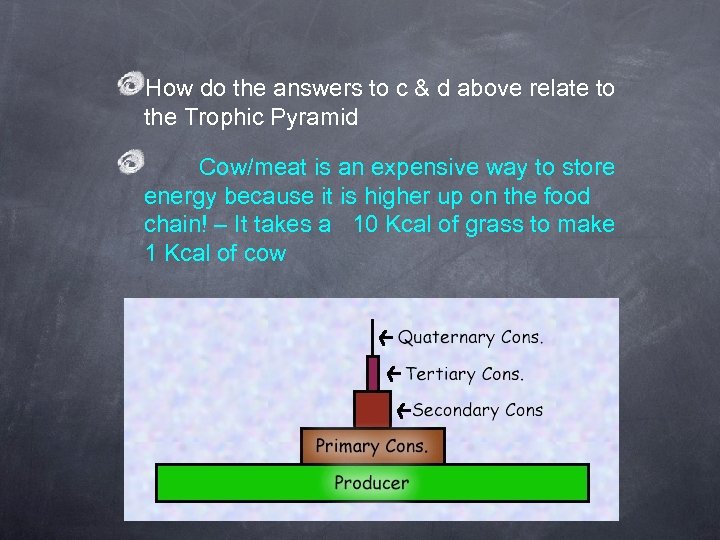 How do the answers to c & d above relate to the Trophic Pyramid Cow/meat is an expensive way to store energy because it is higher up on the food chain! – It takes a 10 Kcal of grass to make 1 Kcal of cow
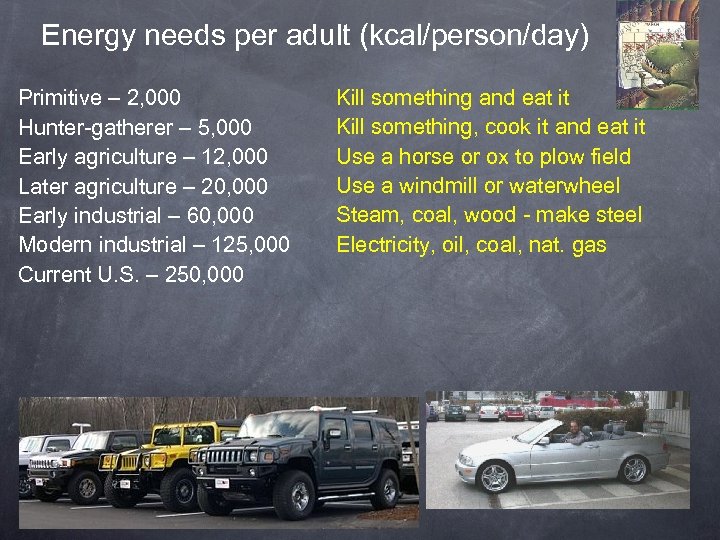 Energy needs per adult (kcal/person/day) Primitive – 2, 000 Hunter-gatherer – 5, 000 Early agriculture – 12, 000 Later agriculture – 20, 000 Early industrial – 60, 000 Modern industrial – 125, 000 Current U. S. – 250, 000 Kill something and eat it Kill something, cook it and eat it Use a horse or ox to plow field Use a windmill or waterwheel Steam, coal, wood - make steel Electricity, oil, coal, nat. gas
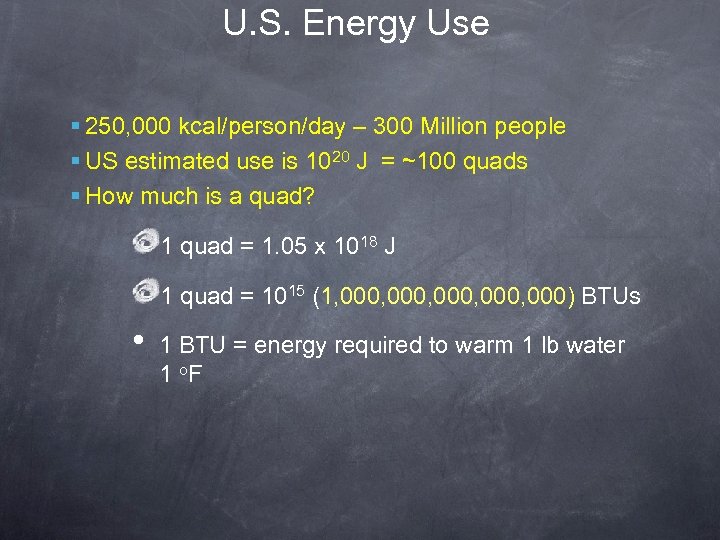 U. S. Energy Use § 250, 000 kcal/person/day – 300 Million people § US estimated use is 1020 J = ~100 quads § How much is a quad? 1 quad = 1. 05 x 1018 J 1 quad = 1015 (1, 000, 000) BTUs • 1 BTU = energy required to warm 1 lb water 1 o. F
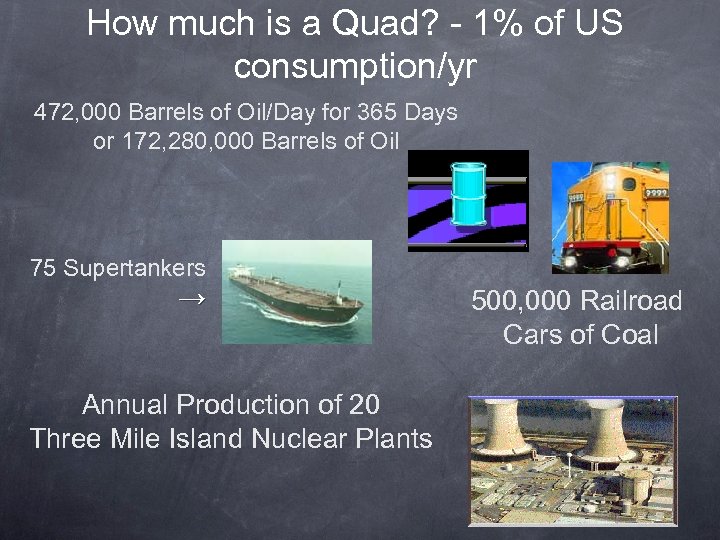 How much is a Quad? - 1% of US consumption/yr 472, 000 Barrels of Oil/Day for 365 Days or 172, 280, 000 Barrels of Oil 75 Supertankers → Annual Production of 20 Three Mile Island Nuclear Plants 500, 000 Railroad Cars of Coal
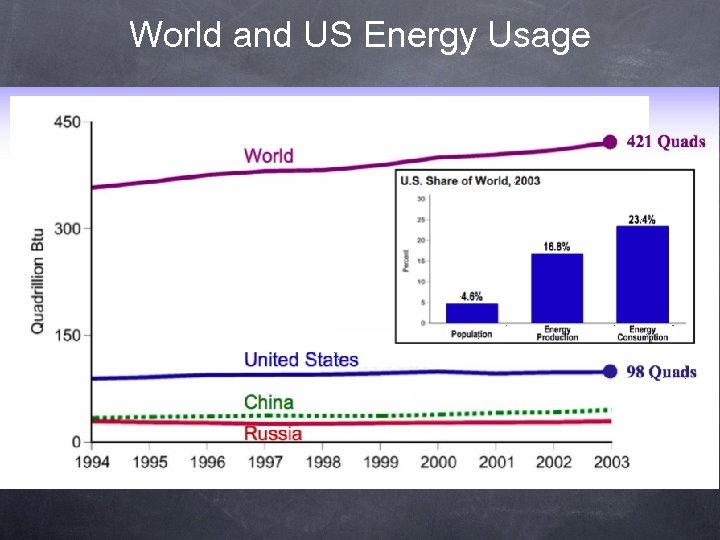 World and US Energy Usage
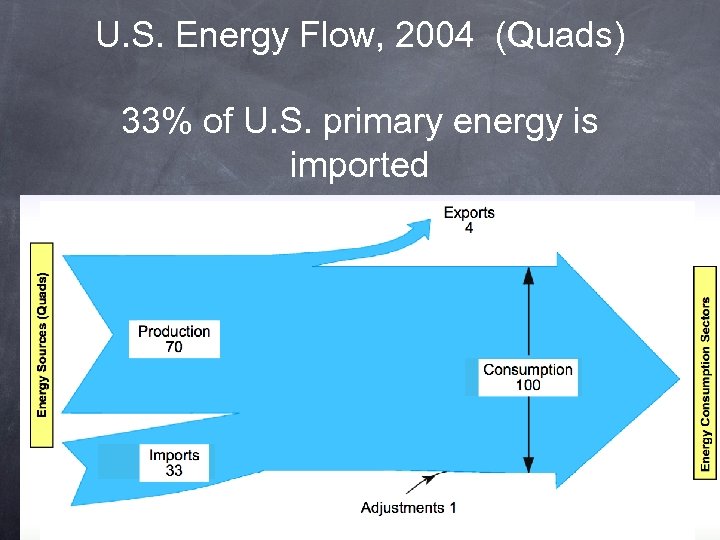 U. S. Energy Flow, 2004 (Quads) 33% of U. S. primary energy is imported
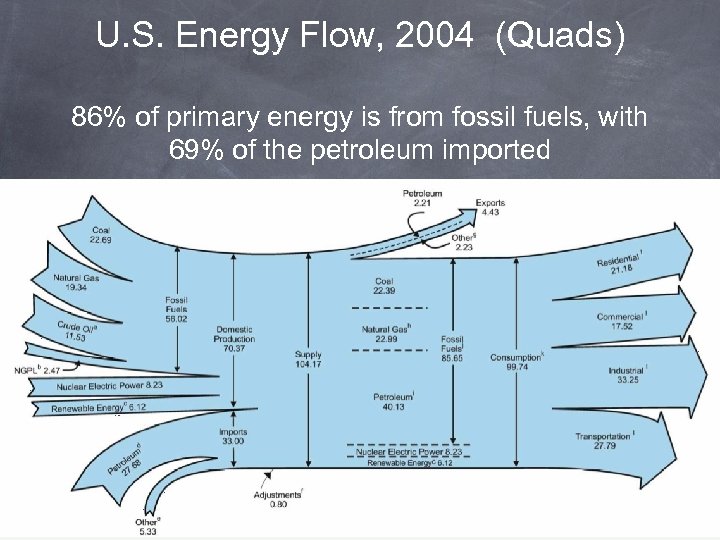 U. S. Energy Flow, 2004 (Quads) 86% of primary energy is from fossil fuels, with 69% of the petroleum imported
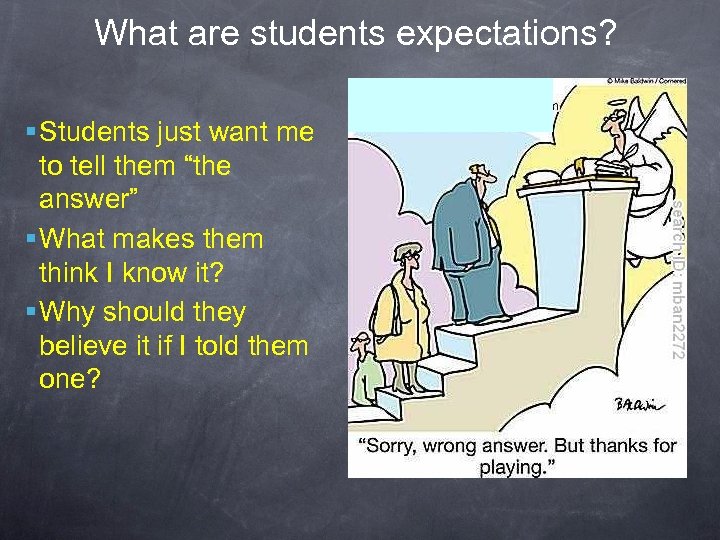 What are students expectations? § Students just want me to tell them “the answer” § What makes them think I know it? § Why should they believe it if I told them one?
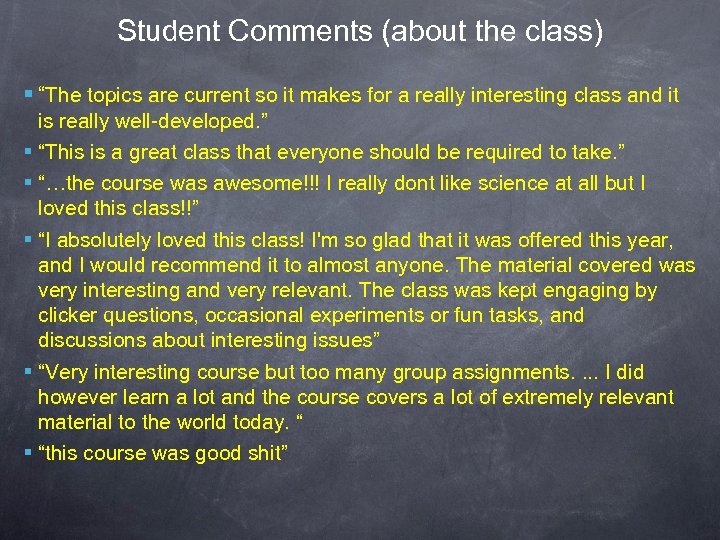 Student Comments (about the class) § “The topics are current so it makes for a really interesting class and it is really well-developed. ” § “This is a great class that everyone should be required to take. ” § “…the course was awesome!!! I really dont like science at all but I loved this class!!” § “I absolutely loved this class! I'm so glad that it was offered this year, and I would recommend it to almost anyone. The material covered was very interesting and very relevant. The class was kept engaging by clicker questions, occasional experiments or fun tasks, and discussions about interesting issues” § “Very interesting course but too many group assignments. . I did however learn a lot and the course covers a lot of extremely relevant material to the world today. “ § “this course was good shit”
 An aside on clickers § Facts (from my point of view) about clickers § Clickers work to keep the class engaged § Clickers work for attendance § Clickers can tell you what your class is thinking § Clickers can tell you when your class does or doesn’t understand a concept § Clickers can be royal pain in the ass for the teacher! Dealing with getting id #’s straight Dealing with lost/forgotten clickers Dealing with minor technical issues § Still I think they are worth the trouble
 The Bonus Question idea § A bonus point is given if the majority of the class gets the correct answer § Students need to convince their classmates § Only students who vote get the point, but it doesn’t matter if you are right or wrong § Lively discussions ensue
 What makes Marquee courses different from most other courses at the University? • The goals of the courses are independent of the subject matter – they are truly cross-disciplinary • The subject matter doesn’t drive the course • Community involvement in the process
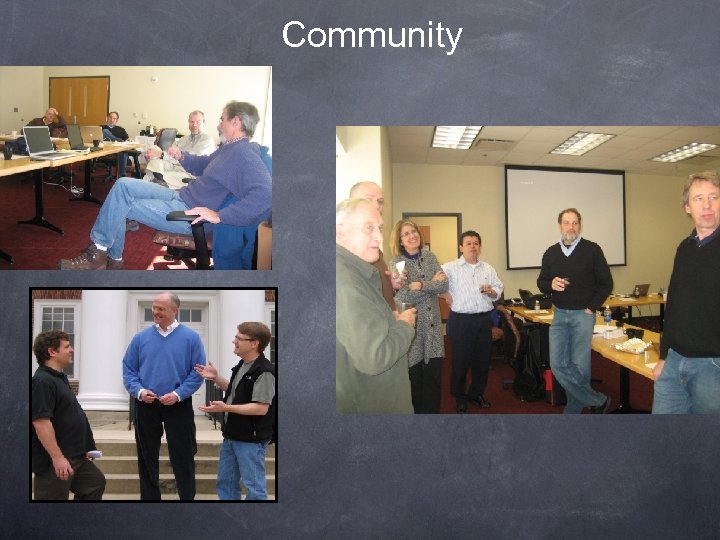 Community
 Community involvement in the process § Senior faculty § People used to collaboration § Strong institutional support – Donna, Ann, etc plus buy-in from the colleges § Community within the disciplines For Physics – Steve, Bill, and me – passed course to Dan Lathrop We plan to keep course changing within the goals of the course § This community provides innovative ideas and keeps the focus on the overall educational goals – rather than the subject material § Provides a focus for TAs
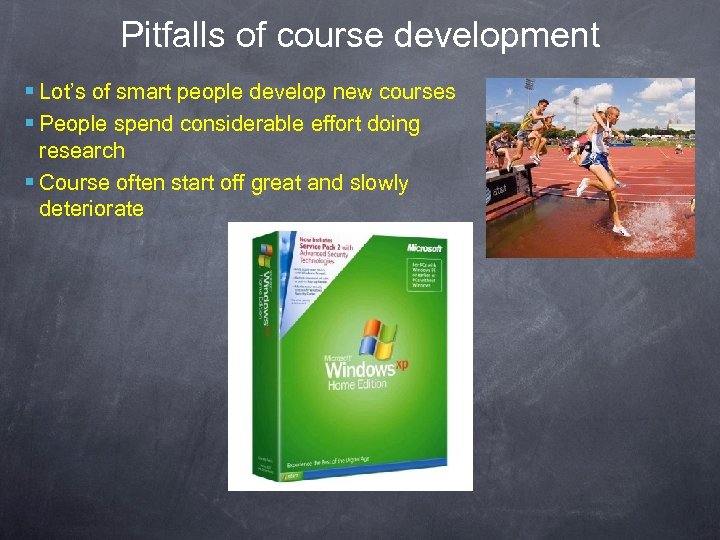 Pitfalls of course development § Lot’s of smart people develop new courses § People spend considerable effort doing research § Course often start off great and slowly deteriorate
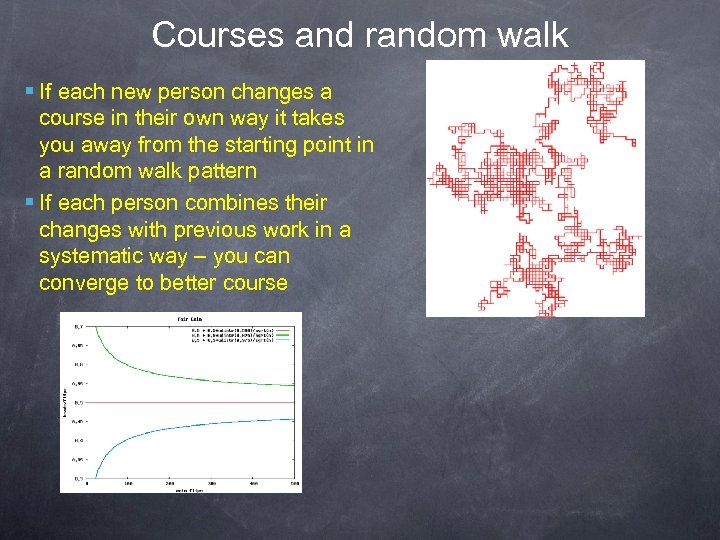 Courses and random walk § If each new person changes a course in their own way it takes you away from the starting point in a random walk pattern § If each person combines their changes with previous work in a systematic way – you can converge to better course
 The n+2 problem § Mathematical induction says if I can show something works for integers 0 or 1 and I can show it works for an arbitrary number n and that it also works for n+1 then it works for all integers n § In course development induction goes like this I can develop a course and show it works for me I can pass it on (successfully to the next person teaching it) Therefore it should work for everyone § But it doesn’t always work for n+2 and beyond
 § Example The n+2 problem Physics 261/271 – engineering lab Students complained like crazy – they hated the lab We did a study and found several major problems The pre-labs took forever because they were graded with more spread than the rest of the somewhat cookbook labs Students spent way too much time on this prelab We also found students were expected to take data, go home and figure it out and write it up They had no help at home from the TA
 § We changed the lab The n+2 problem We changed the grading of the prelabs to a 0, 10, 20 point system We put computers in the labs and had them do all their analysis in class We put in lab tests to see if they were actually learning the material and made them think about it… § We passed this course on to a colleague (who was very good). He came to us with questions “Why do this crazy prelab grading system? ” We had answers When he went to pass the course on (n+2) the next person had questions too – he didn’t have many of those answers Much of the research was lost
 Teaching as the opposite of science Science
 Another example § Physics 174 – a first lab course for Physics majors (1996) Course was created after a survey of faculty and students agreed on fundamental problems with our labs Students didn’t know how to make basic measurements or hook up simple circuits Students didn’t understand error analysis It was possible to miss the entire purpose of the course and get a “B” § The new lab was designed to solve these issues
 Physics 174 § One lab was designed to show them that they could fit data to any function by minimizing chi-squared § They took data with the digital scope fed it into a spreadsheet – then fit it § Several years ago I taught the lab for a colleague This lab had evolved so that the measurement was done differently and the objective which was the fitting was lost altogether. § Lesson – if you don’t make the educational objective clear, it may be lost…
 The software development model § Courses need to be “owned” by a Department or a group § Material changes should encouraged, but be vetted before they are permanently accepted § The software development model People write code and demonstrate it works They provide test data to show it works It’s checked into a library as the production version Other people can check out private copies and modify/improve it as they see fit Before it’s checked back in as the new
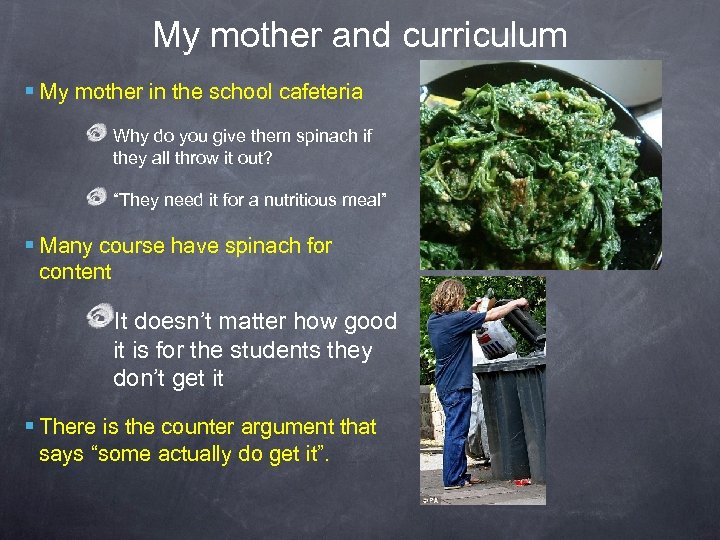 My mother and curriculum § My mother in the school cafeteria Why do you give them spinach if they all throw it out? “They need it for a nutritious meal” § Many course have spinach for content It doesn’t matter how good it is for the students they don’t get it § There is the counter argument that says “some actually do get it”.
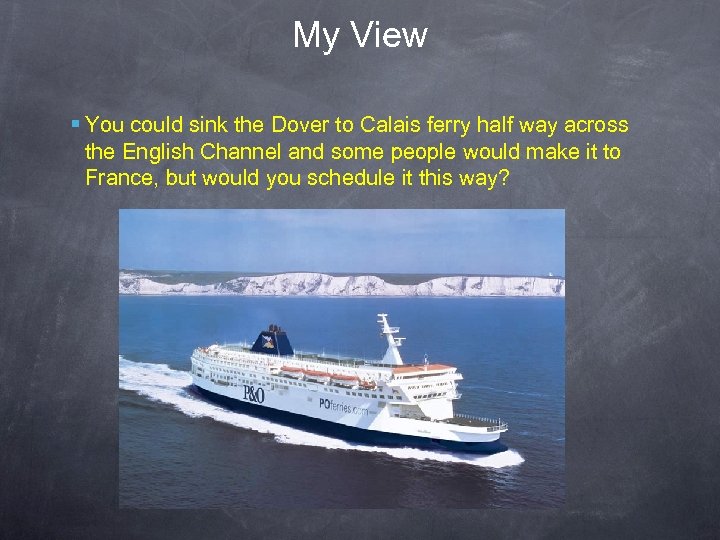 My View § You could sink the Dover to Calais ferry half way across the English Channel and some people would make it to France, but would you schedule it this way?