


 Скачать презентацию MARKETING Real People Real Choices Fourth Edition CHAPTER
fee400b520ab7e9931f9bbbafddfc8da.ppt
- Количество слайдов: 21
 MARKETING Real People, Real Choices Fourth Edition CHAPTER 15 Creating Value Through Supply Chain Management: Channels of Distribution, Logistics, and Wholesaling
 Place: The Final Frontier • Parity in product, promotion and price • Place offers opportunity for differentiation – E. g. Netflix, Walmart, I-tunes • Managing distribution can spell enormous cost savings and profits 2
 Supply Chain Management • The supply chain – firms involved in all activities from raw material procurement to delivering the final product to the consumer • Supply chain management – management of flows among the firms in a supply chain to maximize total profitability • E. g. Hewlett Packard (Identify the flows) 3
 What Is a Distribution Channel? • Series of firms or individuals that facilitate the movement of a product from the producer to the final customer – Direct – Indirect • Channel Intermediaries 4
 Functions of Distribution Channels • Time, place, and ownership utilities • Logistics functions – Transportation and storage • Efficiency creation – Breaking bulk – Creating assortments • Facilitating functions – Repairs and replacements – Credit and financing • Risk taking • Information flow & research 5
 Creating Efficiencies • Breaking bulk – channel members purchase large quantities from manufacturers and sell smaller quantities to many different customers • Creating assortments – channel members provide a variety of products in one location 6
 The Internet • Small firms selling products distributable over the Internet (e. g. software, music, books, magazines, newspapers, etc. ) • Small firms completing the sale over the Internet but outsourcing logistics and transportation functions • Disintermediation - process by which traditional intermediaries are eliminated 7
 Types of Wholesaling Intermediaries • Wholesaling intermediaries – firms that handle the flow of products from the manufacturer to retailer or business user – Independent • Merchant wholesalers (assume title and full risks, earn profits) • Agents and brokers (merely bring buyers and sellers together; earn commissions) – Manufacturer owned • Sales branches, offices and showrooms 8
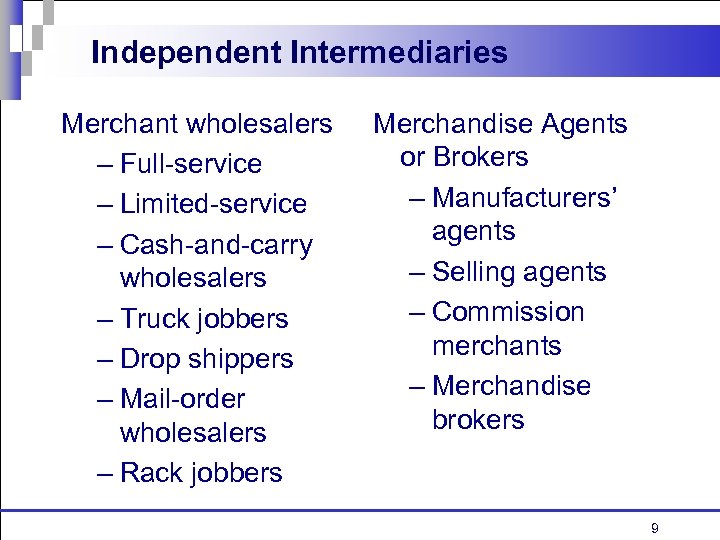 Independent Intermediaries Merchant wholesalers – Full-service – Limited-service – Cash-and-carry wholesalers – Truck jobbers – Drop shippers – Mail-order wholesalers – Rack jobbers Merchandise Agents or Brokers – Manufacturers’ agents – Selling agents – Commission merchants – Merchandise brokers 9
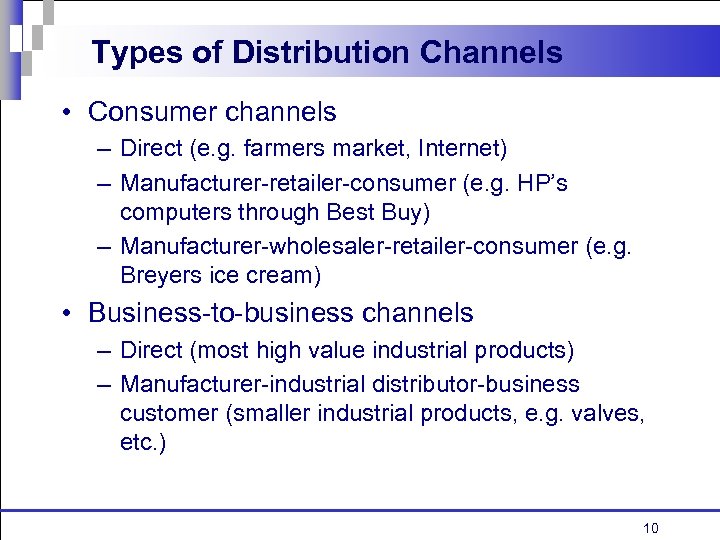 Types of Distribution Channels • Consumer channels – Direct (e. g. farmers market, Internet) – Manufacturer-retailer-consumer (e. g. HP’s computers through Best Buy) – Manufacturer-wholesaler-retailer-consumer (e. g. Breyers ice cream) • Business-to-business channels – Direct (most high value industrial products) – Manufacturer-industrial distributor-business customer (smaller industrial products, e. g. valves, etc. ) 10
 Dual Distribution Systems • Multiple channel usage • Example: – pharmaceutical industry sells to hospitals, clinics, and organizational customers directly and to consumers indirectly through drug retailers • Hybrid marketing systems – Using several channels at the same time 11
 Deciding on a channel strategy • Profit potential • Control over distribution, promotion and pricing • Resources availability 12
 Marketing Systems • Conventional – multi-level distribution channel in which members work independently of one another • Vertical – channel in which there is cooperation among channel members at two or more different levels of the channel • Horizontal – two or more firms at the same channel level agree to work together (e. g. Smaller stores in Walmart; banks inside grocery stores) 13
 Vertical Marketing Systems • Administered – channel members remain independent but voluntarily work together • Corporate – single firm owns manufacturing, wholesaling, and retailing operations (e. g. Sears) • Contractual – cooperation is enforced by contracts that spell out member rights and the terms of cooperation (e. g. IGA food stores ; Ace Hardware) 14
 Contractual VMS • Wholesaler-sponsored – wholesalers get retailers to work together under their leadership in a voluntary chain (e. g. IGA) • Retailer-cooperative – group of retailers with a wholesaling operation to help them compete more effectively with large chains (e. g. True Value Hardware) • Franchise organizations – cooperation is explicitly defined and strictly enforced by franchiser (e. g. Mc. Donalds) 15
 Distribution Intensity • Intensive distribution – Maximize coverage by using all available outlets (e. g. gum, sodas, milk, bread, etc. ) • Exclusive distribution – Limited outlets in a region – Generally for high priced products (e. g. cars, jewelry, pianos, etc. ) • Selective distribution – In between (e. g. house hold appliances, electronic equipment, etc. ) 16
 Managing the Channel • Selecting channel partners • Managing the channel of distribution – Channel leader is the dominant firm that controls the channel (channel captain) – Channel leaders have some form of power relative to other members 17
 Logistics and Customer Satisfaction • Traditionally, logistics was thought of as physical distribution – order processing, warehousing, materials handling, transportation, and inventory control – objective to deliver product at lowest cost • Now, deliver products at the lowest cost provided, expected service quality is maintained 18
 Logistics Functions • • • Order processing Warehousing Materials handling Transportation Inventory Control 19
 Transportation Mode Considerations • • • Dependability Cost Speed of Delivery Accessibility Capability Traceability 20
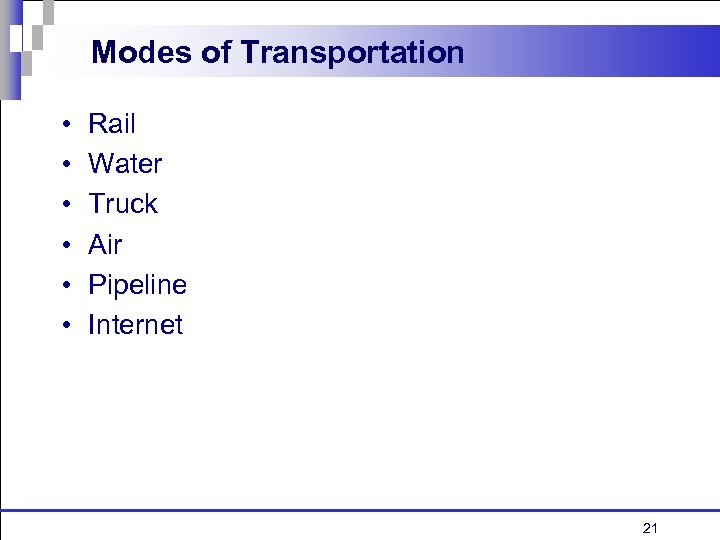 Modes of Transportation • • • Rail Water Truck Air Pipeline Internet 21