


 Скачать презентацию Marketing on the Internet E-Marketing 2 nd Edition
83760303b7dfcba02951b7305ba40a5d.ppt
- Количество слайдов: 65
 Marketing on the Internet E-Marketing (2 nd Edition) Judy Strauss & Raymond Frost Chapter 1 © Prentice Hall 2001
 Chapter 1: Introduction to E-Marketing
 Learning Objectives w Marketing Review – Describe the marketing planning process – Define the marketing concept – Explain the value proposition w Describe the new rules for e-marketing. w Discuss the components of e-business. w Compare and contrast marketing and e-marketing.
 Learning Objectives w Define Internet, Web, intranet, extranet, and corporate portal, and hub. w Identify several e-marketing challenges and opportunities. w Discuss the characteristics of the Net’s two generations. w Name and describe e-marketing models for each of the 4 P strategies.
 The Yahoo! Story Click here Yahoo. com w Marketing Concept: Meeting organizational goals while serving customers needs w Currently has 500, 000 sites classified into 25, 000 categories w Currently the most popular site on the Internet. w 3, 566 advertisers and merchants use Yahoo! w New Rules for E-Marketing
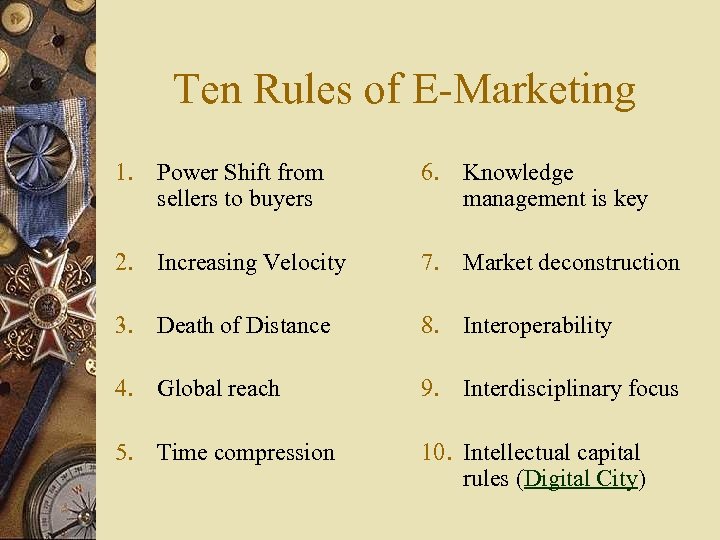 Ten Rules of E-Marketing 1. Power Shift from sellers to buyers 6. Knowledge management is key 2. Increasing Velocity 7. Market deconstruction 3. Death of Distance 8. Interoperability 4. Global reach 9. Interdisciplinary focus 5. Time compression 10. Intellectual capital rules (Digital City)
 Its’ Bigger Than the Internet w Electronic marketing reaches far beyond the web. w Examples: – – Email and Newsgroups Web TV, Cell Phones, and text-only browsers Bar Code Scanners Cable Modem and DSL connections
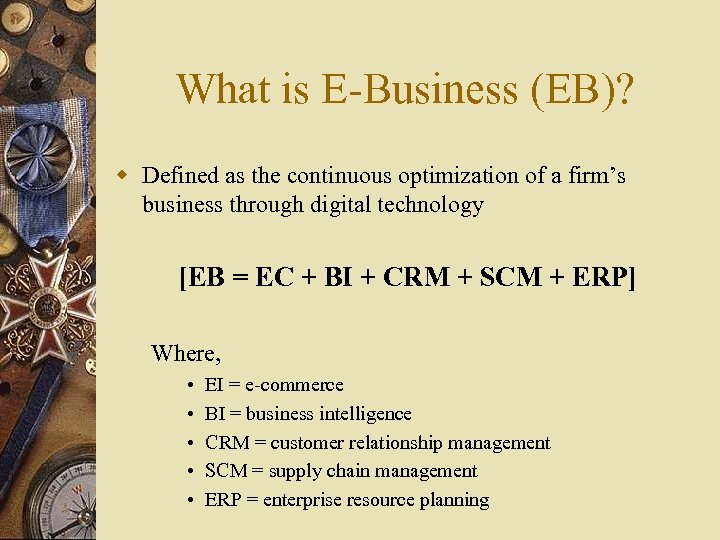 What is E-Business (EB)? w Defined as the continuous optimization of a firm’s business through digital technology [EB = EC + BI + CRM + SCM + ERP] Where, • • • EI = e-commerce BI = business intelligence CRM = customer relationship management SCM = supply chain management ERP = enterprise resource planning
 E-Business continued w EC - uses digital technologies to enable buying/selling w BI - collecting primary/secondary information w CRM - strategy to satisfy customers and build longlasting relationships; high interaction with customers w SCM – delivery of products efficiently and effectively; high interaction with distributors w ERP – optimize business processes and lowering costs – Order entry and purchasing – Invoicing and inventory control
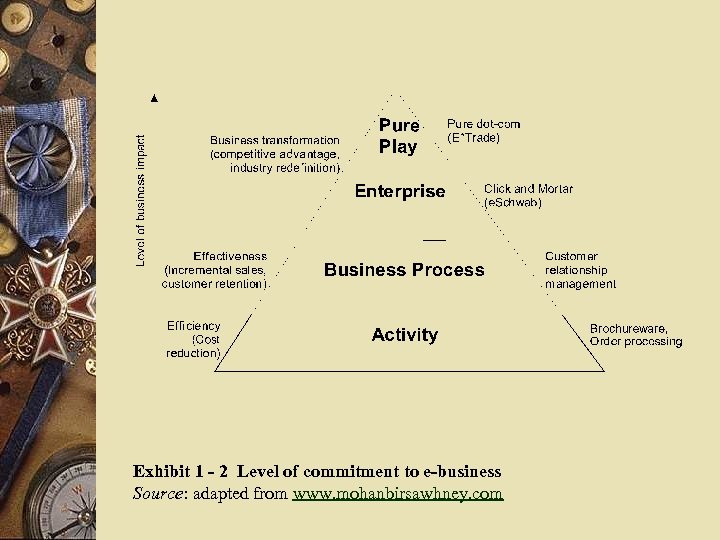 Exhibit 1 - 2 Level of commitment to e-business Source: adapted from www. mohanbirsawhney. com
 What is E-Marketing? w Marketing: – Use of 4 “P’s” to meet customer’s needs w E-Marketing: – Use of technology to increase efficiency of marketing – Increases company profitability and adds customer value
 The Big Picture w Too much digital technology creates: – Decreasing cultural/language differences – Workaholism; less family time – Social class divisions because of high literacy requirements w Digital economies are interdisciplinary – Marketing, MIS/CIS, Finance, Strategists – Human Resources, Production/Operations
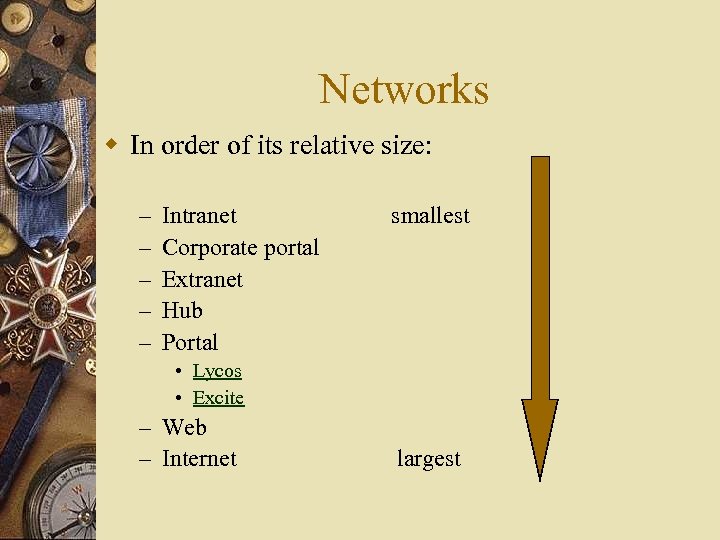 Networks w In order of its relative size: – – – Intranet smallest Corporate portal Extranet Hub Portal • Lycos • Excite – Web – Internet largest
 The Internet w Statistics: Forrester. com; ACNielsen w Computer Industry Almanac estimates that worldwide users will reach 490 million by 2002; and the US is estimated to reach 165 million users w In 2001, consumer online advertising will grow only 25%, while email and promotions will grow 100% and 38%, respectively. w By 2002, E-Commerce may exceed $1. 2 trillion w 15 million virtual grocery shoppers predicted by 2007
 End of the Beginning w High growth, but negative profits w Fewer E-Companies truly succeed – E. Schwab. com w Must rely on traditional marketing strategies w Dot-com drop-outs and mergers occurring w E-business drops the ‘e’ as electronic business is the way things will be done
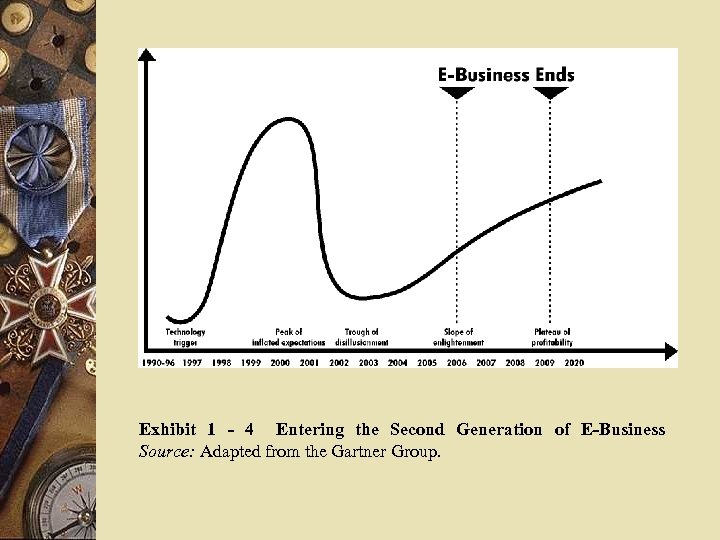 Exhibit 1 - 4 Entering the Second Generation of E-Business Source: Adapted from the Gartner Group.
 E-Marketing Challenges and Opportunities w Markets w Revenge of the Consumer w Businesses w Technology
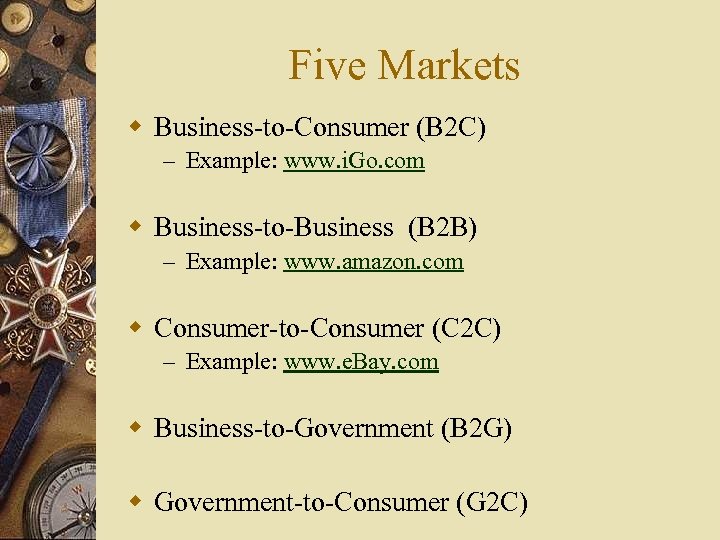 Five Markets w Business-to-Consumer (B 2 C) – Example: www. i. Go. com w Business-to-Business (B 2 B) – Example: www. amazon. com w Consumer-to-Consumer (C 2 C) – Example: www. e. Bay. com w Business-to-Government (B 2 G) w Government-to-Consumer (G 2 C)
 Revenge of the Consumer w 1930 s: – Caveat emptor (“let the buyer beware”) w 2000 s: – Consumers have control w What consumers want: – Privacy – To safeguard their children – Permission before being sent commercial email
 Businesses w Challenges: – Quality customer service – Information overload w Opportunities: – Ways of generating revenue – Greater interdependence in their value chain
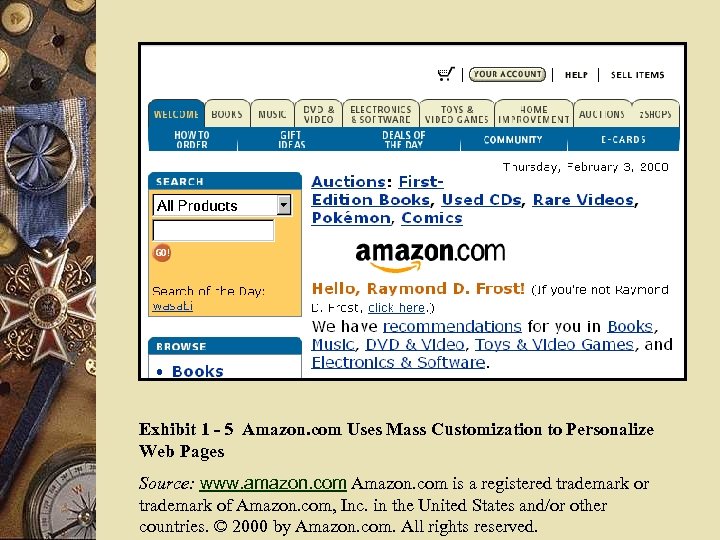 Exhibit 1 - 5 Amazon. com Uses Mass Customization to Personalize Web Pages Source: www. amazon. com Amazon. com is a registered trademark or trademark of Amazon. com, Inc. in the United States and/or other countries. © 2000 by Amazon. com. All rights reserved.
 Technology w Can lower costs on staff and paperwork w Can be a costly investment w Security issues w New payment instruments w Low bandwidth
 E-Marketing Delivers Value = Benefits – Costs w Value - customer perceptions of the product’s benefits w Benefits - attributes, brand name, etc… – Add benefits through mass customization and personalization w Costs - time, money, energy, and psychic – Lower costs through 24/7 convenience and one-stop shopping
 E-Business Model w A method of doing business that contributes to the firm’s profitability whether by increasing revenue or decreasing costs w Necessary for models to identify value for the customer
 Marketing Mix Components w Product w Price w Distribution w Marketing Communication w Relationship Marketing
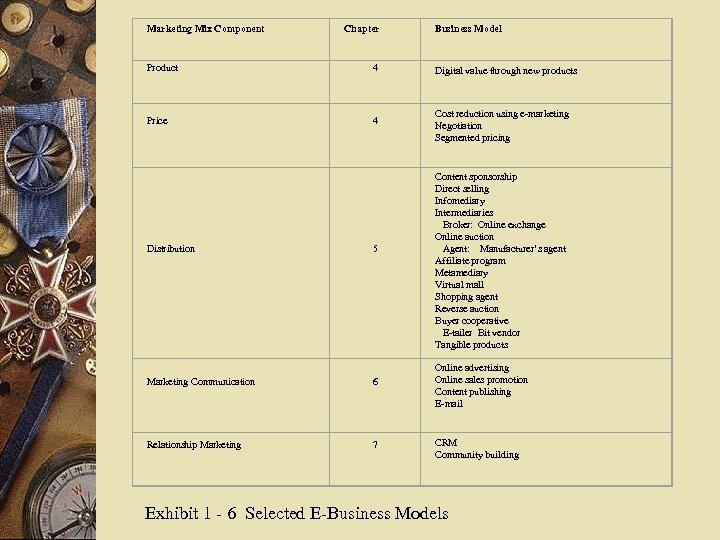 Marketing Mix Component Chapter Business Model Product 4 Digital value through new products Price 4 Cost reduction using e-marketing Negotiation Segmented pricing Distribution 5 Content sponsorship Direct selling Infomediary Intermediaries Broker: Online exchange Online auction Agent: Manufacturer’s agent Affiliate program Metamediary Virtual mall Shopping agent Reverse auction Buyer cooperative E-tailer Bit vendor Tangible products Marketing Communication 6 Online advertising Online sales promotion Content publishing E-mail Relationship Marketing 7 CRM Community building Exhibit 1 - 6 Selected E-Business Models
 Product w Through E-Marketing numerous new products emerged w Breakthrough software, hardware, and services that created digital value
 Price w Efficiencies have been manifested through E-Marketing w No need for a sales force with all order processing, billing and payments are transacted between customer and Website – Cost savings return a larger profit margin and lower prices
 Distribution w A primary E-Marketing application that creates customer value w New ways for selling and distributing products w Affects all manufacturers, service providers and intermediaries w Models: – – Content Sponsorship Model Direct Selling Model Infomediary Model Intermediaries Model
 Content Sponsorship Model w Companies create valuable content or services on their Websites w Self-advertising – Examples: • Yahoo! • g. URL. com
 Direct-Selling Model w Manufacturers eliminating channel intermediaries and sell directly to consumers w Known as “Disintermediation” w Dell Computers
 Infomediary Model w An organization that collects and sells information about consumers or businesses w Similar to a Market Research firm w Hoover’s
 Intermediary Model w Brokers and agents bring buyers and sellers together but neither purchase nor take possession of the actual products – Brokerage firms • E-Trade, E-Bay, Metalsite – Agent firms • Travelocity w E-tailers are firms that buy products and resell them online – “Click and mortar” stores – Example: E-Toys
 E-Marketing Communication w Accomplished through promotion mix elements: – – Advertising Sales Promotion Direct Marketing Public Relations w Models: – – Online Advertising Model Online Sales Promotion Model Content Publishing Model Email Model
 Online Advertising Model w Firms purchase advertising space on Websites owned by other firms w Does not include a firm’s own Website w Dogpile
 Online Sales and Promotion Model w Sampling digital products w Allows consumer to view products before purchasing w E-Music
 Content Publishing Model w A company’s Website w The displaying of a firm’s information about their product offerings on the Website to Internet users w Brochureware w Does not involve transactions w Directed towards stakeholders w Pure Fishing
 E-Mail Model w Three types: – Target Promotions • Companies target users through research and data mining to send e-mail • Bulk Email Software Marketing – Reverse Channel • User to firm • Customer service • Bass Pro Shops – Consumer-to-Consumer • Word of mouth
 Relationship Marketing w Customer Relationship Marketing (CRM) w E-Marketing is able to build long-term relationships due to: – – – Online FAQs Automatic e-mail responders Customized Websites Fax-on-demand Supply chains integrated with the firm’s functions w Model: – Community Building Model
 Community Building Model w Website developed to create a special interest community w Users may provide information for products or services w Bring consumer to concise location, making them more available for communication by a firm w Creates social bonds and enhances customer relationships w Ivillage
 Marketing Plan Tasks w Situation Analysis – Environmental Factors – Marketers collect and analyze external elements that include economic analysis, social and demographic trends, and more – Market opportunity analysis – This entails a supply and demand analysis along with a SWOT analysis. The SWOT analysis determines the strengths, weaknesses, opportunities, and threats. w Selecting Target Market – marketers select the type of customer they are looking to attract.
 Marketing Plan Tasks continued w Setting objectives – marketers set the objectives according to the firm’s mission and resources. w Designing marketing mix strategies – Develop product, pricing, distribution, and promotion strategies w Action Plan – Plan the actual marketing plan implementation w Budget – Set a budget for the marketing plan w Evaluation Plan – Continuously evaluate the plan to make sure objectives are met.
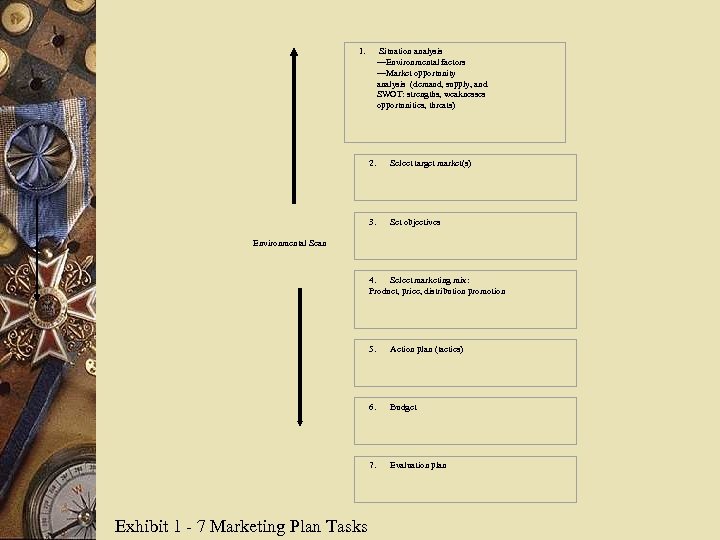 1. Situation analysis —Environmental factors —Market opportunity analysis (demand, supply, and SWOT: strengths, weaknesses opportunities, threats) 2. Select target market(s) 3. Set objectives Environmental Scan 4. Select marketing mix: Product, price, distribution promotion 5. Action plan (tactics) 6. Budget 7. Evaluation plan Exhibit 1 - 7 Marketing Plan Tasks
 Review Questions
 1. List the 10 new rules for e-marketing. Which in your mind is the most important and why?
 Question 1: · Power shift from sellers to buyers. · Increasing velocity. · Death of distance. · Global reach. · Time compression. · Knowledge management is key. · Market deconstruction. · Interoperability. · Interdisciplinary focus. · Intellectual capital rules. The most important is the first—Power shift from sellers to buyers. This is because it affects all marketing strategies. A good case probably can be made for each of the others, however.
 2. Define e-business and e-marketing
 Question 2: E-business is the continuous optimization of a firm’s business activities through digital technology. It involves attracting and retaining the right customers and business partners. It includes digital communication, e-commerce, online research, and it is used by every business discipline. The following formula is simply a graphical representation of important e-business components. EB = EC + BI + CRM + SCM + ERP E-marketing is the use of electronic data and applications for planning and executing the conception, distribution, promotion, and pricing of ideas, goods, and services to create exchanges that satisfy individual and organizational objectives. It affects traditional marketing by increasing efficiency in traditional marketing functions, and the technology of e-marketing transforms many marketing strategies.
 3. How many users are connected to the Internet worldwide? How many in the United States?
 Question 3: Approximately 266 million users are connected to the Internet worldwide and 122 million of those are in the United States. Note: This number will have increased since publication.
 4. Explain the difference between intranet, extranet, and corporate portal.
 Question 4: Intranet—A network that runs internally in a corporation but that uses Internet standards such as HTML and browsers. Extranet—An intranet to which value chain partners have admission for strategic reasons. Corporate Portal—A second-generation intranet. The goal of a corporate portal is to merge all of the employees’ information and communication needs into a single interface. Thus, corporate portals access internal documents, data warehouses, groupware, e-mail, and calendars, in addition to the Web. From largest to smallest: Extranet, Corporate Portal, Intranet. The latter two are usually proprietary to the firm’s employees, while an Extranet is open to a firm’s partners, customers, and other selected stakeholders.
 5. Explain the difference between a portal and a vertical portal. Give examples of each.
 Question 5: A portal is a point of entry to the Internet. Many portals such as Yahoo!, Lycos, and Excite were originally just search engines. What makes them portals is that they now provide many services in addition to searching. A vertical portal is a portal that specializes in one topic, market, or product area. An example is www. homearts. com that specializes in women’s issues concerning the home. Note: This review question requires outside research due to an omission in the text.
 6. Explain how a higher-priced item can deliver more value.
 Question 6: Value includes customer perceptions of the product’s benefits: specifically its attributes, brand name, and support services. Subtracted from benefits is the cost in acquiring the product: monetary, time, energy, and psychic. Higher priced items can deliver more value by adding more benefits or by lowering time, energy and psychic costs.
 7. What is a business model?
 Question 7: A business model is a method of doing business that contributes to the firm’s profitability either by increasing revenue or decreasing costs.
 8. How are business models related to customer value?
 Question 8: When firms decrease costs through e-marketing, they can pass this along to customers via lower prices. E-marketing can also lower costs by saving customers time and making it easier to purchase products. Many business models increase customer benefits, thus enhancing value.
 9. What is the difference between a broker and an agent?
 Question 9: Brokers and agents bring buyers and sellers together but neither purchase nor take possession of the products. Brokers assist in the negotiation and don’t actually represent either side, whereas agents tend to represent either the buyer or seller, taking a commission for their work.
 10. What are three ways in which e-mail can be used for marketing communication?
 Question 10: The first concerns e-mail to target promotions to specific users. The targeting can be very sophisticated—for example, targeting users when they are most receptive to a promotional offering based on data mining of past purchase patterns. The second form of e-mail is the reverse channel: from the user to the firm. The third form of e-mail is from consumer to consumer. This is the modern-day equivalent of word of mouth.
 The End.