


 Скачать презентацию Marketing of High-Technology Products and Innovations Chapter 8
209c88d4db9ce37d7ea5102594d0bfe1.ppt
- Количество слайдов: 42
 Marketing of High-Technology Products and Innovations Chapter 8: Distribution Channels and Supply Chain Management in High-Tech Markets
 Chapter Overview n n Channel Design and Management Channel Considerations in High-Tech Markets Adding New Channels: The Internet From Distribution Channels to Supply Chains © Mohr, Sengupta, Slater 2005
 Distribution Channels n Comprised of the various firms and players in the flow of product from producer to consumer n n n Manufacturers must manage flow of product Manufacturer must manage relationships between firms Distribution activities n n Logistics and physical distribution functions Structure and management of the channel © Mohr, Sengupta, Slater 2005
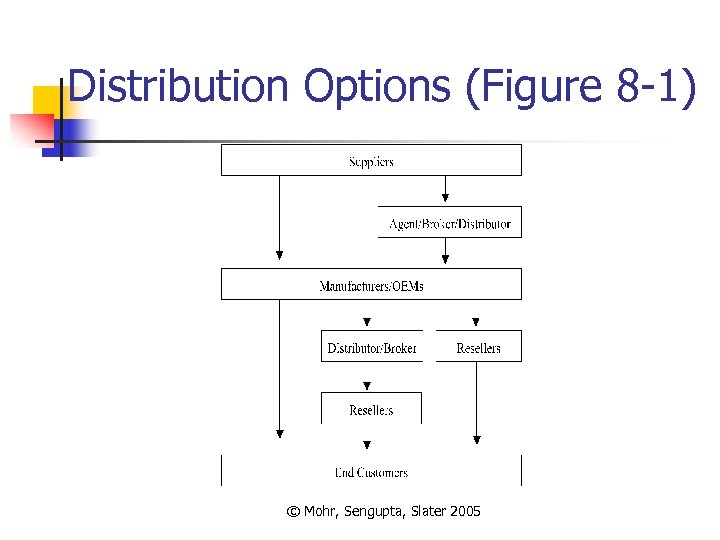 Distribution Options (Figure 8 -1) © Mohr, Sengupta, Slater 2005
 Issues in Distribution n Firms at different stages of the channel n n n May have conflicting goals and objectives Often don’t think in terms of joint problem solving Goal: Manage all functions to provide value to end customer n Meet customer needs in most effective/efficient mode possible © Mohr, Sengupta, Slater 2005
 Effective Channels n n n Identify redundancies that lead to inefficiency and conflict Develop relationships and alliances Work toward cost efficiency and customer satisfaction Rely on technology solutions Use channel members as partners © Mohr, Sengupta, Slater 2005
 Complexities in Managing High-Tech Channels n High value of products n n Rapid pace of market evolution n n Pressure to minimize inventory in channel Price pressures Need to maintain sales/service support Problems with piracy Complexities of the Internet as a new channel © Mohr, Sengupta, Slater 2005
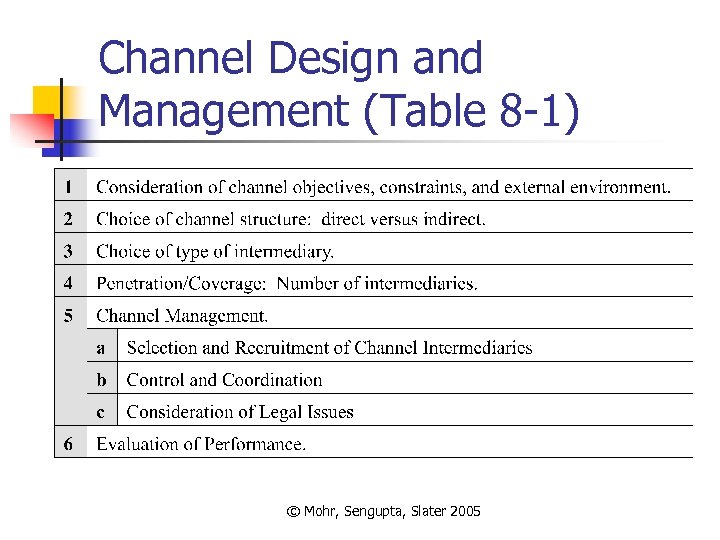 Channel Design and Management (Table 8 -1) © Mohr, Sengupta, Slater 2005
 Channel Objectives, Constraints, External Environment n Base channel design on consideration of n n n Customer behavior and needs Competitors’ channels Product characteristics © Mohr, Sengupta, Slater 2005
 Choice of Channel Structure n Direct: Manufacturer sells directly to end-users n n n Own sales force Company owned stores Internet Indirect: Manufacturer uses intermediaries to market, sell, deliver product to end-users Hybrid (“dual”) channel: direct + indirect © Mohr, Sengupta, Slater 2005
 Considerations in Choice of Channel Structure n Hybrid channel invites complexities n n n Indirect channels subject to less control As different channels compete for customers, conflict increases Direct channels may not be cheaper n Eliminate intermediary but not the functions © Mohr, Sengupta, Slater 2005
 Choice of Type of Intermediary n Resellers: between distributors and end-users n n n Typically local May customize for end-users Distributors n n Typically national Buy from manufacturer, sell to reseller or retailer © Mohr, Sengupta, Slater 2005
 Types of Resellers n VARs and VADs n n Systems Integrators n n Manage large or complex projects Inbound versus Outbound n n Purchase components from different manufacturers, customize for various vertical markets Has a store-front for walk-in traffic –ordealer sales force calls on customers Traditional intermediaries n Mass merchandisers, Category killers, small mom-andpop stores, franchises © Mohr, Sengupta, Slater 2005
 Penetration/Coverage: Number of Intermediaries n Coverage vs. Intra-brand competition n Price competition may damage manufacturer’s reputation, consumers’ perceived quality Dealers make lower margin, lowering incentive for service and support Vertical/territorial restrictions © Mohr, Sengupta, Slater 2005
 Channel Management n Recruit/select channel members n n Rely on trade shows, targeted direct mail, publicity, personal selling Control and coordination to manage, guide, and monitor reseller activities © Mohr, Sengupta, Slater 2005
 More on Control and Coordination Mechanisms n Authoritative controls n n n Ownership Formal centralized decision making (franchising) Power Bilateral controls focused on mutual interest (see next slide) Legal controls © Mohr, Sengupta, Slater 2005
 Bilateral Controls n Relational norms (shared expectations) to work together n n n Flexibility Mutual sharing of benefits/burdens Information sharing Joint interdependence and commitment Trust © Mohr, Sengupta, Slater 2005
 Legal Controls n Tying n n n Sale of popular product linked to second product Bundled rebates Exclusive Dealing n n n Dealer can carry only one manufacturer’s product Designed to ensure incentive for service Antitrust issues arise if access to competition restricted © Mohr, Sengupta, Slater 2005
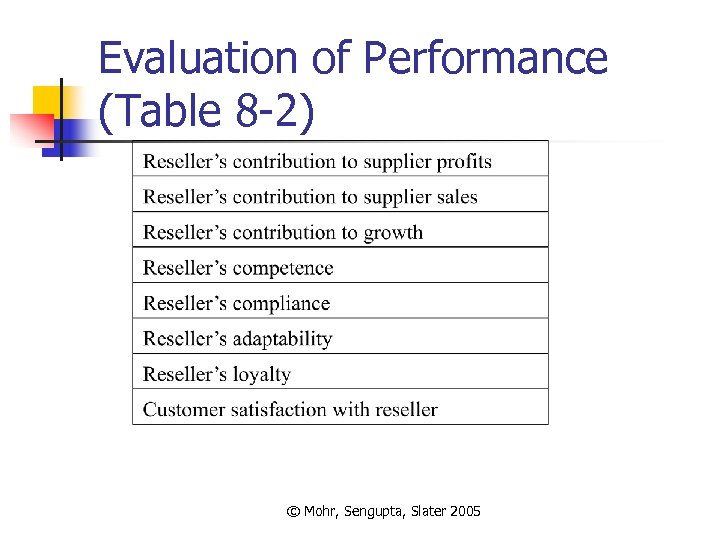 Evaluation of Performance (Table 8 -2) © Mohr, Sengupta, Slater 2005
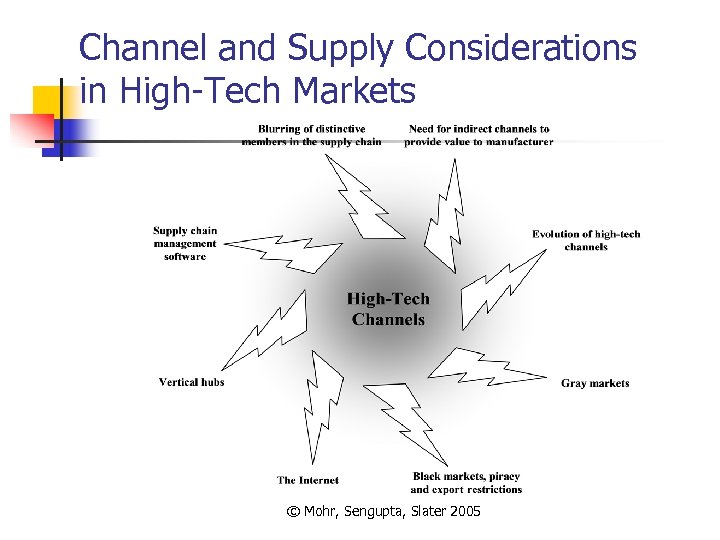 Channel and Supply Considerations in High-Tech Markets © Mohr, Sengupta, Slater 2005
 Blurring of Distinctions n n Distributors/resellers backward integrating into assembling products Suppliers forward integrating into computer manufacturing © Mohr, Sengupta, Slater 2005
 Need for Indirect Channels to Provide Value n Channel assembly n n n Co-location n Customization, speedy turnaround Based on build-to-order model Distributor’s employees work from vendor’s site Customization Shift into services © Mohr, Sengupta, Slater 2005
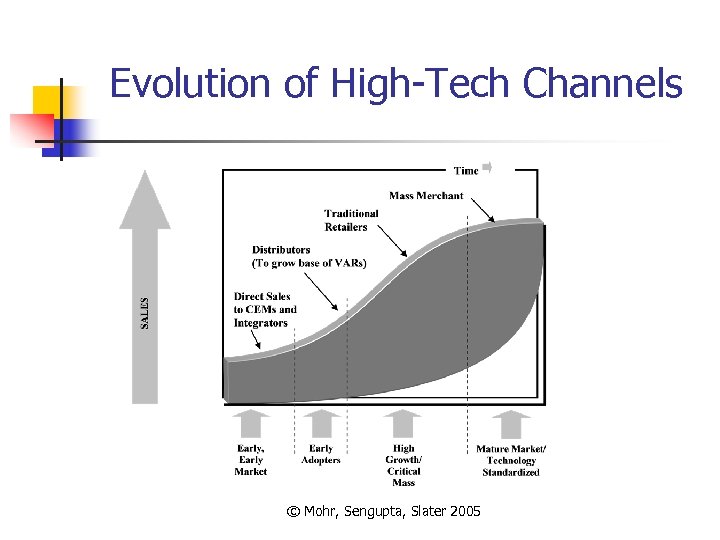 Evolution of High-Tech Channels © Mohr, Sengupta, Slater 2005
 Evolution of High-Tech Channels (Cont’d. ) n To “cross the chasm” n n Direct sales channel useful, but requires volume and predictability of revenues n May need VARs and Systems Integrators Retail channel useful for mainstream market rather than crossing the chasm n Does not create demand nor help develop “whole product” © Mohr, Sengupta, Slater 2005
 Gray Markets n Diversion of goods to unauthorized distributors, sold at discounted prices n n Manufacturer loses control over distribution Legitimate channels lose business Loss of incentive for legitimate channel members to push sales or provide service Intra-brand competition, channel conflict © Mohr, Sengupta, Slater 2005
 Causes of Gray Markets n n n Pricing policies with large volume discounts Differential in international exchange rates (parallel importing) Cost differences between different types of resellers n n Free-riding of discount outlets on full-service outlets Selective distribution n Lack of intra-brand competition may invited gray marketers © Mohr, Sengupta, Slater 2005
 Causes of Gray Markets (Cont. ) n Producers perform marketing functions n n Reduces customer’s risk in buying from unauthorized distributors Incompatible compensation policies n n Utilize plant capacity Meet sales volume quotas © Mohr, Sengupta, Slater 2005
 Solutions to Gray Markets n Track source of units and cut off supply to gray market n n n Signals commitment to legitimate channels Mitigates price erosion May be burdensome administratively One-price policy (no volume discounts) Increase penetration in the market Collect information on extent of the problem, consistently measure channel member performance © Mohr, Sengupta, Slater 2005
 Black Markets, Piracy, and Restricted Exports n Black Markets n n Counterfeit goods Piracy Especially problematic with unit-one cost structures Export Restrictions on sales of “dual use” products to some countries n Ostensibly to protect U. S. security interests © Mohr, Sengupta, Slater 2005
 Adding New Channels: The Internet n Hybrid channels n n n Conflicts between manufacturer and its dealers pursuing same customers “Co-opetition” Options n n Avoid the Web (and conflict) Go to the Web (invite conflict and even mutiny) Disintermediate Bricks-and-clicks model © Mohr, Sengupta, Slater 2005
 Adding an Internet Channel n Does the Web channel add a new value proposition for end-users? n n n Reach new customers Less likely to cannibalize existing channels Does the Web merely create distribution efficiencies? n Cannibalizes existing sales © Mohr, Sengupta, Slater 2005
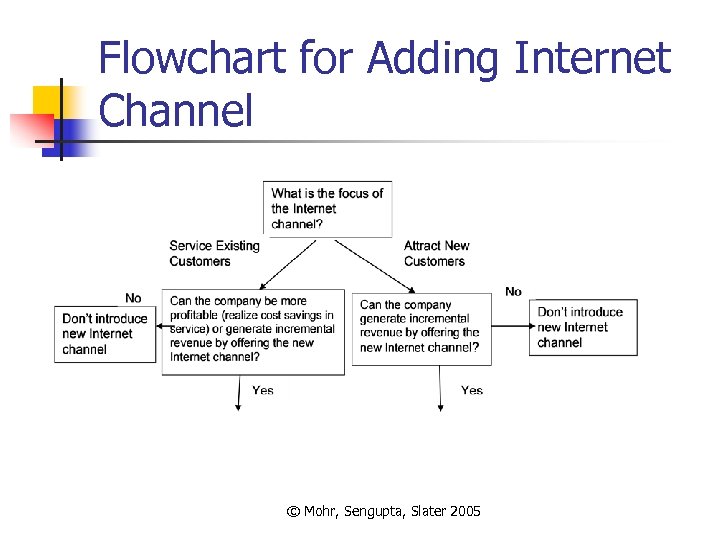 Flowchart for Adding Internet Channel © Mohr, Sengupta, Slater 2005
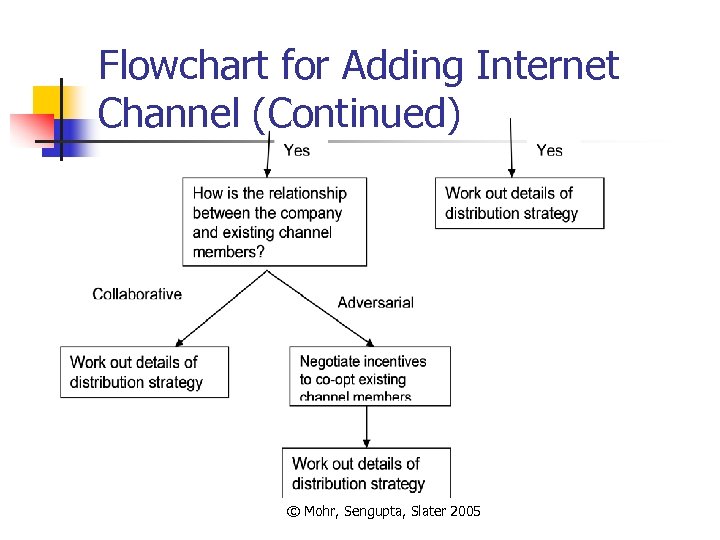 Flowchart for Adding Internet Channel (Continued) © Mohr, Sengupta, Slater 2005
 Avoiding Conflict with Existing Channel n n n Use website to disseminate only product information Use website only to generate leads; direct buyers to dealers Sell limited merchandise offerings through website Take online orders from small customers; direct larger customers to dealers Launch website without publicity © Mohr, Sengupta, Slater 2005
 Managing Conflict with Existing Channel n n n Keep website prices aligned with existing channels Give a cut of each Internet sale to existing channels Improve flow of information with channel members © Mohr, Sengupta, Slater 2005
 Managing Hybrid Channels n Objectives: n n Increase coverage while lowering costs Steps: n n n Identify customer target segments Delineate tasks/functions needed by segments Allocate most effective/efficiency channel to the tasks on a by-segment basis © Mohr, Sengupta, Slater 2005
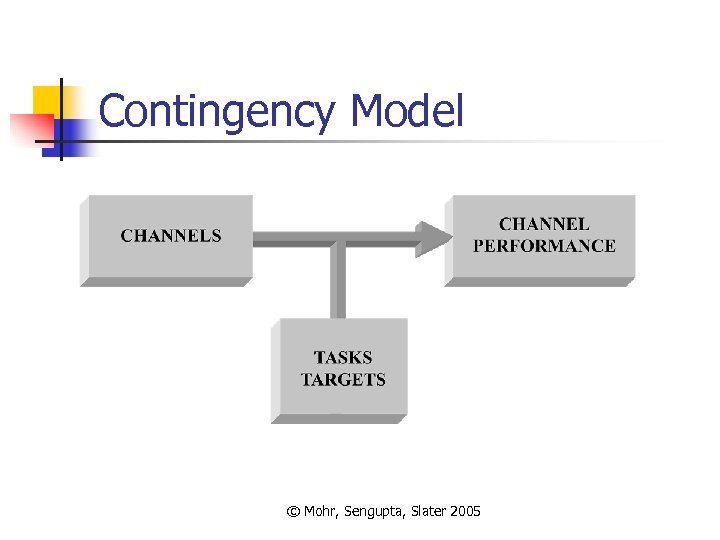 Contingency Model © Mohr, Sengupta, Slater 2005
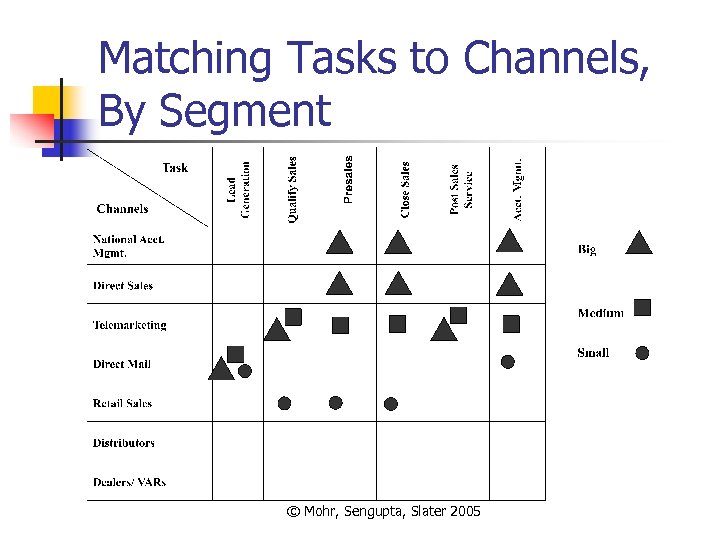 Matching Tasks to Channels, By Segment © Mohr, Sengupta, Slater 2005
 Supply Chain Management n n Match inflow of supplies with the demand at every stage of the value chain based on the actual demand from end-users Reduce inventory as work-in-progress Reduce cycle time Electronic links to customers © Mohr, Sengupta, Slater 2005
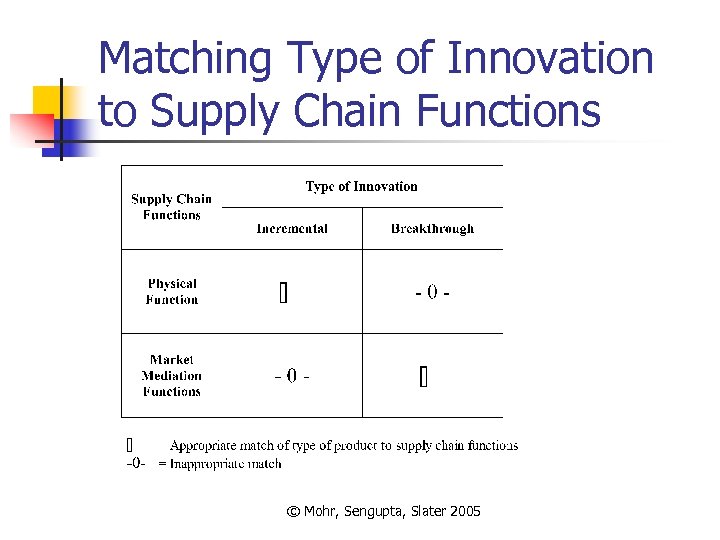 Matching Type of Innovation to Supply Chain Functions © Mohr, Sengupta, Slater 2005
 Implications of Contingency Model for Supply Chain Management n For incremental innovations: n n n Customer needs are known Focus on managing physical functions and close coordination to gain cost efficiencies For breakthrough innovations n n n Must read uncertain market signals, knowing what inventory is required where Focus on responsiveness (speed and flexibility) Consistent with trends to channel assembly © Mohr, Sengupta, Slater 2005
 Trends in Supply Chain Management n Vertical electronic markets on the Internet n n n Supply chain management software n n Hubs used to connect suppliers to their manufacturing customers Often owned by cybermediaries Bring data from manufacturing, inventory, and suppliers to integrate decision making Outsourcing n n Reduces cost but increases supply chain vulnerability Political backlash from unions and legislatures © Mohr, Sengupta, Slater 2005