


 Скачать презентацию Marketing of High-Technology Products and Innovations Chapter 8
ce30ca23fefc333cd5e7111e89de1904.ppt
- Количество слайдов: 55
 Marketing of High-Technology Products and Innovations Chapter 8: Technology and Product Management © 2010 Pearson Education, Inc. publishing as Prentice Hall
 Questions to Consider What opportunities does digital convergence pose? How does NIH relate to myopia? When is it beneficial to customize a product? What are the advantages of a product platform? What controversies are associated with patents? © Mohr, Sengupta, Slater 2009 © 2010 Pearson Education, Inc. publishing as Prentice Hall
 Effective technology development requires continuous monitoring of trends “Digital Revolution” ◦ Worldwide transition from analog to digital technology ◦ Companies that lost touch with trends are facing painful restructuring Kodak © 2010 Pearson Education, Inc. publishing as Prentice Hall
 Effective technology development requires continuous monitoring of trends Digital Convergence 1. Networking previously stand-alone devices 2. Hybrid products (camera phones) 3. Companies are crossing traditional industry boundaries (Apple) ◦ Fits well with consumers’ lifestyles ◦ Global standards © 2010 Pearson Education, Inc. publishing as Prentice Hall
 Technology Maps Help a company anticipate technology trends Define a stream of new products (breakthrough + incremental) company plans to develop over time Used for: ◦ Commitment to new product development ◦ Allocation of resources A flexible blueprint that must be updated regularly © 2010 Pearson Education, Inc. publishing as Prentice Hall
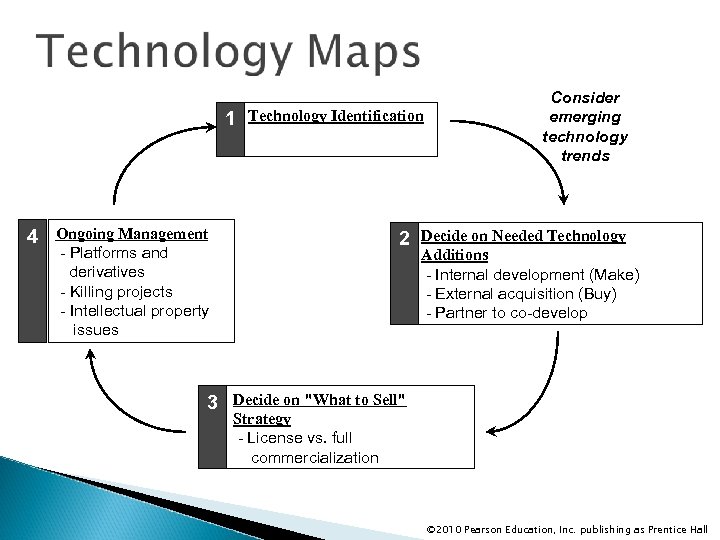 1 4 Ongoing Management - Platforms and derivatives - Killing projects - Intellectual property issues 3 Technology Identification 2 Consider emerging technology trends Decide on Needed Technology Additions - Internal development (Make) - External acquisition (Buy) - Partner to co-develop Decide on "What to Sell" Strategy - License vs. full commercialization © 2010 Pearson Education, Inc. publishing as Prentice Hall
 Technology Maps 1. Technology Identification Take inventory of firm’s most valuable know -how ◦ Products ◦ Processes Example: superior manufacturing skills ◦ Management practices Example: knowledge management © 2010 Pearson Education, Inc. publishing as Prentice Hall
 Technology Maps 2. Decide on Technology Additions What emerging technology trends will affect business? ◦ Areas of weakness in the firm’s technology portfolio? Additional technologies necessary to continue to compete effectively? ◦ “Make vs. buy” decision: development risk Internal development External acquisition Partnering © 2010 Pearson Education, Inc. publishing as Prentice Hall
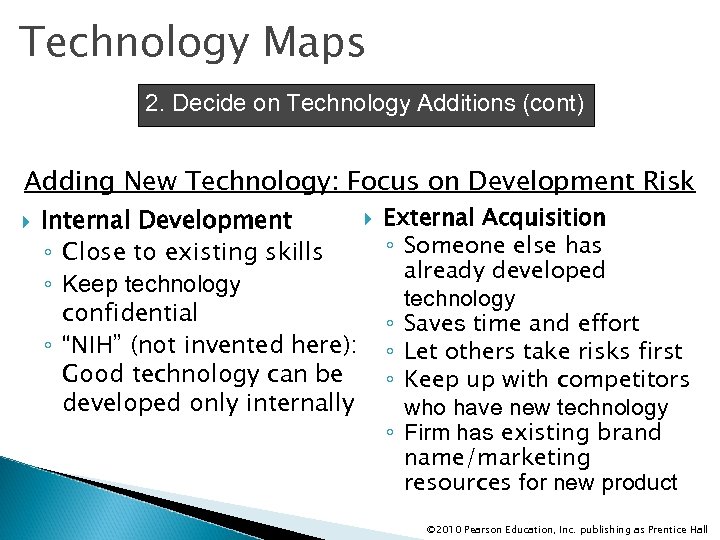 Technology Maps 2. Decide on Technology Additions (cont) Adding New Technology: Focus on Development Risk Internal Development ◦ Close to existing skills ◦ Keep technology confidential ◦ “NIH” (not invented here): Good technology can be developed only internally External Acquisition ◦ Someone else has already developed technology ◦ Saves time and effort ◦ Let others take risks first ◦ Keep up with competitors who have new technology ◦ Firm has existing brand name/marketing resources for new product © 2010 Pearson Education, Inc. publishing as Prentice Hall
 Technology Maps 3. Decide on “What to Sell” Strategy Critical issue: marketing risk Continuum of options (Explored in detail in later slides) © 2010 Pearson Education, Inc. publishing as Prentice Hall
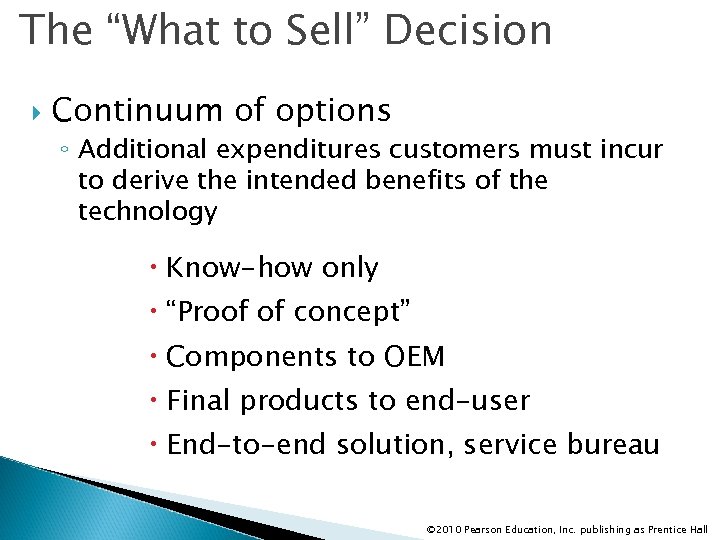 The “What to Sell” Decision Continuum of options ◦ Additional expenditures customers must incur to derive the intended benefits of the technology Know-how only “Proof of concept” Components to OEM Final products to end-user End-to-end solution, service bureau © 2010 Pearson Education, Inc. publishing as Prentice Hall
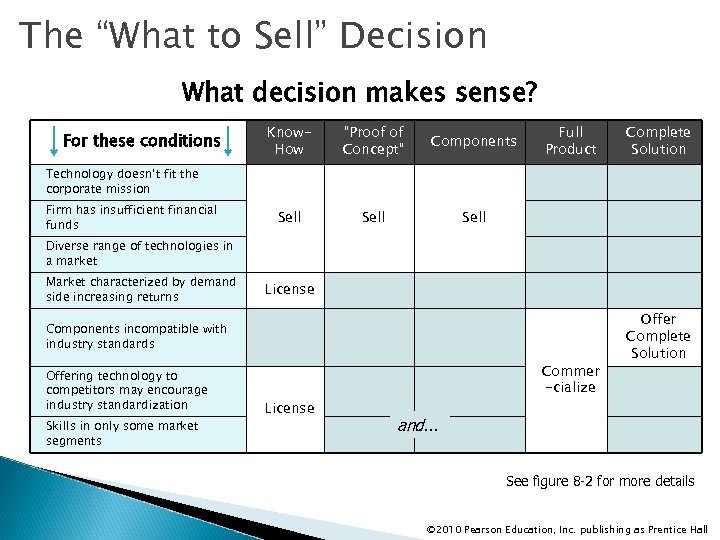 The “What to Sell” Decision What decision makes sense? For these conditions Know. How “Proof of Concept” Components Sell Full Product Complete Solution Sell Technology doesn’t fit the corporate mission Firm has insufficient financial funds Diverse range of technologies in a market Market characterized by demand side increasing returns License Components incompatible with industry standards Offering technology to competitors may encourage industry standardization Skills in only some market segments License Commer -cialize Offer Complete Solution and. . . See figure 8 -2 for more details © 2010 Pearson Education, Inc. publishing as Prentice Hall
 The “What to Sell” Decision Technology Transfer Considerations ◦ From small companies/inventors larger companies with resources/expertise ◦ Federally funded knowledge private sector Profit sharing Realistic/accurate value Intellectual property rights © 2010 Pearson Education, Inc. publishing as Prentice Hall
 Technology Maps 4. Ongoing Management Actively manage technology asset base ◦ ◦ Modularity Product derivatives Product platforms Intellectual property management (Also explored in detail in later slides) © 2010 Pearson Education, Inc. publishing as Prentice Hall
 Product Architecture: Modularity: building a complex product from smaller subsystems that can be designed independently, and function together as a whole Partition information ◦ Visible: design rules, how the subsystems should work together ◦ Hidden: how to design each subsystem independently © 2010 Pearson Education, Inc. publishing as Prentice Hall
 Product Architecture: Modularity (cont) Requires architect company to have deep product knowledge for advance specification of subsystems Reduces uncertainty in product design ◦ Results in product standardization ◦ Low barriers to entry ◦ Incremental (vs. breakthrough) innovations © 2010 Pearson Education, Inc. publishing as Prentice Hall
 Product Architecture: Platforms Product Platform: common architecture based on a single design “Next-generation” products: new product platforms ◦ Require significant investments ◦ Have enhanced performance benefits Example: Each generation of Intel’s microprocessor chips © 2010 Pearson Education, Inc. publishing as Prentice Hall
 Product Architecture: Derivatives Derivative Products: Include different models, brands, or versions of the platform product Intended to fill performance gaps between platform products Example: Slower/faster chip versions, introduced within months of the new chip © 2010 Pearson Education, Inc. publishing as Prentice Hall
 Product Architecture: Platforms and Derivatives Why use a platform and derivative strategy? 1. Unit-one cost § 2. § The cost of producing the first unit is very high relative to reproduction “Gaps” in the marketplace Holes in customer migration from old to new technology (see next slide) © 2010 Pearson Education, Inc. publishing as Prentice Hall
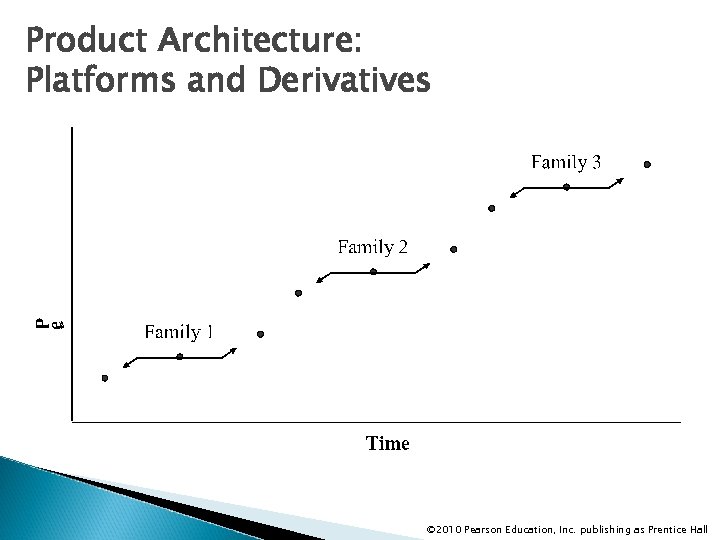 Product Architecture: Platforms and Derivatives © 2010 Pearson Education, Inc. publishing as Prentice Hall
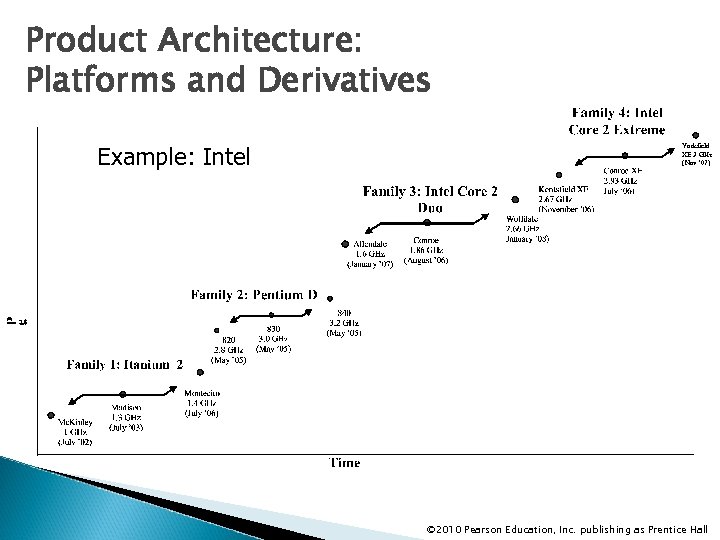 Product Architecture: Platforms and Derivatives Example: Intel Yorkfield XE 3 GHz (Nov ’ 07) © 2010 Pearson Education, Inc. publishing as Prentice Hall
 Product Architecture: Making Decisions about Platforms and Derivatives New Platform Strategy Design for high end of the market ◦ Incorporate as many features as needed for this segment ◦ Willingness-to-pay helps recover high fixed costs ◦ Subtraction of features is lower incremental cost than addition ◦ Consistent with both lead user and chasm concepts © 2010 Pearson Education, Inc. publishing as Prentice Hall
 Product Architecture: Making Decisions about Platforms and Derivatives Customizing Complex Products ◦ Meets customers needs better ◦ Earns customer loyalty and profits for vendor In high-tech, vendors assume more control over customization because customers don’t want to invest in knowledge that can become obsolete quickly Vendors assume less control over customization ◦ Products are standardized and modular ◦ Customers have high product knowledge © 2010 Pearson Education, Inc. publishing as Prentice Hall
 When to “Kill” New Products? Escalation of commitment Product champions/technology enthusiasts are perennial optimists ◦ Personal stake in project ◦ Biases in interpreting information Recall info that confirms beliefs Ignore info that disconfirms beliefs Re-interpret neutral info as positive, and even negative info as positive! © 2010 Pearson Education, Inc. publishing as Prentice Hall
 When to “Kill” New Products? More information is not the answer! Foster internal culture that encourages open questioning Remove project from core of the firm Managers with no prior beliefs make the decision Rely on benchmarks established at outset © 2010 Pearson Education, Inc. publishing as Prentice Hall
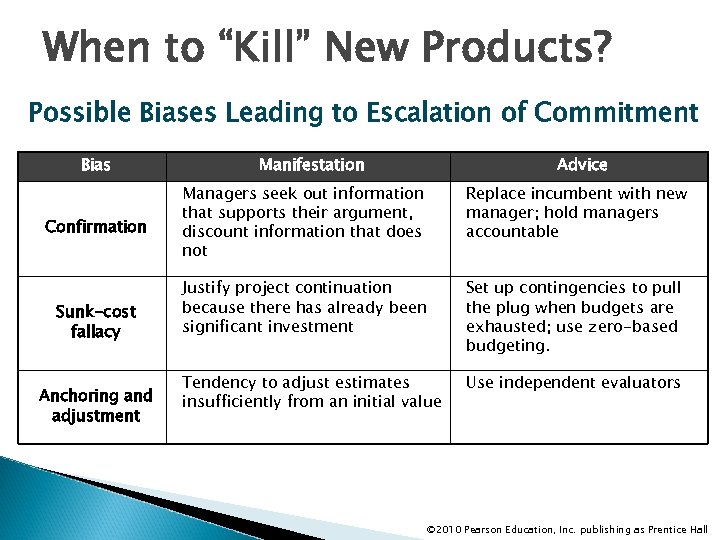 When to “Kill” New Products? Possible Biases Leading to Escalation of Commitment Bias Confirmation Sunk-cost fallacy Anchoring and adjustment Manifestation Advice Managers seek out information that supports their argument, discount information that does not Replace incumbent with new manager; hold managers accountable Justify project continuation because there has already been significant investment Set up contingencies to pull the plug when budgets are exhausted; use zero-based budgeting. Tendency to adjust estimates insufficiently from an initial value Use independent evaluators © 2010 Pearson Education, Inc. publishing as Prentice Hall
 The Role of Product Management: High-Tech Companies Generally unclear scope of responsibilities Launch window: product managers take over from product development team ◦ ◦ Help manage trade shows Determine messaging for PR Develop brochures Organize tech support, customer service In small organizations, job can be daunting: product managers = marketing personnel © 2010 Pearson Education, Inc. publishing as Prentice Hall
 Developing Services: Part of Product Strategy The “services-dominant logic of marketing” ◦ Customer purchases are motivated by the provision of value ◦ The product is the vehicle that creates value ◦ Emphasizes the importance of know-how and relationships © 2010 Pearson Education, Inc. publishing as Prentice Hall
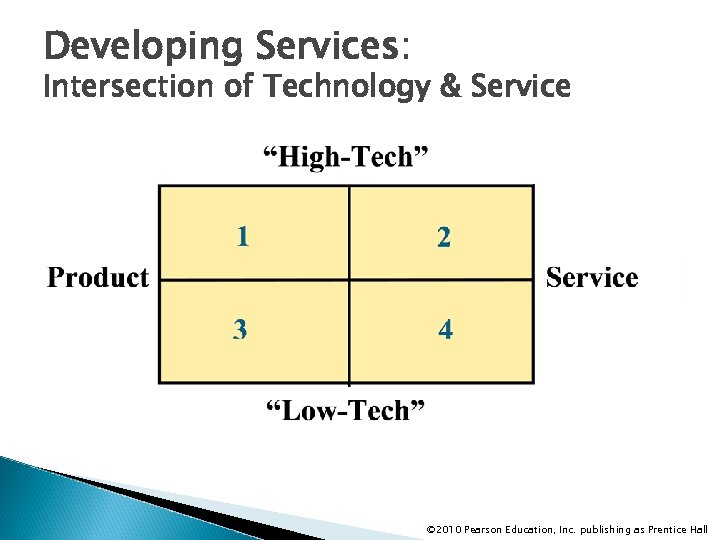 Developing Services: Intersection of Technology & Service © 2010 Pearson Education, Inc. publishing as Prentice Hall
 Developing Services Cell 1: High-Tech Product Augment product with service Generate service revenue after product purchase Training, repair, maintenance contract Does company have sufficient trained service personnel? Can company balance service proficiency and core competency in product innovation? © 2010 Pearson Education, Inc. publishing as Prentice Hall
 Developing Services Cell 2: “Pure” High-Tech Service Includes: contract research firms, IT consulting, service providers How can we leverage customized developments? ◦ Create a platform for standardization of services Is the communication of technical service personnel user-friendly for customers? Can service reliability of underlying technology be maintained? Does company make continuous/adequate investments in upgrades and training resources? © 2010 Pearson Education, Inc. publishing as Prentice Hall
 Developing Services Cell 3: Traditional Product Use technology ◦ Improve customer service Self-service technologies ◦ Make supply chain more efficient ◦ To stay abreast of cutting-edge business practice Examples: 1. Self-scanning devices that allow customers to check out themselves 2. Use of the internet to track orders © 2010 Pearson Education, Inc. publishing as Prentice Hall
 Developing Services Cell 4: Traditional Service Automate labor-intensive operations Examples: 1. Forensic DNA testing 2. ATM’s and online banking © 2010 Pearson Education, Inc. publishing as Prentice Hall
 Unique Characteristics of Services: Implications for High-Tech Marketing Intangibility: product cannot be touched nor examined prior to purchase decision ◦ Marketer’s goal: reduce the perceived risk (demonstrations, free trials, warranties, guarantees) Inseparability: production cannot be separated from consumption ◦ Production can not occur in advance of demand ◦ Potential for quality inconsistencies ◦ Solutions: flexibility or scalability Pricing incentives in low-demand periods Personnel training © 2010 Pearson Education, Inc. publishing as Prentice Hall
 Intellectual Property Considerations for High-Tech Companies 1. Protection is vital: know-how forms basis of competitive advantage 2. Strategic alliances: formed with potential competitors- what happens if alliance fails? 3. Globalization: outsourcing trends require underlying trade secrets to be shared ◦ 4. Legal standards/ cultural values vary Employee mobility: doctrine of inevitable disclosure © 2010 Pearson Education, Inc. publishing as Prentice Hall
 Intellectual Property Considerations for High-Tech Companies Theft: assets can be stored on a disk, shared over the internet ◦ Annually, $11 -12 billion in worldwide software industry losses (SIIA) Double-edged sword: companies must be both open and restrictive in information sharing Balance: incentive to innovate benefit from innovation and society’s right to © 2010 Pearson Education, Inc. publishing as Prentice Hall
 Intellectual Property Original works, “Creations of the mind” Owner has the right to earn economic return from it Protection fosters creativity by providing an incentive to investors to undertake the risks of innovation How to protect it? ◦ ◦ Patents Copyrights Trademarks Trade Secrets © 2010 Pearson Education, Inc. publishing as Prentice Hall
 Intellectual Property: Patents Three criteria invention must meet: 1. Useful: perform some function that benefits humanity 2. Novel: no prior evidence of invention exists 3. Nonobvious: no suggestion of invention exists, even when multiple writings are combined © 2010 Pearson Education, Inc. publishing as Prentice Hall
 Intellectual Property: Patents (cont. ) Confer owner the rights to exclude others from making, using, or selling product/ process ◦ In US, 20 years from date of filing “Patent Trolls”: buy and hold patents, and ◦ never commercialize Hope to file lawsuits for “infringement” © 2010 Pearson Education, Inc. publishing as Prentice Hall
 Intellectual Property: Patents (cont. ) Disadvantages: Patents are public information ◦ Eighteen months from time of filing in the US ◦ Competitors may “invent around” patent Patent owner must enforce rights Costly! © 2010 Pearson Education, Inc. publishing as Prentice Hall
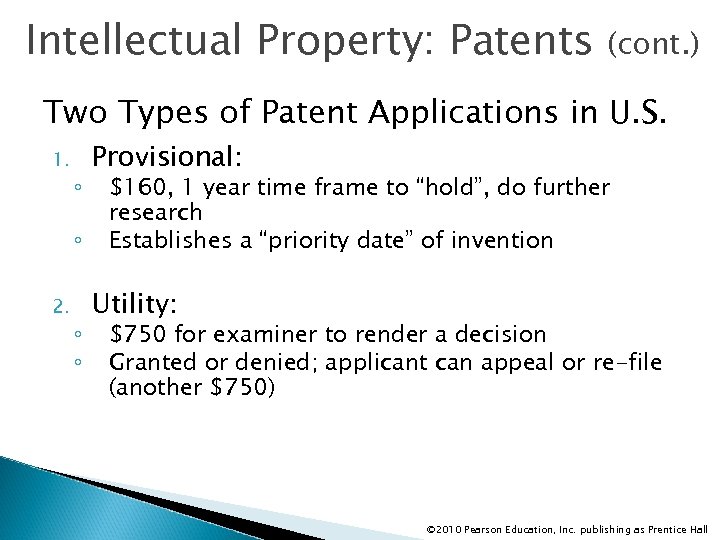 Intellectual Property: Patents (cont. ) Two Types of Patent Applications in U. S. 1. ◦ ◦ 2. ◦ ◦ Provisional: $160, 1 year time frame to “hold”, do further research Establishes a “priority date” of invention Utility: $750 for examiner to render a decision Granted or denied; applicant can appeal or re-file (another $750) © 2010 Pearson Education, Inc. publishing as Prentice Hall
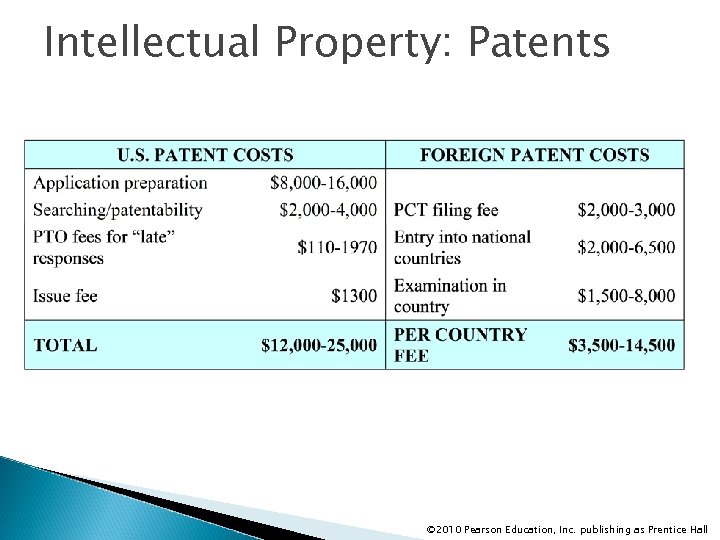 Intellectual Property: Patents © 2010 Pearson Education, Inc. publishing as Prentice Hall
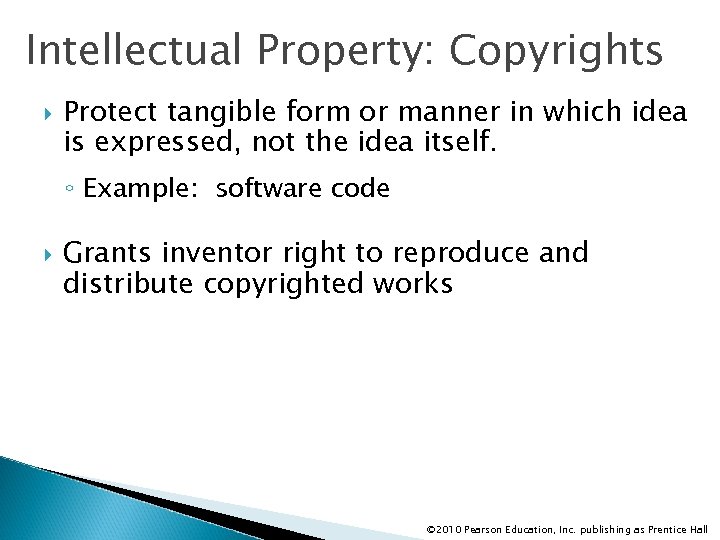 Intellectual Property: Copyrights Protect tangible form or manner in which idea is expressed, not the idea itself. ◦ Example: software code Grants inventor right to reproduce and distribute copyrighted works © 2010 Pearson Education, Inc. publishing as Prentice Hall
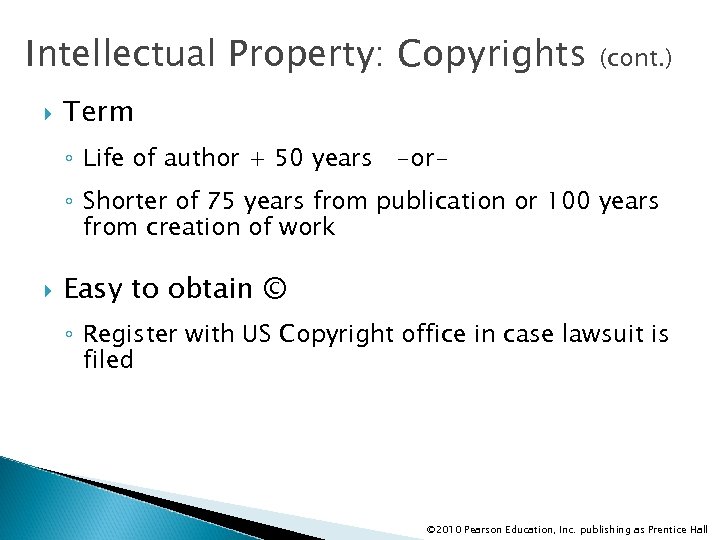 Intellectual Property: Copyrights (cont. ) Term ◦ Life of author + 50 years -or◦ Shorter of 75 years from publication or 100 years from creation of work Easy to obtain © ◦ Register with US Copyright office in case lawsuit is filed © 2010 Pearson Education, Inc. publishing as Prentice Hall
 Intellectual Property: Trademarks Names, symbols, devices to distinguish/ identify goods Protects firm against unscrupulous competitors who try to deceive/mislead customers © 2010 Pearson Education, Inc. publishing as Prentice Hall
 Intellectual Property: Trade Secrets Any concrete information that: ◦ Has commercial value useful to company ◦ Secret generally unknown ◦ Not easily ascertainable Developed at some expense ◦ Provides competitive advantage © 2010 Pearson Education, Inc. publishing as Prentice Hall
 Intellectual Property: Trade Secrets (cont. ) Financial, business, scientific, technical, information including patterns, plans, compilations, formulas, designs, methods, programs, . . . To be granted “trade secret” protection, firm must take reasonable steps to protect information © 2010 Pearson Education, Inc. publishing as Prentice Hall
 Intellectual Property: Trade Secrets (cont. ) Premised on the Notion of Confidential Relationships Nondisclosure Agreements (NDAs) ◦ Signer will not disclose information Noncompete Agreements ◦ Signer will not establish/join a competitor’s firm within a given time frame/territory Invention assignment clauses ◦ Grant firm rights to employees’ inventions © 2010 Pearson Education, Inc. publishing as Prentice Hall
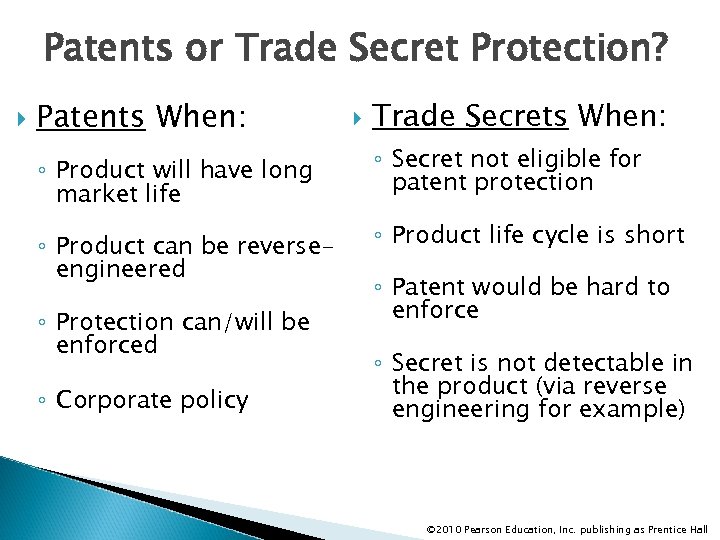 Patents or Trade Secret Protection? Patents When: Trade Secrets When: ◦ Product will have long market life ◦ Secret not eligible for patent protection ◦ Product can be reverseengineered ◦ Product life cycle is short ◦ Protection can/will be enforced ◦ Corporate policy ◦ Patent would be hard to enforce ◦ Secret is not detectable in the product (via reverse engineering for example) © 2010 Pearson Education, Inc. publishing as Prentice Hall
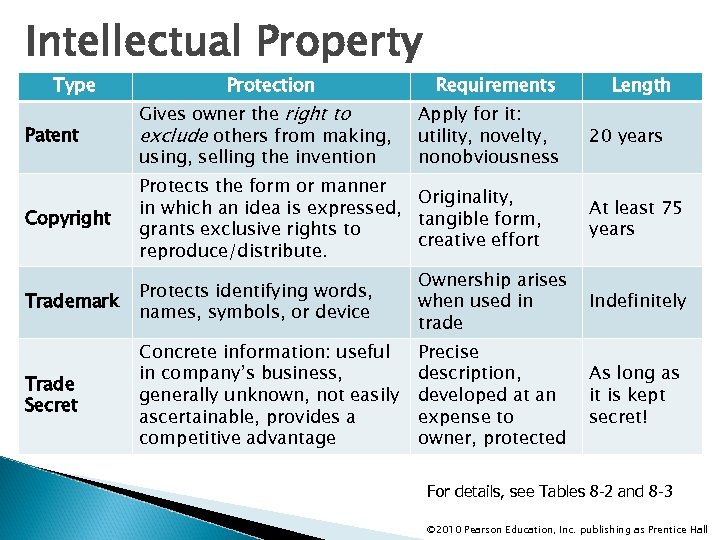 Intellectual Property Type Protection Requirements Length Patent Gives owner the right to exclude others from making, using, selling the invention Copyright Protects the form or manner Originality, in which an idea is expressed, tangible form, grants exclusive rights to creative effort reproduce/distribute. Trademark Protects identifying words, names, symbols, or device Ownership arises when used in trade Indefinitely Trade Secret Concrete information: useful in company’s business, generally unknown, not easily ascertainable, provides a competitive advantage Precise description, developed at an expense to owner, protected As long as it is kept secret! Apply for it: utility, novelty, nonobviousness 20 years At least 75 years For details, see Tables 8 -2 and 8 -3 © 2010 Pearson Education, Inc. publishing as Prentice Hall
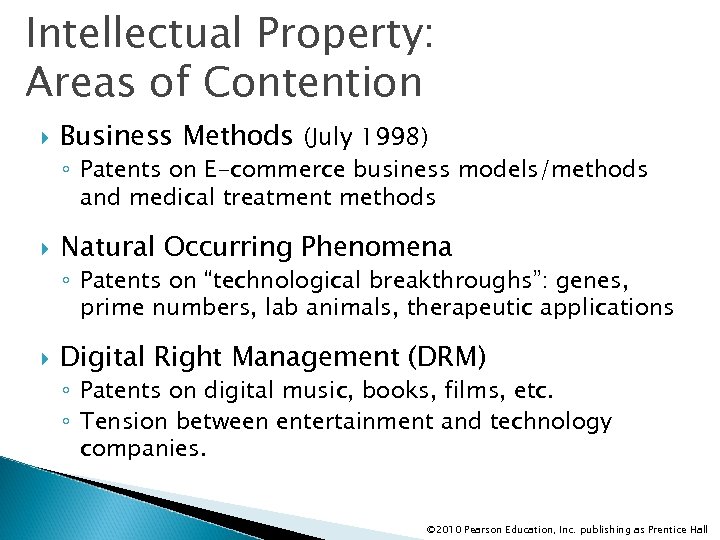 Intellectual Property: Areas of Contention Business Methods (July 1998) ◦ Patents on E-commerce business models/methods and medical treatment methods Natural Occurring Phenomena ◦ Patents on “technological breakthroughs”: genes, prime numbers, lab animals, therapeutic applications Digital Right Management (DRM) ◦ Patents on digital music, books, films, etc. ◦ Tension between entertainment and technology companies. © 2010 Pearson Education, Inc. publishing as Prentice Hall
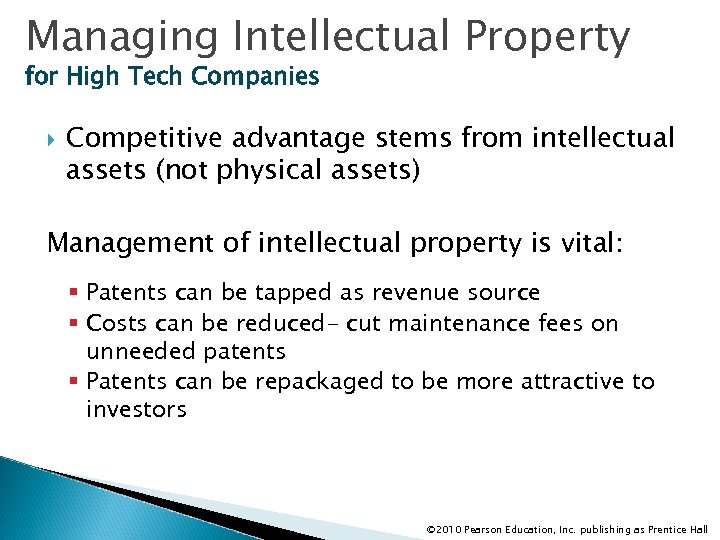 Managing Intellectual Property for High Tech Companies Competitive advantage stems from intellectual assets (not physical assets) Management of intellectual property is vital: § Patents can be tapped as revenue source § Costs can be reduced- cut maintenance fees on unneeded patents § Patents can be repackaged to be more attractive to investors © 2010 Pearson Education, Inc. publishing as Prentice Hall
 Managing Intellectual Property for High Tech Companies Patents can help a firm: ◦ Manage its product line Establish R&D priorities ◦ Respond to shifts in the marketplace Acquisition or partnering opportunities Intellectual property rights are an asset base that deserves strategic focus Patent inventions decisions should fit business strategy © 2010 Pearson Education, Inc. publishing as Prentice Hall
 Chapter Features Opening Vignette: Apple i. Pod Technology Expert: Memjet; Sun Microsystems Technology Solution: Godisa Solar. Aid End-of-Book Case: Ti. Vo, ESRI, Boeing/Airbus © 2010 Pearson Education, Inc. publishing as Prentice Hall
 All rights reserved. No part of this publication may be reproduced, stored in a retrieval system, or transmitted, in any form or by any means, electronic, mechanical, photocopying, recording, or otherwise, without the prior written permission of the publisher. Printed in the United States of America. © 2010 Pearson Education, Inc. publishing as Prentice Hall