

MARKETING MIX — PRODUCT Product is defined

 Скачать презентацию MARKETING MIX — PRODUCT Product is defined
CHP8MktngMix-Product.ppt
- Количество слайдов: 11
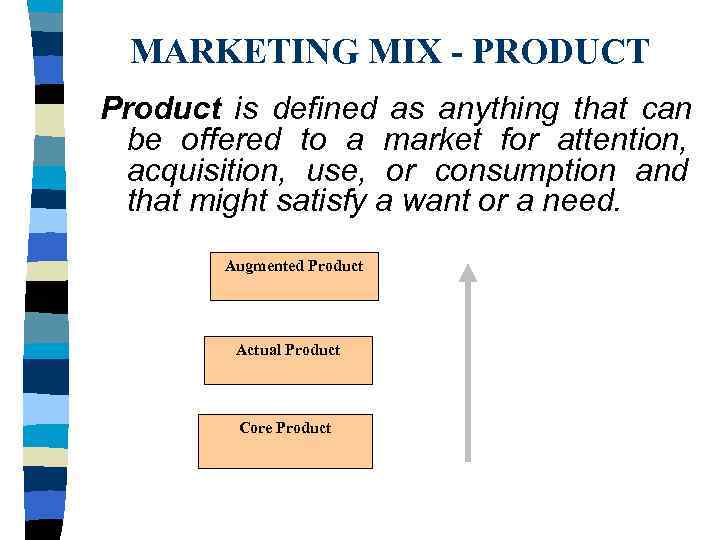
MARKETING MIX - PRODUCT Product is defined as anything that can be offered to a market for attention, acquisition, use, or consumption and that might satisfy a want or a need. Augmented Product Actual Product Core Product
MARKETING MIX - PRODUCT 1) Core product - it is the benefit that consumers seek. E. g. when you buy a mobile phone you buy a communication device than other features 2) Actual Product - a quality level, features, design, a brand name, and packaging 3) Augmented - additional consumer services and benefits
INDIVIDUAL PRODUCT DECISIONS 1) Product Attributes: a) Product Quality has two dimensions: - level and consistency It is ability of a product to perform its functions e. g. overall durability, reliability, precision, ease of operation and repair. b) Product Features are a competitive tool for differentiating the company's product from competitors' products e. g. if customers value little costs should be dropped; if the value high cost should be added. c) Product Design is not a Style e. g. a style + usefulness
INDIVIDUAL PRODUCT DECISIONS 2) Branding: adds value to the product A brand can deliver up to four levels of meaning: a) Attributes - BMW well engineered, well built, durable, high prestige, fast, expensive, and high resale value b) Benefits = functional or emotional attribute c) Values - high performance, safety etc d) Personality - brand image coincides with personality image; if a brand was a person? Young, successful executive
INDIVIDUAL PRODUCT DECISIONS Brand Strategies a) Line extensions several products under the same brand; risky, e. g. Coke? Diet? Light? Can or bottle? b) Brand extensions Johnson & Johnson, Clean &Clear; Blendamet and Blendax etc c) Multi-brands having many brands under one company or product d) New Brand 3) Packaging many marketers call it as 5 th P Attractiveness of design, container or wrapping Based on cost and production factors
INDIVIDUAL PRODUCT DECISIONS 4) Labeling is a part of packaging, where was established, finished, level of quality etc 5) Product-Support Service
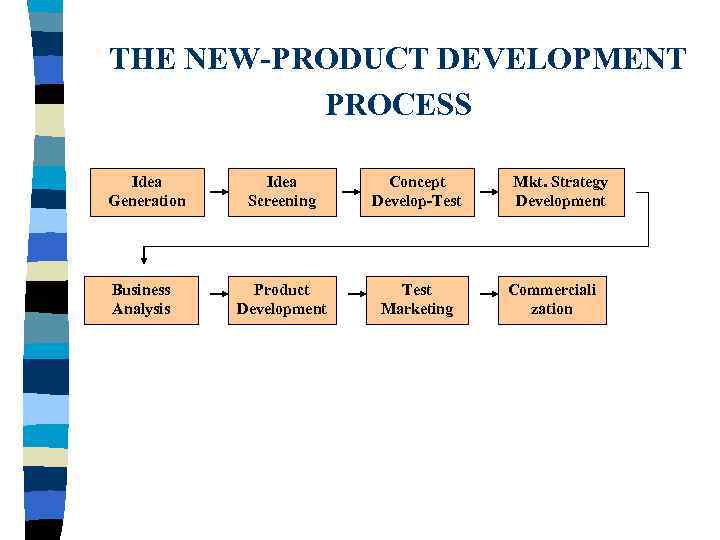
THE NEW-PRODUCT DEVELOPMENT PROCESS Idea Concept Mkt. Strategy Generation Screening Develop-Test Development Business Product Test Commerciali Analysis Development Marketing zation
THE NEW-PRODUCT DEVELOPMENT PROCESS 1) Idea Generation - the systematic search for new- product ideas 2) Idea Screening - spot good ideas and drop poor ones as soon as possible 3) Concept Development and Testing - an attractive idea must be developed into a product concept 4) Marketing Strategy Development a) target market; the planned product positioning; and the sales, market share, and profit goals for the first few years b) product's planned price, distribution, and marketing budget for the first year c) long-run sales, profit goals, and marketing mix strategy
THE NEW-PRODUCT DEVELOPMENT PROCESS 5) Business Analysis - a review of the sales, costs, and profit projections for a new product to find out whether they satisfy the company's objectives 6) Product Development - R&D or engineering develops the product concept into a physical product, prototyping 7) Test Marketing - product and marketing program are introduced into more realistic market settings; positioning strategy, advertising, distribution, pricing, branding and packaging, and budget levels a) Standard test marketing small units of cities b) Controlled test marketing shelf control in specified stores c) Simulated test marketing 8) Commercialization
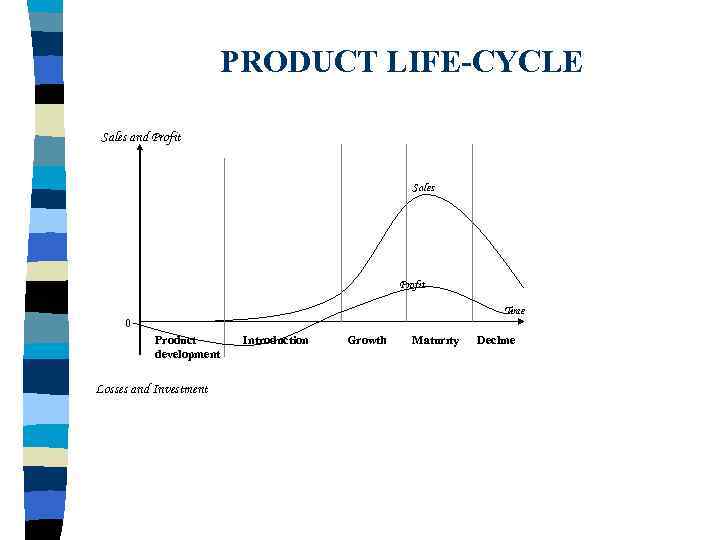
PRODUCT LIFE-CYCLE Sales and Profit Sales Profıt Tıme 0 Product Introduction Growth Maturıty Declıne development Losses and Investment
PRODUCT LIFE-CYCLE 1) Product Development - begins when the company finds and develops a new-product idea. 2) Introduction - is a period of slow sales growth as the product is being introduced in the market. 3) Growth is a period of rapid market acceptance and increasing profits. 4) Maturity is a period of slowdown in sales growth because the product has achieved acceptance by most potential buyers. 5) Decline is the period when sales fall off and profits drop.