



 Marketing
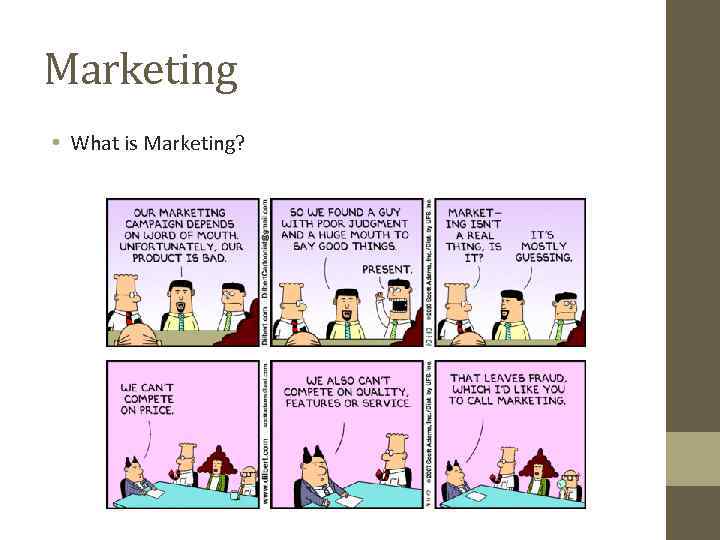 Marketing • What is Marketing?
 Marketing • The management process through which goods and services move from concept to the customer. It includes the coordination of four elements called the 4 P's of marketing: 1. 2. 3. 4. Identification, selection and development of a product, Determination of its price, Selection of a distribution channel to reach the customer's place, and Development and implementation of a promotional strategy.
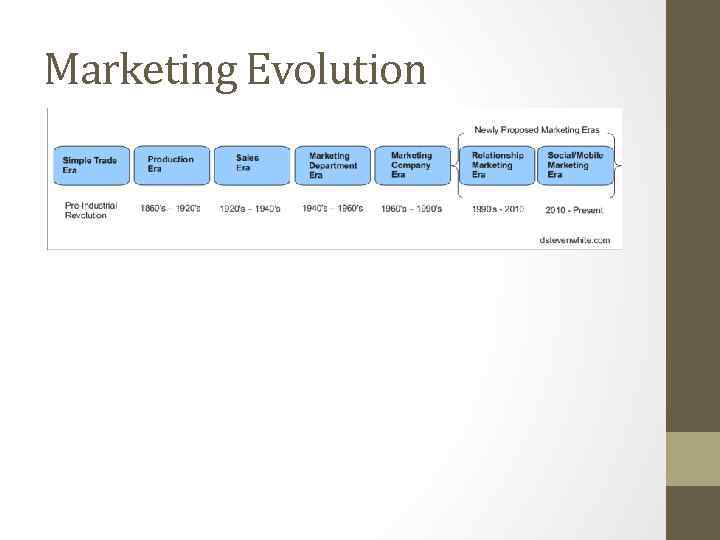 Marketing Evolution
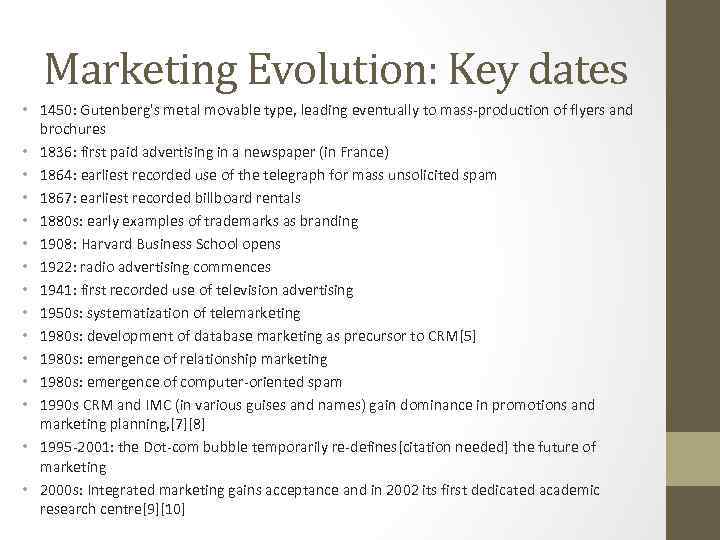 Marketing Evolution: Key dates • 1450: Gutenberg's metal movable type, leading eventually to mass-production of flyers and brochures • 1836: first paid advertising in a newspaper (in France) • 1864: earliest recorded use of the telegraph for mass unsolicited spam • 1867: earliest recorded billboard rentals • 1880 s: early examples of trademarks as branding • 1908: Harvard Business School opens • 1922: radio advertising commences • 1941: first recorded use of television advertising • 1950 s: systematization of telemarketing • 1980 s: development of database marketing as precursor to CRM[5] • 1980 s: emergence of relationship marketing • 1980 s: emergence of computer-oriented spam • 1990 s CRM and IMC (in various guises and names) gain dominance in promotions and marketing planning, [7][8] • 1995 -2001: the Dot-com bubble temporarily re-defines[citation needed] the future of marketing • 2000 s: Integrated marketing gains acceptance and in 2002 its first dedicated academic research centre[9][10]
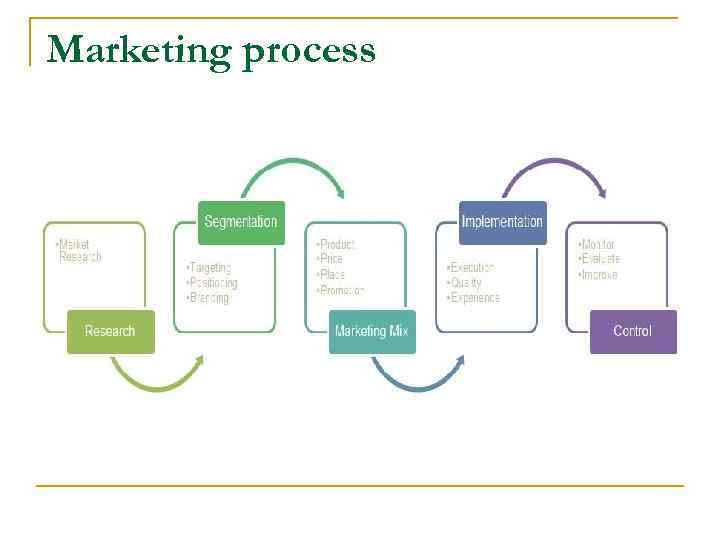 Marketing process
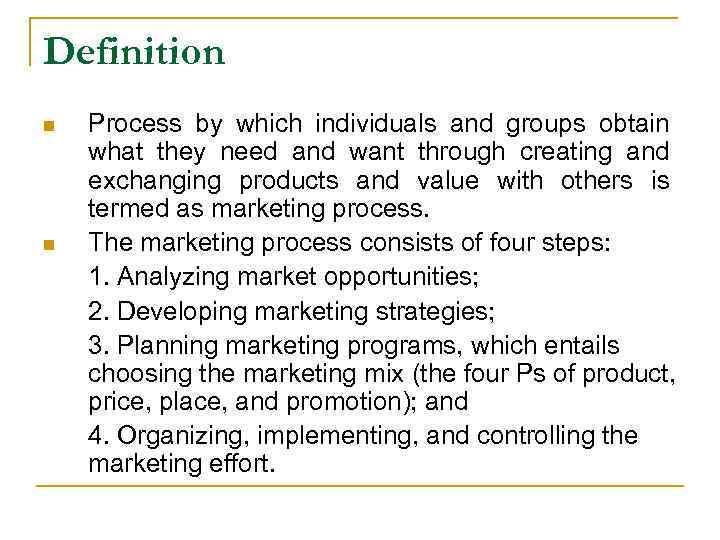 Definition n n Process by which individuals and groups obtain what they need and want through creating and exchanging products and value with others is termed as marketing process. The marketing process consists of four steps: 1. Analyzing market opportunities; 2. Developing marketing strategies; 3. Planning marketing programs, which entails choosing the marketing mix (the four Ps of product, price, place, and promotion); and 4. Organizing, implementing, and controlling the marketing effort.
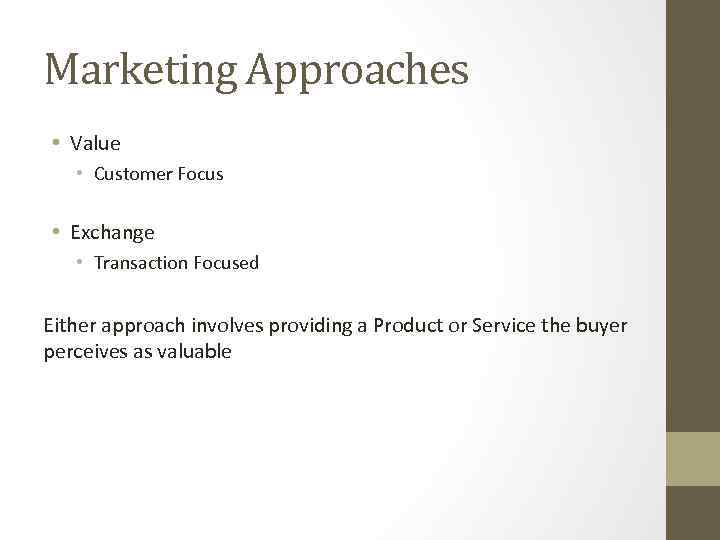 Marketing Approaches • Value • Customer Focus • Exchange • Transaction Focused Either approach involves providing a Product or Service the buyer perceives as valuable
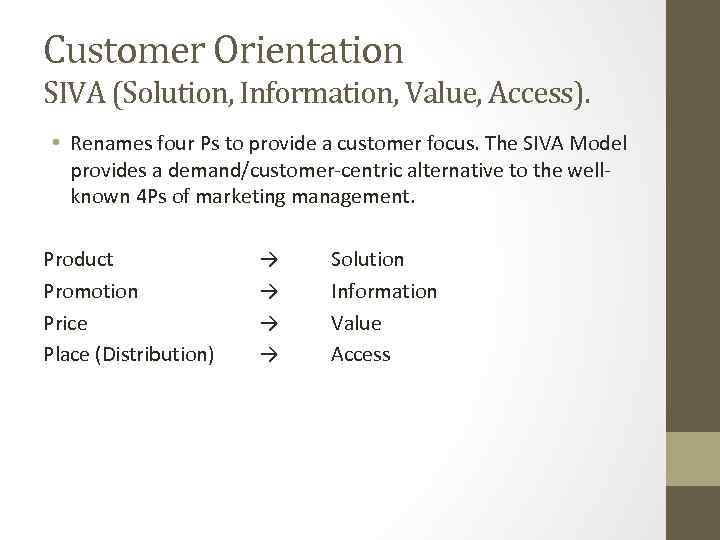 Customer Orientation SIVA (Solution, Information, Value, Access). • Renames four Ps to provide a customer focus. The SIVA Model provides a demand/customer-centric alternative to the wellknown 4 Ps of marketing management. Product Promotion Price Place (Distribution) → → Solution Information Value Access
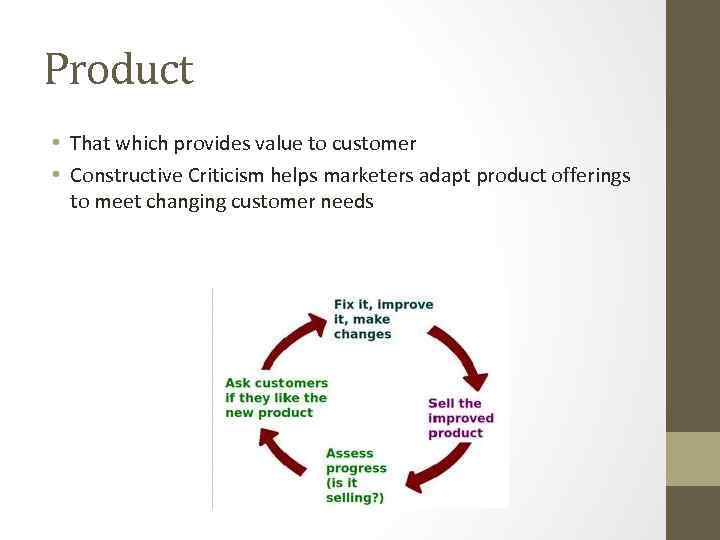 Product • That which provides value to customer • Constructive Criticism helps marketers adapt product offerings to meet changing customer needs
 Promotion: Marketing vs. Advertising • Advertising: The paid, public, non-personal announcement of a persuasive message by an identified sponsor; the nonpersonal presentation or promotion by a firm of its products to its existing and potential customers. • Marketing: The systematic planning, implementation and control of a mix of business activities intended to bring together buyers and sellers for the mutually advantageous exchange or transfer of products.
 Advertising • Single component of the marketing process. • Part of Promotion - getting the word out • Includes the placement of an ad in such mediums as newspapers, direct mail, billboards, television, radio, and the Internet. • Largest expense of most marketing plans, with public relations following in a close second and market research not falling far behind.
 Successful Ad Campaigns • Just Do It Nike adopted this slogan in 1988 while in the midst of financial difficulties. http: //www. youtube. com/watch? v=a. Pky. Pdubq. Ds
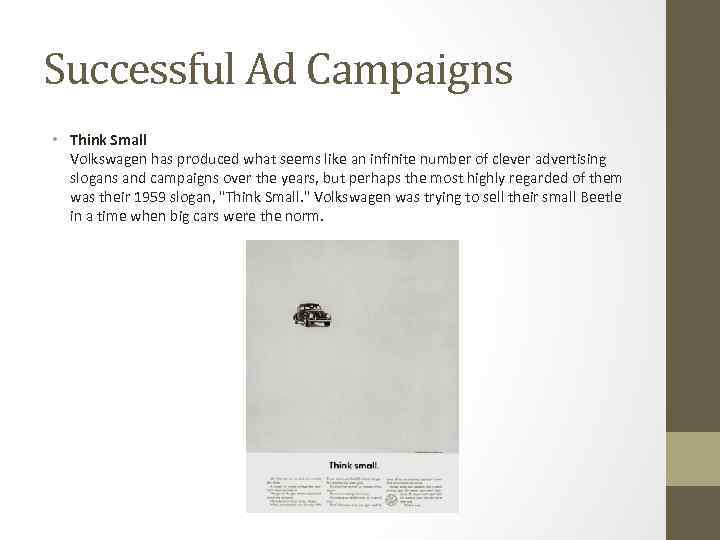 Successful Ad Campaigns • Think Small Volkswagen has produced what seems like an infinite number of clever advertising slogans and campaigns over the years, but perhaps the most highly regarded of them was their 1959 slogan, "Think Small. " Volkswagen was trying to sell their small Beetle in a time when big cars were the norm.
 Successful Ad Campaigns • Have You Had Your Break Today? Mc. Donald's is another company that has come up with a phenomenal number of catchy slogans over the years. In 1995, Mc. Donald's asked consumers a simple question in their advertisements: "Have You Had Your Break Today? " This catchy slogan provided a revamp to the successful 1980 slogan, "You Deserve a Break Today. " • http: //www. youtube. com/watch? v=x. Iykbd_1 z. A 0&list=PLFF 134 AE 149 DC 3 F 97
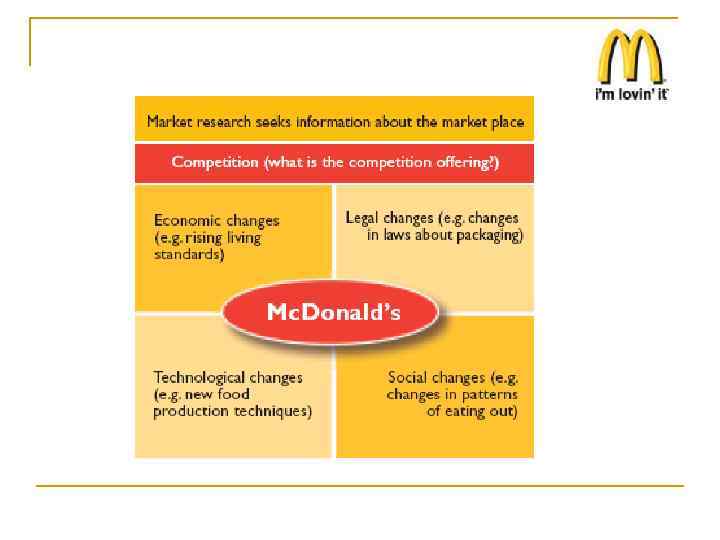
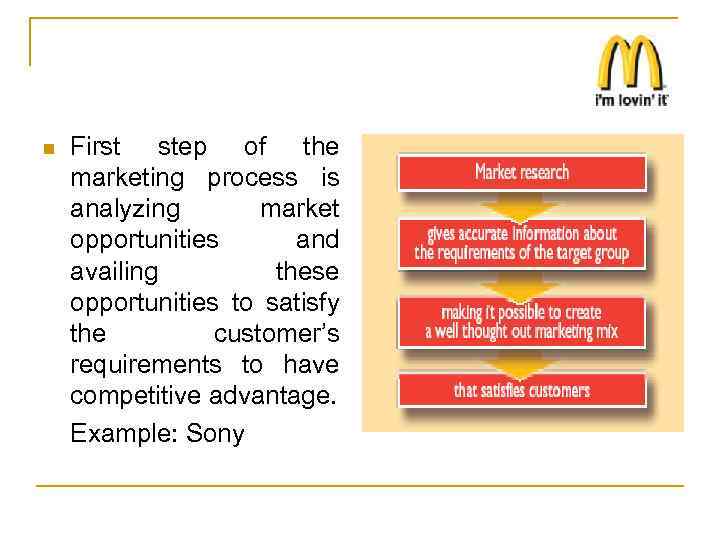 n First step of the marketing process is analyzing market opportunities and availing these opportunities to satisfy the customer’s requirements to have competitive advantage. Example: Sony
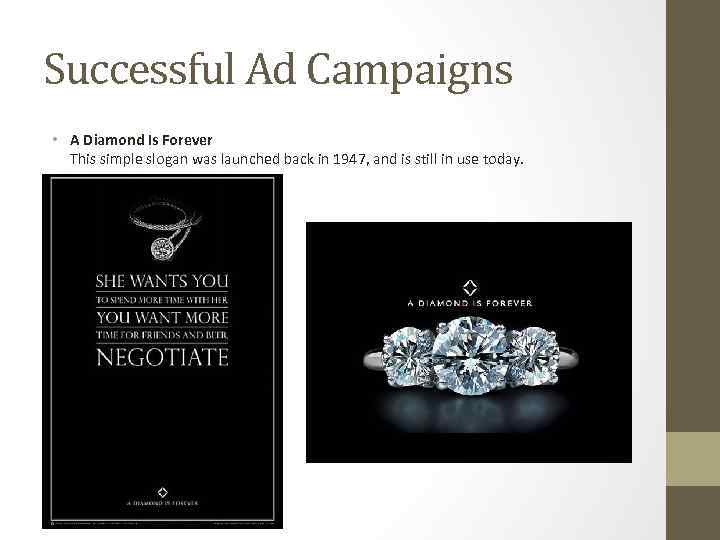 Successful Ad Campaigns • A Diamond Is Forever This simple slogan was launched back in 1947, and is still in use today.
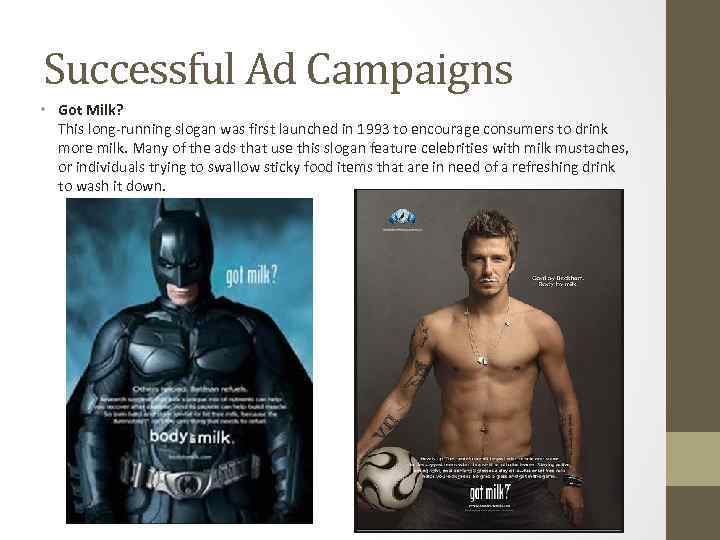 Successful Ad Campaigns • Got Milk? This long-running slogan was first launched in 1993 to encourage consumers to drink more milk. Many of the ads that use this slogan feature celebrities with milk mustaches, or individuals trying to swallow sticky food items that are in need of a refreshing drink to wash it down.
 Price • Cost of Product • Value the Product provides to Customer • Depends on Economic Factors • Take into Account Marketing Mix
 Place • Where product is available or where transaction takes place • With Internet, Place is everywhere for most non-essential goods • If you do not have the proper place you cannot compete in some industries • Make it easy to buy a product
 Example of Brand Loyalty • Coke vs. Pepsi