


 Скачать презентацию Marketing Management Market Research and Market Intelligence Paul
97775a4b5de8ddf288f016021a3b6c16.ppt
- Количество слайдов: 20
 Marketing Management Market Research and Market Intelligence Paul Dishman, Ph. D. Department of Business Management Marriott School of Management Brigham Young University Lecture 6
 Marketing Management Two Types ü Market Research ü Charles Parlin’s Garbage ü Market Information System Paul Dishman, Ph. D.
 Marketing Management Market Research in the News …The work is painstaking, even for someone like Mr. Thoma, who makes espresso at his desk rather than drink the cafeteria brew. The 54 -yearold acoustics engineer is still smoldering with frustration about turn signals. Like a lot of drivers, he found that tick-tick of his car's turn signal a bit annoying, especially when sitting at a long stop light. A passionate piano player, he figured a few bars from a Brahms symphony would sound nice. Trouble was, a test group of potential customers at a private country club in Duesseldorf got sick of the music. Undaunted, Mr. Thoma asked what they thought of notes going up and down the scale. No, thank you. How about the thunk-thunk of an English grandfather clock? Not bad, all agreed, but when sped up to match the legally mandated pace of the blinking turn signals, it sounded like a cheap wristwatch. Source: Wall Street Journal 1/24/02 Paul Dishman, Ph. D.
 Marketing Management More Market Research in the News “P&G Keeps Focus Groupies of Cincinnati Busy as Guinea Pigs in Product Studies” …Ms. Geil is one of 105 subjects in a test to see how sensitive skin reacts to a product ingredient whose identity she doesn't know. She will be paid $55 for wearing patches, replaced every other day, for seven days. In the past week, she has also given her opinion of a facial moisturizer in a questionnaire, while her sons, Joseph, 17, and Andrew, 15, tested Old Spice gel in the shower each morning, and ate granola bars in a taste test one day after school. Ms. Geil figures that for the past 17 years she has participated in about one study a month, ranging from focus groups to taste tests to swabs on her face, hands, legs and back. "It's almost part of our daily routine, doing some kind of market research, " says the 46 -year-old Cincinnative. She remembers her mother testing detergent for cloth diapers when her younger sister was born in 1960. Source: Wall Street journal 1/24/02 Paul Dishman, Ph. D.
 Marketing Management Steps in the MR Process • • Problem Identification Data Decision(s) Budget Data Collection Methodology Analysis Reporting Action Paul Dishman, Ph. D.
 Marketing Management Problem Identification • • What is the Management Decision? Problems vs. Symptoms (What are political ramifications? ) Research Objective? ? – Exploratory • problem definition, suggest hypothesis, “What is problem environment” – Descriptive • describe market potential, customer demographics, customer attitude, etc – Causal/Experimental • Test hypothesis about cause/effect relationship Paul Dishman, Ph. D.
 Marketing Management Research Objective? • You’ve just launched a successful new piece of exercise equipment that has been selling extremely well on QVC. You are ready to approach either K-Mart or Sport. Mart about distributing your product, but you feel that you must first gain an understanding of your who it is that has been buying your product. • You work for a large snack-foods company. Your key sugar supplier’s sugar crop was devastated by a hurricane. He has been forced to drastically raise his prices. You must decide whether to pass the price increase on to your customers. You realize that you need data on the impact of price increases on sales volume. • Research scientists at the chemical company you work for have discovered a new paint that changes color depending on the angle from which it is viewed. As CEO, you would like to grow your business by capitalizing on this invention, but you have no idea as to who your competitors are or what might be appropriate applications for the new paint. Paul Dishman, Ph. D.
 Marketing Management Data Decisions • What type of data do you need to collect? – Secondary vs. Primary – Qualitative • Focus Groups, Personal Interviews – Quantitative • Instruments (questionnaire) – close v. open • Mechanical Instruments (Smith’s) Paul Dishman, Ph. D.
 Marketing Management Discussion • Name the type of research that would be appropriate in the following situations and explain why: - Kellog wants to investigate the impact of young children on their parents’ decision to buy breakfast food - The BYU Bookstore wants to know how students would feels about adding a new “Computer Corner” in the bookstore, staffed by Dell Computer personnel - Mc. Donalds is considering where to locate a new outlet in a fast-growing suburb. - Gillette wants to determine whether a new line of deodorant for teenagers will be profitable - BYU is thinking about developing a new study abroad program and wants to gauge student interest in and Paul Dishman, Ph. D. willingness to pay for the program
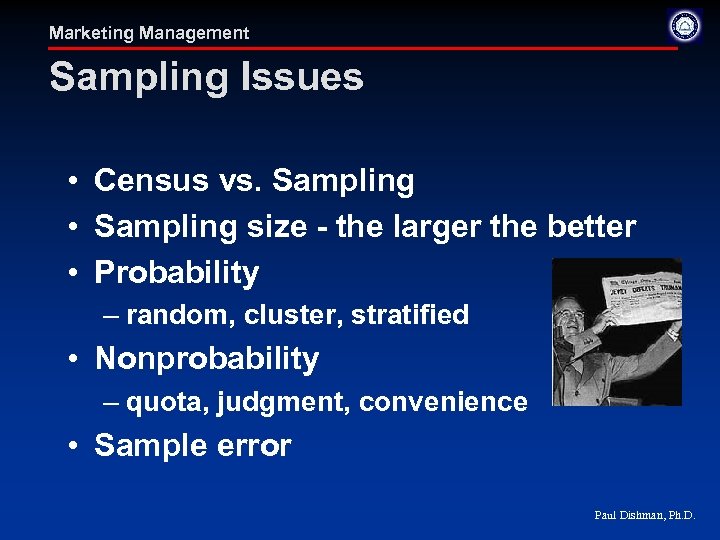 Marketing Management Sampling Issues • Census vs. Sampling • Sampling size - the larger the better • Probability – random, cluster, stratified • Nonprobability – quota, judgment, convenience • Sample error Paul Dishman, Ph. D.
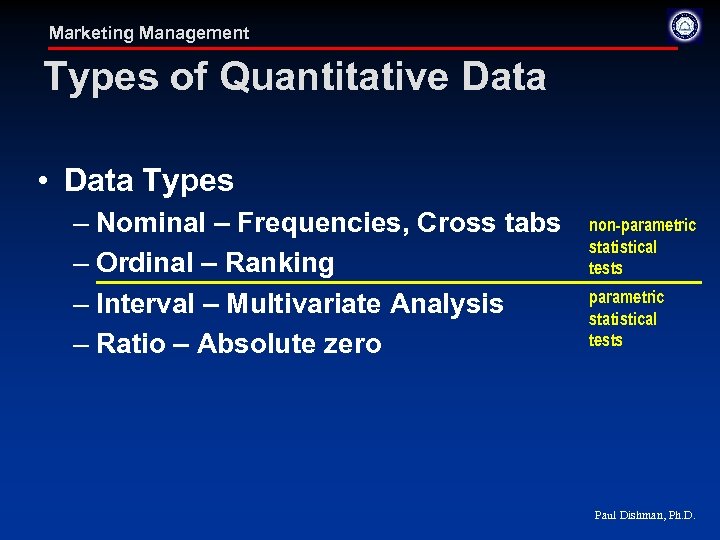 Marketing Management Types of Quantitative Data • Data Types – Nominal – Frequencies, Cross tabs – Ordinal – Ranking – Interval – Multivariate Analysis – Ratio – Absolute zero non-parametric statistical tests Paul Dishman, Ph. D.
 Marketing Management Data Strength • Validity – Collect the right type of information from the respondent • Reliability – Collect the information with high degree of accuracy, free of bias • Representativeness – Collect the information from a representative sample of the population Paul Dishman, Ph. D.
 Marketing Management Budgeting • Cost/Benefit Ratio • Decisions: – Methodology – Design – In-house vs. subcontract Paul Dishman, Ph. D.
 Marketing Management Data Collection Methodology • Instrumentation Decisions – Telephone – Mail – Personal Interview – Internet – Focus Group – Electronic Instrumentation – Test Marketing • Instrumentation Issues – Question design, non-responsiveness, acquiescence, response error Paul Dishman, Ph. D.
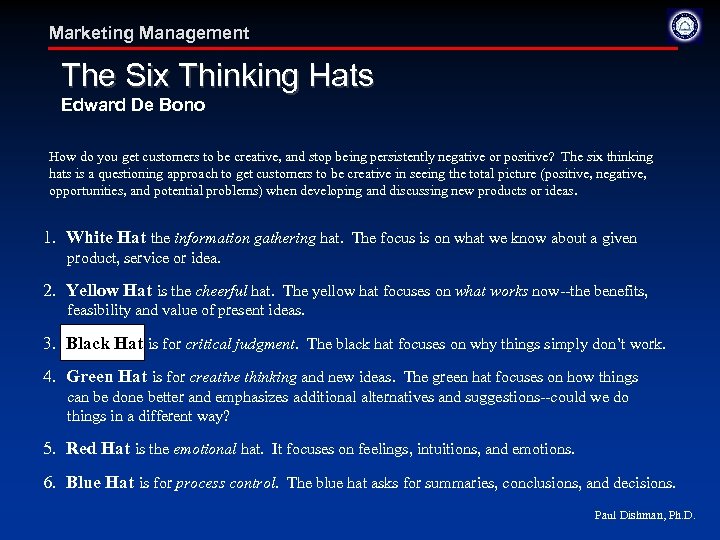 Marketing Management The Six Thinking Hats Edward De Bono How do you get customers to be creative, and stop being persistently negative or positive? The six thinking hats is a questioning approach to get customers to be creative in seeing the total picture (positive, negative, opportunities, and potential problems) when developing and discussing new products or ideas. 1. White Hat the information gathering hat. The focus is on what we know about a given product, service or idea. 2. Yellow Hat is the cheerful hat. The yellow hat focuses on what works now--the benefits, feasibility and value of present ideas. 3. Black Hat is for critical judgment. The black hat focuses on why things simply don’t work. 4. Green Hat is for creative thinking and new ideas. The green hat focuses on how things can be done better and emphasizes additional alternatives and suggestions--could we do things in a different way? 5. Red Hat is the emotional hat. It focuses on feelings, intuitions, and emotions. 6. Blue Hat is for process control. The blue hat asks for summaries, conclusions, and decisions. Paul Dishman, Ph. D.
 Marketing Management Analysis • Qualitative – Contextual • Quantitative – Statistical • Parametric • Nonparametric Paul Dishman, Ph. D.
 Marketing Management Reporting • Recommendation must match management decision • How does audience want to receive information? (Report format) • Archiving Paul Dishman, Ph. D.
 Marketing Management Action • MR should be involved in management decision to the extent possible Paul Dishman, Ph. D.
 Marketing Management Marketing Information Systems • • Good liaison with developers Timeliness of data Format of data How can better information/intelligence make us more profitable/competitive? Paul Dishman, Ph. D.
 Marketing Management Competitive Intelligence • How to keep an eye on environmental changes and make you more competitive… Paul Dishman, Ph. D.