


 Скачать презентацию MARKETING LEADERSHIP AND PLANNING MKT 5114 2015
MKT5114_01 TO SHOW.pptx
- Количество слайдов: 37
 MARKETING LEADERSHIP AND PLANNING MKT 5114 2015
 Objectives of the course ØTo enable you to develop effective high level strategic marketing strategies relating to an organization's corporate and business strategic intent in the short-, medium- and long-terms ØYou should be able to analyze the corporate strategy, determine a range of high level marketing and relationship strategies, and demonstrate how these strategies will deliver an organization's desire for growth and expansion, its changing stance on CSR, ethics and key strategic decisions
 Learning outcomes ØCritically evaluate the links from the corporate strategy to the marketing strategy and ways of delivering an organization's corporate mission and vision effectively ØDevelop marketing strategies to establish an organization's competitive and sustainable marketing and relationship strategies to achieve the organization's strategic intent and deliver its value proposition ØDevelop strategic but operational marketing plans at organizational level (not just functional) using synergistic planning processes, taking account of different planning frameworks (cross-functional and board level contribution) and ensuring they are within the resource capabilities of an organization ØDetermine the most appropriate organizational structures for market-oriented organizations and changing organizations, while evaluating the resource implications and requirements ØDevelop sustainable competitive advantage through suitable approaches to leadership and innovation ØAssess the link between change programs, marketing activities and shareholder value, show these can contribute to an organization's ongoing success, and evaluate the concepts of power, trust and commitment in the context of negotiating change with key stakeholders
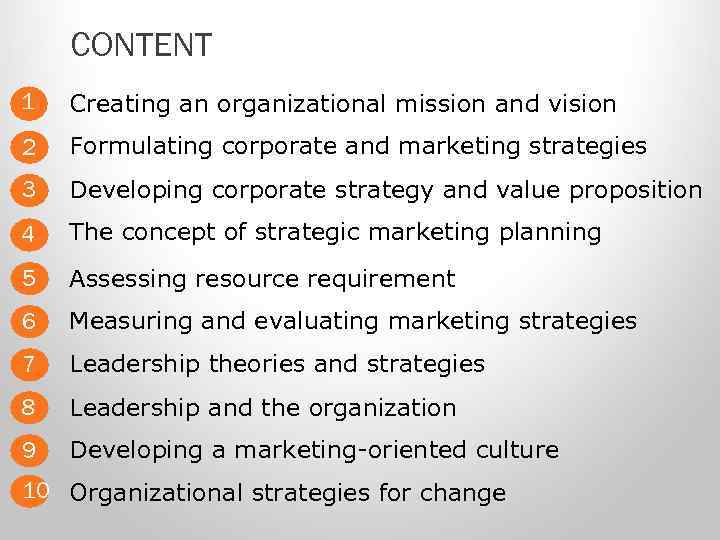 CONTENT 1 Creating an organizational mission and vision 2 Formulating corporate and marketing strategies 3 Developing corporate strategy and value proposition 4 The concept of strategic marketing planning 5 Assessing resource requirement 6 Measuring and evaluating marketing strategies 7 Leadership theories and strategies 8 Leadership and the organization 9 Developing a marketing-oriented culture 10 Organizational strategies for change
 Creating an organizational mission and vision Importance of the Mission and Vision Key terms Mission outlines the fundamental principles guiding strategic choices Vision outlines the desired future at which the organization hopes to arrive Vision provides a business aim, while mission provides business principles. De Wit and Meyer (2005)
 Creating an organizational mission and vision Key terms Vision outlines what the organization wants to be and what it aspires to be in the longer term. The vision needs to identify the organization's strategic intent and create a unique image of the organization for the future.
 Creating an organizational mission and vision Key terms Mission comes from the Latin word mittere which means 'to send'. A mission is a task, duty or purpose that sends some on their way. The mission statement needs to focus on the company's current state, while the vision focuses on the future. The values of the organization, whether moral, ethical and sustainability positioning also need to be appropriately considered when writing the mission statement.
 Vision 'Staying true to our purpose will give us the best shot at achieving our vision of innocent becoming: The earth's favourite little food company A company that makes delicious, healthy, natural, ethical food universally available for all. It's a big task - to do so we're up against the biggest food and drinks companies in the world who have billions of pounds of resources at their disposal. But never underestimate the power of a group of people who believe in what we're doing. ’
 Creating an organizational mission and vision Mission examples • To organize the world's information and make it universally accessible and useful • To enable people and businesses throughout the world to realize their full potential • To be the most successful computer company in the world at delivering the best customer experience in markets we serve • To give people the power to share and make the world more open and connected
 Creating an organizational mission and vision 3 Components of organization mission 1. Organizational beliefs:
 Creating an organizational mission and vision 3 Components of organization mission 2. Organizational values:
 Creating an organizational mission and vision 3 Components of organization mission 3. Business definition:
 Creating an organizational mission and vision Functions of organizational mission Direction: point the organisation in a certain direction Legitimisation: conveys to all stakeholders inside and outside the organisation what activities it is pursuing and on what basis Motivation: inspire individuals to work together in a particular way, with the power to motivate people over a long period of time Strategic change: a change of attitude within an organisation which can lead an organisation in a new direction
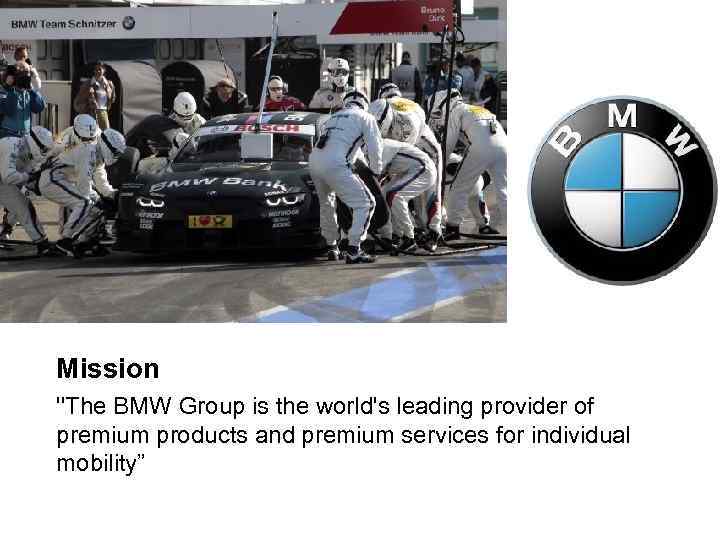 Mission ''The BMW Group is the world's leading provider of premium products and premium services for individual mobility”
 Activity 1. 1 Identify for the organization of your choice is the mission and what is the purpose of the organisation. What do you think about the ability to create a mission statement that will be universally accepted?
 Activity 1. 2 Critically evaluate a mission statement for an organisation of your choice. Compare it to its vision and highlight the differences
 Creating an organizational mission and vision Perspectives on organisational purpose Organisations face two competing pressures: (a) They require a certain amount of economic profitability to survive (b) They need to exhibit a certain amount of social responsibility if they are to retain the trust and support of key stakeholders
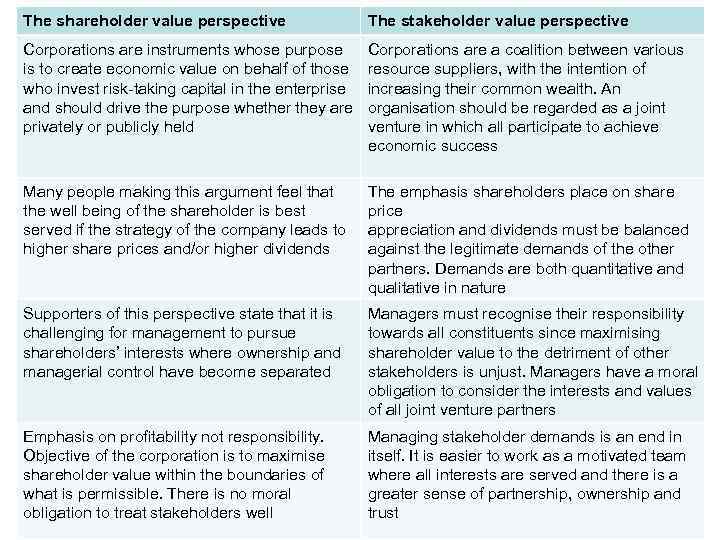 The shareholder value perspective The stakeholder value perspective Corporations are instruments whose purpose is to create economic value on behalf of those who invest risk-taking capital in the enterprise and should drive the purpose whether they are privately or publicly held Corporations are a coalition between various resource suppliers, with the intention of increasing their common wealth. An organisation should be regarded as a joint venture in which all participate to achieve economic success Many people making this argument feel that the well being of the shareholder is best served if the strategy of the company leads to higher share prices and/or higher dividends The emphasis shareholders place on share price appreciation and dividends must be balanced against the legitimate demands of the other partners. Demands are both quantitative and qualitative in nature Supporters of this perspective state that it is challenging for management to pursue shareholders’ interests where ownership and managerial control have become separated Managers must recognise their responsibility towards all constituents since maximising shareholder value to the detriment of other stakeholders is unjust. Managers have a moral obligation to consider the interests and values of all joint venture partners Emphasis on profitability not responsibility. Objective of the corporation is to maximise shareholder value within the boundaries of what is permissible. There is no moral obligation to treat stakeholders well Managing stakeholder demands is an end in itself. It is easier to work as a motivated team where all interests are served and there is a greater sense of partnership, ownership and trust
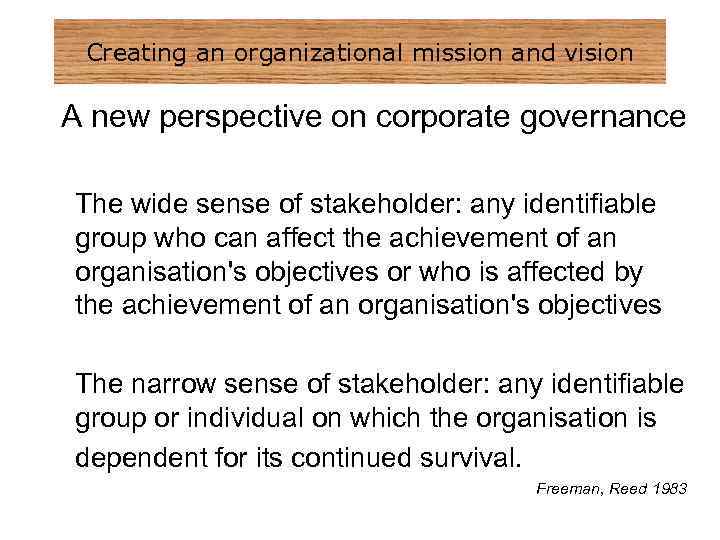 Creating an organizational mission and vision A new perspective on corporate governance The wide sense of stakeholder: any identifiable group who can affect the achievement of an organisation's objectives or who is affected by the achievement of an organisation's objectives The narrow sense of stakeholder: any identifiable group or individual on which the organisation is dependent for its continued survival. Freeman, Reed 1983
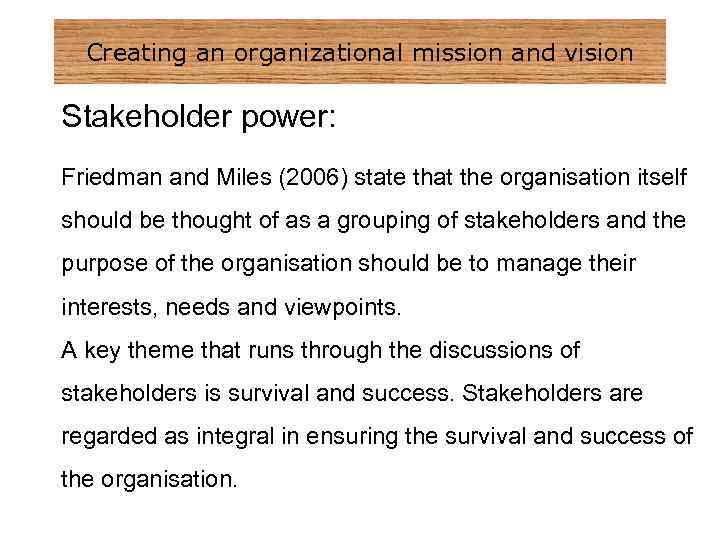 Creating an organizational mission and vision Stakeholder power: Friedman and Miles (2006) state that the organisation itself should be thought of as a grouping of stakeholders and the purpose of the organisation should be to manage their interests, needs and viewpoints. A key theme that runs through the discussions of stakeholders is survival and success. Stakeholders are regarded as integral in ensuring the survival and success of the organisation.
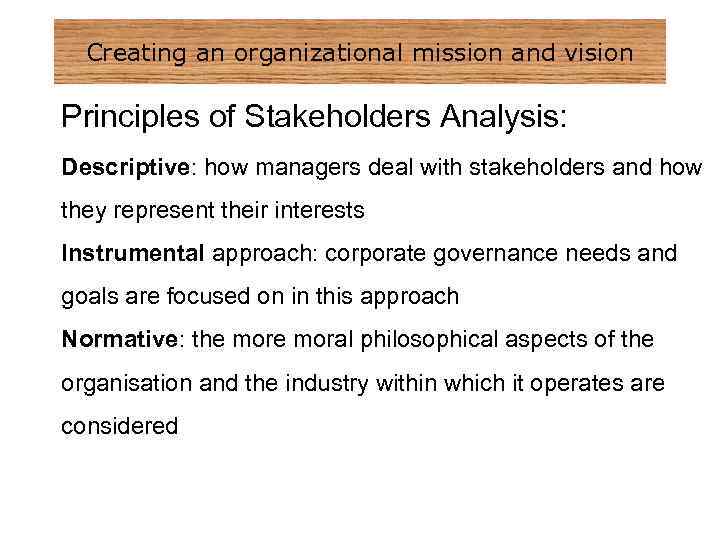 Creating an organizational mission and vision Principles of Stakeholders Analysis: Descriptive: how managers deal with stakeholders and how they represent their interests Instrumental approach: corporate governance needs and goals are focused on in this approach Normative: the moral philosophical aspects of the organisation and the industry within which it operates are considered

 Creating an organizational mission and vision Use of stakeholder concepts in strategy formulation : Stakeholder strategy process is a systematic method for analysing the relative importance of stakeholders, their co-operative potential (how they can help the corporation achieve its objectives) and their competitive threat (how they can prevent the corporation from achieving its objectives) Stakeholder audit process is a systematic method for identifying stakeholders and assessing the effectiveness of current organisational strategies
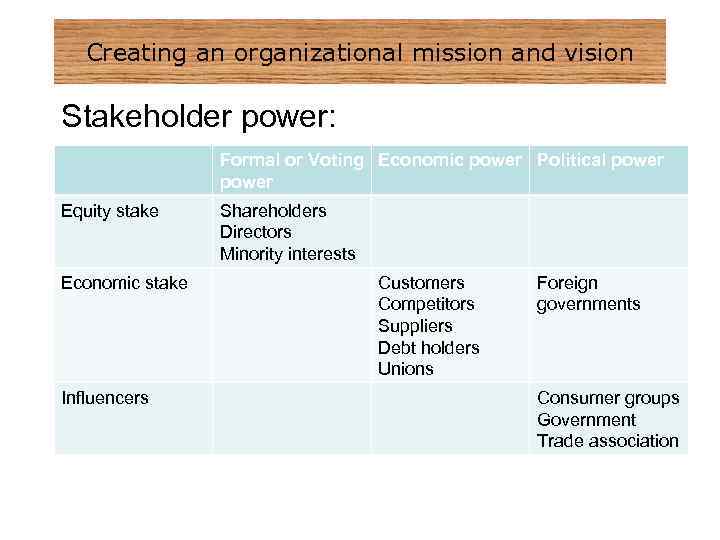 Creating an organizational mission and vision Stakeholder power: Formal or Voting Economic power Political power Equity stake Economic stake Influencers Shareholders Directors Minority interests Customers Competitors Suppliers Debt holders Unions Foreign governments Consumer groups Government Trade association
 Creating an organizational mission and vision If people do not feel involved they will not be committed
 Creating an organizational mission and vision Involving stakeholders in future possibilities: Increasing involvement is a fundamental part of stakeholder management. The downside of involvement is risk. Whenever you involve people in the 'problem' you risk losing control.
 Creating an organizational mission and vision Involving stakeholders in future possibilities: • Most managers learn that the effectiveness of their decisions depends on their quality and commitment from others, and that commitment comes through involvement. • Managers are then willing to assume the risks and to develop the skills of involving people appropriately. • Involvement also requires leadership, engagement, understanding strategic decisions. • Contextualising these decisions is fundamental to the success of the organisation. • Engagement needs to take place at all levels, both internally and externally with stakeholders
 Creating an organizational mission and vision Developing an effective mission statement : Ask yourself the right questions. Say it clearly. Decide what makes your organisation different. Build your brand. Keep it short and sweet. Be honest. Make it a joint effort. Polish the language. Spread the word. Revise as needed.
 Activity 1. 3 For your own company, develop a mission and vision statements. Discuss with the colleagues
 Creating an organizational mission and vision Core competences of the organisation: Key terms Core competences are the collective learning in the organisation, especially how to coordinate diverse production skills and integrate multiple streams of technologies and organising work and the delivery of value.
 Creating an organizational mission and vision Identifying core competences: • Provides potential access to a wide variety of markets. • Should make a significant contribution to the benefits perceived by the customer of the end product it contributes significantly to the value enjoyed by the customer. • Should be difficult for competitors to imitate
 Activity 1. 4 • Using the above guidelines create a full list of the competences for your own organisation. • Shortlist this to five or six core competences. • Critically evaluate the list and consider the contribution of these core competences for the future direction of the organisation

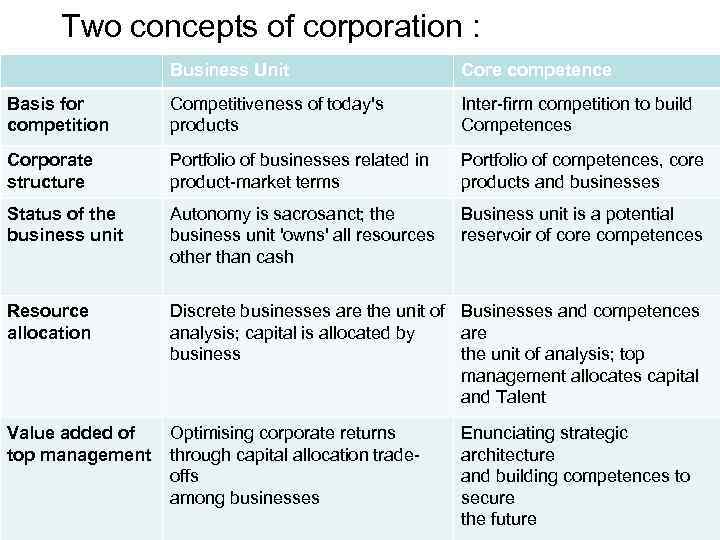 Two concepts of corporation : Business Unit Core competence Basis for competition Competitiveness of today's products Inter-firm competition to build Competences Corporate structure Portfolio of businesses related in product-market terms Portfolio of competences, core products and businesses Status of the business unit Autonomy is sacrosanct; the business unit 'owns' all resources other than cash Business unit is a potential reservoir of core competences Resource allocation Discrete businesses are the unit of Businesses and competences analysis; capital is allocated by are business the unit of analysis; top management allocates capital and Talent Value added of top management Optimising corporate returns through capital allocation tradeoffs among businesses Enunciating strategic architecture and building competences to secure the future
 Creating an organizational mission and vision Risks to establish sustainable core competences if management perceive the organisation as a multiplicity of separate business units: • Under-investment in developing core competences and core products • Imprisoned resources • Bounded innovation
 Wrap up • A mission statement is made up of organisational beliefs, and organisational values, it is how the business defines itself. • There a number of functions of organisational mission: to give direction, legitimisation, motivation, and inspire strategic change where appropriate. • Stakeholders are a key part of the strategy formulation. • Stakeholders need to be involved in the strategy development process. • The mission statement creates the key context for the overall strategic direction of the organisation, but some can be very ambiguous. There will be a number of stakeholders' needs to fulfil and it must say something useful to the key stakeholders, from a financial, social and business perspective.
 Wrap up • When developing a mission statement a number of factors need to be considered that will vary dependent on the organisation, the product, the service and the industry. • The core competence of the organisation is its collective learning especially how to co-ordinate diverse production skills, integrate multiple streams of technologies, organising work and the delivering of value. • Identifying the organisation's core competences is a key part of the strategy development process.