 Скачать презентацию Marketing It s about understanding customers not just selling
3c48d9a76fdc26441001f749945405e7.ppt
- Количество слайдов: 46



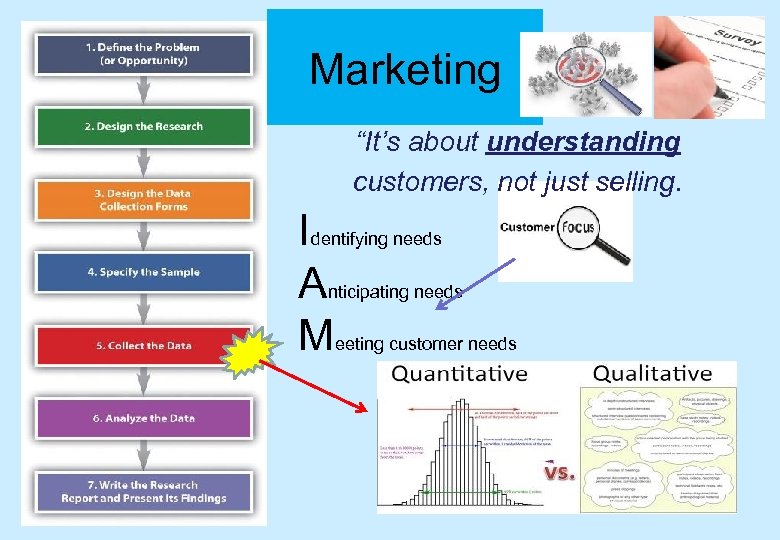
Marketing “It’s about understanding customers, not just selling. Identifying needs Anticipating needs Meeting customer needs
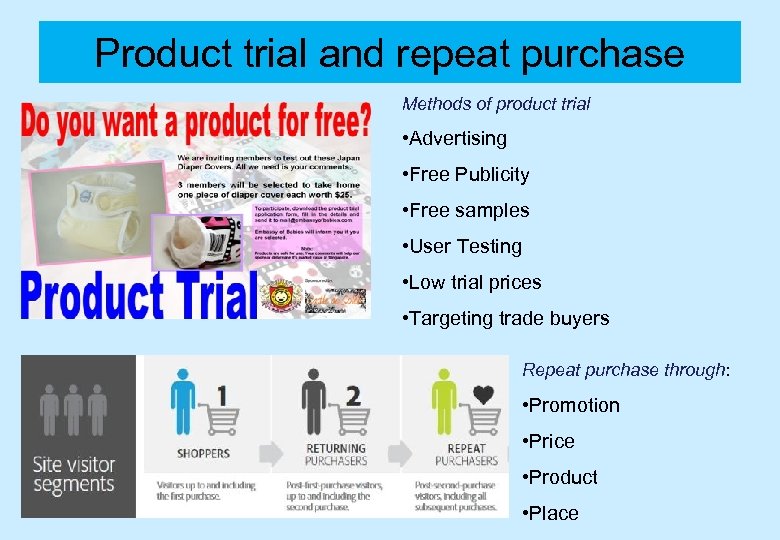
Product trial and repeat purchase Methods of product trial • Advertising • Free Publicity • Free samples • User Testing • Low trial prices • Targeting trade buyers Repeat purchase through: • Promotion • Price • Product • Place
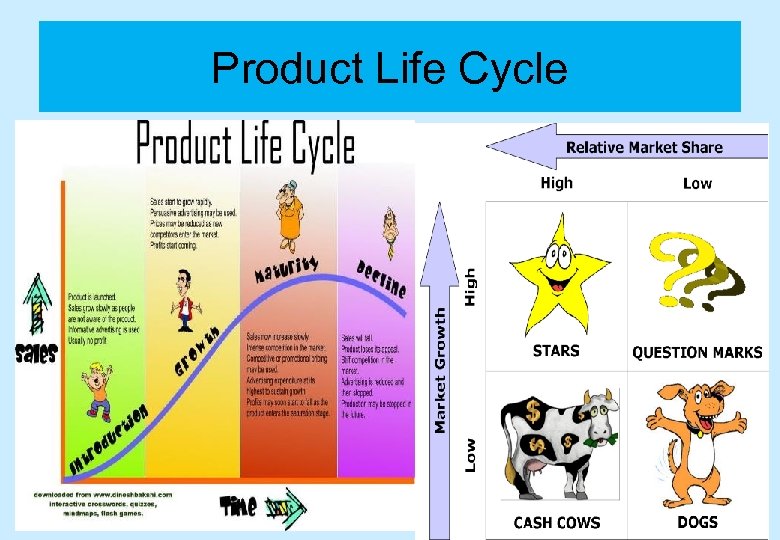
Product Life Cycle
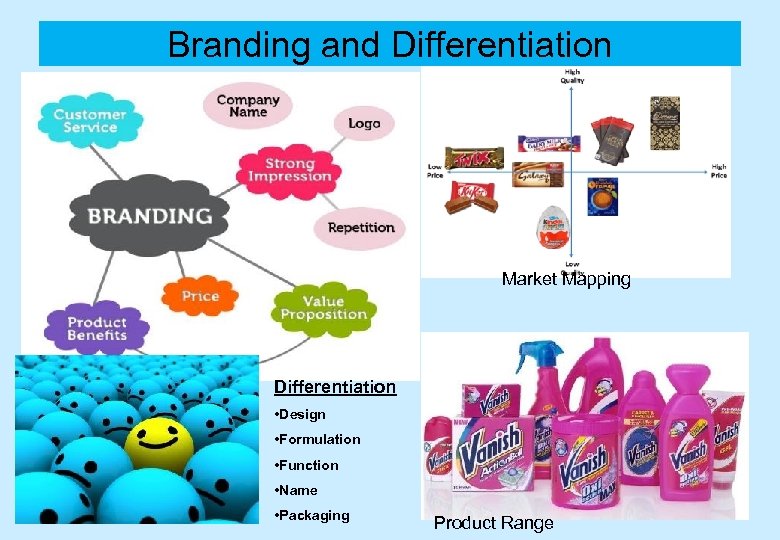
Branding and Differentiation The Product Range Market Mapping Differentiation • Design • Formulation • Function • Name • Packaging Product Range
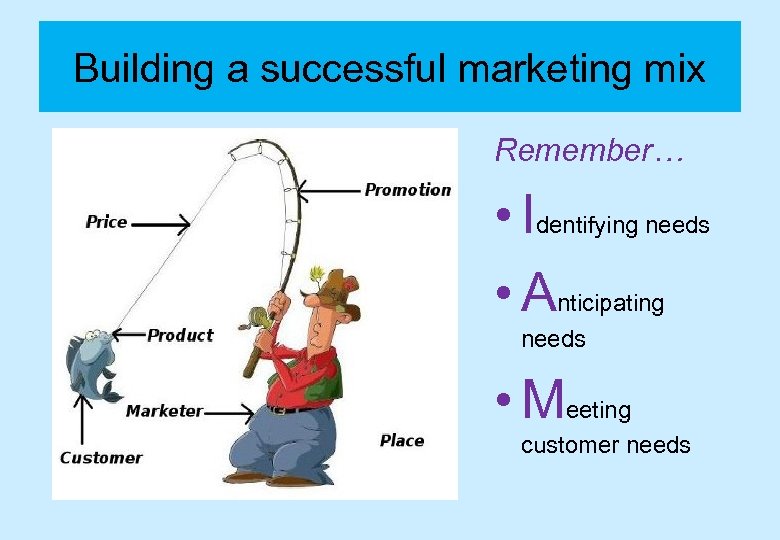
Building a successful marketing mix Remember… • Identifying needs • Anticipating needs • Meeting customer needs
Topic 3. 1 - Marketing What the syllabus says… - How to collect and interpret quantitative and qualitative research data to help decide on issues such as the appropriate marketing mix
Topic 3. 1: Product Trial and Repeat Purchase What the syllabus says… - The concept of breaking down ‘sales’ into product trial and repeat purchase - How to maximise repeat purchase through customer loyalty” - Seeing that the marketing approach to achieve loyalty is different from the way to achieve trial (and they may conflict, for example overselling).
Topic 3. 1: Product Life Cycle What the syllabus says… - The four phases of the life cycle, - extension strategies, - cash flow and the life cycle, - product portfolio analysis through the Boston Matrix” - Phases of the life cycle can be related to product trial and repeat purchase;
Topic 3. 1: Branding and Differentiation What the syllabus says… - The importance of brands as an aid to product trial and repeat purchase - The need to differentiate a product/service from others, given the level of Competition - Useful to analyse brand images using a market map
Topic 3. 1: Marketing Mix What the syllabus says… - The importance of managing a brand through the key variables that make up the mix: Product, Price, Promotion and Place
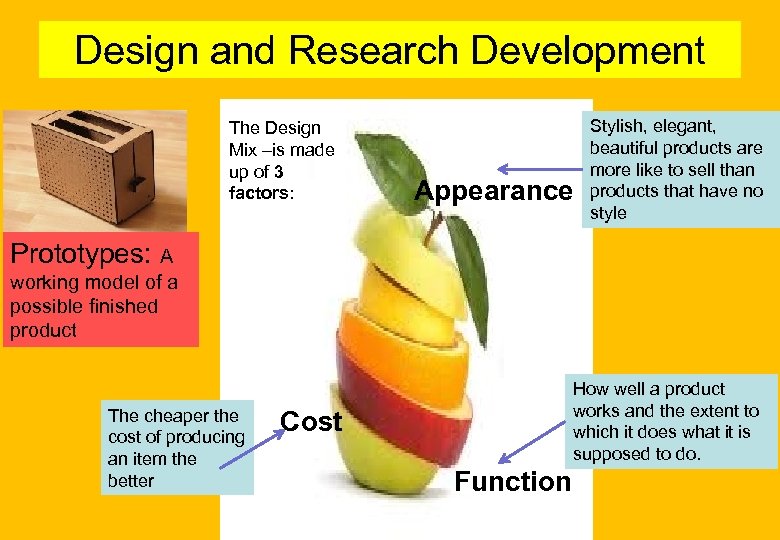
Design and Research Development The Design Mix –is made up of 3 factors: Appearance Stylish, elegant, beautiful products are more like to sell than products that have no style Prototypes: A working model of a possible finished product The cheaper the cost of producing an item the better How well a product works and the extent to which it does what it is supposed to do. Cost Function
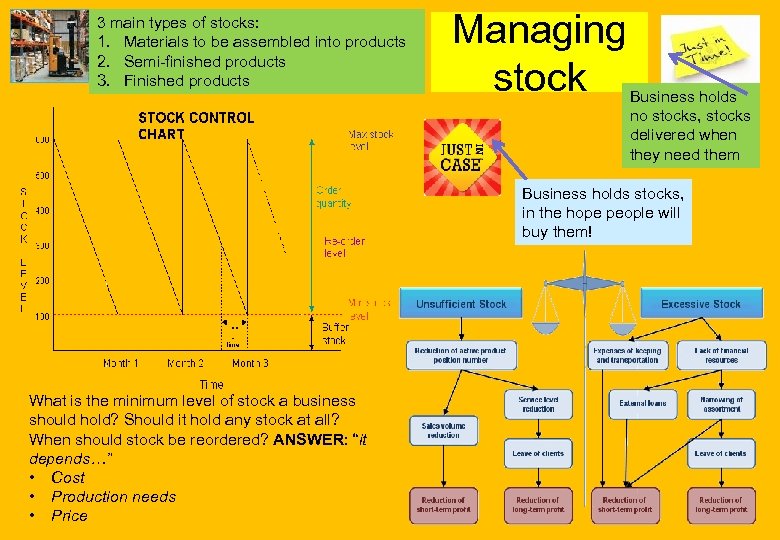
3 main types of stocks: 1. Materials to be assembled into products 2. Semi-finished products 3. Finished products Managing stock Business holds no stocks, stocks delivered when they need them Business holds stocks, in the hope people will buy them! What is the minimum level of stock a business should hold? Should it hold any stock at all? When should stock be reordered? ANSWER: “it depends…” • Cost • Production needs • Price
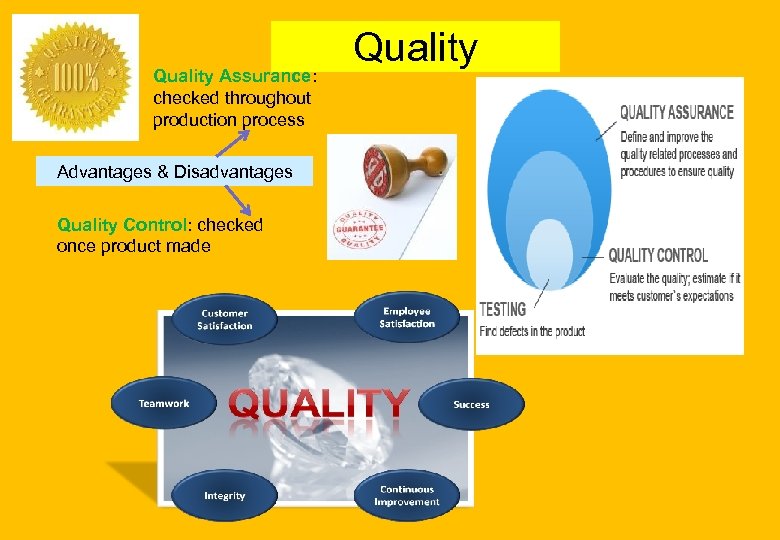
Quality Assurance: checked throughout production process Advantages & Disadvantages Quality Control: checked once product made Quality
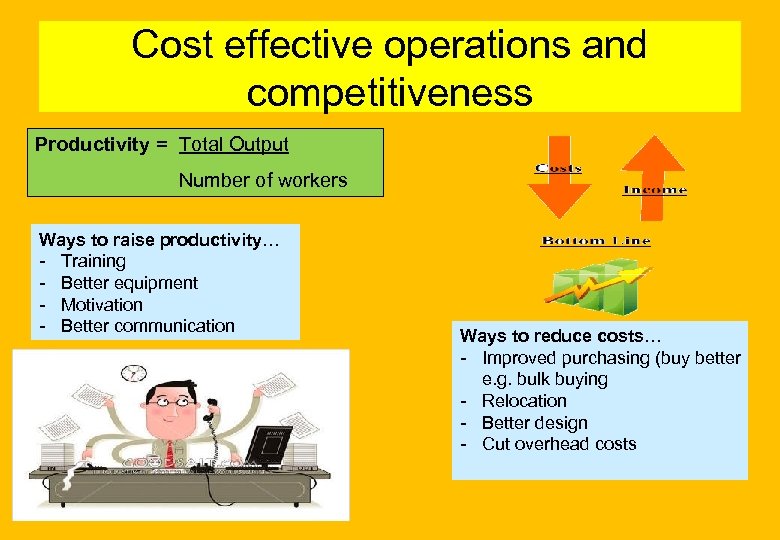
Cost effective operations and competitiveness Productivity = Total Output Number of workers Ways to raise productivity… - Training - Better equipment - Motivation - Better communication Ways to reduce costs… - Improved purchasing (buy better e. g. bulk buying - Relocation - Better design - Cut overhead costs
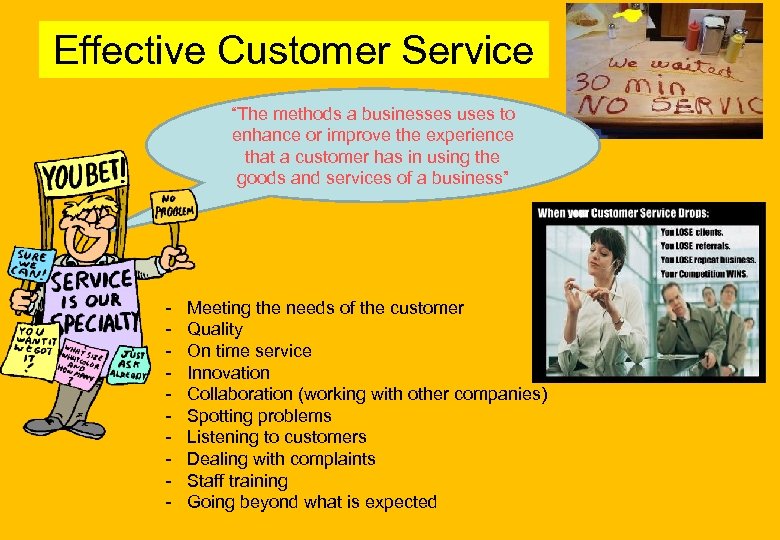
Effective Customer Service “The methods a businesses uses to enhance or improve the experience that a customer has in using the goods and services of a business” - Meeting the needs of the customer Quality On time service Innovation Collaboration (working with other companies) Spotting problems Listening to customers Dealing with complaints Staff training Going beyond what is expected
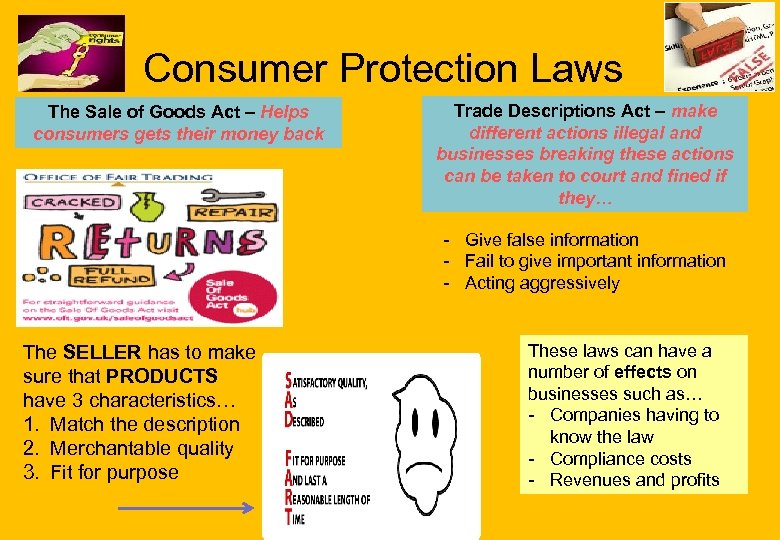
Consumer Protection Laws The Sale of Goods Act – Helps consumers gets their money back Trade Descriptions Act – make different actions illegal and businesses breaking these actions can be taken to court and fined if they… - Give false information - Fail to give important information - Acting aggressively The SELLER has to make sure that PRODUCTS have 3 characteristics… 1. Match the description 2. Merchantable quality 3. Fit for purpose These laws can have a number of effects on businesses such as… - Companies having to know the law - Compliance costs - Revenues and profits
Topic 3. 2: Design and Research What the syllabus says… - Design as a key approach to product differentiation - Be able to appreciate the design mix (Function, cost, appearance) - Show the need for scientific research to provide the basis for development
Topic 3. 1: Stock Control What the syllabus says… - To interpret bar gate stock graphs to see how stock control should work in theory - Understand the need for the use of Just In Time (JIT) stock control - The advantages and drawbacks of different stock control methods – “Just in case” and “Just in time”
Topic 3. 2 Quality What the syllabus says… - Quality control versus a culture of quality assurance
Topic 3. 2: Cost Effective Operations What the syllabus says… - keeping productivity up and costs down to ensure low costs and allow for competitive prices - managers must always keep an eye on costs.
Topic 3. 2: Effective Customer Service What the syllabus says… - Providing customers with the service level they want, when they want it - See the link with repeat purchase levels - The disadvantages of poor customer service - The need to find out what the customer wants from ‘service
Topic 3. 1: Consumer Protection Laws What the syllabus says… - A brief introduction to the purpose of Trade Descriptions and Sale of Goods legislation - The effects of this legislation on business - No need for exhaustive detail, just an outline; ‘Why? ’ and ‘With what effect? ’
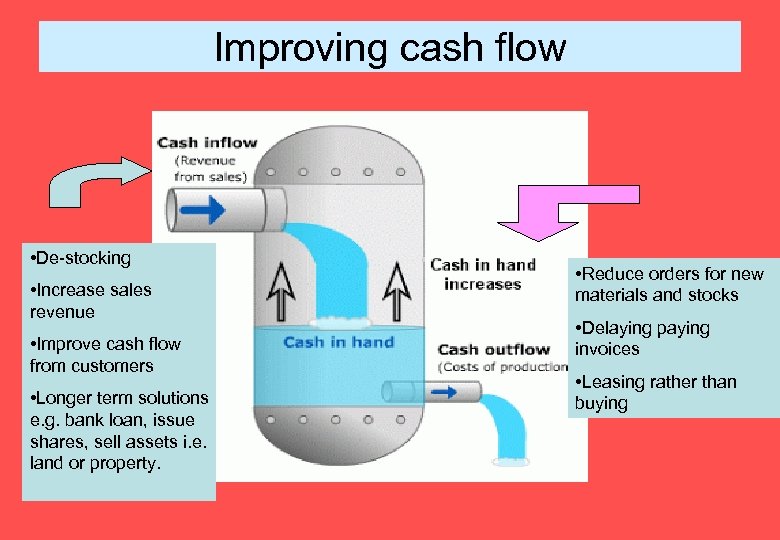
Improving cash flow • De-stocking • Increase sales revenue • Improve cash flow from customers • Longer term solutions e. g. bank loan, issue shares, sell assets i. e. land or property. • Reduce orders for new materials and stocks • Delaying paying invoices • Leasing rather than buying
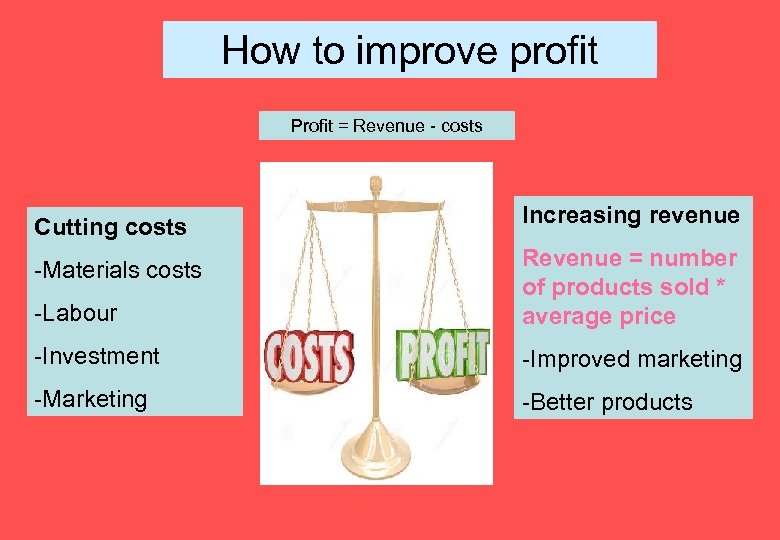
How to improve profit Profit = Revenue - costs Cutting costs Increasing revenue -Materials costs -Labour Revenue = number of products sold * average price -Investment -Improved marketing -Marketing -Better products
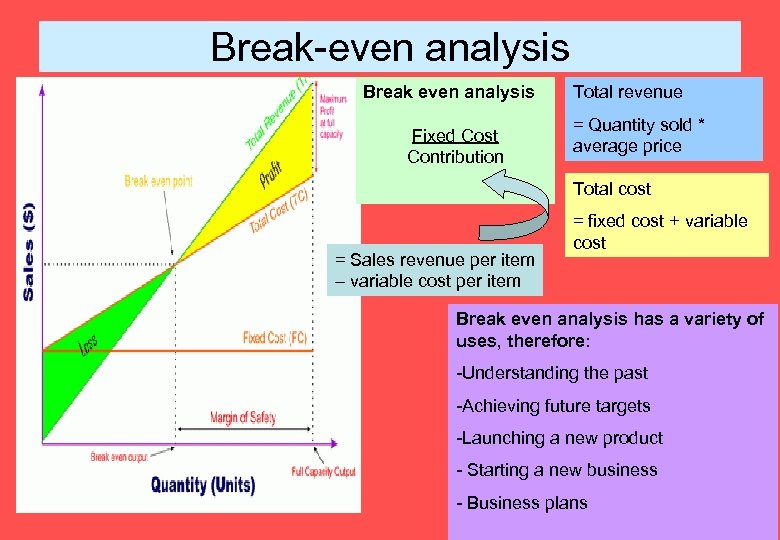
Break-even analysis Break even analysis Fixed Cost Contribution Total revenue = Quantity sold * average price Total cost = Sales revenue per item – variable cost per item = fixed cost + variable cost Break even analysis has a variety of uses, therefore: -Understanding the past -Achieving future targets -Launching a new product - Starting a new business - Business plans
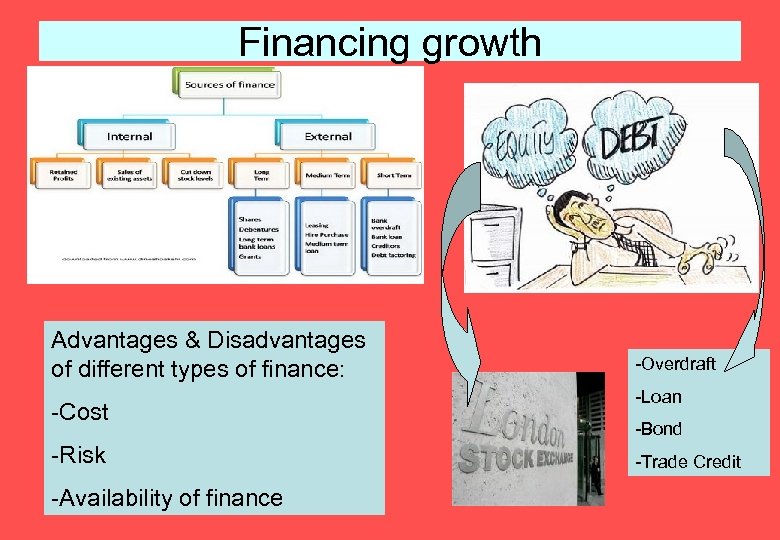
Financing growth Advantages & Disadvantages of different types of finance: -Cost -Risk -Availability of finance -Overdraft -Loan -Bond -Trade Credit
Topic 3. 3: Improving Cash Flow What the syllabus says… - Key aspects of financial management such as how to establish more favourable credit terms with customers and suppliers - The practice of de-stocking - How to analyse the difference between increasing cash inflows and reducing cash outflows. - The importance is identifying what is really within the control of managers.
Topic 3. 3: Improving Profit What the syllabus says… - Cutting costs and increasing revenues - The impact of price changes on profit - Important for students to think beyond the immediate effect, e. g. that staff cuts may save money at the cost of lower motivation.
Topic 3. 3: Break Even What the syllabus says… - How to draw and interpret break-even charts - Calculate the break-even point and margin of safety - How changes to price and costs affect the break-even point - The value to a business of using breakeven analysis - Exam questions would always give students the axes for any graph to be drawn. Students should be able to label the axes and interpret the data.
Topic 3. 3: Financing Growth What the syllabus says… - How to finance a business from: Internal sources - Profit, - Asset sales External sources - Share capital - Debt - Stock market flotation - The important issue is debt versus share capital (equity), ie how risky is the financing of the business?
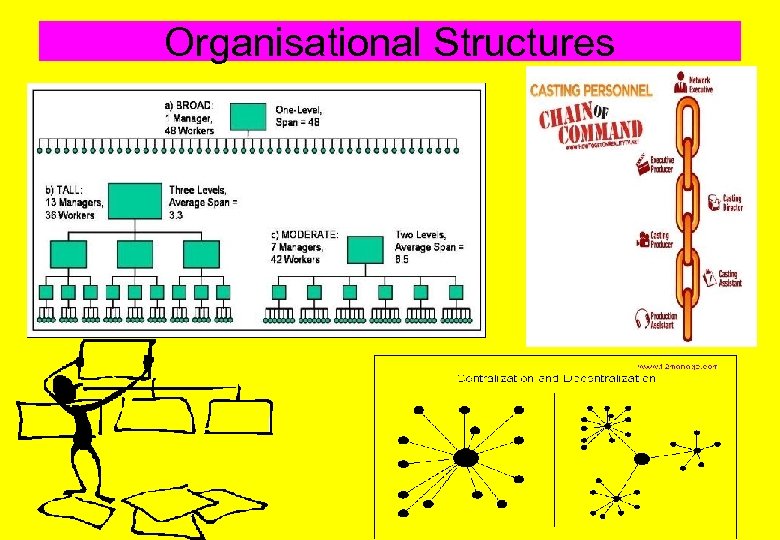
Organisational Structures
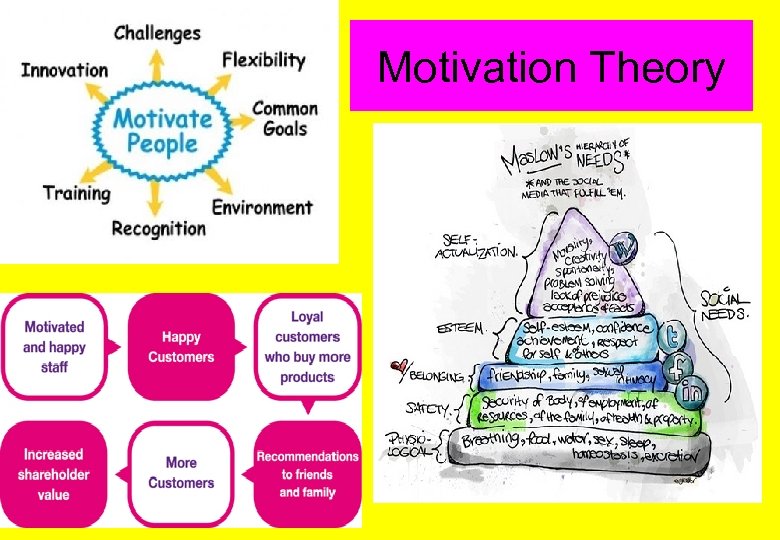
Motivation Theory
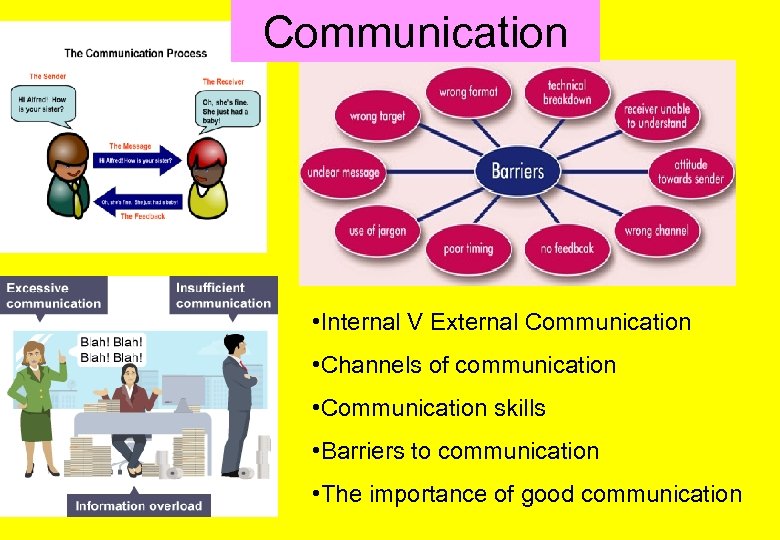
Communication • Internal V External Communication • Channels of communication • Communication skills • Barriers to communication • The importance of good communication
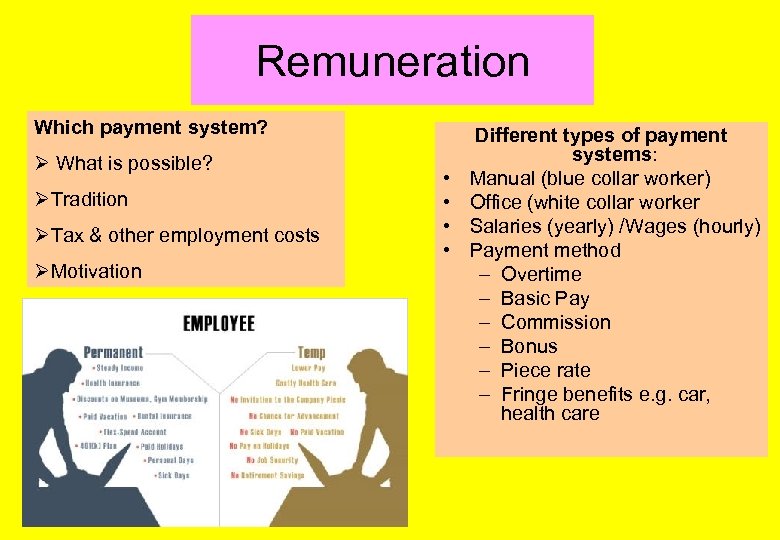
Remuneration Which payment system? Ø What is possible? ØTradition ØTax & other employment costs ØMotivation • • Different types of payment systems: Manual (blue collar worker) Office (white collar worker Salaries (yearly) /Wages (hourly) Payment method – Overtime – Basic Pay – Commission – Bonus – Piece rate – Fringe benefits e. g. car, health care
Topic 3. 4: Organisational Structures What the syllabus says… - The significance of motivation in the workplace. - The importance of divisional structure, levels of hierarchy, chains of command. - Centralised versus decentralised systems. - Link this material to Maslow’s Hierarchy of Needs and to communication.
Topic 3. 4: Motivation What the syllabus says… - The significance of motivation in the workplace, - Maslow’s Hierarchy of Needs and its potential in organisations - The idea that motivation comes from within - Students may have to analyse a business situation using Maslow, and see how an understanding of theory could make a manager better at their job. - This idea is one to query and debate, as motivation may be rooted largely in circumstances.
Topic 3. 4: Communication What the syllabus says… - The impact of insufficient or excessive communication on efficiency - The impact on staff and their motivation - Barriers to effective communication
Topic 3. 4: Remuneration What the syllabus says… - The impact on staff of various payment strategies: - time - piece rate - commission - full-time - salary versus freelance or temporary work - fringe benefits - The impact on business of different payment systems - The key is for students to think from two different perspectives: the employer and the employee. The key concept is financial incentives versus salary/time rate.
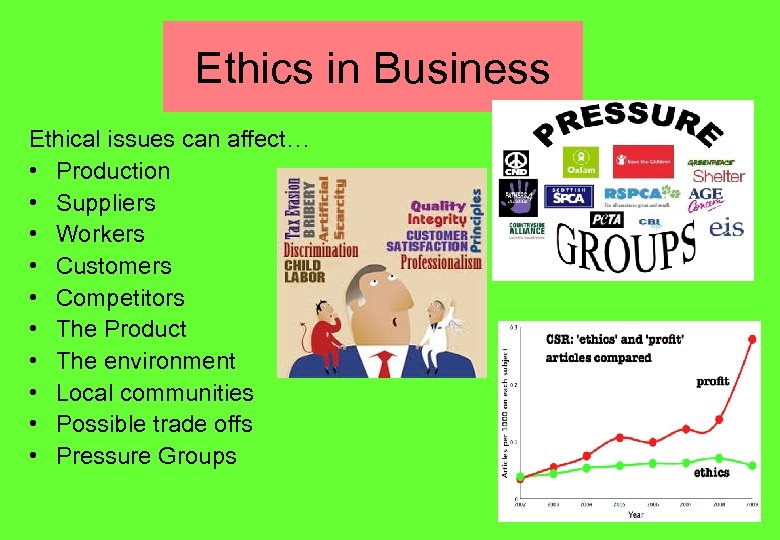
Ethics in Business Ethical issues can affect… • Production • Suppliers • Workers • Customers • Competitors • The Product • The environment • Local communities • Possible trade offs • Pressure Groups
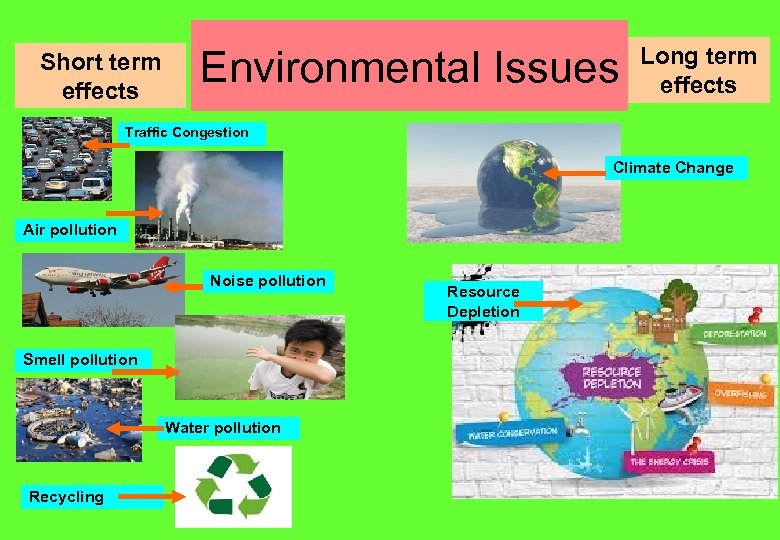
Short term effects Environmental Issues Long term effects Traffic Congestion Climate Change Air pollution Noise pollution Smell pollution Water pollution Recycling Resource Depletion
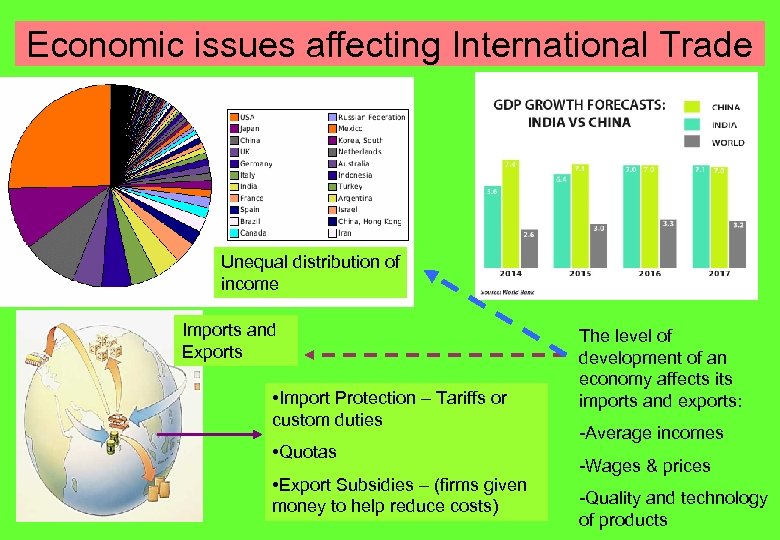
Economic issues affecting International Trade Unequal distribution of income Imports and Exports • Import Protection – Tariffs or custom duties • Quotas • Export Subsidies – (firms given money to help reduce costs) The level of development of an economy affects imports and exports: -Average incomes -Wages & prices -Quality and technology of products
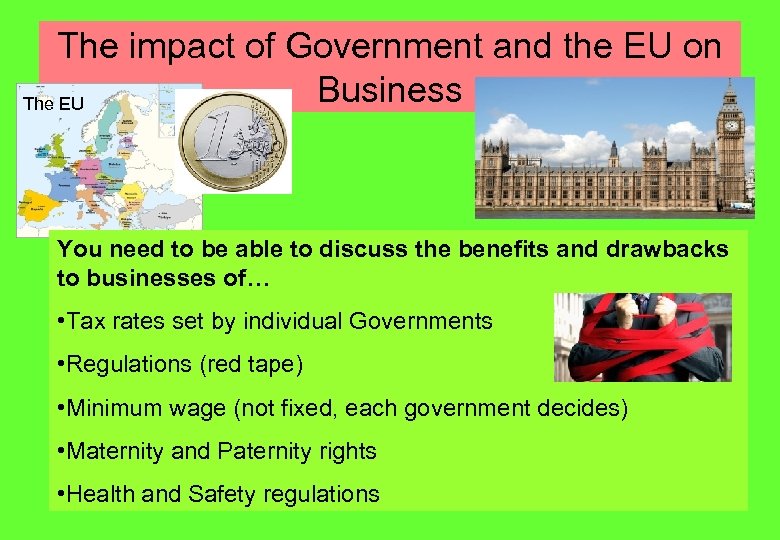
The impact of Government and the EU on Business The EU You need to be able to discuss the benefits and drawbacks to businesses of… • Tax rates set by individual Governments • Regulations (red tape) • Minimum wage (not fixed, each government decides) • Maternity and Paternity rights • Health and Safety regulations
Topic 3. 5: Ethics in Business What the syllabus says… - The meaning of the term ‘ethics’ in business - The complexity of moral issues affecting organisations - Possible trade-off between ethics and profit - The importance of the potential effects of pressure group activity
Topic 3. 5: Environmental issues What the syllabus says… -how businesses affect the environment - Short term environmental effects: - traffic congestion; - air - noise - water pollution - recycling - Long-term environmental effects - global warming - resource depletion - Consider these issues in relation to economic growth in both the developed and developing worlds
Topic 3. 5: Economic Issues affecting trade What the syllabus says… -the extremes of income distribution internationally - the effect of import protection and export subsidy on businesses - Contrast the growth rates in China and India with those in developed countries, considering the opportunities and threats for British businesses.
Topic 3. 5: The impact of Government and the EU on Business What the syllabus says… - The impact of regulation and taxation - The benefits and drawbacks on businesses of + minimum wage + maternity/paternity rights + health and safety regulations - Fear of “red tape”. - What would the impact of a complete withdrawal of all government regulation on business.
Скачать презентацию Marketing It s about understanding customers not just selling
3c48d9a76fdc26441001f749945405e7.ppt