


 Скачать презентацию Marketing Information Information is a marketing asset
Marketing Information System (MkIS).pptx
- Количество слайдов: 14
 Marketing Information • Information is a marketing asset, which: ➢Helps to increase responsiveness to customer demands ➢Helps to identify new customer opportunities and new product/service demands ➢Helps to anticipate competitive attacks and threats • Marketing information is about customer service, the essence of customer concept. Superior customer service can only be achieved by being able to anticipate and satisfy customer needs. Information has to be up-to-date, accurate, relevant and timely Lidia Pashchuk 1
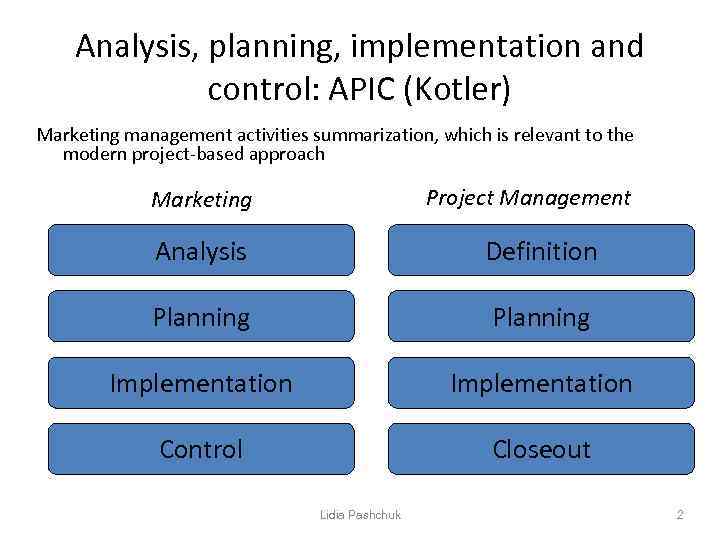 Analysis, planning, implementation and control: APIC (Kotler) Marketing management activities summarization, which is relevant to the modern project-based approach Project Management Marketing Analysis Definition Planning Implementation Control Closeout Lidia Pashchuk 2
 Marketing Information Requirement Key strategic questions: • Where are we now? Situation analysis (current sales by product/ market; market share, competitors’ market shares) • Where do we want to be? Setting project objectives (market forecasts, environmental trends, product/ market potentials) • How might we get there? Shaping the project (marketing mix evaluation, buying behavior, risk evaluation, alternative strategic option) • How can we ensure arrival? Controlling the project (budget, performance evaluation) Lidia Pashchuk 3
 The Roles of Information by Wilson (2006) • Descriptive – describing observations (which products are bought by customers, where); • Comparative – comparison of elements (organization vs competitors; products in product portfolio, markets, etc. ) • Diagnostic – explanation of customer behavior • Predictive – determines outcome of marketing action. Lidia Pashchuk 4
 In-Class Assignment Which information is to be defined as: 1) Descriptive in supermarket 2) Comparative in beverage company 3) Diagnostic in bank 4) Predictive in restaurant
 Knowledge Management • Knowledge is information within people’s mind (CIM) • Knowledge-based economy is economy based on application of knowledge • Markets change. “Tomorrow’s standards are always higher” (Hugh Davidson, 1997) Lidia Pashchuk 6
 Marketing Information System (Mk. IS) “Marketing information system is a continuing and interacting structure of people, equipment and procedures to gather, sort, analyze, evaluate, and distribute pertinent, timely, and accurate information for use by marketing decision-makers to improve their marketing planning, implementation and control” (Kotler) Lidia Pashchuk 7
 MKi. S Functions: - Collection of marketing information - Organization of marketing information - Analysis of marketing information Lidia Pashchuk 8
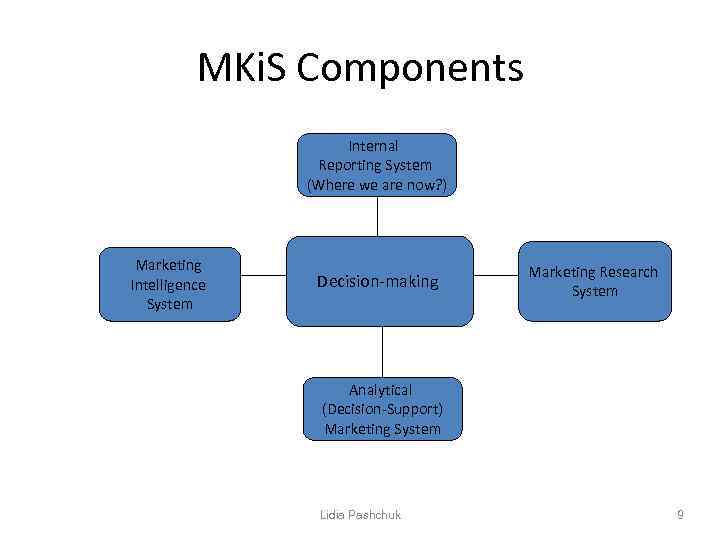 MKi. S Components Internal Reporting System (Where we are now? ) Marketing Intelligence System Decision-making Marketing Research System Analytical (Decision-Support) Marketing System Lidia Pashchuk 9
 Marketing intelligence system • Set of sources and procedures to obtain everyday information about significant developments in the marketing environment • Collects and stores information on external environment (industry reports, competitors’ analysis) • Provides with information to define market potential, growth patterns, competitors’ positioning. Lidia Pashchuk 10
 Internal reporting system: • Customer service data (service records, customer records, helpline calls) • Outbound logistics data (finished goods inventory records, warehouse records, shipping records) • Inbound logistics data (bids received, purchasing and accounts payable systems, raw materials inventory) • Sales and marketing data (accounts receivable system, marketing lead and prospect data, sales commission records, order entry system) • Production and operations data (production schedules and details, production costs, quality control records) Lidia Pashchuk 11
 Analytical marketing system • Provides with analytical tools to enable marketing managers to systematize all data obtain within other elements of Mk. IS • May include statistical packages to support marketing decisions Lidia Pashchuk 12
 Marketing research system • Uses marketing research techniques to gather, evaluate and report findings to minimize uncertainty in business decisions • Fills in informational gaps which are not covered with other Mk. IS components Lidia Pashchuk 13
 Marketing Database • ‘A manual or computerized source of data relevant to marketing decision-making about an organization's customers’ (Wilson, 2002) - database does not have to be computer-based, but it is easier to operate with computerized (f. i. Microsoft Access); - it is better not to limit with customers but with potential and past customers, to take into consideration all the stakeholders and parties involved; - data must be relevant to marketing decision making. Lidia Pashchuk 14