


 Скачать презентацию Marketing Indicator 2 08 Understand sales processes and
dd7b9859b288e01d17bb06b4eeb5c181.ppt
- Количество слайдов: 28
 Marketing Indicator 2. 08 Understand sales processes and techniques to enhance customer relationships and to increase the likelihood of making sales.
 Question? ? ? Who feels they are a good salesperson?
 Identify the components of the selling process. 1. Approach Customer 2. Determine Needs 3. Present the Product 4. Overcome Objections 5. Close the Sale 6. Suggestion Selling 7. Build Relationships
 Describe the importance of establishing relationships with customers. 1. Approach - The first encounter with a potential customer Service approach Asks customer if he/she needs help “May I help you? ” Most effective when routine or in hurry Greeting approach Greet or welcome to store “Welcome to Cici’s. ” Be upbeat and friendly
 Describe the importance of establishing relationships with customers. 1. Approach Continued…. Merchandise approach Comments on product “That video game is rated E. ” Use when customer is looking at an item Combination approach Use 2 or more approaches “Welcome to Hollister, we have a sale on all jeans today. ” “That shirt enhances your eyes, the blue one is only $10 today? ”
 Activity 1 – "Practice w/ Approaches" • Complete Practice w/ approaches worksheet
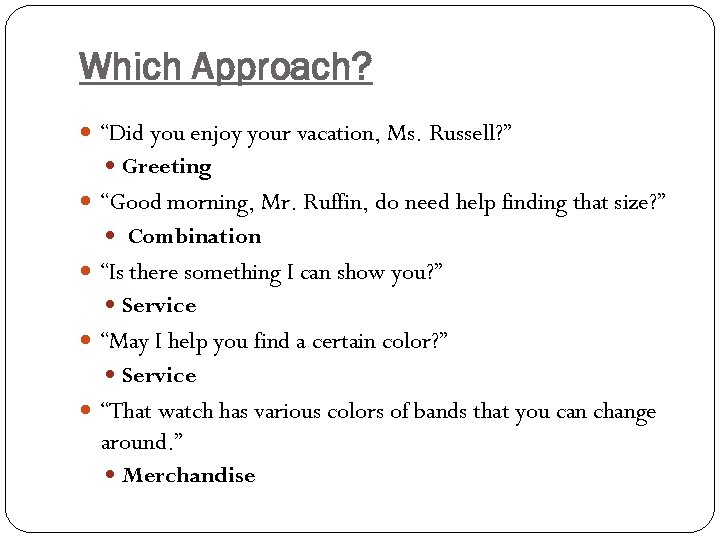 Which Approach? “Did you enjoy your vacation, Ms. Russell? ” Greeting “Good morning, Mr. Ruffin, do need help finding that size? ” Combination “Is there something I can show you? ” Service “May I help you find a certain color? ” Service “That watch has various colors of bands that you can change around. ” Merchandise
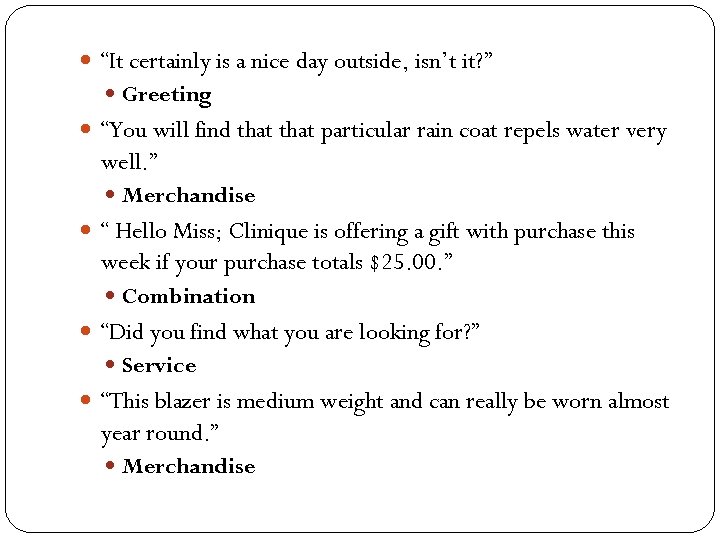 “It certainly is a nice day outside, isn’t it? ” Greeting “You will find that particular rain coat repels water very well. ” Merchandise “ Hello Miss; Clinique is offering a gift with purchase this week if your purchase totals $25. 00. ” Combination “Did you find what you are looking for? ” Service “This blazer is medium weight and can really be worn almost year round. ” Merchandise
 Describe ways to discover customer needs. 2. Determine Needs - find customer’s reasons for buying as early as possible Observing Nonverbal cues for interest Listening Cues for wants and needs Questioning and Engaging Wants, use, previous experience Open ended More than yes or no answers
 Describe the components of prescribing solutions to customer needs. 3. Present the Product What does this product do? Demonstrate – Show them No more than 3 products at a time. Show a medium-priced product first! Highlight the features and benefits Descriptive adjectives and action verbs Avoid: nice, pretty, & fine
 Describe the possibility of the customer not wanting to buy 4. Handle Objections Legitimate reason, doubt, or hesitation for not buying Objection vs. Excuse – difference? Why do people hesitate to buy products? Objection based on: -Need - urgency -Product – color, size, style -Source – past experience -Price – most common -Time – not ready to buy right “now”
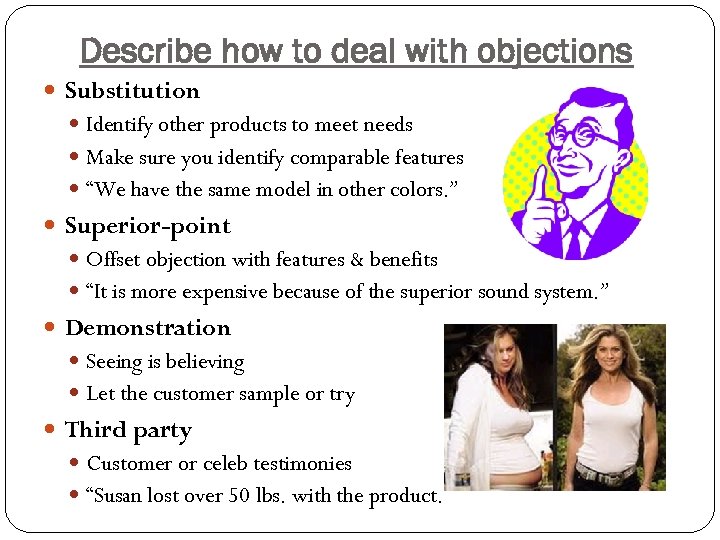 Describe how to deal with objections Substitution Identify other products to meet needs Make sure you identify comparable features “We have the same model in other colors. ” Superior-point Offset objection with features & benefits “It is more expensive because of the superior sound system. ” Demonstration Seeing is believing Let the customer sample or try Third party Customer or celeb testimonies “Susan lost over 50 lbs. with the product.
 ACTIVITY 2 – Handling Customers objections • Get with your 1 o’clock appointment • Complete “Handling Customers Objections” worksheet (on the back of practice w/ approaches) Make sure you read all directions • Answer with complete sentences • We will go over it in about 3 minutes •
 ACTIVITY 3 – Role Play Get with your 9 o’clock appointment • Create a short skit using the steps discussed so far in class. • You must have a clear: • • • Approach Product presentation Determining need of customer Handling objections Be ready to present your skit to the class • Skit must be clear enough for the class to determine which objection you are handling.
 Explain the importance of reaching closure in sales situations. 5. Close – Obtaining an agreement to buy Looking for buying signals & be ready to close at all times Help customers make decisions Create ownership mentality “You” statements “You will enjoy driving this car on family vacations. ”
 Describe aspects of reaching closure in sales situations. Which – Choose between 2 items “Which do you prefer, blue or red? ” Standing-room only – limited # or price change, create urgency “I can’t promise I will have it tomorrow. ” Direct – Ask for sale. “How many can I sign you up for? ” Service – Mention services that are included “I can carry that to your car for you. ”
 Activity 4 – "Techniques for Closing the Sale" • Complete Practice w/ Techniques for Closing the Sale worksheet
 Describe the use of suggestions selling 6. Suggestion Selling - Selling additional goods to enhance the original purchase After a commitment to buy Make recommendations Suggestion should be helpful
 Describe the use of suggestion selling Cross selling – Related merchandise Buying sneakers, suggest Upselling – larger quantities at a lower price Buying a meal at Mc. Donalds, suggest Special sales opportunities – inform about any sales Buying pants, mention sale on shoes.
 Activity 5 – "Suggestions selling" • • • Get w/ your 6 o’clock appt Complete Practice Suggestion Selling worksheet When complete, go back to your seat
 Describe the importance of reaffirming the buyer-seller relationship. 7. Build Relationships Follow-up/ Customer service/ Ensure satisfaction, call, card, email, evaluate performance Handle inquiries and complaints, keep customers satisfied Keeping a client file Useful info. for future reference Order processing/ fulfillment In retail bag merchandise/ B 2 B necessary paperwork Retail – customer pays /E-comm. - payment, packed, shipped Returns, exchanges, & refunds
 Explain techniques for establishing relationships with customers/clients during the initial contact with them. The approach sets the mood / atmosphere for the sale Service Greeting Merchandise Treat the customer as an individual / Do not stereotype Be enthusiastic, courteous, and respectful
 Explain procedures for establishing relationships with customers/clients during initial contacts. Be prepared to approach Appropriate timing Acknowledge all customers as quickly as possible and appropriately Determine appropriate opening statement Be prepared to move from approach to determine needs
 Identify examples of the types of questions used in sales situations. Who……. ? What……? Why……. ? When……? How……. . ?
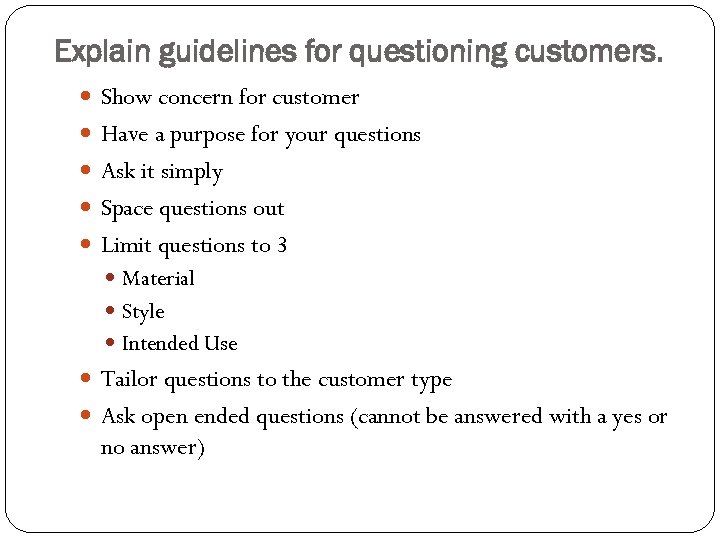 Explain guidelines for questioning customers. Show concern for customer Have a purpose for your questions Ask it simply Space questions out Limit questions to 3 Material Style Intended Use Tailor questions to the customer type Ask open ended questions (cannot be answered with a yes or no answer)
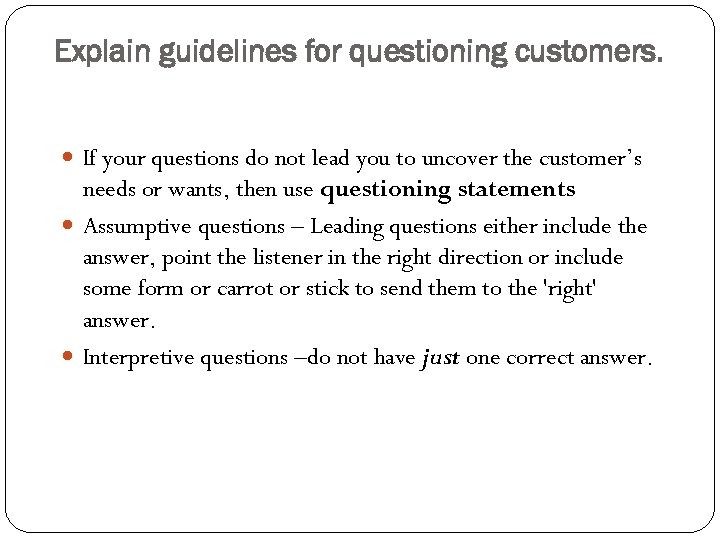 Explain guidelines for questioning customers. If your questions do not lead you to uncover the customer’s needs or wants, then use questioning statements Assumptive questions – Leading questions either include the answer, point the listener in the right direction or include some form or carrot or stick to send them to the 'right' answer. Interpretive questions –do not have just one correct answer.
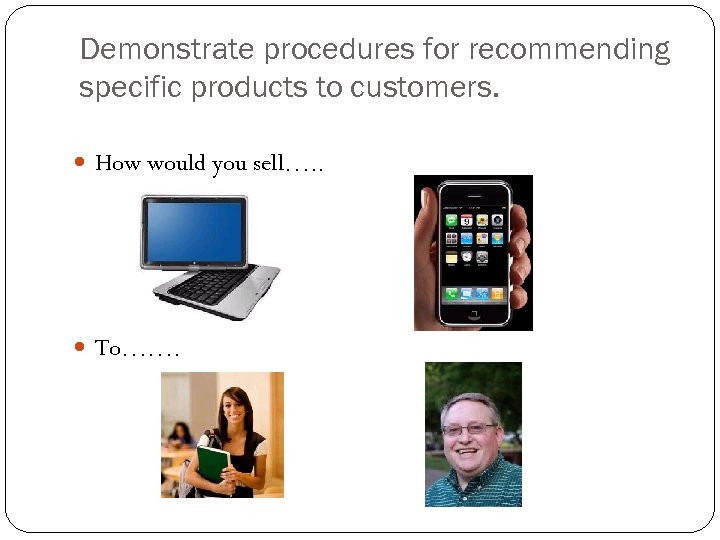 Demonstrate procedures for recommending specific products to customers. How would you sell…. . To…….
 ACTIVITY 6 – Role Play Get with your 8 o’clock appointment • Using all the steps discussed in class, find a product around the room and sell it to your partner; one person will be the sales associate, the other the customer – after complete w/ skit switch roles. • Be ready to act out skit in front of the class •