


 Скачать презентацию Marketing in the New Economy Service Marketing CRM
8115ba6e40492beaca4a98a160263569.ppt
- Количество слайдов: 148
 Marketing in the “New” Economy Service Marketing CRM International Marketing Internet Marketing
 Critical Questions 1. Why is international marketing an important consideration for a purely domestic business? 2. If you were hired as the marketing consultant by a local/national company that is considering going internationalwhat “factors” would you tell them they need to consider when formulating their international/global marketing strategy?
 Levi’s “Global” Marketing Strategy • Global in Concept • Local in Execution
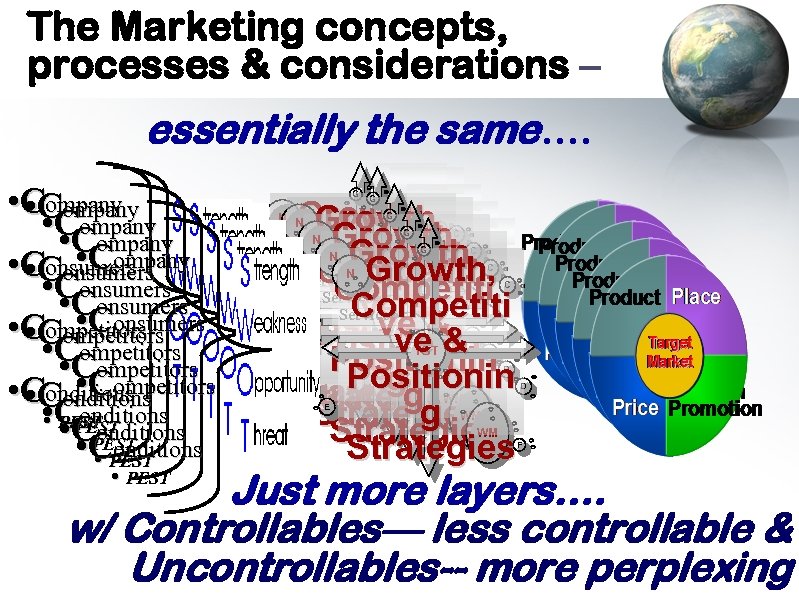 The Marketing concepts, processes & considerations – essentially the same…. • Company • Company • Consumers • Consumers • Competitors • Competitors • Conditions • CPEST onditions • PEST • Conditions • PEST G G Growth, Competiti Service Growth, ve & Competiti ve & Service Positionin ve & Positionin ve Positionin gg Strategies Strategies G N N C G N C C N E TGT TGT TGT E C D D E E E WM WM F F WM D F Just more layers…. w/ Controllables— less controllable & Uncontrollables-- more perplexing
 Int’l Marketing Same as Domestic just more Challenging Challenges in Planning Gathering of data & conducting situation analysis – – Lack of availability, validity, reliability and/or familiarity w/ international data sources – Actual --but limited-- business experience w/ country may be used as substitute for organized research Lack sensitivity to differences in market conditions Interpreting behavior caused by Ethnocentricity &/or consumer results (AKA: the “Self-Reference Criterion” Challenges in Conducting Difficult to control & coordinate marketing programs across countries w/ different media & distribution systems
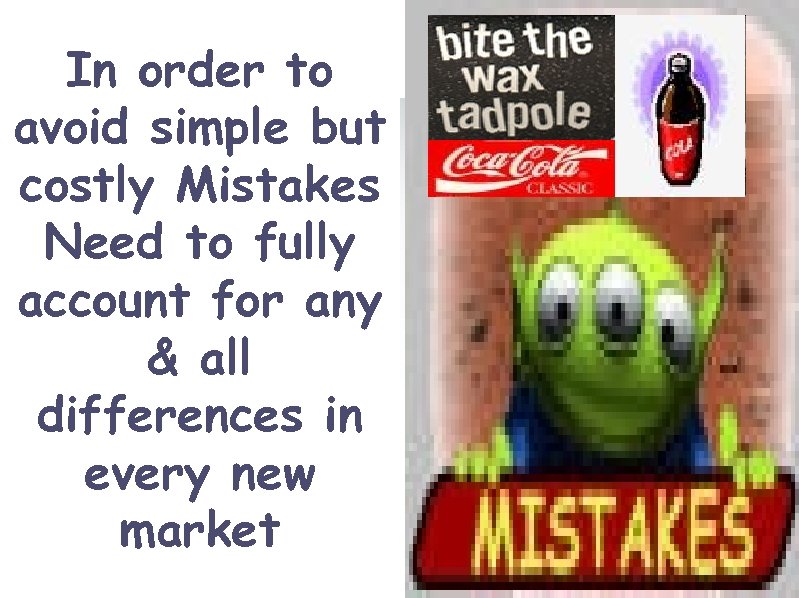 In order to avoid simple but costly Mistakes Need to fully account for any & all differences in every new market
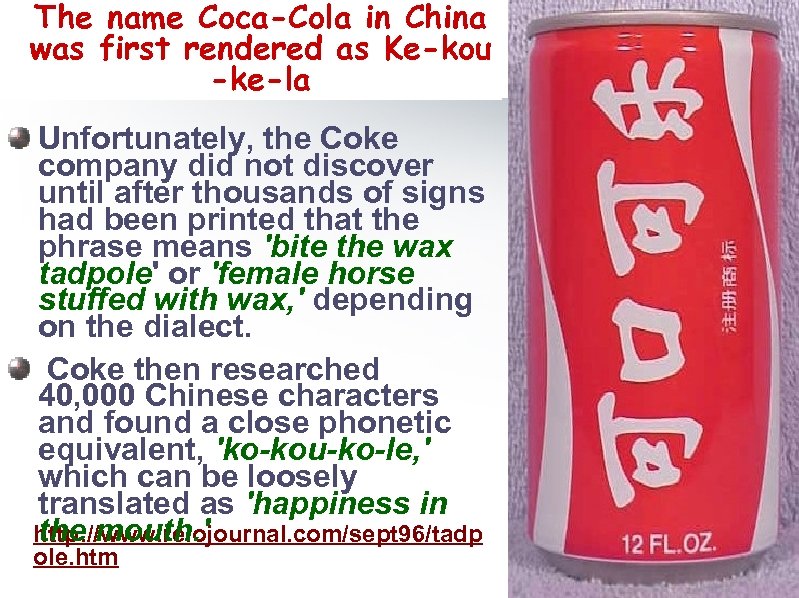 The name Coca-Cola in China was first rendered as Ke-kou -ke-la Unfortunately, the Coke company did not discover until after thousands of signs had been printed that the phrase means 'bite the wax tadpole' or 'female horse stuffed with wax, ' depending on the dialect. Coke then researched 40, 000 Chinese characters and found a close phonetic equivalent, 'ko-kou-ko-le, ' which can be loosely translated as 'happiness in the mouth. ' http: //www. relojournal. com/sept 96/tadp ole. htm
 Pepsi’s slogan, “Come alive with the Pepsi Generation, ” read as “Pepsi will bring your ancestors back from the dead, ” in Taiwan. The Kentucky Fried Chicken slogan, “finger- lickin’ good, ” was translated as “eat your fingers off, ” in Chinese. Clairol introduced the “Mist Stick” curling iron in Germany where mist is slang for manure. Not too many people had use for a manure stick.
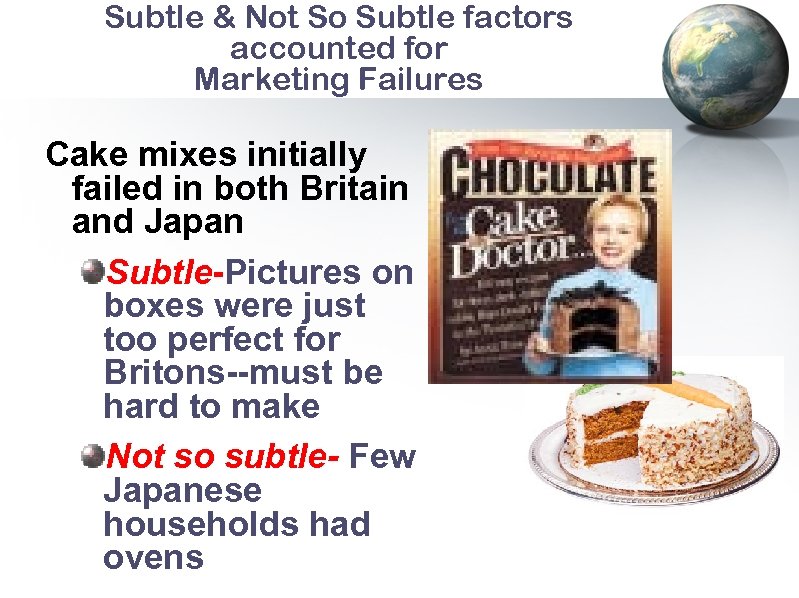 Subtle & Not So Subtle factors accounted for Marketing Failures Cake mixes initially failed in both Britain and Japan Subtle-Pictures on boxes were just too perfect for Britons--must be hard to make Not so subtle- Few Japanese households had ovens
 In Italy, an ad for “Schweppes Tonic Water” translated as “Schweppes Toilet Water. ” General Motors introduced the Chevy Nova in South America and was unaware that Spanish in no va means it won’t go. When Ford’s Pinto flopped in Brazil, Ford learned pinto was Brazilian slang for tiny male genitals. All the nameplates were changed to Corcel, which means horse. Widely circulated, but on Feb. 15, 2003 taken from: http: //www. library. ubc. ca/patscan/funny_trade. html
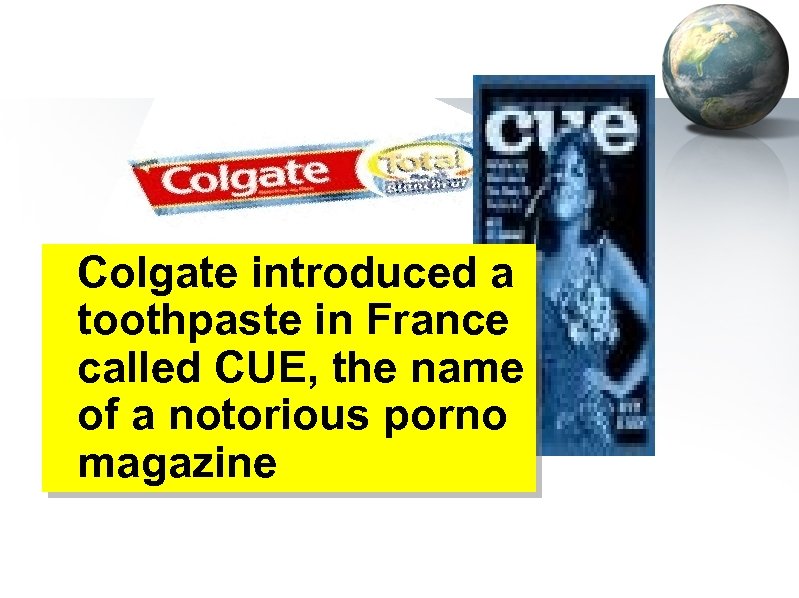 Colgate introduced a toothpaste in France called CUE, the name of a notorious porno magazine
 US Marketers aren't the only ones making mistakes. English Translations made by Japanese firm added to labels to increase prestige for their products being sold in China. Product English Translation Japanese Spam Liver Putty Toilet Paper My Fanny Brand Ready to Eat Pancakes Strawberry Crap Antifreeze Spray Hot Piss Brand Pediatrician’s Slogan Deceased Children Specialist in SOURCE: “Some Strawberry Crap Dessert, dear? ” South China Morning Post, December 9, 1996 p. 12.
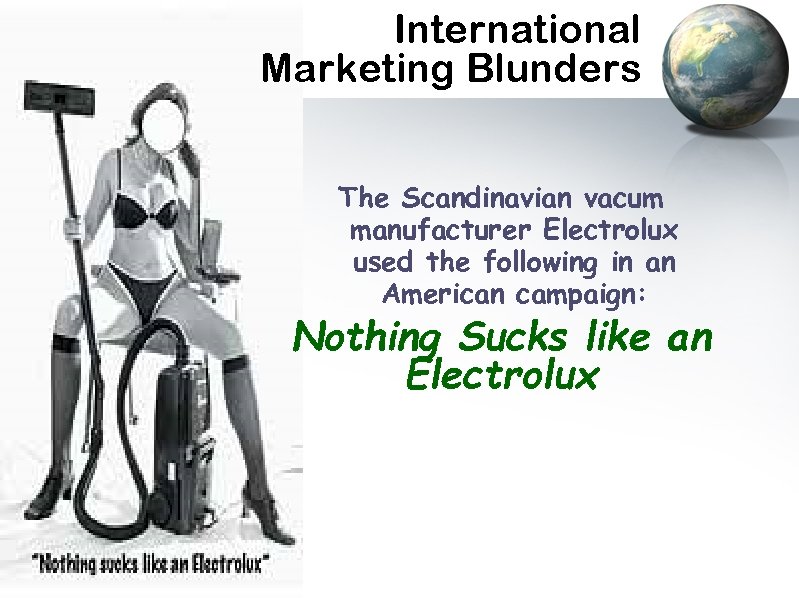 International Marketing Blunders The Scandinavian vacum manufacturer Electrolux used the following in an American campaign: Nothing Sucks like an Electrolux
 Some Unique Brand names Fockink – liqueur: Netherlands Green Piles – lawn fertilizer: Japan Homo Sausage – Japan Krapp – toilet paper: Sweden Last Climax – paper tissues: Japan Pansy – men’s underwear: China Pschitt – soft drink: France Zit – soft drink: Greece
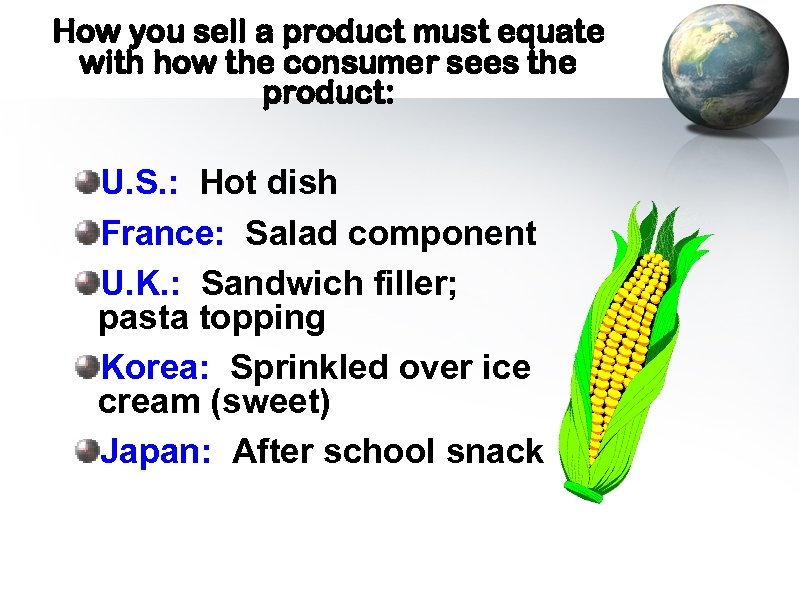 How you sell a product must equate with how the consumer sees the product: U. S. : Hot dish France: Salad component U. K. : Sandwich filler; pasta topping Korea: Sprinkled over ice cream (sweet) Japan: After school snack
 Hallmark cards failed when introduced in France- French dislike syrupy sentiment and prefer writing their own cards. Philips began to earn a profit in Japan only after reduced the size of its coffeemakers to fit into smaller Japanese kitchens and its shavers to fit smaller Japanese hands. Coca-Cola had to withdraw its two-liter bottle in Spain after discovering that few Spaniards owned refrigerators large enough compartments to accommodate it. General Foods’ Tang initially failed in France because it was positioned as a substitute for orange juice at breakfast. The French drink little orange juice and almost none at breakfast. Kellogg’s Pop-Tarts failed in Britain because the percentage of British homes with toasters was significantly lower than in the United States and the product was

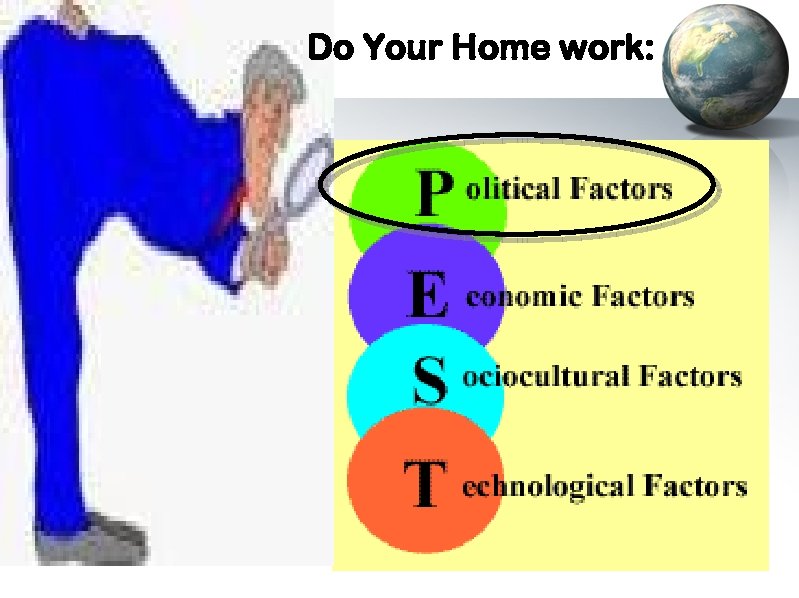 Do Your Home work:
 Political-Legal & Regulatory Variables: Must be constantly monitored as gov’ts constantly alter their countries trade policies, commercial laws & business regulations Every new country and every new market one enters brings with itit’s own set of laws, rules, regulations, standards, requirements, policies, procedures, guidelines, documents, stamps, taxes, fees, licenses, etc.
 Everything is regulated… What you can sell, how much you can sell When you can sell How & to whom you can sell And how much you can sell it for…
 Before you begin to formulate your promotional strategy you need to know for every country & market What. . . ØProducts you can advertise? ØAppeals that can be used? ØTimes products may be promoted? ØRules regarding foreign language use? ØTaxes levied against advertising?
 Can you use: Ads directed to children? Foreign words in ads? National symbols in
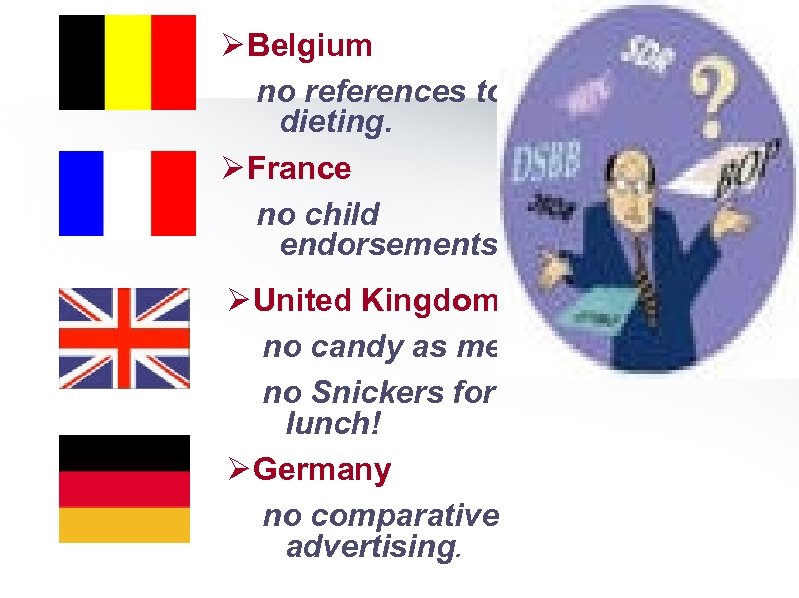 Ø Belgium no references to dieting. Ø France no child endorsements. Ø United Kingdom no candy as meals. no Snickers for lunch! Ø Germany no comparative advertising.
 Examples of Differences in Regulation Of Children’s Ads across Europe Austria No advertising of war toys. Belgium Ads for candy on TV must show a stylized toothbrush. Denmark No advertising of prizes for children. Finland No ads during children’s programs. France No deceptive packaging or contents & No Child endorsements Germany No ads that encourage children to beg parents to buy product. Greece All toy ads banned on TV from 7 a. m. -1 p. m. Ireland Ads should not encourage the consumption of alcohol. Italy Ads aimed at adults not allowed in children’s programming. Source: Lucy Rouse, Dilip Subramanian, Ia Wadendall, and Fiona Mc. Hugh, "A Question of Child Care, " Marketing & Netherlands No candy ads before 7: 55 p. m. Media Europe 1996, March 1996, 34 -35.
 Regulatory Challenges v. In the U. K. , all advertising is allowed if not specifically forbidden… v. In Germany, everything is forbidden if not specifically allowed… v. In Italy, everything is allowed, even if forbidden… v. In Belgium, nobody knows what’s forbidden…
 Other Political- Legal & Regulatory Concerns ü Political Stability ü Respect for “Rule-of-Law” ü Favorable Trade & Investment Environment ü Nondiscrimination ü Access To Markets ü # Regulatory Hurdles ü Nationalism & Nationalization ü View of Profits
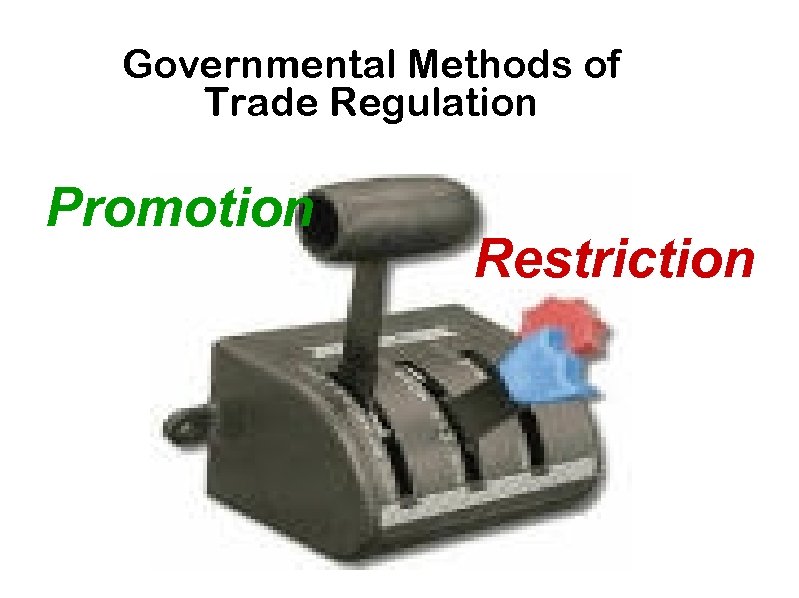 Governmental Methods of Trade Regulation Promotion Restriction
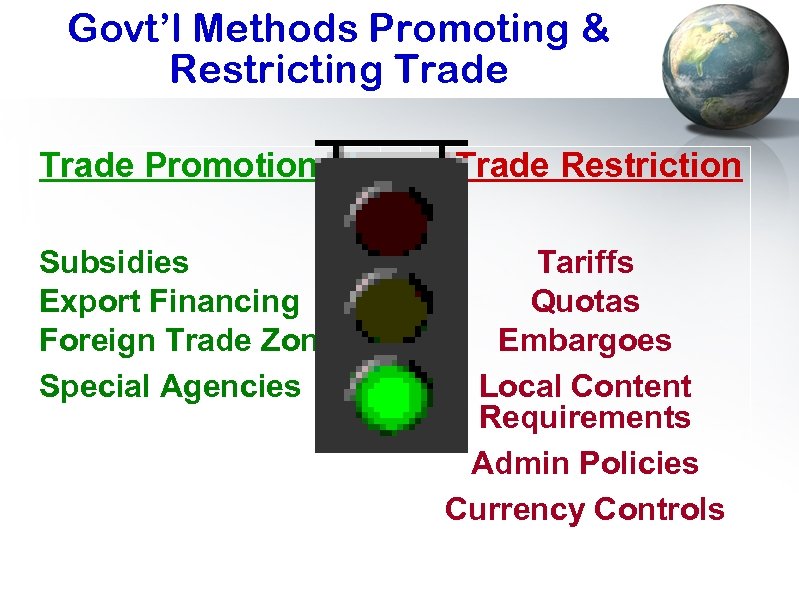 Govt’l Methods Promoting & Restricting Trade Promotion Trade Restriction Subsidies Export Financing Foreign Trade Zones Special Agencies Tariffs Quotas Embargoes Local Content Requirements Admin Policies Currency Controls
 Trade Restriction Local Content Requirements Laws stipulating that producers in the domestic market must supply a specified amount of a good or service. Purpose - force companies from other nations to employ local resources in their production processes —particularly labor
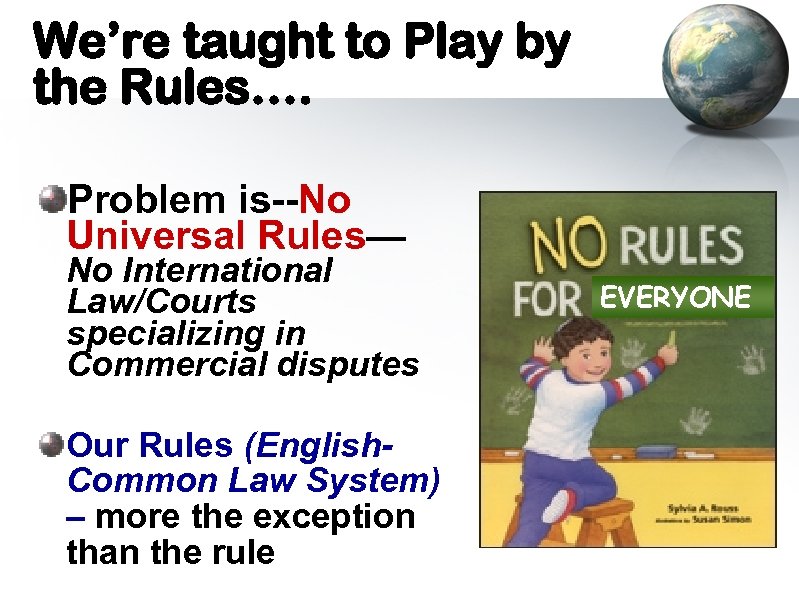 We’re taught to Play by the Rules…. Problem is--No Universal Rules— No International Law/Courts specializing in Commercial disputes Our Rules (English. Common Law System) – more the exception than the rule EVERYONE
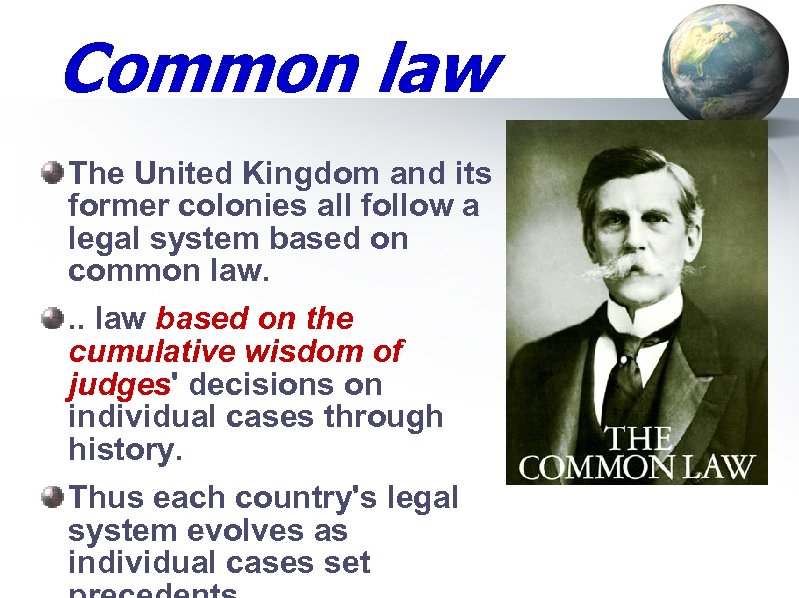 Common law The United Kingdom and its former colonies all follow a legal system based on common law. . . law based on the cumulative wisdom of judges' decisions on individual cases through history. Thus each country's legal system evolves as individual cases set
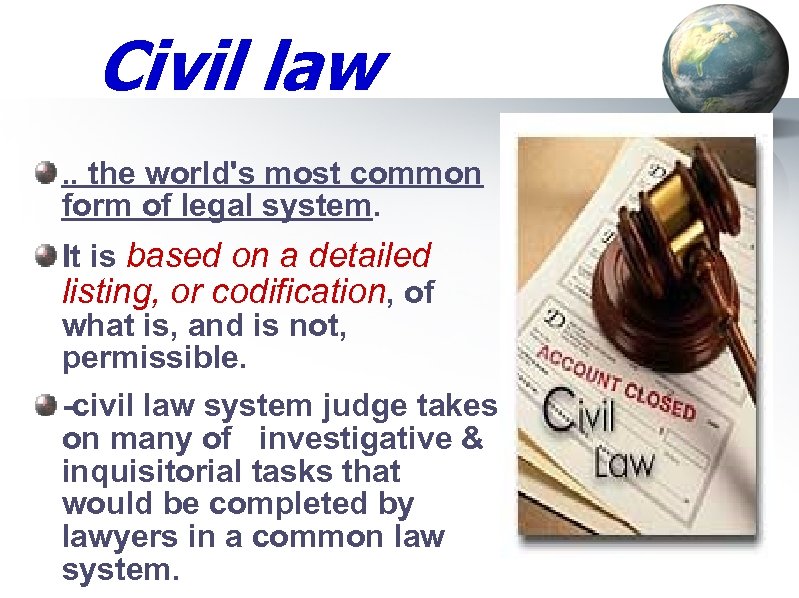 Civil law. . the world's most common form of legal system. It is based on a detailed listing, or codification, of what is, and is not, permissible. -civil law system judge takes on many of investigative & inquisitorial tasks that would be completed by lawyers in a common law system.
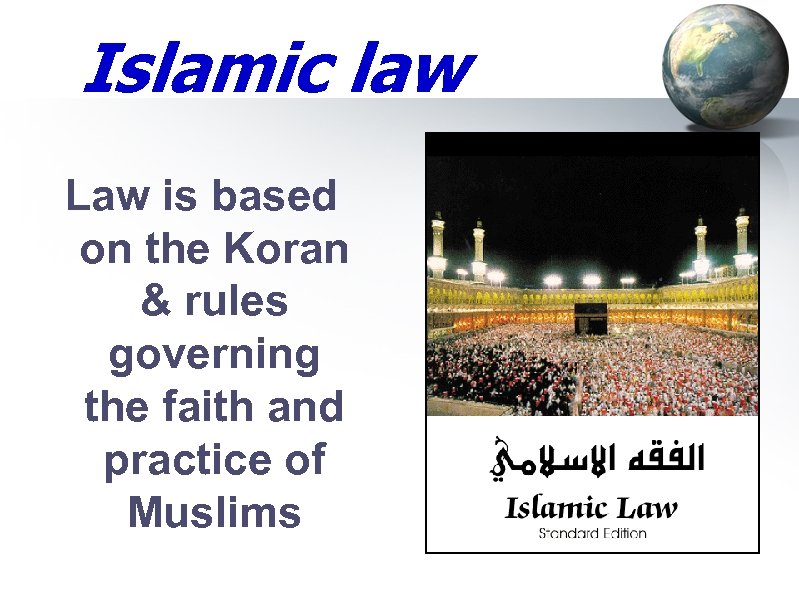 Islamic law Law is based on the Koran & rules governing the faith and practice of Muslims
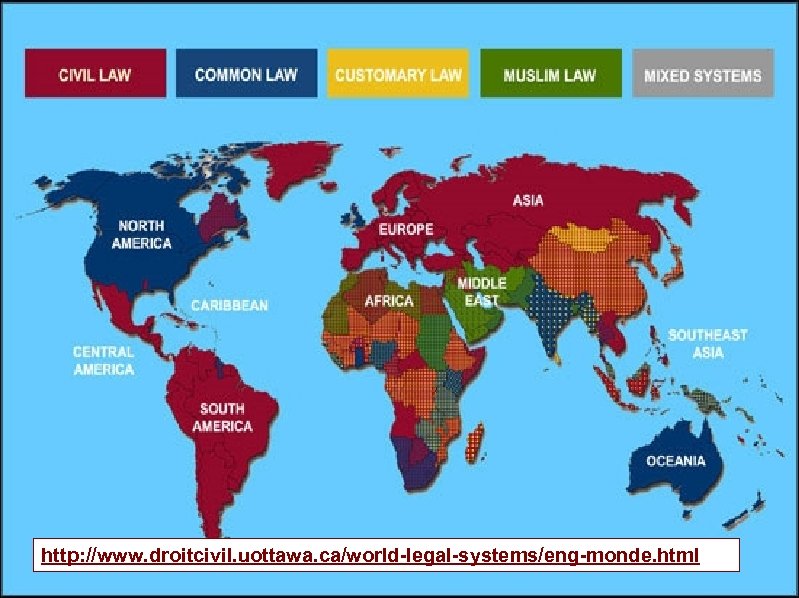 http: //www. droitcivil. uottawa. ca/world-legal-systems/eng-monde. html
 With no Global law– Legal Issues & Disputes in International Business Resolved thru: Contracts Arbitration Ø WTO
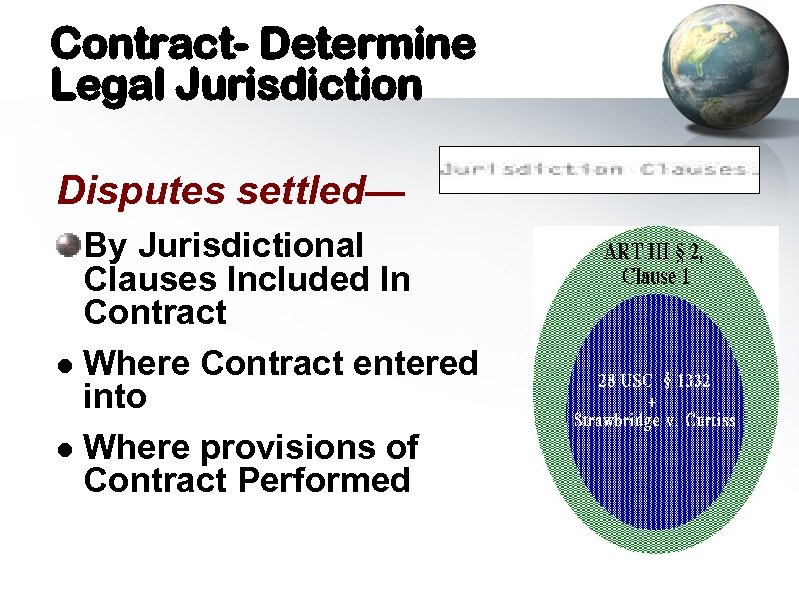 Contract- Determine Legal Jurisdiction Disputes settled— By Jurisdictional Clauses Included In Contract l Where Contract entered into l Where provisions of Contract Performed
 International Arbitration In order to avoid Courts in settling international trading disputes…Ensure that Contracts have arbitration clause inserted that specifies: Country of arbitration The arbitrator & Rules of arbitration
 In past 10 years WTO emerged as principle arbiter of Int’l trade Formed in 1995 - GATT-Uruguay Round - Most comprehensive trade agreement in history- “ (WTO) is the only international organization dealing with the global rules of trade between nations. Its main function is to ensure that trade flows as smoothly, predictably and freely as possible. ” (Extract from WTO website)
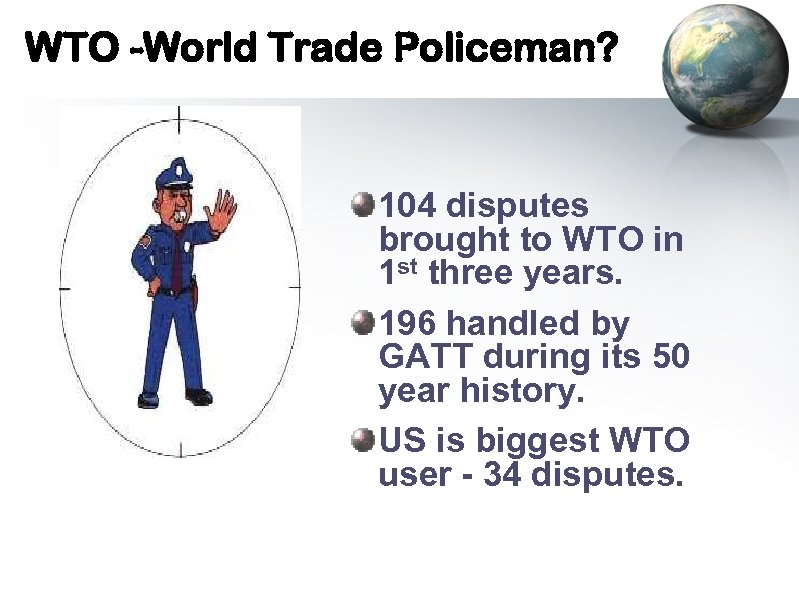 WTO -World Trade Policeman? 104 disputes brought to WTO in 1 st three years. 196 handled by GATT during its 50 year history. US is biggest WTO user - 34 disputes.
 Do Your Home work
 Fish Where the Fish are… Economic Variables Counties level & rate of economic development Per capita income & income distribution Expenditure patterns for goods & services
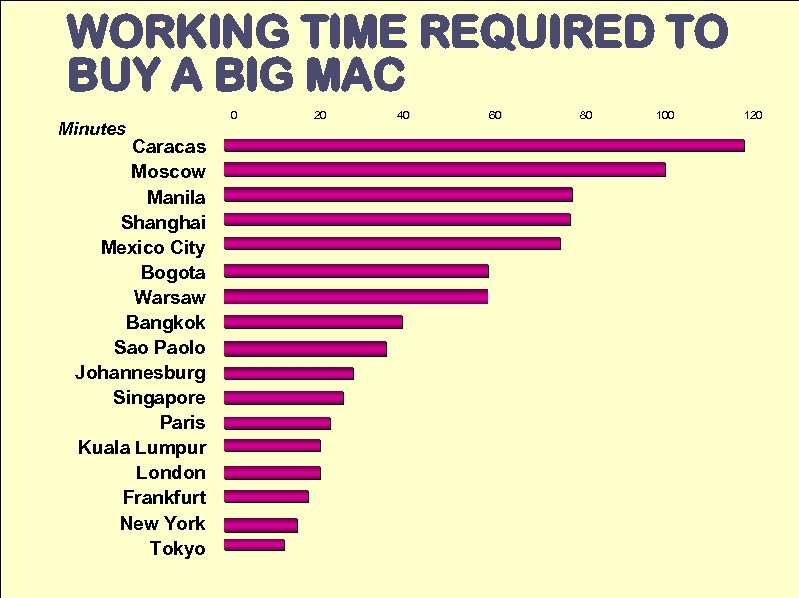 WORKING TIME REQUIRED TO BUY A BIG MAC Minutes Caracas Moscow Manila Shanghai Mexico City Bogota Warsaw Bangkok Sao Paolo Johannesburg Singapore Paris Kuala Lumpur London Frankfurt New York Tokyo 0 20 40 60 80 100 120
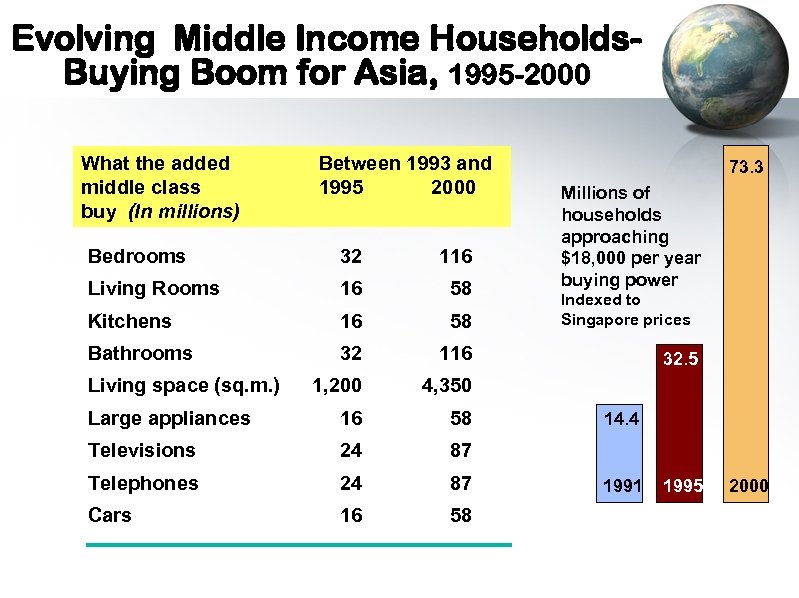 Evolving Middle Income Households. Buying Boom for Asia, 1995 -2000 What the added middle class buy (In millions) Between 1993 and 1995 2000 Bedrooms 32 116 Living Rooms 16 58 Kitchens 16 58 Bathrooms 32 4, 350 Large appliances 16 58 Televisions 24 87 Telephones 24 87 Cars 16 58 Millions of households approaching $18, 000 per year buying power 116 1, 200 73. 3 Living space (sq. m. ) Indexed to Singapore prices 32. 5 14. 4 1991 1995 2000
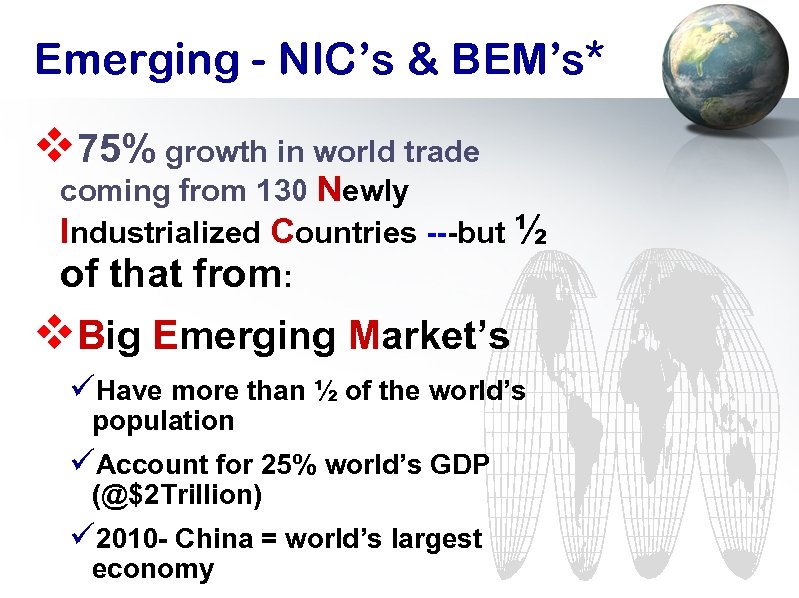 Emerging - NIC’s & BEM’s* v 75% growth in world trade coming from 130 Newly Industrialized Countries ---but ½ of that from: v. Big Emerging Market’s üHave more than ½ of the world’s population üAccount for 25% world’s GDP (@$2 Trillion) ü 2010 - China = world’s largest economy
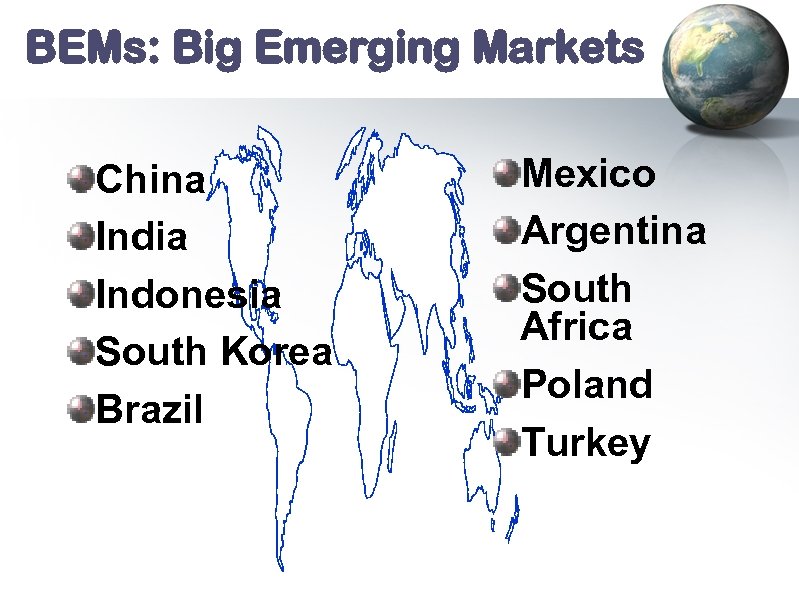 BEMs: Big Emerging Markets China India Indonesia South Korea Brazil Mexico Argentina South Africa Poland Turkey
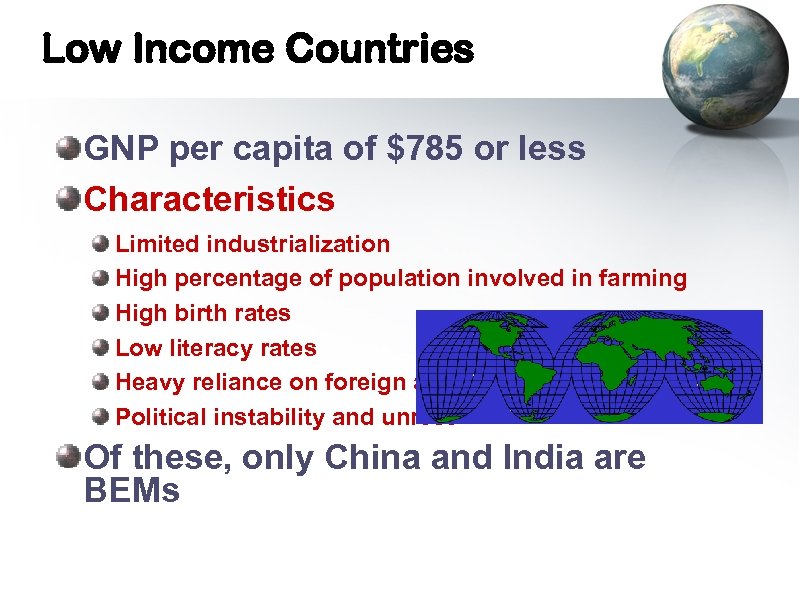 Low Income Countries GNP per capita of $785 or less Characteristics Limited industrialization High percentage of population involved in farming High birth rates Low literacy rates Heavy reliance on foreign aid Political instability and unrest Of these, only China and India are BEMs
 Lower Middle Income Countries GNP per capita between $786 and $3, 125 Sometimes called less-developed countries (LDCs) Characteristics Early stages of industrialization Cheap labor markets Factories supply items such as clothing, tires, building materials, and packaged foods 3 BEMs: Poland, Turkey, Indonesia
 Upper Middle Income Countries GNP per capita between $3, 126 to $9, 655 Characteristics Rapidly industrializing Rising wages High rates of literacy and advanced education Lower wage costs than advanced countries Sometimes called newly industrializing economies (NIEs) 3 BEMs: Argentina, Brazil, Mexico, South Africa
 High Income Countries GNP per capita above $9, 656 Sometimes referred to as postindustrial countries Characteristics Importance of service sector, information processing and exchange, and intellectual technology Knowledge as key strategic resource Orientation toward the future
 Do Your Homework
 C U L T U R E The Int’l Marketer’s Quandary “I BELIEVE I UNDERSTAND WHAT YOU THINK YOU WANT * BUT I AM NOT SURE YOU REALIZE THAT WHAT YOU WANT IS WHAT I SELL”
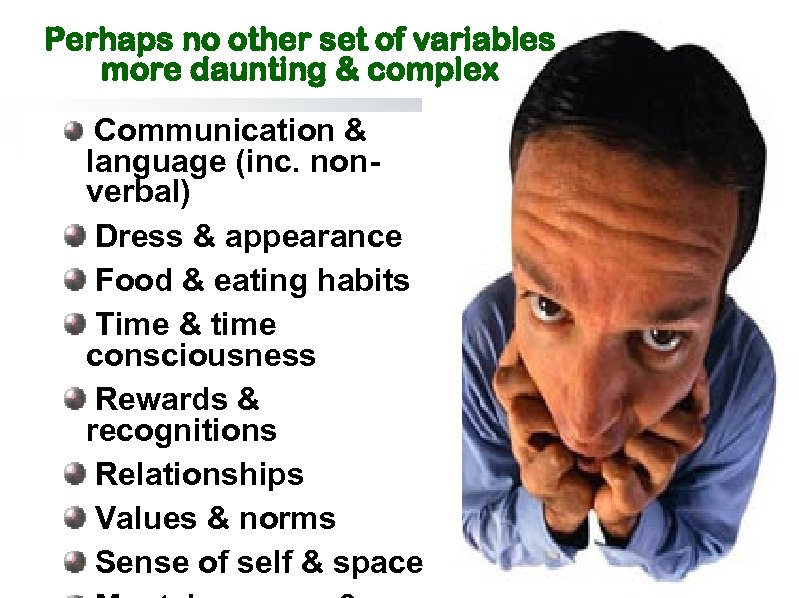 Perhaps no other set of variables more daunting & complex Communication & language (inc. nonverbal) Dress & appearance Food & eating habits Time & time consciousness Rewards & recognitions Relationships Values & norms Sense of self & space
 C U L T U R E Definition of Culture The integrated sum total of learned behavioral traits that are manifest & shared by members of a society” the man-made part of our environment… the distinctive life style of a people acquired thru learned behavior …
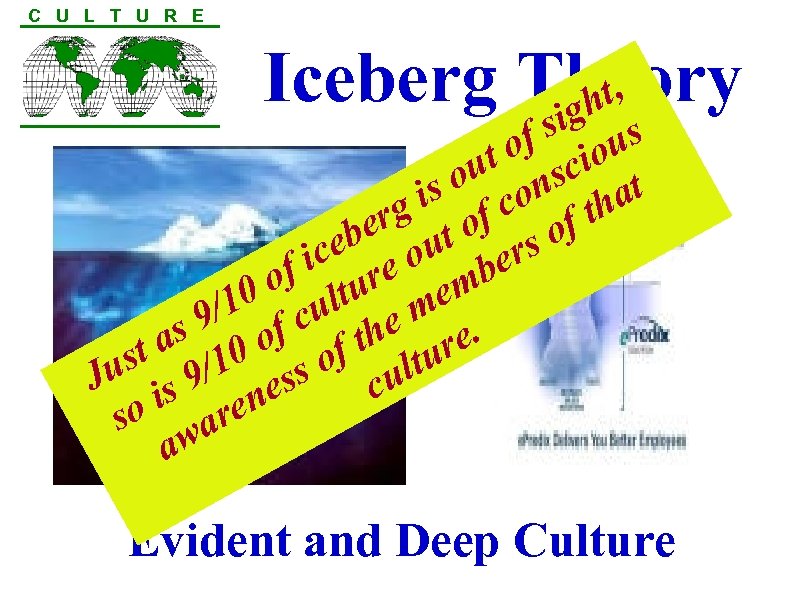 C U L T U R E Iceberg Theory t, gh i f s ous t o sci ou on is c at rg t of of th be u ice re o bers of ltu 0 u em /1 c 9 e m e. as 0 of of th ur st /1 u s cult J is 9 es o aren s w a Evident and Deep Culture
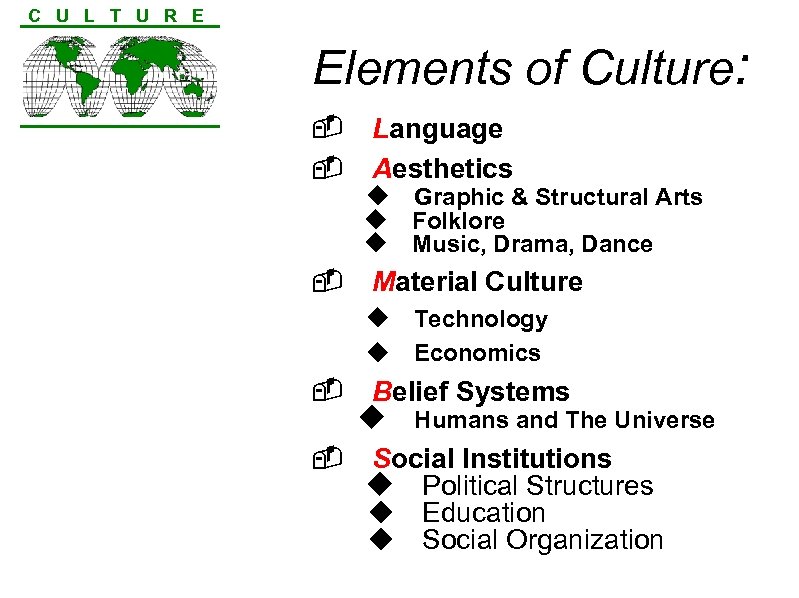 C U L T U R E Elements of Culture: - - Language Aesthetics Graphic & Structural Arts Folklore Music, Drama, Dance Material Culture Technology Economics Belief Systems Humans and The Universe - Social Institutions Political Structures Education Social Organization -
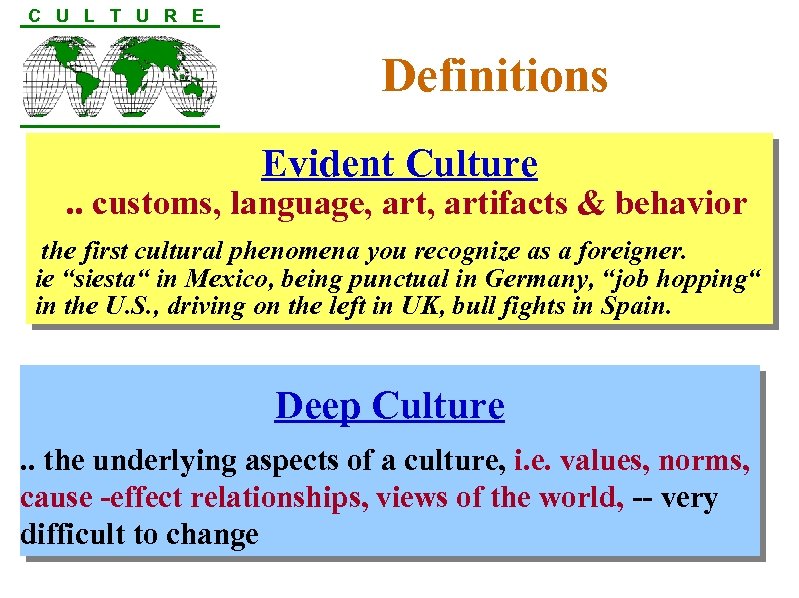 C U L T U R E Definitions Evident Culture . . customs, language, artifacts & behavior the first cultural phenomena you recognize as a foreigner. ie “siesta“ in Mexico, being punctual in Germany, “job hopping“ in the U. S. , driving on the left in UK, bull fights in Spain. Deep Culture. . the underlying aspects of a culture, i. e. values, norms, cause -effect relationships, views of the world, -- very difficult to change
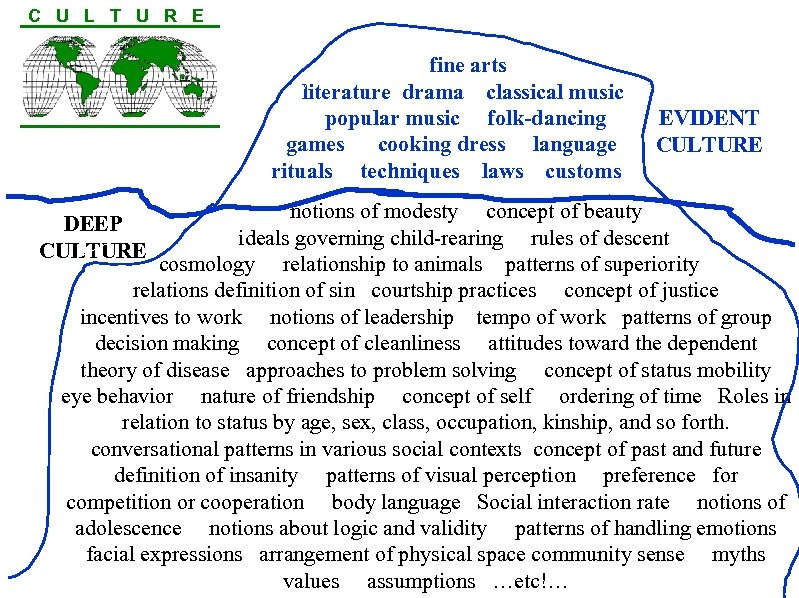 C U L T U R E fine arts literature drama classical music popular music folk-dancing games cooking dress language rituals techniques laws customs EVIDENT CULTURE notions of modesty concept of beauty ideals governing child-rearing rules of descent cosmology relationship to animals patterns of superiority relations definition of sin courtship practices concept of justice incentives to work notions of leadership tempo of work patterns of group decision making concept of cleanliness attitudes toward the dependent theory of disease approaches to problem solving concept of status mobility eye behavior nature of friendship concept of self ordering of time Roles in relation to status by age, sex, class, occupation, kinship, and so forth. conversational patterns in various social contexts concept of past and future definition of insanity patterns of visual perception preference for competition or cooperation body language Social interaction rate notions of adolescence notions about logic and validity patterns of handling emotions facial expressions arrangement of physical space community sense myths values assumptions …etc!… DEEP CULTURE
 C U L T U R E Cultural Research(ers) w/ Marketing Applications HALL Hofstede Trompenaars
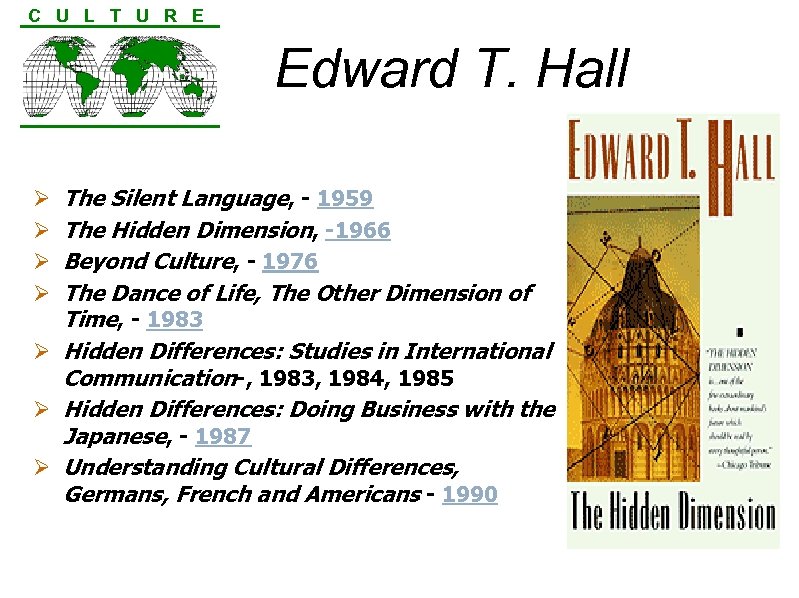 C U L T U R E Edward T. Hall The Silent Language, - 1959 The Hidden Dimension, -1966 Beyond Culture, - 1976 The Dance of Life, The Other Dimension of Time, - 1983 Ø Hidden Differences: Studies in International Communication-, 1983, 1984, 1985 Ø Hidden Differences: Doing Business with the Japanese, - 1987 Ø Understanding Cultural Differences, Germans, French and Americans - 1990 Ø Ø
 C U L T U R E MONOCHRONIC vs. POLYCHRONIC TIME Ø M-time is one-thing-at-a-time § § § Monochronic cultures stress a high degree of scheduling and an elaborate code of behavior built around promptness in meeting obligations and appointments Americans are mostly monochronic Ø P-time is many-things-at-a-time § § § human relationships and interactions are valued over arbitrary schedules and appointments. Many things may occur at once (since many people are involved in everything), and interruptions are frequent. P-time is common in Mediterranean and Colonial. Iberian-Indian cultures.
 C U L T U R E HIGH vs. LOWCONTEXT CULTURES …terms refer to the fact that when people communicate, they take for granted how much the listener knows about the subject under discussion. Ø In low-context communication, listener knows very little & must be told practically everything Ø In high-context communication listener is already 'contexted' - does not need much background information
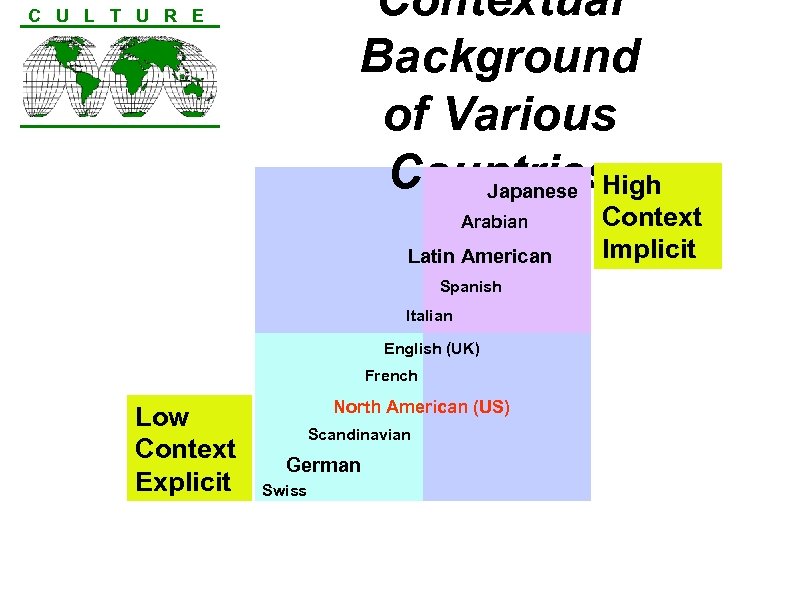 Contextual Background of Various Countries. High Japanese C U L T U R E Arabian Latin American Spanish Italian English (UK) French Low Context Explicit North American (US) Scandinavian German Swiss Context Implicit
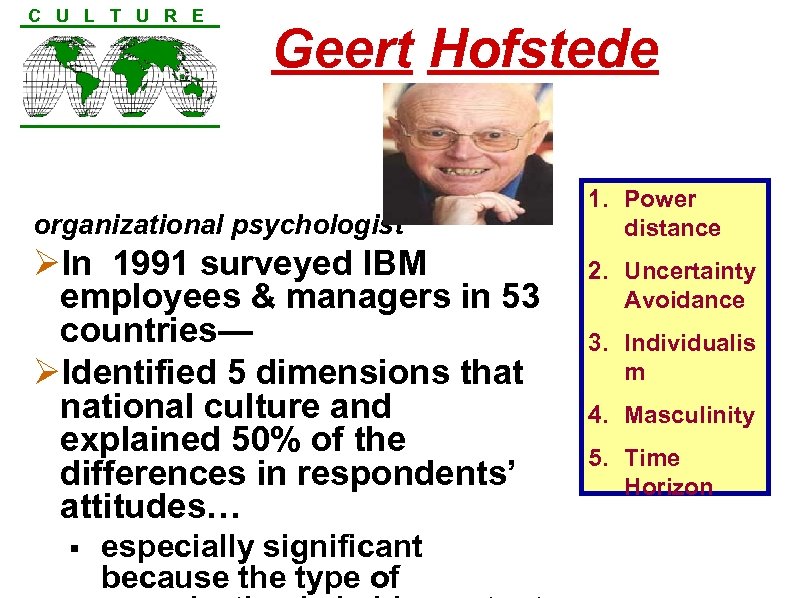 C U L T U R E Geert Hofstede organizational psychologist ØIn 1991 surveyed IBM employees & managers in 53 countries— ØIdentified 5 dimensions that national culture and explained 50% of the differences in respondents’ attitudes… § especially significant because the type of 1. Power distance 2. Uncertainty Avoidance 3. Individualis m 4. Masculinity 5. Time Horizon
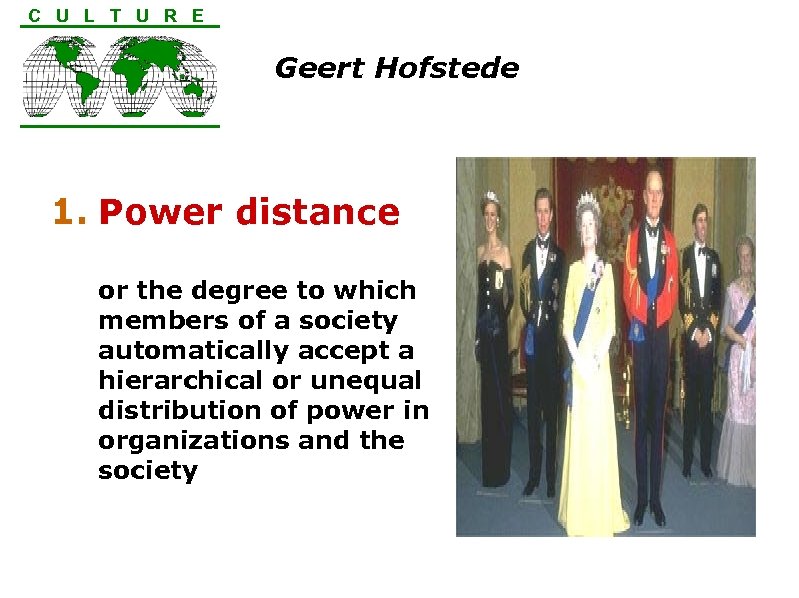 C U L T U R E Geert Hofstede 1. Power distance or the degree to which members of a society automatically accept a hierarchical or unequal distribution of power in organizations and the society
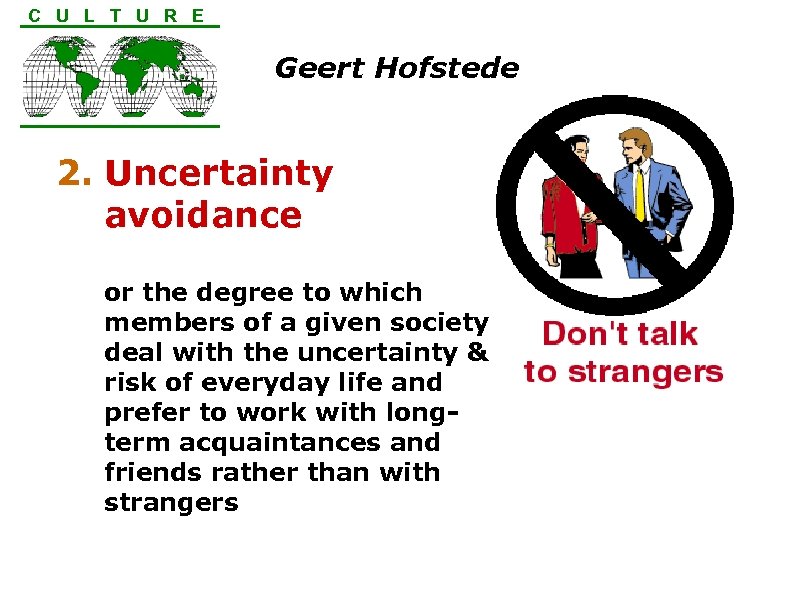 C U L T U R E Geert Hofstede 2. Uncertainty avoidance or the degree to which members of a given society deal with the uncertainty & risk of everyday life and prefer to work with longterm acquaintances and friends rather than with strangers
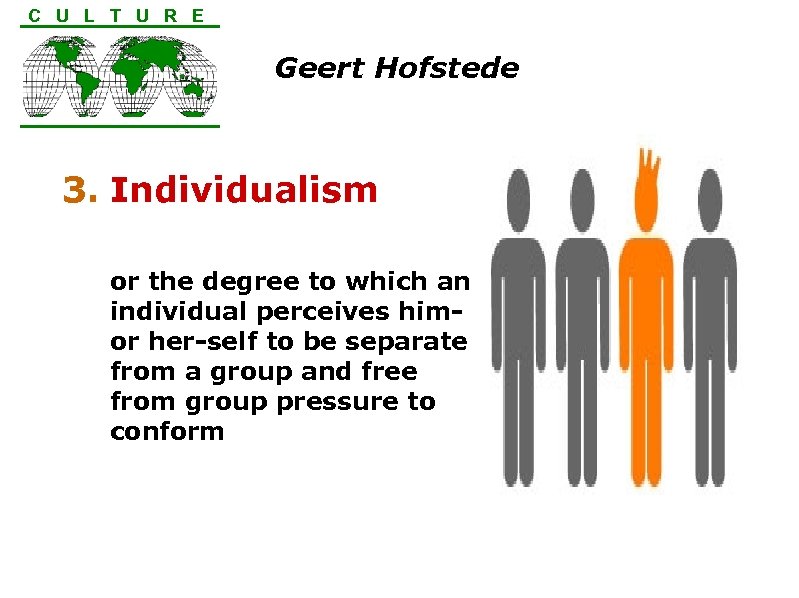 C U L T U R E Geert Hofstede 3. Individualism or the degree to which an individual perceives himor her-self to be separate from a group and free from group pressure to conform
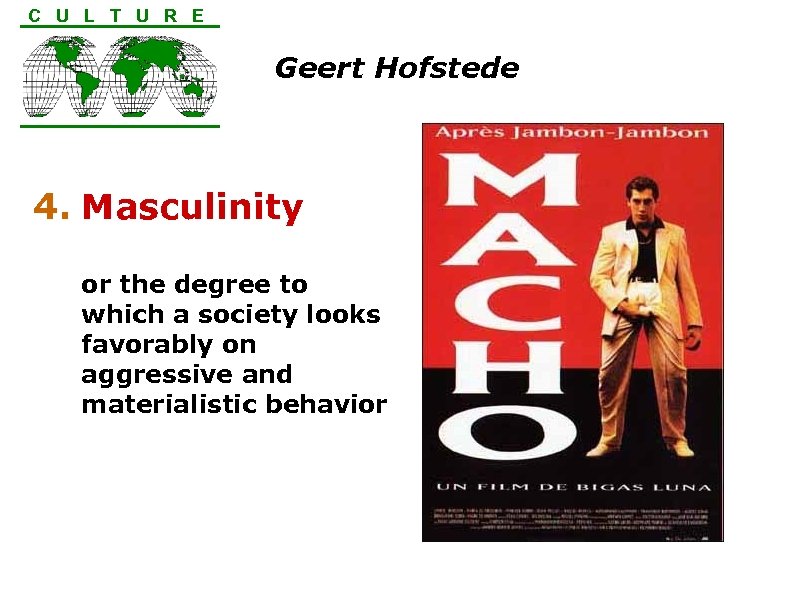 C U L T U R E Geert Hofstede 4. Masculinity or the degree to which a society looks favorably on aggressive and materialistic behavior
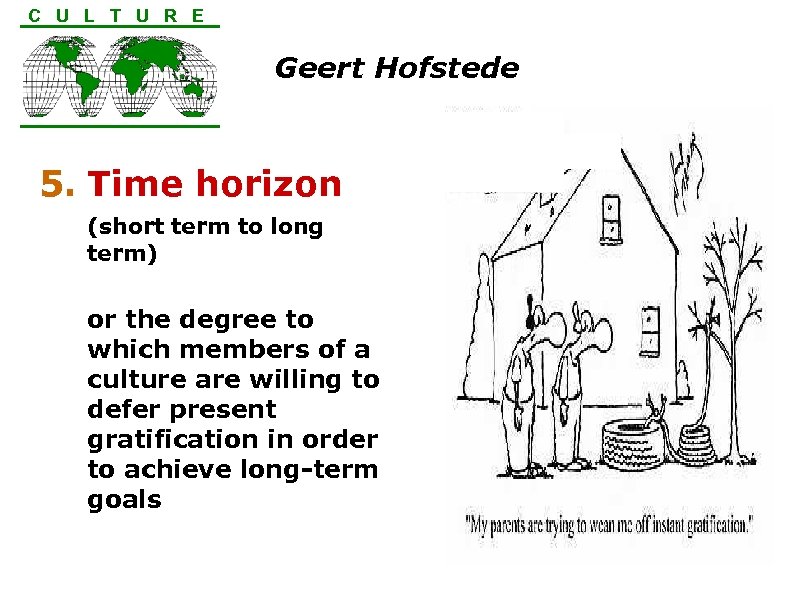 C U L T U R E Geert Hofstede 5. Time horizon (short term to long term) or the degree to which members of a culture are willing to defer present gratification in order to achieve long-term goals
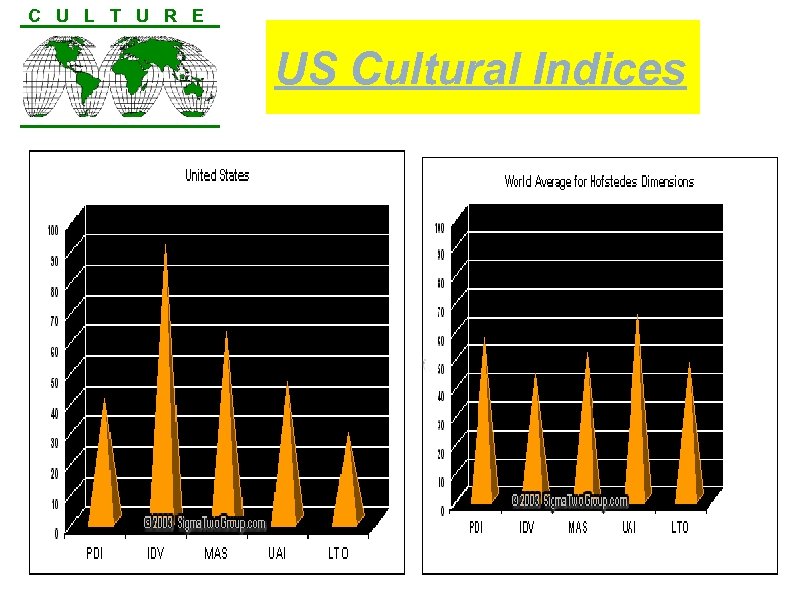
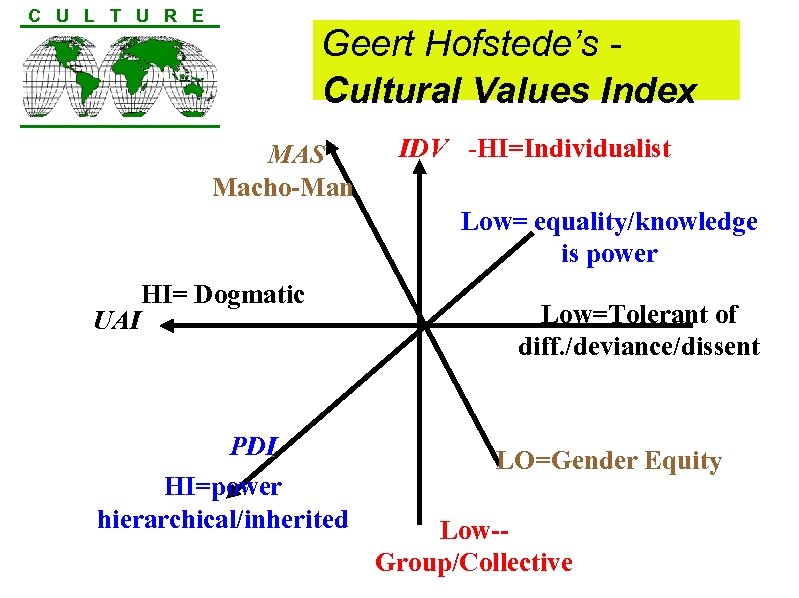 C U L T U R E Geert Hofstede’s Cultural Values Index MAS Macho-Man IDV -HI=Individualist Low= equality/knowledge is power HI= Dogmatic UAI PDI HI=power hierarchical/inherited Low=Tolerant of diff. /deviance/dissent LO=Gender Equity Low-Group/Collective
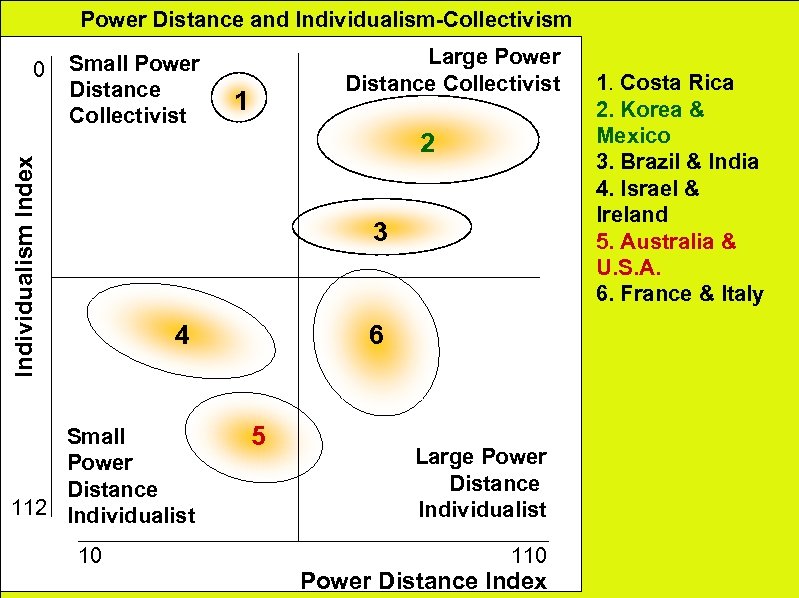 C U Power Distance L T U R E Small Power Distance Collectivist Individualism Index 0 and Individualism-Collectivism Large Power Distance Collectivist 1 2 3 4 Small Power Distance 112 Individualist 10 6 5 Large Power Distance Individualist 110 Power Distance Index 1. Costa Rica 2. Korea & Mexico 3. Brazil & India 4. Israel & Ireland 5. Australia & U. S. A. 6. France & Italy
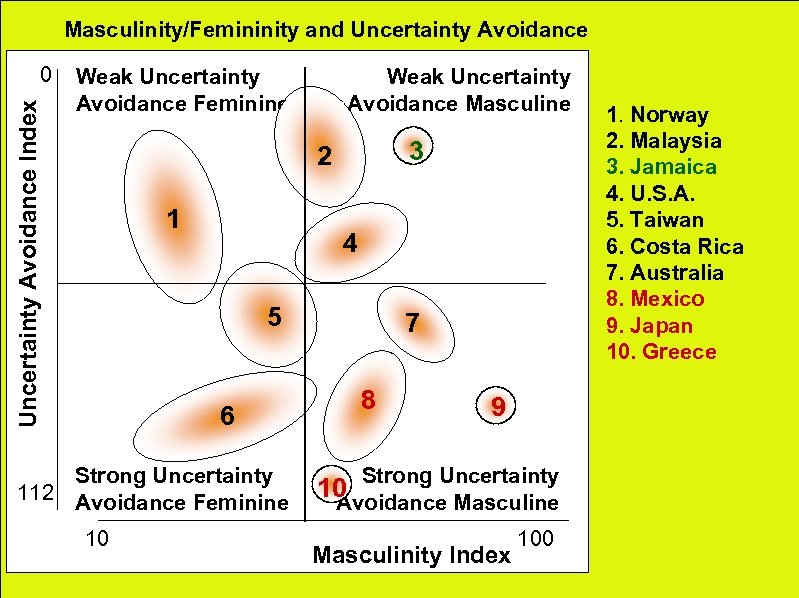 C U L T U R E Masculinity/Femininity and Uncertainty Avoidance Index 0 Weak Uncertainty Avoidance Feminine Weak Uncertainty Avoidance Masculine 3 2 1 4 5 6 Strong Uncertainty 112 Avoidance Feminine 10 7 8 9 10 Strong Uncertainty Avoidance Masculinity Index 100 1. Norway 2. Malaysia 3. Jamaica 4. U. S. A. 5. Taiwan 6. Costa Rica 7. Australia 8. Mexico 9. Japan 10. Greece
 C U L T U R E http: //www. geert-hofstede. com/index. shtml
 C U L T U R E US Cultural Indices
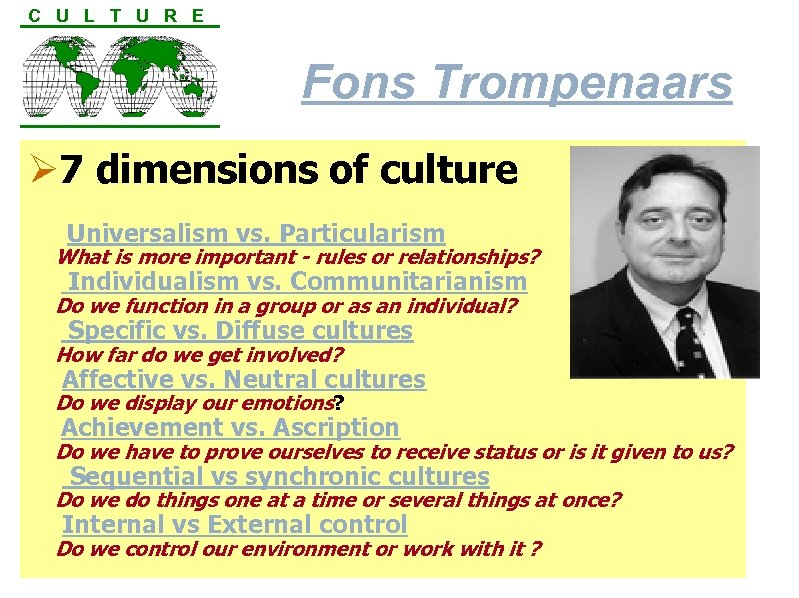 C U L T U R E Fons Trompenaars Ø 7 dimensions of culture Universalism vs. Particularism What is more important - rules or relationships? Individualism vs. Communitarianism Do we function in a group or as an individual? Specific vs. Diffuse cultures How far do we get involved? Affective vs. Neutral cultures Do we display our emotions? Achievement vs. Ascription Do we have to prove ourselves to receive status or is it given to us? Sequential vs synchronic cultures Do we do things one at a time or several things at once? Internal vs External control Do we control our environment or work with it ?
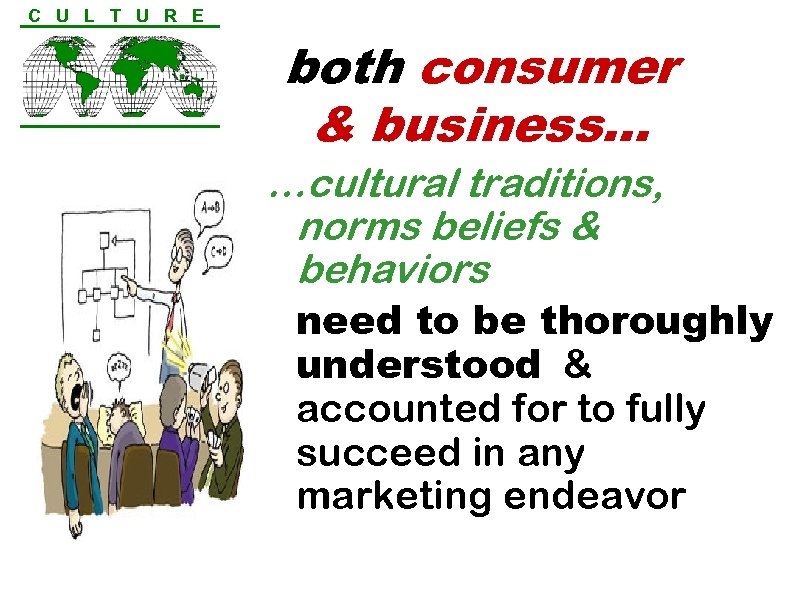 C U L T U R E both consumer & business… …cultural traditions, norms beliefs & behaviors need to be thoroughly understood & accounted for to fully succeed in any marketing endeavor
 C U L T U R E What’s your Int’l Business IQ? 12 Questions
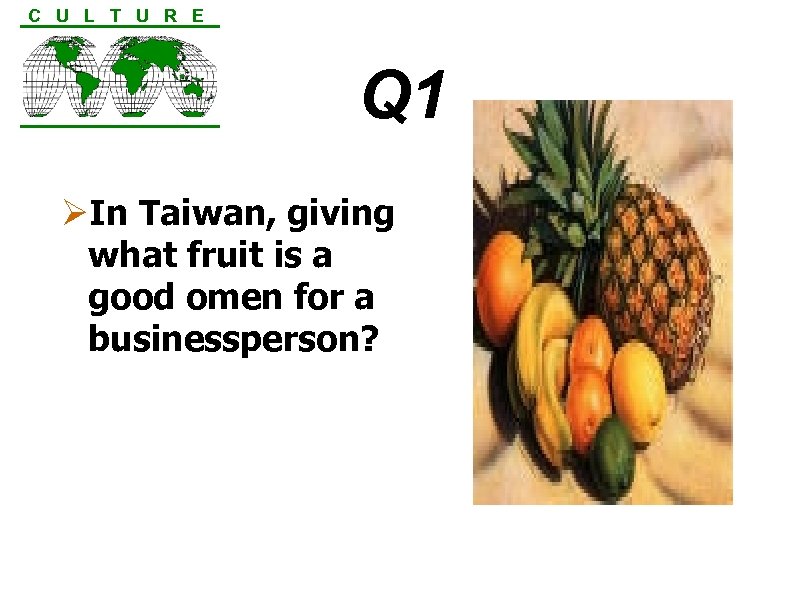 C U L T U R E Q 1 ØIn Taiwan, giving what fruit is a good omen for a businessperson?
 C U L T U R E Q 2 Ø What number in Chinese -speaking countries (also in Japan) is as ominous as the number 13 in Western culture? A: 4 B: 7 C: 3 D: 5
 C U L T U R E Q 3 Ø The executive of a Chinese company is celebrating their 65 th birthday. Which of the following is not a appropriate gift? A: a silk tie B: a silver Mont Blanc pen C: a gold clock D: a crystal paperweight E: gold and jade cufflinks
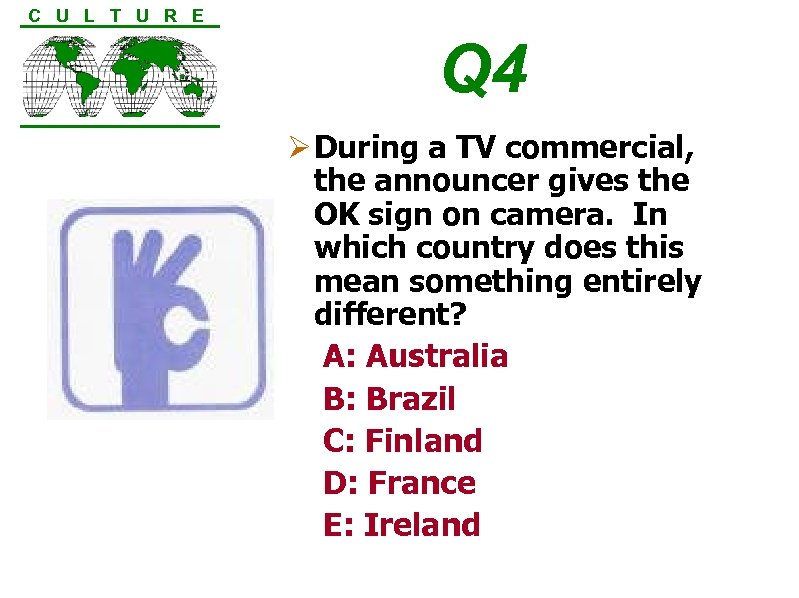 C U L T U R E Q 4 Ø During a TV commercial, the announcer gives the OK sign on camera. In which country does this mean something entirely different? A: Australia B: Brazil C: Finland D: France E: Ireland
 C U L T U R E Q 5 ØIn England, it is inappropriate to discuss business after work over drinks. § A: true § B: false
 C U L T U R E Q 6 Ø You’re creating a sales training manual for employees doing business in Japan. When would you tell them NOT to discuss business? A: at dinner B: over lunch C: on the golf course D: at the start of a business meeting E: in your superior’s office
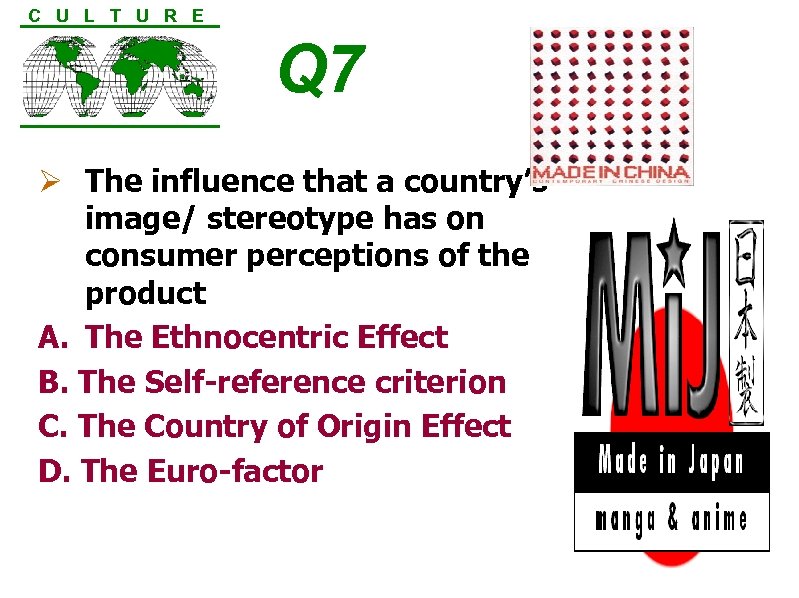 C U L T U R E Q 7 Ø The influence that a country’s image/ stereotype has on consumer perceptions of the product A. The Ethnocentric Effect B. The Self-reference criterion C. The Country of Origin Effect D. The Euro-factor
 C U L T U R E Q 8 Ø Your company would like to send its top sales representative aboard to meet with its distributors in August. In which country is this most likely to become a problem? § § § A: Italy and France B: Ireland Sweden C: Japan and China D: Australia and New Zealand E: Hungary and Romania
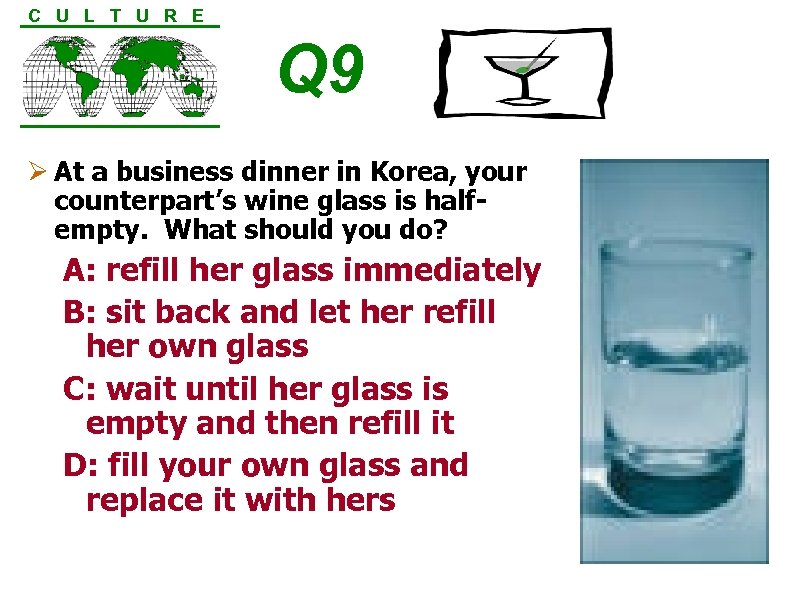 C U L T U R E Q 9 Ø At a business dinner in Korea, your counterpart’s wine glass is halfempty. What should you do? A: refill her glass immediately B: sit back and let her refill her own glass C: wait until her glass is empty and then refill it D: fill your own glass and replace it with hers
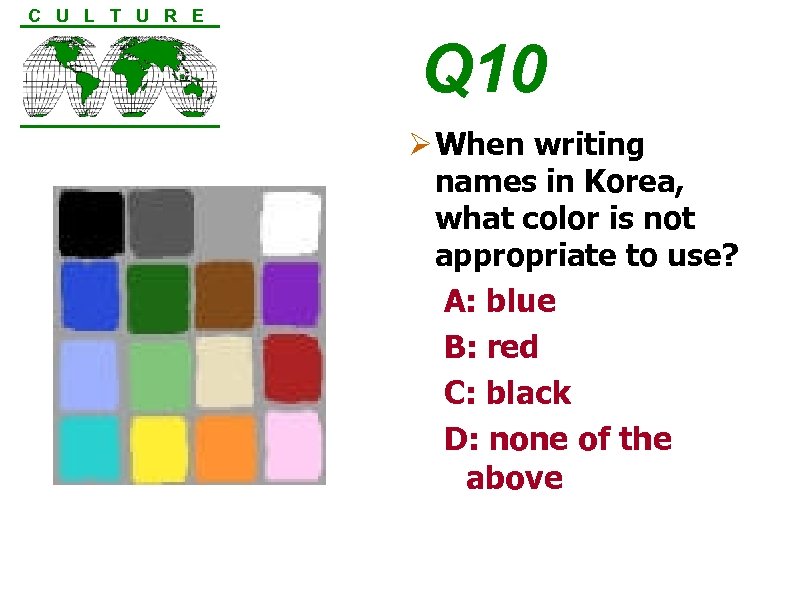 C U L T U R E Q 10 Ø When writing names in Korea, what color is not appropriate to use? A: blue B: red C: black D: none of the above
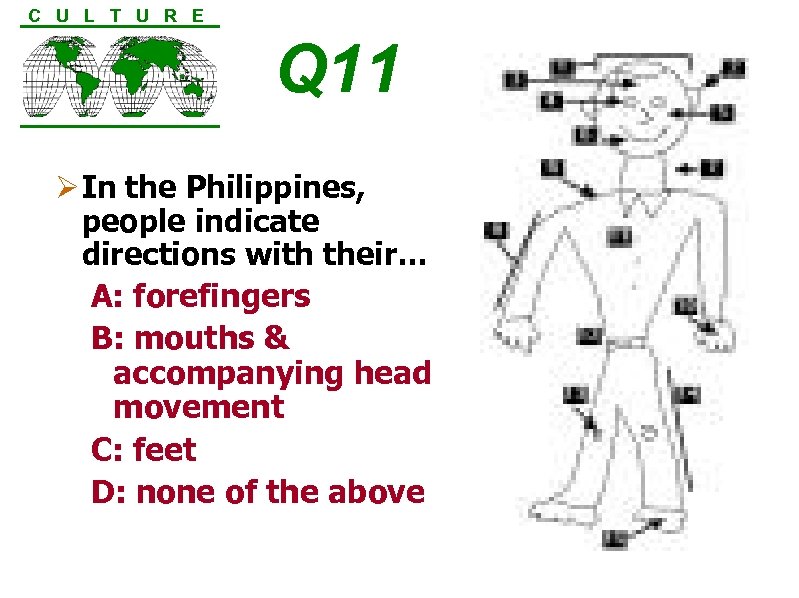 C U L T U R E Q 11 Ø In the Philippines, people indicate directions with their… A: forefingers B: mouths & accompanying head movement C: feet D: none of the above
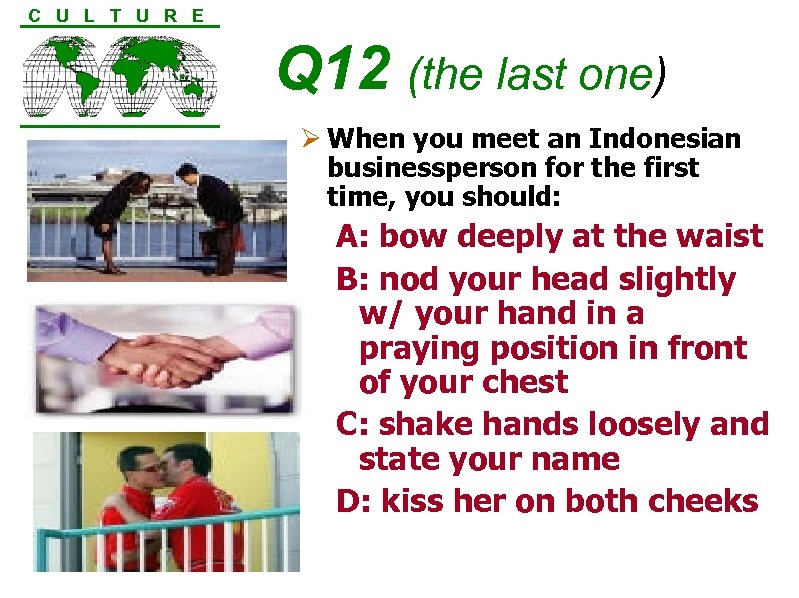 C U L T U R E Q 12 (the last one) Ø When you meet an Indonesian businessperson for the first time, you should: A: bow deeply at the waist B: nod your head slightly w/ your hand in a praying position in front of your chest C: shake hands loosely and state your name D: kiss her on both cheeks
 C U L T U R E What’s your Int’l Business EQ? POP-Quiz Answers
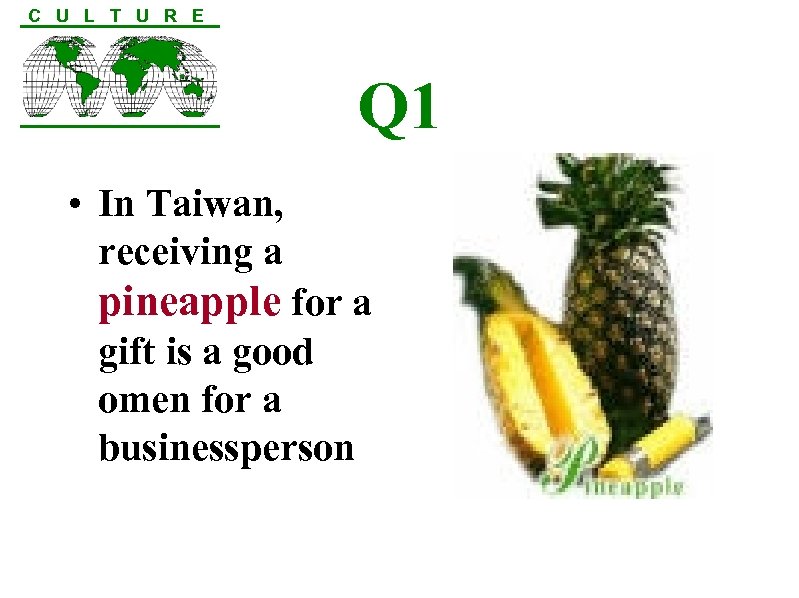 C U L T U R E Q 1 • In Taiwan, receiving a pineapple for a gift is a good omen for a businessperson
 C U L T U R E Cultural Give & Take-Do’s & Don’ts Ø Japan—Do not open in front of giver/ no bows, ribbons Ø Europe: avoid red & white /don’t wrap flowers; don’t spend too much Ø Arabia: Don’t give at outset Ø Latin Am. : Give after informal meetings Ø China: present privately; don’t make a big deal of it
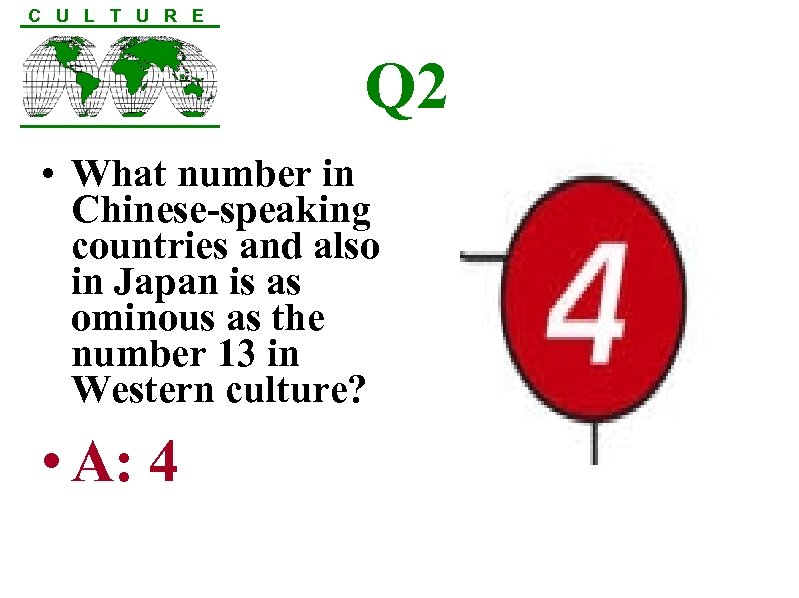 C U L T U R E Q 2 • What number in Chinese-speaking countries and also in Japan is as ominous as the number 13 in Western culture? • A: 4
 C U L T U R E The Other Numbers Other Countries number 7 is considered bad luck in Kenya, good luck in the Czech Republic and has a magical connotation in Benin, Africa. The number 10 is bad luck in Korea. The number 4 means death in Japan.
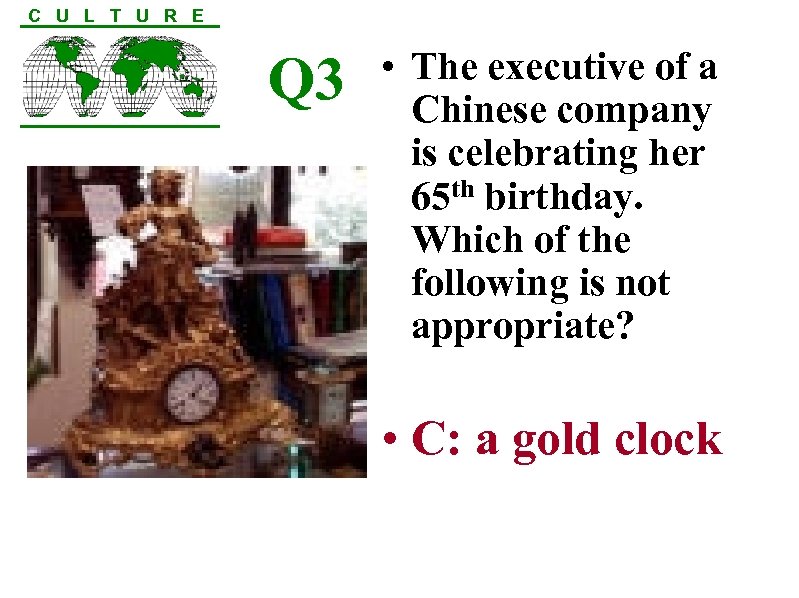 C U L T U R E Q 3 • The executive of a Chinese company is celebrating her 65 th birthday. Which of the following is not appropriate? • C: a gold clock
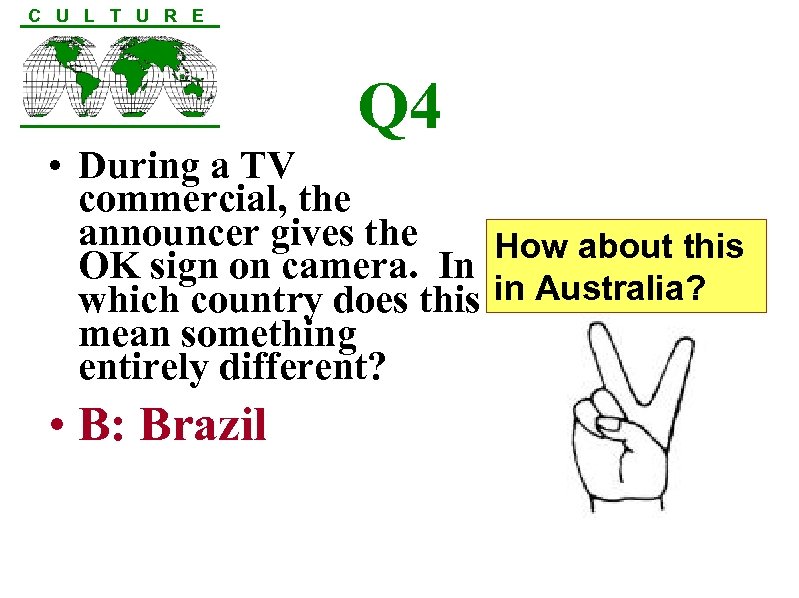 C U L T U R E Q 4 • During a TV commercial, the announcer gives the How about this OK sign on camera. In which country does this in Australia? mean something entirely different? • B: Brazil
 C U L T U R E Q 5 • In England, it is inappropriate to discuss business after work over drinks. • A: true
 C U L T U R E Q 6 • You’re creating a sales training manual for employees doing business in Japan. When would you tell them NOT to discuss business? • D: at the start of a business meeting
 C U L T U R E Q 7 Ø The influence that a country’s image/ stereotype has on consumer perceptions of the product C. The Country of Origin Effect Any influence that “Country of Manufacturer” has on consumers positive or negative perception of product
 C U L T U R E Stereotypes English____ French_____ Italian_____ Japanese_______ American_______ Jamaican_______ Australian_______ Iranian______ Cuban_____ German____ Swiss_____ Russian____ Scottish____ Irish______ Mexican____ Canadian_______ Alaskan_____
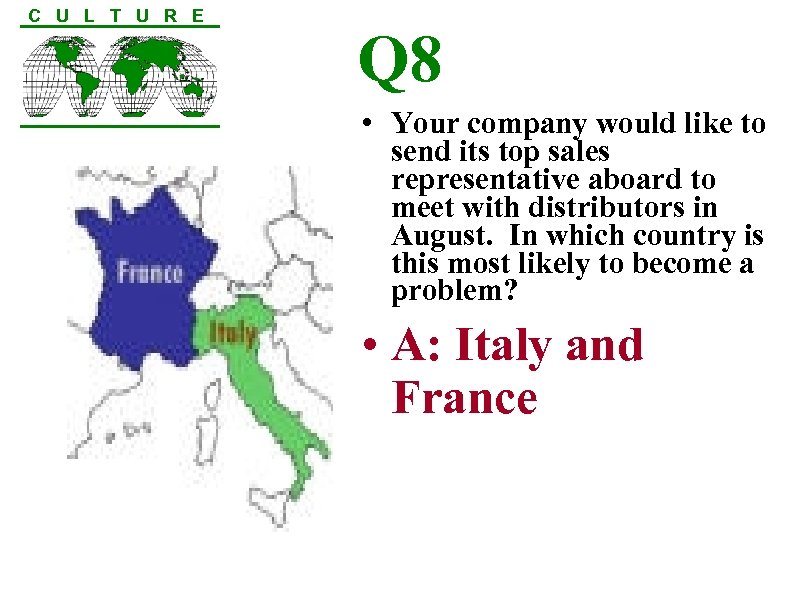 C U L T U R E Q 8 • Your company would like to send its top sales representative aboard to meet with distributors in August. In which country is this most likely to become a problem? • A: Italy and France
 C U L T U R E Q 9 • At a business dinner in Korea, your counterpart’s wine glass is half-empty. What should you do? • C: wait until her glass is empty and then refill it
 C U L T U R E Q 10 Ø When writing names in Korea, what color is not appropriate to use? ØB: red Red represents witchcraft and death in many African countries. Red is a positive color in Denmark.
 C U L T U R E Red ØChina - symbol of celebration and luck, used in many cultural ceremonies that range from funerals to weddings ØIndia - color of purity (used in wedding outfits
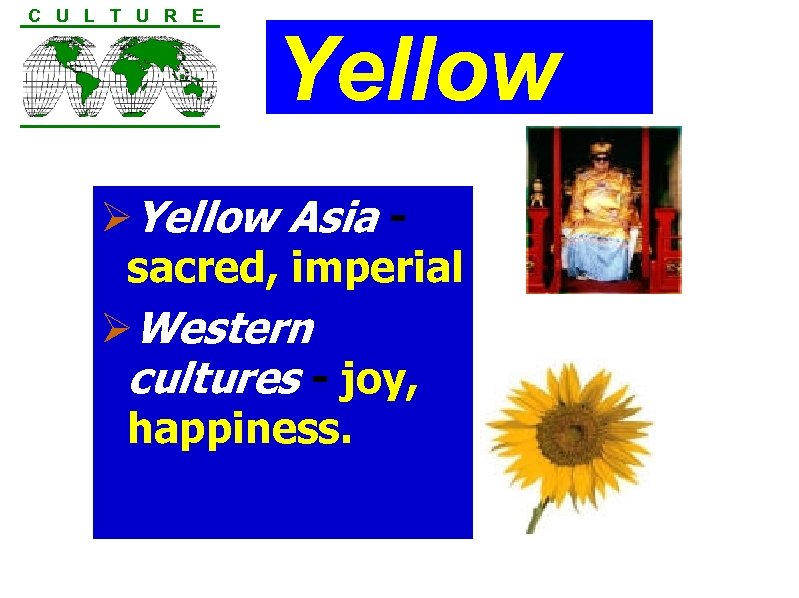 C U L T U R E Yellow ØYellow Asia - sacred, imperial ØWestern cultures - joy, happiness.
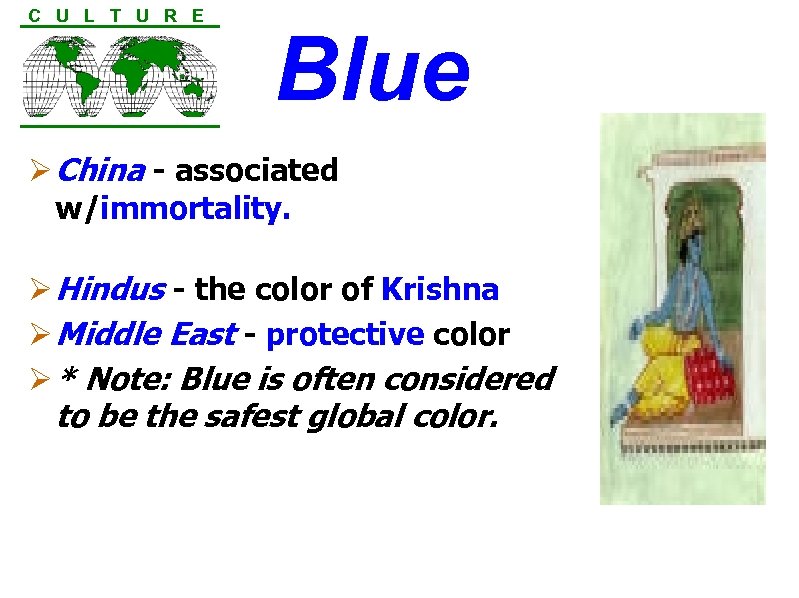 C U L T U R E Blue Ø China - associated w/immortality. Ø Hindus - the color of Krishna Ø Middle East - protective color Ø * Note: Blue is often considered to be the safest global color.
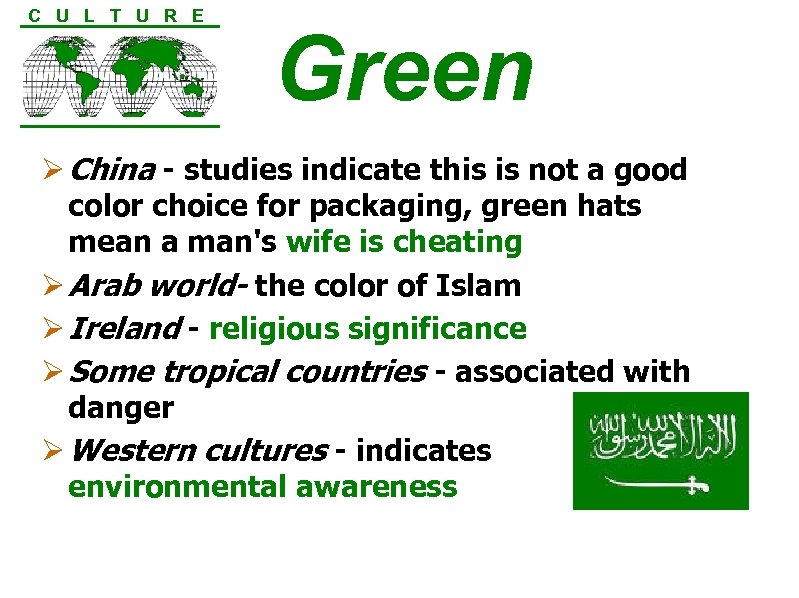 C U L T U R E Green Ø China - studies indicate this is not a good color choice for packaging, green hats mean a man's wife is cheating Ø Arab world- the color of Islam Ø Ireland - religious significance Ø Some tropical countries - associated with danger Ø Western cultures - indicates environmental awareness
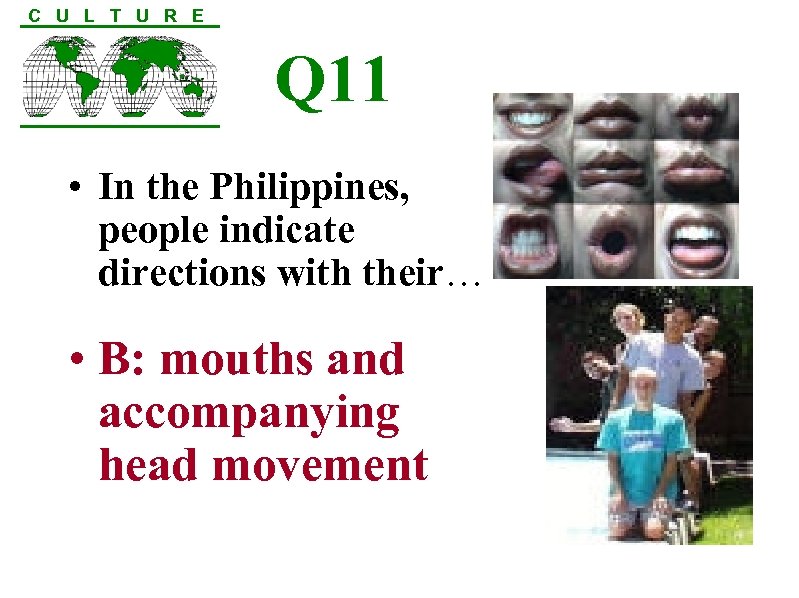 C U L T U R E Q 11 • In the Philippines, people indicate directions with their… • B: mouths and accompanying head movement
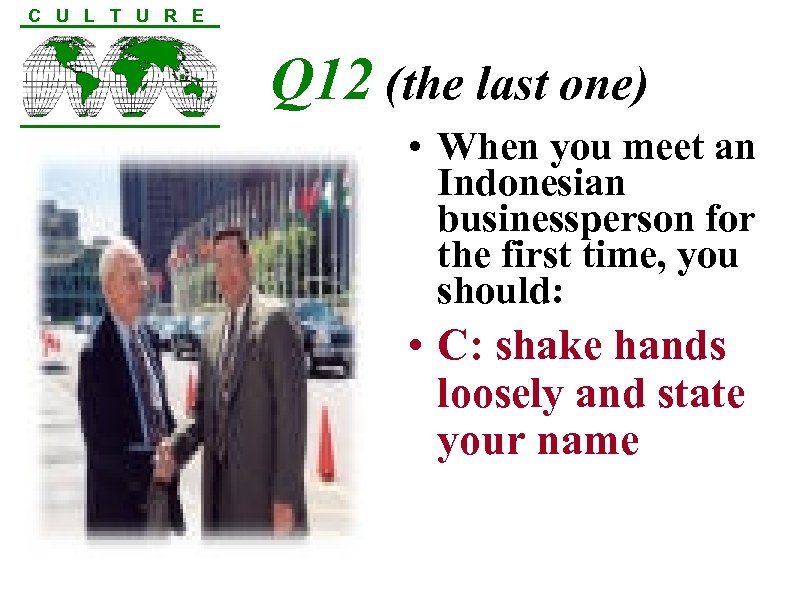 C U L T U R E Q 12 (the last one) • When you meet an Indonesian businessperson for the first time, you should: • C: shake hands loosely and state your name
 C U L T U R E How did You do? 10 -12: Cultural CEO 7 -9: Sr. Management 3 -6: Mgt. Trainee 1 -2: Corp. Toilet Cleaner 0 : Your Fired!
 A High International Business IQ is mandatory for anyone involved in International Advertising…. Cultural Hot Spots humor prestige romance music colors visual imagery Verbal/ Non-Verbal
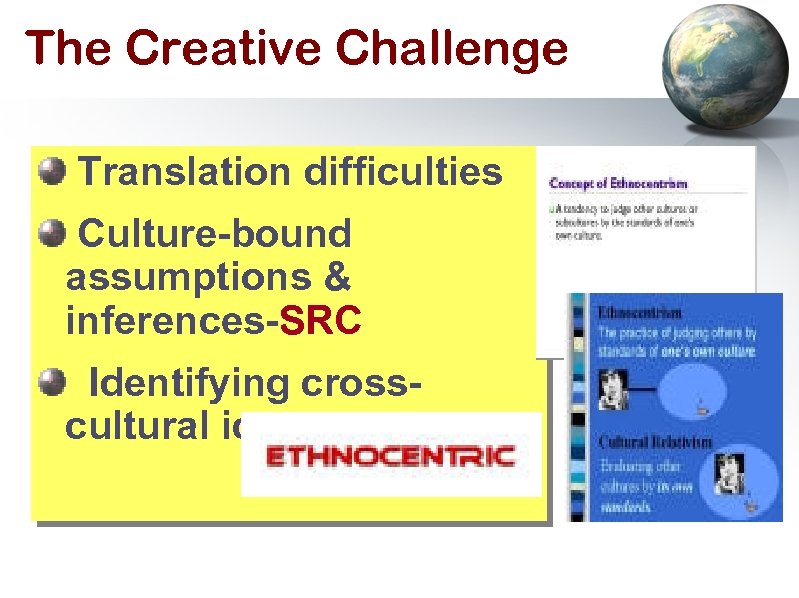 The Creative Challenge Translation difficulties Culture-bound assumptions & inferences-SRC Identifying crosscultural icons
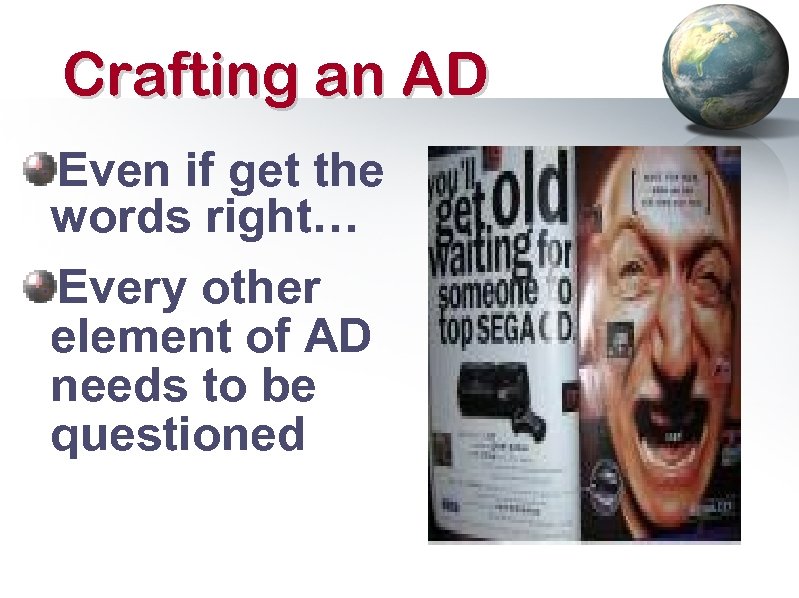 Crafting an AD Even if get the words right… Every other element of AD needs to be questioned
 Questions about Aesthetics? Production techniques used in commercials. • Color • Sound, Music, SFX • Lighting • Angles
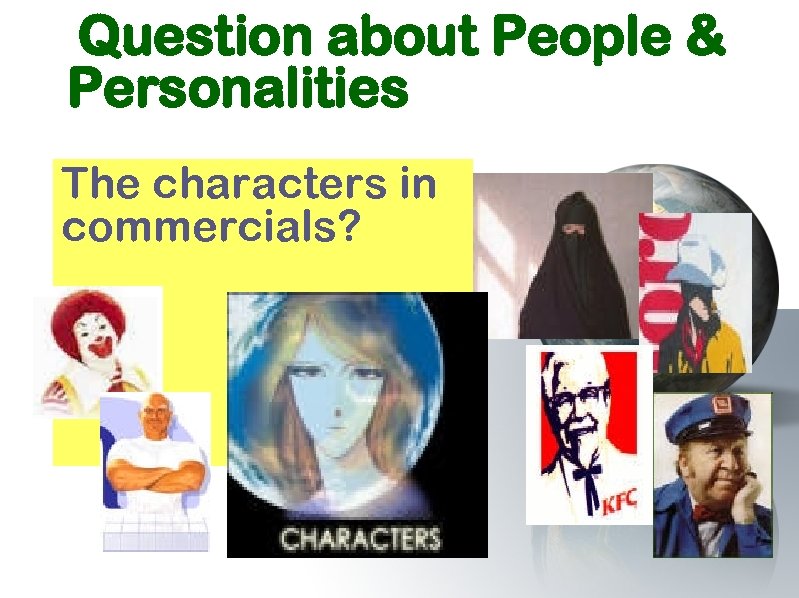 Question about People & Personalities The characters in commercials?
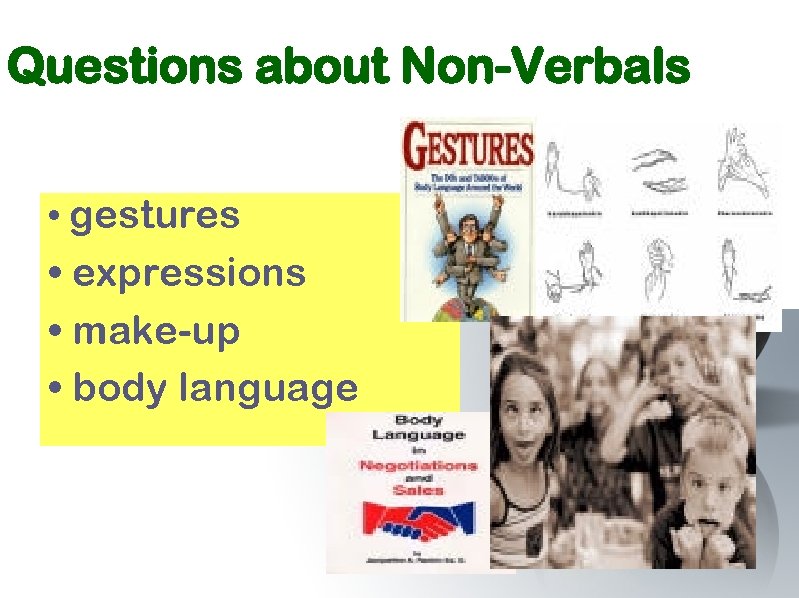 Questions about Non-Verbals • gestures • expressions • make-up • body language
 Questions about Are values being associated w/ product important; appropriate
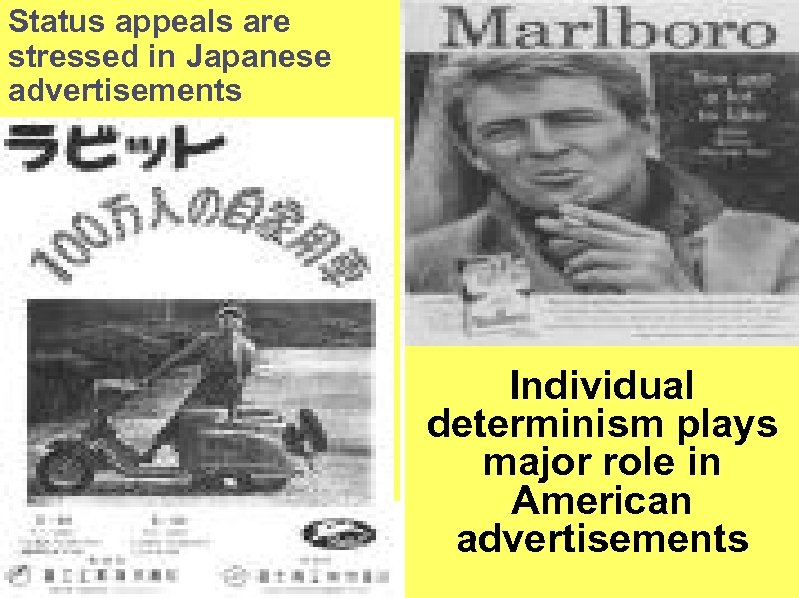 Status appeals are stressed in Japanese advertisements Hong et al. (1987) Individual determinism plays major role in American advertisements
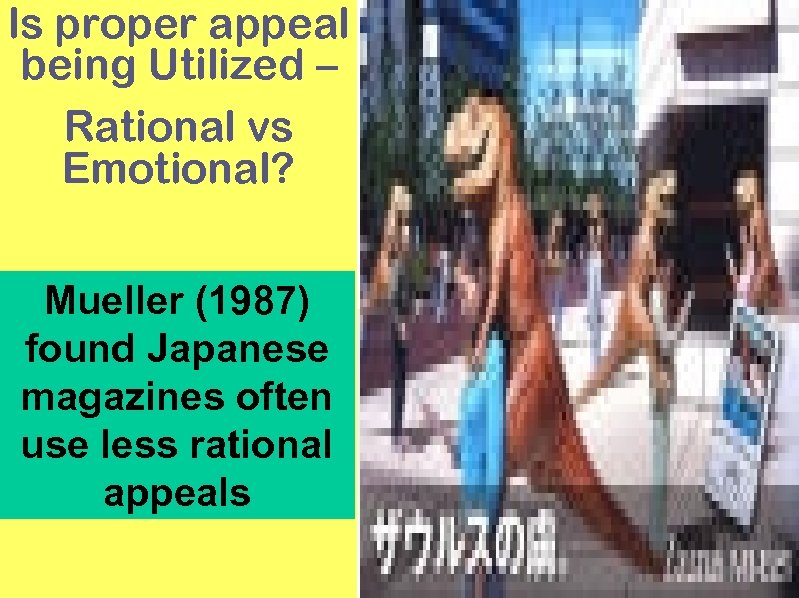 Is proper appeal being Utilized – Rational vs Emotional? Mueller (1987) found Japanese magazines often use less rational appeals
 Examples of International Advertising • http: //www. summitawards. com/winners. html • http: //www. adeater. com/ • http: //www. magindia. com/i nternational/
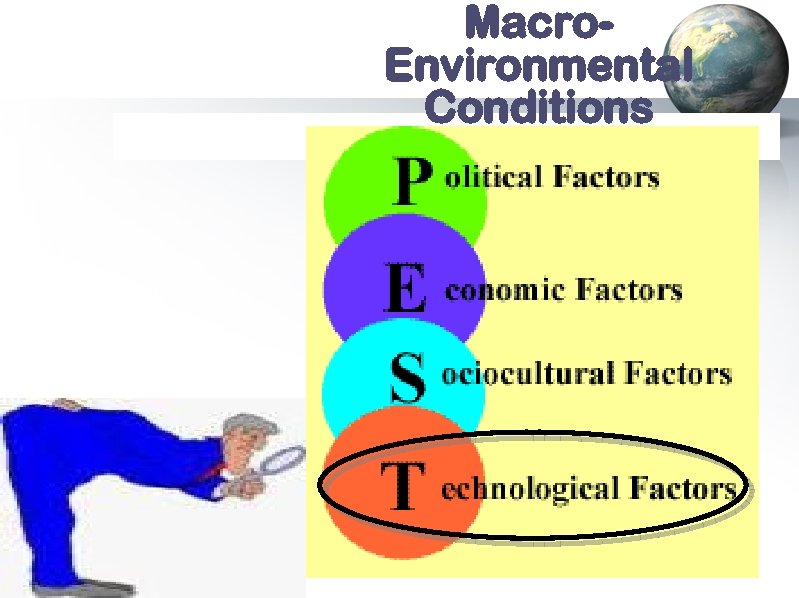 Macro. Environmental Conditions
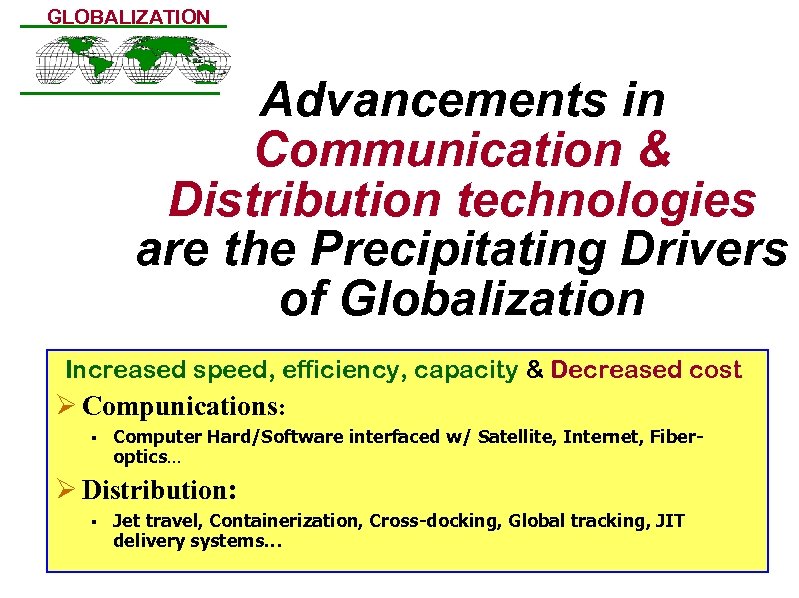 GLOBALIZATION Advancements in Communication & Distribution technologies are the Precipitating Drivers of Globalization Increased speed, efficiency, capacity & Decreased cost Ø Compunications: § Computer Hard/Software interfaced w/ Satellite, Internet, Fiberoptics… Ø Distribution: § Jet travel, Containerization, Cross-docking, Global tracking, JIT delivery systems…
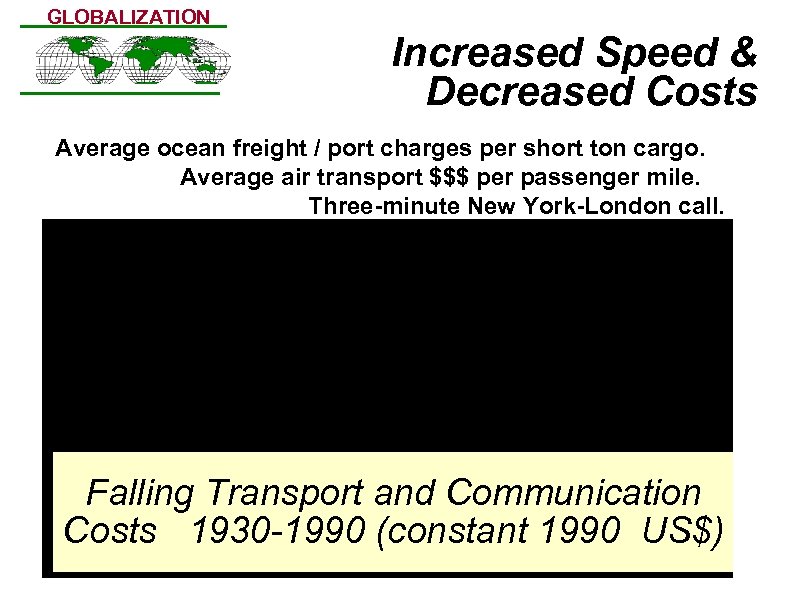 GLOBALIZATION Increased Speed & Decreased Costs Average ocean freight / port charges per short ton cargo. Average air transport $$$ per passenger mile. Three-minute New York-London call. Source: Huf. Bauer, 1991 Falling Transport and Communication Costs 1930 -1990 (constant 1990 US$)
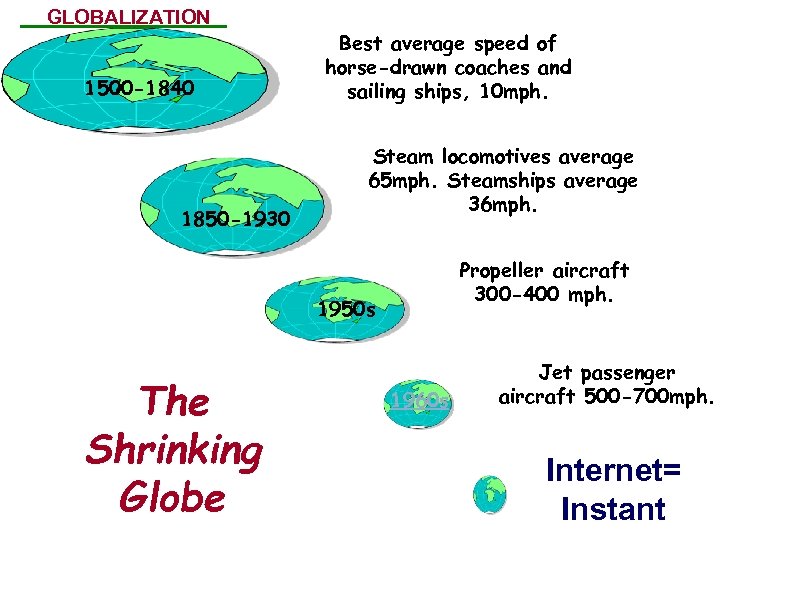 GLOBALIZATION 1500 -1840 1850 -1930 Best average speed of horse-drawn coaches and sailing ships, 10 mph. Steam locomotives average 65 mph. Steamships average 36 mph. Propeller aircraft 300 -400 mph. 1950 s The Shrinking Globe 1960 s Jet passenger aircraft 500 -700 mph. Internet= Instant
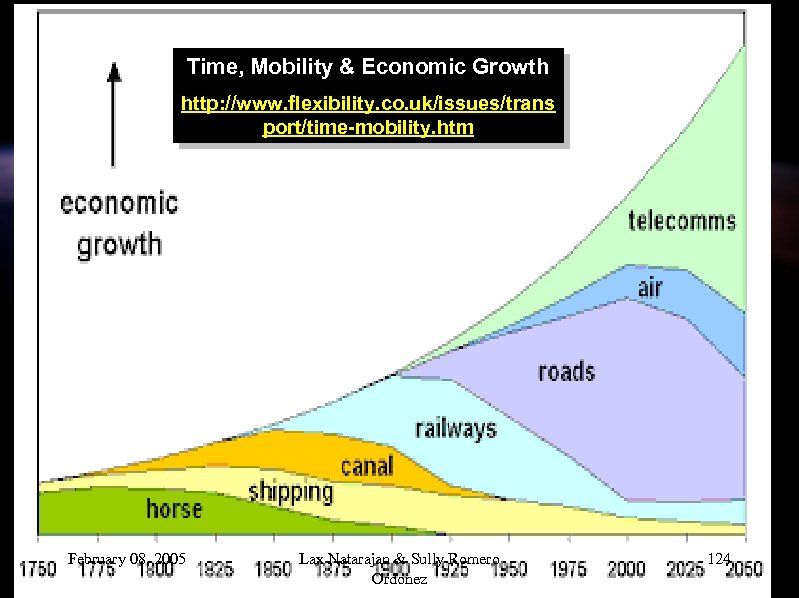 Time, Mobility & Economic Growth http: //www. flexibility. co. uk/issues/trans port/time-mobility. htm February 08, 2005 Lax Natarajan & Sully Romero Ordonez 124
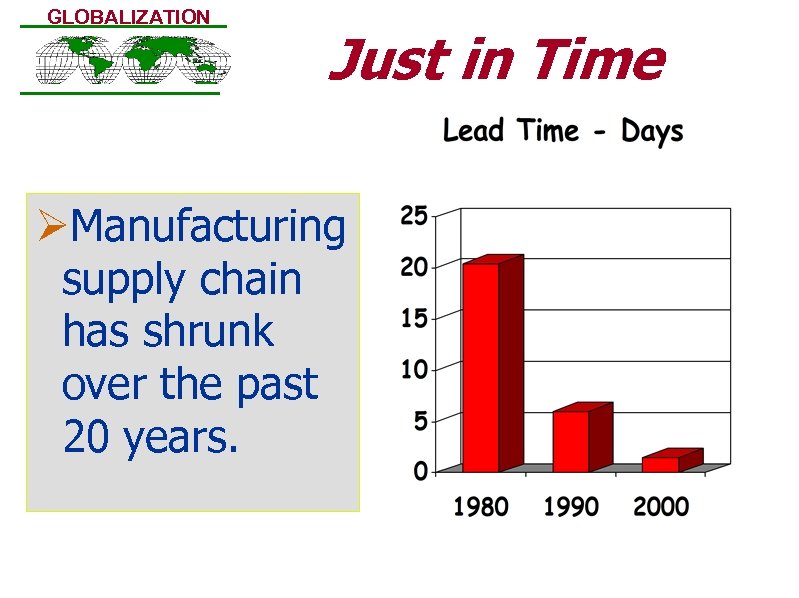 GLOBALIZATION Just in Time ØManufacturing supply chain has shrunk over the past 20 years.
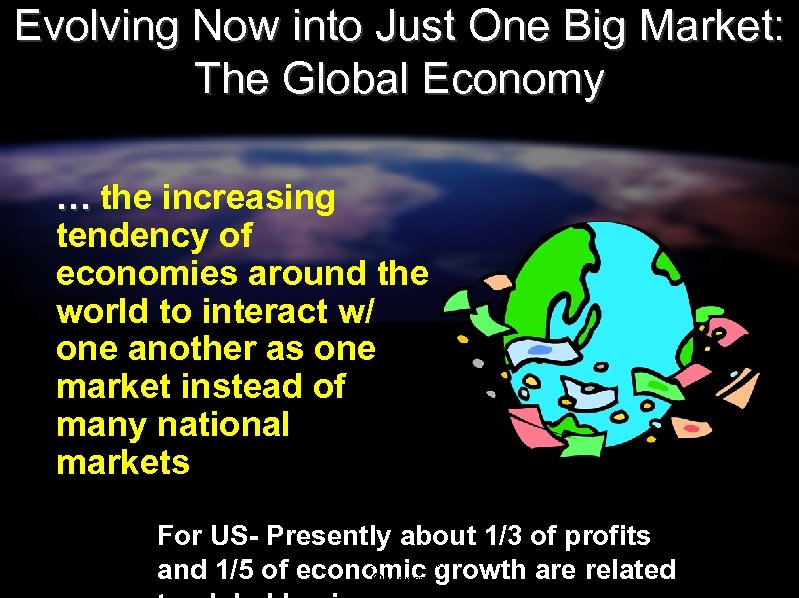 Evolving Now into Just One Big Market: The Global Economy … the increasing tendency of economies around the world to interact w/ one another as one market instead of many national markets For US- Presently about 1/3 of profits February 08, 2005 Lax Natarajan & Sully Romero and 1/5 of economic growth are related Ordonez 126
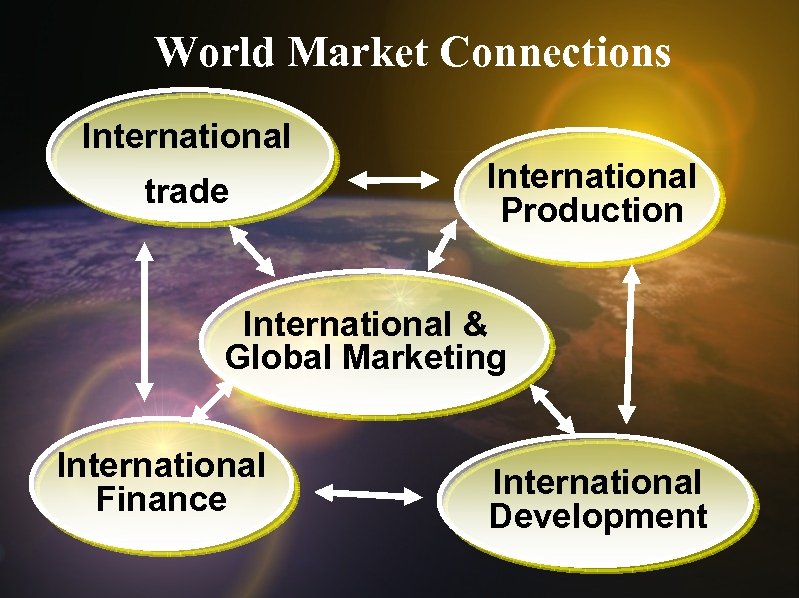 World Market Connections International trade International Production International & Global Marketing International Finance International Development
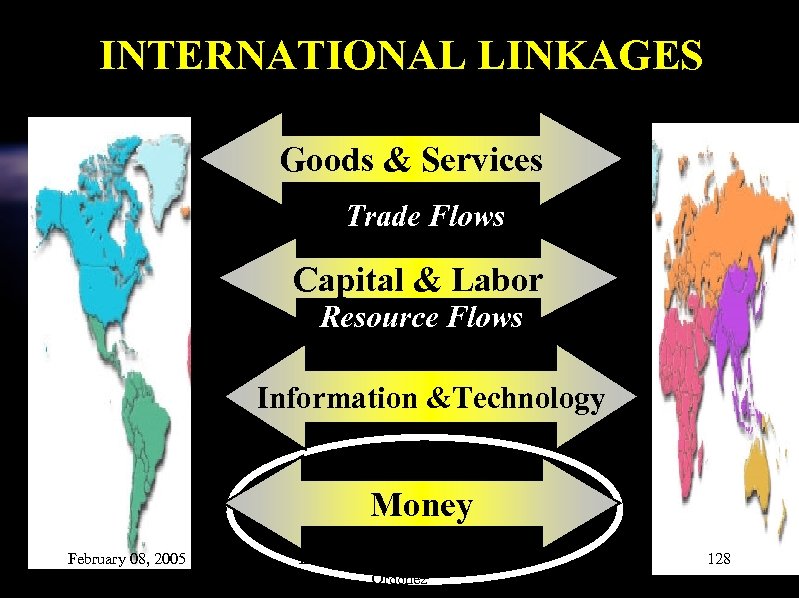 INTERNATIONAL LINKAGES Goods & Services Trade Flows Capital & Labor Resource Flows Information &Technology Money February 08, 2005 Lax Natarajan & Sully Romero Ordonez 128
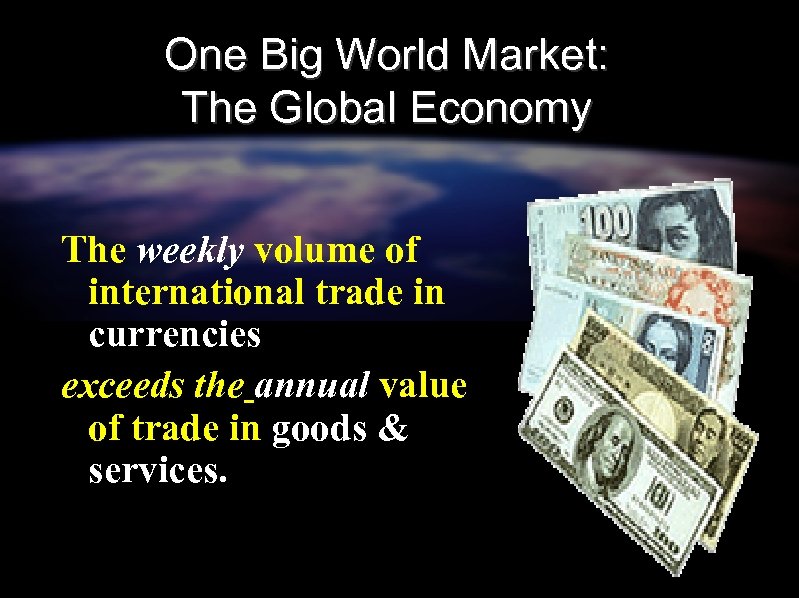 One Big World Market: The Global Economy The weekly volume of international trade in currencies exceeds the annual value of trade in goods & services. February 08, 2005 Lax Natarajan & Sully Romero Ordonez 129
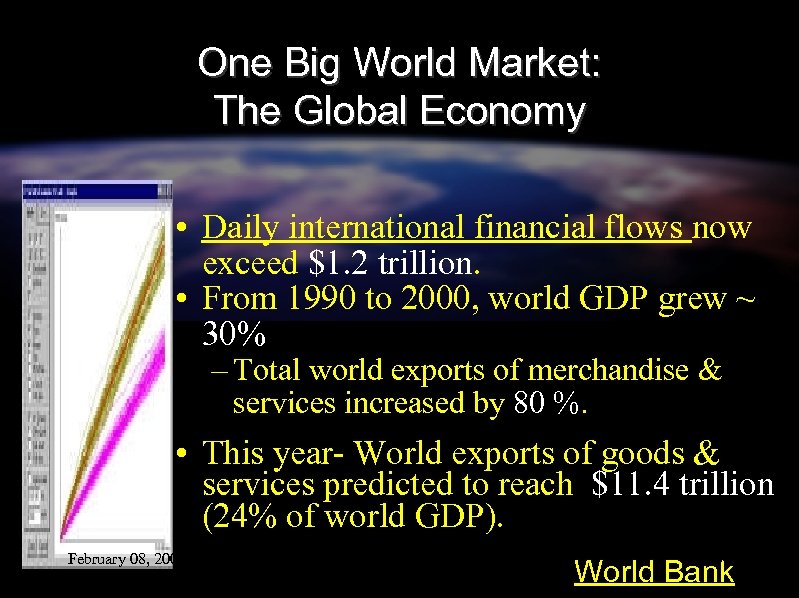 One Big World Market: The Global Economy • Daily international financial flows now exceed $1. 2 trillion. • From 1990 to 2000, world GDP grew ~ 30% – Total world exports of merchandise & services increased by 80 %. • This year- World exports of goods & services predicted to reach $11. 4 trillion (24% of world GDP). February 08, 2005 Lax Natarajan & Sully Romero Ordonez 130 World Bank
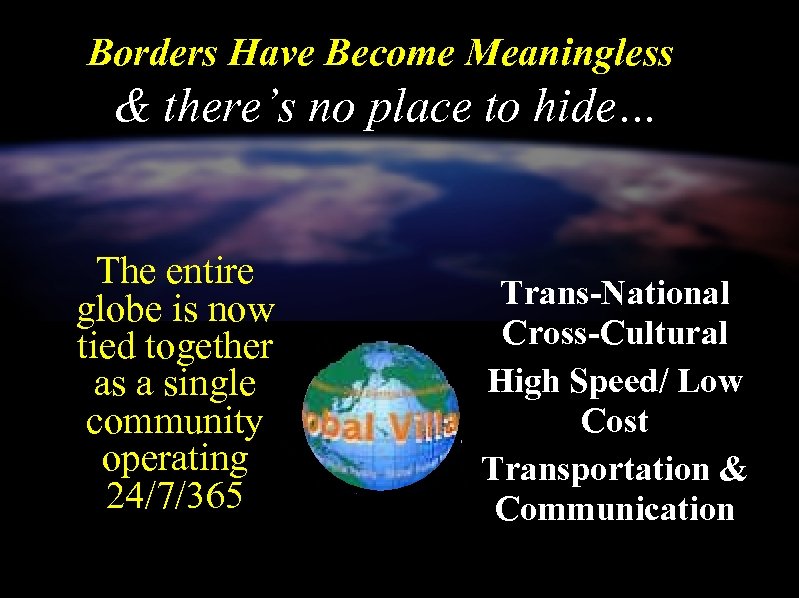 Borders Have Become Meaningless & there’s no place to hide… The entire globe is now tied together as a single community operating 24/7/365 February 08, 2005 Trans-National Cross-Cultural High Speed/ Low Cost Transportation & Communication Lax Natarajan & Sully Romero Ordonez 131
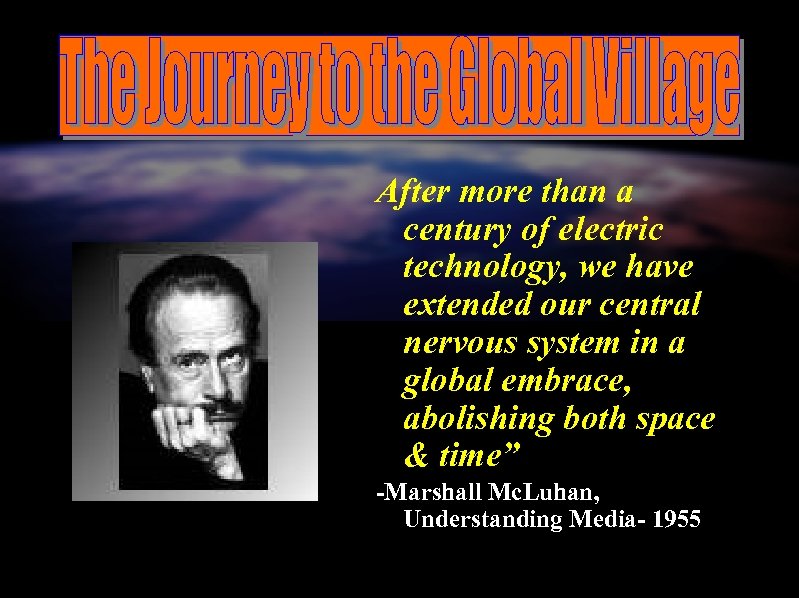 After more than a century of electric technology, we have extended our central nervous system in a global embrace, abolishing both space & time” -Marshall Mc. Luhan, Understanding Media- 1955 February 08, 2005 Lax Natarajan & Sully Romero Ordonez 132
 The Global Village Driver The further & faster people are able to travel & communicate… the greater the amount of interaction & influence February 08, 2005 Lax Natarajan & Sully Romero Ordonez 133
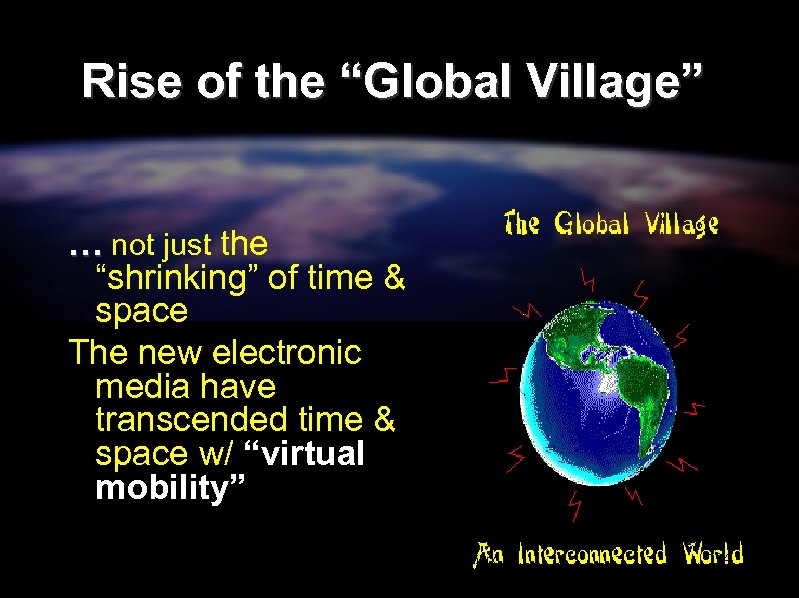 Rise of the “Global Village” … not just the “shrinking” of time & space The new electronic media have transcended time & space w/ “virtual mobility” February 08, 2005 Lax Natarajan & Sully Romero Ordonez 134
![Digital age communication technologies Cable Television Pay Television Services Direct Broadcast Satellite [DBS] MMDS](https://present5.com/presentation/8115ba6e40492beaca4a98a160263569/image-135.jpg "Digital age communication technologies Cable Television Pay Television Services Direct Broadcast Satellite [DBS] MMDS") Digital age communication technologies Cable Television Pay Television Services Direct Broadcast Satellite [DBS] MMDS and LMDS Digital Television Streaming Media Digital Radio Multimedia Computers and Video Games The Internet and World Wide Web Internet Commerce Office Technologies Virtual Reality Home Video Digital Audio Distance Learning Wireless Telephony Broadband Networks Residential Gateways and Home Networks Satellite Communications source >> Future Technologies Inc. [www. fti. com]
Digital age communication technologies Cable Television Pay Television Services Direct Broadcast Satellite [DBS] MMDS and LMDS Digital Television Streaming Media Digital Radio Multimedia Computers and Video Games The Internet and World Wide Web Internet Commerce Office Technologies Virtual Reality Home Video Digital Audio Distance Learning Wireless Telephony Broadband Networks Residential Gateways and Home Networks Satellite Communications source >> Future Technologies Inc. [www. fti. com]
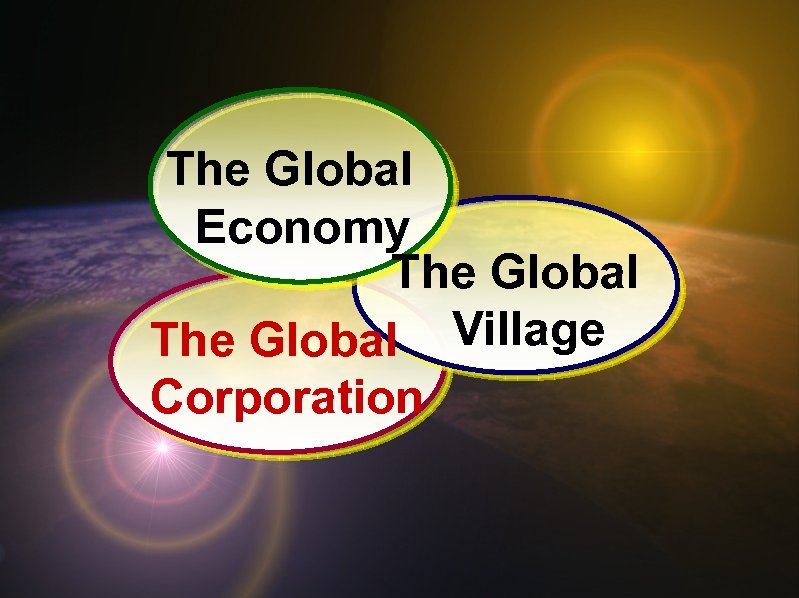 The Global Economy The Global Village Corporation
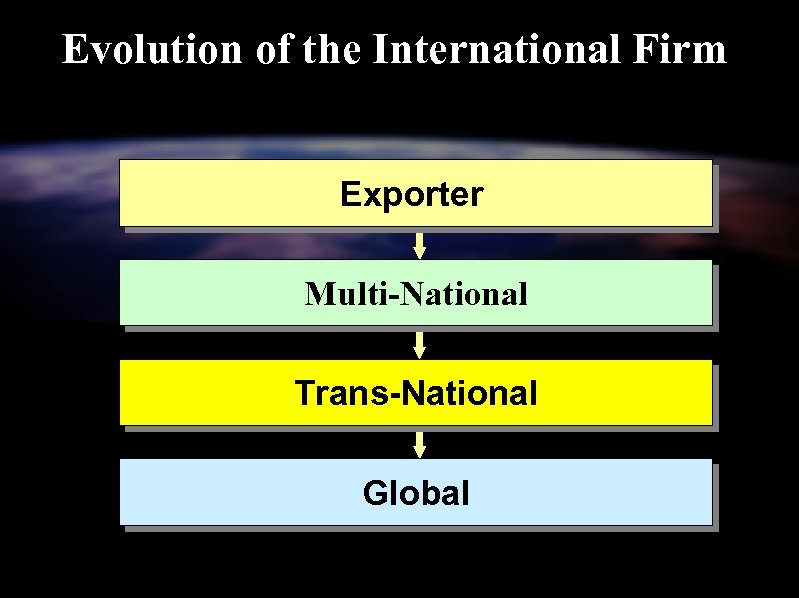 Evolution of the International Firm Exporter Multi-National Trans-National Global February 08, 2005 Lax Natarajan & Sully Romero Ordonez 137
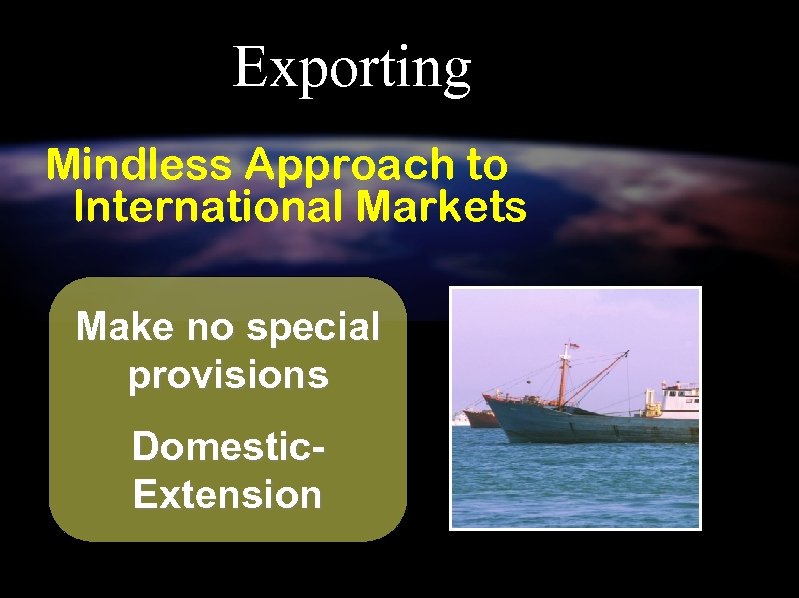 Exporting Mindless Approach to International Markets Make no special provisions Domestic. Extension February 08, 2005 Lax Natarajan & Sully Romero Ordonez 138
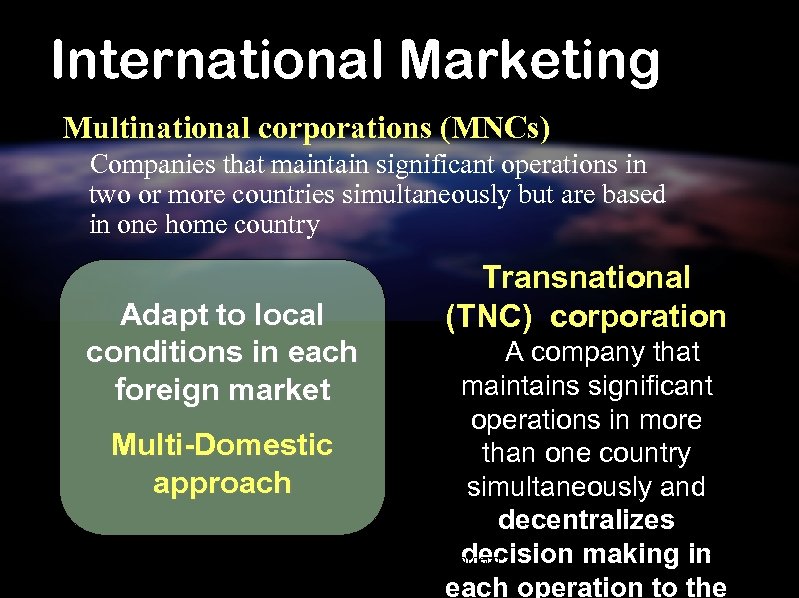 International Marketing Multinational corporations (MNCs) Companies that maintain significant operations in two or more countries simultaneously but are based in one home country Adapt to local conditions in each foreign market Transnational (TNC) corporation A company that maintains significant operations in more Multi-Domestic than one country approach simultaneously and decentralizes decision making in 139 February 08, 2005 Lax Natarajan & Sully Romero Ordonez each operation to the
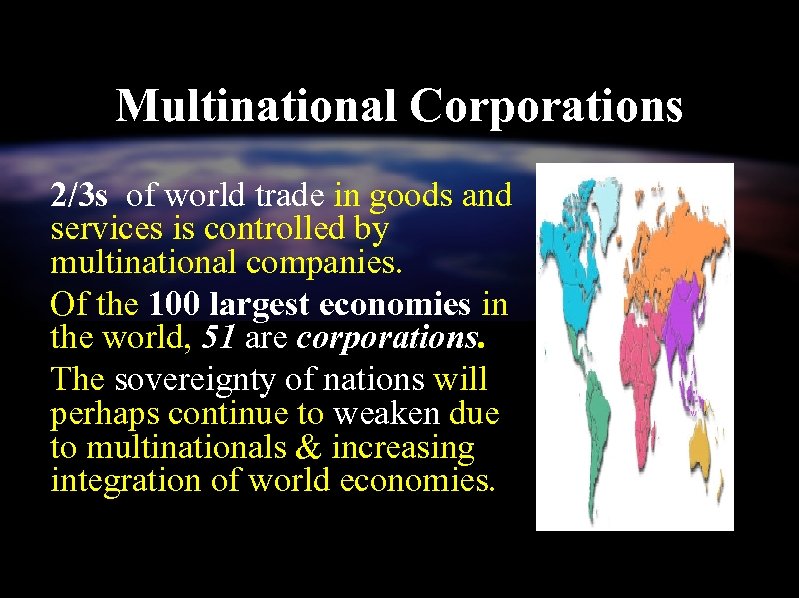 Multinational Corporations 2/3 s of world trade in goods and services is controlled by multinational companies. Of the 100 largest economies in the world, 51 are corporations. The sovereignty of nations will perhaps continue to weaken due to multinationals & increasing integration of world economies. February 08, 2005 Lax Natarajan & Sully Romero Ordonez 140
 Multinational Corporations In 1970, of the 7, 000 multinationals identified by the United Nations, more than 1/2 were from -- the United States & Britain. By 1995, less than half of the 36, 000 multinationals identified by the United Nations came from four countries: the United States, Japan, Germany, and February 08, 2005 Lax Natarajan & Sully Romero Switzerland. Ordonez 141
 Multinational Corporations At present, there are 65, 000 MNCs* w/ 850, 000 affiliates in foreign countries MNCs’ total sales amount to almost $19 trillion. http: //www. nationmaster. com/graph. February 08, 2005 Lax Natarajan & Sully Romero Ordonez T/eco_tra_cor_par# 142
 Global Marketing Company takes an integrated approach across countries & regions -- Manages for worldwide business leverage & competitive advantage … Is a “Mind-set” of Leverage how to approach Commonalities into Int’l Markets a global strategy (but where necessary • Not a matter of allow for local how big company is implementation) • Or- whether or not Global (Glocal) Marketing have a “global product” February 08, 2005 Lax Natarajan & Sully Romero • Or- how many 143 Ordonez
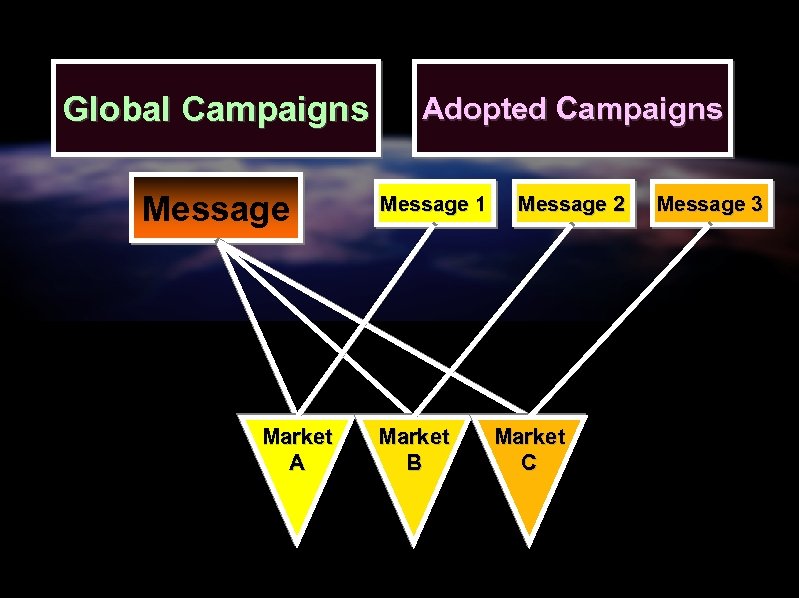 Global Campaigns Message 1 Market A February 08, 2005 Adopted Campaigns Market B Message 2 Message 3 Market C Lax Natarajan & Sully Romero Ordonez 144
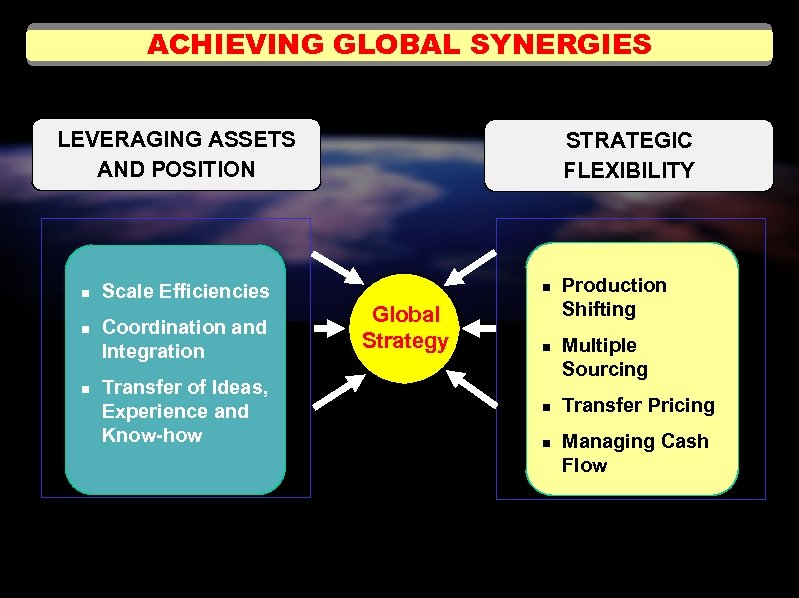 ACHIEVING GLOBAL SYNERGIES LEVERAGING ASSETS AND POSITION n n n Scale Efficiencies Coordination and Integration STRATEGIC FLEXIBILITY n Global Strategy Transfer of Ideas, Experience and Know-how February 08, 2005 n n n Lax Natarajan & Sully Romero Ordonez Production Shifting Multiple Sourcing Transfer Pricing Managing Cash Flow 145
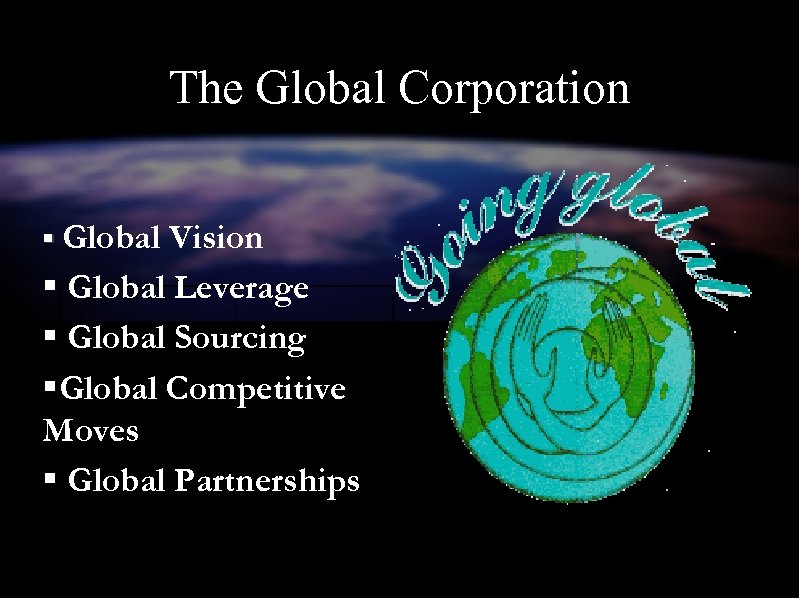 The Global Corporation § Global Vision § Global Leverage § Global Sourcing §Global Competitive Moves § Global Partnerships February 08, 2005 Lax Natarajan & Sully Romero Ordonez 146
 Valuable W 3 Resource http: //globaledge. msu. edu/index. asp Global. EDGE© is a global business knowledge webportal that connects international business professionals worldwide to a wealth of information, insights, and learning resources on global business activities.
 Frito Lay Potato Chips Attack China