


 Скачать презентацию Marketing I Session 6 13 11 2014
Marketing_I_20141113_Session_6.pptx
- Количество слайдов: 18
 Marketing I / Session 6 13. 11. 2014 Martin Samek martin. samek@lbs. ac. at
 Targeting Lauder Business School Marketing I / Session 6 2
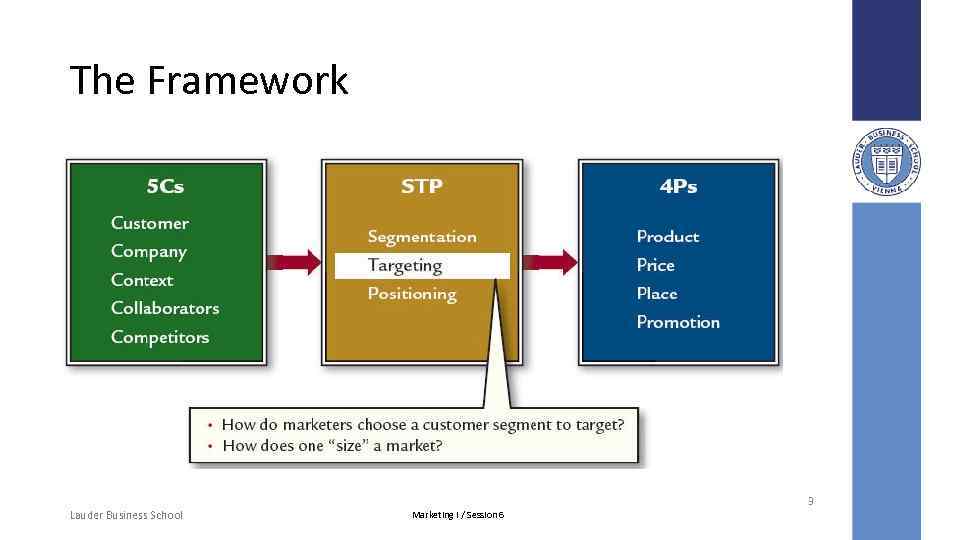 The Framework 3 Lauder Business School Marketing I / Session 6
 What is TARGETING? What is Targeting? v Selecting a market(s) to pursue Why do it? v It’s difficult to satisfy all people´s needs with one product v Targeting is in most cases a matter of resources and risk 4 Lauder Business School Marketing I / Session 6
 How to choose a target? When choosing target market(s), marketers should consider 1. The market’s fit with the firm’s capabilities – More subjective/challenging to assess 2. The profitability potential of the market – More objective 5 Lauder Business School Marketing I / Session 6
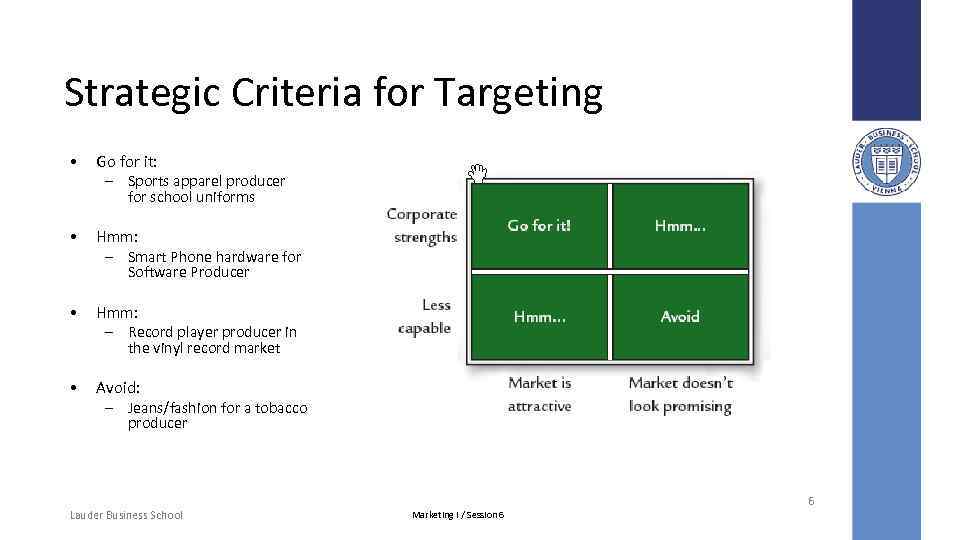 Strategic Criteria for Targeting • Go for it: – Sports apparel producer for school uniforms • Hmm: – Smart Phone hardware for Software Producer • Hmm: – Record player producer in the vinyl record market • Avoid: – Jeans/fashion for a tobacco producer 6 Lauder Business School Marketing I / Session 6
 Fit with Firm‘s Capabilities Does this market “fit” with what we are (as a company)? Questions: Can we satisfy this market? What are our strengths? What resources do we have? What is our experience? What is our corporate culture? What are our current brand personalities, etc 7 Lauder Business School Marketing I / Session 6
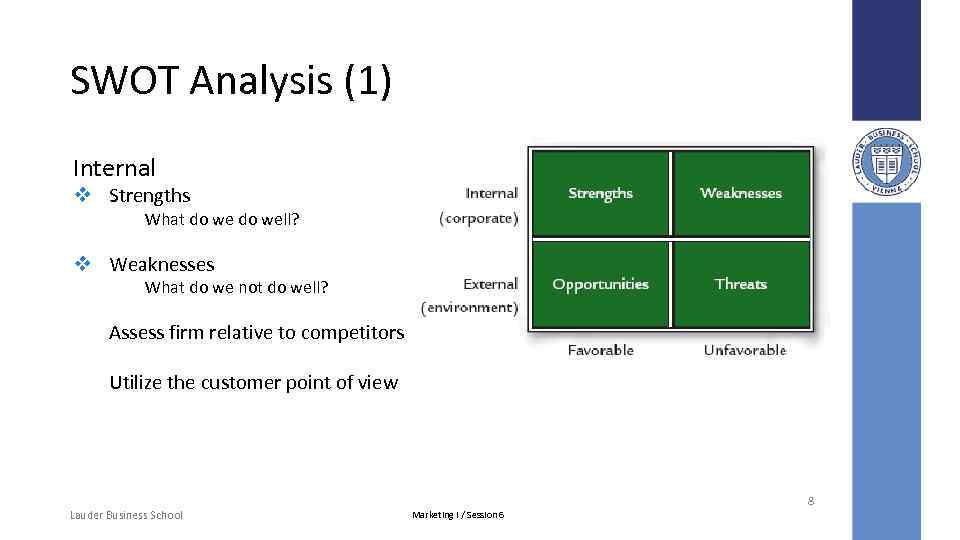 SWOT Analysis (1) Internal v Strengths What do well? v Weaknesses What do we not do well? Assess firm relative to competitors Utilize the customer point of view 8 Lauder Business School Marketing I / Session 6
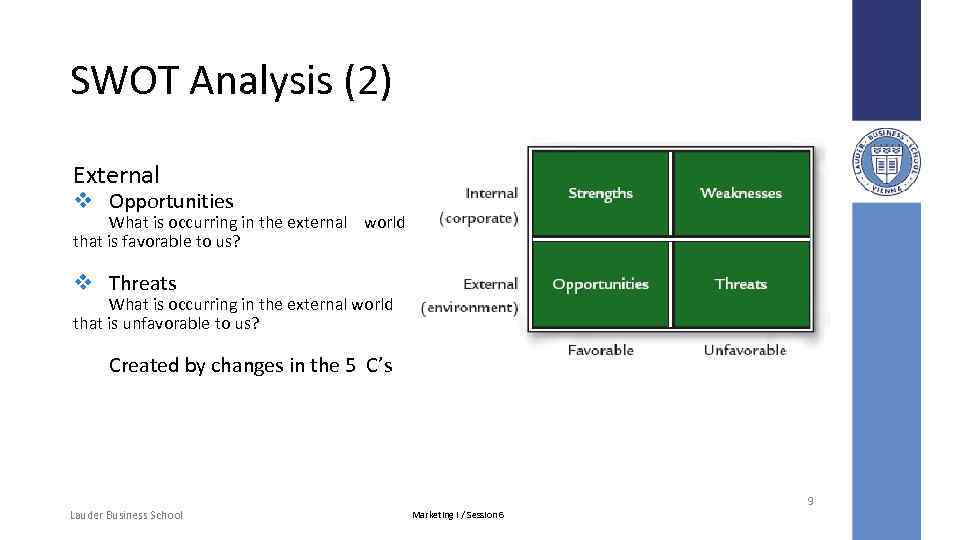 SWOT Analysis (2) External v Opportunities What is occurring in the external world that is favorable to us? v Threats What is occurring in the external world that is unfavorable to us? Created by changes in the 5 C’s 9 Lauder Business School Marketing I / Session 6
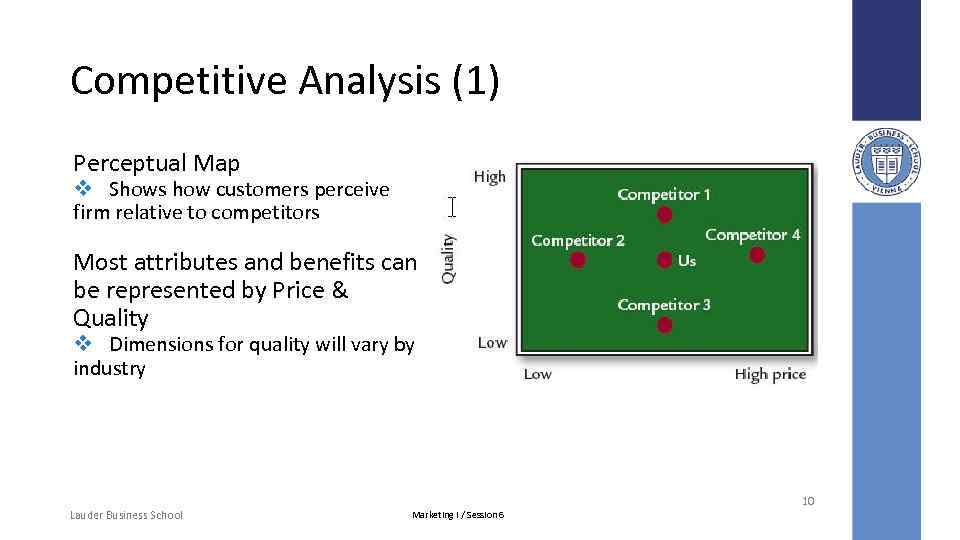 Competitive Analysis (1) Perceptual Map v Shows how customers perceive firm relative to competitors Most attributes and benefits can be represented by Price & Quality v Dimensions for quality will vary by industry 10 Lauder Business School Marketing I / Session 6
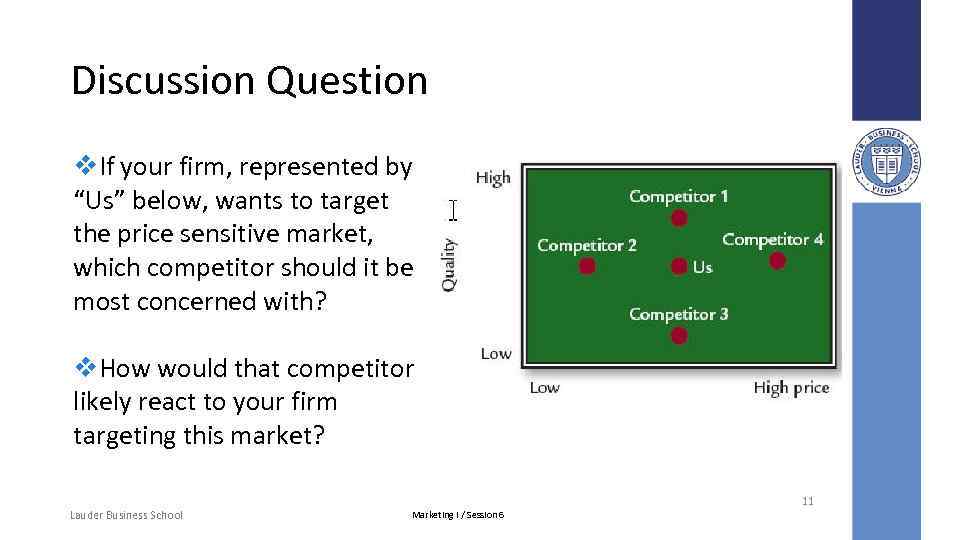 Discussion Question v. If your firm, represented by “Us” below, wants to target the price sensitive market, which competitor should it be most concerned with? v. How would that competitor likely react to your firm targeting this market? 11 Lauder Business School Marketing I / Session 6
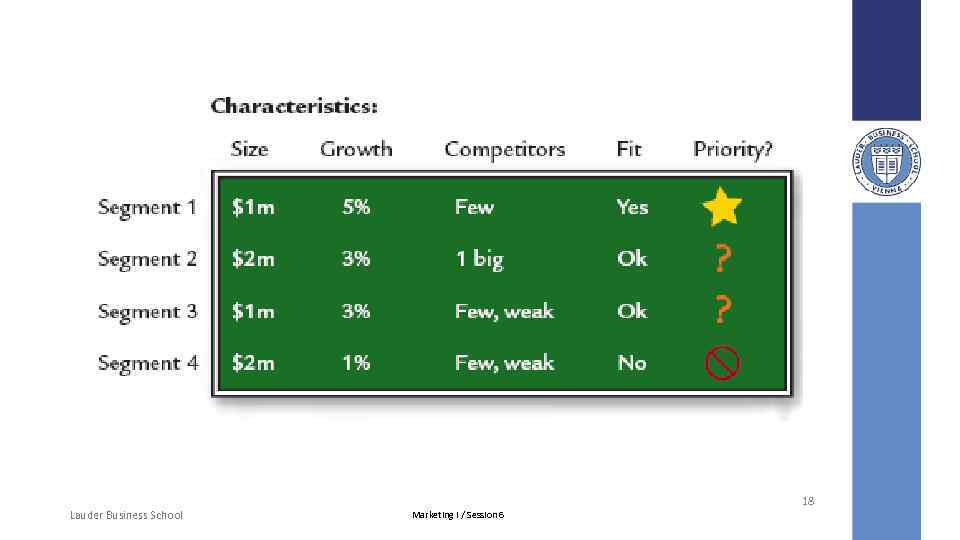
 Profitability Calculation How likely is it that the market will be profitable? Function of -market size -anticipated market growth -current and anticipated levels of competition -customer behavior and expectations 12 Lauder Business School Marketing I / Session 6
 Market Size Project the size of various segments Considerations The more precisely defined the target, the easier it is to estimate Be as precise as possible in estimating Determine upper and lower bounds of estimates Run scenarios to determine sensitivity of estimates Compare the size of each segment 13 Lauder Business School Marketing I / Session 6
 Market Growth Project the market growth for various segments Projecting market growth is risky One technique Obtain industry sales data for previous years Compute a moving average mean years 1, 2 and 3; years 3, 4 and 5; etc. Utilize regression to fit a curve to these data Compare growth rates for each market 14 Lauder Business School Marketing I / Session 6
 Identify Competitive Threat Identify the number of competitors in each market Look in the yellow pages Conduct an on-line search Utilize various terms to ensure thoroughness e. g. , hair salon, beauty shop, etc. Compare the competitive threat in each market 15 Lauder Business School Marketing I / Session 6
 Estimate Profitability Estimate profitability of each segment Estimate price for each segment Estimate costs for each segment variable costs: product material, etc. fixed costs: insurance, rent, etc. Compare profitability of each segment 16 Lauder Business School Marketing I / Session 6
 B 2 B Market Size One approach Start with the total population Break it down into relevant proportions Example: (population x %aware x %trial x %repeat) x per annum purchase Census. gov cross-classifies businesses by sector (e. g. , NAICS codes) and size (e. g. , by sales or number of employees) 17 Lauder Business School Marketing I / Session 6
 18 Lauder Business School Marketing I / Session 6